Letter to the New Congress: Project 2027 steps toward Project 2029 – Ending the Era of Stupid and Mean

Dear Members of the 120th Congress,

Start with the premise you’ll hear cited against public education all year: that the United States ranks low in international comparisons. On average, it does — but that average hides a country split in two. In the 2011 NAEP-TIMSS linking study, Massachusetts’s eighth graders scored behind only five of 47 education systems worldwide, trailing just Japan among them, while Alabama’s, the same year, were statistically indistinguishable from Turkey and Armenia. Run the comparison state by state and the picture varies enormously: Massachusetts, New Jersey, New Hampshire, Wyoming, and Connecticut — America’s best states for education — perform like some of the strongest systems on earth, while the states that won’t invest perform like the weakest ones, and it’s their scores dragging the national average down. The problem was never the country; it’s a particular set of states, and the gap between them is widening: cost-adjusted K-12 investment predicts the chain from funding adequacy to NAEP scores to adult degree attainment to state income growth, and the best- and worst-educated states have been pulling apart for decades (Human Capital Pays, If You Count the Cost; the underlying analysis is in Investing in Human Capital: Does Long-Run K-12 Investment Fuel State Economic Growth?). Our future depends on raising the bottom, not averaging it away — and raising the bottom means forcing the states that won’t try to raise themselves, economically as well as educationally, out of the federal dependence the rest of this letter is about undoing.

You are arriving in Washington, I hope, with majorities in both chambers and a mandate to undo a particular kind of damage. For a term and a half of Trump leadership, with Republican control of Congress compounded by Republican control in too many statehouses facing no federal check, federal education policy has run on two settings: stupid and mean. Stupid, because dismantling the Department of Education, gutting NCES and IES, and threatening to claw back aid from states that pursue equity doesn’t actually improve a single classroom — it just leaves the country unable to measure its own failures. Mean, because the one new federal investment of this era, an uncapped tax credit that bankrolls private school tuition with no strings attached, takes effect on January 1, 2027, the same month you’re sworn in, while the children in the states that need the most help keep getting the least. And it hasn’t just been neglect: in Trump 2.0, the Office for Civil Rights has been weaponized against the very students it exists to protect, turned toward fighting equity and fairness rather than enforcing them.

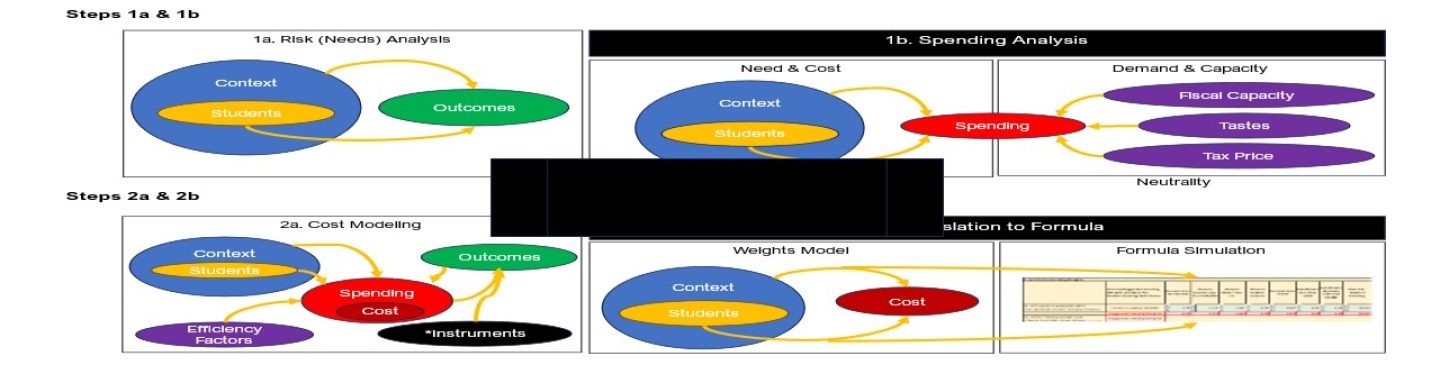
This letter isn’t Project 2029. Project 2029 is the national school finance formula this country needs — a formula that guarantees every child an adequately funded education regardless of which state she happens to live in. I’ve laid out that plan elsewhere, in the working paper this letter is meant to accompany: Equal Educational Opportunity for All: From Short-Term Resistance to Project 2029. Project 2029 cannot be written in a weekend, and it shouldn’t be. It needs a cost model, an effort floor, a legal theory, and data infrastructure that currently doesn’t exist because this administration is actively destroying it. What you can do in 2027 and 2028 — what you must do — is build that foundation. Call it Project 2027. Five tracks, running at the same time.

Track A: Write the adequacy formula into law, even if you phase in the money

With Matthew Di Carlo and Mark Weber, I’ve already specified a federal foundation aid formula that works the way a good state formula works: a national cost model estimates what each district needs to reach common outcome goals; a minimum state-and-local effort requirement, roughly the national average, determines what each state must raise on its own; federal aid fills whatever adequacy gap remains, but only after a state has done its part. In full-compliance simulation, this requires about $52 billion in new federal aid and about $80 billion in new state and local investment, targeted to districts in 34 states. It would take the share of students in inadequately funded districts from about 55 percent to zero, cut the gap between the highest- and lowest-poverty districts by more than 60 percent, and close 59 percent of the Black-white and 49 percent of the Latinx-white funding gap.

You do not have to appropriate all of that in one bill. You do have to authorize the formula, the cost model, and the effort floor now, as a new title of the Elementary and Secondary Education Act, with a multi-year phase-in for states below the floor. Three structural fixes make this real rather than cosmetic:

  • Replace maintenance-of-effort with an effort floor. Current law only requires a state to spend 90 percent of what it spent the year before. A state can sit at the bottom forever and remain compliant. The test should be effort relative to capacity — state and local revenue against gross state product or personal income — not effort against your own prior low bar.
  • Fix Title I’s spending factor. The current formula sends more aid per poor child to states that already spend more, regardless of need. Allocations should track adequacy gaps and effort, not reward states for already having money.
  • Fully fund IDEA. You authorized federal funding of up to 40 percent of the excess cost of educating students with disabilities in 1975. You have never come close. Closing that gap is one of the most direct ways to relieve pressure on low-capacity states without waiting for the broader formula.

Track B: Stop treating “can’t” and “won’t” the same way

Some states can’t fund their schools adequately without help. Others won’t, and currently get backfilled by Washington anyway. I’ve written about both groups at length — in The Dependent States of America and in America’s Worst States for Education — and the formula you authorize in Track A should write the distinction between them directly into statute, not leave it to agency discretion.

GroupExamplesWhat they need
High-effort, low-capacity (“can’t”)Mississippi, New Mexico, West Virginia, AlaskaPrioritized gap-closing aid immediately, no effort hurdle — they’re already taxing near or above the national average and still can’t reach adequacy on their own.
Low-effort, high-capacity (“won’t”)Nevada, Texas, North Carolina, Florida, Arizona, TennesseeRequired to raise their own effort to the national floor before drawing a dollar of gap-closing federal aid.
The same underfunding, two different causes, two different statutory responses.
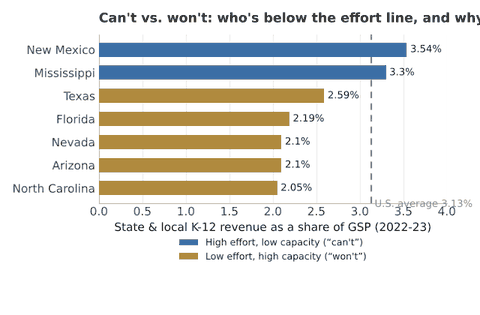
Horizontal bar chart comparing state and local K-12 revenue as a share of gross state product for seven states, colored by whether low funding reflects low capacity ("can't") or low effort ("won't"), against the U.S. average of 3.13 percent.
Figure 1. New Mexico and Mississippi tax themselves near or above the national average and still can’t reach adequacy — that’s capacity. Texas, Florida, Nevada, Arizona, and North Carolina tax themselves well below it — that’s a choice.

North Carolina has the lowest fiscal effort in the nation, 2.05 percent of gross state product, in a large and growing economy. Florida and Arizona would each have roughly 29 and 35 percent more state and local school revenue today had they simply held their 2006 effort levels. These are not capacity problems. Four of the five states on my 2026 worst-states list — North Carolina, Arizona, Nevada, Florida — are literally the four lowest-effort states in the country. And this same logic should apply to the roughly $115 billion in federal aid states already receive, not just new money. Write the effort-floor test into the statute itself, with a bright line rather than a waiver process, so it survives the next administration’s discretion as well as this one’s.
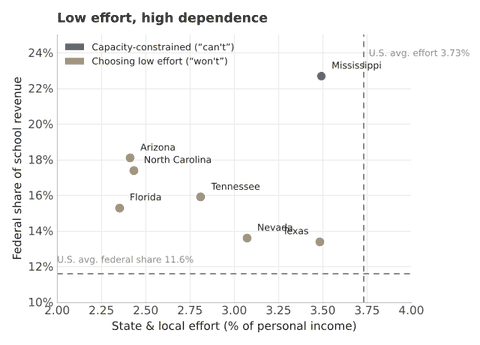
Scatter plot of state and local K-12 funding effort as a percent of personal income against federal share of school revenue for seven states, showing most low-effort states cluster at higher federal dependence than the U.S. average.
Figure 2. Mississippi depends on federal aid because its capacity is low despite near-average effort. Arizona, North Carolina, Tennessee, Florida, Nevada, and Texas combine below-average effort with above-average reliance on Washington — precisely the states an effort floor is meant to reach.

Track C: Give children, not just states, a seat at the table

Several of the states most dependent on federal aid — Arizona and Florida among them — are also where public money now follows parental preference with the fewest strings attached. Arizona’s Empowerment Scholarship Account statute treats a parent’s signature on a funding agreement as compulsory school attendance — no test, no curriculum requirement, no measure of whether the child is learning anything at all. I’ve argued, in Not the Mere Creature of Anyone, that the child in that arrangement is the only party with no rights of her own: she can’t sue her parents for academic neglect, she has no federal constitutional claim, and state courts reviewing these programs increasingly ask whether the public system is harmed, not whether she is being educated.

Congress and ED/OCR don’t need to wait for the full formula to act here. Using existing Title VI, Title IX, IDEA, and Section 504 authority, ED and OCR should put states on notice now that any provider serving a student whose education is subsidized with federal dollars — charter, voucher, or ESA — is bound by the same nondiscrimination and disability obligations as a public school, and that a state’s own voucher statute doesn’t override that. On the legislative side, I’d ask you to:

  • Restore a private right of action under Title VI, closed off by Alexander v. Sandoval (2001), and codify Plyler v. Doe‘s guarantee that every child is entitled to a public education regardless of immigration status.
  • Write “Children’s Recourse” into the conditions on federal aid: register every school-age child in every setting; assess learning rather than attendance or receipts, paired with remediation and, after repeated failure, a required change of setting; keep every child in periodic contact with a mandated reporter; apply neutral accountability conditions, including nondiscrimination and audits, to every provider alike; give older students a voice in decisions about their own schooling; and repeal provisions, like Arizona’s, that deem a signed funding contract to be school attendance.

Draft these as neutral, generally applicable conditions rather than anything targeted at religious providers specifically. That’s not just good policy design — it’s what gives them a chance of surviving whatever the Supreme Court does with St. Mary Catholic Parish v. Roy, Carson v. Makin, and Fulton v. City of Philadelphia. Pierce v. Society of Sisters told us a century ago that the child “is not the mere creature of the State.” She is also not the mere creature of her parents, or of a scholarship-granting organization. Someone has to be answerable to her.

Track D: Rebuild what’s being torn down

None of the above works without data, and the data infrastructure is actively being dismantled. Reauthorize the Education Sciences Reform Act with statutory independence and protected funding for NCES and IES. Codify the Census Bureau’s school finance survey and school-level per-pupil spending reporting, which current law already calls for but which has been unevenly enforced. Fund the cost-modeling capacity the formula in Track A depends on. Project 2029 cannot be built on data that no longer exists by 2029, and right now, that’s the trajectory.

Track E: Shut down the federal voucher tax credit before it starts

The One Big Beautiful Bill Act created the Education Freedom Tax Credit: a nonrefundable, dollar-for-dollar federal tax credit of up to $1,700 per taxpayer for donations to scholarship-granting organizations, with no cap on the total amount of credits the federal government will honor nationally. States have to opt in, and at least 29 already have, several after Democratic governors vetoed the opt-in bill only to be overridden by their own legislatures. The program takes effect January 1, 2027. It carries no learning-assessment requirement, no nondiscrimination requirement, no transparency requirement — none of the accountability conditions that would make it defensible even on its own terms.

There is already a bill sitting in the Senate Finance Committee: S. 4297, the Keep Public Funds in Public Schools Act, introduced by Senator Mark Kelly with 29 Democratic and two independent cosponsors. Pass it, or fold its repeal into the first must-pass vehicle you move. Every other track in this letter is about building better-targeted federal investment in public education. None of it makes sense while an uncapped federal subsidy for private tuition runs in the opposite direction, unmeasured and unaccountable, the same month you take your seats. Stop the bleeding before it starts.

Why this has to be done this way

Spending Clause conditions have to be clearly stated, related to the purpose of the funds, and not so coercive that states have no real choice — that’s South Dakota v. Dole, and it’s not optional. That’s the argument for attaching every new condition in this letter to new adequacy aid, phased in, rather than threatening to claw back money states already depend on. It’s also the sharpest possible contrast with the era you’re inheriting, in which federal aid has been wielded as a political weapon against the states trying to do right by their kids, while states doing the least get the most cover. Project 2027 is not Project 2029. It’s the authorizing statute, the cost model, the effort floor, the data, and the legal architecture that make Project 2029 possible to build in the first place — so that when the country is finally ready to guarantee every child an adequate education, it isn’t starting from nothing.

What the Education States can do in the meantime

Congress will not move on anyone’s timeline but its own, and in the meantime, children are still sitting in classrooms in states that won’t try. That work falls, for now, to what I’ve called the Education States — a group that isn’t exclusively blue or northern; Kansas qualifies. Three things they can do, starting now, to help and to put pressure on the rest: backfill threatened federal aid with their own state funds rather than letting students absorb the loss, much as southern states once used state aid to resist federal civil rights enforcement, but turned toward adequacy instead of evasion; keep building the school-finance and outcomes data infrastructure Washington is actively abandoning, so that when Project 2029 is ready to be built, the evidence base doesn’t have to be rebuilt from nothing; and use their own example, consistently and loudly, to make low effort a political liability rather than a free pass — every Education State governor and legislature who says out loud that Texas, Florida, and North Carolina could afford to fund their schools and choose not to, makes the case for Track B’s effort floor better than any formula can on its own.

Sincerely,
Bruce D. Baker

Sources

Related reading: Equal Educational Opportunity for All: From Short-Term Resistance to Project 2029, the working paper this letter sets the stage for.
The Dependent States of America

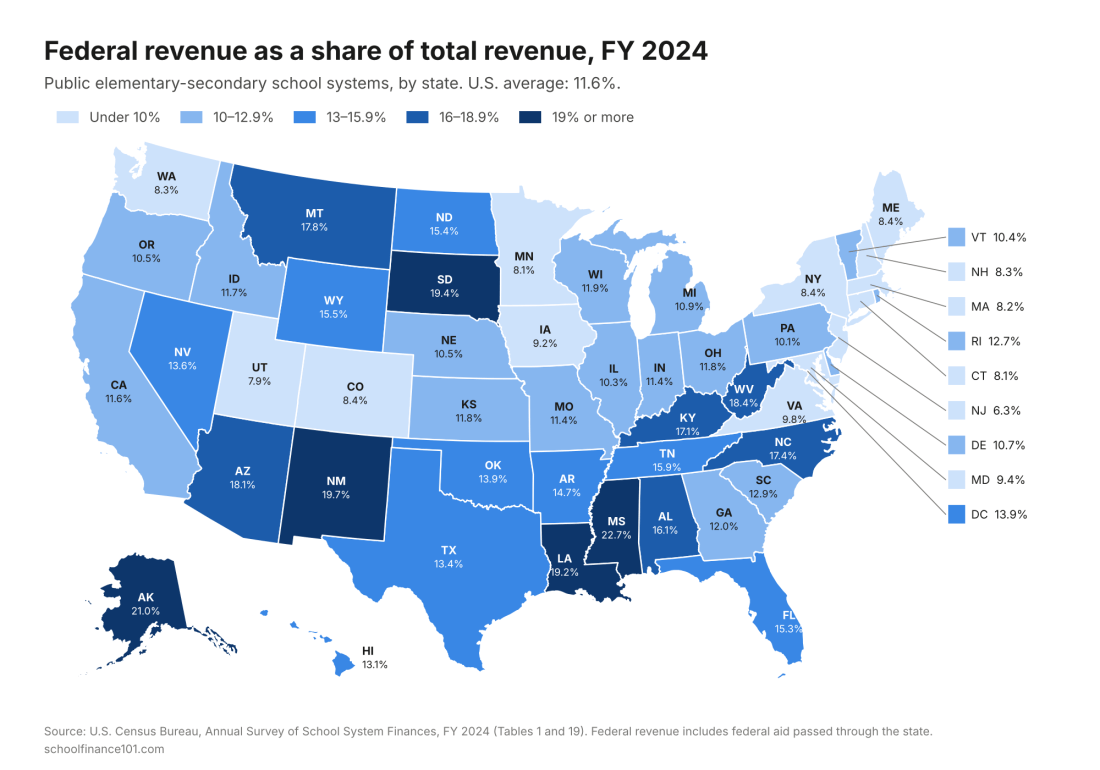
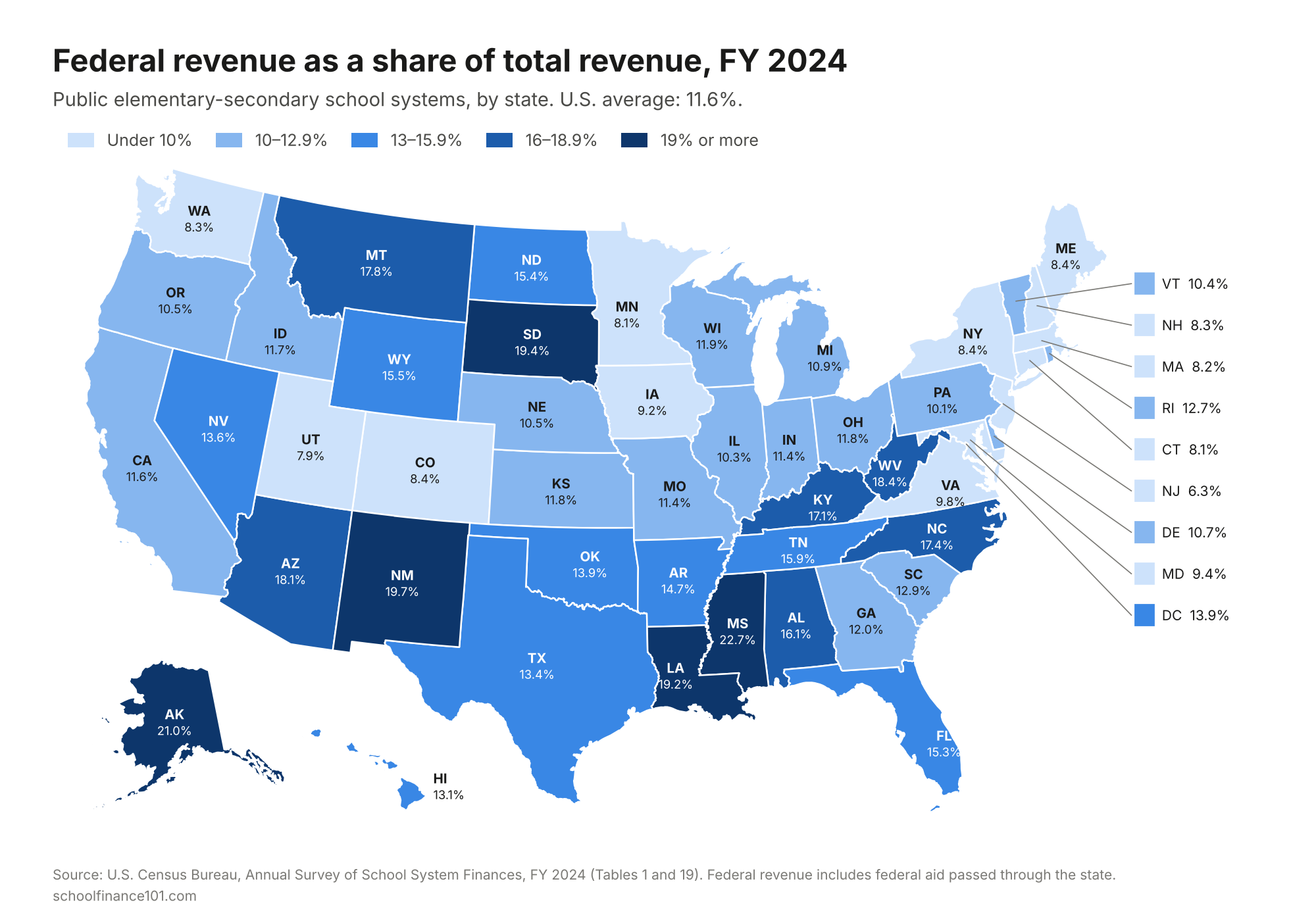
U.S. map of federal revenue as a percent of total public school revenue by state, FY 2024. Highest: Mississippi 22.7%, Alaska 21.0%, New Mexico 19.7%. Lowest: New Jersey 6.3%. U.S. average 11.6%.

We like to think of our public schools as locally controlled and state funded, with Washington playing a bit part. Nationally, that’s roughly right. In fiscal year 2024, according to the Census Bureau’s Annual Survey of School System Finances, public school systems took in about $995 billion, of which about $115 billion, or 11.6%, came from federal sources.

But that national average hides a very different country. In some states, federal aid is a rounding error in school budgets. In others, more than one of every five dollars flowing to local public schools comes from Washington. Welcome to the Dependent States of America.

Mapping dependence

The measure that matters here is dependence: federal revenue as a share of each state’s total school revenue. It tells us how much a state’s schools would be exposed if federal aid were cut, frozen, or weaponized, and how much leverage Washington has (or could have) over what happens in those schools.

U.S. map of federal revenue as a percent of total public school revenue by state, FY 2024. Highest: Mississippi 22.7%, Alaska 21.0%, New Mexico 19.7%. Lowest: New Jersey 6.3%. U.S. average 11.6%.

Mississippi tops the list, with 22.7% of school revenue coming from federal sources, followed by Alaska (21.0%), New Mexico (19.7%), South Dakota (19.4%), Louisiana (19.2%) and West Virginia (18.4%). At the other end, New Jersey’s schools draw only 6.3% of their revenue from Washington, with Utah, Minnesota, Connecticut and Massachusetts all around 8%.

The politics of dependence

It won’t surprise many readers that the Dependent States of America lean heavily red. Sorting states by the 2024 presidential result (using FEC certified state returns):

2024 presidential resultStatesFederal share of total school revenueMedian state
Trump-won3113.5%13.9%
Harris-won (incl. DC)209.7%9.6%
Solid R (R+10 or more)2413.9%15.0%
Lean R (R+2 to 10)414.8%15.5%
Toss-up (margin under 2)310.7%10.9%
Lean D (D+2 to 10)68.6%8.3%
Solid D (D+10 or more)149.9%10.3%
United States5111.6%11.8%
Group shares are pooled (group federal revenue ÷ group total revenue). Rows are shaded by 2024 presidential leaning: solid red = R+10 or more; pale red = R+2 to 10 (Arizona, Georgia, Nevada, North Carolina); pale purple = toss-up, margin under 2 points (Michigan, Pennsylvania, Wisconsin); pale blue = D+2 to 10 (Maine, Minnesota, New Hampshire, New Jersey, New Mexico, Virginia); solid blue = D+10 or more (including DC). Sources: Census Bureau, FY 2024 Annual Survey of School System Finances; FEC 2024 certified results.

Schools in states Trump carried draw 13.5 cents of every revenue dollar from Washington, compared with 9.7 cents in states Harris carried, about 40% more reliance. Dependence rises with the margin: across states, the correlation between Trump’s 2024 margin and the federal share of school revenue is about 0.55 (excluding DC). Nine of the ten most dependent states voted for Trump (New Mexico being the exception). Nine of the ten least dependent voted for Harris (Utah being the exception).

Dependent by circumstance, or by choice?

Here’s the important part. The Dependent States of America are not dependent because Washington is especially generous to them. Federal dollars per pupil are about the same in Trump-won states ($2,403) as in Harris-won states ($2,598). What differs is the denominator. State and local revenue averages about $15,400 per pupil in Trump-won states, compared with about $24,300 in Harris-won states. A similar federal contribution simply makes up a much larger slice of a much thinner budget.

And that thinner budget is not only a function of being poorer. As I lay out in a recent working paper, state wealth and income account for about half, or less, of the variation in how adequately states fund their schools. The rest is effort, or the lack of it. Forty-one states now devote a smaller share of their economies to K-12 schools than they did before the 2007-09 recession. Some states, like Mississippi, have so little capacity that even average effort would leave them well short. Others, like Florida and Arizona, could raise enough on their own simply by exerting average effort. They choose not to.

Both kinds of states show up among the Dependent States of America. New Mexico, West Virginia and Alaska exert above-average effort and remain highly dependent anyway; they are dependent largely by circumstance. Arizona (18.1% federal), North Carolina (17.4%), Tennessee (15.9%) and Florida (15.3%) are dependent substantially by choice: very low-effort states leaning on federal aid, several of them while cutting taxes and expanding private school vouchers. And there’s a bitter irony here. Many of the states most dependent on federal aid today are the same states that, during the civil rights era, adopted “antiregulation” acts, using state aid and local tax policy to shield districts that refused federal desegregation mandates.

Low effort, high dependence

To separate circumstance from choice, the table below lists every state that both puts in below-average effort (state and local school revenue as a share of personal income) and draws an above-average share of its school revenue from Washington.

StateState & local effort
(% of personal income)
EffortFederal share of revenue2024 leaning (margin)
Mississippi3.49%Below avg.22.7%Solid R (R+22.9)
South Dakota2.75%Very low19.4%Solid R (R+29.2)
Louisiana3.71%Near avg.19.2%Solid R (R+22.0)
Arizona2.41%Very low18.1%Lean R (R+5.5)
Montana2.74%Very low17.8%Solid R (R+19.9)
North Carolina2.43%Very low17.4%Lean R (R+3.2)
Kentucky3.67%Near avg.17.1%Solid R (R+30.5)
Tennessee2.81%Very low15.9%Solid R (R+29.7)
Wyoming3.69%Near avg.15.5%Solid R (R+45.8)
North Dakota3.73%Near avg.15.4%Solid R (R+36.5)
Florida2.35%Very low15.3%Solid R (R+13.1)
Arkansas3.58%Below avg.14.7%Solid R (R+30.6)
Oklahoma3.26%Below avg.13.9%Solid R (R+34.3)
Nevada3.07%Below avg.13.6%Lean R (R+3.1)
Texas3.48%Below avg.13.4%Solid R (R+13.7)
Hawaii3.69%Near avg.13.1%Solid D (D+23.1)
Rhode Island3.63%Near avg.12.7%Solid D (D+13.8)
Wisconsin3.58%Below avg.11.9%Toss-up (R+0.9)
Idaho2.86%Very low11.7%Solid R (R+36.5)
United States3.73%11.6%
States with below-average effort and above-average federal share, sorted by federal share. Rows are shaded by 2024 presidential leaning: solid red = R+10 or more; pale red = R+2 to 10; pale purple = toss-up (margin under 2 points); pale blue = D+2 to 10; solid blue = D+10 or more. Effort tiers: very low = under 3.0%; below average = 3.0 to 3.59%; near average = 3.6% to the U.S. average of 3.73%. Effort = FY 2024 state and local school revenue ÷ 2023 personal income. DC excluded (see data notes). Sources: Census Bureau FY 2024 Annual Survey of School System Finances, Tables 1 and 19; FEC 2024 certified results.

Nineteen states meet both conditions, and 17 of them voted for Trump in 2024. The two Harris-won states on the list, Hawaii and Rhode Island, sit just below the national effort average. All seven states with very low effort voted for Trump: Florida (2.35%), Arizona (2.41%), North Carolina (2.43%), Montana, South Dakota, Tennessee and Idaho. Florida, Arizona and North Carolina devote only about two-thirds of the national average share of personal income to their schools, yet each draws more than 15% of its school revenue from federal sources. Mississippi is a different case. Its effort is modestly below average, but its capacity is so low that average effort alone would not get it close to adequacy.

Every state in this table falls below the 4%-of-personal-income effort floor in our federal formula simulation (described below). Under that design, each would have to raise its own effort before receiving gap-closing federal aid.

So what should federal policy do with the Dependent States of America? Two things: allocate aid toward adequacy, and attach meaningful strings.

Allocating federal aid toward adequacy

Federal aid today is layered on top of 50 separate state systems and targeted mainly on child poverty through programs like Title I and IDEA. It helps, but it does little to close either the gaps between adequately and inadequately funded states or the gaps between high- and low-need districts within states. Even during the period of elevated pandemic aid, the highest-poverty districts in southeastern states received the most federal money and the largest federal share, yet their total revenue remained woefully inadequate.

With my colleagues Matthew Di Carlo and Mark Weber, I’ve proposed a different approach: a new federal foundation aid formula that treats the federal government as the top layer of a national school finance system. It works much the way a good state formula works:

  1. Set an adequacy target for every district, using a national education cost model to estimate the per-pupil spending needed to reach common outcome goals (in our simulation, a modest goal: national average reading and math outcomes), adjusted for student needs and regional costs.
  2. Require a minimum state and local effort, in our simulation 3.5% of gross state product or 4% of aggregate personal income, roughly the national average.
  3. Direct that state and local revenue toward the districts furthest below adequacy.
  4. Have federal aid fill whatever gap remains, but only once a state has done its part.

In our proof-of-concept simulation, universal adequacy would require roughly $52 billion in additional federal aid per year, targeted to districts in 34 states, along with about $80 billion in additional state and local fair-share investment. Full participation would reduce the share of students in inadequately funded districts from about 55% to zero and shrink the funding gap between the highest- and lowest-poverty districts by more than 60%.

The effort requirement matters most for the Dependent States of America. Low-capacity states like Mississippi would receive substantially more help once they reach the effort floor, because their gaps genuinely exceed what they can raise. Low-effort states like Florida, Arizona, North Carolina and Tennessee would have to raise their own effort before receiving gap-closing aid. Federal dependence would stop being a subsidy for choosing not to try. And there’s no reason this logic must be limited to new money. The same framework could guide the distribution of the roughly $115 billion in federal revenue already flowing to schools.

Applying pressure where dependence is greatest

When one fifth of a state’s school revenue comes from Washington, Washington has both a stake and a lever. We’ve used that lever before. Southern states were required to adopt education articles in their constitutions as a condition for readmission to the Union after the Civil War. A century later, the Elementary and Secondary Education Act of 1965 put real federal money on the table, and the threat of losing it gave teeth to desegregation enforcement. The federal government is again using that lever, but in the opposite direction, threatening to withhold aid from schools and states that pursue equity.

A future federal role should apply the lever deliberately, and most firmly where dependence is greatest. Conditions attached to federal aid should include:

  • Civil rights protections for all children. Full compliance with Title VI, Title IX, IDEA and Section 504, and with the obligation to educate every child regardless of immigration status. Any provider receiving public funds, including charter and voucher-receiving schools, must be bound by the same nondiscrimination requirements.
  • Common national goals. Shared outcome goals and measures, broader than reading and math scores and including preparation for postsecondary education, the workforce and civic life, that define what adequate funding must accomplish and drive the cost estimates behind the formula. These are national goals, not a national curriculum; achieving them would require revisiting long-standing statutory limits on federal direction of curriculum, and states would retain authority over how to meet them.
  • Minimum effort and no backsliding. States should not be able to eliminate the primary tax sources funding their schools, as Mississippi has proposed with its income tax and Florida with property taxes, or divert public funds to private schools, while drawing federal aid to backfill the hole.
  • Enforceable education rights. Every state constitution includes an education article, but enforcement by state courts has been uneven at best. Federal aid should come with pressure to make those rights real.
  • Transparent data. School-level spending and broader outcome reporting, supported by a rebuilt, not dismantled, National Center for Education Statistics and Institute of Education Sciences.

There are legal limits. Spending Clause conditions must be clearly stated, related to the purpose of the funds, and not so severe that they amount to coercion. That argues for attaching new conditions to new adequacy aid, phased in over time, rather than threatening to pull existing funds overnight. But the principle stands: the more a state’s schools depend on federal dollars, the stronger the federal interest in ensuring those schools serve every child, to common standards, under the protection of the law.

Whose rights? Children’s, not parental preferences

There’s another reason the Dependent States of America deserve federal attention. Several of them are where public money now follows parental preference with the fewest strings attached. Arizona, at 18.1% federal and among the lowest-effort states in the country, has made every school-age child eligible for an Empowerment Scholarship Account since 2022. Under its statute, a parent’s signature on the account agreement counts as compulsory school attendance. The law requires no testing and no curricular approval, and it measures no learning. Florida’s universal program requires a norm-referenced test, but funding turns on submitting the test, not on the score. Idaho’s high court has upheld that state’s private education tax credit, and Wyoming’s has cleared its education savings accounts to operate. All four states appear in the low-effort, high-dependence table above.

As I explain in Not the Mere Creature of Anyone (full working paper), for a century the Supreme Court has asked how much control parents may exercise over their children’s schooling, and almost never what the child is owed. Since 2017, the doctrine has converged on a single result: parental authority, underwritten by public money and increasingly insulated from public conditions. Carson v. Makin requires a state that funds any private option to fund religious ones. Mahmoud v. Taylor and Mirabelli v. Bonta make parental religious objection a powerful claim inside the public schools that remain. And on November 3, the Court hears St. Mary Catholic Parish v. Roy, which asks whether states may attach neutral conditions to the money at all.

Consider, as I did in Experimenting With Our Children, the student in Phoenix who turns 18 having been failed by her account-funded education. She can’t sue her parents; courts have long refused to recognize a duty of care for academic outcomes. She can’t sue the state under the federal Constitution; education is not a fundamental federal right, and the state generally owes no duty to protect a child from harm by a private actor, including a parent. And state courts reviewing universal voucher and account programs have increasingly asked whether the money harms the public system, not whether any individual child is being educated. She is the one party to the arrangement with no rights of her own.

Pierce v. Society of Sisters told us that the child “is not the mere creature of the State.” True. But neither is she the mere creature of her parents. And Pierce struck a bargain that is too often forgotten: parents could leave the public schools, but the state kept the power to reasonably regulate all schools, to inspect and examine them, and to require studies essential to good citizenship. Federal aid can and should reinforce the state’s side of that bargain. Any state that spends public money, its own or Washington’s, on private schooling or home education should, as a condition of federal aid, adopt what I call Children’s Recourse:

  • Register every school-age child, in every setting, so no child disappears from public view.
  • Assess learning, not attendance or receipts, paired with remediation and, after repeated failure, a required change of educational setting.
  • Keep every child in periodic contact with a mandated reporter, such as a teacher, nurse or counselor, and review any withdrawal from school while child-protection concerns are open.
  • Attach neutral accountability conditions to every public dollar: assessment participation, public reporting of outcomes and finances, nondiscrimination in admissions, including on the basis of disability, and audits. To survive Carson and Fulton, these must apply to all providers alike, without discretionary exemptions.
  • Give older students a voice in decisions about their own schooling, the question Justice Douglas asked in his Yoder dissent and the Court has never answered.
  • End the fiction that a funding contract is an education, repealing provisions like Arizona’s that deem a signed account agreement to be school attendance.

None of these measures requires any family to profess anything, and none prescribes a culture or a creed. They ask only that someone be answerable to the child whose public education dollars are being spent. And they rest on the strongest ground available: state constitutional education clauses, which courts in Kentucky, Wyoming, New Hampshire and Washington have read as conferring an individual, even fundamental, right on each child. A right held by the child doesn’t stay behind when the child leaves the public system. It follows her, and so should the state’s duty, and the federal government’s interest, in seeing that she is actually educated.

From the Dependent States of America to Project 2029

None of this will happen under the current federal administration, which is dismantling the Department of Education, clawing back appropriated funds and greenlighting states already eroding their own public schools. In the short term, the work falls to what I’ve called the Education States, which are not exclusively blue or northern (Kansas qualifies), to protect their own students: backfilling threatened federal aid with state funds, much as southern states once used state aid to resist civil rights, and building the data capacity Washington is abandoning.

But short-term resistance is not a plan for the Dependent States of America. Children in Florida, Arizona, North Carolina and Tennessee can’t wait for their legislatures to rediscover the value of public education, and children in Mississippi can’t wait for their state to grow its way to adequacy. That requires a longer game: Project 2029.

Project 2029 is a new reconstruction. Ideally, it would include a federal constitutional amendment requiring that every child be provided, by their state with federal assistance, equal educational opportunity. At a minimum, it must include:

  1. Common national goals and standards, and measures of them, to guide what we expect our schools to accomplish and what it costs.
  2. A national cost model to drive a federal foundation aid formula targeting dollars to where they are needed most.
  3. A required minimum state and local effort, so that federal aid complements rather than substitutes for state responsibility.
  4. Rebuilt federal data and research capacity to monitor progress toward equal educational opportunity.
  5. Children as rights-holders, with federal aid reinforcing each child’s right to an adequate education wherever public money sends her, not deferring to parental preference as a proxy for the child’s interest.

What Congress would have to change

Project 2029 can’t be accomplished by executive order, nor should it be. It requires legislation, and in several places it means rewriting rules that currently get in the way. Congress would need to enact a federal foundation aid program1; replace ESEA’s maintenance-of-effort rule with an effort floor2; fix Title I’s spending factor3; revisit the prohibitions on federal involvement in standards and curriculum4; strengthen civil rights enforcement5; write Children’s Recourse into the conditions on federal aid6; ratify the UN Convention on the Rights of the Child7; make education rights enforceable8; fully fund IDEA9; and rebuild and protect the federal education infrastructure10. The notes below spell out each change and the statutes and cases involved.

Project 2025 was years in the making, so that an administration could act on day one. Project 2029 must be just as detailed and just as ready, but with a crucial difference. It must be built on broad congressional buy-in rather than executive shows of force, and it must uphold, not subvert, our core constitutional commitments: equal protection, due process, free speech, and the balance between the free exercise of religion and the prohibition on its establishment. Over the longer run, it means revisiting the precedents that have subordinated the child to parental preference and public money, from Carson and Espinoza back toward Pierce itself, with any replacement built so it can never again be turned against minority families.

The Dependent States of America are dependent today largely because they’ve chosen to underinvest in their own children, and federal aid has quietly covered for it. Project 2029 should turn that dependence into a partnership: real federal help, toward real adequacy, in exchange for real effort and real protections for every child, protections that belong to the child, not to the adults choosing for her. If we are going to spend public money in a child’s name, someone has to be answerable to that child. Equitable and adequate funding alone won’t get us to equal educational opportunity. But we can’t get there without it.

  1. Enact a federal foundation aid program. A new title of the Elementary and Secondary Education Act (ESEA) authorizing adequacy-based aid driven by a national cost model, with a minimum state and local effort requirement (for example, 4% of personal income or 3.5% of gross state product) and a multi-year phase-in for states below the floor. Elementary and Secondary Education Act of 1965, as amended by the Every Student Succeeds Act (2015), 20 U.S.C. § 6301 et seq. The effort benchmarks follow Baker, Di Carlo & Weber (2022). ↩︎
  2. Replace the maintenance-of-effort rule with an effort floor. ESEA’s current maintenance-of-effort requirement asks only that a state spend at least 90% of what it spent the year before. A state can stay at very low effort forever and remain compliant. The test should be effort relative to capacity, and states should not be able to cut taxes or divert public funds to private schools below that floor while drawing federal foundation aid. ESEA § 8521, 20 U.S.C. § 7901 (maintenance of effort: combined fiscal effort or aggregate expenditures of at least 90 percent of the prior year). ↩︎
  3. Fix Title I’s spending factor. Title I’s formulas use a state per-pupil expenditure factor that sends more aid per poor child to states that already spend more, regardless of capacity or effort. Allocations should instead reflect adequacy gaps and effort. ESEA §§ 1124–1125A, 20 U.S.C. §§ 6333–6337. Under the Basic Grant formula, the state expenditure factor is 40 percent of the state’s average per-pupil expenditure, bounded at 80 to 120 percent of the national average. ↩︎
  4. Revisit the prohibitions on federal involvement in standards and curriculum. The General Education Provisions Act and provisions the Every Student Succeeds Act added to ESEA bar federal direction of curriculum and federal incentives for particular standards. These should be amended to permit common national outcome goals and measures, including an expanded NAEP, while leaving curriculum and instruction to states and districts. General Education Provisions Act § 103, 20 U.S.C. § 1232a; ESEA § 1111(e), 20 U.S.C. § 6311(e); ESEA § 8526A, 20 U.S.C. § 7906a. ↩︎
  5. Strengthen civil rights enforcement. Restore private enforcement of Title VI disparate-impact protections, which the Supreme Court closed off in Alexander v. Sandoval (2001). Codify the guarantee of Plyler v. Doe that every child, regardless of immigration status, is entitled to a public education. And as a condition of federal aid, require states that fund private providers, through vouchers, education savings accounts, tax-credit scholarships or charters, to hold them to the same nondiscrimination, special education and transparency requirements as public schools. Title VI of the Civil Rights Act of 1964, 42 U.S.C. § 2000d; Alexander v. Sandoval, 532 U.S. 275 (2001); Plyler v. Doe, 457 U.S. 202 (1982). ↩︎
  6. Write Children’s Recourse into the conditions on federal aid. Require any state that spends public funds on private schooling, education savings accounts or home education to register every child, assess learning rather than receipts, keep children in contact with mandated reporters, apply neutral accountability conditions uniformly to every provider, give older students a voice, and drop any rule deeming a funding agreement to be school attendance. Drafted as neutral, generally applicable conditions, these stand the best chance of surviving whatever the Court decides in St. Mary. Ariz. Rev. Stat. Ann. § 15-2402(I); Carson v. Makin, 596 U.S. 767 (2022); Fulton v. City of Philadelphia, 593 U.S. 522 (2021); St. Mary Catholic Parish v. Roy, No. 25-581 (U.S., argued Nov. 3, 2026). See Baker (2026), Part VII. ↩︎
  7. Ratify the UN Convention on the Rights of the Child. It recognizes parents’ primary responsibility for their children, exercised consistent with the child’s evolving capacities, while guaranteeing the child a voice in matters affecting her and subjecting private schools to minimum standards. The United States signed it in 1995 and is the only UN member that is not a party. Convention on the Rights of the Child, arts. 5, 12, 18, 29, Nov. 20, 1989, 1577 U.N.T.S. 3 (signed by the United States Feb. 16, 1995). Ratification requires the advice and consent of two-thirds of the Senate, U.S. Const. art. II, § 2, cl. 2. ↩︎
  8. Make education rights enforceable. Condition foundation aid on each state guaranteeing, in law, a judicially enforceable right to an adequate education. In the longer run, pursue a federal constitutional amendment so that this right no longer depends on the willingness of 50 state courts. San Antonio Independent School District v. Rodriguez, 411 U.S. 1, 35 (1973) (no federal fundamental right to education); Papasan v. Allain, 478 U.S. 265, 285 (1986) (leaving open whether a minimally adequate education is a fundamental right). ↩︎
  9. Fully fund IDEA. Congress authorized federal funding of up to 40% of the excess cost of educating students with disabilities in 1975, and it has never come close. Closing that gap is among the most direct ways to relieve pressure on low-capacity states. Individuals with Disabilities Education Act, 20 U.S.C. § 1411(a)(2) (maximum grant of 40 percent of the national average per-pupil expenditure times the number of children served). ↩︎
  10. Rebuild and protect the federal education infrastructure. Reauthorize the Education Sciences Reform Act with statutory independence and stable funding for NCES and IES. Codify the Census school finance survey and school-level spending reporting. Fund the cost modeling a national formula requires, and protect the Department of Education’s statutory functions from administrative dismantling. Education Sciences Reform Act of 2002, 20 U.S.C. § 9501 et seq.; Department of Education Organization Act, 20 U.S.C. § 3401 et seq.; ESEA § 1111(h)(1)(C)(x), 20 U.S.C. § 6311(h)(1)(C)(x) (school-level per-pupil expenditure reporting). ↩︎

Data notes