Every year somebody publishes a ranking of average teacher salaries by state. New York and New Jersey land near the top, Mississippi near the bottom, and everybody argues about whether teachers are overpaid or underpaid. The ranking answers neither question. A salary, all by itself, tells you nothing. The question is the one this series keeps asking: compared to what?
This School Finance Rock lesson is a gritty Louisiana swamp blues about how to measure teacher pay properly, from one place to another and over time. The answer is a comparable wage approach: line teachers up against people who could have walked away, non-teachers of the same age, with the same education, working the same hours and weeks, in the same state, in the same year. Whatever’s left between them is the teaching penalty. And by that measure, the penalty has gotten worse nearly everywhere, and it is worst where states don’t pay what adequate schools cost.
Why “compared to what?” comes first
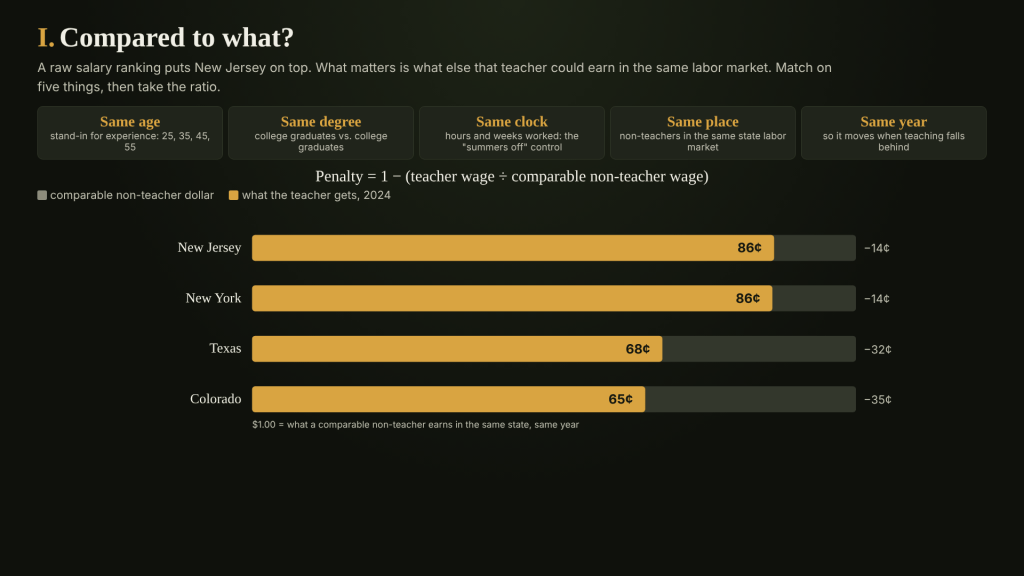
Teacher pay only means something next to what the same person could earn doing something else, in the same labor market, at the same time. That is the market districts actually hire from. Four pieces matter:
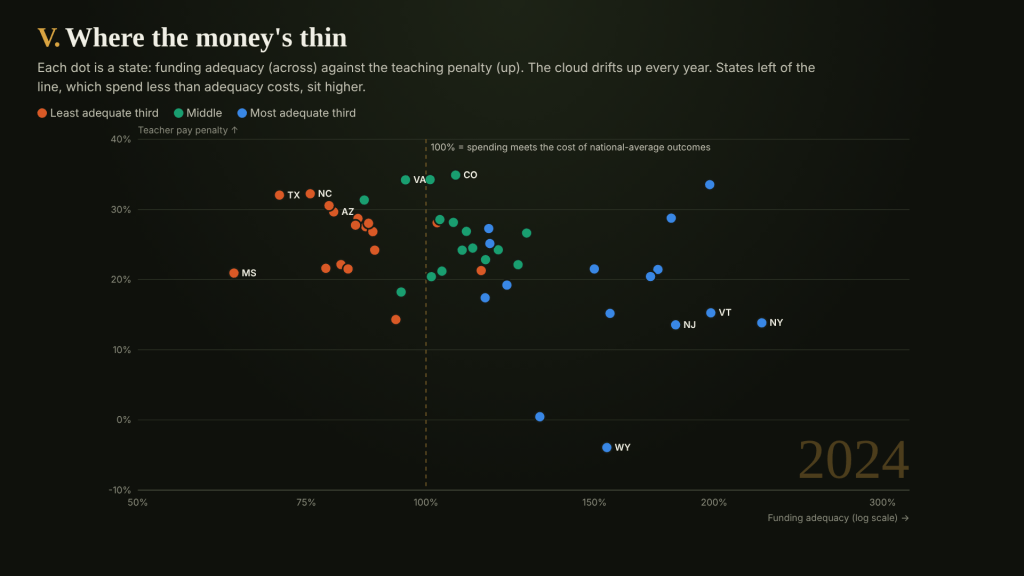
- From one place to another. A $60,000 salary can be competitive in one labor market and hopeless in another. It isn’t just prices and housing. What other college graduates earn differs a lot from state to state. So compare each state’s teachers to non-teachers in that same state, and the local labor market is built in. (The NCES Education Comparable Wage Index uses the same logic to adjust spending across places.) Do that, and New Jersey and New York, at the top of the raw-salary rankings, have some of the smallest teaching penalties. Colorado, Virginia, Texas and North Carolina have some of the largest.
- Over time. “Teacher pay went up 3 percent” means nothing if comparable workers got 6. Adjusting for inflation only tells you about purchasing power. It doesn’t tell you whether teaching is gaining or losing ground against the other jobs a graduate could take. Measure teachers against non-teachers in the same year, and the comparison moves when teaching falls behind.
- Who counts as comparable. Similar age (an imperfect but adequate stand-in for experience) and similar education, a college degree or more.
- The same clock. “But they get summers off!” That’s why the comparison is on the same time basis. Allegretto compares weekly wages. The SFID estimates control for hours and weeks worked. Teachers are still behind.
And benefits? Teachers’ benefits are somewhat better, but they close only part of the gap. In 2024, counting wages and benefits together, Allegretto finds teachers still 17.1 percent behind comparable college graduates. The SFID teacher wage brief estimates benefits offset only about 7 to 9 points of the penalty.
A record penalty
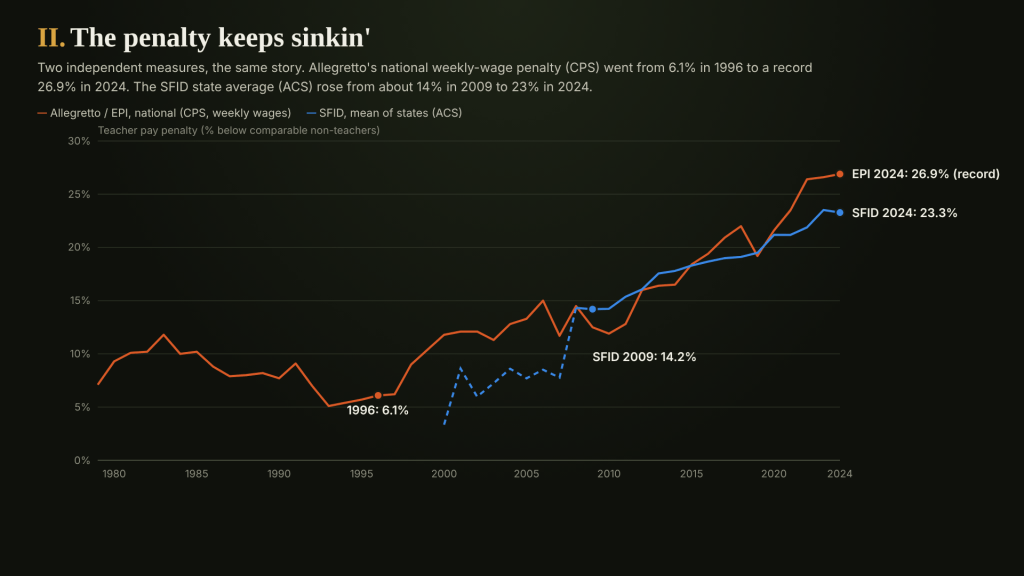
Sylvia Allegretto has tracked the penalty for decades with the Economic Policy Institute. Using Current Population Survey data and regression-adjusting for education, experience and demographics, she finds the weekly wage penalty grew from 6.1 percent in 1996 to a record 26.9 percent in 2024. It ranged from 10.0 percent in Rhode Island to 38.5 percent in Colorado, and was at least 25 percent in 20 states. Women teachers once earned a small premium, about 3.3 percent on average before 1994; by 2024 they faced a 21.5 percent penalty. In 2025 the penalty eased a hair, to an estimated 25.2 percent, still about four times what it was in 1996.
What the SFID state data show
The School Finance Indicators Database estimates the penalty state by state from the American Community Survey. It compares teachers to non-teachers in the same state with similar age, education, and hours and weeks worked, at ages 25, 35, 45 and 55. (The method is laid out in the 2019 teacher wage brief.) Averaging across those ages:
- Across the states, teachers earned about 86 cents on the comparable dollar in 2009 and 77 cents in 2024.
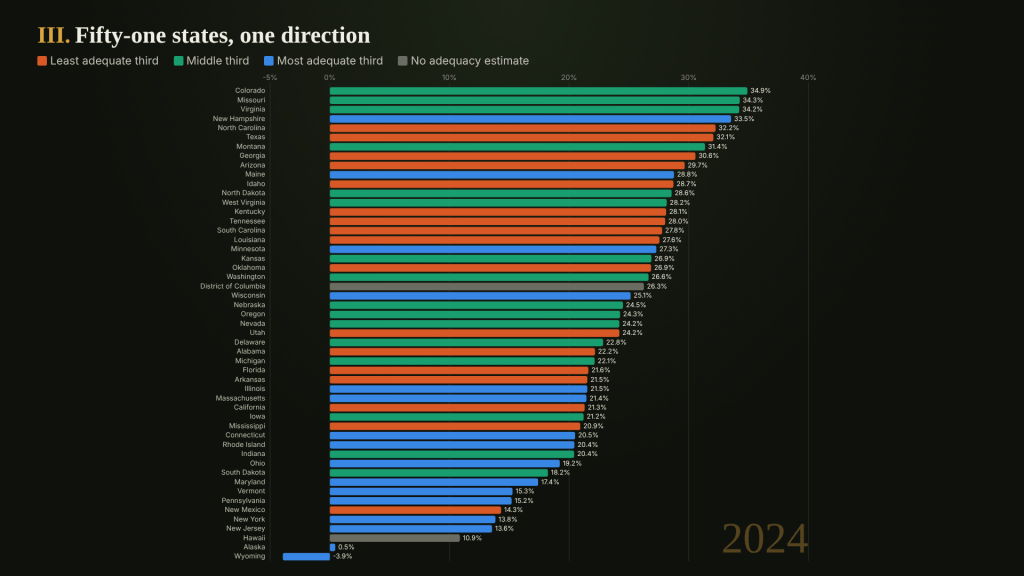
- 50 of 51 (the states plus DC) had a worse ratio in 2024 than in 2000. Alaska is the exception. Wyoming is the only state at or above parity in 2024.
- In 2009, three states had a penalty of 25 percent or more. In 2024, 23 did.
Starve the school, the teacher pays the toll
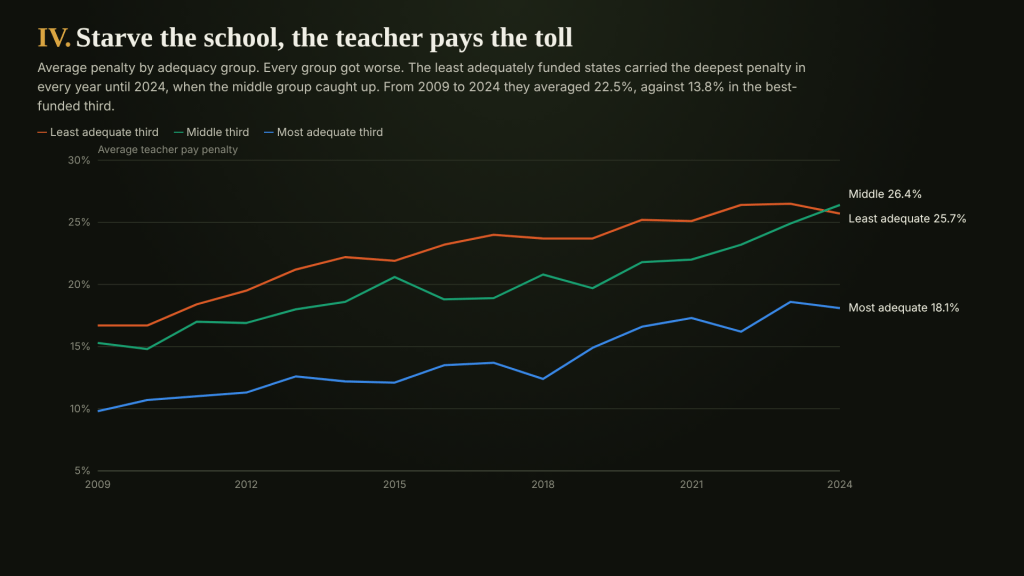
Penalties are much worse in states that don’t fund their schools adequately. Here, adequacy means state and local spending relative to the modeled cost of reaching national-average outcomes (from the SFID and the National Education Cost Model). Split the states into thirds by their average adequacy from 2009 to 2024. The least adequately funded third averaged a 22.5 percent penalty over that period. The best-funded third averaged 13.8 percent. Texas spends about 70 percent of what adequacy costs and pays its teachers about 68 cents on the comparable dollar. North Carolina spends about 76 percent and pays about 68 cents.
The honest part
- The link is across states, not year to year within them. Pooled across 2009–2024 with year effects, a 10 percent gain in adequacy goes with a penalty about 1.2 points smaller. Add state fixed effects and the within-state relationship is small and not statistically significant. One bad budget doesn’t move the penalty overnight. It’s the states that stay underfunded that stay at the bottom.
- The middle caught up. By 2024, the middle third of states had a penalty as large as the least-funded third.
- Watch the 2008 step. The SFID series moves from the 2000 decennial census to the ACS, and the jump between 2007 and 2008 coincides with the 2008 ACS redesign of the weeks-worked question. Treat that step partly as measurement. The cleanest continuous stretch, 2009 to 2024, still shows a nine-cent drop.
- Different data, same story. The SFID estimates track EPI’s but run a few points lower: different survey (ACS vs. CPS), different years and models, and SFID includes private school teachers.
Every line has a receipt
| The lyric | The receipt | Source |
|---|---|---|
| “Folks love a teacher-salary ranking… Like a dollar’s a dollar from the bayou to the Bronx. It ain’t.” | Raw average salaries ignore what comparable workers earn in each labor market. Assessing teacher pay requires a benchmark of similar workers in the same area. | SFID (2019) |
| “What could that same young graduate be makin’ ‘cross the street?” | The comparison group: non-teachers in the same state with similar age, education, and hours and weeks worked. | SFID (2019) |
| “Pay went up, son, three percent… the nurse went up by six” | Illustrative. Inflation adjustment measures purchasing power, not competitiveness. The penalty is measured within each year. | Illustrative |
| “But they got the summers off!… count it by the week” | EPI compares weekly wages; SFID controls for hours and weeks worked. | Allegretto (2025); SFID (2019) |
| “Teachers still seventeen percent behind in twenty twenty-four” | Total compensation (wages + benefits) penalty: 17.1% in 2024. | Allegretto (2025) |
| “Back in ninety-six… six cents thin. By twenty twenty-four, near twenty-seven, record high” | Weekly wage penalty: 6.1% in 1996; record 26.9% in 2024. | Allegretto (2025) |
| “The women in the classroom used to earn a little more” | Female teachers averaged a 3.3% premium before 1994; a 21.5% penalty in 2024. | Allegretto (2025) |
| “Twenty twenty-five, she says it eased a hair. But four times ninety-six…” | Estimated 25.2% penalty in 2025, more than four times 1996’s 6.1%. | Allegretto (2025 update) |
| “Two thousand nine, the teacher made eighty-six cents… By twenty twenty-four, it’s seventy-seven” | SFID mean parity across states (avg. of ages 25/35/45/55): 85.8¢ in 2009, 76.7¢ in 2024. | SFID state panel (ACS) |
| “Fifty out of fifty-one got worse since two thousand’s time” | 50 of 51 (states + DC) had lower parity in 2024 than in 2000; Alaska is the exception. | SFID state panel |
| “Twenty-three states now a quarter short or more” | States with penalties of 25% or more: 3 in 2009, 23 in 2024. | SFID state panel |
| “Jersey’s down fourteen cents, Colorado’s down thirty-five” | 2024 penalties: New Jersey 13.6%, Colorado 34.9%. | SFID state panel |
| “Bottom third in funding: twenty-six cents short… Top third’s… eighteen” | 2024 penalty by adequacy third: about 26% in the least adequately funded third (ranking states within 2024), 18–19% in the best-funded third. | SFID state panel; adequacy from SFID/NECM |
| “Texas spends seventy cents of what it takes… pays its teachers sixty-eight cents” | Texas 2024: spending about 70% of the cost of national-average outcomes; parity 0.68. | SFID state panel |
| “One bad budget don’t move the penalty overnight” | With state fixed effects, the within-state, year-to-year relationship is small and not significant. The gap is between persistently underfunded and better-funded states. | SFID state panel, author’s models |
Key literature
- Allegretto, S. (2025). The teacher pay penalty reached a record high in 2024: Three decades of leaving public school teachers behind. Economic Policy Institute and Center for Economic and Policy Research.
- Allegretto, S. (2025). The teacher pay penalty remained high in 2025. Economic Policy Institute.
- School Finance Indicators Database (2019). Teacher wage competitiveness brief (PDF). schoolfinancedata.org.
- Allegretto, S., & Mishel, L. (2019). The teacher weekly wage penalty hit 21.4 percent in 2018, a record high. Economic Policy Institute.
- Taylor, L. L., & Fowler, W. J., Jr. (2006). A Comparable Wage Approach to Geographic Cost Adjustment (NCES 2006-321). National Center for Education Statistics.
- Baker, B. D. (2018). Educational Inequality and School Finance: Why Money Matters for America’s Students. Harvard Education Press.
Companion songs: Not the Price of Bread (which inflation?), Why Cost Matters and A Recipe Ain’t a Restaurant (Compared to What?). More songs: School Finance Rock.
Full lyrics: Teachin’ Penalty Blues (Compared to What?)
[Intro]
(Spoken)
Pull up a crate, chère.
Folks love a teacher-salary ranking. Top state, bottom state.
Like a dollar’s a dollar from the bayou to the Bronx.
It ain’t.
And a paycheck by itself? It don’t tell you nothin’.
[Verse 1]
Now they print the average salary, rank the states from top to tail
New York sittin’ up in heaven, Mississippi down in jail
But a dollar in the Delta don’t spend like a dollar uptown
And the question ain’t the paycheck, it’s what else is goin’ ’round
(What else? What else?)
What could that same young graduate be makin’ ‘cross the street?
That’s the wage you got to measure. That’s the one you got to beat
[Verse 2]
Then they tell me, “Pay went up, son, three percent since last July”
Well the nurse went up by six, and the engineer went up sky-high
Ain’t enough to beat inflation, you’re racin’ the whole town
When the other folks climb faster, then the teacher’s slidin’ down
(Slidin’ down)
So you weigh ’em in the same year, in the same state, same deal
Side by side on the same scale, chère, that’s how you know what’s real
[Chorus]
Same age (same age), same degree (same degree)
Same hours and the same weeks, same state, same year, you see
Line the teacher up beside the ones who could’ve walked away
Whatever’s left between ’em, that’s the penalty they pay
Lord, that’s the teachin’ penalty blues (penalty blues)
Damn near every teacher in the Union singin’ these blues
[Verse 3]
“But they got the summers off!” hollers the preacher on the stool
Well, you count it by the week, friend, now who’s the fool?
Put the hours on the same clock, put the weeks on the same page
And the teacher’s still behind, still the lowest wage
“But the pension and the health plan!” Yeah, the benefits are fine
They close a little gap, but they don’t close the line
(Spoken) Allegretto added it all up. Wages and benefits together.
Teachers still seventeen percent behind in twenty twenty-four.
[Verse 4]
Back in ninety-six, Miss Sylvia says, the gap was six cents thin
By twenty twenty-four, near twenty-seven, record high again
And the women in the classroom used to earn a little more
Then the other doors swung open, and the penalty walked through the door
(Walked right in)
Twenty twenty-five, she says it eased a hair
But four times ninety-six ain’t relief, it’s despair
[Chorus]
Same age (same age), same degree (same degree)
Same hours and the same weeks, same state, same year, you see
Line the teacher up beside the ones who could’ve walked away
Whatever’s left between ’em, that’s the penalty they pay
Lord, that’s the teachin’ penalty blues (penalty blues)
Damn near every teacher in the Union singin’ these blues
[Verse 5]
I ran them Census numbers, fifty states and D.C. too
Two thousand nine, the teacher made eighty-six cents, that’s true
By twenty twenty-four, it’s seventy-seven on the dime
Fifty out of fifty-one got worse since two thousand’s time
Twenty-three states now a quarter short or more
And Jersey’s teachers make more than Colorado’s, but don’t you keep score
‘Cause it ain’t the size of the check, it’s the size of the hole
Jersey’s down fourteen cents, Colorado’s down thirty-five, Lord, Lord
[Bridge]
Now go down where the money’s thin, where the state won’t pay the cost
Where adequacy’s a rumor and the formula got lost
Bottom third in funding: twenty-six cents short on the dollar
Top third’s still hurtin’, but it’s eighteen, so don’t you holler
Texas spends seventy cents of what it takes to do it right
Pays its teachers sixty-eight cents, and they’re leavin’ every night
Starve the school, and the teacher pays the toll
You can’t hire who you won’t pay, can’t keep ’em, Lord, can’t hold
(Spoken) Now the honest part, chère.
One bad budget don’t move the penalty overnight.
It’s the states that stay underfunded, year after year,
that stay at the bottom. Starvin’ the schools ain’t an accident down there.
It’s a way of life.
[Final Chorus]
Same age (same age), same degree (same degree)
Same hours and the same weeks, same state, same year, you see
Line the teacher up beside the ones who could’ve walked away
Whatever’s left between ’em, that’s the penalty they pay
Lord, that’s the teachin’ penalty blues (penalty blues)
Pay ’em what it costs, or you’ll be singin’ these blues
[Outro]
(Spoken)
Next time somebody shows you a salary ranking,
you ask ’em one question:
Compared to what?
Same age. Same degree. Same hours. Same place. Same year.
Write that one down, kids.
Lyrics by me. Music made with Suno. The raises in verse 2 are illustrative. The charts are not.


