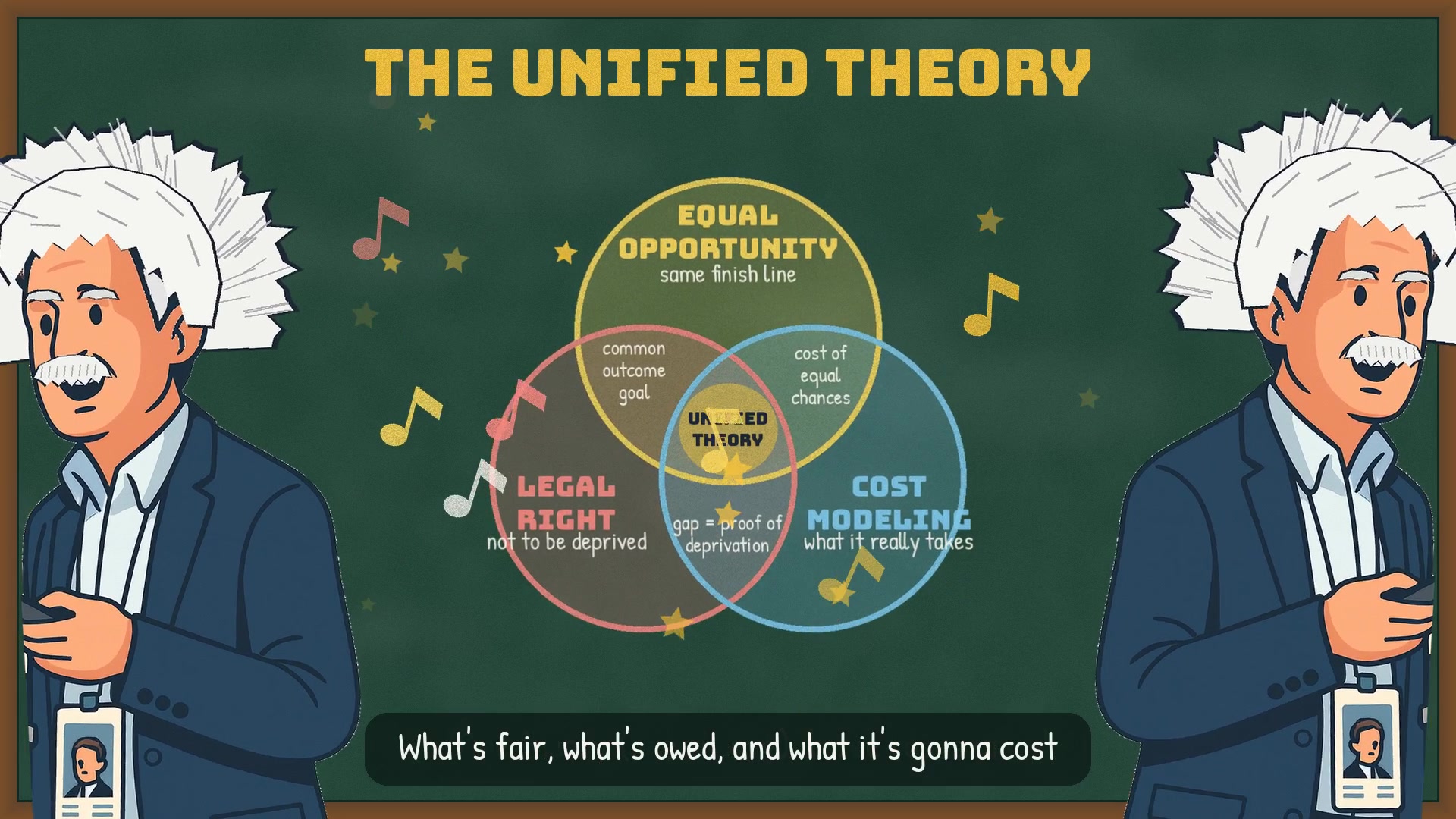
Physicists spent most of a century looking for one theory that would tie the forces of nature together. School finance has had its own three forces pulling in different directions for about as long. Philosophers ask what’s fair. Lawyers ask what’s owed. Economists ask what it costs. Too often each camp answers its own question with its own yardstick, and the three answers never meet.
This School Finance Rock lesson is the capstone to the Equal Opportunity Trilogy (Same Finish Line, Words on Paper and Cost Minus Capacity). It walks through the framework Drew Atchison, Jesse Levin and I have been building: one theory in which the philosophical goal, the legal standard and the empirical method are the same thing, seen from three sides. Picture a three-ring Venn diagram. The video draws it one ring at a time, and an Einstein-haired version of me dances during the instrumental breaks. Cosmic 1970s funk, Moog and horns.
Ring 1: Philosophy. Same finish line.
What does “equal” mean when kids aren’t the same? The old school finance vocabulary, borrowed from public finance, talked about inputs: horizontal equity (equal treatment of equals) and vertical equity (unequal treatment of unequals). Equal dollars, equal teachers, equal buildings. That’s only half the game. Some kids come in hungry, some are learning English, some attend schools where poverty is concentrated, and equal inputs buy them less.
Our framework measures equality at the finish line instead. The purpose of a state school finance system is to provide the resources schools need so that all children have equal opportunity to achieve common, adequate outcome goals. Equity is equal opportunity to reach those common goals. Adequacy is about where the goals are set: high enough that children can grow into productive, self-determined, civically engaged adults. Differentiated inputs are the means, not the measure. “Enough” is whatever it takes for each child to get to the line.
Ring 2: Law. The right not to be deprived.
There’s no explicit right to education in the U.S. Constitution (Rodriguez, 1973), so the action is in state constitutions, and every state wrote its own rule: “thorough and efficient” in New Jersey, “general and uniform” in Washington, “adequate provision” for a “high quality system” in Florida. Courts have translated those words into standards such as “sound basic education” (New York’s CFE, North Carolina’s Leandro) or Kentucky’s seven capacities in Rose (1989).
Different words, one question: was this child deprived of a meaningful opportunity to reach the constitutional standard? You can’t answer that by counting dollars alone, and you can’t answer it by asking whether the state “tried.” You answer it by looking at outcomes and resources side by side. Where outcomes fall short of the standard and resources fall short of what it would take to reach it, that’s deprivation. Kansas is the case study. Across USD No. 229 (1994), Montoy (2005) and Gannon (2016), the courts asked whether funding was reasonably calculated to get children to the state’s standards, and they weighed outcome evidence and cost studies to answer it.
One more legal point. Around 1990, litigation shifted from equal revenue toward minimum adequacy (Clune, 1994). Koski and Reich (2006) warned that adequacy alone can leave equity behind. In our framework, equal opportunity and adequacy travel together, and equal opportunity should be preserved even when revenue limits how high the adequacy bar can be set.
Ring 3: Method. What it really takes.
How do you put a price on “what it takes”? The field has used four families of methods:
- Professional judgment: a panel of educators lists the resources they’d want. In the song, it’s a magic wand.
- Successful schools: average the spending of districts already meeting the standard. That tells you what success costs where it’s already easy, not what it costs for everyone. (See Foundation Aid at 20.)
- Evidence-based: build one prototype school from the research literature, then price it.
- Cost function: use data on every district to estimate how spending relates to outcomes, given student needs, competitive wages, scale and sparsity, and controlling for inefficiency.
Only the cost function ties dollars to outcomes for every district and every kid across the state. It separates the part of spending that is associated with outcomes from the part driven by local preferences and inefficiency. It also treats outcomes as jointly determined with spending, using instrumental variables to deal with that. What comes out is the cost of the common outcome goal for each district: a rate.
Where the rings overlap: the equation
Now put the three rings together, as the bridge of the song does:
- Philosophy and law set the goal: one common outcome standard, held steady for all children.
- The cost model prices the goal for each district. That cost climbs with poverty, English learners, students with disabilities, teacher wages, small scale and long bus routes.
- Line it up against what districts actually spend. Where spending falls below cost, that gap is the empirical measure of deprivation.
- Check the scores. The same districts that fall below the cost line fall below the outcome goal. The gap in dollars and the gap in outcomes line up, which is exactly the evidence the legal standard asks for.
That’s the unified theory: equal opportunity, measured by the outcome, priced by the model and backed by the law. It’s also a working sequence. In Part 1 (“what is”), we test which needs predict outcomes, whether spending is targeted to those needs, and whether spending depends on local wealth (fiscal neutrality). In Part 2 (“what should be”), we estimate the cost model and translate it into formula weights and state and local shares. That last step is the cost-minus-capacity calculation from Part 3 of the trilogy.
Every line has a receipt
| The lyric | The receipt | Source |
|---|---|---|
| “School finance had three: what’s fair, what’s owed, and what it costs” | The framework links a conception of equal opportunity, the legal standards for enforcing it, and the empirical methods for evaluating and calibrating state systems. | Baker (2025), EdWorkingPaper 25-1127; Baker, Atchison & Levin (rev. 2026) |
| “Equal dollars? Equal teachers? Equal buildings? That’s equal inputs, that’s only half the game” | The framework moves beyond input-based “equal treatment of equals” and “unequal treatment of unequals” toward common outcome standards, with differentiated inputs as the means. | Baker (2025); Berne & Stiefel (1984) |
| “‘Cause some kids come in hungry, some are learnin’ English / Some go to school where the poverty runs deep” | Child and community need factors (low income, English learner status, disability, concentrated poverty) predict outcomes and raise the cost of reaching common goals. | Baker (2025), Step 1a; Duncombe & Yinger (2005) |
| “It’s ‘same finish line,’ and ‘enough’ is set by the goal that we all agree on” | Equity is equal opportunity to achieve common outcome goals. Adequacy is outcome goals sufficient for children to become productive, self-determined, civically engaged adults. | Baker (2025) |
| “Every state constitution wrote its own rule: ‘thorough and efficient,’ ‘sound and basic,’ ‘adequate,’ ‘uniform,’ a ‘general’ school” | Education clauses vary: N.J. (“thorough and efficient”), Wash. (“general and uniform”), Fla. (“adequate provision” for a “uniform, efficient, safe, secure, and high quality system”). “Sound basic education” is a judicial standard (N.Y. CFE; N.C. Leandro). | State constitutions; Rodriguez (1973); Rose (Ky. 1989) |
| “Was this child denied a fair shot or not? … You look at what the kids achieved, and what they got” | The legal question is deprivation of opportunity to reach the constitutional standard, shown through outcomes together with resources. Kansas courts weighed outcomes and cost studies. | USD No. 229 (1994); Montoy (2005); Gannon (2016) |
| “It’s not ‘did they spend,’ it’s not ‘did they try'” | Adequacy alone, or effort alone, can leave equity behind. The framework keeps equal opportunity and adequacy together. | Clune (1994); Koski & Reich (2006); Baker (2025) |
| “Some ask a panel … some just average the districts that already made it … some build a model school” | Professional judgment, successful schools and evidence-based methods each price one standard in one kind of setting, with no estimated link between spending and outcomes across all districts. | Baker (2006), JEF; Duncombe & Yinger (2005) |
| “But only one ties the dollars to the outcomes / For every district, every kid” | Cost functions separate the spending variation associated with outcomes from spending driven by local demand and inefficiency, and treat outcomes as endogenous (IV/2SLS). | Baker (2025), Step 2a |
| “Spendin’, outcomes, need and wages, size and distance” | Cost model inputs: spending, outcomes, student needs, competitive wages, economies of scale and sparsity, with controls for inefficiency. | Baker (2025); Why Cost Matters |
| “Below the line? That’s the gap. That’s deprivation, friend / And the very same gap shows up in the scores” | Comparing actual spending with the cost of common outcomes shows where districts fall short. Those districts also fall short on outcomes. Simple spending comparisons can mask, or even reverse, the pattern. | Baker & Losen (2026), EdWorkingPaper 26-1558; SFID / NECM |
| “What’s the goal? (Same finish line!) What’s the right? (Not to be denied!) What’s the cost? (Model it right!)” | The two-part, four-step sequence: needs, spending and needs, fiscal neutrality (what is); cost modeling, weights and formula calibration (what should be). | Baker (2025), Figure 1 |
Key literature
- Baker, B. D. (2025). Framework for Evaluating & Reforming Education Finance Systems (EdWorkingPaper No. 25-1127). Annenberg Institute at Brown University.
- Baker, B. D., Atchison, D., & Levin, J. A unified framework of equal educational opportunity and an empirical framework for evaluating state school finance systems. EdWorkingPapers (rev. 2026).
- Baker, B. D. (2006). Evaluating the reliability, validity, and usefulness of education cost studies. Journal of Education Finance, 32(2), 170–201.
- Berne, R., & Stiefel, L. (1984). The Measurement of Equity in School Finance. Johns Hopkins University Press.
- Clune, W. H. (1994). The shift from equity to adequacy in school finance. Educational Policy, 8(4), 376–394.
- Koski, W. S., & Reich, R. (2006). When “adequate” isn’t: The retreat from equity in educational law and policy and why it matters. Emory Law Journal, 56, 545.
- Duncombe, W., & Yinger, J. (2005). How much more does a disadvantaged student cost? Economics of Education Review, 24(5), 513–532.
- Baker, B. D., & Losen, D. J. (2026). Unpacking racial disparities in school spending: Why “progressiveness” and “comparability” are not enough (EdWorkingPaper No. 26-1558).
- Cases: San Antonio Independent School District v. Rodriguez, 411 U.S. 1 (1973); Rose v. Council for Better Education, 790 S.W.2d 186 (Ky. 1989); USD No. 229 v. State, 256 Kan. 232 (1994); Montoy v. State, 279 Kan. 817 (2005); Gannon v. State, 303 Kan. 682 (2016).
Companion songs, the Equal Opportunity Trilogy: Same Finish Line, Words on Paper and Cost Minus Capacity. Also Why Cost Matters and A Recipe Ain’t a Restaurant. Take it as a course: this song is the Week 15 synthesis in the School Finance Rock open course. More songs: School Finance Rock.
Full lyrics: Unified Theory
[Intro, spoken]
Physicists spent a century lookin’ for one theory
To tie all the forces together
School finance had three
What’s fair, what’s owed, and what it costs
Turns out… it’s all one equation
[Verse 1]
First the philosophers came to the table
Askin’ what “equal” means when kids ain’t the same
Equal dollars? Equal teachers? Equal buildings?
That’s equal inputs, that’s only half the game
‘Cause some kids come in hungry, some are learnin’ English
Some go to school where the poverty runs deep
If the goal’s an equal shot at common outcomes
Then an equal slice of inputs comes up cheap
[Pre-Chorus]
It’s not “same start,” it’s not “same stuff”
It’s “same finish line,” and “enough”
Is set by the goal that we all agree on
Then every kid gets what it takes to run
[Chorus]
One theory (one theory), three roads in
What’s fair, what’s owed, and what it’s gonna cost
They all lead to the same finish line
Where no kid’s chance is lost
Equal opportunity, measured by the outcome
Priced by the model and backed by the law
That’s the unified theory (unified theory)
One and all
[Verse 2]
Then the lawyers took it to the courthouse
Every state constitution wrote its own rule
“Thorough and efficient,” “sound and basic”
“Adequate,” “uniform,” a “general” school
But the question for the court’s the same one
Was this child denied a fair shot or not?
And you don’t prove that just by countin’ dollars
You look at what the kids achieved, and what they got
[Pre-Chorus]
It’s not “did they spend,” it’s not “did they try”
It’s “were the kids denied,” and the reason why
Is in the outcomes and the dollars side by side
Short of what it takes, and the gap runs wide
[Verse 3]
Now how do you price out “what it takes”?
Some ask a panel what they’d buy with a magic wand
Some just average the districts that already made it
Some build a model school from the research they found
But only one ties the dollars to the outcomes
For every district, every kid, across the state
Spendin’, outcomes, need and wages, size and distance
That’s the cost model, and it hands you the rate
[Bridge]
Take the outcome goal, hold it steady for all
Let the model show how the cost climbs as the need gets tall
Kids in poverty, kids learnin’ English, kids with disabilities
Teacher wages, tiny schools, the bus line through the trees
Now line it up next to what they really spend
Below the line? That’s the gap. That’s deprivation, friend
And the very same gap shows up in the scores
Philosophy, law, and the math, all three, they’re yours
[Breakdown]
What’s the goal? (Same finish line!)
What’s the right? (Not to be denied!)
What’s the cost? (Model it right!)
One theory!
[Outro]
Three questions. One answer. Same finish line.
Lyrics by me. Music made with Suno. The chalkboard charts in the video are illustrative. The receipts are not.


