For sixty years, someone has stood up at a hearing with a chart showing spending going up and test scores staying flat, and declared that money doesn’t matter for schools. It started with a misreading of the 1966 Coleman Report. It got its scoreboard in the 1980s. It still shows up at state commissions today.
The research moved on a long time ago. So here’s the whole story as a 1970s Saturday-morning civics lesson, with your professor at the chalkboard and a receipt for every line.
Every line has a receipt
Nothing in the song is invented. Every number comes from Does Money Matter in Education? (3rd ed., Albert Shanker Institute, 2025) or from the newer studies collected in last month’s update and its policy brief. The two trend drawings in the video, the “favorite chart” and the long-run earnings curve, are labeled sketches of a shape, not data.
| The lyric | The receipt | Source |
|---|---|---|
| “In nineteen sixty-six, they did a giant survey, six hundred thousand kids” | The Coleman Report, Equality of Educational Opportunity: roughly 600,000 students in about 4,000 schools. | Money Matters, 3rd ed. |
| “Your family background matters most… But folks heard ‘schools don’t matter’” | Family background explained more of the variation in achievement than measured school resources. That finding got shortened, over and over, to “schools don’t matter.” | Money Matters, 3rd ed. |
| “For the kids with less, the role of schools was even bigger” | The report itself found that differences in schools mattered more for minority and disadvantaged students. | Money Matters, 3rd ed. |
| “Spending went up, and the scores didn’t climb” | The perennial national trend chart: real spending rising, long-term NAEP flat. The video labels its version a sketch, because the point is what the chart can’t show. | Money Matters (Oct. 2026) |
| “They tallied up the studies… ‘No strong, no systematic link!’” | Hanushek (1986), Journal of Economic Literature, and later vote counts of correlational studies: “no strong or systematic relationship.” | Money Matters, 3rd ed. |
| “Greenwald, Hedges, Laine said, ‘Let’s run the math today!’” | Greenwald, Hedges & Laine (1996), Review of Educational Research: a meta-analysis of the same literature found consistently positive relationships. | Money Matters, 3rd ed. |
| “Close elections! Court orders! Formulas with funny kinks!” | The quasi-experimental designs behind the modern literature: close tax and bond elections, court-ordered reforms and formula-driven aid changes. | Money Matters, 3rd ed. |
| “Ten percent more, all twelve years… seven percent more pay, and three points less of poverty” | Jackson, Johnson & Persico (2016), QJE: +0.31 years of schooling, +7% wages, −3.2 points adult poverty, with larger effects for low-income children. | Money Matters, 3rd ed. |
| “Thirty-one studies… a thousand bucks for four years” | Jackson & Mackevicius (2024), AEJ: Applied: $1,000 per pupil for four years raises test scores 0.032 SD and college-going 2.8 points. | Policy brief |
| “The kids who lost a thousand bucks… test scores dipped, fewer went to college” | Jackson, Wigger & Xiong (2021), AEJ: Policy: a $1,000 Great Recession cut lowered scores 0.039 SD and college-going 1.24 points. | Policy brief |
| “Four hundred thirty-three per kid went flowing down the hill” | Chin & Chen (2026), AERJ: Indiana’s 2011 voucher and charter expansion cost the most-exposed districts $433 per pupil. Class sizes rose, schools closed, and achievement fell for several groups. | Policy brief |
| “Arkansas raised the floor to fifty K… the biggest raises didn’t want to go” | Zamarro et al. (2026), CALDER WP 336: under the LEARNS Act floor ($36K to $50K), raises over $8K increased district retention 3.1 points. | Policy brief |
| “Seventeen thousand bond votes… HVAC’s the MVP, point-two standard deviations” | Biasi, Lafortune & Schönholzer (2025), QJE: HVAC projects raised scores by more than 0.20 SD; on average $1,000 of capital spending raised them about 0.05 SD, with the gains concentrated in low-income districts. | Policy brief |
| “Less crime when kids grow up, and mobility” | Baron, Hyman & Vasquez (2026), REStat (Michigan, adult crime); Biasi (2023), Journal of Labor Economics (intergenerational mobility). | Policy brief |
| “Four point seven percent more per worker” | Jackson (2026), NBER WP 35755: state finance reforms raised earnings per worker about 4.7% after 30 years. The video’s curve is a labeled sketch of that shape. | Policy brief |
| “The districts didn’t spend it. They cut taxes on the side.” | Clemens, Hoxie & Veuger (2026), NBER WP 35447: the extra federal aid replaced local property taxes, so spending didn’t rise, and neither did test scores. | Policy brief |
| “It matters most of all for kids who need it most” | Returns are largest in high-poverty, historically underfunded districts (Rauscher & Shen 2022; Baker 2025). | Money Matters, 3rd ed. |
Why the doubt got buried
The “money doesn’t matter” case was built on two things: correlations that couldn’t separate spending from need, and vote counts that treated every underpowered “not significant” result as a vote against money. When Greenwald, Hedges and Laine pooled the same studies properly, the relationship was positive. When researchers found money that changed by chance, through close elections, court orders and formula kinks, they got the same answer in state after state and decade after decade.
Money matters whether it’s going up or down, and whatever the source. It shows up in test scores, graduation, college, earnings, crime and state economies. It matters most for the kids who need it most. The one recent null result is the exception that proves the rule: when the aid never became spending, nothing changed.
Read the full case
Money Matters. And the Evidence Keeps Piling Up. (Oct. 22, 2026)
Money Matters — and the Evidence Keeps Growing (PDF policy brief)
Baker (2025), Does Money Matter in Education? 3rd ed., Albert Shanker Institute (PDF)
Full lyrics: Money Matters (The Receipts Rag)
[Intro]
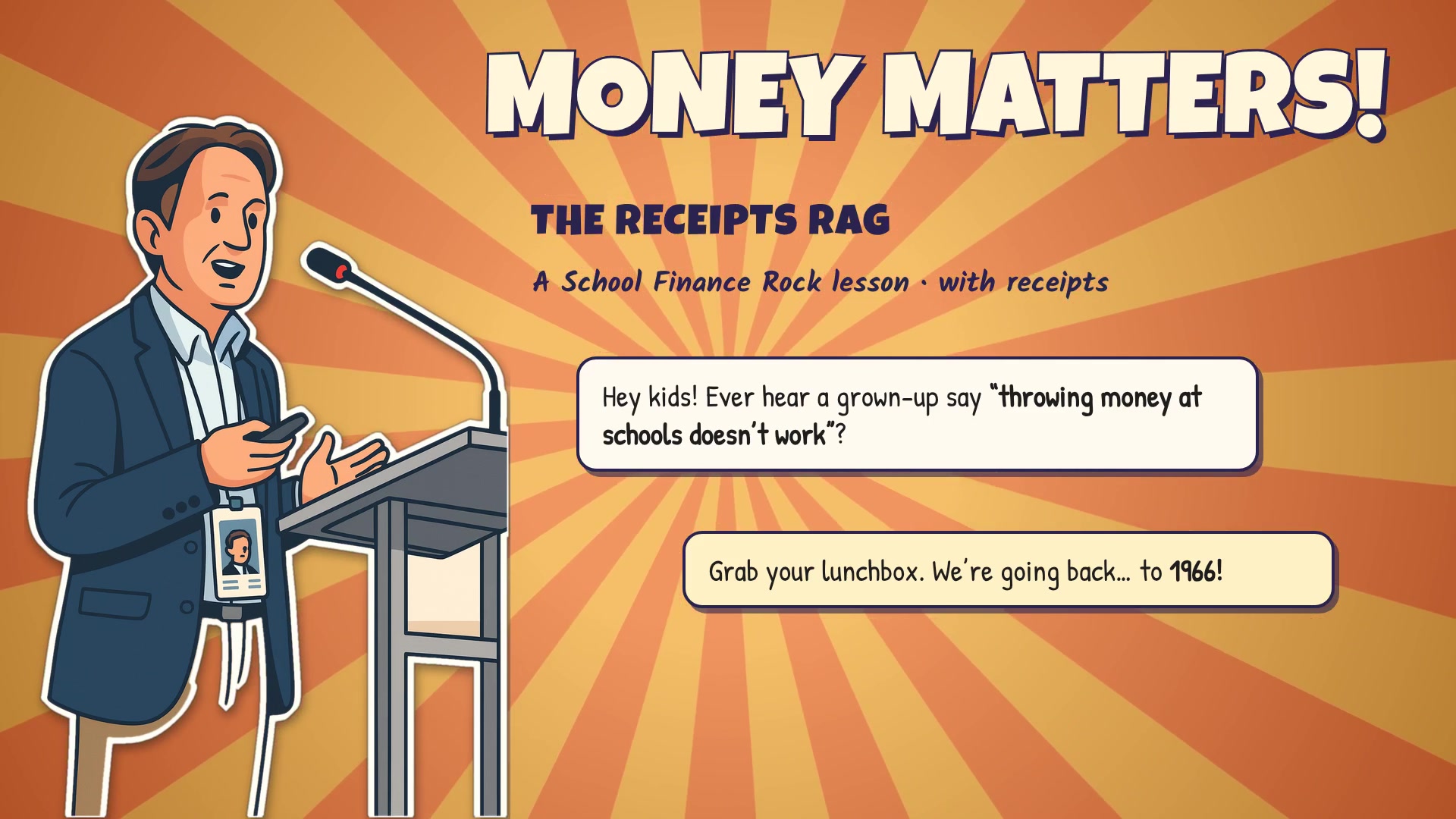
Hey kids! Ever hear a grown-up say “throwing money at schools doesn’t work”?
Well, grab your lunchbox. We’re going back… to 1966!
[Verse 1]
In nineteen sixty-six, they did a giant survey,
Six hundred thousand kids, from Boston down to Jersey.
Jim Coleman crunched the numbers, and the numbers seemed to say,
“Your family background matters most in how you learn each day.”
But folks heard “schools don’t matter,” and they ran it up the pole,
Forgot the part that said that for the kids with less, the role
Of schools was even bigger! Hey, that’s a big detail!
But a half-read headline travels, and the whole truth missed the mail.
[Chorus]
Money matters! Money matters!
Whether going up or down!
Money matters! Money matters!
In the city, in the town!
From the courthouse to the ballot box, from Title One to bonds,
When the dollars reach the classroom, why, the kids respond!
[Verse 2]
Then along came the Merchants of Doubt, with a chart and a frown,
“Look! Spending went up, and the scores didn’t climb, so the theory’s falling down!”
They tallied up the studies like a scoreboard at a game,
And said, “No strong, no systematic link!” The headlines did the same.
They blew big clouds of doubt with long-term trends on display,
“Since 1970 we’ve tripled it, and look, the scores just lay!”
But a line that goes up next to one that’s flat
Can’t tell you what a dollar does. A chart can’t settle that!
[Bridge]
But wait! What if you counted those same studies the right way?
Greenwald, Hedges, Laine said, “Let’s run the math today!”
They pooled the very same research, weighed the effects each one found,
And the positive results came out on top, way out ahead of ground!
[Verse 3]
Now scientists got clever. They said, “Let’s find a test,
Where money changes just by chance, then compare it with the rest!”
Close elections! Court orders! Formulas with funny kinks!
Natural experiments: now that’s how a scientist thinks!
Jackson, Johnson, Persico followed kids for decades long:
Ten percent more, all twelve years, and the evidence came on strong.
More years of schooling, seven percent more pay,
And three points less of poverty when they grew up one day!
[Chorus]
Money matters! Money matters!
Whether going up or down!
Money matters! Money matters!
In the city, in the town!
Thirty-one studies, take the average, and here’s the score:
A thousand bucks for four years, and the kids get more!
[Verse 4]
When the Great Recession hit, and the budgets took a slice,
The kids who lost a thousand bucks? Well, they all paid the price.
Their test scores dipped, fewer went to college in the end.
So when you cut, it’s not “efficient.” It’s a harm you can’t pretend.
And out in Indiana, when the vouchers drained the till,
Four hundred thirty-three per kid went flowing down the hill.
Class sizes grew, some schools shut down, and scores began to fall.
Call it “choice” or call it “cuts.” It’s money, after all!
[Verse 5]
Now where’s the money go? Mostly people, that’s the deal!
Like teachers who stay put because the paycheck’s fair and real.
Arkansas raised the floor to fifty K, and what’d you know?
The teachers with the biggest raises didn’t want to go!
And what about the buildings? Is a boiler worth the fuss?
Seventeen thousand bond votes say it is, so listen up to us:
Fix the air and fix the heat, HVAC’s the MVP,
Point-two standard deviations! That’s a learning recipe!
[Verse 6]
It doesn’t stop at test scores. No, it follows you through life:
Less crime when kids grow up, and mobility that’s rife.
Wait thirty years, the whole state’s paychecks start to swell:
Four point seven percent more per worker! Ring that bell!
[Breakdown]
Now one new study found no gain. “Aha!” the doubters cried.
But the districts didn’t spend it. They cut taxes on the side.
No new dollars in the classroom? Then no new gains you’ll see.
That’s not doubt, my friend. That’s proof of the theory!
[Final Chorus]
Money matters! Money matters!
Whether going up or down!
Money matters! Money matters!
Whatever source it’s found!
For the scores and the diplomas, college, jobs and paychecks too,
And it matters most of all for kids who need it most, it’s true!
[Outro]
So when the clouds of doubt roll in, with a chart and a frown…
Just show ’em the receipts…
’cause the doubt’s been buried down.
MONEY… MATTERS!


