An update on what the causal research says about school funding, with a new policy brief attached.
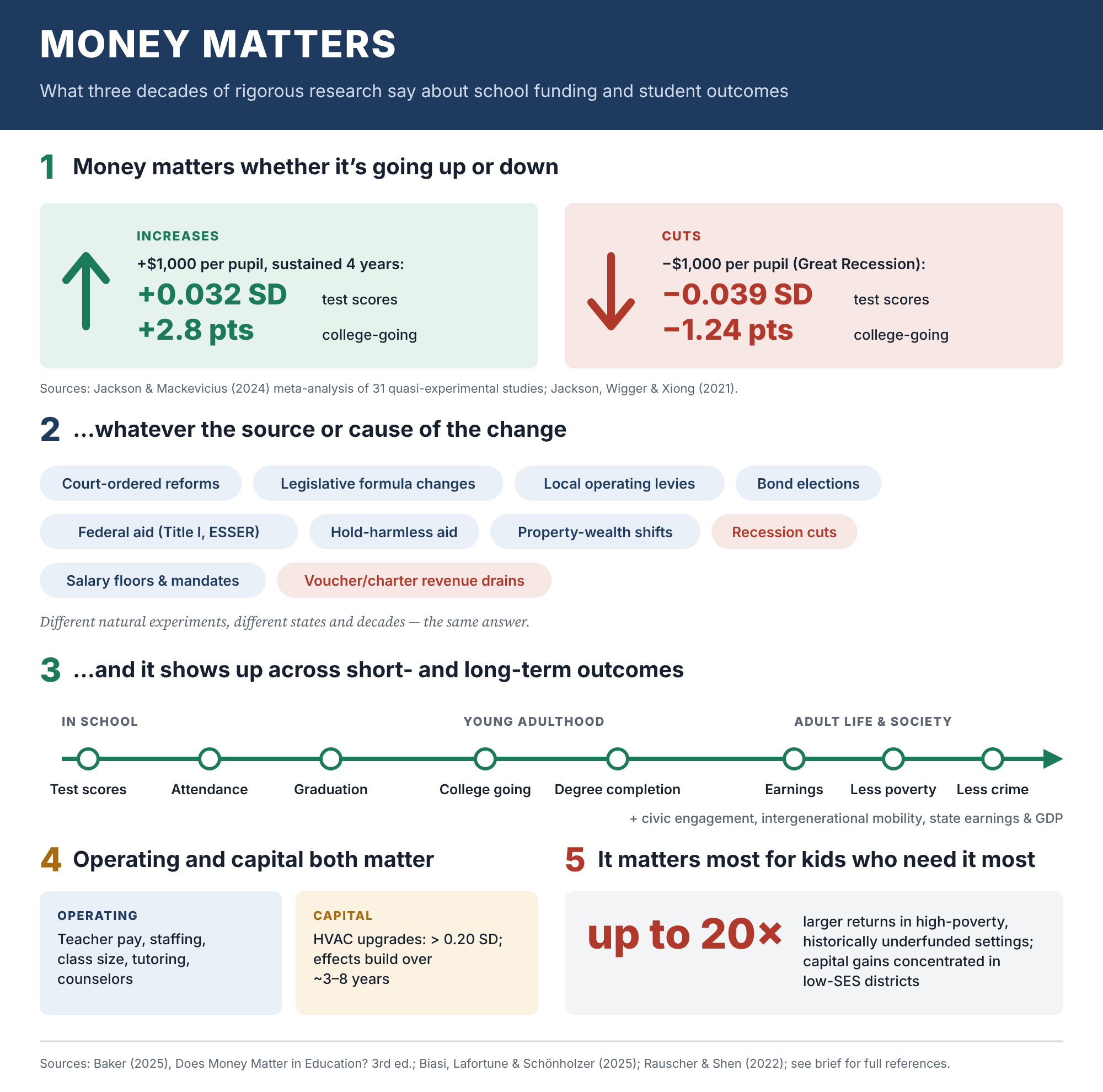
In January 2025, the Albert Shanker Institute released the third edition of Does Money Matter in Education? The bottom line, which I put in all caps on purpose: MONEY MATTERS, WHETHER IT’S GOING UP OR DOWN. It matters whatever the source or cause of the change, for operating and capital spending alike, and most of all for children in high-poverty, historically underfunded districts.
That was 21 months ago. Since then, pandemic aid has run out, districts are going over fiscal cliffs, universal voucher programs are diverting public revenue, and the federal role in education is under direct attack. So it’s fair to ask: has anything in the newer research changed the picture?
It has. The picture got stronger.
What’s new
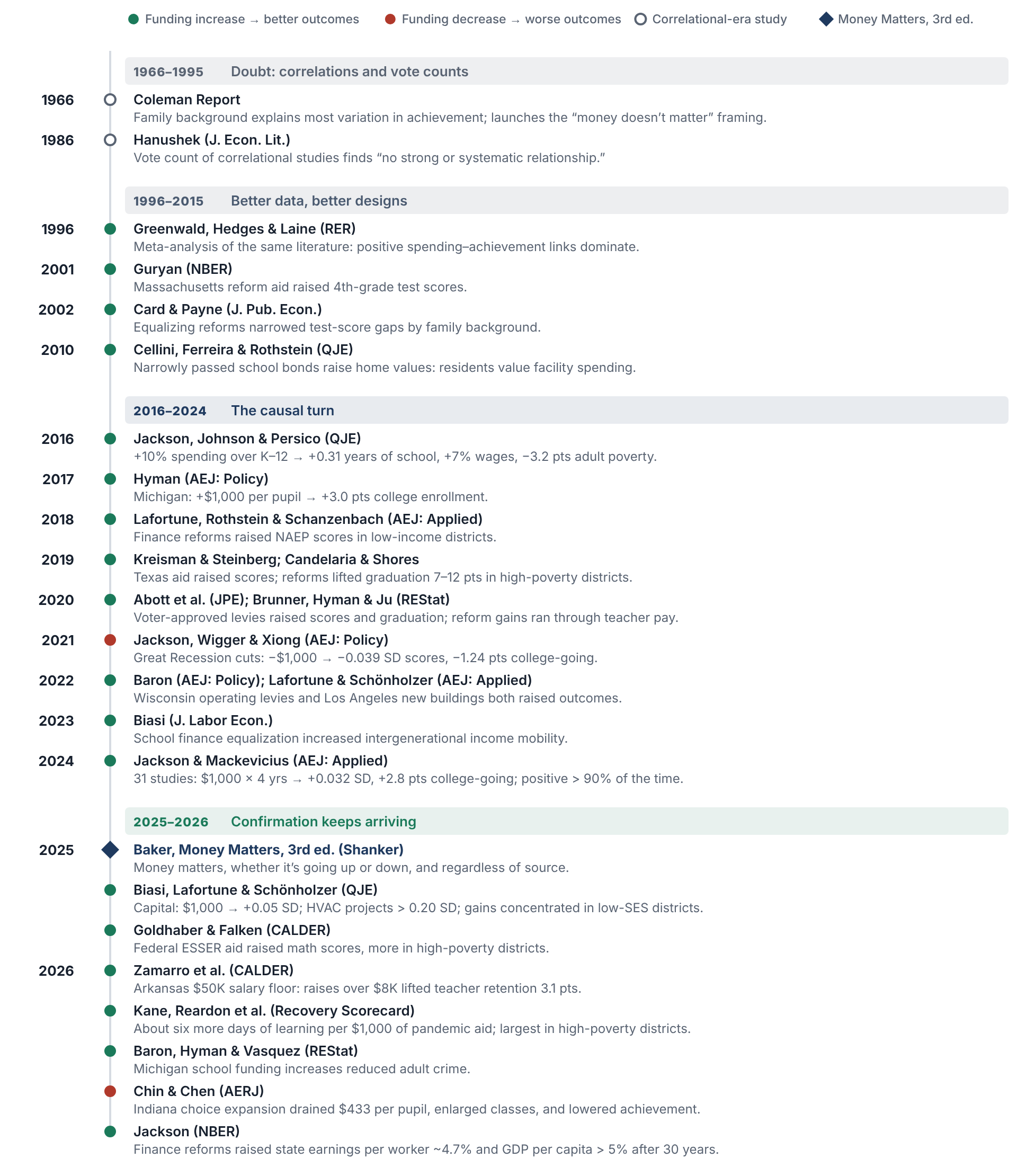
Here’s a quick tour of the rigorous, causally designed studies that have appeared, or appeared in major journals, since the third edition. The attached brief has details and full citations.
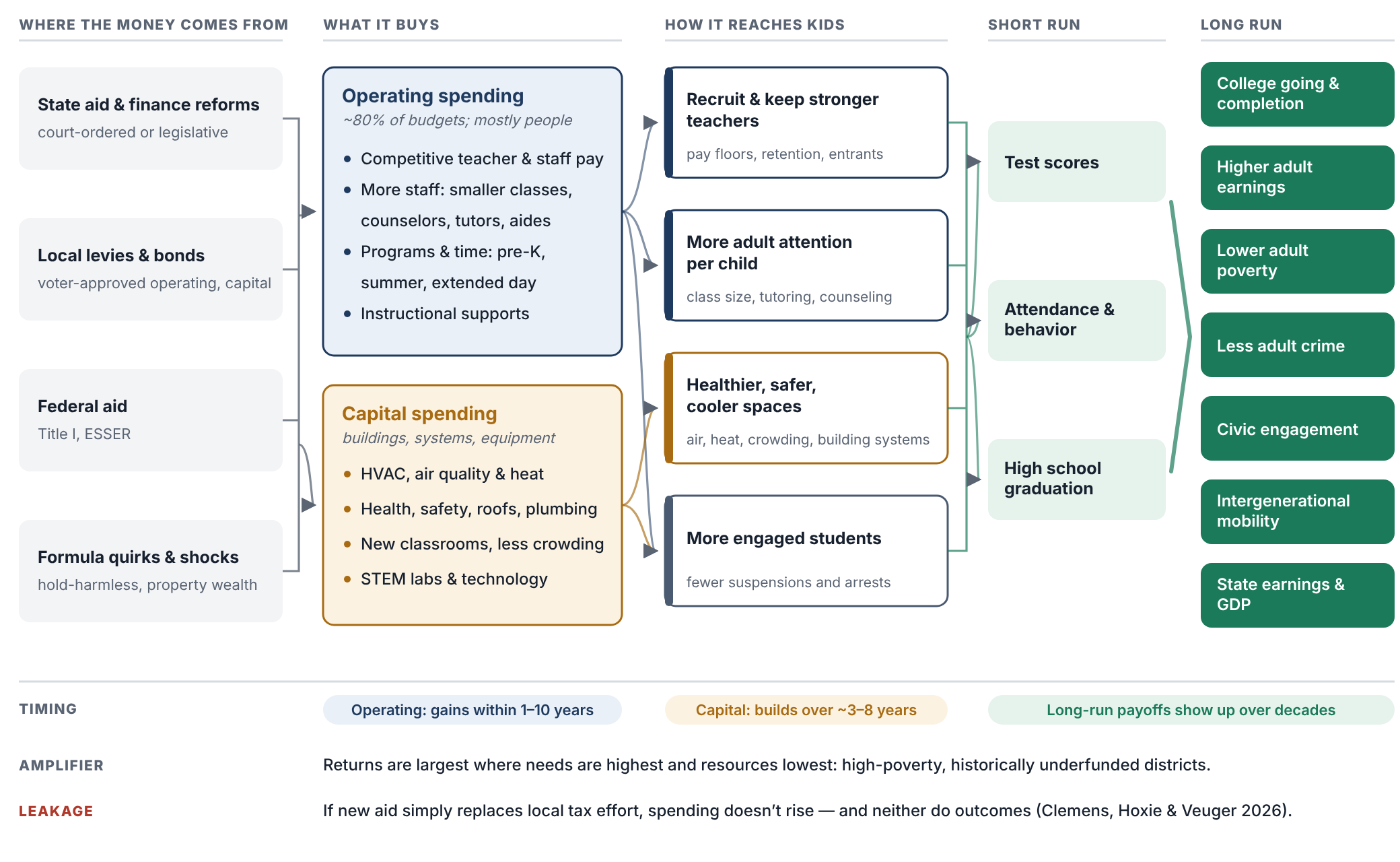
Capital spending matters, a lot, in the right places. Biasi, Lafortune and Schönholzer, now published in the Quarterly Journal of Economics (2025), study roughly 17,000 school bond elections using close-election comparisons. On average, $1,000 of capital spending raises test scores by about 0.05 SD. HVAC projects raise scores by more than 0.20 SD, and health, safety and building-system projects by about 0.15 SD. Athletic facilities? They raise home prices but not test scores. The gains are concentrated almost entirely in districts serving low-income students. So yes, kids learn better when they aren’t sweltering in 90-degree classrooms with bad air. Who knew?
Teacher pay keeps teachers, and that pays off. Arkansas raised its minimum teacher salary from $36,000 to $50,000 under the LEARNS Act. Zamarro and colleagues (CALDER, 2026) find that the biggest raises produced the biggest retention gains: teachers who got more than $8,000 were 3.1 points more likely to stay in their districts. In New Jersey, Shakya (2024) finds that districts adopting a $50K starting salary saw gains in math proficiency and graduation rates. Rauscher, Mellon, Loeb and Abott (2024) trace part of the effect of voter-approved operating levies to teacher salaries and counselors, and they find returns roughly twice as large in low-spending, high-poverty districts.
Federal pandemic aid helped, mostly where it was targeted. Goldhaber and Falken (CALDER, 2025) use the Title I formula to isolate ESSER’s effects and find positive math gains, larger in high-poverty districts. The Education Recovery Scorecard team (Kane, Reardon and colleagues, 2026) estimates about six extra days of learning per $1,000, and finds that the highest-poverty districts would have seen almost no math recovery without the aid. Those effects are modest per dollar. That’s what you’d expect from one-time money pushed out fast in a crisis, against the largest learning loss in modern history. They’re still positive.
Cuts hurt, including cuts by another name. Chin and Chen (AERJ, 2026) study Indiana’s 2011 voucher and charter expansion. The most exposed districts lost about $433 per pupil, class sizes grew, schools closed, and achievement eventually turned significantly negative for several student groups. Money matters going down, too. It’s the same lesson as the Great Recession studies, with a new cause.
The payoffs extend into adulthood and into state economies. Baron, Hyman and Vasquez, now in the Review of Economics and Statistics (2026), show that Michigan’s school funding increases reduced adult crime. And Kirabo Jackson’s new NBER paper (2026) follows the money all the way to the macroeconomy. After state school finance reforms, earnings per worker stay flat for about 15 years while the affected kids are still in school, then climb to roughly 4.7% above the counterfactual after 30 years. GDP per capita ends up more than 5% higher.
The exception that proves the rule
One new study found no effect. Clemens, Hoxie and Veuger (NBER, 2026) look at districts just above and below an ESSER eligibility threshold and find that the extra federal money didn’t improve test scores. Why? Because those districts didn’t spend it on schools. They used it to cut local property taxes. Per-pupil spending didn’t rise, so outcomes didn’t either.
That isn’t evidence against “money matters.” It’s evidence for it. Money matters when it reaches classrooms. This is why maintenance-of-effort provisions matter.
About those scatterplots
Every so often someone posts a chart of state spending against NAEP scores, or of rising national spending against flat or falling scores, and declares the case closed. In 2025–26 we got a Brookings cross-state analysis and a Texas A&M blog post along these lines. The Brookings authors, to their credit, say plainly that their analysis is not causal.
Those charts are the 2020s version of the Coleman-era correlations that the entire modern literature was built to get past. States that spend more differ in student need, labor costs, and a hundred other ways. And a national score decline that coincides with smartphones, a pandemic and changing test-taking populations tells you nothing about what an additional dollar does in a given district. That’s exactly why researchers turned to close elections, formula kinks, court orders and policy shocks. When you do that, you get the same answer over and over.
Why the case keeps getting stronger
Look at the timeline. Through the 1980s and early ’90s, the “money doesn’t matter” argument rested on vote counts of correlational studies. Starting around 2016, quasi-experimental studies began piling up: different states, different decades, different funding sources (courts, legislatures, local voters, the federal government, even recessions and voucher programs) and different outcomes (test scores, graduation, college, earnings, poverty, crime, civic engagement, mobility, state GDP). The direction almost never changes.
Each new natural experiment is another independent test. Each one passes. That’s what a mature, robust body of evidence looks like.
So what?
- Cuts are not neutral. States staring at fiscal cliffs or voucher-driven revenue losses should expect real, measurable harm to kids, concentrated in high-need districts.
- Progressive funding is efficient funding. The highest returns are in the districts with the greatest needs and the fewest resources.
- New money has to add, not replace. Pair aid with maintenance-of-effort requirements.
- Fund people and buildings. Salaries, staffing, HVAC and safe buildings are complements, not competitors.
- Use the right time horizon. Several years for operating effects, three to eight for capital, decades for economic returns.
The question isn’t whether money matters. It’s whether we’re willing to provide it.
The full policy brief, “Money Matters — and the Evidence Keeps Growing,” with the infographic, pathways figure, evidence timeline and references, is attached below.


