Last week I asked who answers to the 18-year-old the voucher failed. The honest answer? Pretty much no one. No one owed her any duty, there was no standard anyone could be said to have missed, and there’s no defendant she could realistically sue.
That post was about two states – Arizona and Florida – and one kind of program. Here I step back and ask how we got here. Put simply, for a hundred years now, the U.S. Supreme Court has asked one question about children’s schooling – how much control do parents get? – and has almost never asked the other – what is the child owed? The answers to that first question have piled up, mostly in one direction. And in the past decade, they’ve been joined by a second line of cases that sends public money right along with them.
None of this is a new worry here. Back in 2020, Preston Green and I laid out the post-Espinoza end game: once states must fund religious schools, the next fight is over whether they can still regulate them – including against discrimination. That same year, in a dust-up with the Hechinger Report over our op-ed, we pointed out that federal law has never squarely barred a religious school from excluding students by race on religious grounds. What’s changed? Those dominoes are now falling, pretty much on schedule. The next one gets argued before the Supreme Court on November 3.
Below, I a) map out that case law, b) look at how other democracies handle the same questions, and c) sketch out what I’m calling Children’s Recourse – a framework that treats children as rights-holders in their own name. A caveat up front: I’m not a lawyer. What follows is a school finance guy’s reading of the doctrine, not legal advice.
Four lines of cases, one direction
The cases sort into four branches, by the constitutional question each one asks:
| Branch | Question | Constitutional hook | Answer as of October 2026 |
|---|---|---|---|
| A. Exit | May the state compel attendance at public schools? | 14th Amendment due process (parental liberty); Free Exercise | No. States may regulate private and home schooling, but not require public schooling. |
| B. Control inside public schools | Must public schools exempt or inform objecting parents? | Free Exercise; due process | Yes, under strict scrutiny, when a policy burdens a child’s religious upbringing. |
| C. Establishment limits on aid | May public money reach religious schools? | Establishment Clause | Yes, if routed through parents’ choices. The old test is gone. |
| D. Free Exercise mandates to fund | Must a state that funds private schooling include religious schools? | Free Exercise | Yes. Whether neutral conditions can still exclude them is pending. |
Each branch started from a different question. But since 2017, all four have landed in the same place – more parental control, and more public support for private and religious schooling.
Exit: Meyer, Pierce and Yoder
It all starts in the 1920s. In Meyer v. Nebraska (1923), the Court struck down a wartime ban on teaching German (and other foreign languages) to young children. Two years later, in Pierce v. Society of Sisters (1925), a unanimous Court struck down Oregon’s Compulsory Education Act, which required nearly every child to attend a public school. And here’s the line that’s been quoted ever since: “The child is not the mere creature of the State.”
Let’s be clear – these decisions protected real people from real bigotry. Oregon’s law was backed by the Klan and aimed squarely at Catholic schools. Meyer and Farrington v. Tokushige (1927) protected immigrant communities from nativist laws. But notice what the Court actually protected: the parents’ liberty to direct their children’s upbringing (and, in Pierce, the schools’ property interests). The child shows up only as the object of that liberty.
Equally important is what Pierce left in place. The Court said nothing disputes the state’s power “reasonably to regulate all schools, to inspect, supervise and examine them, their teachers and pupils,” and to require that “certain studies plainly essential to good citizenship must be taught.” That reservation remains good law. Hold onto it – it matters for everything that follows.
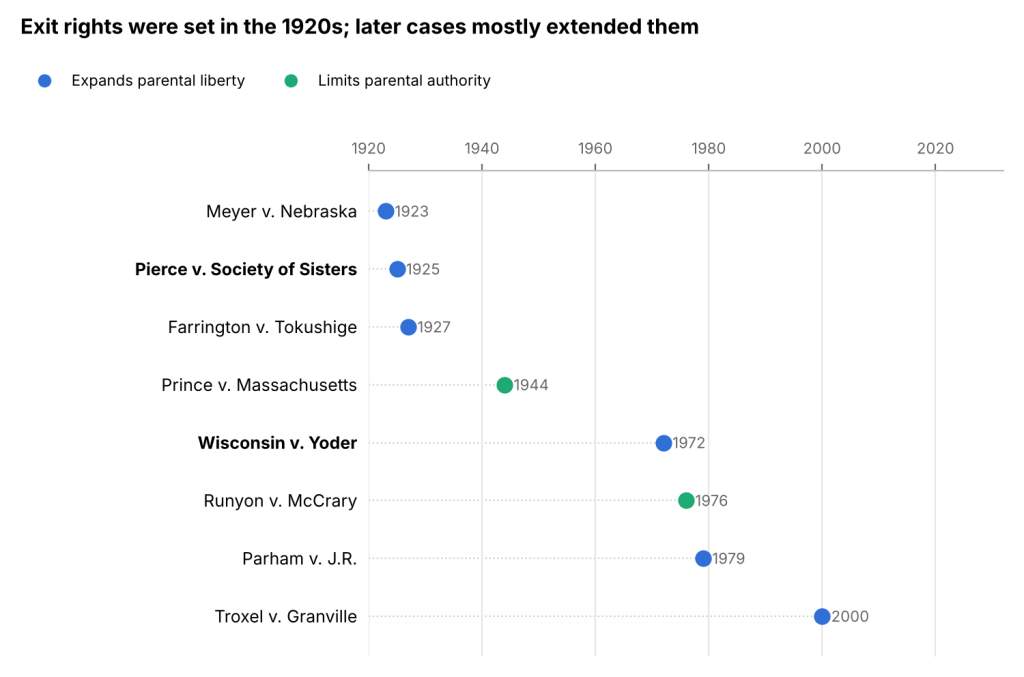
The one major limit came in Prince v. Massachusetts (1944), which upheld the child-labor conviction of an aunt and legal custodian who had her nine-year-old niece selling Jehovah’s Witness literature on the street. As the Court put it, parents may be free to become martyrs themselves, but they are not free “to make martyrs of their children.”
Then came Wisconsin v. Yoder (1972), which allowed Amish parents to end their children’s formal schooling after eighth grade. Justice Douglas, dissenting in part, raised the point the rest of the Court skipped right over – nobody asked the kids. If a child wanted to be a pianist, or an astronaut, or an oceanographer, he wrote, the decision let the parents’ religious views foreclose that. Half a century later, the doctrine still hasn’t answered him.
Oh, and the Court has never actually decided a home-schooling case. Home schooling rests on state statutes plus Pierce. And as I showed last week, those statutes range from reasonable oversight to Arizona’s rule that a signed ESA contract simply is school attendance.
From exit to veto: Mahmoud and Mirabelli
For most of the last century, parents who objected to what public schools taught had one main remedy – leave. Lower courts consistently held that merely exposing a child to ideas the parents reject is not a burden on religion. See, for example, Mozert v. Hawkins County (6th Cir. 1987), on a reading curriculum, and Parker v. Hurley (1st Cir. 2008), on picture books depicting same-sex families. Employment Division v. Smith (1990) reinforced that baseline, holding that neutral, generally applicable laws don’t require religious exemptions – and recasting Yoder as a narrow “hybrid rights” case.
That baseline collapsed in the span of about two years.
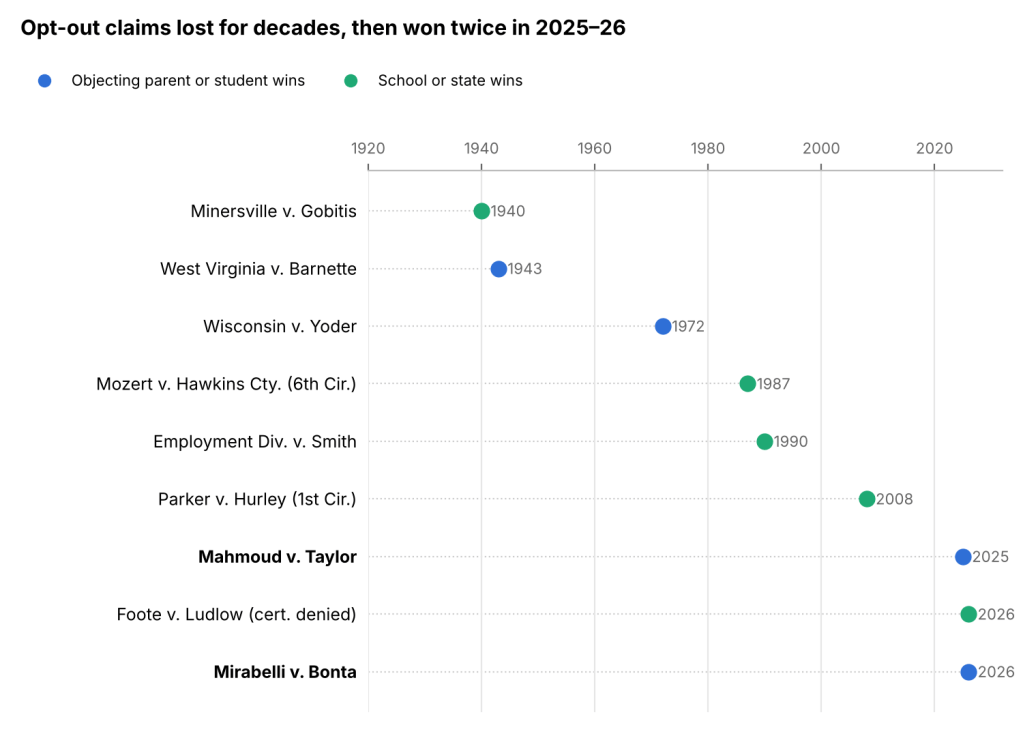
In Mahmoud v. Taylor (2025), the Court held 6–3 that Montgomery County parents were entitled to notice and an opt-out from LGBTQ-inclusive storybooks. Instruction that “substantially interferes” with a child’s religious development now triggers strict scrutiny – even when the policy is neutral and applies to everyone. Then in March 2026, in Mirabelli v. Bonta, the Court (again 6–3, this time on its emergency docket) reinstated, as to the parent plaintiffs, an injunction against California policies that barred schools from telling parents about a student’s gender transition without the student’s consent, grounding that ruling in both Free Exercise and substantive due process. Seven weeks later, it declined to hear Foote v. Ludlow, a similar case parents had lost in the First Circuit.
Whatever one thinks of those outcomes, look at what’s missing. The child’s own interests – in learning about the world, or in a confidential relationship with a school counselor – show up only as something the parent’s rights override. To be fair, Mirabelli does leave one door open: the state may still protect children from unfit parents, through child-abuse law and custody proceedings. That’s now about the only space left for child-protective policy inside schools.
Following the money
And this is where the doctrine becomes a school finance story.
For most of the 20th century, the Establishment Clause limited how public money could reach religious schools. The Court allowed bus fares (Everson, 1947) and secular textbooks (Allen, 1968). But in the 1970s and early 1980s, it struck down salary supplements, tuition reimbursements and most direct aid under Lemon v. Kurtzman (1971) and Committee for Public Education v. Nyquist (1973). Then that wall came down, brick by brick.
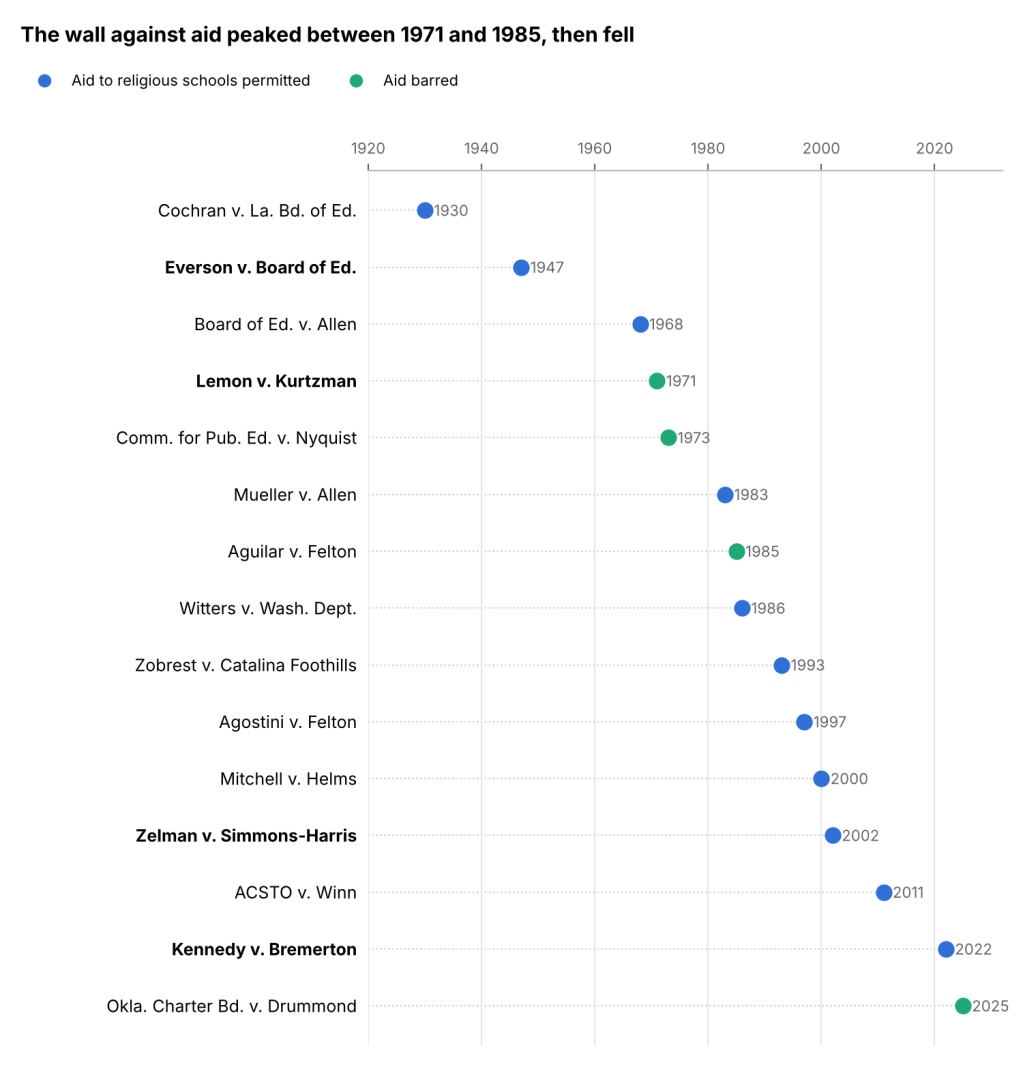
Mueller v. Allen (1983) upheld tax deductions for school expenses. Agostini v. Felton (1997) let public Title I teachers work inside parochial schools. Zelman v. Simmons-Harris (2002) upheld Cleveland’s vouchers as a program of “true private choice,” even though nearly all participating seats were in religious schools. Arizona Christian School Tuition Organization v. Winn (2011) held that taxpayers couldn’t even get into court to challenge tax-credit scholarships. And Kennedy v. Bremerton (2022) formally abandoned the Lemon test altogether.
The one line still standing – barely – is religious charter schools. In Oklahoma Statewide Charter School Board v. Drummond (2025), the Court split 4–4, with Justice Barrett recused. That left in place the Oklahoma Supreme Court’s ruling against St. Isidore, a Catholic virtual charter school, but set no precedent whatsoever.
Meanwhile, a second line of cases flipped the old rule on its head. Rather than the Establishment Clause limiting aid, the Free Exercise Clause began requiring it.
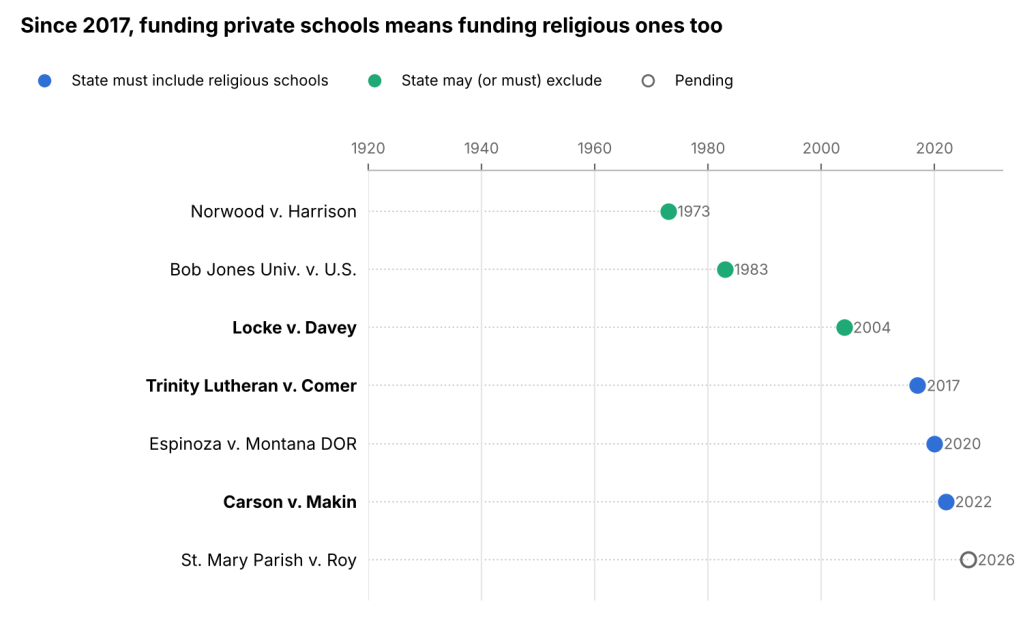
As recently as Locke v. Davey (2004), the Court said states had “play in the joints” to decline to fund religious instruction. Then came the following:
- Trinity Lutheran v. Comer (2017): a state can’t exclude a church preschool from a playground-resurfacing grant simply because it is religious.
- Espinoza v. Montana Department of Revenue (2020): a state no-aid clause can’t bar religious schools from a tax-credit scholarship program. The Court added that a state “need not subsidize private education” at all. (Remember that line.)
- Carson v. Makin (2022): Maine’s town-tuitioning program can’t exclude schools that teach religion. The Court rejected any distinction between a school’s religious status and its religious use of funds.
Next up is St. Mary Catholic Parish v. Roy, argued November 3. Colorado’s universal preschool program requires participating providers to enroll children regardless of, among other things, sexual orientation or gender identity. Catholic preschools in the Archdiocese of Denver refused, and were excluded. The question now is whether a neutral condition like that can still keep them out. If the answer is no, states lose much of their ability to attach any accountability strings at all to private school funding.
Put the funding cases and the opt-out cases together and here’s what you get. Public money now follows parental exit, often with few if any conditions. Meanwhile, parental objections increasingly dictate what happens inside the schools that remain public. Heads, parents win. Tails, parents win.
State constitutions: a right that belongs to the child
With the federal Establishment Clause largely out of play, and Espinoza disabling state no-aid clauses that single out religious schools, what’s left are state constitutional education clauses. We tend to call the litigation under those clauses “school finance” cases – I’ve certainly done my share of calling them that – but the label is misleading. Most of these clauses say nothing about money. Rather, they obligate the state to provide an education to a defined population, usually defined by age. New Jersey’s, for example, requires a thorough and efficient system of free public schools “for the instruction of all the children in the State between the ages of five and eighteen years.”1 And courts have mostly defined adequacy in terms of outcomes. Kentucky’s Rose v. Council for Better Education (1989) laid out capacities every child should attain, including sufficient knowledge of economic, social and political systems to make informed choices.2 New York’s high court, in Campaign for Fiscal Equity, asked whether students leave school able to function productively as civic participants and to compete for decent jobs.3 Funding enters as the remedy, not the right. If the state is depriving children of those outcomes, and more money is what it takes to fix that, so be it. Only Kansas’s constitution speaks directly to finance, requiring that the legislature “make suitable provision for finance of the educational interests of the state.”4
Equally important, these decisions tend to treat the right as one held by each child – not by districts, and not by taxpayers. New Jersey’s Abbott decisions speak of the “educational entitlements that the Constitution guarantees” to children in the state’s poorest districts.5 Courts in Kentucky, Wyoming and New Hampshire have gone further, calling education a fundamental right.6 Washington’s Supreme Court has held that the state’s “paramount duty” to educate gives every child in the state a corresponding constitutional right.7 Why does this matter here? Because the recent voucher and ESA rulings below mostly asked a different question – not whether a child is receiving an adequate education, but whether money spent elsewhere harms the public system. Framed that way, challengers have mostly lost.
| State | Year | Program | Outcome |
|---|---|---|---|
| Idaho | 2026 | Parental Choice Tax Credit (refundable, up to $5,000) | Upheld unanimously: the duty to maintain public schools doesn’t bar funding alternatives |
| Wyoming | 2026 | Steamboat Legacy ESA ($7,000) | Injunction lifted unanimously; the court called the program separately funded and found no showing it impairs the right to education. Merits pending. |
| Utah | Pending | Utah Fits All ESA | Trial court struck it in April 2025; still before the Utah Supreme Court, program running meanwhile |
| Ohio | Pending | EdChoice vouchers | Trial court held the universal program violates the thorough-and-efficient clause (June 2025); appeal argued May 2026 |
| South Carolina | 2024 | Education Scholarship Trust Fund | Struck, 3–2, in Eidson v. South Carolina Department of Education: direct benefit to private schools |
| Kentucky | 2022 | Tax-credit education opportunity accounts | Struck: no tax money for schools other than common schools |
| Florida | 2006 | Opportunity Scholarships | Struck in Bush v. Holmes under the uniformity clause |
The Wyoming framing is the one to watch. The state’s superintendent greeted the ruling as proof that the program is “not a school finance case,” and the court found no showing that the ESA impairs the right to education. That is a striking result in a state whose own supreme court has called education a fundamental right. If universal ESAs are treated as separately funded and outside the school finance system, then education clauses can say nothing about public money spent on children who leave the public system. That is, unless the right at stake is an individual, fundamental right to an adequate education, held by the child him- or herself. A right like that doesn’t stay behind when the child leaves. It follows the child, and so does the state’s duty to secure the outcomes its courts have defined. That is precisely the gap my 18-year-old falls through, and the most promising way to close it.
What’s missing: the child
It’s not that the Constitution has no place for children’s own rights. Rather, schooling is the outlier – the one area where the parent’s interest is simply presumed to be the child’s. The footholds are already there:
- In re Gault (1967): children hold due process rights in their own name.
- Tinker (1969) and West Virginia v. Barnette (1943): students hold speech and conscience rights against the state. Notably, Barnette protected a student’s refusal to salute the flag as the student’s right.
- Prince (1944): parental and religious authority yields to the state’s interest in a child’s welfare.
- Plyler v. Doe (1982): denying a child a basic education imposes a lifetime of hardship – a harm the Court said would follow the child “each and every day of his life.”
- Papasan v. Allain (1986): left open whether a minimally adequate education is constitutionally protected – the question Gary B. v. Whitmer answered yes to, before that ruling was vacated.
But no one has yet assembled these pieces into a doctrine of children’s educational rights. That’s the task at hand.
How other democracies do it
It helps to look abroad, because the usual framing – parental freedom versus state monopoly – turns out to be a false choice. Peer democracies protect parents’ freedom to choose religious and private schools. Several fund religious schools far more generously than any U.S. state does. But they also bound that freedom in ways American law no longer does.
| Country | Compulsory schooling and home education | Religious and private schools | Child’s own voice |
|---|---|---|---|
| Germany | School attendance required; home education generally prohibited | Constitutionally protected and state-subsidized; approved schools may not sort pupils by parents’ means | Child chooses own religion at 14 and can’t be switched against their will from 12 |
| Netherlands | Compulsory; home education only by narrow exemption | Funded on the same basis as public schools since 1917; about two-thirds of primary schools are privately run | National standards, inspection and citizenship education apply to all |
| France | Compulsory from age 3; home instruction needs prior authorization since 2022 | Contract schools get state-paid teachers in exchange for the national curriculum | General child-protection framework |
| England | Home education legal; the Children’s Wellbeing and Schools Act 2026 adds registers of children not in school and requires consent to withdraw children under child-protection inquiry | About a third of state schools have a religious character, fully state-funded | Older pupils can opt into sex education even if parents withdraw them |
| Sweden | Home education only in exceptional circumstances | Voucher-funded independent schools may not charge tuition; teaching must be non-confessional | General child-protection framework |
The European bargain, put simply, is generous funding in exchange for public accountability – a national curriculum, inspection, admissions rules and limits on fees. The European Court of Human Rights does protect parents’ religious and philosophical convictions in education. But its test, going back to Kjeldsen v. Denmark (1976), is whether the state indoctrinates – not whether a child is merely exposed to ideas the parents reject. Objective, critical, pluralistic instruction can be made compulsory, and exemptions are owed mainly where teaching is confessional. Mahmoud, by contrast, treats exposure itself as the burden.
Every one of these countries has ratified the UN Convention on the Rights of the Child, which treats parental authority as direction given for the child, “consistent with the evolving capacities of the child,” and gives the child a right to be heard. The United States? The only UN member that hasn’t ratified it.
Of course, the comparison comes with its own cautions. European funding reflects established churches and Dutch “pillarization” – histories that don’t transplant easily into a system with an Establishment Clause. The “parallel society” reasoning used to uphold Germany’s home-schooling ban, and the integration rationale behind Switzerland’s mandatory mixed swimming lessons, have been applied against religious minorities – the Swiss case involved Muslim families. And the very conditions these systems attach, like Germany’s bar on sorting pupils by parents’ means and Sweden’s ban on fees, show they treat sorting by family background as a known risk of publicly funded private schooling, to be managed by rule.
Children’s Recourse
The premise is simple. Children are rights-holders. Parents are fiduciaries – their authority exists for the child’s benefit and shrinks as the child matures. The state is the guarantor of a real education for every child, whatever choices adults make – and especially when the state is footing the bill for those choices.
What states can do now, without overruling anything. Remember that reservation in Pierce – the power to regulate all schools, teachers and pupils? That means a state can:
- Register every school-age child, in any setting.
- Assess learning – not just attendance, and not just receipts – with remediation and, after repeated failure, a required change of setting.
- Keep every child in periodic contact with a mandated reporter – a teacher, nurse or counselor.
- Attach neutral accountability conditions to every public dollar: assessment participation, public outcome and financial reporting, admissions and disability nondiscrimination, and audits. After Carson, these must apply to all participants alike. St. Mary will tell us how far that goes.
- Give older students a statutory voice in decisions about their own schooling, modeled on Justice Douglas’s Yoder dissent and Article 12 of the CRC.
In state courts. Education-clause challenges like those in Ohio and Utah are one path. The stronger one, I’d argue, builds on the individual right many state courts already recognize. Children themselves, through guardians, can argue that the state’s duty to secure adequate educational outcomes runs to each child – including those whose public dollars the state sends elsewhere.
In federal courts, defensively first. That means defending neutral funding conditions, confining Mahmoud to instructional content, and building on Mirabelli’s child-protection carve-out. Over time, it means affirmative claims for the minimally adequate education Papasan left open.
Over the long run, revisiting the precedents themselves – from the newest and least entrenched back toward the oldest: Carson and Espinoza; then Zelman and the abandonment of Lemon; then Mahmoud and Mirabelli; then Yoder; and eventually the parental-liberty holdings of Meyer and Pierce. Those last two rest partly on the same Lochner-era reasoning about economic liberty that the Court abandoned in 1937. I’m not naïve about the odds. Mahmoud, Mirabelli and Carson were all 6–3, and premature federal cases could entrench the very rules they target. This is a decades-long project. And most of the near-term gains are available without it.
Taking the objections seriously
- History. Meyer, Pierce and Farrington protected Catholic, German-speaking and Japanese-American families from laws designed to erase them. Any framework that expands state power over schooling has to be built so it can’t be turned against minority communities again.
- Who holds the power. A state that can compel attendance can also dictate content. Barnette’s warning against compelled orthodoxy cuts in every direction – and folks across the political spectrum now invoke it.
- The evidence is genuinely mixed. Home-schooling outcome data are thin and self-selected, and how often home schooling conceals abuse is disputed. Voucher studies show large early test-score losses in Louisiana, Indiana and Ohio, alongside some positive attainment findings in Milwaukee, D.C. and Florida. Claims of harm should rest on careful data, not anecdotes – the same standard I’d apply to claims of voucher success.
- The middle ground may be enough. Many scholars, including Amy Gutmann, Harry Brighouse and Rob Reich, favor strong regulation for autonomy and civic minimums while preserving parents’ freedom to exit. Most of the near-term agenda above is consistent with that position.
The end game, revisited: why the urgency is greater now
Six years ago, Preston Green and I argued that Espinoza wasn’t the end of anything. Rather, it was the latest domino after Zelman and Mitchell. The next, we suggested, would be what we called a “Bethel Academy” – a religious school that takes public money while claiming the state can’t enforce its nondiscrimination rules against it. And if that domino fell, we wrote, a state unwilling to subsidize discrimination would be left with one option: stop funding private providers, charter schools included, and fund and operate only its own schools. A year later, I argued that charter schooling had reached a critical juncture – that it could become “increasingly private, more overtly religious, openly discriminatory” unless states made charter governance truly public. And in 2025, with Drummond pending, I warned that religious charter operators could refuse any regulation they claim conflicts with their beliefs, including rules against racial discrimination (Green, Baker & Eckes, 2024).8
Race is where critics push back hardest, so let’s be precise. When we raised it in 2020, voucher advocates insisted that Runyon v. McCrary settles the matter. It doesn’t. Runyon expressly declined to decide whether federal law reaches “private sectarian schools that practice racial exclusion on religious grounds.”9 Preston Green, Suzanne Eckes and I lay out the full case in the Peabody Journal of Education: the Free Exercise decisions since 2017 could let voucher-funded schools exclude Black students on religious grounds, recreating a modern version of the “segregation academy.”10 As we explain there, the real backstops are case law and federal tax policy – Norwood v. Harrison (1973), which barred state textbook aid to segregated private schools,11 and Bob Jones University v. United States (1983). Bob Jones let the IRS deny a tax exemption to a university that banned interracial dating on religious grounds, calling the eradication of racial discrimination in education a compelling interest.12 That holding may well survive. But neither case has been tested against the Court’s post-2017 Free Exercise doctrine, under which a funding condition with secular exceptions can be recast as discrimination against religion. And that’s precisely the question in St. Mary. Nor is the history reassuring. Some of the earliest state tuition-grant programs in this country paid white students’ way into “segregation academies” after Brown – until the Court struck down Prince Edward County’s version in Griffin v. County School Board (1964).13
So why is the urgency greater now? Because the pieces have all arrived at once:
- Universal ESAs that measure receipts rather than learning – now upheld in Idaho and cleared to run in Wyoming.
- Carson, requiring states to fund religious instruction once they fund any private option.
- Mahmoud and Mirabelli, making religious objection a trump card inside the public schools that remain.
- St. Mary, argued November 3, deciding whether neutral conditions can still bind the providers who take the money.
- Drummond’s 4–4 split, leaving religious charter schools one vote away – with the recused justice free to sit on the next case.
Taken together, these let a non-state actor a) take public money in a child’s name, b) define its mission by its own religious beliefs, and c) claim exemption from the rules that protect that child – rules about whom a school may exclude, what it must teach, and whether anyone checks that the child learned anything at all. The state can’t exclude the provider, and may soon be unable to condition the money. The parent can choose, but owes the child no measurable standard. And the child? The child is the one party in the arrangement with no rights of her own. That’s why Children’s Recourse can’t wait for the long game. The near-term steps above – and the hard choice Preston and I laid out back in 2020 – are on the table now.
Not the mere creature of anyone
Pierce’s most famous sentence has been read for a century as a shield for parents against the state. I no longer think it deserves that reputation. Its defenders point to the bargain it struck – parents may leave, but the state keeps the power “reasonably to regulate all schools.” Well, that bargain has been unwound, one case at a time. Carson says a state that funds exit must fund religious exit. Mahmoud and Mirabelli say religious objection can override what happens inside the schools that remain. And if St. Mary holds that neutral conditions can’t bind the providers who take the money, the regulatory half of Pierce will be a dead letter (or close to it), while the exit half just keeps on growing. At that point, Pierce isn’t a check on the problem. Pierce IS the problem – the foundation every one of these cases builds on. Put bluntly, it may have to be reversed, not merely reinterpreted. No, that’s not a call to revive Oregon’s nativism. It’s a call to replace a rule that treats children as their parents’ to direct with one that protects every child – minority families’ children included – in their own right. A child is not the mere creature of the state. Nor is a child the mere creature of their parents. Or of a scholarship-granting organization processing receipts.
If we’re going to spend public money in a child’s name, someone has to be answerable to that child. Right now, under the doctrine the Court has built, no one is. Children’s Recourse is an attempt to change that.
Full working paper
Baker, B.D. (2026). Not the Mere Creature of Anyone: Parental Control, Public Money, and the Case for Children’s Educational Rights. Working Paper. [PDF]
- N.J. Const. art. VIII, § 4, ¶ 1. ↩︎
- Rose v. Council for Better Education, Inc., 790 S.W.2d 186, 212 (Ky. 1989). ↩︎
- Campaign for Fiscal Equity, Inc. v. State, 86 N.Y.2d 307 (1995) (CFE I); Campaign for Fiscal Equity, Inc. v. State, 100 N.Y.2d 893 (2003) (CFE II). ↩︎
- Kan. Const. art. 6, § 6(b), http://www.ksrevisor.gov/kanconst/093_006_0006.html. ↩︎
- Abbott v. Burke, 153 N.J. 480, 489 (1998) (Abbott V). ↩︎
- Rose, 790 S.W.2d 186; Campbell County School District v. State, 907 P.2d 1238 (Wyo. 1995); Claremont School District v. Governor, 703 A.2d 1353 (N.H. 1997) (Claremont II). ↩︎
- Seattle School District No. 1 v. State, 585 P.2d 71 (Wash. 1978); McCleary v. State, 269 P.3d 227 (Wash. 2012). ↩︎
- Green, P., Baker, B. D., & Eckes, S. (2024). The potential for race discrimination in voucher programs in a post-Carson world. Peabody Journal of Education, 99(4), 403–415. https://doi.org/10.1080/0161956X.2024.2381370 ↩︎
- Runyon v. McCrary, 427 U.S. 160, 167 (1976). ↩︎
- Green, Baker & Eckes (2024), supra note 8. ↩︎
- Norwood v. Harrison, 413 U.S. 455 (1973). ↩︎
- Bob Jones University v. United States, 461 U.S. 574, 604 (1983). ↩︎
- Griffin v. County School Board of Prince Edward County, 377 U.S. 218 (1964). ↩︎


One thought on “Not the Mere Creature of Anyone: A Century of Parental Control Over Schooling, and the Case for Children’s Recourse”