Following public dollars through a school district is, by comparison, straightforward. The budget is public, the audit is public, the board meets in the open and you can request the contracts. Charter school finance doesn’t work that way. Not because it’s illegal, but because one public funding stream can pass through a nonprofit school, a for-profit management company, a related real-estate entity and a tax-exempt bond, and at almost every hop the entity holding the money has less and less obligation to tell anyone anything.1
So this School Finance Rock song is a field guide. A noir detective in a fedora chases one public dollar down a stairwell, one level per verse, and the light gets dimmer at every landing. A shell-game hustler works the stairs. The goal isn’t just to show that the money disappears. It’s to show you exactly where to look at each step, and exactly where the trail goes cold.
The opacity ladder
Level 0: the school district. The baseline. Public budget, independent audit, open meetings, records requests. This is what followable looks like, and everything below gets measured against it.
Level 1: the charter school. A private nonprofit corporation holding a public charter. It files an IRS Form 990, free on ProPublica’s Nonprofit Explorer: Part VII for pay, Part VIII for revenue, Part IX for expenses (look for one big “management fees” line), Schedule L for transactions with insiders, Schedule R for related organizations, Schedule O for explanations. The school’s independent audit has a related-party footnote, and the authorizer usually gets an annual financial report. The catch: all of it is filed months after the year ends, after the board has already signed the deal.
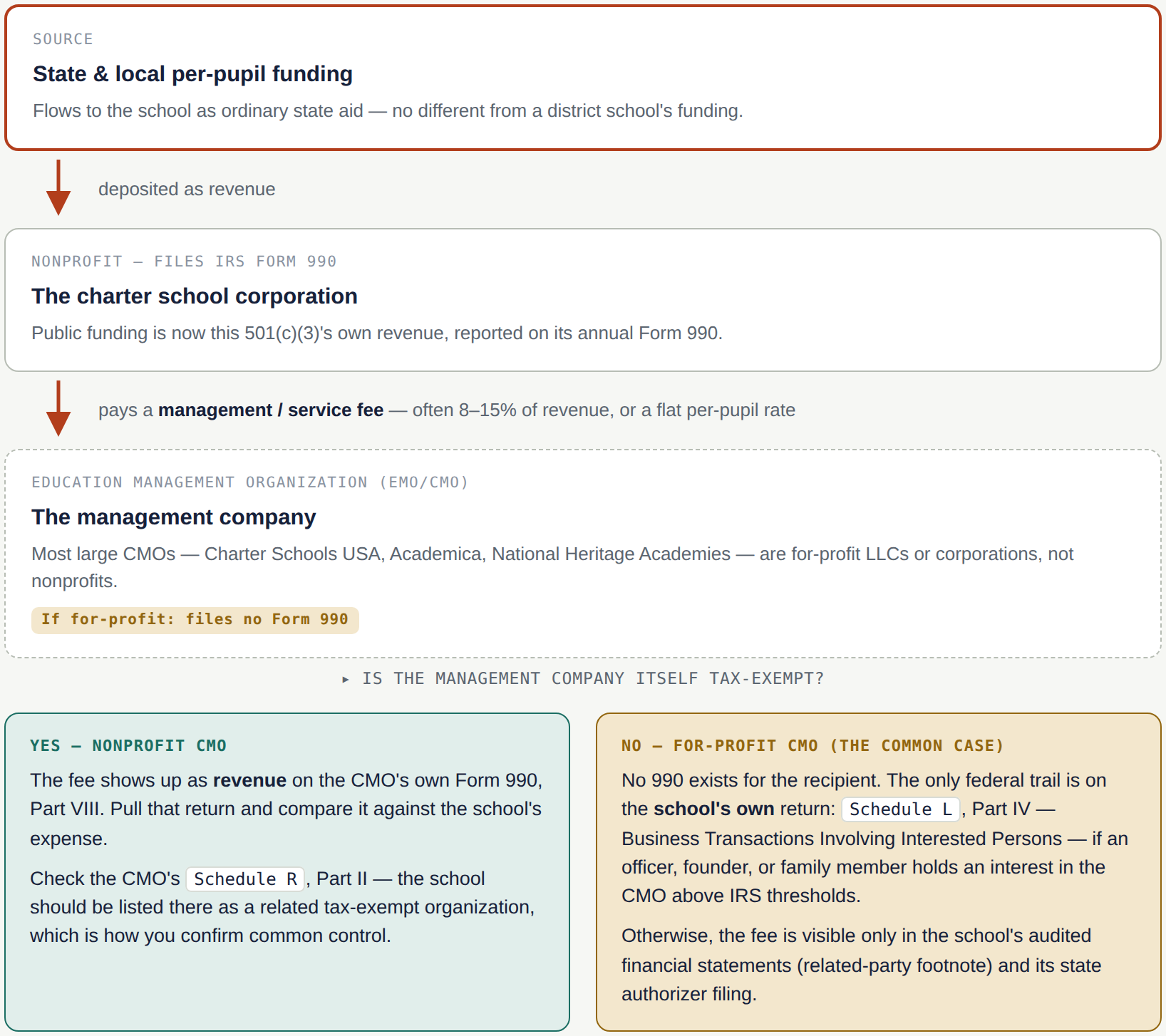
Level 2: the management company. If it’s a nonprofit, it files its own 990, and you can match its revenue against the school’s fee. If it’s for-profit, the common case, it files nothing.2 How the contract is written decides what you can see. Under a fee-for-service contract, you can at least see the price. Under a sweeps contract, the school sends nearly all its revenue to the manager, about 95 percent at White Hat’s Ohio schools, and the manager pays the teachers, the rent and everything else. On the school’s 990, dozens of expense lines collapse into one. And who owns what the money bought? When White Hat’s boards tried to leave, the Ohio Supreme Court said, 4–3, that the company did.3 One tool that works at this level is public-records law: in 2009, Pennsylvania’s Office of Open Records ordered Chester Community Charter School’s for-profit manager, CSMI, to open its books, and $60.6 million in public money came to light.4
Level 3: affiliated LLCs. Payroll, curriculum, staffing, construction and leasing companies set up by the founder, the manager or their families. They’re pass-throughs for tax purposes, so there’s no return to read, just a Secretary of State page with a formation date and a registered agent. Some states, like Delaware, Wyoming and New Mexico, say very little about who owns them. The test that works: run every name and address through more than one system and see whether anything comes back twice. Relay Graduate School of Education and Uncommon Schools listed the same Newark address on their IRS filings: the building that housed North Star Academy.5 In Miami, Academica’s founding family collected about $9 million a year in management fees and another $19 million a year in rent: two invoices, one family.6
Level 4: the buildings. Three routes, each darker than the last. (1) The founder’s own LLC is the landlord: pull the deed and compare the rent to the market. (2) A “Friends of” nonprofit buys the building with tax-exempt bonds issued by a conduit authority, often out of state, and leases it back to the school, so the school’s rent pays off the bonds. The public buys the building twice and doesn’t own it. The best single document in the whole chase is the bond’s official statement, free on EMMA. (3) A real estate investment trust owns the building under a triple-net lease: the school pays rent plus taxes, insurance and maintenance, carrying the costs of ownership without owning anything. A public REIT files 10-Ks on EDGAR, but those rarely show the single school.
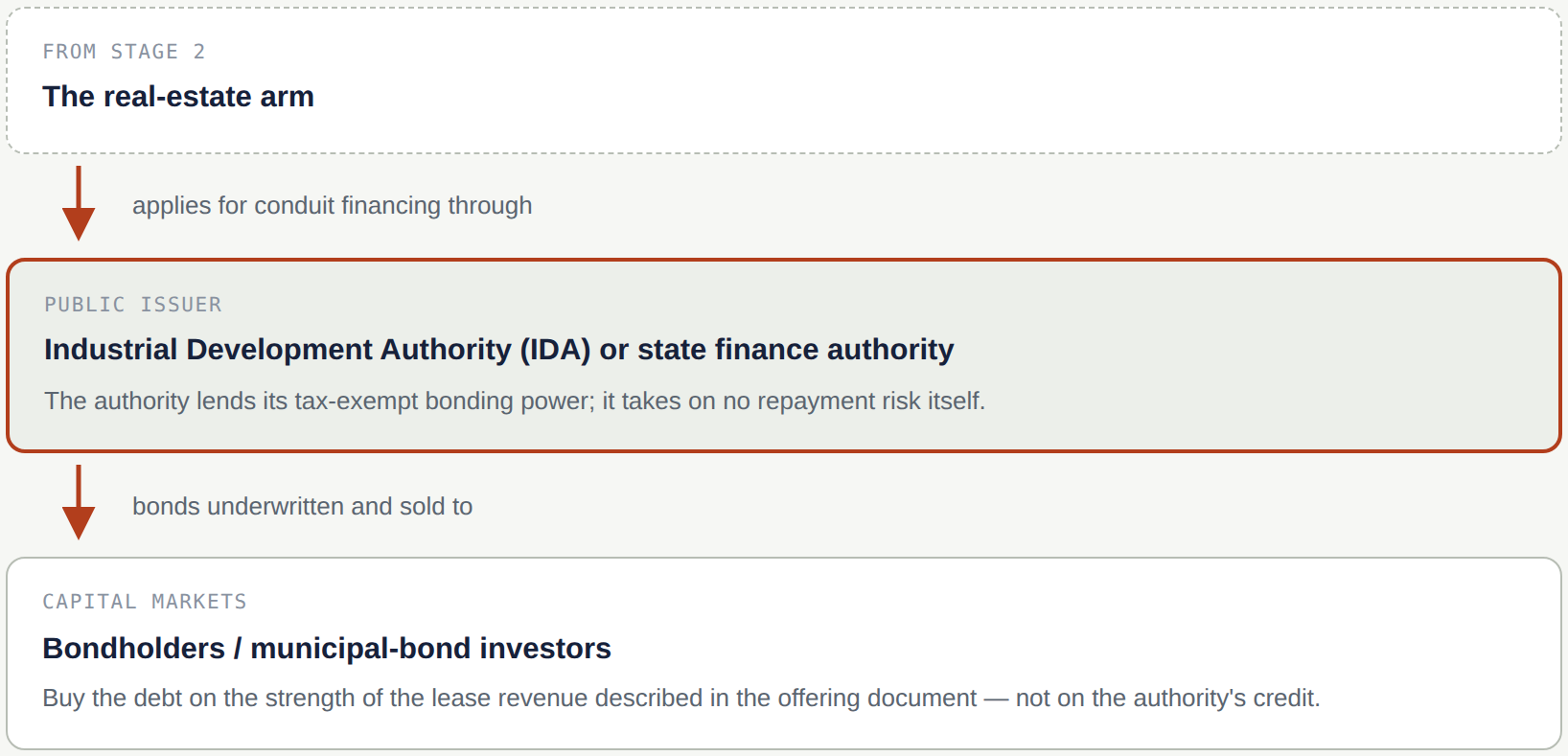
Here’s what an official statement looks like in practice. The 2013 New Jersey Economic Development Authority bonds for TEAM Academy say on the cover that the borrower will lease the facilities to the school “for lease payments sufficient to pay the principal of, premium, if any, and interest on the Bonds,” and then, in capital letters: “THE BORROWER, ASHLAND SCHOOL, INC., IS A SINGLE PURPOSE ENTITY, IS NOT A SCHOOL.”7 At a much bigger scale, Chester Community’s founder sold the school’s buildings to a new nonprofit for $50.7 million in 2010 and leased them back, and in 2021 National Heritage Academies sold 69 campuses in seven states to a brand-new nonprofit, financed by $853.6 million in tax-exempt bonds issued through La Paz County, Arizona. Nobody was charged. Nobody had to be.8
Level 5: the dark. Holding companies, private equity, trusts, offshore entities. No 990, no 10-K, no records law that reaches here. At the bottom, the only light is somebody else’s: reporters, auditors and regulators, courts and whistleblowers, and officials’ own financial disclosures. That last one is how the Optima founder’s stakes surfaced in Florida.9
The field checklist
- Pull the school’s Form 990 (Parts VII, VIII and IX; Schedules L, O and R), its independent audit and its authorizer report.
- List every name: board members, officers, the management company, landlords and vendors.
- Run each name and address through the Secretary of State registry, county deed records, EMMA, EDGAR and ProPublica. Look for anything that comes back twice.
- Get the management contract. Fee-for-service, or sweeps?
- Get the lease. Who owns the building, at what rent, with what triple-net costs?
- Find the bond official statement on EMMA and read the lease, security and related-party sections.
- Write down where the trail goes cold.
That last step is the finding. Every place the trail goes cold is a place the law could require it not to. Derek Black, Preston Green and I laid out the fixes in 2019, and they still apply: prohibit related-party deals or review them independently before they’re signed, audit facility deals routinely, and protect whistleblowers. Add one more: if a vendor runs the school, its books should be public too.10 Public when the money comes in, public when it goes out.
Every line has a receipt
| The lyric | The receipt | Source |
|---|---|---|
| “I started at the district, where the windows all are clear” | District budgets, audits, meetings and contracts are public by law. | Baker (2026a) |
| “Part Seven for the salaries, Part Nine for what they spent, Schedule L for the insiders, Schedule R for where it went” | Where to look on a charter school’s Form 990. | Baker (2026a) |
| “If it’s for-profit, pal, there’s no nine-ninety there” | For-profit management companies file no Form 990. | Baker (2026a) |
| “Ninety-five cents on the dollar, that’s how White Hat ran its slate… the court said the chairs were theirs. Four to three.” | White Hat’s sweeps contracts took about 95% of state funding; the Ohio Supreme Court upheld the company’s ownership of the equipment, 4–3 (2015). | Baker (2026b) |
| “Pennsylvania made ’em open it, and sixty million came” | Pennsylvania’s Office of Open Records ordered CSMI’s books opened in 2009: $60.6 million since 1999. | Baker (2026c) |
| “Delaware tells you zip, Wyoming, New Mexico, the same anonymous trip” | LLC ownership disclosure varies by state, and some states reveal very little. | Baker (2026a) |
| “When one comes back twice, pal, that’s when you write it down” | Relay GSE and Uncommon Schools listed the same Newark address on their IRS filings. | Baker (2016) |
| “A ‘Friends of’ nonprofit buys it with a tax-exempt bond… the public buys the building twice” | Conduit bonds issued in a public authority’s name, repaid from the school’s rent. | Baker (2026a); Baker (2015) |
| “Read the official statement, it’s on EMMA, and it’s free” | Example: NJEDA, TEAM Academy, 2013: “the Borrower… is a single purpose entity, is not a school.” | NJEDA (2013) |
| “Chester, Pennsylvania. Twenty-ten… fifty point seven million” | The founder sold the school’s buildings to a new nonprofit and leased them back. | Baker (2026c) |
| “Sixty-nine campuses. Seven states. Eight hundred fifty-three million in bonds. Out of La Paz County, Arizona.” | National Heritage Academies’ 2021 sale-leaseback. No charges. | Baker (2026b) |
| “Or a politician’s disclosure, amended after all. That’s how they found the Florida one.” | The Optima founder’s stakes surfaced in an amended congressional financial disclosure. | Baker (2026d) |
Key literature
- Green, P.C., Baker, B.D. & Oluwole, J. (2014). Having it both ways: How charter schools try to obtain funding of public schools and the autonomy of private schools. Emory Law Journal, 63(2).
- Baker, B.D. & Miron, G. (2015). The business of charter schooling: Understanding the policies that charter operators use for financial benefit. National Education Policy Center.
- Green, P.C., Baker, B.D. & Oluwole, J. (2018). Are charter schools the second coming of Enron? Indiana Law Journal, 93, 1121.
- Black, D.W., Baker, B.D. & Green, P.C. (2019, February). Charter schools exploit lucrative loophole that would be easy to close. The Conversation.
Read the full case
The Charter Money Trail (Sept. 6, 2026) · The Charter School Company Store, Revisited (Sept. 10, 2026) · Edu-Grift Top 5 (Sept. 13, 2026) · The Company Store Goes to Tallahassee (Oct. 25, 2026) · We bought it twice but we no longer own it (2015)
More songs: School Finance Rock
Full lyrics: Follow the Money (If You Can)
[Intro, spoken]
The case was a dollar. One public dollar.
Per-pupil money, regular as the rain.
Somebody asked me where it went.
I said I’d find out. I said… if I can.
[Verse 1]
I started at the district, where the windows all are clear,
The budget’s posted online and there’s an audit every year.
The board meets out in public, every vote is on the page,
File a records request, you get the contracts and the wage.
That’s the baseline, pal, that’s what a paper trail should be.
Then the dollar caught a charter, and it slipped away from me.
[Chorus]
Follow the money (if you can),
Down the stairs, past the shells and the shell-game man.
Public when it comes in, private when it goes out,
One more door, one more floor, one more shadow of doubt.
Follow the money (if you can).
[Hustler]
Step right up! Keep your eye on the dollar!
Nonprofit shell… and around she goes!
[Verse 2]
First landing’s a nonprofit with a charter on the door,
It files a nine-ninety, and here’s what that’s for:
Part Seven for the salaries, Part Nine for what they spent,
Schedule L for the insiders, Schedule R for where it went.
Read the auditor’s footnote, where the insiders have to show,
But it’s filed a year past signin’, so the deal’s done ‘fore you know.
[Verse 3]
Second landing’s darker, there’s a management company’s door.
If it’s a nonprofit, it files too, you can match it to the score.
But if it’s for-profit, pal, there’s no nine-ninety there,
Just one big “management” line, and the rest is thin air.
Then there’s the sweeps contract: the school sweeps the whole pot out the gate,
Ninety-five cents on the dollar, that’s how White Hat ran its slate.
The manager pays the teachers, pays the rent, buys every chair,
And when the boards tried to leave, the court said the chairs were theirs.
Four to three. Buy back your own furniture.
So get the management contract, file the records claim:
Pennsylvania made ’em open it, and sixty million came.
[Chorus]
[Hustler]
Which shell? Which shell? LLC… and around she goes!
[Verse 4]
Third landing’s LLCs, a whole hallway full of doors:
Payroll, curriculum, staffing, the builder and the stores.
They pass their taxes through, so there’s no return to read,
Just a Secretary of State page with an agent’s name, indeed.
Some states tell you who owns ’em, Delaware tells you zip,
Wyoming, New Mexico, the same anonymous trip.
So run every name and address through every book in town,
And when one comes back twice, pal, that’s when you write it down.
[Verse 5]
Fourth landing is the buildings, and there’s three ways it goes:
The founder’s LLC as landlord. Pull the deed and check the rent it shows.
Or a “Friends of” nonprofit buys it with a tax-exempt bond,
From some county’s bond authority three states beyond,
Then it leases it right back, so the rent pays off the debt,
And the public buys the building twice and doesn’t own it yet.
Or a REIT holds the deed with a triple-net lease in hand:
The school pays the rent, the taxes, the insurance and the upkeep on the land.
For the bonds, read the official statement, it’s on EMMA, and it’s free,
For the REIT, the ten-K on EDGAR, where the single school’s hard to see.
[Bridge, spoken]
Chester, Pennsylvania. Twenty-ten.
The founder sells the school’s buildings to a brand-new nonprofit. Fifty point seven million.
Leases ’em right back.
Twenty twenty-one. Sixty-nine campuses. Seven states.
Eight hundred fifty-three million in bonds.
Out of La Paz County, Arizona.
Nobody charged. Nobody had to be.
[Verse 6]
Bottom of the stairwell, and the bulb is burnin’ out:
Holding companies and trusts and private equity about.
No nine-ninety, no ten-K, no records law that reaches here,
Just a lawyer and a door, pal, and the dollar disappears.
The only light down here comes from somebody else’s hand:
A reporter or an auditor, a judge, a whistleblower who’ll stand,
Or a politician’s disclosure, amended after all.
That’s how they found the Florida one. Read the footnotes. All of ’em.
[Outro]
So here’s the method, kids, go write it on your hand:
Pull the nine-ninety, the audit, the authorizer’s plan.
List every name and run it through the registry and the deed,
EMMA for the bonds, and EDGAR for the REIT.
Get the management contract and the lease, and ask who owns the chair,
And write down where it went cold, ’cause the fixin’ starts right there.
Lyrics by me. Music made with Suno. The detective and the hustler are fictional; the documents and numbers are not. The structures described here are documented mechanisms. Most of the arrangements cited were legal, and nothing here is an allegation about any specific school’s current finances.
- Baker (2026), The Charter Money Trail. The stage diagrams in this post come from that walkthrough, which also covers the reporter’s toolkit: ProPublica Nonprofit Explorer, IRS exempt-organization search, EMMA, state corporate registries, county deed records and authorizer portals. ↩︎
- Baker (2026), The Charter Money Trail, Stage 1. Most large management companies are for-profit LLCs or corporations, so the fee typically leaves the school’s books and lands somewhere that files no Form 990. ↩︎
- Hope Academy Broadway Campus v. White Hat Mgt., L.L.C., 2015-Ohio-3716 (4–3). White Hat’s sweeps contracts routed roughly 95 percent of each school’s state funding to the manager. See Baker (2026), Edu-Grift Top 5. ↩︎
- Pennsylvania’s Office of Open Records ruled on May 8, 2009 that CSMI, in running Chester Community Charter School, was performing “what is otherwise a governmental function.” See Baker (2026), The Charter School Company Store, Revisited, citing The Philadelphia Inquirer (May 25, 2009). ↩︎
- Baker (2016), The Charter School Company Store, drawing on Uncommon’s and Relay’s IRS Form 990 filings. ↩︎
- Baker (2026), The Charter School Company Store, Revisited, citing StateImpact Florida (2011) and the Miami Herald. ↩︎
- NJEDA, Charter School Revenue Bonds (Series 2013 Project for the TEAM Academy Charter School), Preliminary Official Statement (Oct. 18, 2013). See also Baker (2015), We bought it twice but we no longer own it. ↩︎
- Chester: Baker (2026), Company Store, Revisited, citing Chalkbeat Philadelphia (2016). National Heritage Academies: Baker (2026), Edu-Grift Top 5, citing Network for Public Education and NCSPE at Teachers College. ↩︎
- Baker (2026), The Company Store Goes to Tallahassee, citing Florida Bulldog (Sept. 2025). ↩︎
- Black, D.W., Baker, B.D. & Green, P.C. (2019, Feb.). Charter schools exploit lucrative loophole that would be easy to close. The Conversation. Green, P.C., Baker, B.D. & Oluwole, J. (2018). Are charter schools the second coming of Enron? Indiana Law Journal, 93, 1121. ↩︎


