Following public dollars through a traditional school district is, by comparison, straightforward. District budgets are public record. Board meetings are open. Every dollar of state and local revenue flows into a single governmental entity that files public financial statements, undergoes independent audits, and answers to elected or appointed boards bound by open-meetings and public-records law. You can follow the money because the law requires the money to be followable.
Charter school finance doesn’t work that way — not because it’s illegal, but because it’s structured differently from the ground up. A single public funding stream can pass through a nonprofit school corporation, a for-profit management company, a related real-estate entity, and a tax-exempt bond issuance — and at almost every hop, the entity receiving the money is under no obligation to disclose anything to the public. Some links in that chain file a Form 990. Some don’t file anything at all. The paper trail doesn’t disappear, but it moves from one regulatory regime to another — nonprofit tax filings, corporate registries, county property records, municipal bond disclosures — each with its own rules, its own audience, and its own blind spots. Tracing it means knowing which of several unrelated public filing systems to check at each step, and accepting that at some steps, no public filing exists at all.
The walkthrough below maps that structure stage by stage: what becomes public, what doesn’t, where to look when it is, and where the trail goes cold when it isn’t.
Field method — public-records tracing. How one dollar of per-pupil funding can travel from a school budget line, through a management company, into a related real-estate entity, and out the far end as a municipal bond — and which public filing catches it at each hop.
- Three hops: management fee → related-party transfer → bond-financed real estate
- Filings used: IRS Form 990 · Schedules L & R · EMMA bond disclosures
- Audience: reporters, auditors, curious taxpayers
How to read the boxes
- Public money / public agency — district, state aid, or a bond authority
- Nonprofit entity — solid border, files a Form 990
- For-profit entity — dashed border, no 990 ever filed
- Where to find it — the specific public filing to pull
- Disclosure gap — the point the paper trail usually goes cold
1. Budget line to management fee
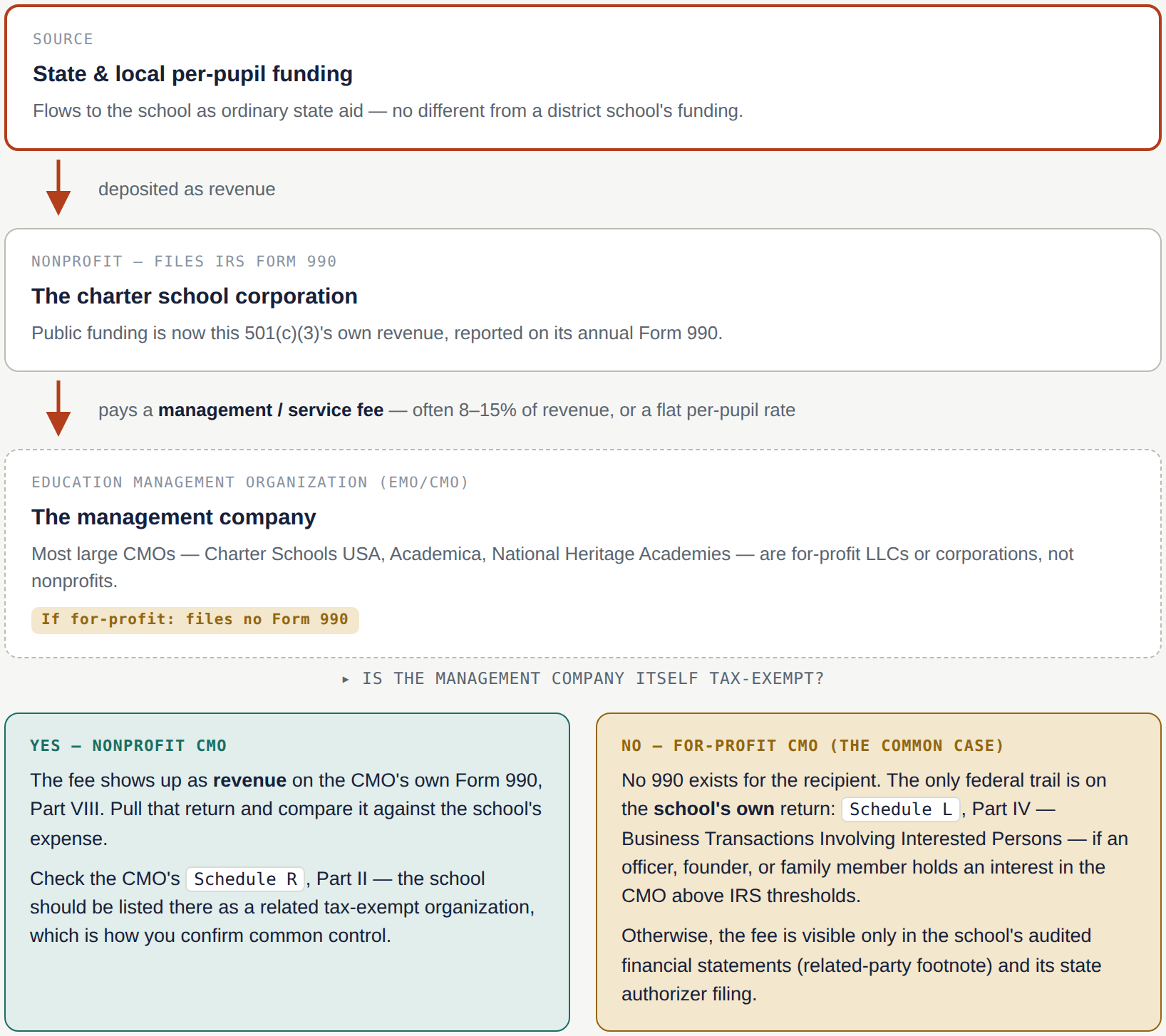
Public per-pupil funding lands in the nonprofit charter school’s checking account, then a slice of it leaves the same year as a fee to whoever runs the school day-to-day. Most large CMOs — Charter Schools USA, Academica, National Heritage Academies — are for-profit LLCs or corporations, not nonprofits, so the fee (often 8–15% of revenue, or a flat per-pupil rate) typically leaves the nonprofit school’s books and lands somewhere that files no Form 990 of its own.
Where to pull it
Form 990, Part IX (Statement of Functional Expenses) on the school’s own return — look for a “management fees” line, or a lump “other expenses” figure explained in Schedule O. Search both entities by name or EIN on ProPublica’s Nonprofit Explorer, which hosts the full 990 as filed, including Schedules L, O, and R. The school’s state charter authorizer annual financial report and independent audit, filed with the state education agency, almost always break out the management fee separately and by percent of revenue.
If the management company is itself a nonprofit, the fee shows up as revenue on its own Form 990, Part VIII — compare it against the school’s expense line, and check the CMO’s Schedule R, Part II, where the school should be listed as a related tax-exempt organization. If the management company is for-profit (the common case), no 990 exists for the recipient at all; the only federal trail is the school’s own return, Schedule L, Part IV (Business Transactions Involving Interested Persons), and only if an officer, founder, or family member holds an interest in the CMO above IRS thresholds. Otherwise, the fee is visible only in the school’s audited financial statements (related-party footnote) and its state authorizer filing.
2. Management company to related-party real estate
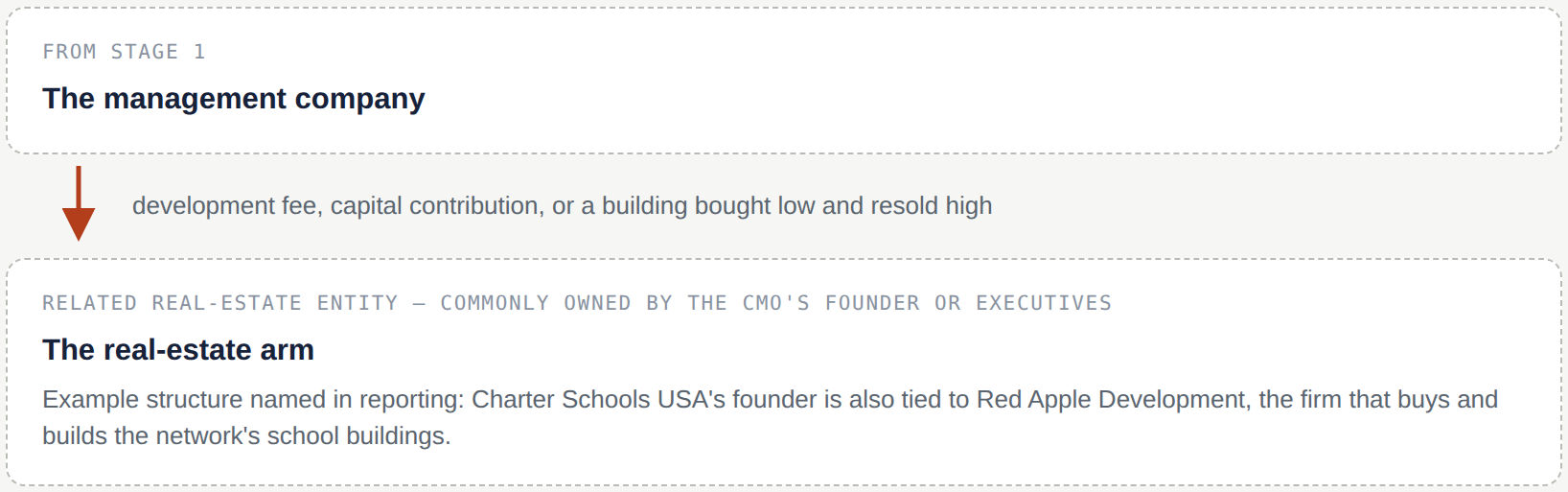
A second, related entity — often created and controlled by the same people who run the CMO — now receives money for land or a building, typically a development fee, a capital contribution, or a building bought low and resold high. This is the hop courts and auditors call “self-dealing” when it’s priced above market. In reporting on Charter Schools USA, the network’s founder is also tied to Red Apple Development, the firm that buys and builds the network’s school buildings.
Documented pattern
Reporters tracing county property records found a Charter Schools USA building bought for $2.2M in March 2011 and resold six months later, to the network’s own real-estate arm, for $9.3M — a markup the school then paid off through rent. A second building followed the same path, $3.75M to $9.7M. — Truthout, 2014, citing county deed records
Adjudicated example
A federal court found Imagine Schools breached its fiduciary duty by routing a charter board into an above-market lease with SchoolHouse Finance — Imagine’s own wholly owned real-estate subsidiary — and ordered $935,400 in damages, calling the arrangement “self-dealing.” — Renaissance Academy for Math & Science of Missouri v. Imagine Schools, Inc., W.D. Mo. 2014; see also St. Louis Post-Dispatch coverage of the ruling
Where to pull it
Run the real-estate entity’s name through your state’s Secretary of State / corporate-registry search (e.g., Florida’s Sunbiz, Delaware’s Division of Corporations) — registered agent and officer names are what tie it back to the CMO’s leadership. If the entity is a nonprofit “Friends of” corporation rather than an LLC, it files its own Form 990 — check Schedule L for the lease or purchase transaction and Schedule R for the ownership link. Pull the county property appraiser and recorder of deeds records for the parcel: purchase price, resale price, and date — this is how property flips like the one above are actually caught. The school’s audited financial statements (related-party transactions note, usually near the end) should disclose the lease and the related party, even when the 990 doesn’t.
3. The building gets bond-financed
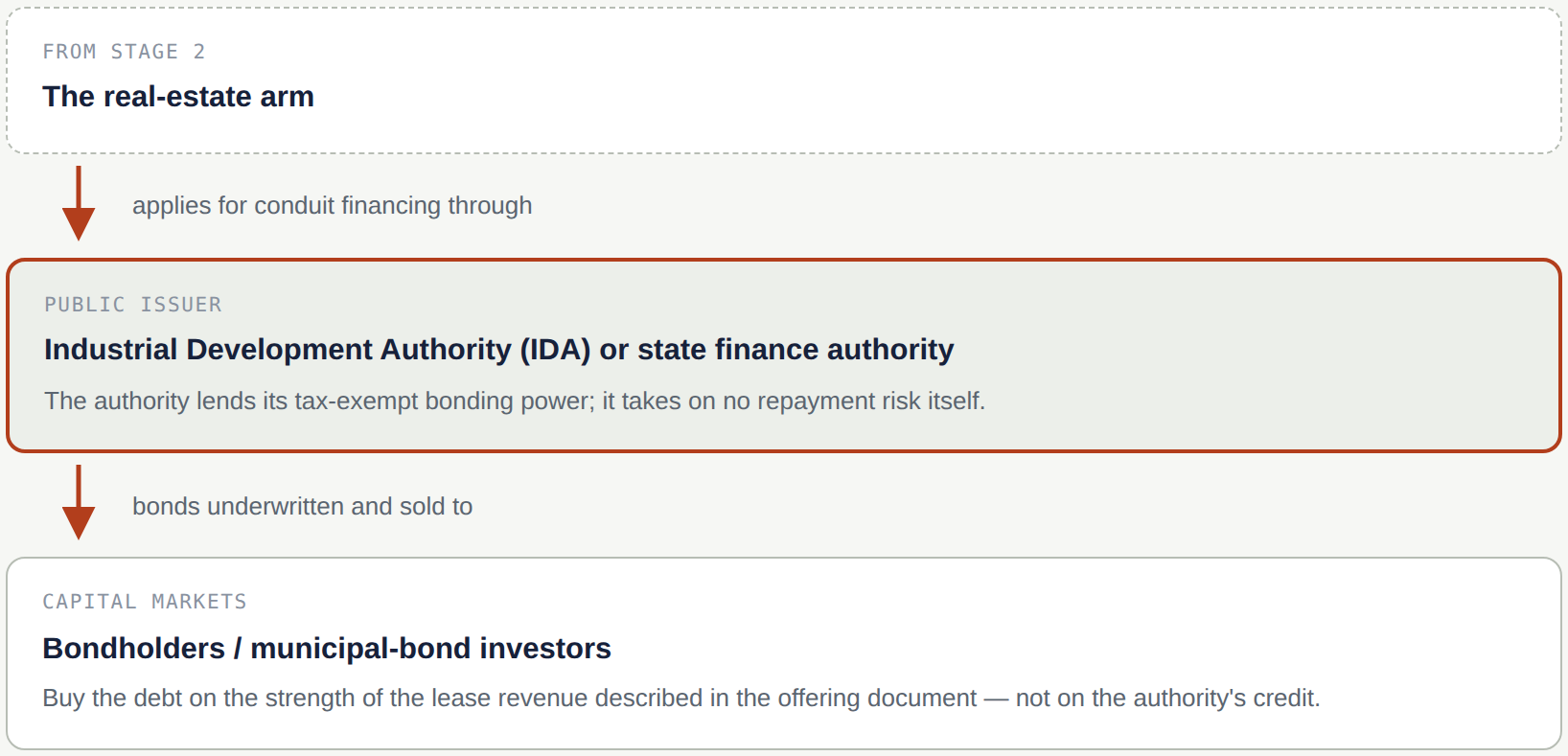
Rather than pay cash, the real-estate entity typically borrows the purchase or construction price through tax-exempt bonds, applying for conduit financing through an Industrial Development Authority or state finance authority. The authority lends its tax-exempt bonding power but takes on no repayment risk itself; the bonds are underwritten and sold to bondholders and municipal-bond investors, who buy the debt on the strength of the lease revenue described in the offering document — not on the authority’s credit. The bonds are issued in the name of a public authority, but repaid entirely by the charter school’s lease payments.
Adjudicated example
The SEC charged UNO Charter School Network with failing to disclose, to buyers of a $37.5 million bond offering, that a construction contract had gone to a company owned by a senior officer’s brother. — SEC v. UNO Charter School Network, settled June 2014
Where to pull it
Search emma.msrb.org — the SEC-designated municipal-disclosure archive — by issuer name, borrower/”obligated person” name, or CUSIP to find the Official Statement (OS). Inside the OS: the “Security and Sources of Payment” section names the lease or loan agreement that backs repayment; the maturity schedule gives the par amount and interest rate for every maturity; the cover page names the underwriter, bond counsel, and trustee. EMMA also holds every continuing-disclosure filing made after closing — the charter school’s annual audited financials and enrollment figures, filed for as long as the bonds are outstanding. That’s the ongoing monitoring trail, not just a one-time snapshot.
The loop closes here. The charter school’s per-pupil funding — the same dollars that started at Stage 1 — now also makes the lease payment that services this debt. One public revenue stream is paying, in the same fiscal year, a management fee, a related-party real-estate return, and municipal bond debt service.
Reporter’s toolkit
Six free lookups, in the order you’ll actually use them, to run any charter network through the three stages above.
| ProPublica Nonprofit Explorer Full-text 990s, including Schedule L and Schedule R, searchable by organization name or EIN. | IRS Tax Exempt Organization Search Confirms exempt status and pulls the raw filed return when ProPublica hasn’t indexed it yet. |
| EMMA (MSRB) Every municipal bond Official Statement and continuing-disclosure filing, searchable by issuer, borrower, or CUSIP. | State Secretary of State registry Corporate filings for the LLC or Inc. behind a management or real-estate entity — officers, registered agent, formation date. |
| County property appraiser / recorder of deeds Purchase price, resale price, and date for any parcel — the record that exposes a flip. | State charter authorizer portal Annual financial reports and independent audits, which usually break out the management fee by name and percent of revenue. |
On the examples above: the Winthrop/Woodmont property-flip figures are as reported by Truthout (2014) from county deed records; the SEC and Renaissance Academy/Imagine Schools matters are settled federal enforcement and adjudicated court findings, cited to the SEC’s June 2014 press release and the W.D. Missouri court’s December 2014 ruling respectively. Charter Schools USA and Red Apple Development are named here only as the illustrative structure that reporting has already documented — not every CMO/real-estate pairing follows this pattern, and not every instance of it is unlawful. This piece describes a documented mechanism and where its paper trail lives; it is not an allegation about any specific school’s current finances.
Related reading
- The Charter School Company Store — more on the range of methods charter operators use to convert public revenue into private gain
- We bought it twice but we no longer own it — the bad public policy behind charter school real estate deals
- Pondering Chartering: Who’s actually running America’s charter schools? — on the governance structures behind charter management


One thought on “The Charter Money Trail”
Comments are closed.