Charter schools generally can’t issue the kind of low-interest, taxpayer-backed general obligation bonds that districts use to buy land and build schools. That basic financing gap has, over time, produced two distinct and well-documented problems in how charter operators end up housed. They’re often talked about as one blurry story about “charter real estate deals,” but they’re actually separate mechanisms, with separate fixes, and it’s worth treating them that way.
Neither problem requires resolving the larger, separate argument about whether chartering itself is good policy. Both are fixable with fairly ordinary transparency and pricing rules — the kind already applied to public companies and, in places, to districts themselves.
Problem 1: districts selling public buildings to charters for far less than they’re worth
A handful of states require or strongly encourage school districts to sell closed public school buildings to charter operators at a mandated discount, skipping any real appraisal or competitive process. The public built and maintained these buildings; the transfer price reflects almost none of that investment.
Indiana’s so-called “$1 law,” on the books since 2011, requires school districts to sell or lease closed buildings to charter schools for a dollar. Indianapolis Public Schools has made exactly two such sales: the former School 11 building went to KIPP Indy for $1 in 2012, and the former School 98 building went to the Tindley charter network for $1 in 2017 — buildings IPS taxpayers had financed construction and decades of upkeep on. The charters note they then had to sink hundreds of thousands to millions of dollars into renovations, and neither made a taxable profit on eventual resale — but the initial transfer price, for a facility the public built and maintained, was a dollar (Chalkbeat Indiana, February 2024).
California law requires districts to offer surplus school property to charter schools before anyone else, at a sale price that can legally be set as low as 25 percent of the property’s current market value (California Legislative Analyst’s Office).
And in 2025, Ohio’s state budget process included a provision that would let the state force closure of public school buildings and then force the district to sell those buildings to charter or private schools below market value — over the objections of the state’s largest districts. The superintendent of Canton City Schools called it “a bad deal for taxpayers” in a district that had just approved bond levies to build new neighborhood schools (WYSO / Statehouse News Bureau, May 2025).
The fix here is simple: require an independent appraisal, and price the sale at or near market value, or at minimum require the district to be compensated for its documented capital investment. A state can still prioritize charter access to vacant buildings without simply giving those buildings away.
Problem 2: charter operators paying inflated rent to a landlord tied to their own leadership
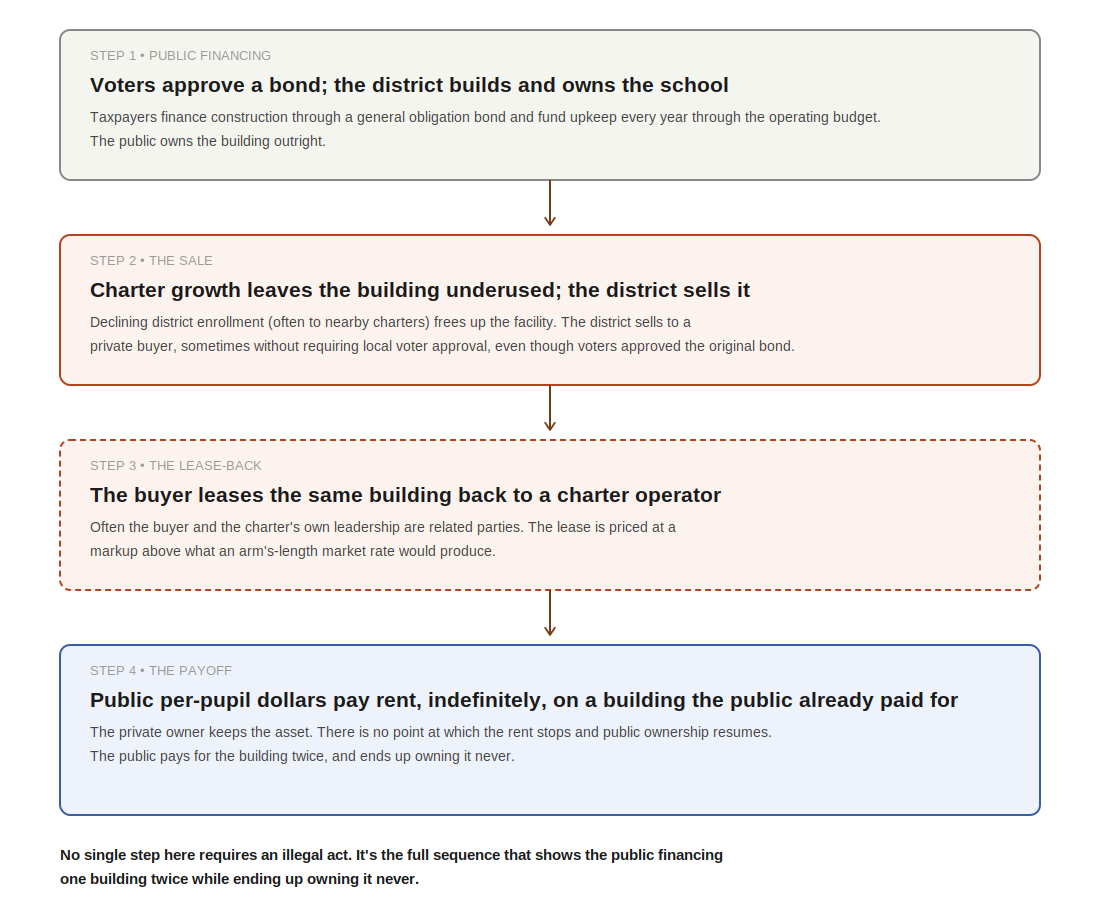
Because most charters lease rather than own, someone else typically holds title to the building and collects rent from the school’s public per-pupil funding. That’s ordinary and not inherently a problem — landlords take on real financing risk purchasing or building facilities whose only realistic tenant is a five-year-renewable charter school. The problem is a specific, recurring variant: when the landlord and the charter’s own leadership turn out to be the same people, and the rent is priced well above what an arm’s-length market rate would produce.
Cornerstone Charter Schools, a five-school Detroit network, is a clean illustration. Cornerstone’s founder, Clark Durant, also leads the New Common School Foundation, which owns and leases the buildings his schools occupy — and Cornerstone Education Group, the management company that collects 10 to 13.5 percent of the schools’ per-pupil funding on top of the rent. One Cornerstone elementary school alone paid more than $500,000 a year to rent its own building, under a triple-net lease that also stuck the school with taxes, insurance, and maintenance (WXYZ Detroit). “A really big, disconcerting piece of this puzzle,” I told a Detroit reporter, “is that these are a number of entities drawing on the public dollars and then sending that money back and forth between themselves.” That arrangement escalated past a policy question in November 2020, when the estate of the network’s largest historical donor filed a complaint with Michigan’s attorney general accusing Durant of running the foundation “as a for-profit entity with the primary purpose of financially benefiting Mr. Durant” himself — pointing to a compensation package that rose 61 percent in a single year and a pair of interest-bearing loans running in both directions between Durant and the foundation he leads (WXYZ Detroit; Crain’s Detroit Business).
Most of this architecture never sees a courtroom, which is part of why it persists. Hellenic Classical Charter Schools, in Queens, is a rare exception. Hellenic’s lease on its building — originally about $660,000 a year, held by a Greek Orthodox parish — was transferred to “Friends of Hellenic Classical Charter Schools,” a nonprofit that shares a chairperson with the school itself, which then subleased the same building back to Hellenic at more than $2 million a year. New York City, on the hook to reimburse charter rent under state law, balked; the state education commissioner sided with the school anyway. In March 2025, an Albany judge overturned that decision, citing “multiple red flags” — the related-party sublease and the rent’s exponential jump chief among them — and ruled the city need only reimburse a school’s “actual rental cost,” not whatever a related party decides to charge it (Chalkbeat New York).
New Jersey supplied its own entry in January 2026: a state comptroller’s investigation into CAPS Asbury found the charter’s management company, CAPS Inc., holding the master leases on all three of the school’s buildings, subleasing them back to the school it manages, and collecting 14 to 15 percent of the school’s revenue in management fees on top — the same landlord-and-manager combination, filed under a different agency’s letterhead (NJ Office of the State Comptroller).
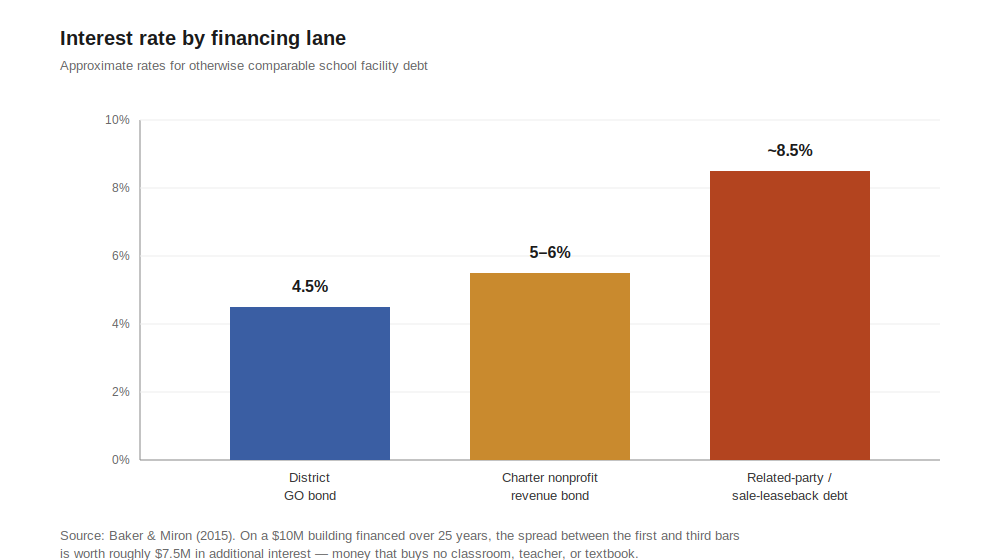
The aggregate pattern shows up in the data, too. Ohio’s state auditor found charter schools leasing from a management company paid an average of $2,325 per pupil in rent, against $848 at comparable charter schools with no related-party lease — nearly three times as much, for materially identical buildings (Ideastream Public Media).
The fix here is also simple, and it’s the one a court already improvised in Hellenic’s case: require any related-party facilities lease to be benchmarked against a market comparison before an authorizer approves it, or before public reimbursement is owed, and require the same related-party disclosure a public company already owes its own shareholders — applied to a nonprofit spending public money instead of investor money.
What ties the two together
Both problems have the same shape: a transaction involving public money and a public asset, priced without the scrutiny a genuine market transaction would face. In Problem 1, the state itself mandates the discount by statute. In Problem 2, the discount runs the other direction — a related party charges above market — but the missing ingredient is identical: nobody with the authority to say no is required to ask whether the price is fair.
Neither fix requires banning charter schools or deciding the broader argument about chartering. It requires only what every case above was missing until, in Hellenic’s case, a judge finally supplied it: someone with the authority to ask whether the person filing the paperwork was also the person collecting the money — and the power to say no when the answer was yes.
Sources
- Baker, B. D., & Miron, G. (2015). The business of charter schooling. National Education Policy Center.
- Pak-Harvey, A. (2024, February 15). Charter schools bought two IPS buildings for a dollar each. What happened next? Chalkbeat Indiana.
- California Legislative Analyst’s Office. Rules regarding surplus school property.
- WYSO / Statehouse News Bureau. (2025, May 23). Public schools could be forced to close some buildings, sell them cheaply to charter schools.
- WXYZ Detroit. Ethical questions raised around Cornerstone Charter Schools’ real estate deals.
- WXYZ Detroit. Clark Durant in battle with Pulte Trust, a major Cornerstone charter funder.
- Welch, S. Crain’s Detroit Business. Pulte estate, Cornerstone foundation battle over millions.
- Chalkbeat New York. (2025, March 24). Judge backs NYC in dispute with state over charter school rent reimbursement.
- New Jersey Office of the State Comptroller. (2026, January 12). Investigation of CAPS Asbury.
- Eddings, A. (2019, January 24). State auditor: Charter schools paying higher-than-market-rate rents. Ideastream Public Media.


