A decade ago on this blog I wrote about charter operators who require the people paid with public money to spend a share of it back at a store the operator itself owns. The mechanism hasn’t gone anywhere. Here it is again, in five cases across four states, with the receipts — and, this time, a schematic for each one.
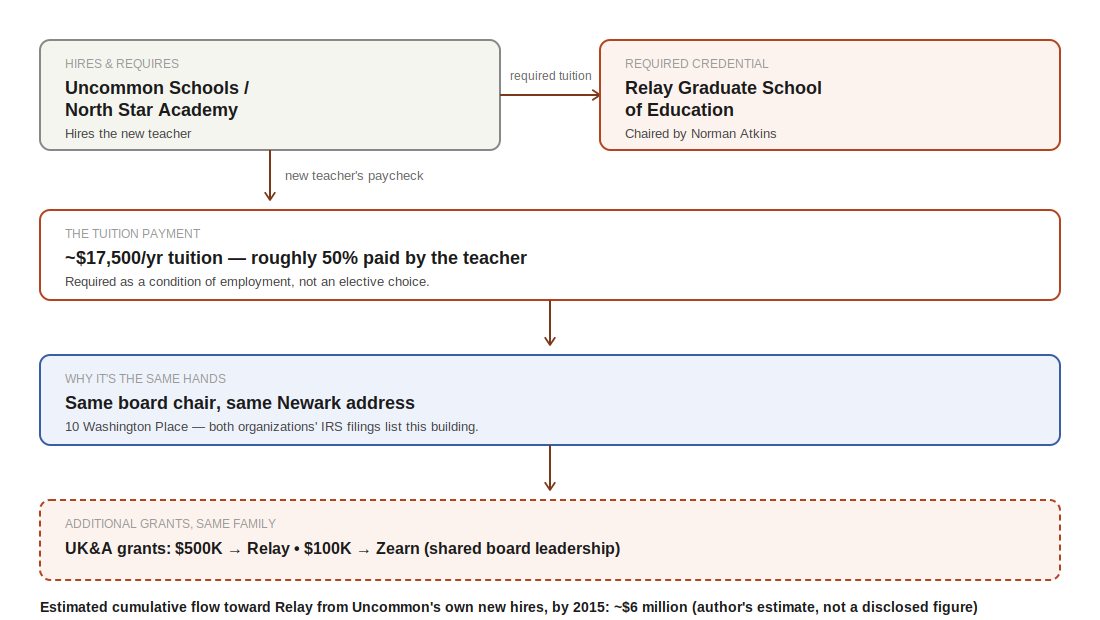
In 1947, Tennessee Ernie Ford hadn’t yet recorded “Sixteen Tons,” but every coal miner in Appalachia already knew the joke wasn’t really a joke: paid in company scrip, redeemable only at the company store, “I owe my soul to the company store.” Nobody pays a teacher in scrip anymore. But in 2009, new teachers walking into Uncommon Schools’ North Star Academy in Newark discovered a tidier version of the same arrangement: as a condition of taking the job, they had to enroll in a master’s program at Relay Graduate School of Education — an institution chaired by the same person who chaired Uncommon’s own board, housed in the same Newark building as the school employing them, and priced at roughly $17,500 a year, with the new teacher’s own paycheck covering close to half of it.
I wrote about this back in December 2016 under the headline “The Charter School Company Store.” I’ve spent the years since researching a much bigger version of this book chapter, and the honest news is that the mechanism hasn’t needed updating so much as re-cataloging. It shows up in real estate, in curriculum contracts, in management fees, and — this is the detail I keep coming back to — in the credential a new teacher is required to buy from their own employer’s affiliate before they’re allowed to start the job. Below are five fully documented cases, one from the archive and four from the last twelve months, each with a schematic showing exactly where the money enters, where it’s required to leave, and where it lands back in the same hands it started in.
Newark: the credential you’re required to buy
Start with North Star Academy, because it’s the cleanest specimen. Relay Graduate School of Education was co-founded in 2011 by, among others, Norman Atkins, who also chaired Uncommon Schools’ board. Jamey Verrilli held Relay’s Newark deanship and a board seat at North Star Academy at the same time. Both organizations’ IRS filings list the same street address — 10 Washington Place, Newark, the same building housing North Star Academy itself. None of that is illegal. What it means, in practice, is that the decision to require a credential and the decision about who gets paid for supplying it sat with the same small group of people. (Source: my own 2016 reporting, drawing on Uncommon’s and Relay’s IRS Form 990 filings.)
Running New Jersey’s own staffing data against Relay’s published tuition figure, I get a rough cumulative estimate on the order of $6 million flowing from Uncommon’s own new hires toward Relay by 2015 — money that started as a teacher’s salary, and ended up, in significant part, back inside the same corporate family that had just hired her. New Jersey Department of Education staffing reports for North Star Academy alone counted 103, then 134, then 153 “novice” teachers across three consecutive years between 2009 and 2015 — each one, under Uncommon’s own hiring policy, a plausible Relay enrollee. That’s the arithmetic behind the $6 million; it’s my own back-of-envelope calculation from public staffing data and a published tuition figure, not a number either organization has itself disclosed. A related fundraising affiliate, Uncommon Knowledge & Achievement, separately reported $500,000 to Relay and $100,000 to Zearn, a curriculum company sharing board leadership with Uncommon, in a single tax year. Individually, every one of those looks like a grant. Read together against the shared address and the shared board seats, they look like an organization funding itself in triplicate.
Miami: two invoices, one family
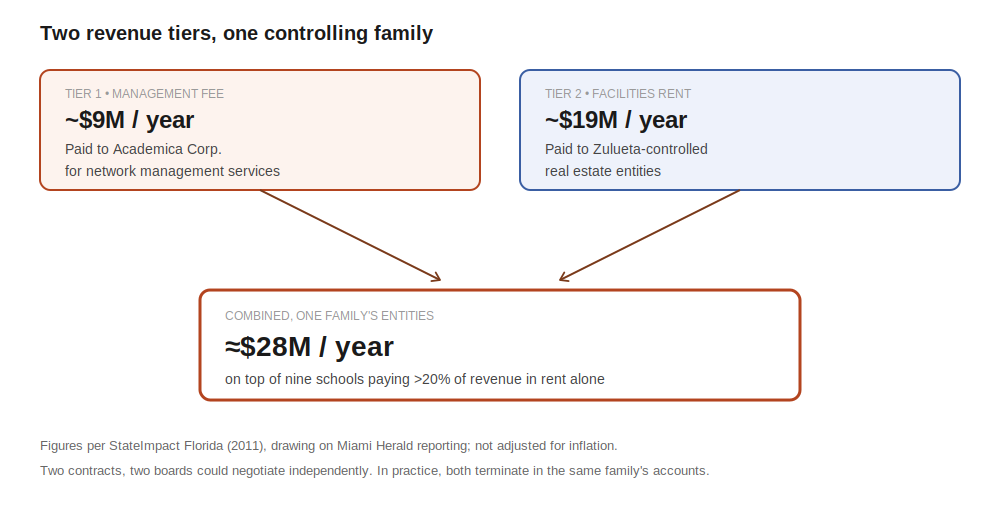
Academica, the charter management company Fernando Zulueta built starting in 1999, runs the same idea at regional scale — and shows something the Newark case doesn’t: a company store with two separate registers. By 2011, StateImpact Florida’s reporting (drawing on the Miami Herald’s own investigation) found Zulueta family interests controlling more than two dozen companies doing business with the schools Academica managed. Academica itself collected roughly $9 million a year in management fees. A separate set of Zulueta-controlled real estate entities collected another $19 million a year in rent from the same network, on a portfolio of more than $115 million in South Florida properties that, because they house public schools, pay no property tax at all — nine schools were paying more than a fifth of their total revenue in rent alone.
A 2014 federal audit found Fernando Zulueta sitting on the board of Mater Academy, one of his own network’s schools, while that school signed leases with his family’s development companies, and turned up a vendor relationship with an architecture firm that employed his brother-in-law — Erik Fresen, a sitting state representative who sat on the House’s PreK-12 Appropriations Committee, the panel with jurisdiction over the same charter-facilities funding stream his brother-in-law’s schools drew on, while sponsoring legislation requiring public school districts to share construction-tax revenue with charter schools. Academica disputed the inspector general’s characterization of these findings when the report was released; I note the dispute because a company’s denial belongs next to a federal auditor’s finding, not in place of it.
Two contracts, two boards could in theory negotiate independently — a school could push back on the management fee without touching the lease, or vice versa. In practice, $9 million and $19 million a year both terminated in the same family’s accounts, and no single filing was ever built to add the two together.
Chester, Pennsylvania: the books it took a lawsuit to open
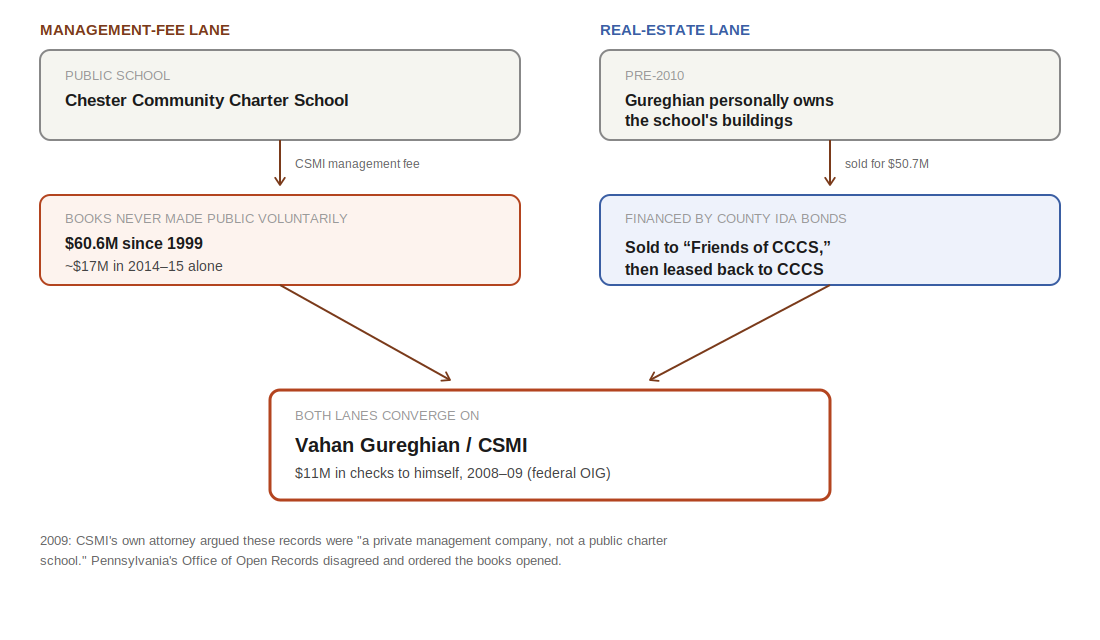
Then there’s the case that shows what happens when nobody can see the invoice at all. Chester Community Charter School, Pennsylvania’s largest brick-and-mortar charter, enrolling roughly 3,000 K–8 students, has been run since the 1990s by CSMI, a for-profit company controlled by Vahan Gureghian — a developer, lawyer, and, per Inquirer reporting, the largest individual donor to Governor Tom Corbett. In January 2009, The Philadelphia Inquirer filed a Right-to-Know request for CSMI’s salaries, payments to Gureghian, and profit figures. CSMI’s lawyer refused, arguing the records belonged to “a private management company, not a public charter school.” Pennsylvania’s Office of Open Records disagreed, ruling on May 8, 2009 that CSMI, in running the school’s day-to-day operations, was performing “what is otherwise a governmental function,” and ordered the books opened. What came out: $60.6 million in public subsidies to CSMI since 1999, for a school then enrolling roughly 2,150 kids.
Seven years later, a federal inspector general reviewing charter management organizations found that Gureghian had the authority to write checks to himself from the school’s accounts without board approval, and had done so to the tune of roughly $11 million in the 2008–09 school year alone (CCCS’s attorney disputes the “without approval” characterization, telling investigators each payment had in fact received board sign-off). By 2014–15, CSMI was collecting nearly $17 million in a single year, for a school then enrolling roughly 2,900 students — and CSMI’s profit margin on the arrangement has never been publicly disclosed, then or since. And in 2010, Gureghian sold the school’s own buildings — which he owned personally — to a newly created nonprofit, Friends of Chester Community Charter School, for $50.7 million, financed by Delaware County industrial development authority bonds, then leased them back. Pennsylvania’s auditor general, Eugene DePasquale, flagged the whole arrangement as improper, since the school, through its own affiliate, still effectively owned the building it was collecting lease reimbursement to rent — the “we bought it twice” mechanism this project documents elsewhere, run one more time through a services company instead of a REIT.
Arizona, 2024–25: three cases in one school year
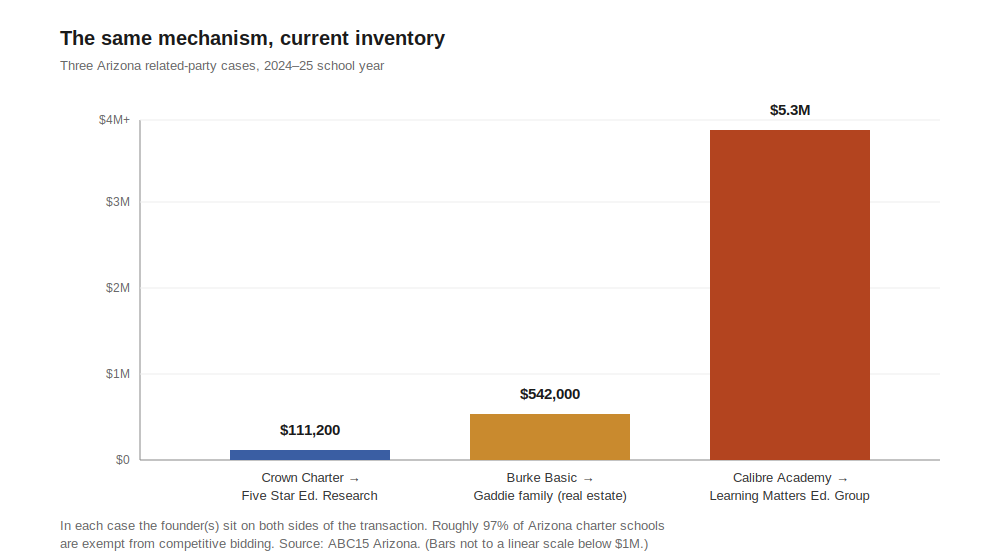
None of this ended when the last decade did. ABC15 Arizona documented three related-party arrangements running in the 2024–25 school year, in a state where roughly 97 percent of charter schools are exempt from competitive bidding even as related-party transactions are required to surface, after the fact, in an annual audit. At Crown Charter School in Litchfield Park, co-founders James Shade and T.C. Crownover — a married couple, Shade as chief executive and Crownover as board chair — directed $111,200 to Five Star Educational Research, a California-based nonprofit curriculum provider where Shade serves as CEO and Crownover as chairman. At Burke Basic School in Mesa, the Gaddie family, which founded the school, leases its building from a for-profit entity the family manages, collecting $542,000 at a rate the family itself put at $10 per square foot annually. And at Calibre Academy and its affiliated Thrivepoint Alternative High Schools, serving roughly 2,100 students combined, a for-profit called Learning Matters Educational Group supplied curriculum, technology, and management services under contracts totaling $5.3 million in a single year. (Source: ABC15 Arizona.)
None of these arrangements, on the reporting available, has been found unlawful; all were disclosed, as Arizona law requires, in the schools’ own audited financial statements. What they share with Newark in 2009, Miami in 2011, and Chester in 2009 is simpler than a legal violation: in each case, the person deciding what the school would buy and the person collecting payment for the sale were, functionally, the same person, and the disclosure requirement’s only real function was to make that fact locatable, not to change it.
New Jersey, 2026: when the vendor also runs the board
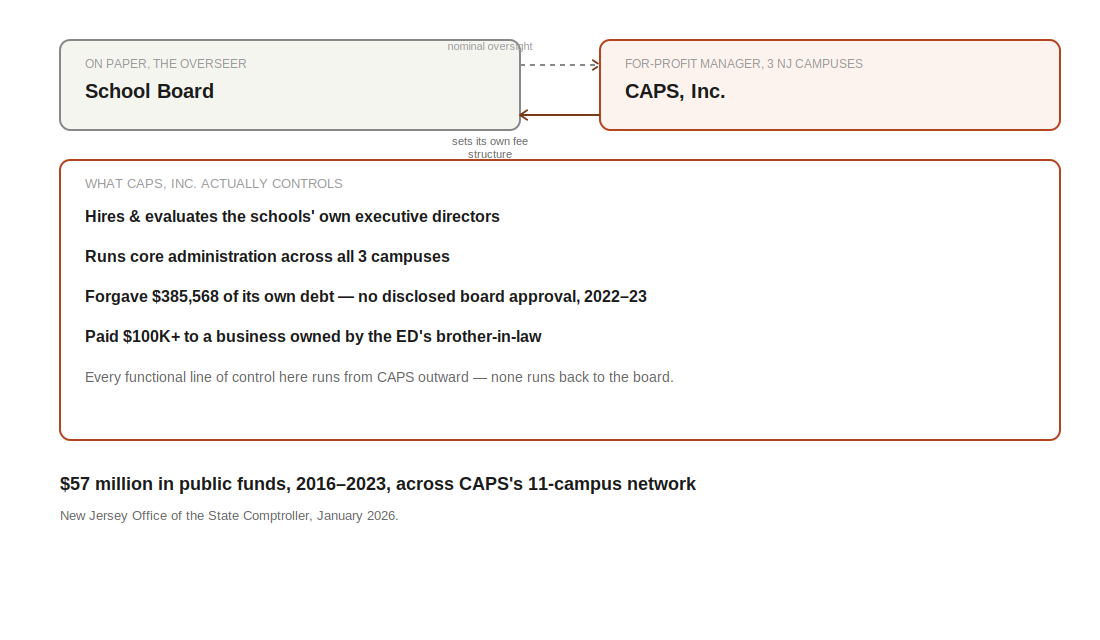
A parallel January 2026 finding by New Jersey’s Office of the State Comptroller extends the pattern from curriculum and real estate into something closer to full operational control. Reviewing College Achieve Public Schools, Inc. (CAPS, Inc.) — the for-profit manager of three New Jersey charter schools, including College Achieve Greater Asbury Park — investigators found the schools’ own board had, in the Comptroller’s word, ceded “sweeping authority” to the vendor: hiring and evaluating the schools’ own executive directors, running core administrative operations across all three campuses, and controlling the fee structure governing its own compensation. Across its eleven-campus network, CAPS, Inc. had received $57 million in public funds between 2016 and 2023; in the single year 2022–23, the company forgave $385,568 in debt the school owed it, without disclosed board approval, and separately paid more than $100,000 to a business owned by the brother-in-law of the network’s own executive director. A vendor empowered to hire its own overseer, forgive its own debts, and route six figures to its chief executive’s in-laws is not managing a school’s company store so much as it has become the only store left standing — the board that was supposed to shop elsewhere no longer meaningfully can.
The scale, side by side
Here’s the scale, side by side, with the caveat that these cover different time periods and shouldn’t be read as directly comparable — they’re listed to show that the mechanism spans small dollar amounts and very large ones, not to rank the cases:
| Case | Amount | Period |
|---|---|---|
| CSMI / Chester Community (PA) | $60.6 million | cumulative since 1999 |
| CAPS Inc. (NJ) | $57 million | cumulative, 2016–2023 |
| Academica (Miami) | $28 million | per year (mgmt. fee + rent) |
| Relay GSE tuition from Uncommon’s new hires | ~$6 million | cumulative, by 2015 |
| Learning Matters / Calibre Academy (AZ) | $5.3 million | per year (curriculum + tech + mgmt.) |
| Burke Basic / Gaddie family (AZ) | $542,000 | per year (real estate) |
| Crown Charter / Five Star Educational Research (AZ) | $111,200 | per year (curriculum) |
The one thing every case shares
Every one of these arrangements was, at the time it was examined, either fully legal or defensible under existing disclosure rules. That’s the finding that matters more than any single dollar figure. A related-party disclosure requirement that surfaces the relationship only in an audited financial statement’s footnote, months after a board has already signed the contract, isn’t stopping anything — it’s documenting it. Every case above cleared the bar its state actually set. None of them was stopped by it.
I go into all five of these in more depth — with the full sourcing, the underlying filings, and a field guide for anyone who wants to trace their own local charter operator’s related-party contracts — in a chapter of the same name in the book I’m currently drafting, The Grift Model. If you want to run the same check on a school in your own community, start with three documents: the school’s Form 990 (Schedule L for related-party transactions, Schedule R for related organizations), your state’s charter-authorizer annual audit, and your state’s corporate registry for whoever’s name is on the vendor’s paperwork. None of it requires a subpoena. It just requires running the same name through more than one place and seeing whether it comes back twice.
Sources
- Baker, B. D. (2016, December 12). The charter school company store. School Finance 101.
- StateImpact Florida. (2011, December 14). How Academica became the biggest name in Florida charter schools. NPR (drawing on Miami Herald reporting).
- StateImpact Florida. (2014, April 21). Feds investigating Florida’s largest charter school management firm. NPR.
- The Philadelphia Inquirer. (2009, May 25). Inquirer wins appeal; Chester charter school must produce records.
- WHYY. (2016). Federal report on charter schools elicits more calls to revise Pa. law.
- CAPS. (n.d.). How Chester Community Charter School got a 9-year deal (summarizing Philadelphia Inquirer reporting).
- Chalkbeat Philadelphia. (2016, June 14). Own a school? Or rent? For charters, it’s complicated.
- ABC15 Arizona. (n.d.). All in the family: Arizona charter schools and “related-party” transactions.
- New Jersey Office of the State Comptroller. (2026, January 12). OSC presses for oversight after charter school delegates sweeping control to vendor.
Related reading: The Charter School Company Store (2016) and the Edu-Grift hub for the rest of this series.


One thought on “The Charter School Company Store, Revisited”
Comments are closed.