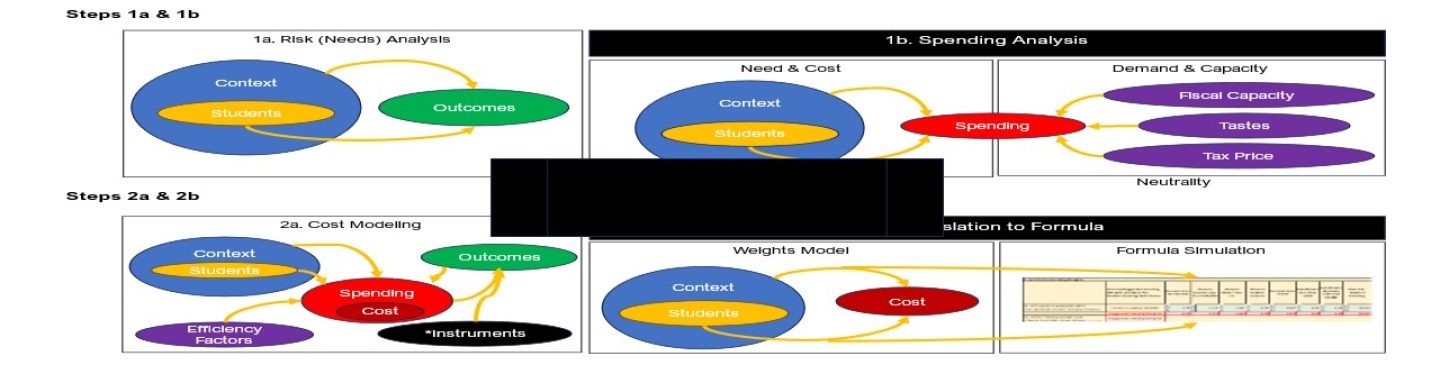
“The schools got a spending problem.” Budgets went up, scores stayed flat, so the money must be going to waste. It’s one of the most repeated lines in education policy, and it almost always mixes up four words that mean different things: productivity, spending, cost and efficiency.
I laid out the definitions in Defining Productivity, Cost, and Efficiency (2024). This time a saloon crooner in a fedora sorts them out, backed by a big band. Pull up a stool.
Four words they keep mixing up
Productivity is what the schoolhouse makes: how many students are served and graduated, how well they learn (usually measured by reading and math scores in grades 3–8, increasingly as value-added), and, in the long game, outcomes like earnings and civic participation.1
Spending is every dollar out the door, now or later: staff, buses, food, buildings, overhead and deferred obligations like pensions. Spending just adds up the bill. It doesn’t ask what you got for it.2
Cost is the least you’d have to spend to reach a given level of outcomes, for these students, in this place. It depends on the wages a district has to pay, how remote and spread out it is, how big it is, and who its students are. The same results cost more for some kids and some communities.3
Efficiency is the relationship between the two. Spending minus inefficiency equals cost, so the gap between what’s spent and what it would cost is the inefficiency. But not everything outside the test scores is waste. The band, the ball field and the art room serve purposes communities value that test-based outcome measures don’t capture.4
“Cut costs!” usually means cut spending
When pundits call for “cost-cutting,” they usually mean spending cuts. Real efficiency gains mean getting the same results with less. Cut spending and lose results, and you haven’t gained any efficiency; you’ve broken even. And there’s no point chasing a theoretically perfect school. The useful work is understanding how efficient real schools and districts are on average, and how they vary around that average.5
As for all those claims that public schools are wasteful? Ask for the receipts. When Kevin Welner and I looked at the federal “Increasing Educational Productivity” project, we found its recommendations weren’t backed by substantive analyses of cost-effectiveness or efficiency.6 So next time someone tells you schools have gotten fat, ask: compared to what it costs?
Every line has a receipt
The graphs in the video are stylized illustrations of the concepts, not actual data.
| The lyric | The receipt | Source |
|---|---|---|
| “They tell me the schools got a spendin’ problem. Budgets up, scores flat. Must be waste, right?” | U.S. public schools are often described as having an efficiency problem, but those claims are rarely backed by thorough analysis. | Baker (2024); Baker & Welner (2011) |
| “How many kids walk through the door… readin’ and math, grades three through eight… the paychecks and the votes” | Productivity: quantity (students served or graduated) and quality (grade 3–8 reading and math, value-added, long-term outcomes like earnings and civic participation). | Baker (2024) |
| “The teachers and the buses, the lunches… the pensions comin’ due someday… It don’t care who passed the test.” | Spending: all current and deferred expenses, regardless of outcomes. | Baker (2024) |
| “It’s the least you’d have to spend to hit the mark… with the wages that you’ve got to pay… or the district’s small and far away” | Cost: minimum spending for a given outcome level, given student backgrounds, wage variation, remoteness and economies of scale. | Baker (2024) |
| “Kids in poverty, kids learnin’ English… Same results cost more for some” | It costs more to reach the same outcomes with some students than with others. | Duncombe & Yinger (2005); Baker, Weber & Srikanth (2021) |
| “Take your spendin’, subtract the waste, and what’s left over, that’s the cost” | Spending – inefficiency = cost. | Baker (2024) |
| “The band, the ball field, the art room, they ain’t in the scores you found” | Valued spending on athletics, arts and community programs isn’t captured by test-based outcomes, which doesn’t make it unnecessary. | Baker (2024) |
| “When a pundit says ‘cut costs,’ he means cut the spend… cut the spend and lose results… you just broke even” | “Cost-cutting” usually means spending cuts. Real efficiency means doing the same with less; cuts that lower outcomes are a break-even on efficiency. | Baker (2024) |
| “Nobody’s built the perfect school… look at how the real ones vary” | Don’t chase the theoretically perfect school; study average efficiency and how real districts vary around it. | Baker (2024) |
| “All those claims the schools are wasteful? Ask for the receipts.” | The federal productivity project’s recommendations weren’t backed by substantive analyses of cost-effectiveness or efficiency. | Baker & Welner (2011); Baker & Welner (2012) |
Key literature
- Baker, B.D. & Welner, K.G. (2011). Productivity research, the U.S. Department of Education, and high-quality evidence. Boulder, CO: National Education Policy Center.
- Baker, B.D. & Welner, K.G. (2012). Evidence and rigor: Scrutinizing the rhetorical embrace of evidence-based decision making. Educational Researcher, 41(3), 98–101.
- Duncombe, W. & Yinger, J. (2005). How much more does a disadvantaged student cost? Economics of Education Review, 24(5), 513–532.
- Baker, B.D., Weber, M. & Srikanth, A. (2021). Informing federal school finance policy with empirical evidence. Journal of Education Finance, 47(1), 1–25.
Read the full case
Defining Productivity, Cost, and Efficiency (Nov. 25, 2024)
Companion songs: Not the Price of Bread and Why Cost Matters
More songs: School Finance Rock
Full lyrics: Spendin’ Ain’t the Same as Cost
[Intro]
They tell me the schools got a spendin’ problem.
Budgets up, scores flat. Must be waste, right?
Pull up a stool, pal. There’s four little words they keep mixin’ up,
and I’m gonna sort ’em out for ya.
[Verse 1]
Number one’s productivity, that’s what the schoolhouse makes:
How many kids walk through the door, and how much learnin’ takes.
Readin’ and math, grades three through eight, that’s the yardstick most folks use,
And the long game, pal: the paychecks and the votes the grown kids choose.
[Verse 2]
Number two is spendin’, every dime that’s out the door:
The teachers and the buses, the lunches, the lights, the floor,
The pensions comin’ due someday, the overhead, the rest.
Spendin’ just adds up the bill. It don’t care who passed the test.
[Chorus]
’Cause spendin’ ain’t the same as cost, baby,
No, cost ain’t the same as waste.
Spendin’s what you paid, and cost is what it takes
To get the kids to the right place.
Take your spendin’, subtract the waste,
And what’s left over, that’s the cost, ace.
Spendin’ ain’t the same as cost, baby,
So don’t you mix ’em up in haste.
[Verse 3]
Number three is cost, and here’s where the fellas get it wrong:
It’s the least you’d have to spend to hit the mark, and it don’t run long.
For these kids, in this town, with the wages that you’ve got to pay,
Out where the bus rides take an hour, or the district’s small and far away.
Kids in poverty, kids learnin’ English, kids who need a little more:
Same results cost more for some, and that’s what the word “cost” is for.
[Verse 4]
Number four’s efficiency, the one they love to quote:
Spendin’ over cost, that gap’s the waste. Go on, take a note.
But hold on, pal, before you start to swing that axe around:
The band, the ball field, the art room, they ain’t in the scores you found.
A thing the test can’t measure ain’t a thing that’s gone to waste.
It’s a different kind of good, my friend. And a town’s got a right to its taste.
[Chorus]
[Bridge]
Now when a pundit says “cut costs,” he means cut the spend.
Doin’ the same with less? Now that’s efficiency, my friend.
But cut the spend and lose results, you didn’t save a dime,
You just broke even, pal, and you wasted everybody’s time.
And nobody’s built the perfect school, so don’t go chase that ghost.
Look at how the real ones vary, and learn from what works most.
And all those claims the schools are wasteful?
Ask for the receipts. Usually there aren’t any.
[Verse 5]
So next time some fella tells you schools have gotten fat,
Ask him “Compared to what it costs?” and watch him tip his hat.
Ask him where’s the evidence, and who he bothered to check,
Ask him if he knows the difference. Ask him nice. Then hit the deck.
[Final Chorus]
[Outro]
Spendin’… ain’t cost… Cost… ain’t waste…
Write that one down, kids.
- Baker (2024), Defining productivity, cost, and efficiency. Productivity is measured by quantity (students served or graduated) or quality (usually reading and math scores in grades 3–8, increasingly value-added, and potentially longer-term outcomes like earnings or civic participation). ↩︎
- Baker (2024). Spending covers all current and deferred expenses for programs, services and supports, including food, transportation and overhead, regardless of outcomes. ↩︎
- Baker (2024). Cost is the minimum spending needed to reach a given outcome level, given student backgrounds and contextual factors such as wage variation, remoteness and economies of scale. On student needs, see Duncombe, W. & Yinger, J. (2005). How much more does a disadvantaged student cost? Economics of Education Review, 24(5), 513–532. For national district-level cost estimates, see Baker, B.D., Weber, M. & Srikanth, A. (2021). Informing federal school finance policy with empirical evidence. Journal of Education Finance, 47(1), 1–25. ↩︎
- Baker (2024). Spending – inefficiency = cost. Spending on athletics, arts and community programs serves other purposes that test-based outcomes don’t capture, which doesn’t make it unnecessary. ↩︎
- Baker (2024). Genuine efficiency improvement means doing the same with less. Spending cuts that lower outcomes are a break-even on efficiency. The useful work is understanding the average efficiency of real schools and districts and how they vary around it, not chasing a theoretically perfect school. ↩︎
- Baker, B.D. & Welner, K.G. (2011). Productivity research, the U.S. Department of Education, and high-quality evidence. National Education Policy Center. Baker, B.D. & Welner, K.G. (2012). Evidence and rigor: Scrutinizing the rhetorical embrace of evidence-based decision making. Educational Researcher, 41(3), 98–101. ↩︎


