Every spring, Jazz at Lincoln Center brings the best high school big bands in the country to New York to play Duke Ellington. It’s a joy to watch. It’s also, year after year, a showcase dominated by two kinds of schools: audition-based arts magnets, and suburban districts with more money than their costs require, sending kids who are far less likely to be poor than the kids one town over.
We like to call jazz America’s democratic art form, a music stitched together from blues and spirituals, New Orleans brass bands, Afro-Cuban rhythm and European harmony, open to anyone with a horn and something to say. Our school funding systems didn’t get the memo. And the problem doesn’t stop at who wins high school trophies. It shows up in where today’s most acclaimed young players went to school.
Put bluntly: if you want your kid playing lead alto at Lincoln Center, practice helps. Real estate, or an audition seat, helps more.
Two ways to look at it
- Who wins. I pulled every high school ensemble award from DownBeat’s Student Music Awards (2011–2014 and 2017–2020, the years in DownBeat’s online archive) and every U.S. finalist in Jazz at Lincoln Center’s Essentially Ellington competition from 2009 through 2026. That’s 446 appearances by 121 programs.
- Who makes it. I traced the high schools of 85 U.S.-raised DownBeat Critics Poll winners under 65: Rising Star winners from 2016 through 2026 and main-poll winners from 2016 through 2022.
As with our recent look at AP math access, I compared each public school and its district with its own labor market: the surrounding districts competing for the same teachers, not the nation. Funding adequacy comes from the National Education Cost Model in the School Finance Indicators Database, which compares actual spending with the estimated cost of reaching national-average outcomes. School demographics come from federal enrollment data (2021–22).
Who wins: better funded, less poor, whiter than the neighbors
Among the 83 neighborhood public high schools that won or made the finals, the typical winner is advantaged relative to its neighbors on every measure:
- Funding: the median winning district is funded at 1.13 times its labor market’s adequacy, and 61 of 79 are above their regional average.
- Poverty: the median winning school is 24 percent low-income against 41 percent across the region’s high schools. Roughly three of every four nearby high schools are poorer.
- Race: the median winner is 25 percent Black and Hispanic against 36 percent regionally.
It isn’t just the winners. Across all districts with 2,000 or more students, the chances of producing a winning program climb steadily with relative funding and fall with relative poverty.
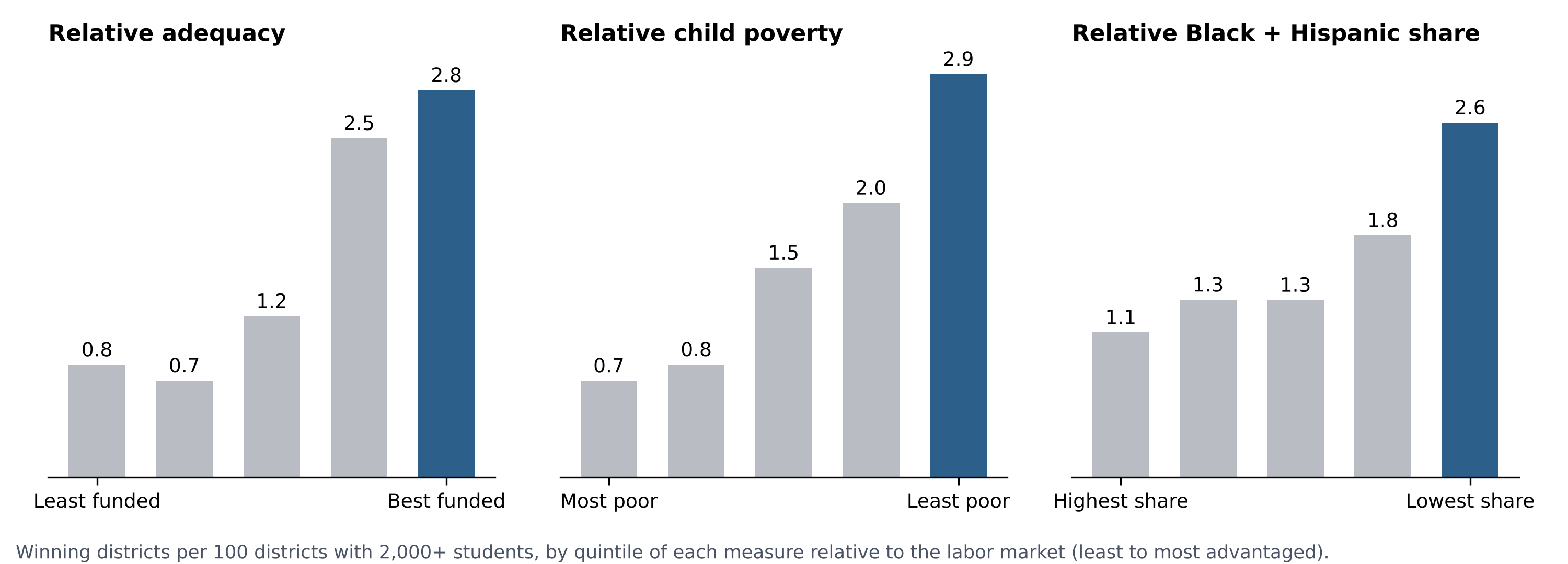
Funding, poverty and race travel together, so it’s hard to pull them apart statistically. In models with all three, relative poverty carries the most weight. Funding matters most when comparing districts within the same state: an extra 0.10 of relative adequacy raises the odds of having a winner by about 17 percent.
Who makes it: the neighborhood band room has dropped out
The Critics Poll winners tell a generational story. Among those born between 1961 and 1979, half of those whose high school is on record came up through neighborhood public schools, and most of those schools are poorer than their regions: Wycliffe Gordon at Butler High in Augusta, Gregory Porter at Highland High in Bakersfield, Ralph Peterson at Pleasantville High in New Jersey, Jimmy Greene at Bloomfield High in Connecticut, Terri Lyne Carrington at Medford High outside Boston.
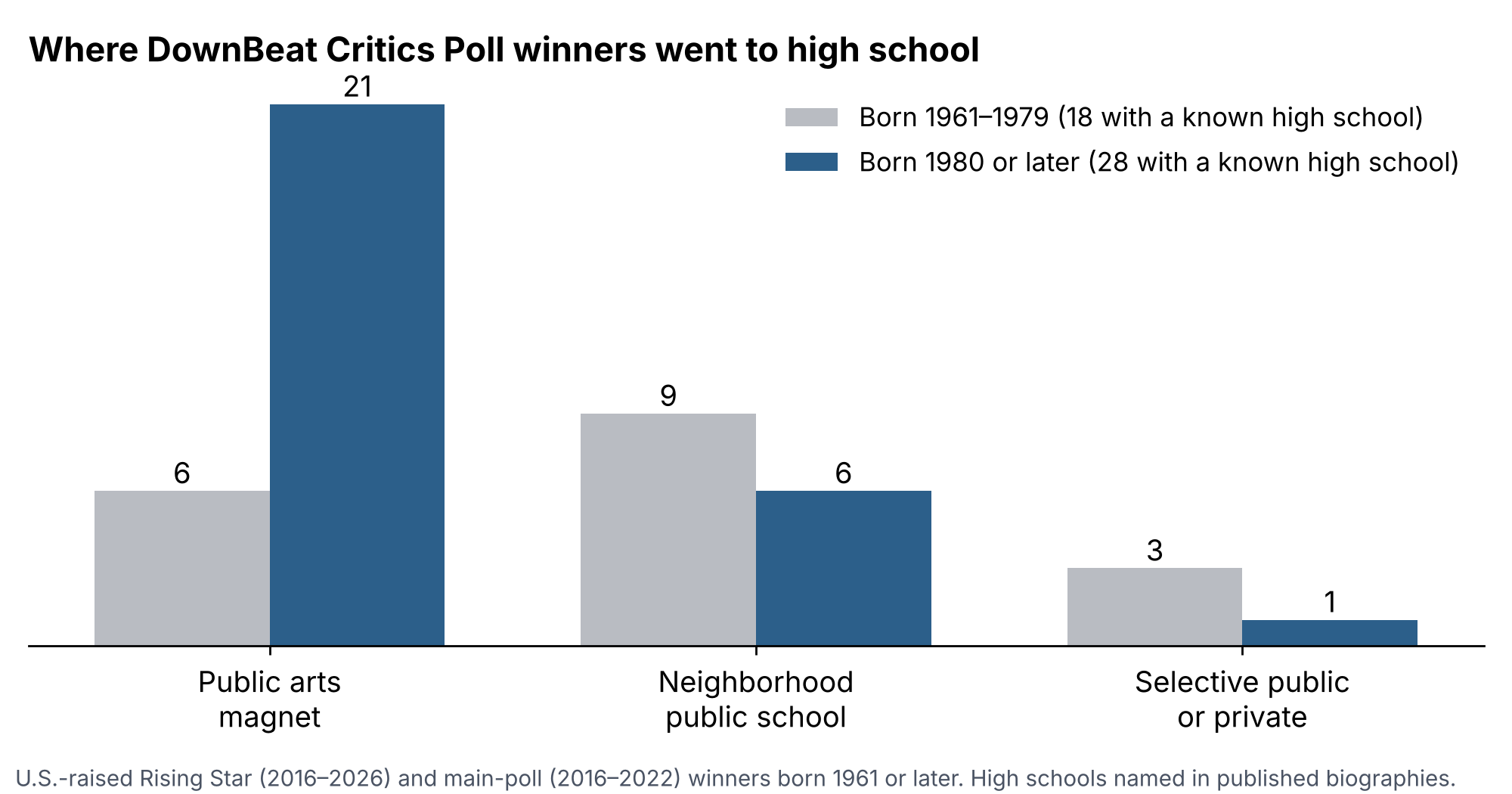
For those born since 1980, the picture flips. Twenty-one of 28 with a known high school came through public arts magnets: Houston’s High School for the Performing and Visual Arts (Robert Glasper, James Francies), LaGuardia (Lakecia Benjamin), Douglas Anderson in Jacksonville (Theo Croker, Ulysses Owens Jr., Jamison Ross), Duke Ellington in D.C. (Ben Williams), Booker T. Washington in Dallas (Jazzmeia Horn), LACHSA (Gerald Clayton, Kris Bowers). Eleven of the 14 magnets I could measure enroll far fewer low-income students than their regions: a median of 27 percent against 55 percent.
The younger players who did come out of neighborhood schools mostly came from places like John Jay High in Katonah-Lewisboro (Nir Felder; a district funded at 2.66 times its labor market), New Trier (Aaron Weinstein), Berkeley (Ambrose Akinmusire) and Montclair (Emmet Cohen). The older anecdotes fit too: Brad Mehldau and Joel Frahm in the Hall High jazz band in West Hartford, and Kevin Hays and Gary Versace growing up in Greenwich. Thundercat, out of Locke High in Watts, is the real exception.
Magnets: excellence by audition
Public arts magnets are 14 percent of the competition programs in my data but took 19 of the 47 Essentially Ellington podium places since 2009. They are how big, under-funded, majority-minority urban districts compete. Their districts average 0.87 of labor-market adequacy, and Houston, Dallas and Duval are all well below. Dillard in Fort Lauderdale, which is 96 percent Black or Hispanic and 80 percent low-income, has won Essentially Ellington three times. But most magnets enroll a much less poor slice of their cities than the comprehensive high schools down the street. That’s excellence for a few hundred audition-selected kids per city, not a pipeline for everybody.
There are neighborhood-school exceptions worth celebrating. Beloit Memorial in Wisconsin has made 13 Essentially Ellington finals from a district funded at 70 percent of its labor-market adequacy, with two-thirds of its students low-income. Memphis Central won the whole thing in 2025. Garfield in Seattle, Quincy Jones’s alma mater, still wins with a student body that looks like its region. They tend to rest on extraordinary directors, which is exactly the kind of thing adequate funding is supposed to make less rare.
Listen
None of this takes anything away from the kids or their band directors. These are terrific bands. Here is Memphis Central High School, the 2025 Essentially Ellington champion:
| Band | Track record | Low-income %, school / region | Watch |
|---|---|---|---|
| Osceola County School for the Arts, Kissimmee, FL (arts magnet) | Essentially Ellington champion 2022, 2023 and 2026 | 41 / 45 | 2026 · 2023 |
| Memphis Central High School, Memphis, TN | Essentially Ellington champion 2025 | not available | at Lincoln Center, May 2025 |
| Dillard Center for the Arts, Fort Lauderdale, FL (arts magnet) | Champion 2011, 2012, 2018; seven podium finishes | 80 / 54 | 2019, “Blues to Be There” · 2015, “Cotton Club Stomp” |
| Roosevelt High School, Seattle, WA | Champion 2019; 16 finals since 2009 | 15 / 38 | 2019 · 2024 |
| Garfield High School, Seattle, WA | Champion 2009 and 2010; 11 finals | 40 / 38 | 2014, “Black and Tan Fantasy” · 2024 |
| Beloit Memorial High School, Beloit, WI | 13 Essentially Ellington finals | 66 / 43 | 2022, “The Tattooed Bride” |
| Folsom High School, Folsom, CA | 17 DownBeat awards, 11 outright wins | 12 / 39 | Jazz Band I, 2017 |
| Rio Americano High School, Sacramento, CA | 9 DownBeat awards, 8 Essentially Ellington finals | 28 / 39 | 2019, “Tutti for Cootie” |
| Foxborough High School, Foxborough, MA | 11 finals, three podiums | 21 / 19 | 2022, “Symphony in Riffs” |
| Agoura High School, Agoura Hills, CA | 10 finals; third in 2024 | 26 / 65 | 2023 |
| Tucson Jazz Institute, Tucson, AZ (community program) | Champion 2013, 2014 and 2017 | not a school | 2016, “Old King Dooji” |
Democratizing jazz is a school finance problem
A nationally competitive jazz program is expensive in ordinary ways. It needs a specialist director (often two), a string bass, a drum kit, a baritone sax and a vibraphone the school owns, rehearsal time in the school day, a middle school feeder band, and money for recording, entry fees and travel. Districts with more money than their costs require can carry all of that as part of a full curriculum. Districts below adequacy cut it first, or concentrate it in a single magnet, or leave it to tuition-based community programs. Those programs took another 10 of the 47 Essentially Ellington podium places.
So, is jazz a music of privilege? Not in any simple sense: many of the best magnets are majority Black and Hispanic, and some of the most decorated bands come from cities that their states under-fund. But the door has narrowed to two entrances: live somewhere advantaged, or win an audition seat. A generation ago a working-class neighborhood high school in Augusta or Bakersfield could still produce a major jazz musician. That’s the door that has closed, and it’s the one adequate, equitable school funding is supposed to hold open. It’s the same story we told about AP math: the programs that look “extra” are exactly where relative funding advantage turns into visible opportunity.
A few caveats. These are competition results, and entering takes a recording and fees, so some strong programs never show up. I could retrieve only 8 of the last 18 years of DownBeat student results. Biographies name a high school for only 46 of the 85 Critics Poll winners, and school demographics are a recent snapshot, not conditions when each musician attended. The full working paper has the models and the complete lists.
Sources: DownBeat Student Music Awards (2011–14, 2017–20 results); DownBeat Critics Poll results, e.g. 2022 and 2020; Jazz at Lincoln Center Essentially Ellington announcements and 2026 winners; School Finance Indicators Database, National Education Cost Model; NCES Common Core of Data via the Urban Institute Education Data Portal; musician biographies from Wikipedia, All About Jazz, Point of Departure, Berkeley High Jazz and NPR.


Bruce, thank you for this analysis. Reading it, I also can’t help but think about the politics of aesthetics and canon. In the context of Lincoln Center, especially for youth bands, “Jazz” as a genre is bounded by a fairly narrow set of parameters. The type of “Jazz” these young people are evaluated on is an art form developed in the mid-twentieth century almost entirely by people of color, most of whom lived in the communities which today would have the “least funded” schools in your analysis. Now canonized and used in competitions, what was once cultural can now be evaluated as a set of skills a musician learns and works with, so, of course, those districts that have the time and money to drill those skills also have the best chance. But what about culture? Those “least funded” communities are still hot beds of culture full of the sounds and skills immigrant communities bring with them–the very stuff that made the canonized version of “Jazz.” If there was space for the creativity and culture of those young people within the framework of these competitions, we might see these metrics shift a bit.
I could not agree more and that’s largely why I finally got around to writing this piece that I’ve been wanting to write for decades, actually. AI made it easier to scrape the DB and EE awards data and like to my school finance data. I might go so far as to argue that having the common pathways to jazz performance be through these schools and districts has also, IMHO, sucked some of the life, musicality and soul out of the music. I hear so many kids and young adults these days with incredible technical skill and lots of patterns under their fingers, but few if any who develop a musical solo and within it, play each not from its beginning to end.
This is also tied to the parental resources used to access private lessons, professional quality instruments and other set up. I’ve noticed in the past decade or so, elite private independent schools developing strong jazz programs, because many great musicians live in the area. Newark Academy in Livingston NJ is one of them. When I taught at an elite private school in NYC in the 90s, we had great full time and part time jazz faculty on staff.