Or: if you wouldn’t buy it with your own money, maybe don’t buy it with mine.
I keep hearing that vouchers are the fiscally conservative choice. Competition, markets, money following the child, all that. Fine. Let’s take that seriously. Let’s run vouchers through the same tests a fiscal conservative should apply to any other $5-billion-a-year government program. Not the bumper sticker version of conservatism. Not culture wars. Not anti-woke. The green-eyeshade, show-me-the-return, who-audits-this version.
Florida makes a good test case, because Florida went big, fast. The state spent about $3.9 billion on private school vouchers in 2024–25, up from 12% of its main K-12 funding formula three years earlier to 23%. For 2025–26, the Florida Policy Institute puts total voucher spending at about $5 billion: roughly $3.8 billion through the Family Empowerment Scholarship and another $1.1 billion or so in tax credits for the Florida Tax Credit Scholarship, serving more than half a million students.
Here are five questions any economically conservative legislator should ask before adopting or expanding a program like this.
1. What are we actually buying?
The first rule of spending other people’s money: don’t pay for something that was going to happen anyway. Economists call it a windfall, or an inframarginal subsidy. Conservatives used to call it waste.
According to Step Up for Students data reported by the Florida Policy Institute, 69% of students newly enrolled since Florida went universal in 2023 were already attending private school. For those families, the state isn’t buying a change in schooling. It’s buying a discount on a purchase they had already made.
Do the math on the average Family Empowerment Scholarship of roughly $7,250. If only 31 of every 100 new users actually switched schools, the state is paying about $23,400 for each student who actually changed sectors. Florida’s public schools spend about $12,700 per pupil. So the “efficient market alternative” costs nearly twice as much per child it actually moves as the “bloated government monopoly” it’s supposed to discipline.
And some share of what’s left gets eaten by price. Douglas Harris and Gabriel Olivier find private school tuition rose 5% to 10% more in states that expanded vouchers than in states that didn’t. Hand a seller a subsidy for its customers and the seller raises the price. That isn’t a left-wing talking point. It’s Econ 101.
2. What’s the return?
Before a business scales a product, it wants evidence the product works. Here the evidence on large statewide voucher programs is not kind. Studies of statewide programs in Louisiana, Indiana, Ohio and Washington, D.C., found academic losses for students who used vouchers to switch to private schools. In Louisiana, math scores fell by about 0.4 standard deviations after one year. (I went through this research in more detail in Red State, Blue State, Round Two.)
In fairness, the best evidence for vouchers comes from Florida itself: the Urban Institute found that the Florida Tax Credit Scholarship, back when it was limited to low-income families, raised college enrollment by about 6 percentage points, mostly at community colleges, with little effect on degree completion. Notice what Florida did with that evidence. It took the one version with a plausible return, a targeted program for low-income kids, and turned it into an open-ended entitlement for families who were already paying tuition. That’s like running a pilot in one store, seeing modest results, and then opening 500 stores in neighborhoods where people already shop somewhere else.
3. What’s the next best use of the money?
This is the question that separates actual fiscal conservatives from people who just like vouchers. Every dollar has an opportunity cost. So what else could Florida buy with $5 billion a year?
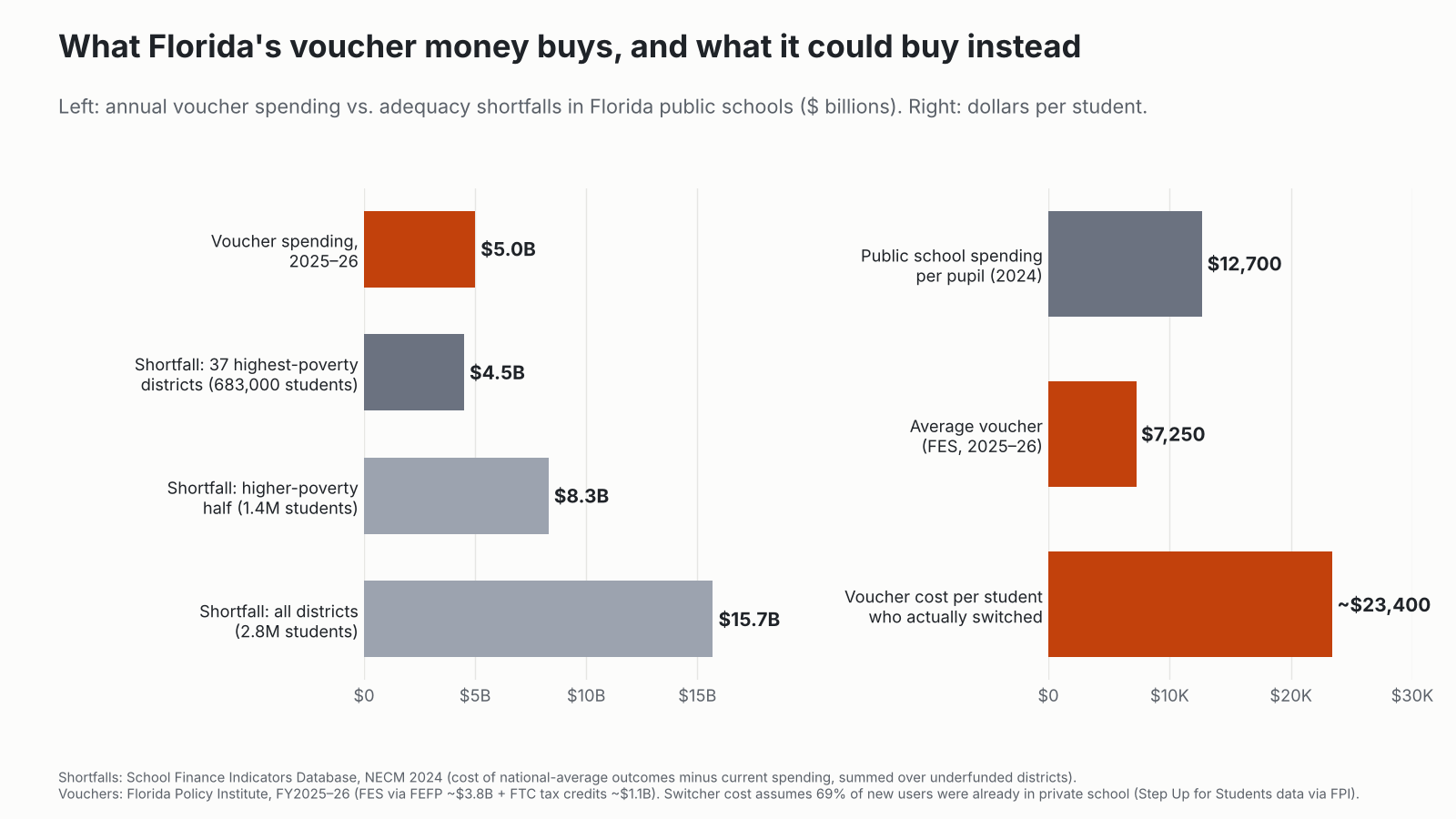
By the National Education Cost Model, 64 of Florida’s 67 school districts spend less than it would cost to reach merely national-average outcomes. Statewide, Florida’s public schools fell about $15.7 billion short in 2024. The 37 districts serving the poorest fifth of Florida’s students, about 683,000 kids, were funded at about 65% of adequate and fell about $4.5 billion short.
So for roughly what Florida now spends on vouchers, it could fully fund every one of those 37 districts to adequacy and have about half a billion dollars left over. And these aren’t the places the voucher crowd likes to caricature. The list starts with Hamilton, Putnam, DeSoto, Dixie, Bradford, Gadsden, Suwannee and Madison: mostly small, rural north Florida and Heartland counties, most of which vote the way the legislature does. They’re funded at 52% to 81% of adequate. Their families mostly don’t have a private school down the road to spend a voucher at, anyway.
What’s the return on that alternative? Here we actually have good evidence. Kirabo Jackson and Claire Mackevicius pooled the rigorous studies of school spending and found that $1,000 more per pupil sustained for four years raises test scores by about 0.03 standard deviations and college-going by about 2.8 percentage points, with larger effects for lower-income students. Spread $5 billion across the districts serving Florida’s higher-poverty half of students (1.4 million kids) and that’s about $3,500 per pupil. If the effects scale anything like linearly, that’s on the order of a 10-point increase in college-going for those kids. Compare that to the voucher alternative: a discount for families already in private school, plus test score losses for many who switch.
4. Can we audit it?
A conservative doesn’t write a check without receipts. Florida’s own Auditor General, reviewing the 2024–25 school year, found the Department of Education had trouble tracking about $270 million in voucher funds, flagged possible overpayments for roughly 30,000 students, and noted that about $47 million had gone to families for private schools while their children were actually enrolled in public schools. Imagine the press release if a public school district couldn’t account for $270 million. Actually, you don’t have to imagine. You’ve read it a hundred times.
5. Is the cost under control?
Vouchers in Florida went from 12% of the state’s main K-12 funding formula to about 24% in four years, and the cap on home-education scholarships is set to come off entirely in 2027. An uncapped, demand-driven entitlement whose fastest-growing users were already paying for the service themselves is not what most conservatives would call fiscal discipline. It’s what they’d call Medicare Part D.
The conservative decision rule
If I were advising a legislature in a state thinking about adopting or expanding vouchers, and I wanted to be as economically conservative as possible about it, I’d ask them to commit, in writing, to these before spending a dime:
- Don’t pay for what’s already happening. Limit eligibility to students currently in public school, or you’re mostly buying windfalls.
- Target where the evidence is. The only plausible positive evidence is for targeted, low-income programs. Universal eligibility has none.
- Price the alternative. Before spending $X on vouchers, publish what $X would do in the state’s most underfunded public districts, using an actual cost model.
- Require the same accountability. Same audits, same testing, same public reporting as public schools, or don’t call it accountability.
- Cap it. A fixed appropriation, not an open-ended entitlement that grows by whatever demand turns out to be.
Florida fails all five. That doesn’t make it free-market. It makes it a very expensive subsidy with a free-market logo on it.
Closing: so show me the return
To be fair, voucher advocates do sometimes try to make the return-on-investment case. It just doesn’t survive contact with their own spreadsheets.
Take the Commonwealth Foundation’s 2020 report Unleashing Educational Opportunity, which claimed that expanding Pennsylvania’s tax credit scholarships by 10% a year could yield, at the high end, about $6 billion in lifetime earnings gains, another $2.1 billion from additional high school graduates and $228 million in reduced crime. As I explained in my NEPC review, the earnings estimate rested on a 2% of a standard deviation gain in reading, borrowed from a meta-analysis of charter schools, not vouchers. It ignored math entirely, and it ignored the negative results from statewide voucher programs in Indiana and Ohio. The crime savings came from the author’s own Milwaukee study, stretched to cover the entire Commonwealth. And the caveats that the estimates shouldn’t be added together, and came from other places, sat on page 9, well away from the executive summary. Swap in Indiana’s math effect of about −0.15 standard deviations and, using the report’s own formula, lifetime earnings fall by more than 16%. As I put it then, “applying the report’s own methods, it is more likely that Pennsylvania would suffer significant economic losses, not gains.” The presentation made “mountains of molehills.”
Four years later, the Foundation was back with Pennsylvania’s Education Tax Credit Scholarships, this time playing down the cost. It described the $630 million program as about 1.7% of the $37 billion spent on K-12 from all sources. Measured against the state’s own $8.16 billion contribution, which is the relevant comparison for a state tax expenditure, it’s about 7.7%, or one of every $13 the state spends on schools. As I noted in that review, the same $630 million spread across the public school students of Philadelphia, Allentown, York and Reading would come to nearly $4,000 per pupil, in districts that, as I’ve shown, have never been funded anywhere near adequate.
Now compare that to the evidence on the other side of the ledger. Kirabo Jackson, Rucker Johnson and Claudia Persico, following children through adulthood, found that a 10% increase in per-pupil spending sustained across all 12 school years led to about 0.31 more years of completed schooling, roughly 7% higher adult wages, and a 3.2 percentage point lower annual chance of adult poverty, with effects much more pronounced for children from low-income families. The pooled studies in Jackson and Mackevicius tell the same story: real, measurable returns, larger for lower-income students.
Emily Rauscher has made the return-on-investment case most directly, and in the language a fiscal conservative should appreciate. In “Progressive Spending Is Efficient” (with Yifan Shen, in the American Journal of Sociology), she uses a decade of county-level data to show that the achievement returns to school spending are highest where prior investment has been lowest, places that often serve large shares of Black students, and that returns diminish where spending is already high. Her conclusion is the one that matters here: progressive funding isn’t just the equitable choice, it’s the efficient one. In “When Money Matters Most” (with Greer Mellon, Susanna Loeb and Carolyn Abott), comparing districts where local school funding measures barely passed with those where they barely failed, she finds that extra operating dollars raise achievement, especially in math, with significantly larger gains in low-resource districts, and that spending on teacher salaries and counselors appears especially effective for Black and low-income students. In plain terms: the next dollar buys the most where the last dollar was scarcest. That’s diminishing marginal returns, not ideology.
That’s the point an honest economic conservative should take home. Returns to public school spending are highest exactly where Florida and Pennsylvania spend least relative to need: high-poverty districts funded well below adequate. Returns to universal vouchers are, on the best statewide evidence, zero to negative, and a large share of the money doesn’t change anyone’s schooling at all. If you’re going to sell vouchers as an investment, you have to show the return. The advocates’ own estimates, run honestly, point the other way. The money that pays off is the money that reaches Putnam County and Philadelphia, not the tuition bill at a school the family was already paying.
Data notes
Adequacy and shortfalls come from the School Finance Indicators Database, National Education Cost Model (2024 release): district current spending per pupil compared with the modeled cost of national-average outcomes, with shortfalls summed as enrollment times the per-pupil gap across underfunded districts. The “poorest fifth” is the set of districts serving the 20% of public school students in the highest-poverty districts (Census SAIPE), and the “higher-poverty half” is defined the same way at 50%. Voucher spending and enrollment are from the Florida Policy Institute; the average scholarship is FES spending through the FEFP divided by FES enrollment for 2025–26. The cost per student who actually switched applies the 69% share of new post-2023 users already in private school to the average scholarship; it’s an illustration, not a program-wide estimate. Projected spending effects use the pooled estimates from Jackson and Mackevicius (2024) and assume linear scaling, which is a simplification.
Sources
- School Finance Indicators Database, National Education Cost Model (2024 release).
- Florida Policy Institute, growth in Florida’s private school vouchers and 2025–26 education budget analysis.
- Florida Auditor General report 2026-046, as reported by Spectrum News 13 and the Florida Phoenix.
- Jackson, C. K., & Mackevicius, C. L. (2024). What impacts can we expect from school spending policy? Evidence from evaluations in the United States. American Economic Journal: Applied Economics, 16(1), 412–446.
- Chingos, M., & Kuehn, D. (2017). The effects of statewide private school choice on college enrollment and graduation (Urban Institute), as summarized by Chalkbeat.
- Harris, D., & Olivier, G. working paper on voucher expansion and private school tuition, EdWorkingPapers.
- Jackson, C. K., Johnson, R. C., & Persico, C. (2016). The effects of school spending on educational and economic outcomes: Evidence from school finance reforms. Quarterly Journal of Economics, 131(1), 157–218.
- Rauscher, E., & Shen, Y. (2022). Variation in the relationship between school spending and achievement: Progressive spending is efficient. American Journal of Sociology, 128(1).
- Rauscher, E., Mellon, G., Loeb, S., & Abott, C. (2024). When money matters most: Unpacking the effectiveness of school spending. EdWorkingPaper.
- Baker, B. D. (2020). NEPC Review: Unleashing Educational Opportunity: The Untapped Potential of Expanded Tax Credit Scholarships (Commonwealth Foundation, August 2020). National Education Policy Center.
- Baker, B. D. (2024). NEPC Review: Pennsylvania’s Education Tax Credit Scholarships: How EITC Serves Children and Families in the Commonwealth (Commonwealth Foundation, September 2024). National Education Policy Center.
- Baker, B. D. (2026). Red State, Blue State, Round Two and A Philadelphia Story of Underfunding. School Finance 101.


