Parsing Charter School Disability Enrollments in PA and NJ

Here are a few quick figures that parse the disability classifications of children with disabilities served by charter schools in Pennsylvania and New Jersey.

Two previous posts set the stage for this comparison. In one, I explained how charter schools in the city of Newark, NJ, by taking on fewer low income students, far fewer LEP/ELL students and very few children with disabilities other than those with the mildest/lowest cost disabilities (specific learning disability and speech/language impairment) are leaving behind a much higher need, higher cost population for the district schools to serve.

Effects of Charter Enrollment on District Enrollment in Newark:

https://schoolfinance101.wordpress.com/2012/08/06/effects-of-charter-enrollment-on-newark-district-enrollment/

In another post, I walked through the financial implications of Pennsylvania’s special education funding formula and specifically the charter school special education funding formula on districts where large shares of low need disability students are siphoned off by charters and where high need disability students are left behind to be served by districts with depleted resources.

The Commonwealth Triple-screw:

https://schoolfinance101.wordpress.com/2012/06/05/the-commonwealth-triple-screw-special-education-funding-charter-school-payments-in-pennsylvania/

In short, under the Pennsylvania charter school funding formula, for each child classified as having a disability and choosing to attend a charter school, the sending district must pay the “average special education expenditure” of the district – regardless of the actual IEP needs of that student. So, there’s a strong financial incentive to serve large numbers of low need special education students in PA charters. But this, of course, leaves a mess behind for local districts, who then have a far higher need special education population and have lost substantial shares of their available funding (due to a completely arbitrary and wrongheaded calculation of the sending tuition rate).

This post merely provides a few more comprehensive follow up figures on the issue of higher versus lower need disability students and charter school enrollments.

First, in New Jersey, here’s the statewide breakout of charter special education enrollments and market shares based on data from 2010 (same as used in Newark post)

  • In short, charter schools in NJ serve about 1.7% of the population.
  • They serve about 1.05% of the population of children with disabilities.
  • AND… they serve only  about .23% of the population of children with disabilities other than Specific Learning Disability or Speech/Language Impairment!

That’s a big deal! It’s a big deal because this leaves behind significant numbers of high need disability children to be served by districts. And, to the extent that charter expansion follows the same trend, this will lead to even greater concentration of children with disabilities in general in district schools and children with more severe disabilities in particular.

Here’s the average disability classification profile for NJ public districts and for NJ charter schools.

Now, for Pennsylvania, where there exists a significant incentive for charter schools to boost their special education populations but to avoid serving children with more severe disabilities. Here are the counts for counties with at least 500 students in charter schools:
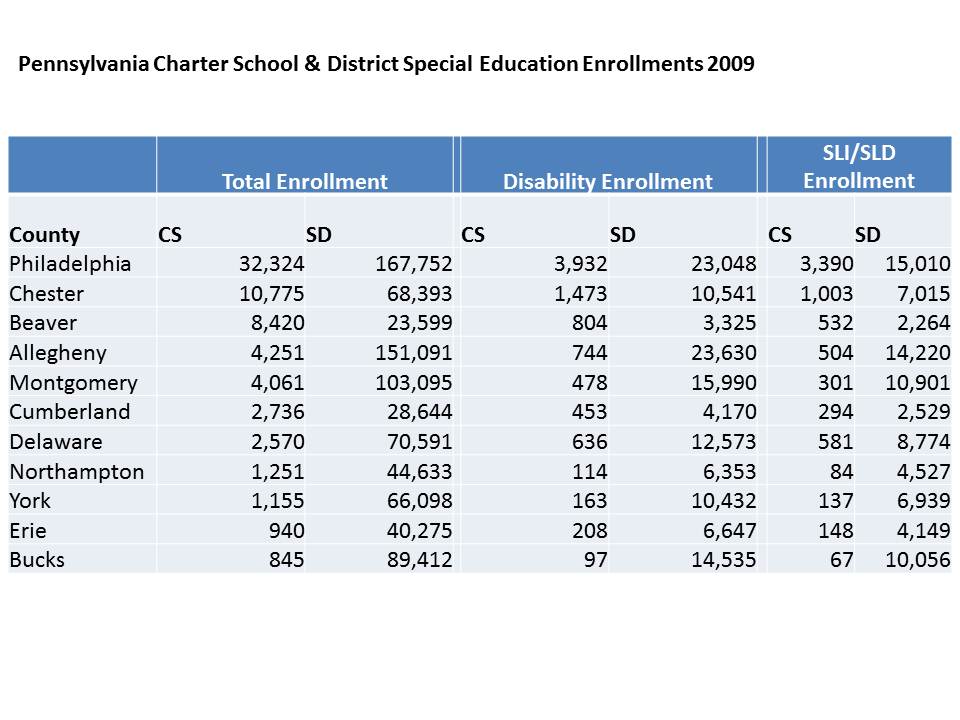
Here are the enrollment shares within counties:
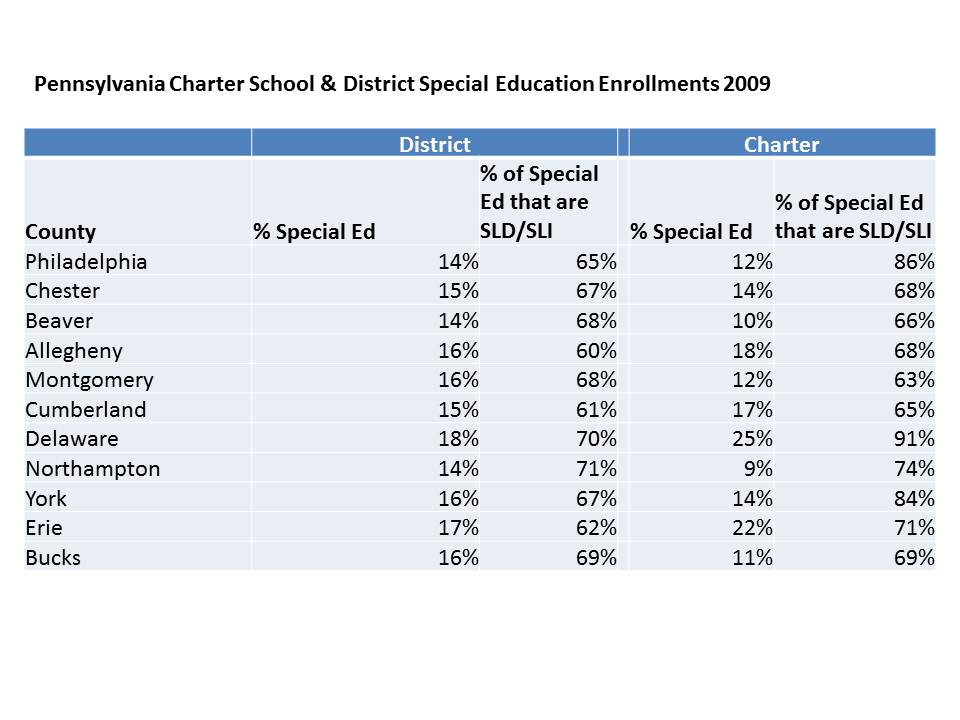
And finally, here are the population shares served:
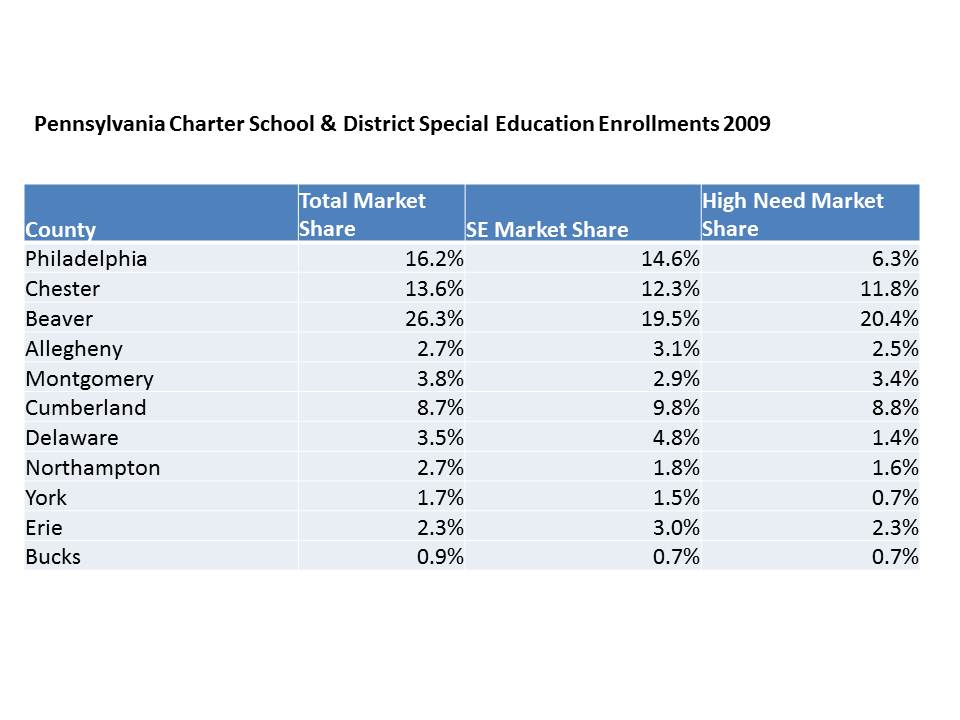
So, for example, in Philadelphia county, which is the city:

  • Charter schools serve 16.2% of the student population
  • Charter schools serve about 14.6% of the children with disabilities
  • BUT… charter schools serve only about 6.3% of children with disabilities other than SLD or SLI!

Even in those counties where charters serve a larger share of the county-wide total special education population, they only occasionally serve an equitable share of children with more severe disabilities (often in specialized schools).

In Delaware County, charters do serve a higher overall special education population share than districts in the county, but serve a much smaller share of non-SLI/SLD disabilities. And Chester-Upland in particular bears the fiscal brunt of this practice!

That said, clearly, PA charter schools are generally serving more comparable aggregate shares of children with disabilities than NJ charter schools and perhaps the financial incentive plays a role.

Again, a critical issue here is the nature of the population left behind in district schools.

These figures also dispel a common assertion of charter advocates/pundits who, when challenged as to why special education rates tend to be generally low in charters, often argue that it’s because the charters are implementing better early interventions and thus avoiding classifying children in marginal categories like “specific learning disability.” To begin with, there’s absolutely no evidence to support this claim. That aside, these figures show that in fact, many charters do seem to have plenty of students in these marginal categories. What they don’t have is students in the more severe disability categories such as mental retardation and traumatic brain injury and it is certainly unlikely that charter school early interventions are successfully preventing children from being later misclassified into these categories.

Statewide, of 724 children with TBA, only 7 were in charters. Of 21,987 mentally retarded children, only  396 (1.8%) were in charters.  But about 4.1% of all enrollments were in charters.

I’ll admit… I am losing my patience on some of these issues. Excuse me for a moment while I vent. I’m losing my patience in large part because of the ridiculous responses/reactions I get every time I simply post some data either relating to charter school enrollments or finances.  I seem only to get a flood of ridiculous responses when I’m presenting information on Charter schools. Not when I criticize value-added estimates, or point out misuse of SGPs. Pretty much exclusively when I present data on charter schools.

It’s time to cut the crap and start digging into what’s really going on here, and how to move toward a system that best serves all of the children rather than ignoring and brushing aside these issues and pushing forward with what appears to be an emerging parasitic model.

Let’s evaluate the incentives. And instead of protecting perverse, damaging financial incentives like those in PA, simply because they drive more money to charters, let’s do the right thing. Hey, it may be the case that charter allocations are otherwise too low, but raising them for the wrong reasons, with a wrong mechanism  and with bad incentives is still, wrong, wrong and bad.

It may also be the case that the data we are using for making comparisons – using total of free and reduced lunch, rather than parsing income categories, comparing total special education rates instead of by classification, are encouraging charter operators to boost their enrollment subgroups by focusing on the margins. In which case, we need to make it absolutely clear by increasing data reporting precision and availability, that serving kids just under the threshold (or in marginal categories) isn’t enough. More fine grained comparisons are necessary!

I’ve said before that I don’t really believe that every school – every magnet school – every charter school – every traditional public school – can or should try to serve exactly the same population. I do believe there’s room for specialization in the system. I also believe that many charters that “succeed” so-to-speak, do so because they’ve figured out how to serve well their non-representative populations. And many would likely fail miserably at trying to serve children with more severe disabilities (as many district schools have).

BUT… accepting that there’s room for some specialization within the system and some uneven distribution of students is a far cry from what is now emerging, as charter market shares increase significantly in some cities and in some zip codes. And that must stop!

Still Searching for Miracle Schools and Superguy: Updates on Houston and New York City

I was following a conversation on Twitter a short while back in which one student activist – Stephanie Rivera of Rutgers asked another – Alexis Morin from Students for Education Reform – why SFER chooses to focus almost exclusively on charter schools as beacons of “success” and thus a significant part of the “solutions” for urban education moving forward. Observing this interaction brought me back once again to the astounding gaps in logic which are so pervasive in the current reform rhetoric which seeks to find policy solutions almost exclusively in charter schools and in changing teacher compensation and dismissal policies.  The reformy solutions are pretty much a given regardless of the original question or what the analyses yield.

Too often, the following faulty reasoning is applied in search for solutions in the education reform debate:

  1. Scan the horizon for successful charter schools (even though charters are no more successful, on average than their more dominant counterparts – district schools). [Charter schools on average, are average. Some are above average and others, well, not so much. Because charters are still much smaller in total numbers, if one was to simply look for “good” schools, the odds of picking a charter would in fact be smaller.]
  2. Assume that better-than-average charter schools – successful ones – are better than traditional public schools. [ignoring that while, by virtue of being the upper half of a similar distribution, they are really no different from the upper half of traditional public schools].
  3. Assume that because the better-than-average charter schools are better than the average traditional public school, that being a charter school  – bearing the label/classification “charter” – has something to do with it. [even though a comparable – or even larger – share of other schools bearing the label “charter” are actually doing worse than the average traditional public school].
  4. Assume that bearing the label – “charter” – necessarily means that these schools have and use creatively and inventively the substantially greater autonomy granted to them. [That is, they certainly don’t waste their time on stuff like spending more money, providing smaller class sizes and paying teachers more].

I have seen this utterly ridiculous stream of contorted logic rolled out on numerous occasions in the past few years, and even in the past few weeks.

A while back, I posted two separate entries called “Searching for Superguy” – one for New York City and one for New Jersey – in order to display the distribution of performance, corrected for demographics, for New York City and New Jersey charter schools.

Since that time, I’ve compiled quite a bit more data on charter (and other) schools in a variety of settings. I’ve also developed a clearer vision of exactly what constitutes one of those “miracle” schools we’re all searching for. A miracle school is characterized by at least the following four factors:

  1. Serves the same kids (poverty, language proficiency, disability)
  2. Spends less than other schools serving similar kids
  3. Has high average outcomes compared to schools serving similar kids
  4. Achieves better value-added on measured student outcomes than other schools

For today’s post, I offer you a tour of charter schools in New York City and in Houston Texas – two cities with significant concentrations of charter schools and two cities with significant numbers of charter schools affiliated with major charter management organizations.

A Tour of Houston and New York City Charter Schools

Serve the Same Kids?

The first question, of course, is do charter schools in these cities serve the “same kids?” as traditional public schools in the same city/borough and at the same grade level. To answer this question, I estimate regression models to three years of data (2008 to 2010) where the population characteristic of interest is the dependent variable, and a)year of data, b) location of school (city) and c) grade level/range are the independent variables. Houston is treated as a single city (uh… because it is) and New York is carved into boroughs for this analysis. That is, schools are compared with same grade level schools in their borough. Charter Schools are lumped together by CMO, with schools not belonging to major CMOs lumped together for this analysis (they are indeed a very heterogeneous group). The analysis is weighted by the enrollment of the schools.

Figure 1 shows that in New York City, Charter Schools serve a) far fewer children who qualify for free lunch , b) far fewer LEP/ELL children and c) far fewer children with disabilities than school serving the same grade level in their borough. Uncommon schools are indeed the least common. But Success academies have particularly large deficits in LEP/ELL children. These schools simply aren’t comparable in terms of student populations.

Figure 1. New York City Demographics

Figure 2 shows the Houston schools by CMO. With my present data I was unable to parse free from free or reduced price lunch, which may be important. But, this figure and some of my previous analyses confirm that at least in Houston, charters are doing a better job of serving low income kids (than NYC charters). However, most Charter CMOs still seem to have a significant aversion to children with disabilities and in most cases, also to children who are LEP/ELL.


Figure 2. Houston Demographics

Spend Less?

The spending analysis is conducted similarly, using 3 years of data and using a regression model where spending per pupil is the dependent variable and where student characteristics, grade level and year are the independent variables. This analysis plays off our recent NEPC report, using the same data (expanded to include all NYC charters, and cleaned&merged with additional measures) and same methods.  I have stayed with my original expenditure measure for BOE schools (defended here) and have used Annual Financial Report (nor IRS 990) data for charters.

Figure 3 shows that in New York City, charters are generally outspending traditional public schools serving similar student populations. KIPP and Uncommon schools are outspending BOE schools by over  $4,000 and $3,500 respectively and Harlem Childrens Zone schools are spending similarly (and that’s not even counting all of the additional money flowing to/through the parent organization. it’s just the annual financial report data!).

Figure 3. New York City Spending

Figure 4 shows more of a mixed bag in Houston. Non-major-CMO charters spend less than district schools. KIPP’s elementary schools spend less, but not consistently/significantly so (some do). Cosmos/Harmony schools also spend less, but through different means.  Others are indistinguishable, with some network schools spending more and others less (some Yes Prep schools outspend districts schools serving similar students).

Figure 4. Houston Spending

Have High Average Outcomes?

The following several graphs explore ht distribution of spending and outcomes for individual schools. Note that these graphs don’t include all of the other stuff that might need to be included to parse whether spending differences actually help produce outcome differences. That’s not the point here. Rather, these are just descriptive graphs of the relative spending and outcomes of these schools – focusing on schools serving middle grades.

Figure 5 shows that each of the charters spends quite a bit more than otherwise similar district schools. Each charter also has higher average performance (except St. Hope) than district schools. But, as shown above, they also have less needy students.  In other words, no miracles by these measures. Higher average outcomes yes. Lower spending? NO. Same kids? NO!
Figure 5. New York City Average Outcomes

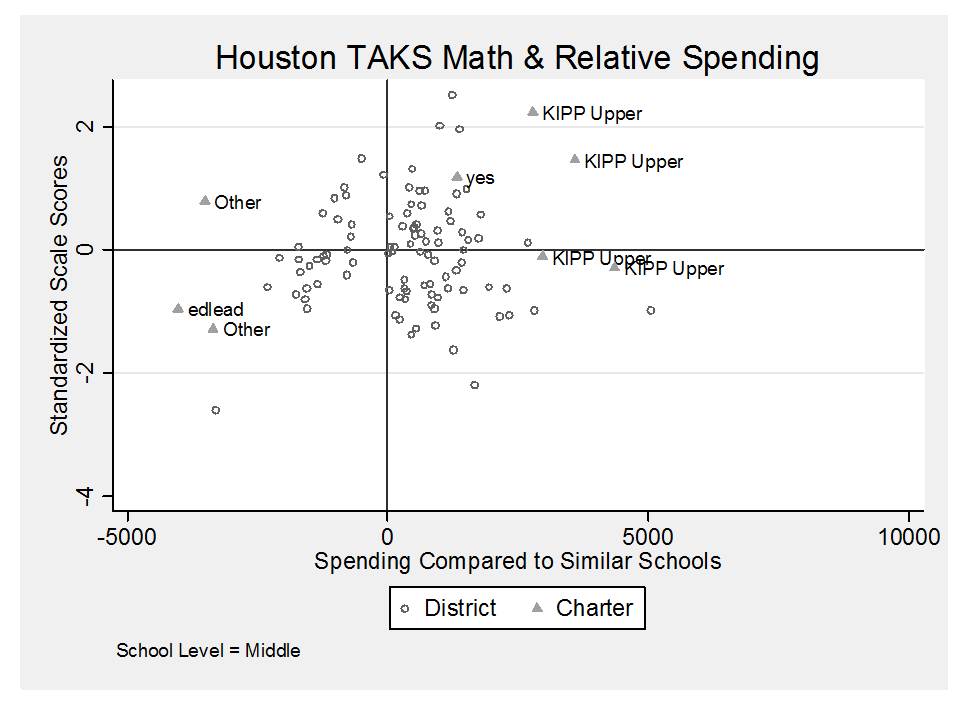
Figure 6 shows the average spending and outcomes for schools in Houston. Among KIPPs, all spend much more than district schools and two have higher than average outcomes and the other two have average outcomes. The Yes Prep school in the sample spends more and has higher than average outcomes. Meanwhile, some other charters spend less and do less well, and one spends less and has somewhat higher than average outcomes. Notably, however, the population characteristics of these schools were also mixed. It may be the case that these KIPP schools have more needy populations than the average district school, and on average are doing average to better. That’s not bad. However, we must acknowledge they are doing this at a much higher price! Similar kids? Mixed (more low income, fewer ELL or special ed). Better outcomes? Also mixed, but okay. Less money? No, actually more… a lot more.

Figure 6. Houston Average Outcomes (standardized)

Have Greater Gains?

Okay, here’s one last shot. Let’s look at achievement gains instead of just level of performance. I’ve constructed school level average gains for NYC schools by aggregating the teacher value added data for teachers in each school (weighted for the number of students who contribute to their scores in English Language Arts or Math). In other words, in this analysis a school is only as good as its teachers (consistent with reformy wisdom) and, for that matter, the children served by (linked in data records to) those teachers.

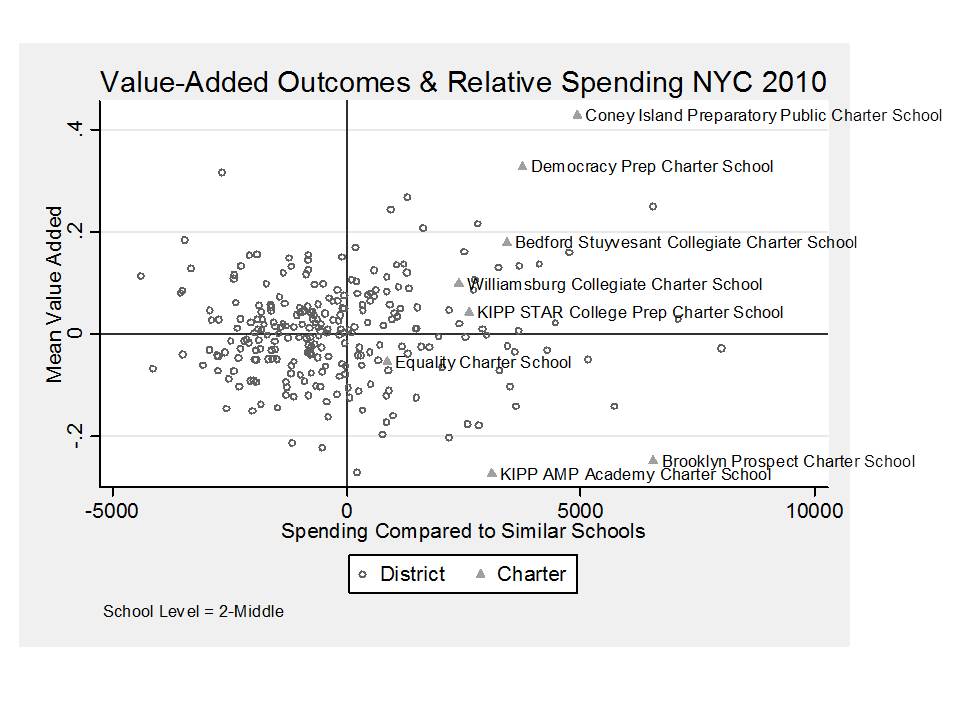
Figure 7 again shows that in New York City, charters tend to significantly outspend district schools with similar populations – well except Equality charter which is somewhat closer. On average, the average gains are indeed higher in these higher spending charters – actually moving upward in sort of a pattern. But remember, the peer groups in these schools also aren’t particularly comparable. KIPP AMP and Brooklyn prospect, however, don’t do so hot.  But, if there’s any case to be made here with these charters, resources just might matter. Not the same kids. More money. Some reasonable outcomes.

Clearly, some deeper investigation is warranted. But, in each case there are also district schools, including lower spending district schools that outperform most of the charter schools.

Figure 7. New York City Value-Added

Finally, we’ve got Figure 8, showing the distribution of school level value added ratings from the FAST TEXAS system. Here, the KIPPs in particular are more of a mixed bag. Some have higher and others lower value added.  Note that in Texas these “progress” metrics seem to be associated with student characteristics.  All of the KIPP schools and the Yes Prep school spend more than district schools. Clearly, some deeper investigation is warranted. But, in each case there are also district schools, including lower spending district schools that outperform all of the charter schools.


Figure 8. Houston Value-Added

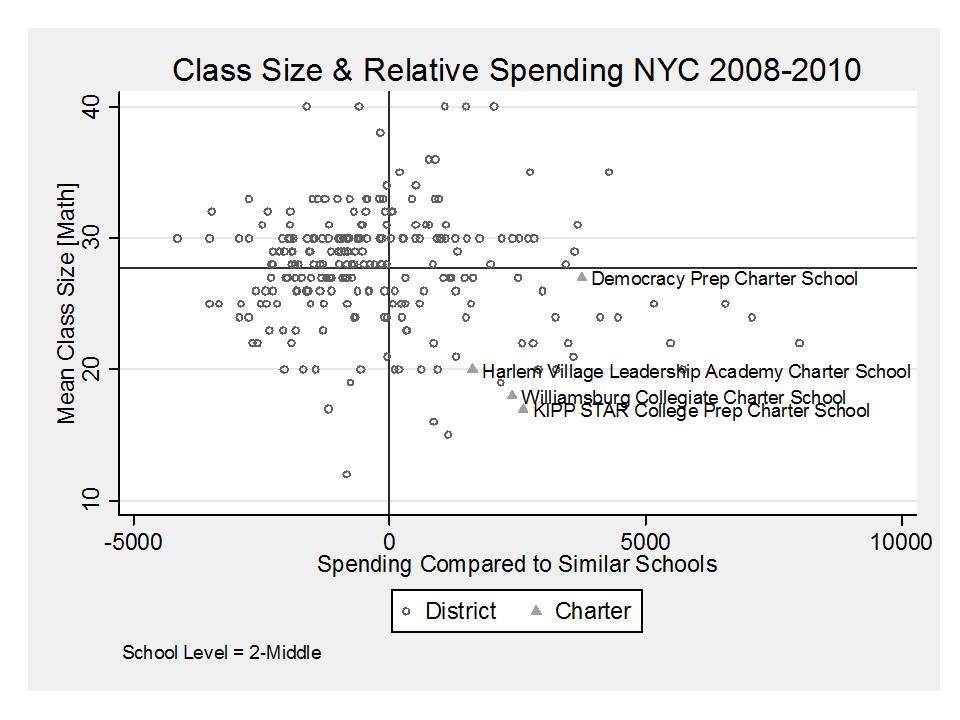
As a bonus, I also have this slide on class sizes (8th grade math) for NYC schools serving 8th grade. I’ve related class size to spending here, showing that each of these higher spending charter chains (except for Democracy Prep) seem to be leveraging at least some of that funding to provide much lower class sizes.

Bonus Slide: Class Size and Relative Spending in NYC

Closing Thoughts

In closing, we all really need to step away from the misguided logic I laid out in the beginning of this post – that “charter” in and of itself is meaningful  and that the only answers for the future of education must be found among successful charter schools – especially miracle charters under the watchful eye of Superguy. If there’s anything we know by now about Superguy is that he’s got some pretty nice financial backing!

Superschools & Miracle-Guy… uh… wait… Superguy and Miracle Schools, if they do exist, are a rarity. Further, if they do exist, they are as likely if not more likely (by sheer numbers) to be traditional public schools and not charter schools. But regardless of the governance of the schools, when looking for ideas (not “solutions”) for how to improve educational opportunities, we should be focused on the following:

  1. Attempting to learn what we can from all types of schools and not predetermining that we should look at successful “charter” schools. This is especially true since charters are proportionately no more successful than other types of schools and, given that they are smaller in total numbers, they are in total, less numerous among all successful schools.
  2. Being really, really careful about parsing out reasons for success before declaring schools to be miracles (and we should avoid the whole notion of “miracle schools”). We must look closely at population characteristics and population dynamics (mobility/attrition/neighborhood changes).
  3. When we do find schools – charter or other – that appear to be making unexpected gains, we should explore what it is that they are doing. We should explore their resource use. We should explore the strategies they employ and we should figure out not just what it is costing them to adopt these approaches but what it would cost to adopt these approaches in other settings and more broadly.

Finally, publicness and true public access matters. While we may analyze and compare schools more thoughtfully regardless of their governance. I would now argue that when we consider the policy path forward we should actually give serious consideration to their governance.

All else equal, I am increasingly uneasy with the notion of creating larger numbers and shares of schools that are LIMITED PUBLIC ACCESS as I described in a previous post on charter schools. Intended or not, this is what has become of large segments of charter schooling.

I am concerned with the effect of expanded limited public access schools on those truly public schools around them. Intentional or not, this is how charter expansion seems to be playing out.

I am equally if not more concerned with the idea of shifting larger shares of children into schools where those children and their parents may forgo their constitutional and statutory protections, except where explicitly laid out in state charter statutes. Intended or not in the letter of state charter statutes, it is the charter operators themselves who invariably invoke their “private” status when defending the stifling of teachers’ free expression, or teachers’ claims seeking damages (under federal law) for mistreatment by a state actor, or students/parents claims regarding strict enforcement of discipline codes.

The maintenance of constitutional protections and true public access – non-exclusion – MUST play a significant role in the determination of the path forward. We should not be too quick to trade constitutional protections to employee or student free speech, privacy rights, protections from unreasonable searches and various statutory rights for a few additional points on state assessments or for a few dollars cut from school spending.

That said, the figures laid out above suggest that we likely aren’t even getting systematic or sizable bang for the buck when/if we do trade these constitutional protections. So perhaps that point is moot.

Related Resources

Baker, B.D., Libby, K., & Wiley, K. (2012). Spending by the Major Charter Management Organizations: Comparing charter school and local public district financial resources in New York, Ohio, and Texas. Boulder, CO: National Education Policy Center. Retrieved [date] from http://nepc.colorado.edu/publication/spending-major-charter.

(Follow up: https://schoolfinance101.wordpress.com/2012/05/07/no-excuses-really-another-look-at-our-nepc-charter-spending-figures/)

Baker, B.D. & Ferris, R. (2011). Adding Up the Spending: Fiscal Disparities and Philanthropy among New York City Charter Schools. Boulder, CO: National Education Policy Center, 33. Retrieved April 24, 2012, from http://nepc.colorado.edu/publication/NYC-charter-disparities.

The Gulen Charter School Teacher Supply Problem

There’s been some increased interest in recent months in what are often referred to as Gulen Charter Schools, or those schools affiliated with Fethullah Gulen. I’ve tried to stay off of this topic for the most part because I don’t like to write about “conspiracy theories” or even potentially inflammatory religious/cultural issues – at least on this blog.  Here are a few recent video clips/new stories:

From Ohio: http://www.youtube.com/watch?v=4qDbELO12uo

From 60 Minutes: http://www.youtube.com/watch?v=O4OtHpUCqy0&feature=related

New York Times article on Texas Gulen Schools: http://www.nytimes.com/2011/06/07/education/07charter.html

There are also a handful of websites that provide additional highly critical information on these schools.

What has intrigued me when I’ve watched these news clips and when I’ve read other news stories, is that when these schools’ leaders are challenged as to why they hire so many teachers on visas from Turkey, their standard response is that there just aren’t enough qualified applicants for their schools from U.S. resident citizens.

Yes, teacher supply can be an issue, especially in math and science. And economic research on the topic suggests that wages – especially the competitiveness of wages with other career alternatives – may play a role. See this report for a related analysis of teacher wages in the State of Washington (& relative competitiveness of Science/Math teacher wages)

Now, I’ve been conducting several analyses of teacher salary structure over time, trying to see how charter schools pay their teachers compared to other charter schools and public districts. It’s really important to understand that wages, wage growth expectations and job security expectations all may have significant influence on the supply of quality applicants for teaching positions.

It strikes me, after looking at salary structure data on Gulen schools that therein lies the problem.

Check this out. First, there’s the graph I made for our recent report on charter school expenditures. This graph appears in an appendix to the report, and represents exploratory analysis of what’s behind some of the spending differences between charter schools and between charters and public districts.

For this graph and a following graph on NJ Gulen schools, I use teacher level data from multiple years to estimate a model of teacher salaries as a function of experience and degree level. Then I project out the predicted salary for teachers at each experience level holding degree levels constant. This gives me a picture of how teacher wages compare between schools for comparably educated teachers and at different experience levels.

Harmony (Cosmos/Gulen) schools in Texas are relatively low spending schools and have particularly low labor expenses. Notably, this network of Texas charter schools is large enough to drag down average spending and average labor costs for charters statewide.

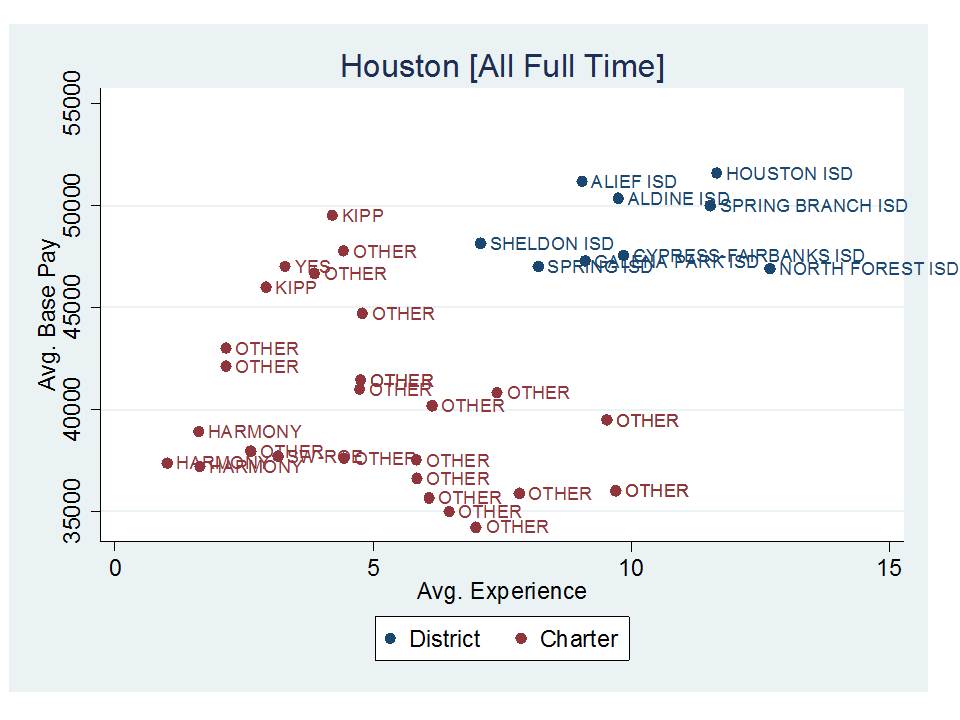
In the Houston area in particular, not only do the Gulen schools pay very low starting salaries, but salaries don’t appear to grow over the first few years of experience. Notably, the Harmony/Cosmos/Gulen schools really don’t have any teachers with more than a few years of experience. Now, this could be in part because no-one would really want to stick around if there’s no outlook for wage growth over time, or because no-one who would have intended to stick around ever applied to begin with, leading the schools to make extensive use of temporary imported staff.

Figure 1. Houston Area Wages for Charter & District Schools

Source: http://nepc.colorado.edu/publication/spending-major-charter

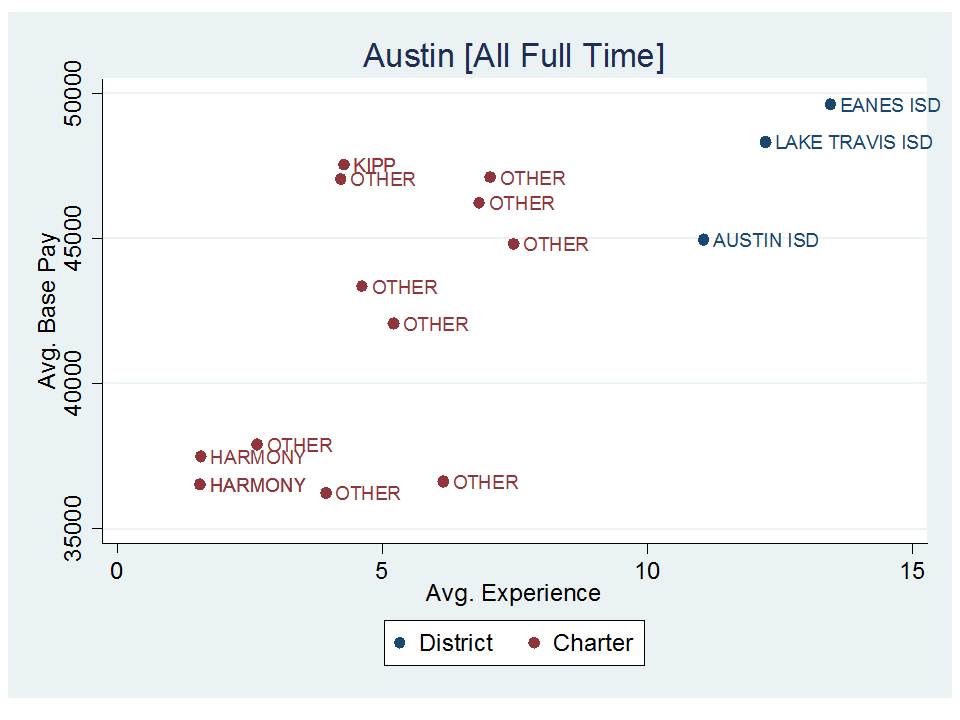
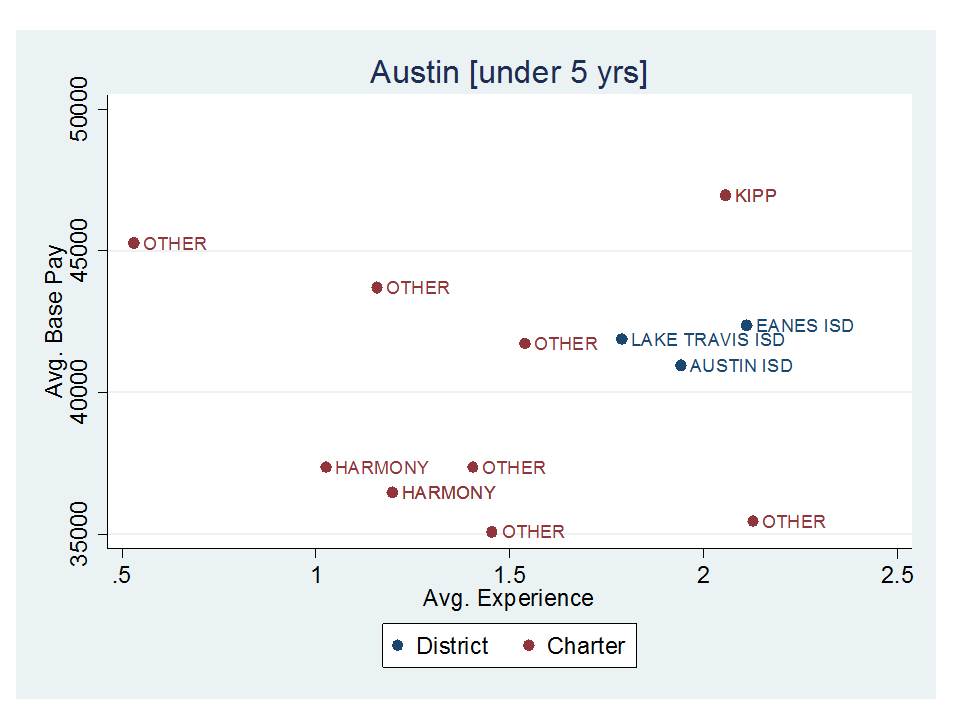
Figure 2 through Figure 4 show the average school level wages for teachers in Texas district and charter schools in Houston and Austin. Notably, Harmony schools have very low average experience levels and also have very low average salaries. They also have low average salaries even given their low average experience levels. Is it any wonder they suffer a teacher supply problem? Especially with a curricular emphasis on math and science? And especially in tech heavy urban centers.

Figure 2. Houston at all experience levels

Figure 3. Houston for teachers w/less than 5 years

Figure 4. Austin at all experience levels

Figure 5. Austin for teachers w/less than 5 years

Now, this salary structure anomaly for Gulen affiliated schools in Texas really isn’t just a Texas thing. That’s what struck me, and eventually led me to write this post – which at this point is still incomplete. Here’s what Gulen salaries look like in New Jersey, when compared with other charter schools and when compared with three major urban districts. Now, New Jersey’s urban districts have a quirky salary structure that I could quite honestly do without. As described by one NJ charter school leader, the urban districts in NJ often have a “hockey stick” salary schedule that stays relatively flat for the first several years/steps and then jumps way up around the 13th year. That actually permits some charter schools to gain a recruitment/retention edge by scaling up salaries more quickly on the front end. Notably, these charter schools to the best of my knowledge are not recruiting large shares of temporary staff from foreign countries!

But the Gulen affiliated schools – in this case Paterson Science and Technology and Central Jersey College Prep – have a strikingly similar compensation strategy to Harmony schools in Texas, and quite different from other major charter schools (notably, there are other minor charter schools that pay quite poorly, similar to the Gulen schools at the front end, but with more growth in pay for accumulated experience).  Again, one might expect these LOW and FLAT salaries to be a major barrier to generating a supply of high quality domestic applicants.

Figure 6. New Jersey Charter and District Salaries

Data Source: Based on regression model estimated to salary data from annual NJ fall staffing file. Salaries estimated as a function of a) total experience, b) degree level, c) year (3years of data included, 2008 to 2010) and d) FTE status.

In a sense, these Gulen salary structures and claims of insufficient teacher supply especially in math and science may be providing us with some insights as to what happens when we choose to pay teachers so poorly and when we strip them of any expectation of increased wages with experience. Maybe they do really have a domestic teacher supply problem. But their solution to that problem is not a scalable solution for American public schooling at large (cheap imported and temporary labor).

Quite honestly, any school that persists in offering this low a wage with no growth over time, while complaining about lack of supply of worthy U.S. applicants really isn’t even trying! Clearly, they are operating exactly how they want to operate – and have little if any interest in attracting the best and brightest science and math graduates from the U.S.

While it may be the case that some of these schools are producing reasonable average outcomes – and doing so at substantially reduced labor costs – this is clearly a model with serious limitations to its scalability. Further, there exist significant concerns that much of the apparent “high” performance in these schools is a function of student selection & attrition. (see also: http://www.texastribune.org/texas-education/texas-education-agency/what-drives-high-achievement-at-harmony-charters-/)

Just pondering. More to come, no doubt. Cheers!

For more on salary competitiveness and teacher quality/supply, see: http://www.shankerinstitute.org/images/doesmoneymatter_final.pdf

Note: There is also some evidence, like this: http://www.charterschoolwatchdog.com/tuzuk—a-contract-to-steal.html which suggests that for Turkish teachers, Gulen schools receive a sizable kickback on the salaries and levy numerous fees against those salaries. That would, of course, generate a substantial amount of money for the Gulen organization.  My Texas teacher level data set has over 800 teachers in Harmony schools in 2009-10, with cumulative reported base salaries near $30million. KIPP, Yes Prep and IDEA all have less than half of that number.  I’d appreciate any documentation readers might have regarding current contractual agreements, fees, etc. for non-U.S. employees of these schools. Thanks!

More thoughts on Charter Punditry & Declarations of Certainty

I’m a little late in pouncing on this one. JerseyJazzMan beat me to the punch with some relevant points.  A short while back, the Wall Street Journal posted an op-ed by Deborah Kenny, CEO of New York based charter chain Harlem Village Academies. Kenny’s op-ed purported to explain why charter schools are successful.  Of course, we could spend all day on that contention alone, since it is relatively well understood that charter results have been mixed at best. Indeed, I have explained in my published work and in blog posts that the track record for certain charter chains and in certain settings seems stronger than in others.

Here is how Deborah Kenny explained why charters succeed (implicitly where traditional public schools do not):

Critics claim that charter schools are successful only because they cherry-pick students, because they have smaller class sizes, or because motivated parents apply for charter lotteries and non-motivated parents do not. And even if charters are successful, they argue, there is no way to scale that success to reform a large district.

None of that is true. Charters succeed because of their two defining characteristics—accountability and freedom. In exchange for being held accountable for student achievement results, charter schools are generally free from bureaucratic and union rules that prevent principals from hiring, firing or evaluating their own teams.

http://online.wsj.com/article_email/SB10001424052702303703004577472422188140892-lMyQjAxMTAyMDIwNDEyNDQyWj.html?mod

As is par for the course of late in such arguments, Kenny’s chartery punditry is completely void of any data or contextual information that might provide insights as to why, or even whether charter schools “succeed.” Yet, while bafflingly void of substantiation, Kenny’s punditry is disturbingly decisive & hyper-confident.

It is yet another case of declaring to know absolutely what we absolutely don’t know!

For the moment, let’s accept Kenny’s proposition that at least in New York City, many charter schools affiliated with high profile management organizations have posted solid test scores (not entirely the case… but let’s accept that proposition…).

So then, let’s compare New York City charter schools from these CMO chains to traditional public schools in the city on a handful key parameters – a) how much they spend and b) which kids they serve – each relative to the schools which they supposedly far outshine.  These are things that actually matter. Now… if they do spend the same as NYC traditional public schools and serve similar student populations, we might be able to make the case that their “success” is a function of something different that they are doing with the same dollar – more bang for the buck. A relevant question… but a hard one to distill. But, if they serve very different student populations, then it’s even harder to distill what the heck is really going on.[1]

Further, if they are outspending NYC public schools that do serve similar populations, their access to resources may be what allows them to do different stuff… which may then explain their supposed “success.”  It would certainly be hard to make the above claims without looking at any of this, wouldn’t it?

So, here’s the stat sheet:

For each of these comparisons I have used a three year panel of data on NYC Charters schools and all NYC traditional public schools, from 2008 to 2010. To compare spending, I have used the estimates generated in our recent report on charter school spending:

  • Baker, B.D., Libby, K., & Wiley, K. (2012). Spending by the Major Charter Management Organizations: Comparing charter school and local public district financial resources in New York, Ohio, and Texas. Boulder, CO: National Education Policy Center. Retrieved [date] from http://nepc.colorado.edu/publication/spending-major-charter.

Further discussion of the spending comparisons for NYC can be found here: https://schoolfinance101.wordpress.com/2012/05/07/no-excuses-really-another-look-at-our-nepc-charter-spending-figures/

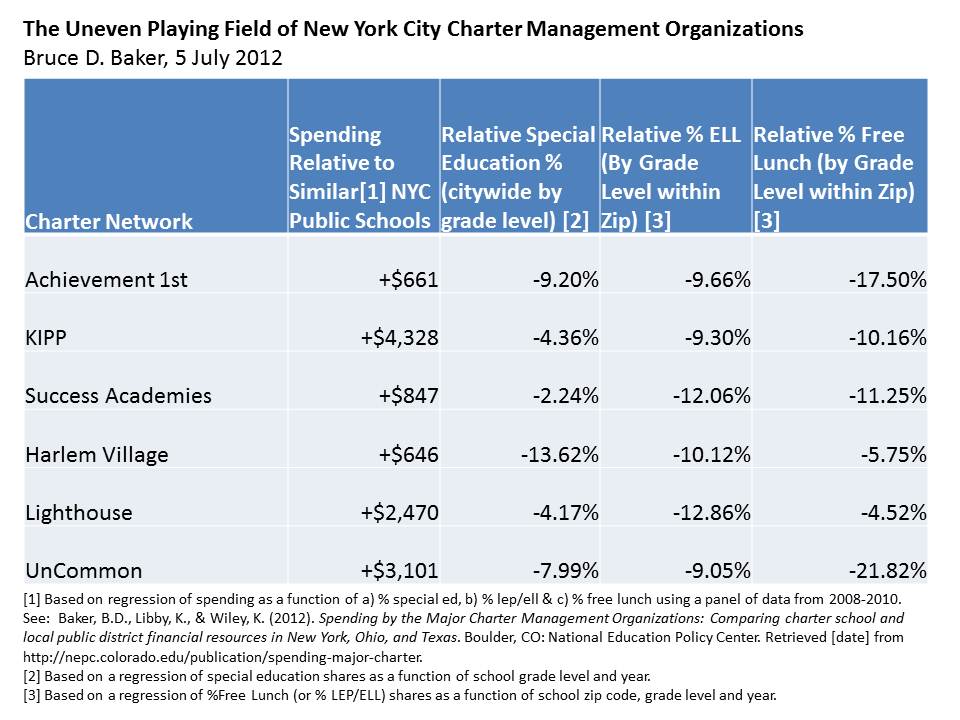
In short, each of these charter chains spends more per pupil than NYC public schools that serve similar student populations. Some, like KIPP and UnCommon schools spend a lot more!

Further, when compared against same grade level schools citywide, each of these charter chains serves fewer children with disabilities (and I lack data on the type of disabilities, which may also matter).

Finally, when compared against same grade level schools in the same zip code, each of these charter chains serves far fewer low income children and FAR fewer children with limited English language proficiency.

These substantive differences in resources and student populations make it difficult if not impossible to assert that these charter school chains operating in New York City have somehow identified a magic formula for success that is neither resource dependent nor dependent on serving very different student populations than city district schools.

There is certainly no basis whatsoever for asserting that accountability and freedom – specifically freedom from bureaucratic and union rules – are necessarily the determinants of charter success. In fact, these broad principles apply similarly to all independent charters, but while some are good, others suck – and many are allowed to persistently suck despite supposed heightened accountability. Indeed, the upper half is better than average! And the lower half… is not!

It’s hard to suggest that either of these factors – accountability or freedom – are the determinants of charter success when success varies so widely across charters. What does tend to vary across charters is a) access to philanthropic resources and b) student populations served. AND… it may also be the case that some charters have adopted unique strategies…… some of which may actually come with additional costs!

There may be some cool stuff going on in some of these schools, just as there may be some cool stuff going on in NYC district schools.  It may well be that freedom from bureaucratic rules permits schools to do cool stuff.  It would certainly seem advantageous in the context of New York State moving forward to be able to skip out on complying with new, ill-conceived teacher evaluation legislation.

We need to figure out what works and for whom, whether those ideas come from traditional public schools, charter schools or private schools.

We need to figure out the costs of doing these things. Ken Libby, Kathryn Wiley and I discuss these issues in our recent policy brief (read it! It’s not some anti-charter propaganda. It’s an actual study of spending data… with detailed documentation & extensive lit review).

Unfortunately, the tendency among charter “defenders” is to simply deny, deny, deny… ignore costs (make bizarre, unfounded excuses, present half-assed, back of the napkin estimates, or sidestep them)… ignore substantive contextual issues, etc., etc., etc. (certainly, the tendency among the attackers is to declare all charter operators/supporters to be union-busting privatizing profiteers – also an unhelpful characterization for a diverse array of institutions).

It’s time to start digging deeper into what makes schools tick and for whom and how to provide the mix of schooling that best serves the largest share of children.


[1] As I explained in a recent post, even in a lottery study – of students lotteried in/lotteried out – those lotteried out likely attend schools with substantively different classroom peers than those lotteried in, and it remains difficult if not impossible to distill school/teacher effect from peer effect since both operate at the classroom level.


New Jersey Charter Data Roundup: A look at the 2010-11 Report Cards

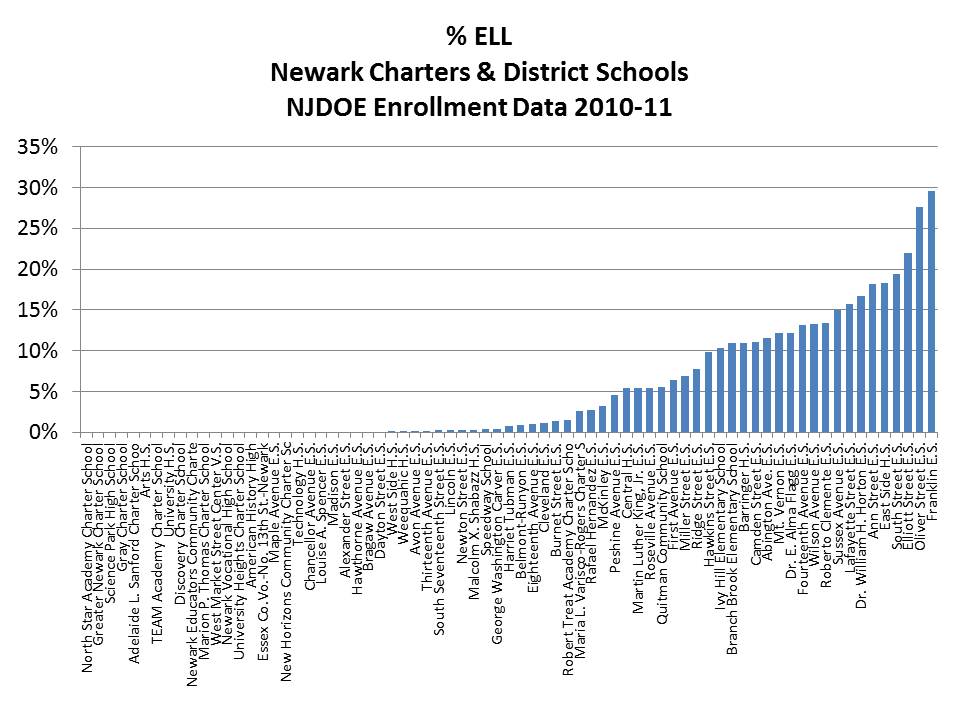
Here’s a quick run-down on the 2010-11 New Jersey School Report Card data on charter schools. No-one else is putting out decent summaries of this stuff, so I feel obligated to revisit these data periodically. They don’t change much over time. But those older blog posts get buried over time. So, here we go.

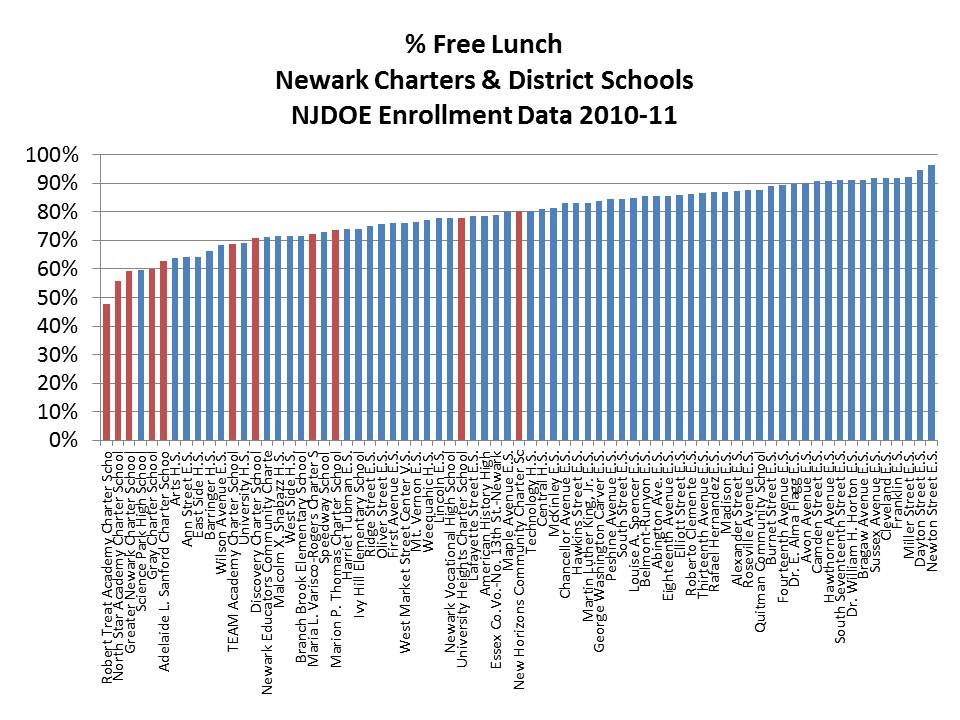
Let’s take a specific look at Newark because that’s where most of our attention has been paid regarding high flying charter performance.

Data sources:

1. NJDOE Report Card

2. NJDOE Enrollment File

3. NJDOE Directory File (for City location)

Percent Free Lunch

Percent ELL

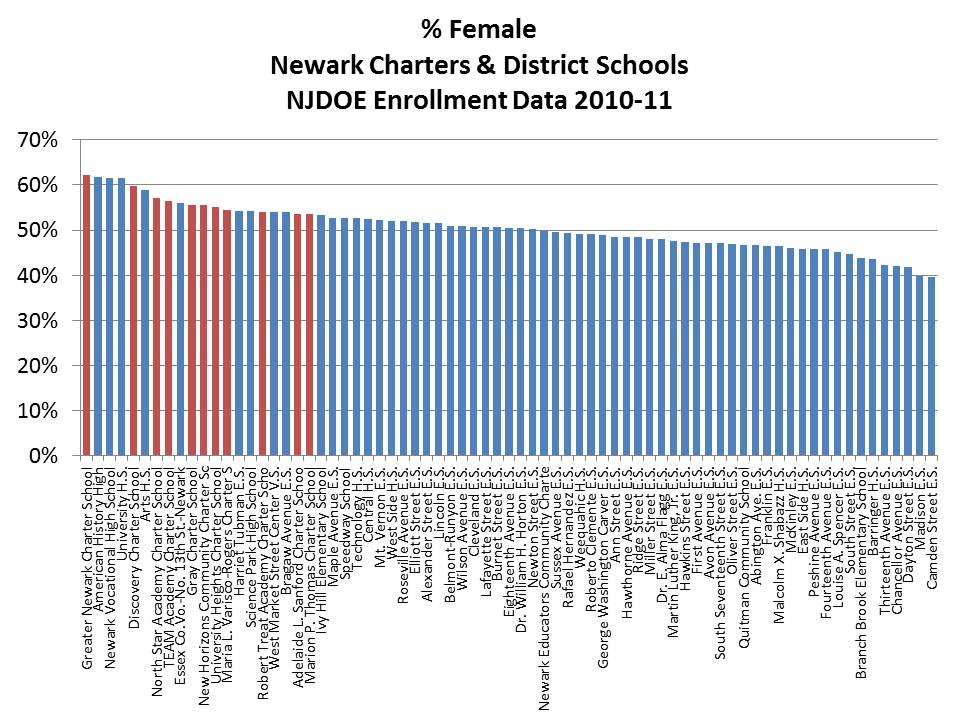
Percent Female

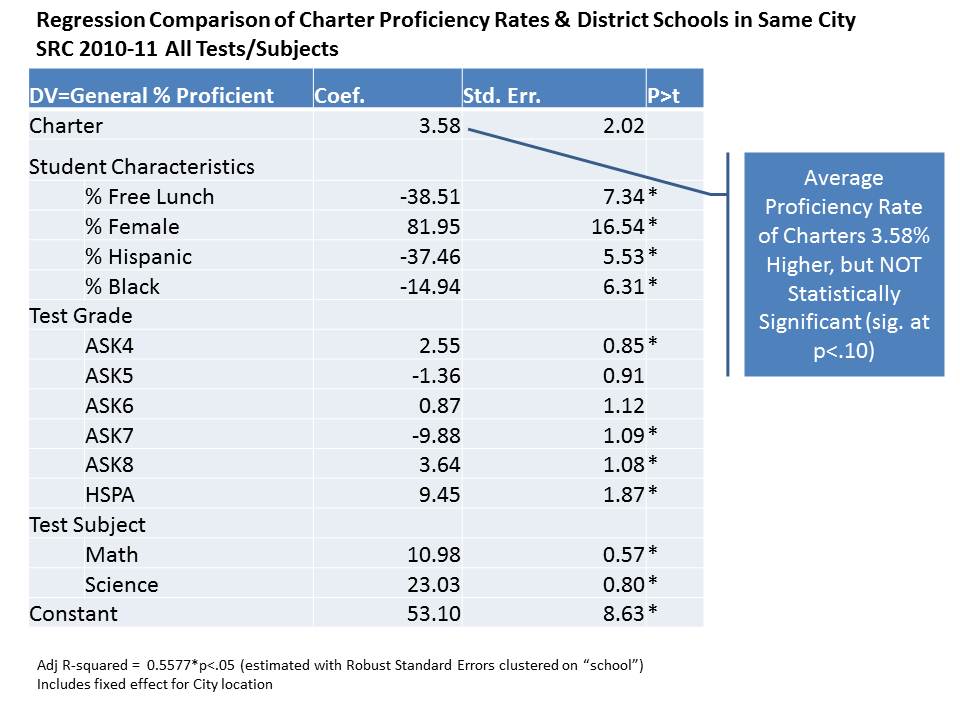
Regression Model of Charter Performance

More explanation is provided below. But this regression model (raw output on link below) is simply intended to compare the average proficiency rates across all tests and grades of charter schools to other schools in the same city and with similar characteristics. The bottom line is that as in previous similar regressions, there remains a small statistically non-significant margin of difference in average overall proficiency. But, the graphs that follow are perhaps more fun/interesting to explore.

CharterRegression

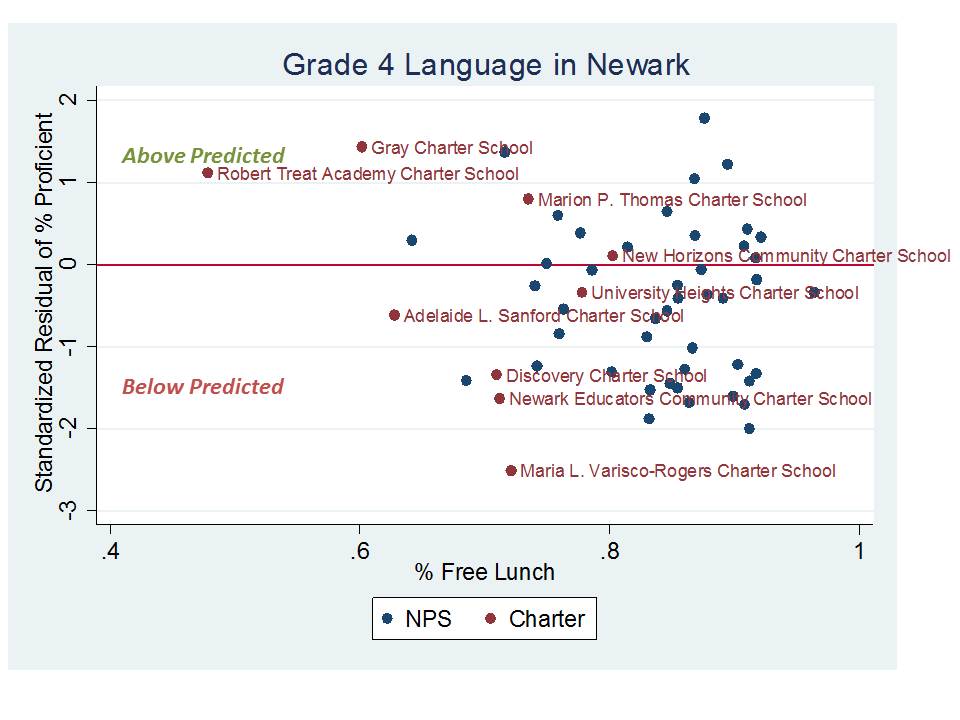
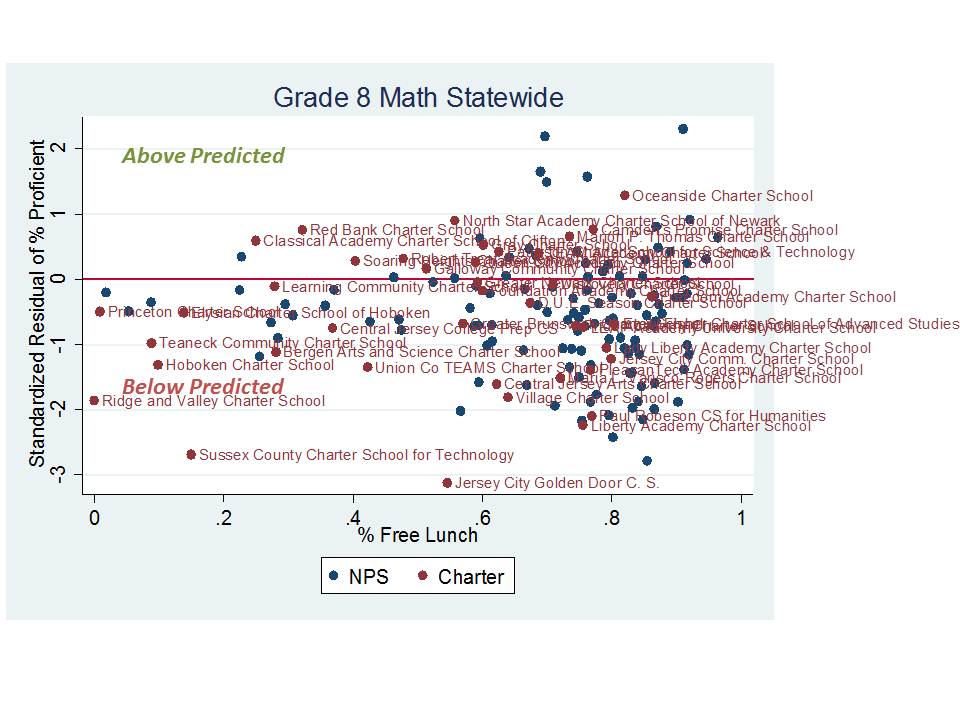
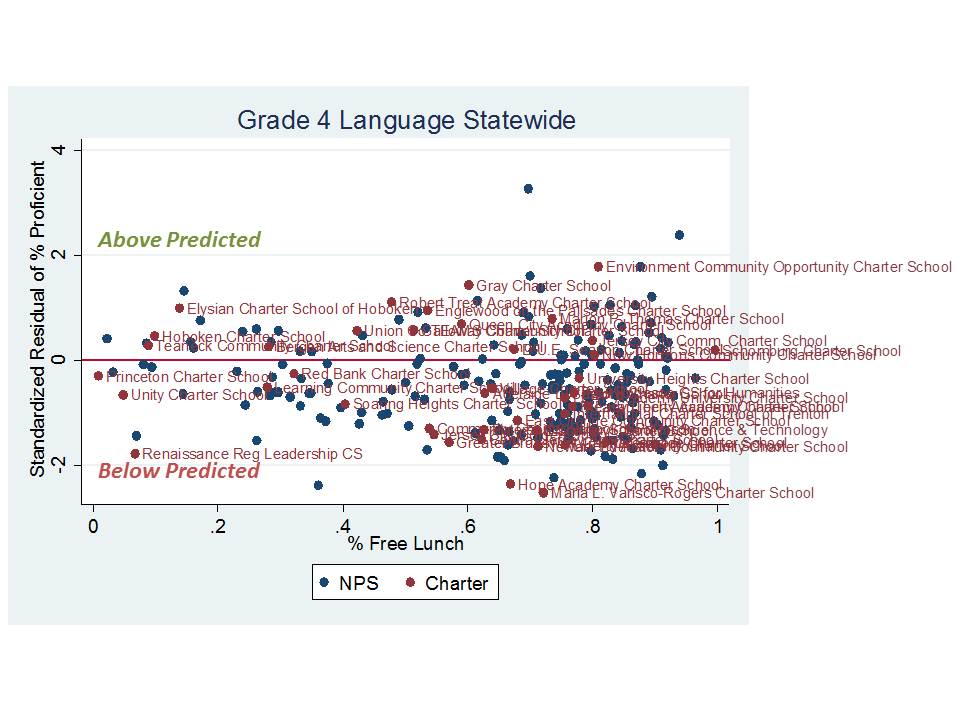
Now, for the following figures, the overall charter effect variable is removed, so that we can see how individual charter schools lie with respect to expected proficiency levels. The following figures compare schools to their predicted performance given each of the characteristics in the regression model. On the vertical axis is the standardized residual or the standard deviations above or below predicted performance. Along the horizontal axis is the percent free lunch of the schools, just so that we can see how they sort out by poverty concentration. Note that poverty concentration is already controlled for in the models. I begin with a few figures for select tests in Newark, and then present some statewide figures.

Newark Schools over and under predicted performance

Statewide schools over and under predicted performance

On average, this statewide picture is actually pretty ugly. It would certainly be very hard to argue that charter school expansion across New Jersey has led to any substantive overall improvement of educational opportunities. Numerous charter schools are substantial underperformers. And overall, as the regression model indicates, the net performance is bread even.

Take home points

This analysis merely compares the average proficiency rates of schools with similar characteristics in the same city. It does not measure whether charters “add value” per se.  This isn’t really ideal from a research perspective, because it doesn’t attempt to sort out whether these schools are actually doing something that leads to higher performance.

To address this question we might try either of two strategies – estimating achievement gains across matched schools – or hypothetically matched schools/children, or by a lottery based analysis comparing kids lotteried in to those lotteried out and staying in neighborhood schools.

But, I would argue that we still might not learn much of policy relevance for Newark from either of these approaches. Why?

Well, let’s consider the first approach – a matched school analysis (or virtual match based on individual students).  Let’s say we specifically wanted to determine the effectiveness of schools like North Star, Robert Treat or Gray charter.  The problem is that there really aren’t any “matched” schools or match-able kids – except perhaps those in magnet schools.  Note on matching-based-analyses… given that nearly all kids in a city like Newark qualify for Free OR REDUCED lunch, matching would have to be done on the basis of Free Lunch! If not, substantial precision/accuracy is lost and the comparisons invalid.

We might look outside of Newark for matched schools or students, but then other contextual factors might compromise the analysis quite substantially, and this might cut either for or against the charters.

Further, it appears that gender balance matters – not just a little – but a lot. Gordon McInnis tipped me off to this.  I hadn’t realized how big a deal it was in these schools.

Note that I’ve also left out attrition here, so that even if the schools were matched by poverty rates, gender and ELL concentration, there might be substantive differences in which students leave over time, altering the peer group composition over time (as weaker students leave).  Again, it may be most relevant to compare Newark Charters to Newark Magnets and/or children who attend them, which are most similar to these Newark Charters.

We could try to construct hypothetical or virtual matches based on similar individual children (to those in the charters) across the district who may or may not actually attend school together. But therein lies the problem, most other similar kids left in district schools would be attending school in substantively different peer groups than those in charters like North Star, Gray or Treat.

AND if we did find an “effect” on student achievement growth what the heck would it mean? And how would it inform our policy decisions?

Well, if we did, we would still have significant difficulty sorting out as to whether that effect has anything to do with school quality, or with student peer group  – quite possibly the largest in school factor affecting achievement.

Alternatively, one could attempt a lottery based analysis in which we look at the gains of kids lotteried in and lotteried out of the charters – left in their neighborhood schools. But in this case we would certainly have kids whose peer groups differ dramatically.  Again, we could try to “correct” for that uneven distribution, but the fact is that we simply can’t fully correct for the substantial contextual differences across these schools.  Too many Newark charters (and those in Jersey City and Hoboken) simply don’t even come close to resembling the student composition of traditional public schools in the same area.

So who cares? Well, it matters a great deal for policy implications whether the effect is created by concentrating less poor, English speaking females in a given school or by actually providing substantively better curriculum/instruction.  The latter might be scalable but the FORMER IS NOT! There just aren’t enough non-poor girls in Newark to create (or expand) a whole bunch of these schools!

No Excuses! Really? Another look at our NEPC Charter Spending Figures

UPDATED MAY 11, 2012

Not surprisingly, KIPPs first response to our recent NEPC study was to declare it outright flawed. KIPP then proceeded to make up every possible explanation they could – every possible “excuse” – conjure every possible out of context – or different context estimate or “fact” to make their case that they in fact spend equal or less than schools in New York City and Houston.

I guess what continues to perplex me most is the stance that KIPP takes whenever anyone writes anything about them, in a report not sponsored by them or by one of their major funders (some of which are quite good).  Whether a descriptive analysis of attrition rates or our analysis of spending per pupil, KIPPs standard response is to deny, deny, deny.

We have not said anywhere in our report that there’s anything wrong with spending more to do a good job – run a good school. It would be preposterous for us to make such an assertion. We have simply tried to lay out a reasonable comparison of what schools are spending, compared to otherwise similar schools. These comparisons are appropriate, and are necessary for making judgments about any marginal benefits that might be achieved by students attending different schools.

We show that part of the KIPP puzzle in Houston is explained by their attempts to provide more competitive front end teacher wages. Nothin’ wrong with that! It’s certainly a logical recruitment/retention strategy. Notably, it would become difficult to maintain these margins as school staff matures. These are issues worth monitoring over time – to see if CMOs entering their second and third decades of operation can continue to hold expenses down by holding staff experience down, while still recruiting and retaining energetic, high quality teachers. I will likely be conducting more extensive analyses of these salary structures across KIPP and other schools in NYC and Texas in the future, and hope to have a more productive discussion on the topic when that time comes.

KIPP argues that we counted all of their centralized expenses against them, and counted NONE against the NYC public schools. This is not true. We actually didn’t count KIPP regional and national expenses that exist beyond what the locals pay in management fees accounted for on their budgets.

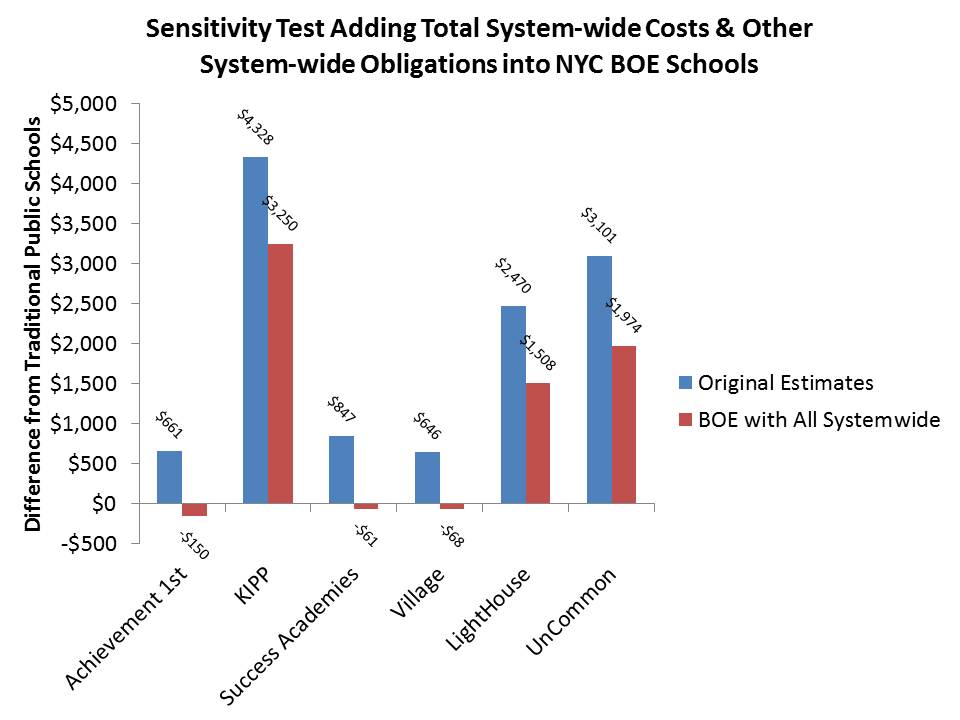
Second, as I will show below, even if we count all of the system-wide expenses (& other obligations) of NYC BOE schools, KIPP schools continue to substantially outspend them.

Further, KIPP complains that we include expenses on their KIPP to College program. It’s a program. It’s a support service. It’s an expenditure. Further, even the KIPP schools budgets that don’t include KIPP to college exceed NYC BOE spending. And KIPP plays the usual card, in reference to Houston, not NYC, that they must incur the full costs (from their operating expenses) of facilities, implying that public districts have absolutely no costs of facilities.

Clearly, such comparisons are complicated and we acknowledge as much throughout our paper. Further, we provide substantial detail as to the types of data being compared and potential issues with the comparisons.

New York City

Let’s look first at our New York City comparisons. The data in NYC are pretty good, but because the charter financial reports are not part of the same system as the district school site budgeting data, they are not necessarily designed to be directly comparable. We had removed system-wide costs from the NYC BOE schools, in addition to removing costs for facilities (because BOE also pays for charter facilities), food and transportation, and we removed payments to charters. KIPPs assertion is that clearly if we add back in all system-wide costs NYC BOE schools would be spending at least the same if not more than KIPP schools.  This is especially the case if, as KIPP asserts, that pension costs alone should add $2,200 per pupil to the BOE schools (this is a perfect example of a wrong context number extracted from a different comparison [a good one by IBO]).

Of course, this assertion doesn’t pass a basic smell test even given the information that already existed prior to our report. In the Independent Budget Office report which we cite, the IBO evaluated the comparability of the public subsidy rate of co-located (as with KIPP) charters and BOE schools, finding that the co-located charters had the equivalent subsidy of slightly higher than BOE schools on average district-wide. Note that subsidy rates aren’t expenditures. It’s a different comparison. But subsidy rates provide a starting point for what could be spent. And KIPP was ahead at the starting line, albeit only slightly.

Add to that, the fact that KIPP schools do not serve average special education populations, the major driver of differences in spending across BOE schools (as we validate). Thus, compared to these schools rather than average district-wide, KIPP moves further ahead. Then, I think we all understand by this point that KIPP raises and spends at least some private funding.  Fair enough? We’ve got two reports out on this:

  1. Baker, B.D. & Ferris, R. (2011). Adding Up the Spending: Fiscal Disparities and Philanthropy among New York City Charter Schools. Boulder, CO: National Education Policy Center. Retrieved [date] from http://nepc.colorado.edu/publication/NYC-charter-disparities.
  2. Baker, B.D., Libby, K., & Wiley, K. (2012). Spending by the Major Charter Management Organizations: Comparing charter school and local public district financial resources in New York, Ohio, and Texas. Boulder, CO: National Education Policy Center. Retrieved [date] from http://nepc.colorado.edu/publication/spending-major-charter.

Add their private spending to the already growing margin, and you’ve got a bigger margin of difference in per pupil spending between KIPP schools and otherwise similar NYC BOE schools. On its face, it’s highly suspect for KIPP to argue that they do not spend more than NYC BOE schools.

But, just for fun, let’s rerun the regressions from our report with all system-wide costs added back to BOE schools and see if that puts them ahead of KIPP spending.

Here’s the overall comparison:

Even after adding system-wide costs back into BOE schools, KIPP schools spend more than $3,000 per pupil more than BOE schools.

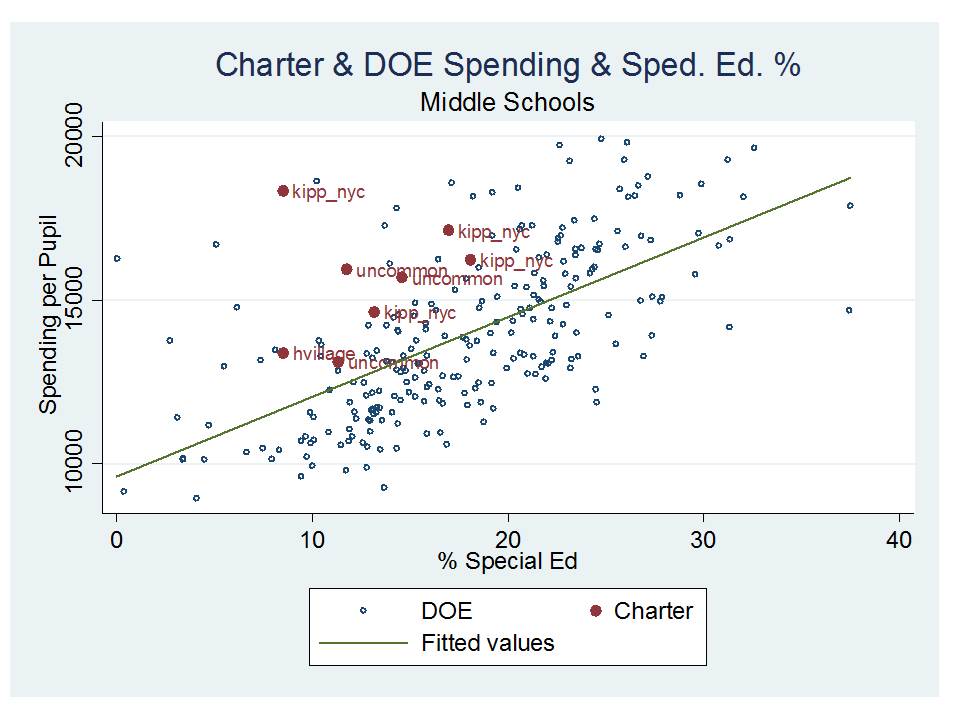
Now here are the breakout scatterplots, starting with our original:

And then with all system-wide costs added back in to BOE school:

Hmmm… seems that KIPP schools are still significantly outspending otherwise similar BOE schools – about 25% more.

Another really important point here is that none of these adjustments alter KIPP charter spending relative to the other charters. KIPP continues to outspend the other charters by as much as they did in our original analyses.

What we don’t include for KIPP

We don’t include regional (KIPP NY) or national expenditures above and beyond what is covered by the school management fees. We write extensively in Appendix C of our report about these additional expenditures and difficulty in parsing precisely how much was spent by KIPP regional and national organizations and what services were provided as in-kind services to schools. This is a potentially significant break that we give to KIPP, setting aside entirely their centralized costs of the organization (those above and beyond what is covered by management fees).

Texas

It was problematic enough for KIPP to assert that they spend similarly to NYC BOE schools, but it was surely a stretch to assert that they spend similarly to Houston ISD schools which have been significantly constrained under state school finance policies in recent years. KIPP first pulls the facilities cost card to make their case, as usual, implicitly assuming public district facilities to be free. We discuss this issue on Page 49 of our report (and in numerous other locations):

Charter advocates often argue that charters are most disadvantaged in financial comparisons because charters must often incur from their annual operating expenses, the expenses associated with leasing facilities space. Indeed it is true that charters are not afforded the ability to levy taxes to carry public debt to finance construction of facilities. But it is incorrect to assume when comparing expenditures that for traditional public schools, facilities are already paid for and have no associated costs, while charter schools must bear the burden of leasing at market rates – essentially and “all versus nothing” comparison. First, public districts do have ongoing maintenance and operations costs of facilities as well as payments on debt incurred for capital investment, including new construction and renovation. Second, charter schools finance their facilities by a variety of mechanisms, with many in New York City operating in space provided by the city, many charters nationwide operating in space fully financed with private philanthropy, and many holding lease agreements for privately or publicly owned facilities.

KIPP also argues that their per pupil spending figures are inflated due to spending for growth. Hey. That’s an expenditure. By the way, typically, per pupil expenditures rise with declining enrollment (as the denominator goes down). Yes, there might be scaling up expenditures, but they tend not to have dramatic effect on per pupil expenditures. If KIPP has chosen to pay for redundant administration, etc. in order to support scaling up, then so be it. That’s an expenditure. We would hope to see these expenses level off down the line with additional analyses. We’ll wait and see on that.

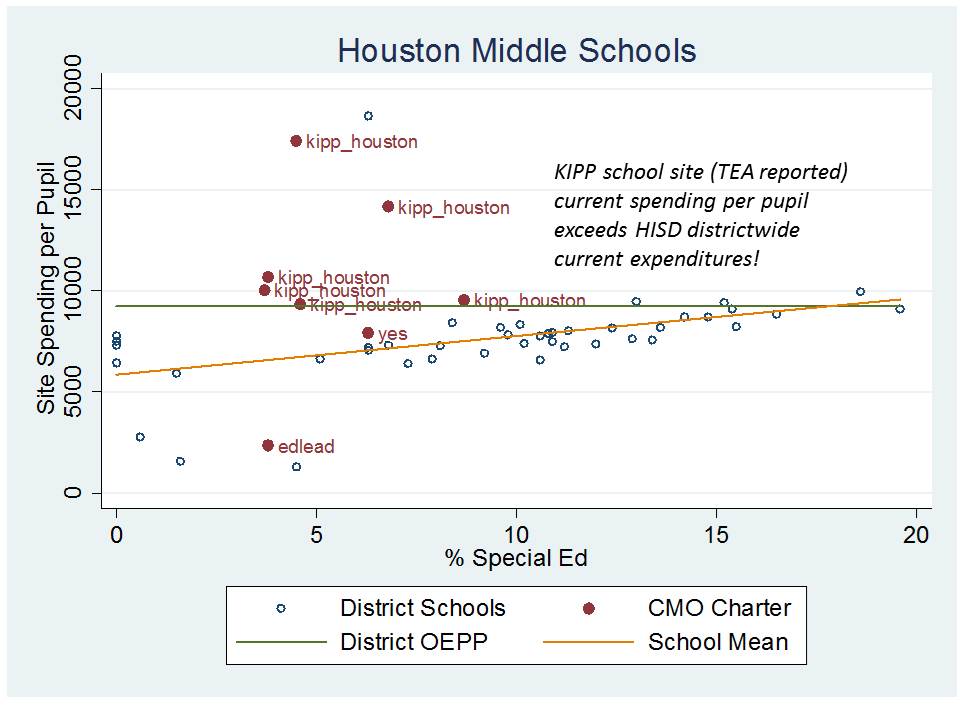
But, back to our actual comparisons in Houston. We used two different approaches in Texas. First of all, in Houston, KIPP spending per pupil was much closer than in other Texas cities, where KIPP spending totally blew away district schools spending. But back to Houston. Using current operating expenditures per pupil data for KIPP and Houston schools, we show that KIPP middle schools outspend not only otherwise similar schools in HISD, but the district-wide average operating expenditure per pupil.

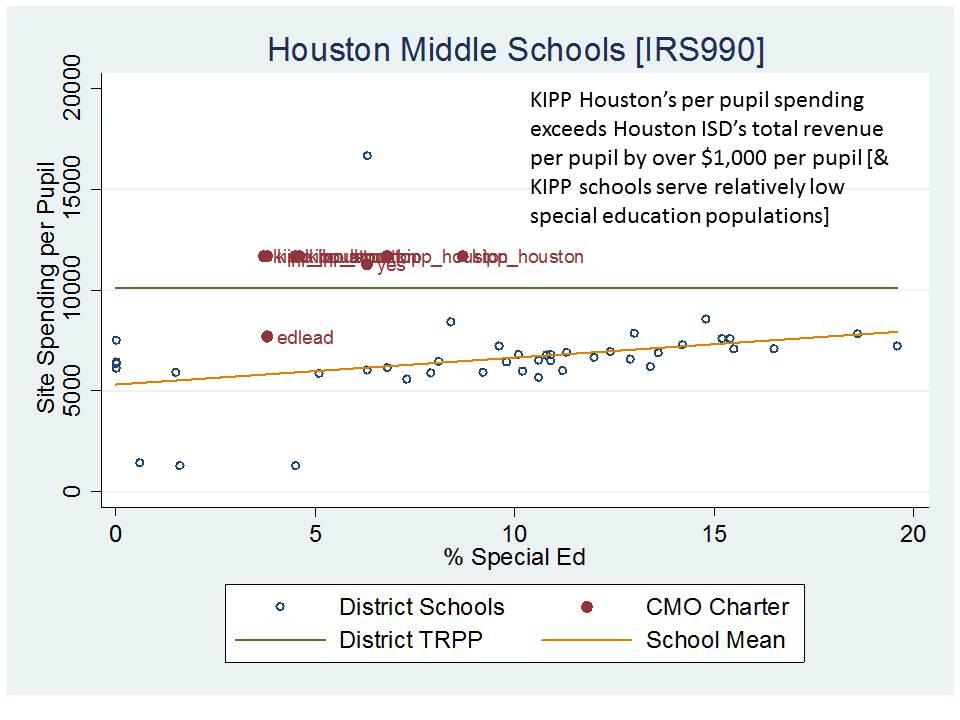
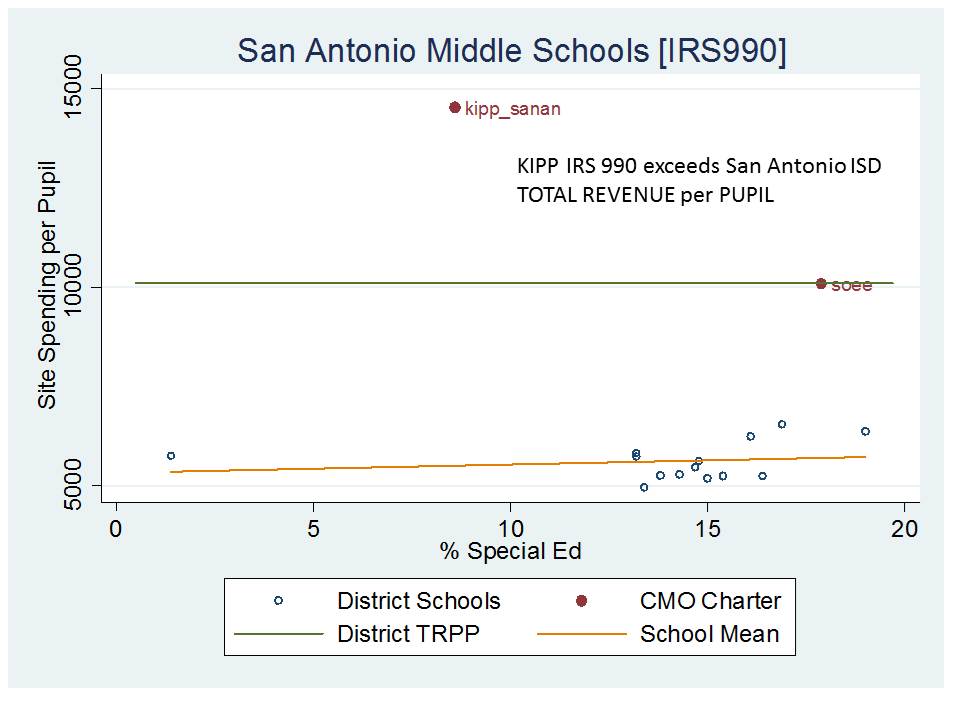
Further, we show that KIPP total district (IRS 990) expenditures significantly exceed Houston ISD’s TOTAL REVENUE PER PUPIL, including revenue for retiring debt and maintenance of HISD’s large capital stock.

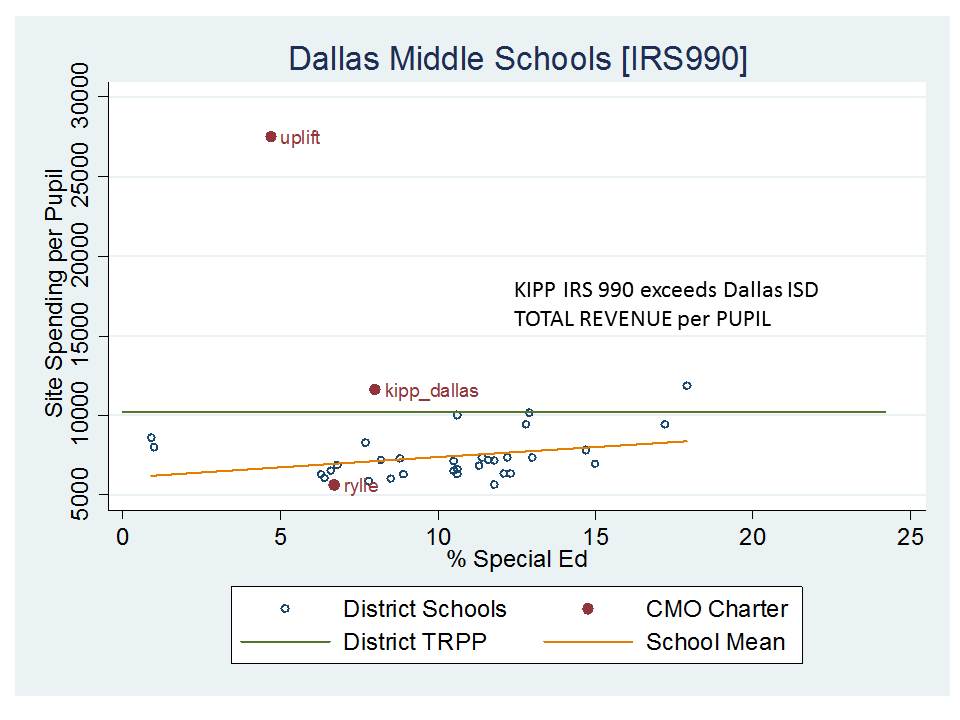
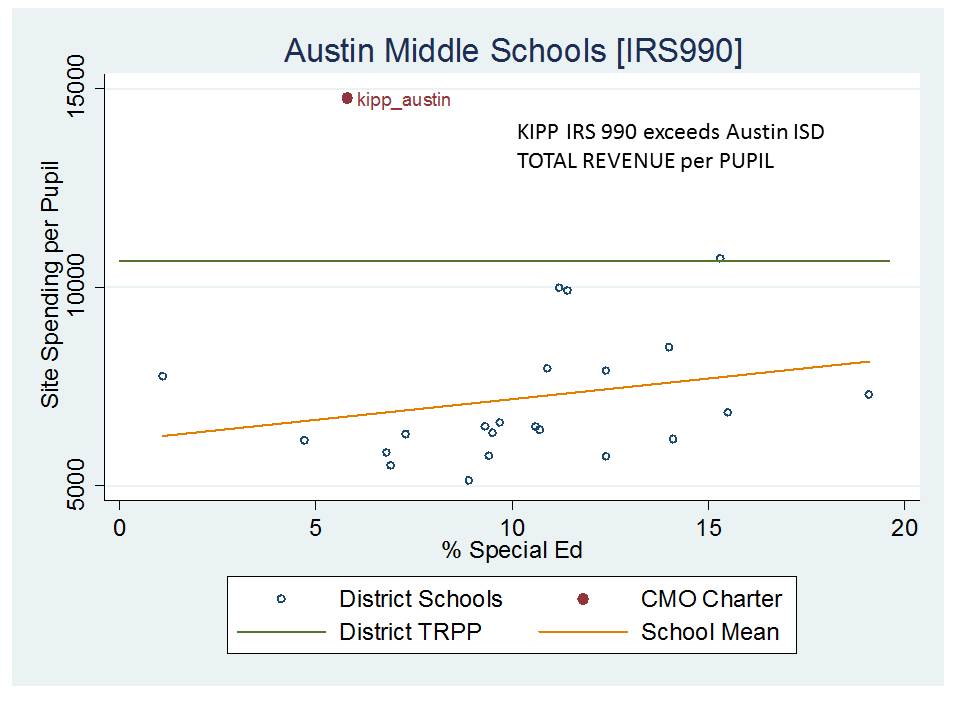
Here are additional figures not included in the report, comparable to the figure above for other cities in Texas where KIPP  operates. In each and every case, KIPP IRS 990 total expenditures per pupil EXCEED district TOTAL REVENUES PER PUPIL.

What we don’t include for KIPP

Again, we don’t attempt to figure out the additional expenses of KIPP national allocated to schools, above and beyond what is paid for from the local/regional KIPPs through management fees to the national organization.

Closing Thoughts

I encourage those interested in these topics to not only browse the abstract of our report, but to also dig deep into the appendices and end notes – which are as long as the report itself. Heck, follow the hyperlinks to the data sources and take your own stab at this stuff. That’s what we need out here – not more excuses and unfounded anecdotal arguments.

I actually hesitate to write about KIPP and perhaps that’s just what they want. Apparently no one should write about them that hasn’t been paid by them to write about the. Those who do should be forewarned that you’ll have to waste inordinate time responding to their complaints – excuses – about what you wrote. As of this post, I hope to be done with this topic.

Follow up on why Publicness/Privateness of Charter Schools Matters

My post the other day was intended to shed light on the various complexities of classifying charter schools as public or private. Some have argued that the distinctions I make are a distraction from the bigger policy issues. The point was not to address those issues, but rather to dispose of the misinformed rhetoric that charter schools are necessarily public in every way that traditional public schools are. They clearly are not. And the distinctions made in my previous post have important implications not only for teachers employment rights (or any school employee), but also for student rights. Further, it is really, really important that teachers considering their options and parents considering their options understand these distinctions and make fully informed choices.

Preston Green of Penn State University [co-author of Charter Schools and the Law] offered the following comments on my previous post:

Charter schools are always characterized as “public schools.” Many parents assume that they would receive the same constitutional rights in charter schools as other public schools. In fact, I use to think this.

My thinking changed when I spoke at a workshop for charter school attorneys. Several attorneys insisted that they were not beholden to federal constitutional and statutory provisions. They cited the Ninth Circuit’s Caviness decision, in which the Ninth Circuit held that a charter school was not a state actor with respect to employment issues. These attorneys insisted that the same logic applied to student issues as well.

This is especially concerning for black males. Researchers have consistently found that black male students are disproportionately subjected to school discipline, such as suspensions and expulsions. In public schools, the Due Process Clause protects them from arbitrary suspensions and expulsions. For example, in Pennslyvania,schools must provide students with an informal hearing for out-of-school suspensions from 4-10 days (22 Pennsylvania Code § 12.8, 2012). The school must provide parents with written notification of the time and the place of the hearing. The student has the write to speak and produce witnesses at the hearing as well as the right to question witnesses present at the hearing.

Pennsylvania regulations also require formal hearings for school exclusions of more than 10 days (22 Pennsylvania Code § 12.8, 2012). Formal hearings require the school to provide parents with a copy of the expulsion policy, notice that the student may obtain counsel, and the procedures for the expulsion hearing. The student has the power to cross-examine, testify, and present witnesses. Further, the school must maintain an audio recording of the hearing.

If charter schools are not public actors, then constitutional law would not apply. I have argued that courts might apply contract law, as is generally the case for private schools. If a private school “has clearly stated the rule, preferably in writing, and a parent chooses to have his or her child attend the school, a court will generally uphold the rule” (Shaughnessy, 2003, p. 527). For example, in Flint v. Augustine High School (1975), a Louisiana private school expelled two students for violating its no smoking policy. The school’s handbook called for a fine of $5 for the first offense, and a penalty of either a $10 fine or an expulsion for the second offense. The state court of appeals upheld the suspension of the students. In reaching this decision, the court declared that private institutions “have a near absolute right and power to control their own internal disciplinary procedure which, by its very nature, includes the right and power to dismiss students” (p. 234). Although the court allowed that due process protections could not “be cavalierly ignored or disregarded,” it held that “if there is color of due process – that is enough” (p. 235).

In Hernandez v. Bosco Preparatory High (1999), a New Jersey court for the first time addressed the question of the procedural rights of expelled private high school students. It found that constitutional law did not apply to private high schools. Interestingly, the court found that high school students would receive less protection than private university students.

I raise these points because parents may be unwittingly giving up their constitutional protections to attend charter schools. One has to wonder whether parents would enroll their children if they were aware of this possibility.

The distinction is important. And it’s a distinction that may occur at many levels of the system, as I explained in the previous post. Again, this is not to say that publicness/privateness necessarily speaks to substantive differences in school quality for children, or workplace quality for employees.  As I’ve mentioned numerous times on my blog, my best teaching job was at an elite private (no doubt, no ambiguity, private) school. My worst was at a different private school, with two public districts in between – one much better than the other. The issues of publicness/privateness proved inconsequential to me personally during my time as a teacher (mainly because I left the worst private school before I decided to engage in any [more] battles). But to others they may not, and it is important to understand the distinction. At least a few teachers in privately governed charter schools have already been blindsided by misinformed assumptions that they possess public employee protections.  Given the comments of Preston Green above, I suspect student rights cases are not far behind.

Charter Schools Are… [Public? Private? Neither? Both?]

…Directly Publicly Subsidized, Limited Public Access, Publicly or Privately Authorized, Publicly or Privately Governed, Managed and Operated Schools

Let’s break it down:

Directly publicly subsidized

Charter schools are directly subsidized by a combination of (primarily) state and local tax dollars (state dependent) transferred to charter schools on the basis of their enrollments.

This funding is analogous to a directly subsidized voucher program that would transfer tax dollars to private schools on the basis of students signing up for the voucher program.

This funding is also analogous to the state aid that is delivered on a pupil enrollment basis to local public school districts, but the funding is different from local tax dollars that are raised based on the values of taxable properties and are not dependent on pupil enrollments.

Note that traditional public schools or charter schools may receive a variety of non-government (non-taxpayer supported) revenues including private gifts, private foundation grants, fees/event receipts, facilities rental, etc.

The direct subsidy for charters is distinctly different from indirect subsidies like tuition tax credits, which provide the opportunity for individuals or other entities to receive a full tax credit for donating funds to an independently operated/managed entity which then distributes those funds as vouchers or scholarships.

An important legal distinction is that the U.S. Supreme Court has recently decided that when tuition tax credit funds are used to support religious education, taxpayers have no standing to challenge that distribution as a distribution of their tax dollars, due to the indirect nature of the subsidy. See: ARIZONA CHRISTIAN SCHOOL TUITION ORGANIZATION v. WINN

Limited Public Access

Charter schools are limited public access in the sense that:

  1. They can define the number of enrollment slots they wish to make available
  2. They can admit students only on an annual basis and do not have to take students mid-year
  3. They can set academic, behavior and cultural standards that promote exclusion of students via attrition.

[may vary and/or be restricted under state policies]

A traditional public school or “district school” or “government school” must accept students at any point during the year and but for specific disciplinary circumstances that may permit long term suspensions and expulsions. Traditional public schools cannot shed students who do not meet academic standards, comply with more general behavioral codes or social standards, such as parental obligations.

Imagine a community park, for example, that is paid for with tax dollars collected by all taxpayers in the community, and managed by a private board of directors. That board has determined that the park may reasonably serve only 100 of the community’s 1,000 residents. The amount of tax levied is adjusted for the park’s capacity. To determine who gets to use the park annually, interested residents subscribe to a lottery, where 100 are chosen each year. Others continue to pay the tax whether chosen for park access or not. The park has a big fence around it, and only those granted access through the lottery may gain entrance. Imagine also that each of the 100 lottery winners must sign a code of conduct to be unilaterally enforced by the private manager of the park. That management firm can establish its own procedures (or essentially have none) for determining who has or has not abided by the code of conduct and revoke access privileges unilaterally. This is clearly not a PUBLIC park in the way that scholars such as Paul Samuelson describe public goods.

Note that while public districts may limit slots to individual schools, especially magnets (which are clearly also limited public access), districts must accommodate all comers (a charter school operated by a district would be part of a system that is not limited in enrollment). That is, they cannot limit total slots in the district, regardless of physical plant constraints. Districts may also limit slots at schools through assignment policies and choice-based enrollment plans. But again, districts cannot limit total slots or mid-year access. This is an important difference between districts and charters. State laws may require that under-subscribed charters must admit students mid-year. But this requirement would not apply to those charters that are fully subscribed and/or have waiting lists.

Another note: Unlike a pure public good, both traditional public schools and a public park would be subject to diminishing value to each participant as they become overcrowded. That is, at some point, as additional individuals access the park or the school, it begins to diminish the value that each individual receives. So  even the more “public” park or school isn’t really a pure public good. My point here is that there are still substantive differences between traditional public schools and charter schools.

Put very simply, the ability to decide precisely how many students a school will serve, and wait list/deny others, makes charter schools significantly more limited than public school districts in their public access.

Save for another day the topic of restrictive real estate development and local public school districts.

Publicly or Privately Authorized [contingent on state policy]

States have varied policies regarding the entities that may grant charters for charter schools to commence (and continue) operations and draw on public tax dollars to serve children who subscribe. In some states, only government agencies themselves can authorize charter schools and therefore may also un-authorize them. In other states, statutes grant authority to private entities to grant and revoke charters. These private entities tend to be non-profit entities, including universities which may be quasi-public, governed by boards of directors that are private citizens, not elected government officials.

That boards of directors or governing bodies of authorizers are not public or elected officials is an important delineation. Indeed statutes may declare that they must comply with all statutes and regulations pertaining to public officials, but such requirements are not implicit.

The non-public, non-government status of governing boards of charter authorizers has significant legal implications regarding such issues as a) whether meetings are subject to open meetings laws, b) whether records are subject to open public records laws. Further, recourse for individuals – employees or students – against these private entities differs than it would if these entities were public.

Publicly or Privately Locally Governed [contingent on state policy]

States have varied policies regarding the local governance of charter schools, but many states require that the local governance of independently operated charters take the form of a board of directors which consists of self-appointed private citizens, not elected or appointed public officials. States also permit local public school districts to operate their own charter schools which remain under the authority of their local board of education which is either directly elected or consists of appointed government officials (usually mayoral appointments).

Again, the distinctions are important, having significant legal implications for taxpayers, students and employees.

As with authorizers, private boards of directors might invoke the claim that they are not subject to open meetings laws or open public records requirements. Unless explicitly stated in state charter laws, this argument might be accepted, since private boards of directors are not implicitly subject to these requirements.

Publicly or Privately Managed and Operated [contingent on state policy]

Finally, whether governed by the public officials of the local public school district, or by a board of directors of private citizens, those governing boards might choose to contract a private entity to manage and operate the school.

That entity might be the entity with which the employees of the school hold their contracts. This has significant implications for employee rights, as we have seen in the 9th circuit ruling in Caviness v. Horizon Community Learning Center. (teachers do not have certain legal recourse against private employers under Section 1983 of the U.S. Code which applies only to “state actors.”)

It also has implications for public access to information on teacher contractual agreements. Private managers of charter schools may invoke their private status, along with their private governing boards, to claim that teacher contracts are not subject to open public records requests, even though those teachers’ salaries are paid for with public tax dollars.

They may similarly invoke claims of their private status in limiting access to meetings. Again, unless explicitly stated to the contrary in state law, charter managers and their governing boards may succeed in avoiding disclosure.

Private managers of charter schools, and private boards governing charter schools may also choose to require student disciplinary codes and parental participation regulations and may invoke provisions in those codes which allow them to unilaterally dismiss parents or families (to the extent permissible under state charter laws). Because the managers and governing boards are not state actors, student and family recourse may be limited.

Scholars Preston C. Green, III, Erica Frankenberg et al. (Penn State University) have a forthcoming article discussing the implications of the Caviness decision regarding student rights in privately governed and managed charter schools. They note:

Although charter schools are frequently portrayed as “public schools,” a recent United States Court of Appeals decision, Caviness v. Horizon Learning Center (2010) suggests that charter schools may not have to provide constitutional protections for their students.  Therefore, contract law may apply to conflicts between charter schools and their students, as is the case in private schools.  Private schools have a great deal more latitude over disciplinary issues than public schools (Shaughnessy, 2003).

A few final thoughts…

These are important distinctions. They are not trivial.

Teachers choosing to sign contracts with private governing boards and/or managers of charter schools should understand that they likely do not have the rights of public employees, unless explicitly stated.

So too should parents of children attending privately governed and managed charter schools.

Further, so too should taxpayers and/or citizen/voters understand that depending on how the courts see it, and depending on whether charter laws are sufficiently detailed in their requirements, privately governed and privately managed charter schools may not be required to fully disclose financial documents pertaining to the expenditure of public funds, or to permit access to their meetings.

The fact that many state charter laws and federal regulatory references to charter schools refer to them as “public” is a hollow proclamation that has little legal or practical bearing on the more nuanced distinctions I address here.

Those who casually (belligerently & ignorantly) toss around the rhetoric that “charters are public schools” need to stop. This rhetoric misinforms parents, teachers and taxpayers regarding their rights, assumptions and expectations.

I’m under the impression that many teachers considering working for, or currently working for privately operated charters do not necessarily understand how their rights may differ from those of traditional public school teachers and I suspect the same is true for parents and students. That’s certainly not to say that all privately managed charter schools would take advantage of their increased latitude in negative ways. There are some good private management companies and perhaps some bad ones, just like there are good private schools and bad ones (I had the pleasure of working at one of each!).

Those who characterize charter schools as purely private also don’t fully capture the nuances laid out above, though some charters – by virtue of the many layers of organization laid out above and by virtue of emerging case law – may be moving in that direction.

Note that these legal debates over whether charter schools are state actors or private entities only come about because, when an issue is raised regarding open records or meetings, or employee or student rights, it is the lawyers for the charter school that invoke the claim that they are private entities. Like here! or here!   I surely hope those invoking their private status when legally convenient are not among those proclaiming their public status when politically convenient. You just can’t have it both ways.

A Few Additional CT Charter Figures

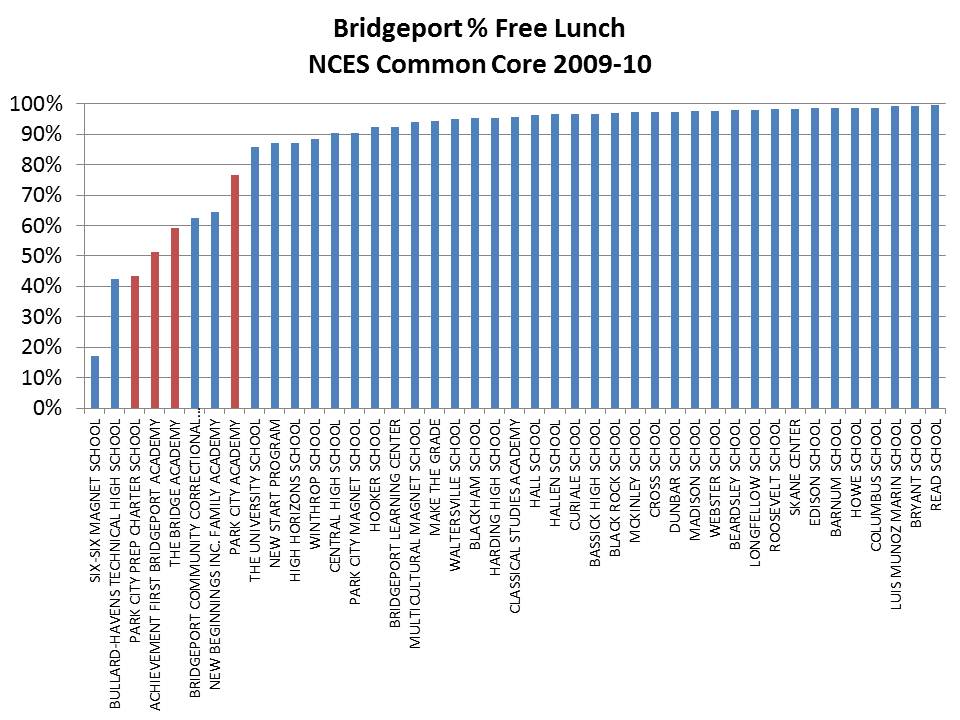
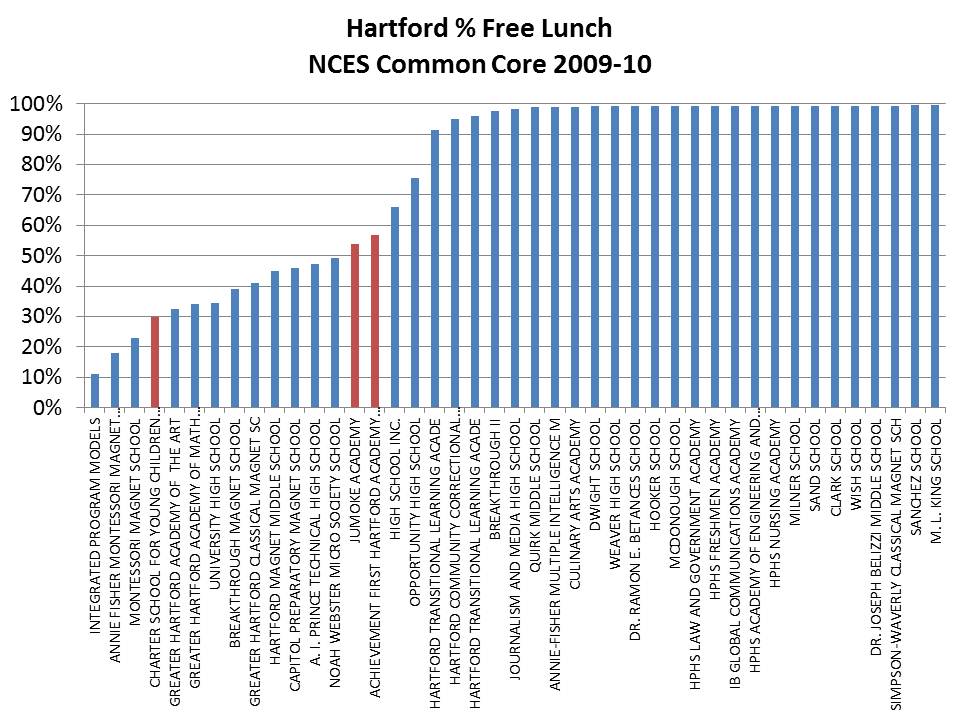
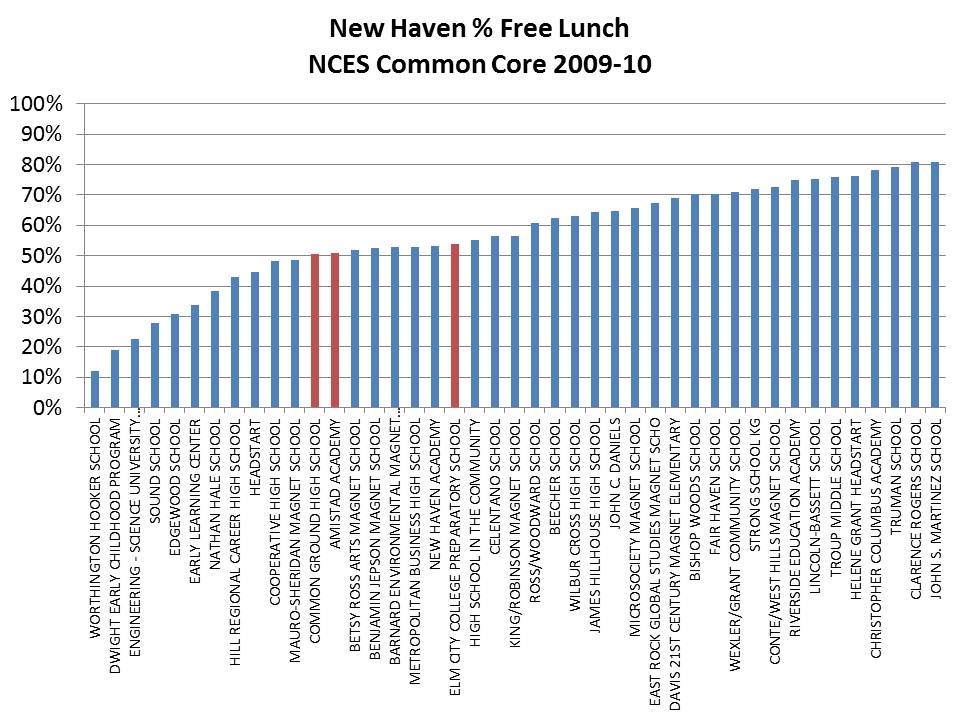
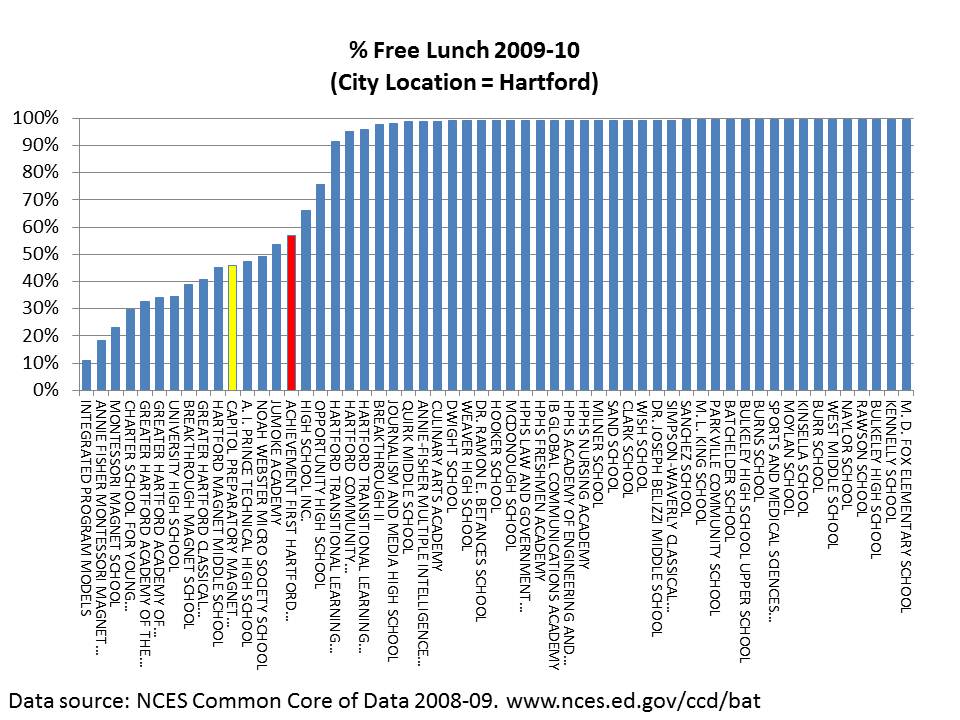
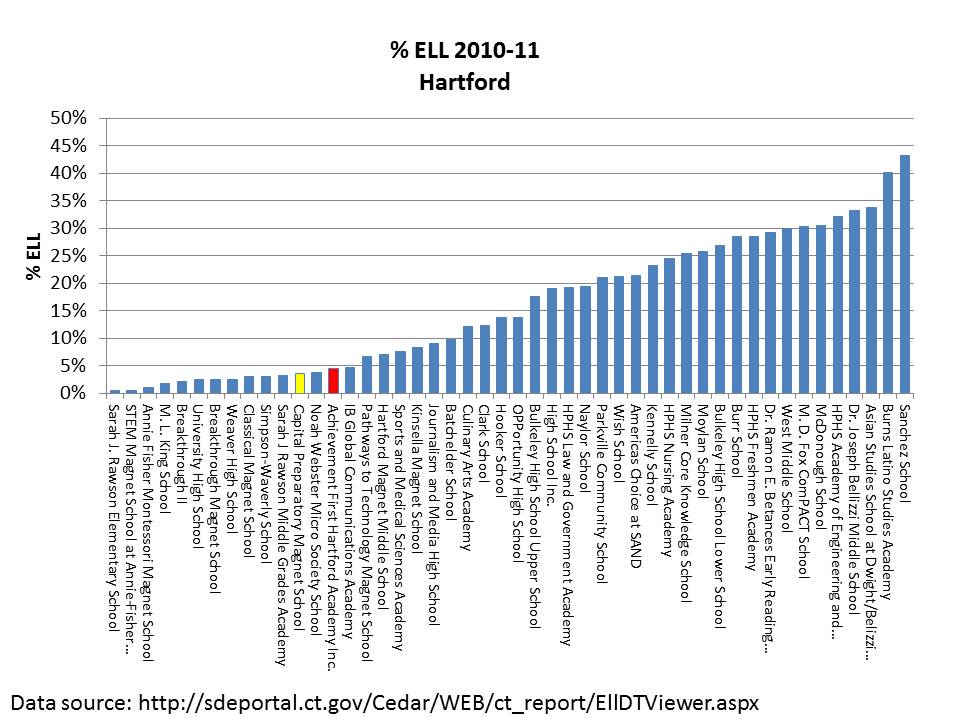
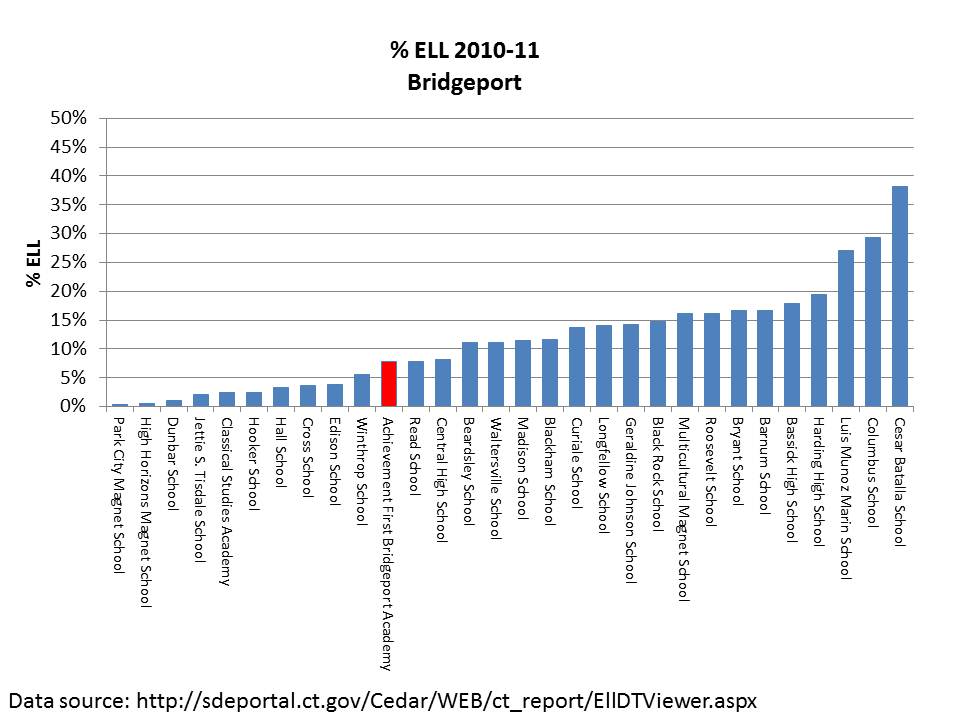
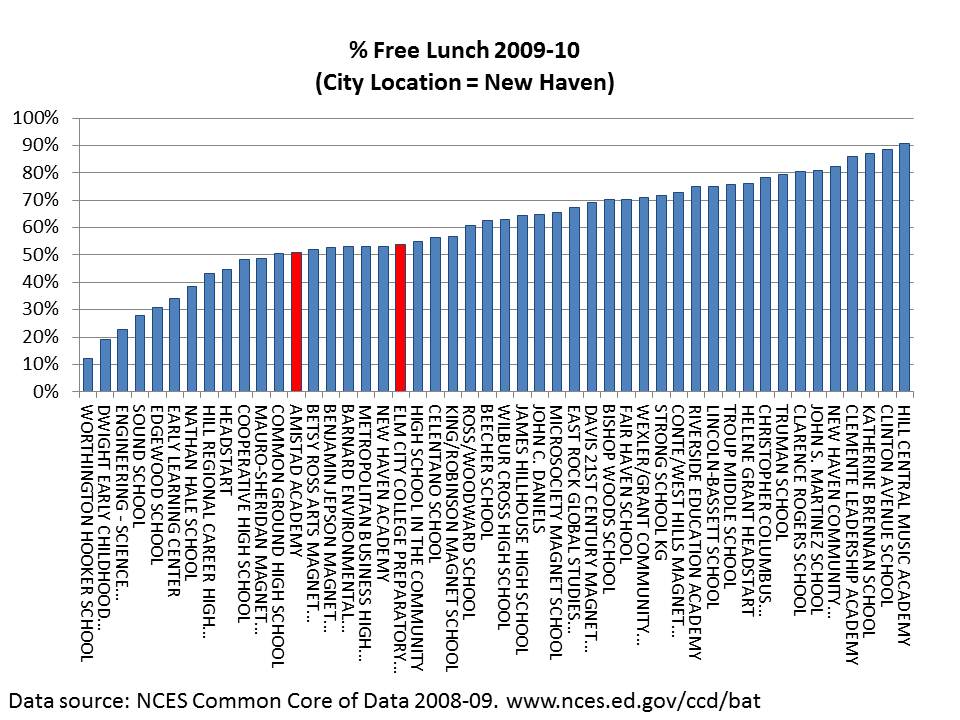
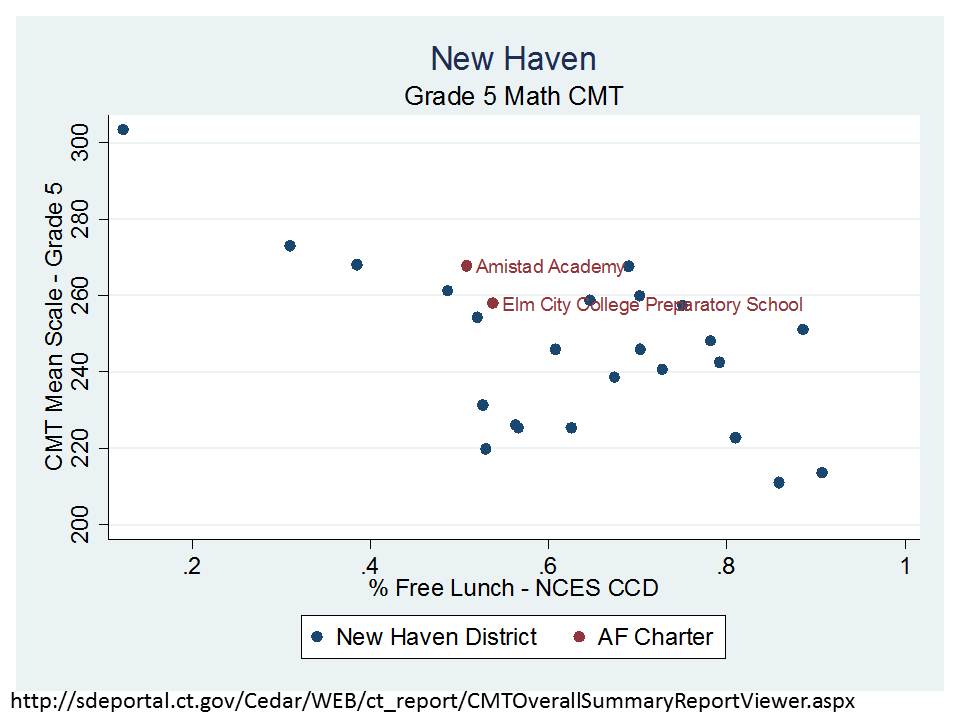
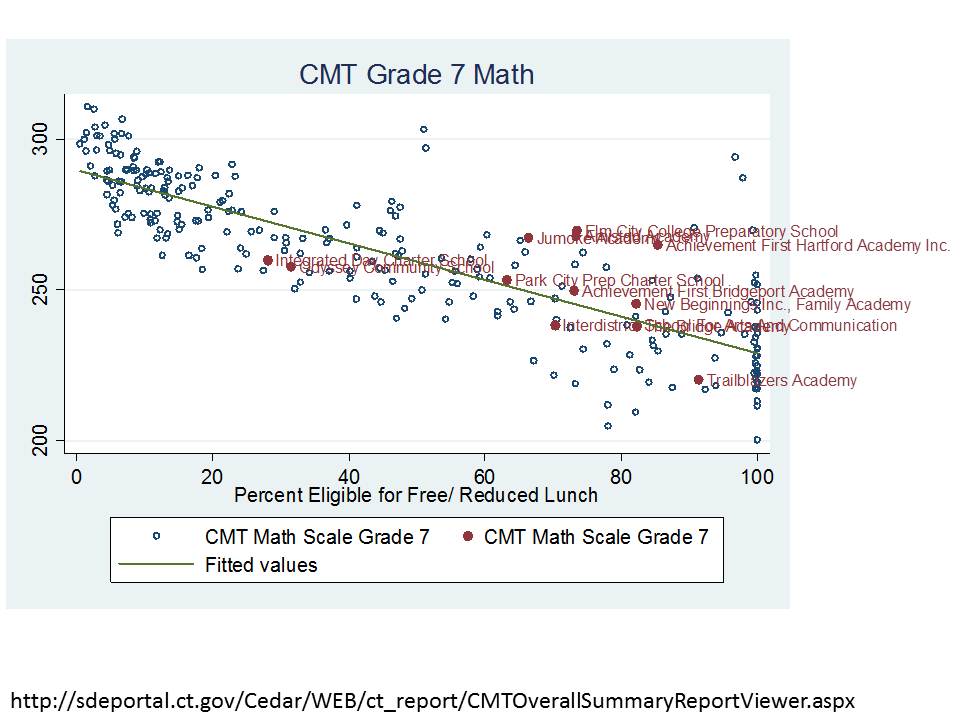
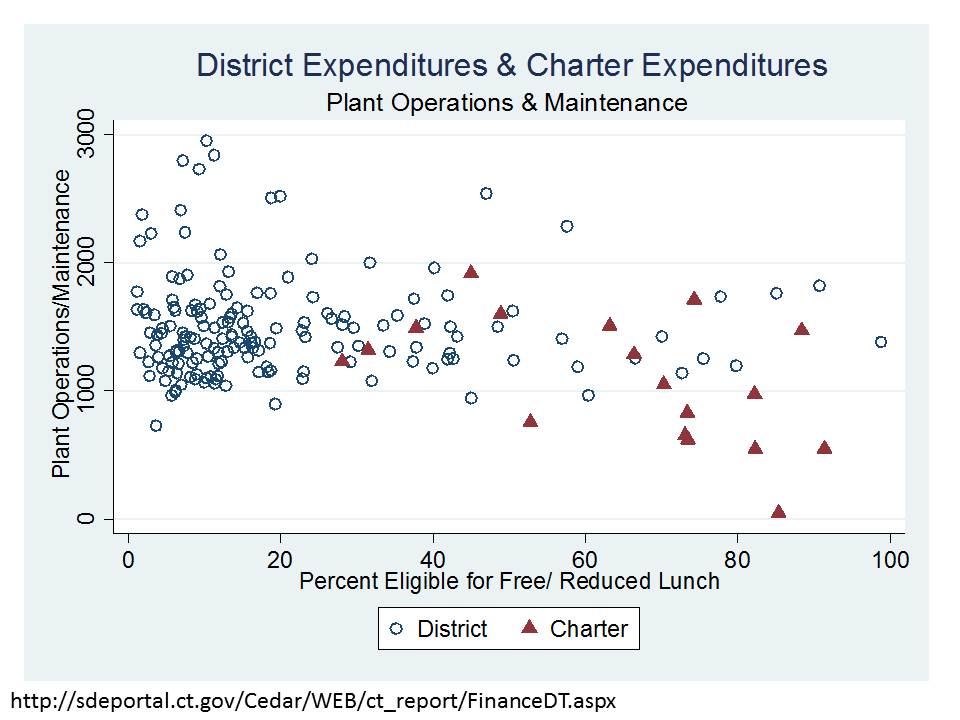
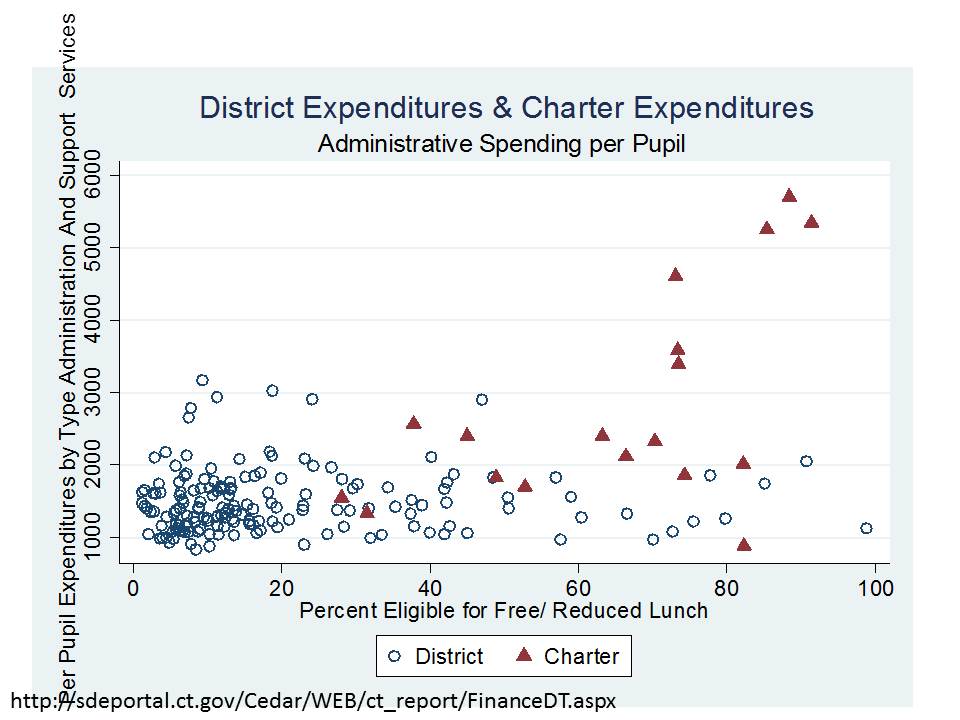
I was admittedly in a bit of a rush the other day to pull together some figures on CT charter schools based largely on data I had previously compiled, some of which only included Achievement First charter schools.  Here, I include all charter schools in Hartford, New Haven and Bridgeport, and address only the % Free Lunch numbers using the most recent available data from the NCES Common Core of Data, which are from 2009-10.  A few quick points are in order.

First, this is not “old” data per se. It is one year lagged from the  most recent official state data (2010-11). Current year (2011-12) data would not be appropriate for use until the close of the year. Thus 2010-11 would be the most recent complete data, if available. Also, these types of data tend to be relatively stable over time. They don’t shift much over a 2 year period, but I’ll keep updating as complete end of year data become available. The burden of reporting accuracy falls on the schools and districts.

Second, this is not a “study.” A study, so to speak, in my view, requires far more extensive analysis than this. And yes, this is a topic on which I have conducted those more extensive analyses (though not specifically involving CT charter schools). This is a blog, and in this blog post and in the previous blog post on CT Charter schools I have merely rendered graphs of the existing data as reported by the schools. There’s no data editing involved, and no tricky statistical analyses ( like the regression model of wages in my CT teacher post – which come from previous work). It’s just graphs. Then why bother? Well, I bother because much of what I see in the ongoing debate over CT charter schools (and charters in some other locations) is guided by misinformation, or at least misconceptions (of charters beating the odds with the “same” students – proving poverty doesn’t matter! nor does money?).  Misinformation that is easily enough correctable with a simple graph or two, or map, or even table of the numbers. Hey… all of these numbers are available to each and every one of you. I’ve provided posts in the past where I explain how to get them and how to summarize and graph them.  I wish someone else would save me the time, and go make their own graphs, or at least present and discuss the existing data to provide relevant context for current policy discussions. But alas, I’ve not seen that happening (though a few individuals have jumped into the game). Thus, I stick my nose, uninvited into another state’s business once again.

All of that said, here are a few more graphs:

The upshot of these graphs is that it would certainly be unfair to criticize Achievement First specifically for serving fewer low income children than district schools in these major cities. In fact, in both New Haven and Hartford, the Achievement First charters have the higher low income concentrations among the charters, and in Bridgeport they are not the lowest.

It is also important to understand that districts have to a large extent self-induced economic segregation through their own magnet school programs. I’ve addressed the same issue regarding Newark, NJ in the past. So, economic segregation within these cities is not entirely driven by the presence of charters but rather by the complex mix of district traditional and magnet schools coupled with the introduction and expansion of charters.


Snapshots of Connecticut Charter School Data

In several previous posts I have addressed the common argument among charter advocacy organizations (notably, not necessarily those out there doing the hard work of actually running a real charter school – but the pundits who claim to speak on their behalf) that charter schools do more, with less while serving comparable student populations. This argument appears to be a central theme of current policy proposals in Connecticut, which, among other things, would substantially increase funding for urban charter schools while doing little to provide additional support for high need traditional public school districts. For more on that point, see here.

I’ve posted some specific information on Connecticut charter schools in previous posts, but have not addressed them more broadly. Here, I provide a run-down of simple descriptive data, widely available through two major credible sources. Easy enough to replicate any/all of these analyses on your own with the publicly available data:

Connecticut State Department of Education (CEDaR) reports

National Center for Education Statistics Common Core of Data

Since the common claim is that charters do more (outcomes) with less (funding) and while serving the same kids (demographics), it is relevant to walk through each of these prongs of the argument step by step.

DEMOGRAPHIC COMPARISONS

These graphs focus on Connecticut’s most acclaimed high-flying charter schools, those affiliated with Achievement First, and the graphs are relatively self explanatory.

Note: % Free lunch information comes form 2009-10 NCES Common Core of Data and includes all schools identified as being located within the city limits. % ELL data is from 2010-11 CEDaR system and includes Achievement First Charters and District Schools (leading to smaller numbers of total schools due to special school and other charter exclusions). Special education data are gathered from individual school snapshot reports (CEDaR).

For fun, in this one, I’ve also noted the position of Capital Prep – which is a magnet school, and it is well understood that the student populations at Hartford magnets are substantively different from Hartford regular public schools. But strangely, there is even substantial rhetoric out there about this school being an example of beating the odds!?!

Finally:

Put very simply – Achievement First Charter schools DO NOT SERVE STUDENT POPULATIONS COMPARABLE TO DISTRICT POPULATIONS.

I have explained previously how this is relevant to broader policy discussions. Specifically, it is relevant to the claim that these schools can serve as a model for expansion yielding similar outcomes for all children in New Haven, Bridgeport or Hartford. In very simple terms, there are not enough non-low income, non-disabled and non-ELL kids around in these settings to broadly replicate the outcomes that these schools may be achieving.  Again, this public policy perspective contrasts with the parental choice perspective. While from a public policy perspective we are concerned that these outcomes may be merely a function of selective demography, from a personal/parental choice perspective within any one of these cities, the concern is only for the outcomes, and achieving those outcomes by having a desirable peer group is as desirable as achieving those outcomes by providing higher quality service.

FINANCIAL & OTHER RESOURCE COMPARISONS

Below (at end of post) I provide an important explanation/discussion of issues in comparing charter school and traditional public district finances. First and foremost, it is important to understand simply from the above comparisons, that these schools serve substantively different student populations, thus equal dollar inputs is, from the outset, an inappropriate fairness metric. But the complexities go beyond that. In CT and other locations, host districts retain responsibility for transportation and special education costs, even for students attending charters. Thus, it would be reasonable, as I did in a previous post to subtract out those expenditures from district budgets when comparing to charter spending. Now, on the other side, Charters do often have to lease facilities at their own expense, which in a state like CT would typically run about $1,500 to $2,000 per pupil. More in NYC, similar in NJ. But, while charter advocates would have you believe that districts have $0 cost of facilities, that is not necessarily true. For CT public districts, plant operations expenses per pupil tend to be on the order of $1,000 to $2,000 per pupil, and large urban districts maintaining significant capital stock with significant deferred maintenance tend to be toward the high end. More discussion of the factors which cut each way is in the note at the end of the post. So, here’s a quick run-down on charter and district expenditures in CT, cut different ways (all expressed in per pupil terms, and with respect to district/charter % Free or Reduced price lunch shares):

So… after taking out special education and transportation, charters appear relatively well resourced.

EVEN IF WE ASSUME THAT THE NET DIFFERENCE IN FACILITIES COST IS ABOUT $1,000 PER PUPIL BETWEEN CHARTER AND DISTRICT SCHOOLS, CHARTERS ARE IN PRETTY GOOD SHAPE IN CT.  (That assumption would pull the $1,000 per pupil off the charter estimates above). This would assume the facilities maintenance/operations/debt service in hosts to be about $1,000 and lease/operations/maintenance for charters to be about $2,000 per pupil.

Here’s an alternative angle (from previous post)

I also showed in a previous post that for Amistad, the funding difference translates to both a class size advantage and salary advantage:

Class sizes are more mixed in Hartford, but in Bridgeport (the least well funded urban district), Achievement First offers much smaller class size:

OUTCOMES

The final prong of the argument involves those higher outcomes – those beating the odds with the same kids and less money – outcomes.  Here are a few samples of the 5th grade math outcomes by district, focusing on the position of the Achievement First charter schools. I’ve graphed the school level 5th grade math 2010-11 Connecticut Mastery Test mean scale score by school level % Free Lunch (prior year). It’s important to understand that these charter schools not only have much lower % Free Lunch but also tend to have low ELL populations and also have much lower shares of enrollment with disabilities.

Here’s Hartford, where the Achievement First school looks so unlike nearly every Hartford public school reporting 5th grade math scores that it’s hard to even make a comparison. But, the two dots over near the Achievement First school do perform similarly.

Comparisons are comparably ridiculous in Bridgeport.

But more reasonable in New Haven! Even then, Amistad and Elm City Prep fall somewhat in line with New Haven schools serving similar % Free Lunch.

A statewide look at 7th grade math scores provides a better showing especially for Achievement First schools, but the analysis is hardly decisive. Note that this graph uses % Free or Reduced Lunch from CEDaR sources. Using such a high income threshold for low income status tends to mash schools in urban districts against the right hand side of the figure, removing some important variation.  I’ll redo with % free if/when I get the chance. This graph includes schools statewide, including affluent suburban schools. Among the notable features of the graph is that low income status matters, whether for charter schools or for traditional district schools. Most fall along the trendline.

In this case, the Achievement First schools in particular have higher math mean scale scores than traditional public schools serving the same % Free Lunch, BUT… this DOES NOT ACCOUNT FOR THE ADDITIONAL DIFFERENCES IN ELL AND SPECIAL EDUCATION WHICH MAY (WILL) SUBSTANTIALLY INFLUENCE THESE COMPARISONS!

Perhaps most importantly, these scatterplots are essentially little more than descriptive comparisons of mean scale scores against schools similar on a single parameter (% Free Lunch). BUT, even this simple adjustment serves to undermine the current rhetoric in Connecticut, as I discussed in a previous post.

NOTE: Charter-District School Spending Comparisons & the Facilities Cost Issue

A study frequently cited by charter advocates, authored by researchers from Ball State University and Public Impact, compared the charter versus traditional public school funding deficits across states, rating states by the extent that they under-subsidize charter schools.[1] The authors identify no state or city where charter schools are fully, equitably funded. But simple direct comparisons between subsidies for charter schools and public districts can be misleading because public districts may still retain some responsibility for expenditures associated with charters that fall within their district boundaries or that serve students from their district. For example, under many state charter laws, host districts or sending districts retain responsibility for providing transportation services, subsidizing food services, or providing funding for special education services. Revenues provided to host districts to provide these services may show up on host district financial reports, and if the service is financed directly by the host district, the expenditure will also be incurred by the host, not the charter, even though the services are received by charter students. Drawing simple direct comparisons thus can result in a compounded error: Host districts are credited with an expense on children attending charter schools, but children attending charter schools are not credited to the district enrollment.  In a per pupil spending calculation for the host districts, this may lead to inflating the numerator (district expenditures) while deflating the denominator (pupils served), thus significantly inflating the district’s per pupil spending. Concurrently, the charter expenditure is deflated.

Correct budgeting would reverse those two entries, essentially subtracting the expense from the budget calculated for the district, while adding the in-kind funding to the charter school calculation. Further, in districts like New York City, the city Department of Education incurs the expense for providing facilities to several charters. That is, the City’s budget, not the charter budgets, incur another expense that serves only charter students. The Ball State/Public Impact study errs egregiously on all fronts, assuming in each and every case that the revenue reported by charter schools versus traditional public schools provides the same range of services and provides those services exclusively for the students in that sector (district or charter).

Charter advocates often argue that charters are most disadvantaged in financial comparisons because charters must often incur from their annual operating expenses, the expenses associated with leasing facilities space. Indeed it is true that charters are not afforded the ability to levy taxes to carry public debt to finance construction of facilities. But it is incorrect to assume when comparing expenditures that for traditional public schools, facilities are already paid for and have no associated costs, while charter schools must bear the burden of leasing at market rates – essentially and “all versus nothing” comparison. First, public districts do have ongoing maintenance and operations costs of facilities as well as payments on debt incurred for capital investment, including new construction and renovation.  The average “capital outlay” expenditure of public school districts  in 2008-09 was over $2,000 per pupil in New York State, nearly $2,000 per pupil in Texas and about $1,400 per pupil in Ohio. Based on enrollment weighted averages generated from the U.S. Census Bureau’s Fiscal Survey of Local Governments, Elementary and Secondary School Finances 2008-09 (variable tcapout): http://www2.census.gov/govs/school/elsec09t.xls

Second, charter schools finance their facilities by a variety of mechanisms, with many in New York City operating in space provided by the city, many charters nationwide operating in space fully financed with private philanthropy, and many holding lease agreements for privately or publicly owned facilities. New York City is not alone it its choice to provide full facilities support for some charter school operators (http://www.thenotebook.org/blog/124517/district-cant-say-how-many-millions-its-spending-renaissance-charters). Thus, the common characterization that charter schools front 100% of facilities costs from operating budgets, with no public subsidy, and traditional public school facilities are “free” of any costs is wrong in nearly every case, and in some cases, there exists no facilities cost disadvantage whatsoever for charter operators.

Baker and Ferris (2011) point out that while the Ball State/Public Impact Study claims that charter schools in New York State are severely underfunded, the New York City Independent Budget Office (IBO), in more refined analysis focusing only on New York City charters (the majority of charters in the State), points out that charter schools housed within Board of Education facilities are comparably subsidized when compared with traditional public schools (2008-09). In revised analyses, the IBO found that co-located charters (in 2009-10) actually received more than city public schools, while charters housed in private space continued to receive less (after discounting occupancy costs).[1] That is, the funding picture around facilities is more nuanced that is often suggested.

Batdorff, M., Maloney, L., May, J., Doyle, D., & Hassel, B. (2010). Charter School Funding: Inequity Persists. Muncie, IN: Ball State University.

NYC Independent Budget Office (2010, February). Comparing the Level of Public Support: Charter Schools versus Traditional Public Schools. New York: Author, 1

NYC Independent Budget Office (2011) Charter Schools Housed in the City’s School Buildings get More Public Funding per Student than Traditional Public Schools. http://ibo.nyc.ny.us/cgi-park/?p=272

NYC Independent Budget Office (2011) Comparison of Funding Traditional Schools vs. Charter Schools: Supplement http://www.ibo.nyc.ny.us/iboreports/chartersupplement.pdf

Additional Figures

Administrative expenses in charters often include facilities lease agreements in addition to any recruitment/marketing expenses and growth/expansion.