Part 1 looked at governors’ budgets and how hard states try to fund their schools. This post asks a different question about who holds state office: does it matter whether they are women?
The short answer: women in the legislature, yes, modestly, and mostly for children in the highest-poverty districts. Women governors, no detectable difference. The full analysis is in a new working paper, Who Pays Attention? Women in State Leadership, Partisanship, and School Finance, 1993–2024.
More women in state office
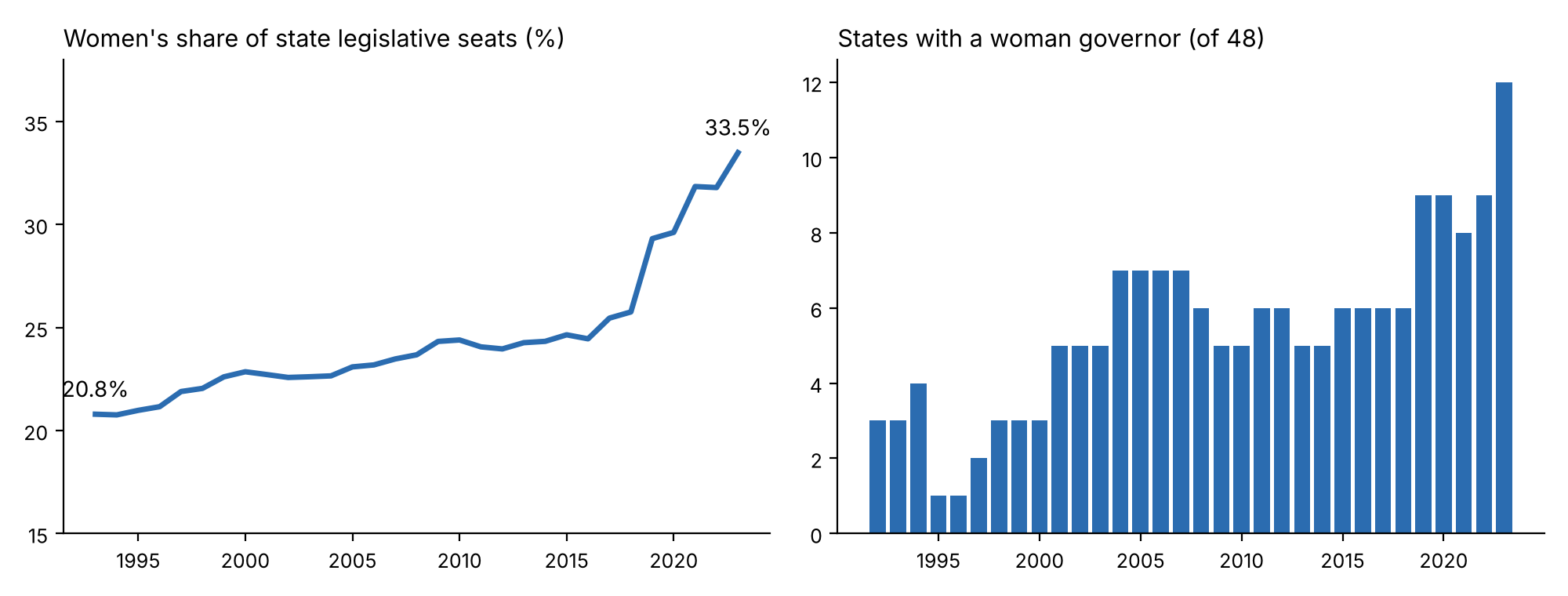
Women held about 21% of state legislative seats in the early 1990s and about 34% by 2023. The number of states with a woman governor rose from three to twelve. That is a large, uneven change in who writes state budgets, and it gives us a way to ask whether it shows up in school funding.
How I looked
I built two indexes from the School Finance Indicators Database. The first runs from 1993 to 2024 and combines fiscal effort, the progressiveness of revenue, spending and staffing, and wage-adjusted resources. The second runs from 2009 to 2024, when adequacy measures become available, and combines effort, equal opportunity, and adequacy for all students and for those in high-poverty districts.
Following the design Zachary Oberfield and I used in The Politics of Progressivity, the models compare each state with itself over time and control for state policy liberalism, the racial composition of the school-age population, court-ordered reforms and charter enrollment. I then test the results with state-specific trends, year-to-year changes, placebo tests using future legislatures, and an event study of 182 changes of governor.
Women in the legislature
Over 1993–2024, a 10-point higher share of women in the legislature goes with a modestly higher school finance index, mainly through effort. That association is fragile. It shrinks when demographic change is accounted for, and it does not show up as year-to-year improvement.
Since 2009, when adequacy can be measured, the picture is sharper. The association is nearly twice as large and holds up with state trends. It runs through the poorest districts: a 10-point higher share of women goes with spending in the highest-poverty fifth of districts covering about 4 more percentage points of what it would cost to reach national-average outcomes, and with a narrower gap between high- and low-poverty districts. Overall adequacy barely moves.
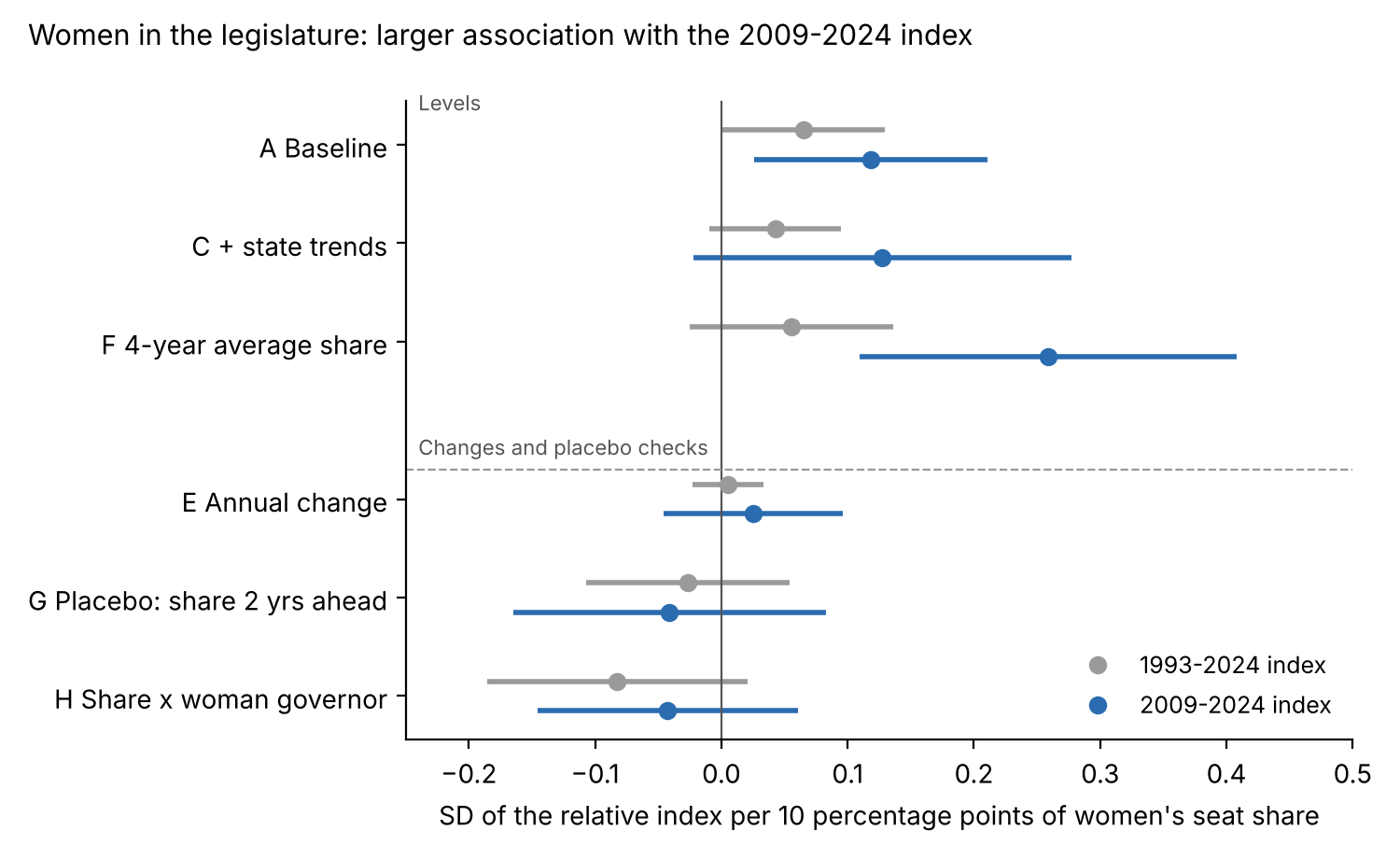
Two cautions. The association builds slowly over the whole period rather than showing up in any single budget year, which fits a policy effect but also fits other slow-moving changes in states. And part of it runs through ideology: legislatures with more women enact more liberal policy in general, and more liberal states fund schools more generously.
Women governors
Women governors leave no detectable mark on either index. In the event study, states that elected a woman governor tracked those that elected a man before the change and after it. With only 27 transitions to a woman, small effects cannot be ruled out, but there is no sign of a large one.
Party, again
As in Part 1, the steadier signal is party. Republican governors are associated with lower fiscal effort, though not with less progressive distribution. They also move state policy to the right more broadly, so some of the party difference runs through the general direction of state policy.
What Kansas suggests, and what the data show
In School Finance and Education Equity: Lessons from Kansas (2021), Chapter 6, “Women on the High Plains,” tells part of how a conservative state built and defended an equitable school finance system. Women in Kansas politics, from Governor Joan Finney to the moderate Republican legislators who pushed back on school cuts, were central to that story. So I tested whether women legislators matter more in conservative states. Nationally, they do not: the association is about the same across the spectrum. Kansas may be a story of particular people at particular moments.
Elections matter
Who sits in the legislature changes slowly, one election at a time, and so does school funding. These results suggest that, over time, legislatures with more women have done more for the children in the poorest districts. Tomorrow’s ballots include thousands of state legislative seats as well as governors. Both matter for schools.
The working paper
Baker, B.D. (2026, November). Who pays attention? Women in state leadership, partisanship, and school finance, 1993–2024. School Finance 101 Working Paper. PDF
Data: School Finance Indicators Database; Center for American Women and Politics; Caughey and Warshaw’s state policy ideology series (1937–2024); governor terms from Jacob Kaplan’s governors dataset, extended through 2023. Comments welcome.


