Teaching is a predominantly female profession. Nationally, 77% of public school teachers are women (NCES); in New Jersey, women hold 76% of full-time teaching jobs.
It is also an underpaid one. The Economic Policy Institute finds that teachers earned 25.2% less in weekly wages than comparable college-educated workers in 2025, up from 6.1% in 1996. Counting teachers’ better benefits, the penalty is still 14.5% (EPI). New Jersey does better than most states but not well: EPI puts its penalty at about 14%. School Finance Indicators Database estimates found New Jersey teachers earning 15.9% less than similarly educated non-teachers of the same age (SFID via NJPP; Shanker Institute). A mostly female profession paid well below its peers is already a gender pay story.
Within teaching, though, it would at least seem that there should be no gender pay gap. Public school salaries are set by negotiated guides: a step for each year of experience, a column for each degree, the same scale for everyone in the district. A woman and a man with the same degree and years should earn the same.
The data tell a few different stories. I looked at every full-time certificated employee in New Jersey from 2017-18 through 2023-24, more than 800,000 person-years of salary records.
- The pay gap does exist. In 2023-24 the typical woman teacher earned $79,069 and the typical man $83,510, about 95 cents on the dollar. Even among teachers in the same district with the same degree, experience and assignment, women earn about 0.6% less.
- It is bigger for principals. The typical woman principal earned $145,500, against $155,567 for men. Within the same district, at the same school level and size, women principals earn 3.3% less, about five times the teacher gap. Among high school principals the median gap is $20,496.
- Women tend to be in the lower-paying jobs and settings, even within K-12 schooling. Elementary-only districts are 86% women and pay about 6% below average for the same credentials. Principals are 30 points less likely to be women than the teachers in their own schools, and men principals are twice as likely to lead a high school.
The common thread: where pay follows a published rule, the gap nearly disappears. It persists where pay is negotiated person by person, and where women and men end up in different districts and different jobs.
Teachers: the salary guide does its job
Most of the teacher gap comes from who teaches what, and where. Men are concentrated in high schools, in larger schools, and in fields such as science, industrial arts, vocational education and social studies, and those settings pay more. Hold job code, school level and size, and district constant, and the gap all but disappears.
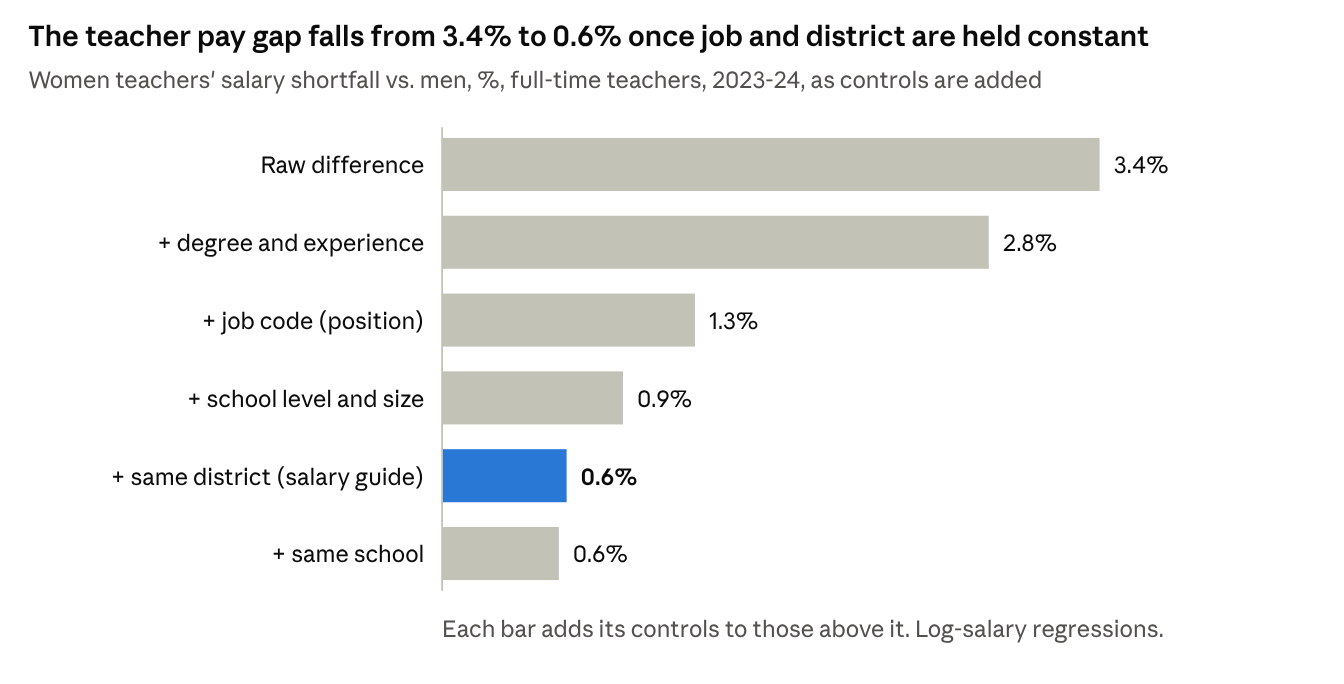
Within the same district, a woman teacher with the same degree, experience and assignment as a man earns about 0.6% less, roughly $520 a year. In elementary and middle schools it is 0.2–0.3%, and for teachers with 25 or more years’ experience it is essentially zero.
What is left is mostly money outside the guide. In 2022-23 and 2023-24, men teachers’ supplements, such as coaching and club stipends, averaged $1,460 against $814 for women. Measured on base salary alone, the within-district gap shrinks from 0.71% to 0.39%.
Principals: the gap the guide doesn’t reach
Principals are a different story. In 2023-24, women principals earned 3.3% less than men in the same district, at the same school level and size, with the same degree and experience. That is roughly $4,800 a year, about five times the teacher gap. Assistant principals show about 2%. Superintendents show about 2% after accounting for district enrollment.
The gap does not depend on what kind of school a principal leads: it is 2.6% in elementary schools, 2.3% in middle schools and 3.0% in high schools. It does grow with seniority, from 2.0% for principals with under 15 years of experience to 3.2% for those with 25 or more. That is what we would expect if pay is negotiated contract by contract and differences compound over a career.
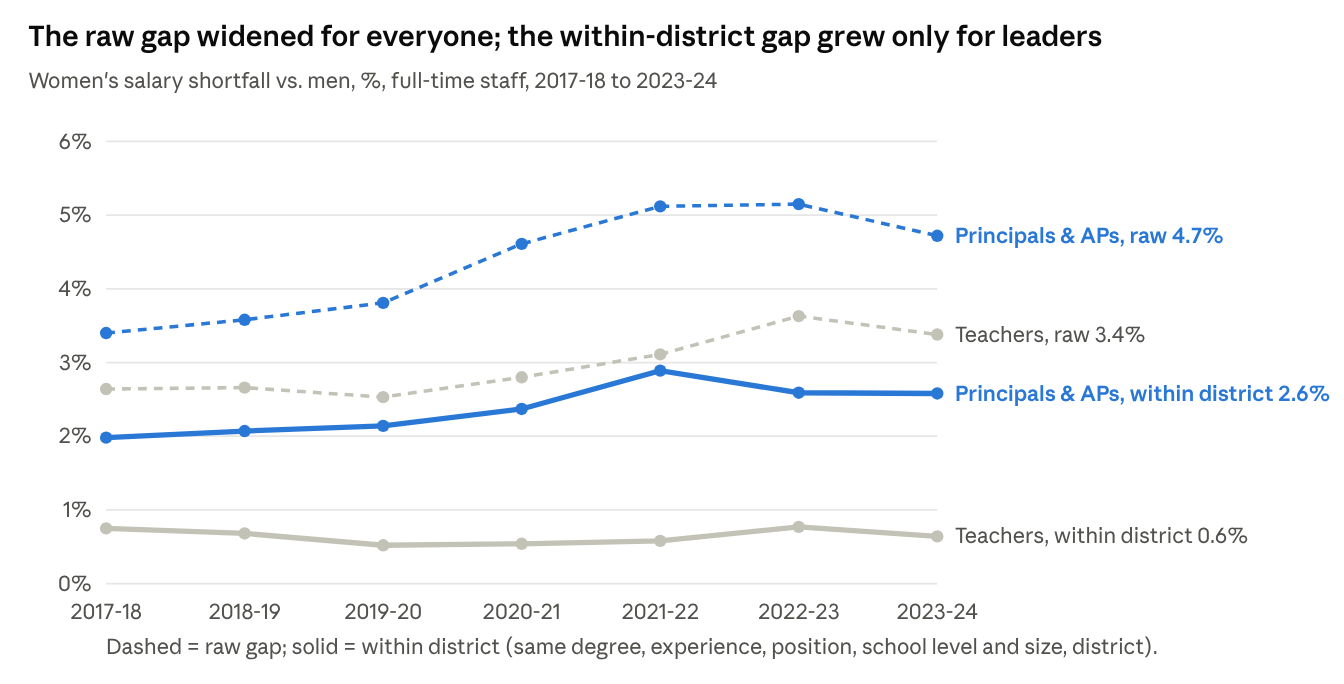
The trend makes the contrast plain. Raw gaps widened for teachers and leaders alike between 2018 and 2024. For teachers, the gap within the same district held at 0.5–0.8% every year. For principals and assistant principals it grew, from 2.0% to 2.6%.
Representation compounds the problem. Women are 76% of New Jersey’s teachers but 48% of its principals, 37% of its superintendents and 31% of its high school principals, the best-paid principal jobs.
Who works where
Much of the raw gap comes from structure rather than from different pay for the same post. Three patterns stand out.
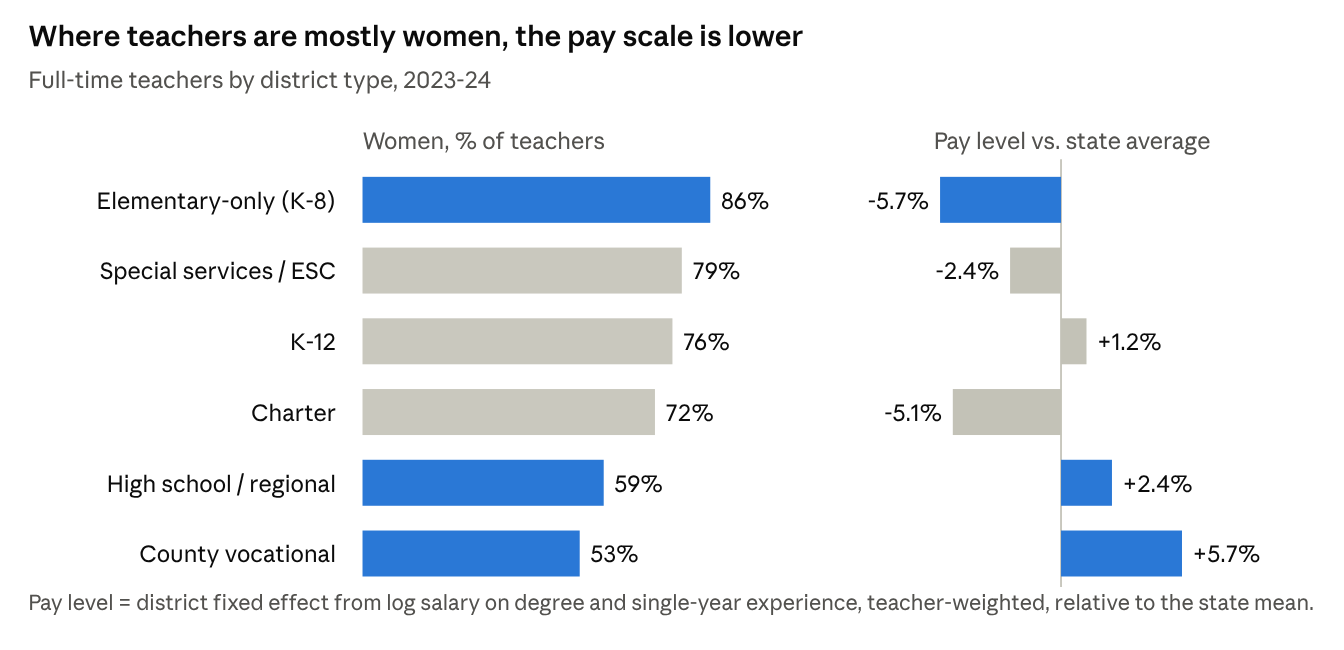
Different districts, different staffs, different guides. New Jersey still runs hundreds of elementary-only (K-8) districts alongside regional high school and county vocational districts. The elementary districts are 86% women and pay about 6% below the state average for the same degree and experience. Regional high school districts (59% women) and county vocational districts (53% women) pay 2–6% above it.
Men teachers are more likely to work under those higher guides. 8.0% of men teachers work in regional high school districts, against 3.6% of women, and 4.9% of men work in county vocational districts, against 1.7% of women. Nearly one in five women teachers (18.5%) works in an elementary-only district, against one in ten men.
This is not just a difference in job mix. Comparing teachers in the same job code, elementary-only districts still pay 5.1% below average, while regional high school districts pay 0.7% above and vocational districts 2.2% above. District by district the pattern holds: each 10 points more women on a teaching staff goes with a pay scale about 3.5% lower. Which district a teacher works in accounts for about 23% of the raw teacher gap.
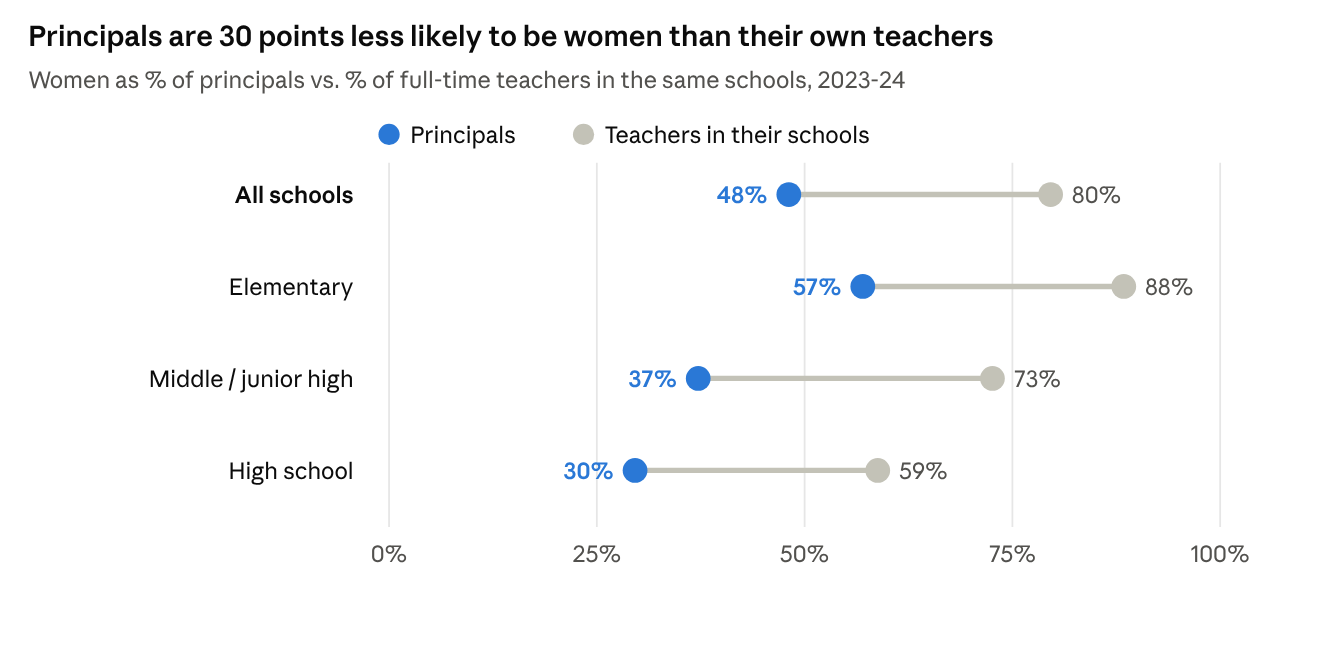
Principals don’t look like their staffs. In 2023-24, 48% of principals were women, compared with 80% of the teachers in their own schools. The shortfall is about 30 points at every level: elementary principals are 57% women against 88% of their teachers, and high school principals 30% against 59%. Even in schools where 90% or more of the teachers are women, only 56% of principals were women between 2018 and 2024. If principals mirrored their own schools’ teachers, roughly 620 more women would have been principals in 2023-24. Assistant principals come closer, at 50% women against 70% of their teachers.
Men lead the high schools. A quarter of men principals lead high schools, against an eighth of women; 71% of women principals lead elementary schools, against half of men. In regional high school districts, 7 of 50 high school principals are women.
| Principals, 2023-24 | Men | Women |
|---|---|---|
| Share leading high schools | 25% | 12% |
| Median salary, elementary | $152,230 | $145,481 |
| Median salary, high school | $169,096 | $148,600 |
The high school premium goes mostly to men. Men high school principals earn $16,867 more at the median than men elementary principals; for women the difference is $3,120. Women who lead high schools tend to run smaller ones (median enrollment 735 vs. 1,022), and more often in charters and lower-paying districts. Inside the same district, women high school principals earn about 3% less than men, about the same as at other levels.
Putting it together: for teachers, school level, job, school size and district explain about 60% of the raw gap. Experience explains most of the rest, and about a fifth is left unexplained. For principals, school level explains about a fifth and district and school size about a third. Half the principal gap remains unexplained, among people in the same district, at the same level, leading schools of the same size.
The full policy brief, with data and methods, detailed tables, robustness checks and policy recommendations, is available as a PDF:


