Let me start by saying that these are three groups for which I have a good appreciation. But, these groups have allowed much of their education reform agenda to be misguided by bad analyses and the time has come to clear up some major problems with the assumptions that drive many of the policy recommendations of these groups.
Issue 1 – Teacher Quality Distribution: Yes, the uneven distribution of teacher quality is a major factor – perhaps the greatest inequity in education that must be resolved.
Hanushek and Rivken conclude: “The substantial contribution of changes in achievement gaps between schools is consistent with an important role for schools, and we find that the imbalanced racial distribution of specific characteristics of teachers and peers—ones previously found to have significant effects on achievement—can account for all of the growth in the achievement gap following third grade.” (p. 29) Hanushek, E., Rivken, S. (2007) School Quality and the Black-White Achievement Gap. Education Working Paper Archive. University of Arkansas, Department of Education Reform.
There are undoubtedly inequities in the distribution of quality teachers across public schools within public school districts and some of the causes of these inequities may be traced back to district leadership and teacher contract structure.
But, without a doubt (and validated by most rigorous analysis of teacher labor markets), most of the disparities in the distribution of quality teaching occur BETWEEN, NOT WITHIN school districts – just as most of the differences in student populations occur between, not within districts. Most of the disparities have little to do with school district HR offices succumbing to seniority privileges and contractual bumping provisions, and have much more to do with racial and socioeconomic differences in students between districts and persistent disparities in school funding, infrastructure, etc.
Ed Trust and CAP in particular have been off base, driven there by empirically bad, conceptually weak, largely non-peer reviewed “policy” research. They have been led to believe that teacher quality distribution is primarily a district problem and one that can be fixed by altering “comparability” regulations of Title I. That is, using federal pressure to make districts fix their own problems. While districts should be required to do so, these problems are small piece of the much bigger puzzle. By obsessing so much on these issues, these organizations have completely taken their eye off the ball on the largest and most persistent inequities that plague our public schooling systems.
Issue 2 – The Role of Federal Title 1 Programs. These organizations are excessively if not obsessively focused on the role of Federal Title I funding. On the one hand, because they believe that most teacher quality disparities exist within districts – mainly districts having Title I schools, they also seem to believe that these disparities can be largely resolved by changing what are called “comparability” regulations of Title I to require districts receiving Title I funds to make greater assurances that their teachers are equitably distributed. Great! Let’s do that. I’m fine with that, but again, it’s trivial piece of the puzzle when districts with large numbers of Title I schools, or even 100% Title I schools can’t compete with their neighboring districts for teachers to begin with – and where those school districts may have few or no Title I schools.
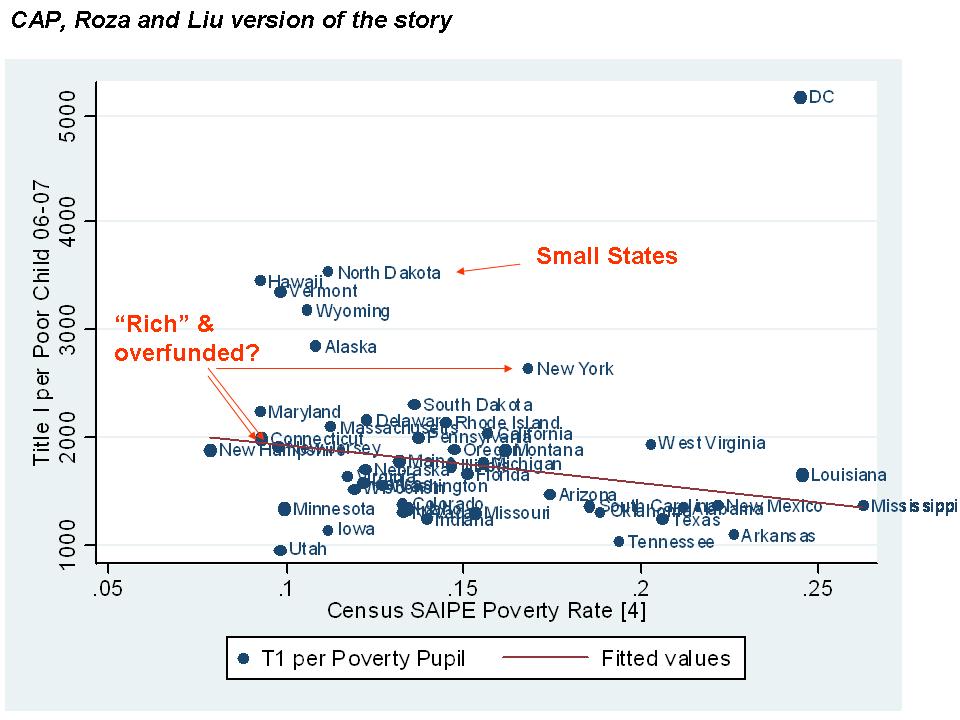
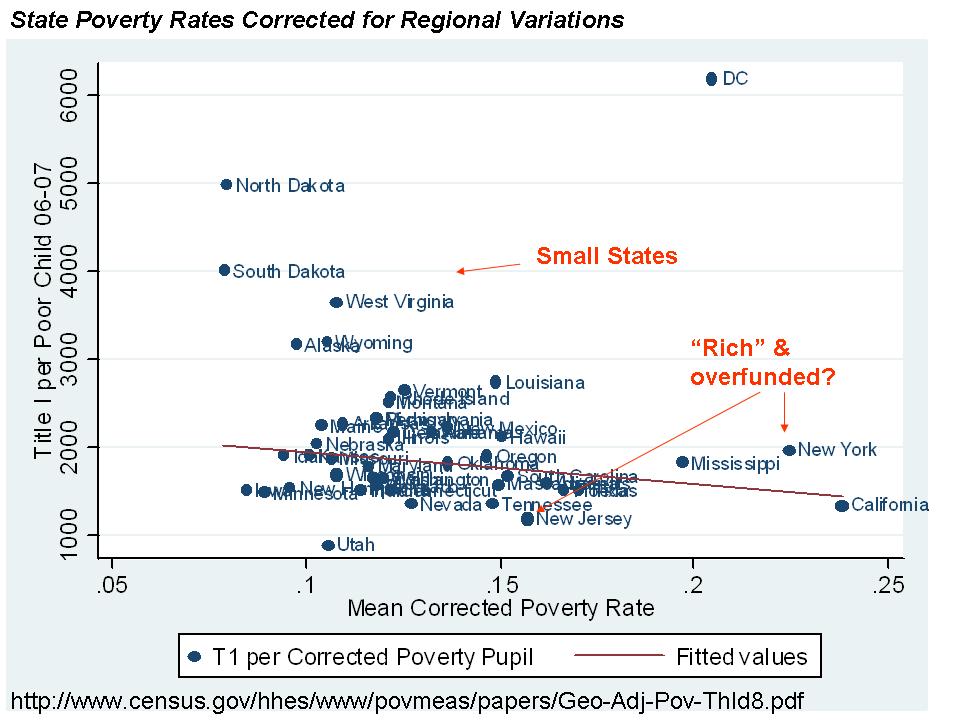
These organizations also appear somewhat obsessed with this idea that Title I money itself is being allocated in ways that make rich districts and rich states richer, while depriving poor districts and poor states. This is also largely a conclusion drawn from very weak analysis which fails to account sufficiently for regional variations in the cost of providing services and for regional variations in the fit of poverty thresholds to income distributions. I’ll happily elaborate for anyone who truly gives a damn about the technical details, but suffice it to say that – but for the small state minimum allocations to places like Vermont or Wyoming – the cross state and within state distribution of Title I funds is much less awful than I ever expected, and actually not so bad. Driving more Title I funds to southern and rural districts and away from poor urban core northern districts would likely be a very bad policy choice and would be based on deeply problematic analyses.
Finally, on this point, most issues of funding inequity are STATE POLICY ISSUES. The federal role remains relatively small. Some states do much better than others and we need to focus our attention on that. Further, while there do exist disparities within school districts across schools, the larger disparities are still STATE POLICY CONCERNS and exist BETWEEN, NOT WITHIN DISTRICTS. As a side note, it is also the case that districts adopting these hip-and-cool weighted student formulas as within district allocation mechanisms, do no better than districts in the same state using other allocation methods, at improving either fiscal equity or teacher quality equity across schools.
Issue 3 – Measuring Equity in School Funding. Here I have more appreciation and less to gripe about, but wish to point out some critical flaws in the approach used by The Education Trust in their Funding Gap analyses. I bring this topic up because the language used by the above mentioned organizations speaks to the Education Trust framework for evaluating whether states are doing the right thing on school finance. The Ed Trust approach is to look at the average spending of the highest and lowest poverty school districts in a state, with a few arbitrarily selected weights to adjust for “costs” associated with poverty. There’s a whole lot missing here which ultimately leads to some bad conclusions about some states. To begin with, I agree that what we need to be looking for is a progressive distribution of fiscal inputs – systematically higher in higher poverty settings than lower poverty settings. Unfortunately, taking the average of the top and bottom group tells us NOTHING of how SYSTEMATIC the patterns are! Instead, one must evaluate the overall relationship – ACROSS ALL DISTRICTS, EVEN THOSE IN THE MIDDLE – between district fiscal inputs and poverty. On inputs, if we are truly interested in measuring the state’s own policies, we should look at the sum of state and local revenues per pupil. Second, because of the mis-measurement of poverty across rural versus urban settings (something noted in a few Ed Trust reports) and because of economies of scale related cost differences, we should actually account for differences in the location and size of school districts. We should also account for differences in regional wage variation, which Ed Trust does. But, when all of these are thrown in together, into a rigorous analysis of funding progressiveness across districts within states, one gets a much different picture for some states than the picture provided by the oversimplified Funding Gap analysis. See Connecticut
Conclusions – Okay, so this is just Baker, a school finance techie geek bitching and moaning about trivial statistical problems with research largely conducted by Marguerite Roza and colleagues at the Center for Reinventing Public Education and the reliance of CAP, DFER and Ed Trust on that work. Perhaps – BUT – we are talking about billions of dollars here. And the distribution of billions of dollars should be backed by reasonably rigorous analysis and good assumptions. So, here are the take home points:
1) Teacher quality distribution is critically important and the main problem exists between school districts.
2) State school finance systems – not Title I and not district allocation policies – are the primary underlying cause of resource disparity across children in public schools, where the primary types of resource disparity are those that exist between districts.
- Funding one or two high poverty districts well in state is by no means “systematic” progressiveness
- FUNDING EQUITY – FUNDING PROGRESSIVENESS – IS A NECESSARY (though perhaps not in-and-of-itself sufficient) UNDERLYING CONDITION FOR ACHIEVING TEACHER QUALITY EQUITY
As such any legitimate requirements for states to qualify for additional fiscal stabilization funds or for Race to the Top Funding should include precise indicators about state responsibility to improve school funding equity and adequacy. Ed Trust, CAP and DFER have done a huge disservice by missing this point entirely.
Most recent presentation on Title 1:
Baker.AERA.Title1
Most recent presentation on Within/Between Funding & Teachers:
AEFA 2009b_color
HERE IS A MUCH MORE PRECISE SET OF COMMENTS REGARDING SCHOOL FUNDING, FROM THE EDUCATION LAW CENTER OF NJ:
ELCRTTFcoments.Aug28


 School Finance 101