Blog

A busy day in school finance…

Just checking my news alerts today. A lot going on:

Massachusetts formula review: http://www.wickedlocal.com/gloucester/news/education/x786214932/Lawmakers-seek-review-of-18-year-old-education-funding-formula

Kansas meeting among potential plaintiffs in response to aid cuts: http://www.dodgeglobe.com/education/x402527694/Schools-for-Fair-Funding-meeting-in-Dodge-City

New lawsuit brewing in Arizona: http://www.kold.com/Global/story.asp?S=11138528

Comments on these at a later point.

Coulson’s selective reading skills…again!

So… I’m browsing the Cato web site and Andrew Coulson’s blog entries this morning and find  post where Coulson explains that a 2008 study shows that spending more on K-12 education reduces economic growth (9-2-09 post).

http://www.cato-at-liberty.org/2009/09/02/fretting-about-college-costs-dont-forget-k-12/

So, I look at the study. Here are the first two sentences of the conclusion section of that study:

“Overall, our findings indicate that the three most consistent predictors of income growth are expenditures on higher education, highway expenditures, and K12 pupil–teacher ratios. They consequently contribute to the debate over the effects of class size, by supporting the body of research asserting that smaller classes make a positive difference (e.g., Burr 2001; Glass and Smith 1978; McGiverin et al. 1989).”

http://www.springerlink.com/content/26p7q52122326523/fulltext.pdf

Is there a reason why this wasn’t cited? It’s the main conclusion of the study? Does Coulson expect his readers not to actually make the effort to … read the study? and it’s findings? Even a lazy jump to the conclusions (all I could muster this morning) casts a very different light on the study than Coulson’s one liner: “State-run schooling has become so profligate and inefficient, in fact, that one recent study finds higher public school spending is associated with LOWER subsequent economic growth.”

Note that class sizes are perhaps the most significant driver of K-12 education expenditures.Yes, the same study does show a negative relationship between the education spending measure and economic growth, but in a model which also includes the pupil to teacher ratio measure – which makes interpreting the spending measure somewhat trickier. That is higher spending – at constant pupil to teacher ratio (which strongly affects spending) – is associated with lower growth. This is certainly not the same as a bold conclusion that spending more on K-12 education lowers growth.

Coulson still clueless

In his most recent response to my response:

http://www.cato-at-liberty.org/2009/09/01/author-of-the-private-school-spending-study-responds/

Coulson continues to miss the entire point of my report and misunderstand methodological detail. First, Coulson assumes that the entire point of the report is to show that private schools spend a lot and that they spend more than public schools. The point is that some do and some don’t. The report is about the variation and factors associated with that variation.

Coulson continues to obsess over the potential bias in the sample of religious schools in particular noting that those attempting to maximize revenue are more likely to file their tax returns and make them public in a timely manner through sources such as Guidestar. Perhaps. But, what I have shown of those schools – the largest group reporting being Christian Association Schools – is that they spend very little. I have triangulated this aggregate spending data with data on class size and teacher salaries (from other sources) to show the relationship among these factors. CAS schools spend very little, have low teacher salaries and teachers with relatively weak academic backgrounds. If this is a select group of upward bias spending CAS schools, I find that somewhat depressing. But it is possible. In any case, it does not compromise the findings or policy conclusions of the report. Note that on certain key characteristics that drive spending, the schools in the IRS 990 sample were comparable to all CAS schools in the NCES Private School Universe. That is the purpose of comparing the class sizes between the two. Again, the CAS schools reporting IRS 990 represented nearly 30% of student enrollment in CAS schools based on the NCES PSU survey (which really isn’t a universe. there are missing schools).

The front end of the report (pages 15 to 23) spends a great deal of time pointing out the distribution of children in private schools by affiliation. I included this front end specifically because I wanted the reader to know what I was and was not able to address in relation to private schooling generally. The report is very clear that Catholic schools are noticeably absent in financial filings despite their enrollment dominance in some regions. Perhaps some financial accountability is in order for these schools if we expect them to play such a strong role in serving the public good. However, in some regions, Catholic schools on average take a back seat to CAS schools and Independent Schools combined, both of which are relatively well represented in the analysis. This is true in the South. See figure 8, page 23. Private Independent schools do include some very elite schools (though I’ve excluded boarding schools from the analysis) but are a more diverse group and larger sector of schools than Coulson acknowledges. And, I was able to compile IRS filings for Independent Schools serving about 75% of the total Independent School population in the states and labor markets in the analysis.

Andrew Coulson should learn to read… Private School Study

I just read this piece from Cato attempting to discredit my recent policy report:

http://www.cato-at-liberty.org/2009/08/31/union-funded-study-says-private-schools-expensive/

Among other things Andrew Coulson asserts that large degrees of selection bias taint my study of Private School Expenditure and that not only did I ignore this, but I hid it intentionally and skewed the results. Okay, I urge anyone to read the study and check the extent of methodological detail.

http://www.greatlakescenter.org/docs/Policy_Briefs/Baker_PvtFinance.pdf

http://epicpolicy.org/publication/private-schooling-US

Regarding Coulson’s specific claims of selection bias:

Apparently, Coulson failed to read pages 24 and 25 of the report or view Figures 9 or 10 of the report where I detail precisely the extent to which the IRS 990 sample of 1,500 schools is representative of various private school affiliations as reported in the NCES Private School Universe Survey. Here, I show that the IRS filings represent 74.2% of private independent school enrollments for the states and labor markets studied and nearly a third of Christian Association Schools. I acknowledge the possibility of sampling bias, and make additional comparisons in Figure 21 (page 39) of the report, showing that the reported pupil to teacher ratios in the full NCES Private School Universe Survey align well with the pupil to teacher ratios in the schools which reported finances on IRS 990. Class sizes are a primary driver of per pupil spending.

On a more trivial note, elimination of schools with budgets of less than $500k has little or no effect on labor market, state or national averages which are weighted by the numbers of children served. Further, Coulson’s assertion that these schools are systematically lower spending per pupil is incorrect. They are all over the map.

To clarify the parenthetical regarding DC spending on Page 42. Current Expenditures per pupil in that year (2006-07) were about $14,300 in DC, and total about $20,200. It would be relevant to compare the total figure here. Nonetheless, the DC private independent schools in particular still outspent DC Public.

Finally, Coulson appears to totally miss the point of the study, which is not that private schools are somehow invariably high spenders. Rather, the point is that spending among private schools varies. It varies a lot, and it varies largely by religious affiliation with Christian Association Schools in particular spending much less than public schools. As such, when low voucher levels are set in existing voucher programs like that in DC, it should come as no surprise that most vouchers are used at religious schools. They (typical vouchers) simply aren’t even close to sufficient for private independent schools. Perhaps if the DC voucher program did allocate $28k per child (Coulson’s version of DC public schools spending per pupil), this would make a difference.

Also, regarding the sponsorship of the study – The study received a nominal honorarium of $4,000 from the Great Lakes Center and EPIC. Note, however, that from a public school teachers’ union perspective, there’s not much in there to cheer about. In fact, the study finds that even the higher spending privates do not necessarily pay their teachers more than public schools in the same labor market. Rather, the additional expense is in smaller class sizes which are largely a function of more diverse curricular offerings. Indeed the much lower spending private schools do have both larger classes and lower paid teachers.

UPDATE: Coulson updated his post to include the statement: “The religious private schools that do file Form 990 are thus a small self-selected group that is presumably seeking to maximize its revenue from charitable donations, and hence very likely biased toward higher spending schools.”

So, the implication is that my sample of private religious schools is biased toward the higher spending ones. Note that I have a near 30% sample of Christian Association Schools, and that my main conclusion about these schools is that they are very low spending and coupled with that have very weak teachers, relatively larger class sizes (than independents) and very low teacher salaries.  Is he sure that he wants to argue that this group is likely a biased, self-selected group of high spenders among CAS schools. Again, I compare my 990 sample to all CAS schools in the NCES PS universe survey in Figure 21. I do point out that my very small Catholic sample does appear biased in this very way (those few that did report were somewhat different than “average” Catholic schools in Figure 21).

Ed Trust, DFER and Center for American Progress misguided

Let me start by saying that these are three groups for which I have a good appreciation. But, these groups have allowed much of their education reform agenda to be misguided by bad analyses and the time has come to clear up some major problems with the assumptions that drive many of the policy recommendations of these groups.

Issue 1Teacher Quality Distribution: Yes, the uneven distribution of teacher quality is a major factor – perhaps the greatest inequity in education that must be resolved.

Hanushek and Rivken conclude: “The substantial contribution of changes in achievement gaps between schools is consistent with an important role for schools, and we find that the imbalanced racial distribution of specific characteristics of teachers and peers—ones previously found to have significant effects on achievement—can account for all of the growth in the achievement gap following third grade.” (p. 29) Hanushek, E., Rivken, S. (2007) School Quality and the Black-White Achievement Gap. Education Working Paper Archive. University of Arkansas, Department of Education Reform.

There are undoubtedly inequities in the distribution of quality teachers across public schools within public school districts and some of the causes of these inequities may be traced back to district leadership and teacher contract structure.

But, without a doubt (and validated by most rigorous analysis of teacher labor markets), most of the disparities in the distribution of quality teaching occur BETWEEN, NOT WITHIN school districts – just as most of the differences in student populations occur between, not within districts. Most of the disparities have little to do with school district HR offices succumbing to seniority privileges and contractual bumping provisions, and have much more to do with racial and socioeconomic differences in students between districts and persistent disparities in school funding, infrastructure, etc.

Ed Trust and CAP in particular have been off base, driven there by empirically bad, conceptually weak, largely non-peer reviewed “policy” research. They have been led to believe that teacher quality distribution is primarily a district problem and one that can be fixed by altering “comparability” regulations of Title I. That is, using federal pressure to make districts fix their own problems. While districts should be required to do so, these problems are small piece of the much bigger puzzle. By obsessing so much on these issues, these organizations have completely taken their eye off the ball on the largest and most persistent inequities that plague our public schooling systems.

Issue 2 – The Role of Federal Title 1 Programs. These organizations are excessively if not obsessively focused on the role of Federal Title I funding. On the one hand, because they believe that most teacher quality disparities exist within districts – mainly districts having Title I schools, they also seem to believe that these disparities can be largely resolved by changing what are called “comparability” regulations of Title I to require districts receiving Title I funds to make greater assurances that their teachers are equitably distributed. Great! Let’s do that. I’m fine with that, but again, it’s trivial piece of the puzzle when districts with large numbers of Title I schools, or even 100% Title I schools can’t compete with their neighboring districts for teachers to begin with – and where those school districts may have few or no Title I schools.

These organizations also appear somewhat obsessed with this idea that Title I money itself is being allocated in ways that make rich districts and rich states richer, while depriving poor districts and poor states. This is also largely a conclusion drawn from very weak analysis which fails to account sufficiently for regional variations in the cost of providing services and for regional variations in the fit of poverty thresholds to income distributions. I’ll happily elaborate for anyone who  truly gives a damn about the technical details, but suffice it to say that – but for the small state minimum allocations to places like Vermont or Wyoming – the cross state and within state distribution of Title I funds is much less awful than I ever expected, and actually not so bad. Driving more Title I funds to southern and rural districts and away from poor urban core northern districts would likely be a very bad policy choice and would be based on deeply problematic analyses.

Finally, on this point, most issues of funding inequity are STATE POLICY ISSUES. The federal role remains relatively small. Some states do much better than others and we need to focus our attention on that. Further, while there do exist disparities within school districts across schools, the larger disparities are still STATE POLICY CONCERNS and exist BETWEEN, NOT WITHIN DISTRICTS. As a side note, it is also the case that districts adopting these hip-and-cool weighted student formulas as within district allocation mechanisms, do no better than districts in the same state using other allocation methods, at improving either fiscal equity or teacher quality equity across schools.

Issue 3 – Measuring Equity in School Funding. Here I have more appreciation and less to gripe about, but wish to point out some critical flaws in the approach used by The Education Trust in their Funding Gap analyses. I bring this topic up because the language used by the above mentioned organizations speaks to the Education Trust framework for evaluating whether states are doing the right thing on school finance. The Ed Trust approach is to look at the average spending of the highest and lowest poverty school districts in a state, with a few arbitrarily selected weights to adjust for “costs” associated with poverty. There’s a whole lot missing here which ultimately leads to some bad conclusions about some states. To begin with, I agree that what we need to be looking for is a progressive distribution of fiscal inputs – systematically higher in higher poverty settings than lower poverty settings. Unfortunately, taking the average of the top and bottom group tells us NOTHING of how SYSTEMATIC the patterns are! Instead, one must evaluate the overall relationship – ACROSS ALL DISTRICTS, EVEN THOSE IN THE MIDDLE – between district fiscal inputs and poverty. On inputs, if we  are truly interested in measuring the state’s own policies, we should look at the sum of state and local revenues per pupil. Second, because of the mis-measurement of poverty across rural versus urban settings (something noted in a few Ed Trust reports) and because of economies of scale related cost differences, we should actually account for differences in the location and size of school districts. We should also account for differences in regional wage variation, which Ed Trust does. But, when all of these are thrown in together, into a rigorous analysis of funding progressiveness across districts within states, one gets a much different picture for some states than the picture provided by the oversimplified Funding Gap analysis. See Connecticut

Conclusions – Okay, so this is just Baker, a school finance techie geek bitching and moaning about trivial statistical problems with research largely conducted by Marguerite Roza and colleagues at the Center for Reinventing Public Education and the reliance of CAP, DFER and Ed Trust on that work. Perhaps – BUT – we are talking about billions of dollars here. And the distribution of billions of dollars should be backed by reasonably rigorous analysis and good assumptions. So, here are the take home points:

1)      Teacher quality distribution is critically important and the main problem exists between school districts.

2)      State school finance systems – not Title I and not district allocation policies – are the primary underlying cause of resource disparity across children in public schools, where the primary types of resource disparity are those that exist between districts.

  1. Funding one or two high poverty districts well in state is by no means “systematic” progressiveness
  2. FUNDING EQUITY – FUNDING PROGRESSIVENESS – IS A NECESSARY (though perhaps not in-and-of-itself sufficient) UNDERLYING CONDITION FOR ACHIEVING TEACHER QUALITY EQUITY

As such any legitimate requirements for states to qualify for additional fiscal stabilization funds or for Race to the Top Funding should include precise indicators about state responsibility to improve school funding equity and adequacy. Ed Trust, CAP and DFER have done a huge disservice by missing this point entirely.

Most recent presentation on Title 1:

Baker.AERA.Title1

Most recent presentation on Within/Between Funding & Teachers:

AEFA 2009b_color

HERE IS A MUCH MORE PRECISE SET OF COMMENTS REGARDING SCHOOL FUNDING, FROM THE EDUCATION LAW CENTER OF NJ:

ELCRTTFcoments.Aug28

Who should qualify for Race to the Top?

I’ve been asked at least a few times this past week about what types of requirements should be included for states to qualify for Race to the Top federal stimulus funding. Interestingly, there seems thus far to be little focus on whether states are actually financing their schools equitably and adequately and putting up reasonable effort to finance their schools as a requirement for accessing stimulus funds. More disconcerting is the fact that there also seems little emphasis on even whether stimulus stabilization funds are being used to advance equity and adequacy of funding. In some cases, which I will elaborate at a later date, stabilization funds have actually been allocated in ways that erode equity and reduce state effort. That being water under the bridge, what might be some reasonable requirements for Race to the Top and second year stimulus funds, and which states might qualify and not qualify?

Category 1: Fiscal Effort

A state’s effort in school finance is often measured as the aggregate state and local pk-12 public education resources allocated as a percent of Gross State Product (now labeled Gross Domestic Product – State). Some have suggested that states which maintain current effort levels should qualify for stimulus funds. This seems a low bar for states that put up very little effort like Delaware and Louisiana. It seems to me that low effort states – states below the average state – should have to show that they’ve increased effort significantly. But, states that are above the average should perhaps be held to the maintenance standard. I discuss Louisiana’s effort here.

Category 2: Fiscal Adequacy

Effort and adequacy are somewhat linked, as one can see in my rant about Louisiana and Mississippi. Louisiana is low effort and low adequacy in funding whereas Mississippi is average effort and low adequacy. That is, Louisiana is perhaps more to blame for its own inadequacy than Mississippi, which simply lacks the economic base.

I would argue that any state which has (a) below average effort and (b) per pupil spending adjusted for regional variation in wages (using the NCES Comparable Wage Index)  should be low on the list for additional stimulus funds. States with below average regional adjusted spending and below average effort should be required to increase both in order to qualify.  Sadly, however, I suspect that states like Louisiana would gladly further deprive the less than 85% of children who actually attend their public schools of these additional resources (LA has the highest share in private schools). Indeed, these requirements are a double-edged sword.

Category 3: Fiscal Equity

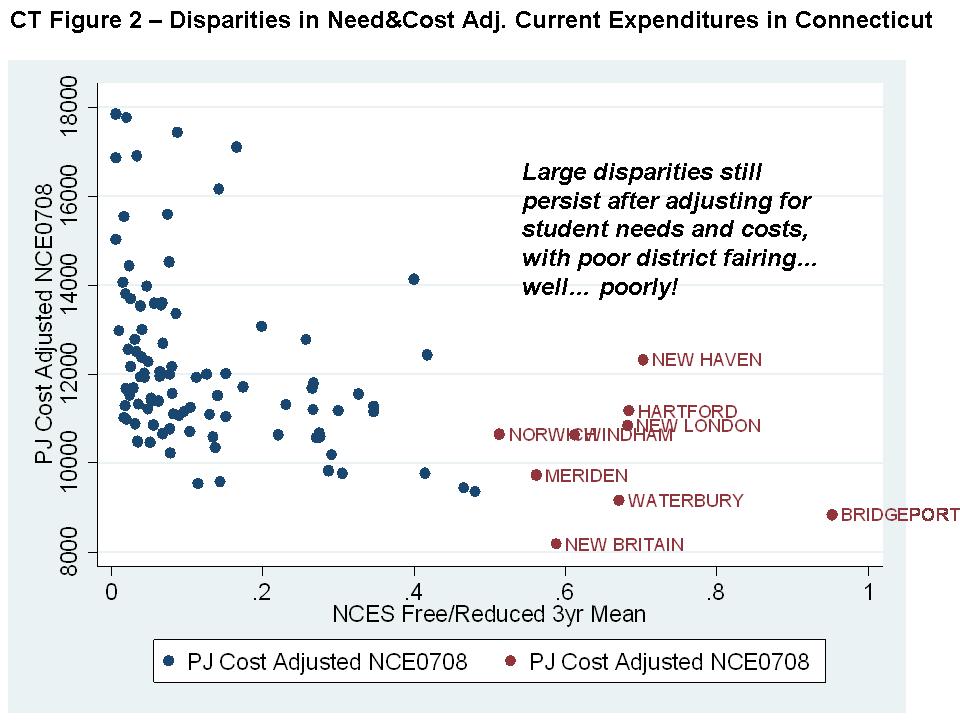
This one is a little more complicated, but the general idea is that states should have to be able to show that they’ve made effort toward targeting additional resources – state and local district revenues – to higher poverty school districts. In a forthcoming indexing system, we control for a variety of school district characteristics to evaluate whether, on average, a state school finance system results in systematically more state and local revenue per pupil in higher poverty school districts than lower poverty ones. Unfortunately the Education Trust approach of looking at the highest and lowest 25% of districts by poverty misses the boat – because it fails to capture whether the pattern is systematic across all districts. A good example is Connecticut, which shows a positive differential in state and local revenue between high and low poverty districts, but when measured statistically across all districts, the relationship is not statistically significant – or systematic. That’s because Connecticut district revenues are all over the map. The average spending for high poverty districts is skewed by only two (Hartford and New Haven) which are relatively higher state and local revenue districts. Meanwhile, districts like Bridgeport, Waterbury, New Britain and others are pretty much left out.

So, that in mind, what needs to be measured here?  Well, to qualify for Race to the Top funds, I believe that the first states in line should be those where there exists a systematic positive relationship between state and local revenues per pupil and either/or (a) US Census Poverty estimates (b) NCES Common Core Free/Reduced Lunch rates. This includes only a handful of states such as New Jersey and Minnesota (although also driven by Minneapolis and St. Paul, but better than CT). For states with either no relationship between state and local revenue and poverty, or a negative one, those states should have to show that they have improved significantly the relationship between state and local revenue per pupil and poverty.  For example, New York State, one of the nation’s most “regressively” funded states could reduce it’s negative relationship significantly by following through with planned increases to funding to New York City schools and to many other poor, small city districts around the state which remain, in the hole, so to speak.  Similarly, Pennsylvania which until recent reforms was the most regressively funded state in the nation, could really put a dent in its negative funding relationship by following through with the Governor’s plan to continue phase in of the new funding formula. This, in my mind would make PA an ideal candidate for Race to the Top funding.

Random thoughts on CT

I picked this article up on twitter: http://www.courant.com/news/education/hc-education-commissioner-0819.artaug19,0,3631152.story

From these figures below, it looks to me like Connecticut has some other issues to deal with. This is  a perfect example of just how illogical state aid distribution and state school finance formulas can be.

Variation in Nominal Expenditures

Variation in Need & Cost Adjusted Expenditures

Private School Spending

New out today (copy of press release):

Ground-breaking study has major implications for public school spending and voucher programs

Contact: Teri Battaglieri – (517) 203-2940; greatlakescenter@greatlakescenter.org
Bruce Baker – (732) 932-7496 ext. 8232; bruce.baker@gse.rutgers.edu

EAST LANSING, Mi., (August 18, 2009) – Private school spending varies far more widely than spending on public education, a new report finds. Further, the differences in spending among different parts of the private school sector reflect clear patterns with major implications for voucher policies and even for spending levels in the public sector.

Those are some of the findings in a first-ever, comprehensive examination of some 1,500 private schools nationally conducted by Rutgers University associate professor and school finance expert Bruce D. Baker.

The report, Private Schooling in the U.S.: Expenditures, Supply, and Policy Implications, is based on a review of financial and enrollment information contained in IRS tax returns combined with data from the National Center for Education Statistics. It was released today by the Great Lakes Center for Education Research and Practice.

Baker presents comparisons of expenditures among different types and affiliations of private schools, and compares those expenditures with public school expenditures for districts in the same state and labor market. Results indicate that (1) the less-regulated private school sector is more varied in many key features (teacher attributes, pay and school expenditures) than the more highly regulated public schooling sector, (2) these private school variations align and are largely explained by affiliation—primarily religious affiliation—alone, and (3) a ranking of school sectors by average spending correlates well with a ranking of those sectors by average standardized test scores.

“On average,” Baker explains, “the private schools studied spend more than public schools in the same metropolitan areas (and nationally), although some spend much less. Some private schools have lower pupil-to-teacher ratios than public schools, while others have comparable ratios. Some have comparable teacher salaries, and some pay their teachers much less. And, some have teachers with stronger academic qualifications than public school teachers, while others have teachers with weaker academic qualifications.”

What’s “most striking” about such patterns, Baker observes, is that they are largely explained by religious affiliation alone. Christian Association Schools have the lowest spending, the lowest salaries, teachers with the weakest academic records, and the highest pupil-to-teacher ratios. Moreover, earlier research concludes that these schools have the lowest student test scores. Catholic schools tend to approximate public schools in all these areas. Hebrew schools and independent day schools (generally not religiously affiliated) have higher spending – often substantially higher – and this is reflected in these resource categories.

Baker’s findings may provide some insights into why research on voucher programs has yielded mixed results regarding student achievement levels for participating low income students. The potentially high-performing parts of the private school sector are the ones that spend much more than available voucher subsidies. In fact, they spend much more than public schools. Private independent day schools—which have the academically strongest teachers and the smallest classes among private schools—will, Baker points out, “remain well out of reach of voucher recipients.” In many markets, such schools on average spend twice what public schools spend, which in turn is often twice the voucher levels allocated. Thus, even under a voucher scheme that paid what public schools receive per pupil, these private schools would have to subsidize half the total cost of teaching voucher students to match what they spend on their non-voucher students.

Baker recommends that policy makers who would look to private schools for lessons on how to improve public education begin with a clear awareness of the stark differences among subsets of private schools, avoiding policy recommendations based on averages or isolated instances. He also points to the importance of understanding the differences between private school spending and tuition, given that spending is often subsidized by outside resources (which themselves are often taxpayer subsidized). Regarding voucher policies, policy makers need to understand the tradeoff between attempts to craft policies with a limited impact on the public treasury and to craft policies that provide real choice to voucher recipients. Current policies appear to sacrifice choice for fiscal prudence, but this report demonstrates that the result is access to only a couple parts of the private sector, both of which have strong religious affiliations and neither of which appears to offer academic benefits over public schools.

Find Bruce Baker’s report, Private Schooling in the U.S.: Expenditures, Supply, and Policy Implications, on the web at: http://www.greatlakescenter.org.

Small Districts, Racial Isolation and New Jersey

Attached are some slides from a presentation I’ve done around the state on the question of how school district size affects education costs. I’ve added to this slide set a few additional slides on the effects of racial composition on education costs, which come from the same statistical model of NJ school district costs, at constant outcomes.

Race & Cost in NJ

The Administrative Blob in Schools: How much does it matter?

A common assertion among public education critics is that public schools simply spend too much on administration and too little “in the classroom.” For example, this was the basis of a reform promoted a few years back which was called the 65 cent solution (which turned out to be a divisive scam as exposed by reporters from the Austin American Statesman in Texas).  One reader of my blog recently commented that he/she thought that Bob Bowdon was in fact making a reasonable argument that the problem with public schools is the administrative bloat, or blob as it has been referred to by others. I do not know whether Bowdon explicitly makes this particular argument or not. But it again raises the question of whether it even makes sense to make this argument in light of what the best empirical research actually says on this topic.

Here’s an excerpt of  a literature review from one of my recent articles in Educational Policy (detailed citations available on request) –

=====

The core assumption of the 65% solution is that increasing the share of spending to areas labeled as “instruction” will improve student outcomes without increasing overall levels of education spending. Implicit in this argument, and highlighted by some anecdotal examples provided on the FCE web site, is the notion that schools are presently wasting too much money in areas such as administration. FCE argues the districts can reallocate that money to instruction. In the 1990s, while schools endured the aftermath of A Nation at Risk and the subsequent criticisms of rising education spending and stagnant outcomes, many policy analysts conducted studies on education spending. These studies made the forgone conclusion that central administrative expenses were necessarily inefficient and therefore harmful for students, and that higher percentages of dollars allocated “to the classroom” were efficient, and therefore beneficial to students. Programmers developed software for school districts to track dollars to the classroom  and studies reported instructional expenditures in New York City schools at only 21.9% in an attempt to validate the inefficiency of large urban school districts (Speakman et al., 1996). However, few methodologically strong studies were able to directly link student outcomes to the ratio of resources districts allocated to  administrative and other non-instructional expenses and classroom instructional expenses.
A significant point of confusion in the literature on instructional spending relates to the difference between instructional spending levels and instructional spending as a share of total spending. For example, proponents of the 65% Solution point to a policy brief prepared for Texas legislators (Patterson, 2005) citing the research of Wenglinsky (1997) as finding a positive relationship between instructional spending and student outcomes. Wenglinsky, however, does not evaluate tradeoffs between instructional and other spending an outcomes, but rather finds that either instructional or administrative spending increases, both of which appear related to increased overall staffing and class size reduction, lead to improved educational outcomes.
Like Wenglinsky (1997), Ferguson and Ladd (1996) find in Alabama that instructional spending has a positive effect on test scores. Using data from Oklahoma school districts, Jacques and Borsen (2002) evaluate the effects of spending levels on student outcomes across a variety of categories, finding “Test scores were positively related to expenditures on instruction and instructional support, and are negatively related to expenditures on student support, such as counseling and school administration.” (p. 997) The authors raise concerns however with deriving causal implications from their findings, noting: “It could be that schools with problems hire more administrators and counselors.” (p.997) Taken together, these findings suggest that when policy makers add new money to education systems, adding that money to instruction areas while holding other areas constant may improve outcomes. In each case, however, researchers evaluated the level of resources allocated to schools, but not tradeoffs or potential reallocation of existing levels of resources. A core tenet of both the 65 and 100% solutions is not that states raise the level of funding for schools, but rather that lawmakers’ require districts to reallocate existing funds.
Bedard and Brown (2000), in an unpublished working paper, attempt the leap from evaluating levels of spending across categories to evaluating relative proportions, and find that reallocation from administration specifically toward classroom instruction might lead to increased outcomes. “Either the reallocation of $100 from administrative to classroom spending, with no change in overall expenditures, or an $100 increase aimed directly at the classroom moves the average California high school approximately 5 percentage points higher in the state test score rankings.” (p. 1) But, Taylor, Grosskopf and Hayes (2007) also in an unpublished working paper, using data on Texas schools to test directly the 65% solution, find that “the analysis suggests that schools that spend a larger share of their budgets on instruction are significantly less efficient than other public schools.” (p. 1)
Two other published, peer reviewed studies specifically examine the relationship between administrative expenses and student outcomes also yielded conflicting findings.  In one, Brewer (1996) found little relationship between non-instructional expenses and student outcomes.  Marlow (2001), contrasting with Brewer’s findings to an extent, found that: “While numbers of teachers do not influence performance measures, numbers of administrators are shown to positively affect performance — results that suggest that too many teachers, but too few administrators, are employed.”
Finally, Huang and Yu (2002) combine NAEP data with NCES Common Core expenditure data to evaluate whether current expenditures per pupil and/or the difference between an individual district’s instructional spending rate and the state average instructional spending rate (called DDR in their study) relate to student outcomes in 1990, 1992 and 1996. The authors found overall positive effects of current spending on outcomes but “Net of relevant district factors, DDR was found unrelated to districts’ average 8th grade math performance.” This test is similar to testing whether districts over or under a 65% instructional spending threshold perform better or worse. The difference is that each district’s instructional share is benchmarked against its own state mean.

=====

So, as it turns out, the best empirical research on this topic (into which I would put Lori Taylor’s work) tends not to show negative effects of administrative expense, or positive effects of instructional expense on student outcomes when addressed as internal shares of total budgets.

But what about New Jersey – that high spending, heavy administrative blob state? And especially those Abbott districts? Well, as I have discussed in previous posts, it turns out that New Jersey administrative salaries are actually relatively non-competitive if compared with (a) private school heads within New Jersey or (b) superintendents in other states like Illinois or Texas. I have also shown that Abbott district administrative shares and administrative expenses per pupil are in line with other New Jersey districts. My forthcoming research also shows that private independent schools spend much larger shares on administration than public schools in the same state. (post on this is forthcoming)

I have not yet checked on total administrative shares in NJ versus other states… but you see… the literature would suggest that administrative shares of spending are not, in fact, a huge drag on student outcomes. Rather, one might counter based on the available information that higher administrative expense and specifically administrative salaries might be warranted in New Jersey in order to begin attracting a stronger leader pool – especially in the schools and districts where they are most needed.