Blog

Some statistical context for Central Falls

Pundits have been tweeting and blogging the Central Falls Rhode Island High School story this week, with many cheering the bold “turnaround” strategy of firing all of the school’s teachers. Essentially, the district Superintendent has dismissed all teachers in the school with the option for them to re-apply. The reason for the dismissal is that the school has performed very poorly in recent years on state assessments and when teachers were asked to work extra time, their union resisted – or so the reports go.

Pundits seem to think this is a great idea: http://www.usatoday.com/news/education/2010-02-24-all-educators-fired_N.htm

But Joe Williams of Democrats for Education Reform, a political action group, says: “This is what real political cover can do for public education. You see very clear signals coming from Washington that the Obama administration is serious about turning around our worst schools.”

Central Falls has long been one of the worst-performing in Rhode Island. Just 7% of 11th-graders tested last fall were proficient in math and 55% were proficient in reading. In 2008, 52% of students graduated within four years.

And: http://www.southcoasttoday.com/apps/pbcs.dll/article?AID=/20100224/NEWS/100229948

U.S. Secretary of Education Arne Duncan applauded the plan, saying students only have one chance for an education.

“When schools continue to struggle we have a collective obligation to take action,” he said in a written statement.

The U.S. Department of Education does not play a role in deciding which model schools choose and did not know Wednesday whether Central Falls was the first to opt to get rid of its teachers, said Sandra Abrevaya, a department spokeswoman.

The decision won praise from Republican Gov. Don Carcieri, a former math teacher who supports Gist.

“We can no longer stand by as our schools underperform,” Carcieri said in a written statement. “While we have some excellent individual teachers, our students continue to be held back by a lack of a quality education and by union leadership that puts their self-interests above the interests of the students.”

So, according to the above cast of characters, the way to fix low performing schools is simply to shake them up, get rid of the status quo current crop of teachers and others will be anxiously waiting in line to fill their shoes and fix these schools with the same or fewer resources and the same kids who’ve been there for years. I often point out that getting rid of your current teachers can really only lead to improvement if you are able to replace them with better ones. Are there 74 better teachers waiting in line outside Central Falls HS?

That issue aside, let’s take a look at where Central Falls fits in among Rhode Island High Schools in terms of a) student characteristics, b) spending per pupil and c) outcomes (based on 2006 data – which hasn’t shifted much over time). First, let’s look at the relationship between school level free/reduced lunch rates and combined (summed) proficiency rates across RI HS:
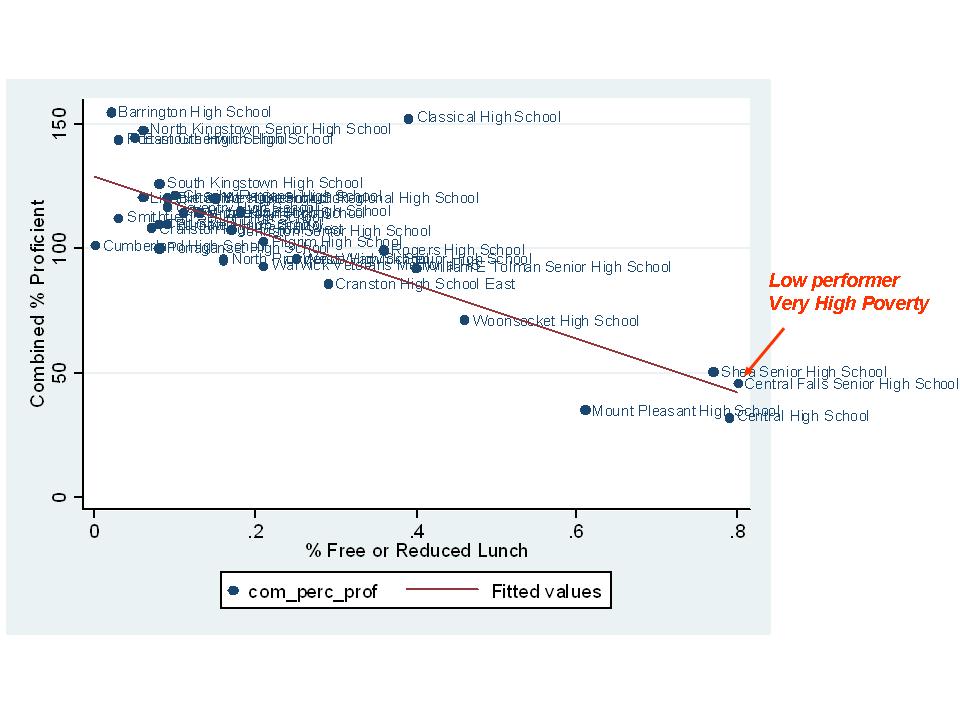
Yes, Central Falls is in tough shape – very high poverty and relatively low performing. But, not really off the trendline (above it, if anything) for performance given its poverty level and better than other high schools of similar poverty.

Now lets look at Central Falls performance with respect to school site spending from Rhode Island’s IN$ITE database:
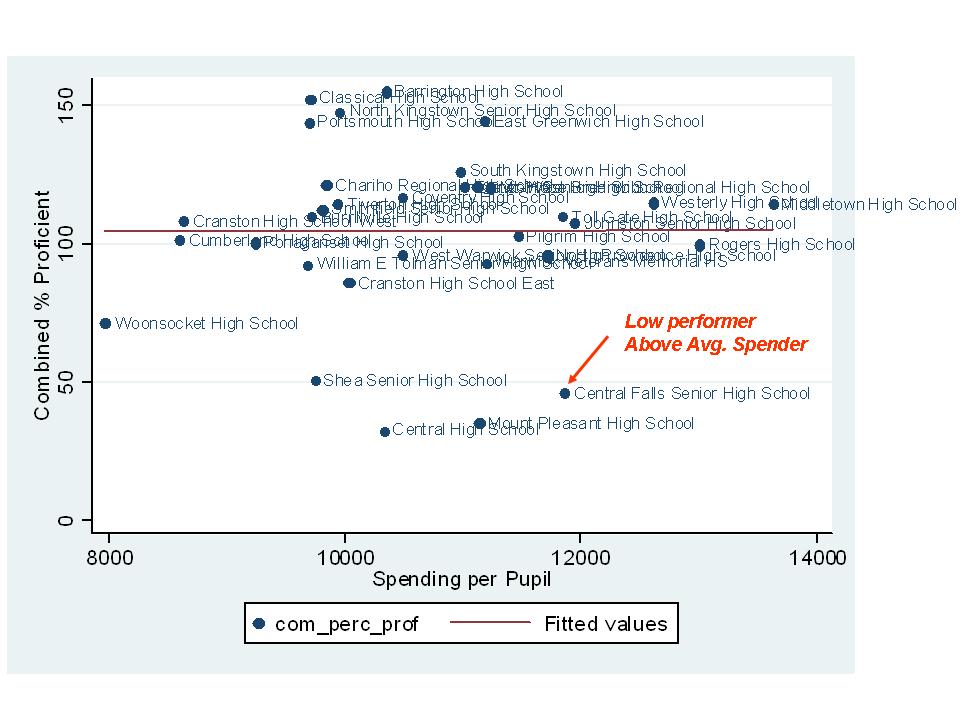
Central Falls spending is somewhat above average. But again, its student needs are far greater than average – in fact, they are on the outer edge of the entire distribution. So, it is unlikely that “somewhat above average” per pupil spending is going to fully compensate for their high needs.

Here is an oversimplified, but still ugly enough statistical model of the relative costs, given student populations, economies of scale and current outcomes, of Rhode Island High Schools in 2006 (I had run this previously with 2003 to 2005 with similar results):
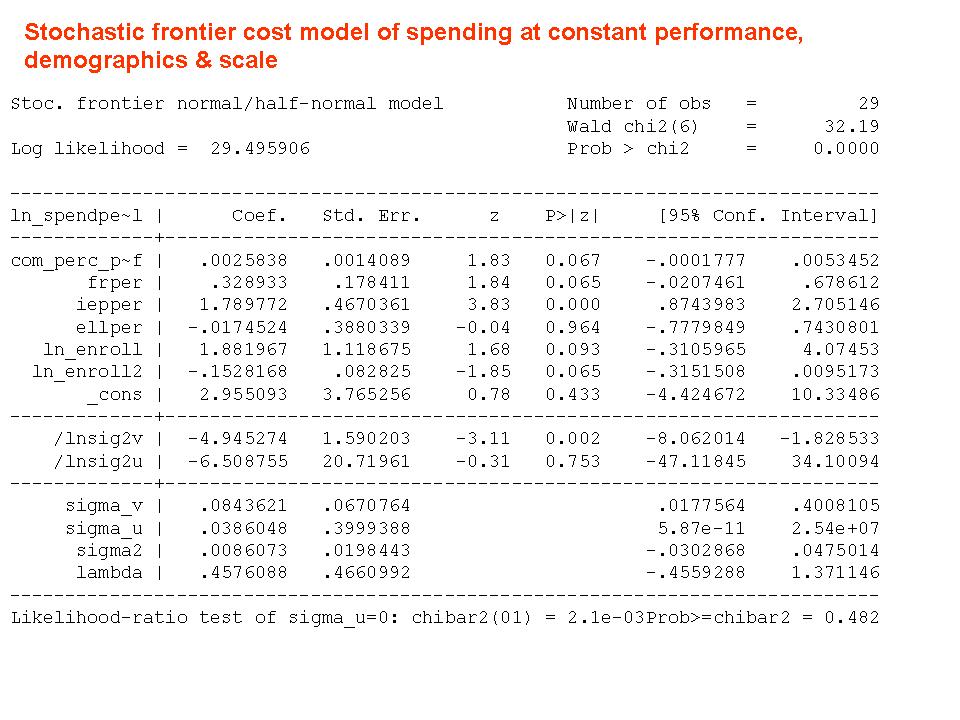
Admittedly this is no way to do “real” rigorous research. This is a single year of data on 30 high schools and too many covariates for the data. But, these data do reconcile with the model of the previous 3 years. I should also note that such analysis – those that try to pin down the relative efficiency of school district performance and/or cost – are generally unstable/unreliable. All that fun stuff aside, we have this crude model that tells us that at constant outcomes, per pupil costs are higher in higher poverty high schools and high schools with more special education children. And the model can produce for us an indicator of the extent to which each high school spends more or less than expected for the outcomes it receives – that is, the relative efficiency of the school. For the other stat geeks who might be reading, in this particular case, the estimates from the Stochastic Frontier Model and from the OLS regression model were identical.

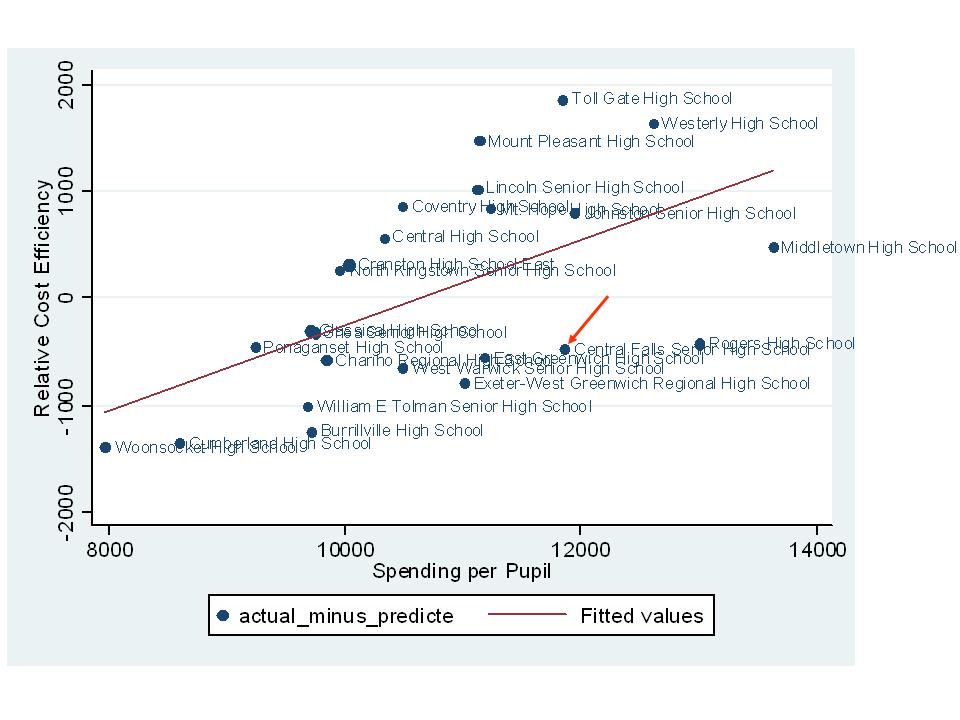
Here’s the “relative efficiency” of Rhode Island High Schools with respect to cost, from lower to higher poverty high schools.

As it turns out, the relative efficiency of Central Falls HS stacks up pretty well with other Rhode Island High Schools. That is, the actual spending per pupil in Central Falls is not far off from the predicted amount to achieve their current outcomes, with their current population.

Here’s the above data, rescaled (from the OLS version of the model), and with the relative efficiency measures sorted from lowest to highest per pupil spending. The “0” line is the line where the district spends what it is predicted to spend to achieve its current outcome levels given its current students. Central Falls actually spends less than it is predicted to spend given its students and current outcome levels.  Many other high schools spend far more than expected, given their students and current outcomes.
This seems like a fairer comparison than simply casting stones at Central Falls teachers for their miserable test scores.

This is not to excuse low performance or to simply set a lower bar for this school because it serves a very high need population. But it is to point out that given their resources and their kids, they are doing as well as can be expected and better than many other Rhode Island high schools.

This analysis is far from definitive, but is illustrative. If it turns out, through more rigorous multi-year analyses, that Central Falls is efficiently producing its current (miserably low) level of outcomes at its current (relatively inadequate) spending level (at least by comparison with all other Rhode Island High Schools), then one answer here might actually be that Central Falls needs more resources to achieve better outcomes. Why is there no talk of this possibility?

The figures above suggest that Central Falls is doing as well with what it has as any other Rhode Island High School, after accounting for student needs. Where is the outcry over the amount Westerly High is spending to achieve its current outcomes (far less efficient that even Central Falls, in this quick analysis)? Yes, Westerly gets better outcomes, but with a much less needy student population (under 20% free or reduced compared to over 80%) and nearly $1,000 per pupil more in spending.

=====

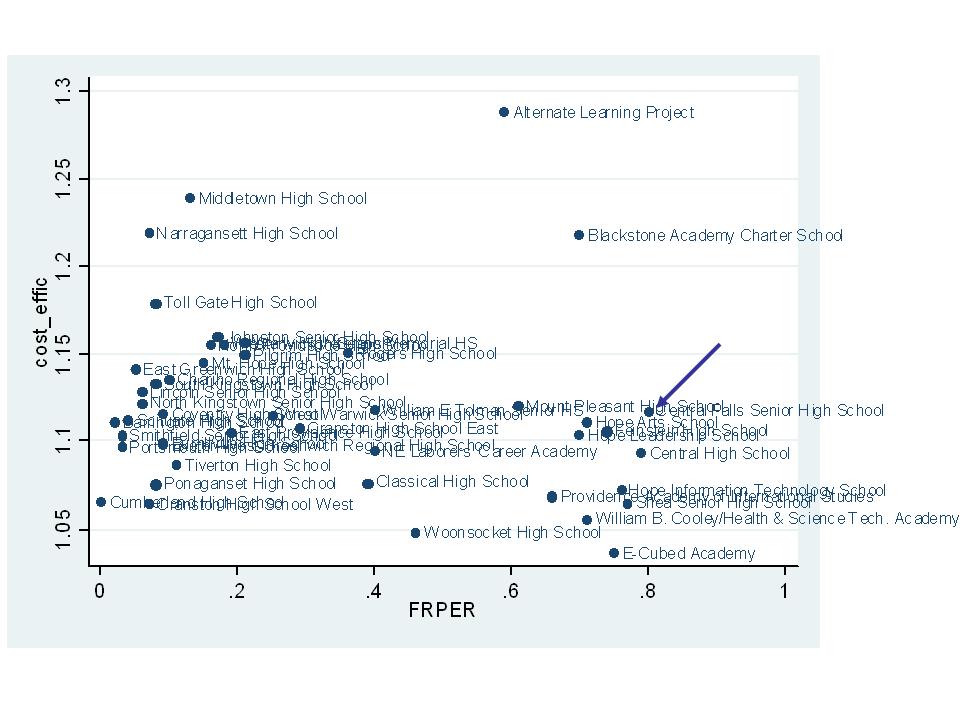
Here’s the position of Central Falls based on my previous 2004-05 analysis. The overall cost inefficiencies are higher because the high schools were included in a model with middle and elementary schools (but with a dummy variable identifying them as high schools). This model included math outcomes only (language arts outcomes were non-significant). Again, Central Falls is not the standout inefficient school (Higher up in the graph is less efficient).
Common Standards and the Capacity to Achieve Them

It would appear that the Common Standards movement has picked up some momentum this week, with the administration’s pitch that Title I aid should be tied to states adopting common college readiness standards. This is all good talk, but standards alone, on paper and/or in state policies or proclamations don’t achieve themselves. It is inappropriate for state policymakers, federal policymakers, pundits or the general public to simply assume that local public school districts all have sufficient resources to achieve any reasonable common standards.

Perhaps if those standards are set obscenely low they will be broadly attainable at current state and local spending levels. Even then, there will be significant inequities in the ease with which those standards are attained.

Noticeably absent in the current policy conversations is any discussion of the relative capacity of state education systems and local school systems  to achieve any reasonable common standards. It would be far more logical for the federal government to tie Title I funding not to some vacuous statement of endorsement of toothless common standards, but rather to a guarantee that the state will ensure that all local public school districts (and charter schools) have sufficient financial resources to achieve common standards – whatever they are.  In this paper, I, along with Lori Taylor, explain how we approach the measurement of cost and its implications for common standards.

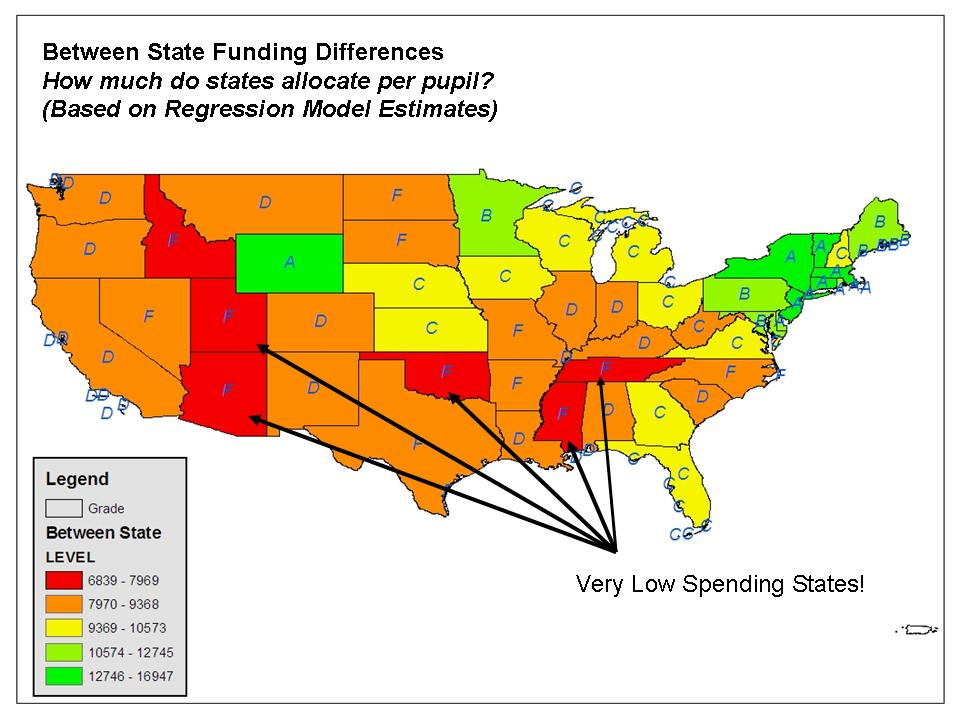
To see just how far our nation has to go in order to move toward common capacity to achieve common standards, let’s take a look at some national maps. Let’s start with a map of the projected relative state and local revenue per pupil levels across states, corrected for a variety of “cost” factors (regional wage variation, economies of scale, population density, poverty):

After correcting for a variety of factors, some stats like Tennessee, Mississippi, Utah and Oklahoma simply spend far less than most others on schools and only slightly above half as much as some states.

Here’s a different view, down to the district level based on an alternative set of cost adjustments. This second map shows that not only are some states much lower spending overall, but within those states, after adjusting for various cost differences, there also exist significant differences in spending (in this case, the map uses current operating expenditures per pupil with Title I funding). Again, Tennessee and Mississippi have overall very low spending. So do many areas of eastern central Washington, much of California and Texas major urban centers. Estimates are not provided for non-unified districts (large expanses of white bkgd).

So, by this point, you’re probably saying – yeah… but money doesn’t really matter that much. It’s how you use it. Maybe Tennessee, for example, is just really, really efficient at producing great outcomes on little expenditure.

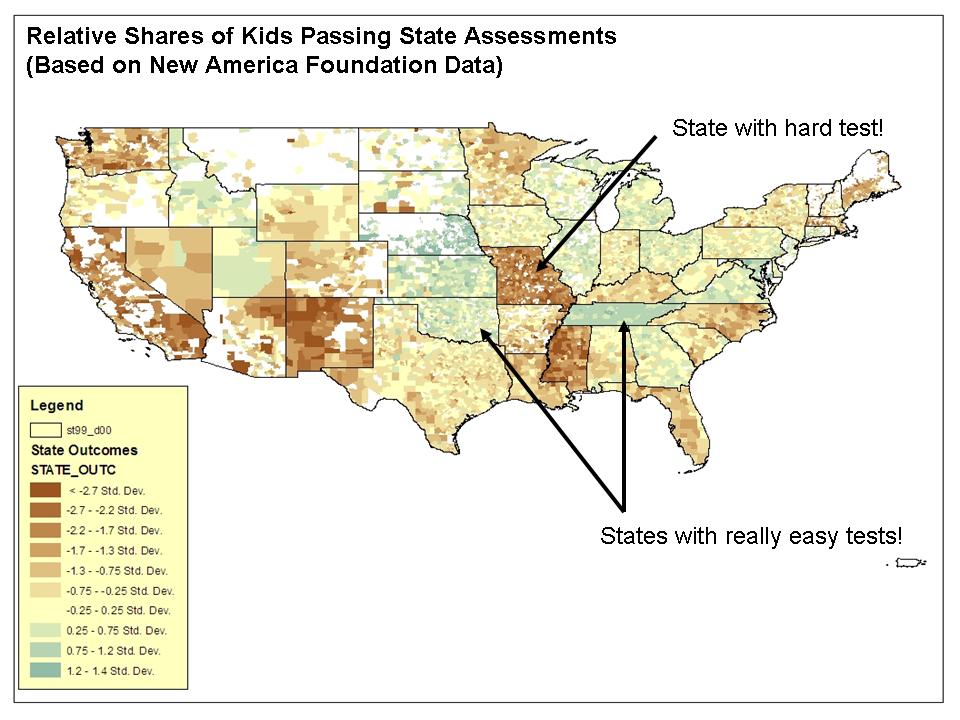
Let’s now take a look at state assessment outcomes by districts, nationally. In this map, I’ve taken the proficiency levels for each district, based on the 3 year data set compiled by the New America Foundation (Thanks NAF) and I’ve expressed them as standard deviations from the national mean proficiency rate. Blue areas are those with relatively high proficiency rates and brown areas have relatively low proficiency rates. Check it out:

Wow, Tennessee does do great, despite its low spending! So does Oklahoma. These are model states, right? Low spending, yet really high performance on their own state tests! Check out Missouri. What’s going on there? Well, as it turns out, Tennessee is doing great on its own self-validation exercise – state tests – because it has really easy state tests – or, in other words, really low proficiency cut-points for its state tests. This is the game that states have been playing since the adoption of NCLB. We don’t have to spend much, or actually fix our education system as long as we set low enough standards to make it look like we’re awesome. This is well documented in a series of NCES reports which map state cut-points to NAEP cut-points. By the way – Missouri has a very hard test (in contrast with Kansas, right next door, which has relatively easy tests.)

Finally, here is a scatterplot of the relationship between an overall index of the relative equity and adequacy of state and local revenues per pupil, and state mean 4th and 8th grade, math and reading NAEP assessments for 2007. The funding equity/adequacy ratings are based on national, district level data from 2005 to 2007, and account for a) relative effort by states to fund schools (% of gross state product), b) shares of children in the public school system (and ratio of family income of those not in the system to those in the system), c) predicted state and local revenue level at average poverty, and d) extent to which funding is targeted based on poverty differences across districts.

If we really plan to get serious about Common Standards, then states like Louisiana, Tennessee, Alabama and Oklahoma are going to need to step things up a bit. Notably, low fiscal capacity states like Mississippi and Alabama will need significant federal assistance to pull this off. But, Tennessee and Louisiana are two states which spend less by choice – having among the lowest “effort” among states (% of Gross State Product allocated to schools).

Alternatively, we could just set standards as low as Tennessee standards, spend as little as Tennessee and pat ourselves on the back for a job well done. I don’t believe that this is the intent of the common standards movement, but I may be wrong. Nonetheless, if we continue to throw around the rhetoric of common standards without ever discussing the capacity to achieve them, then we should not expect much to ever come of this movement. Without sufficient capacity, there can be no substantive reform.

For more on whether school finance reforms actually can help, see: https://schoolfinance101.wordpress.com/2009/12/14/finance_reforms/

Stossel & Coulson Misinformation on Private vs. Public School “Costs”

Last summer, I had an interesting exchange with Andrew Coulson regarding the issue of private school costs. That discussion can be found here: https://schoolfinance101.wordpress.com/category/private-school-costs/

I had the displeasure this evening, while channel surfing, to catch a few minutes of John Stossel’s latest episode on the failures of the public education system and low-cost wonders of private education markets.  Here’s a link that summarizes some of the content of Stossel’s latest: http://www.washingtonexaminer.com/opinion/columns/John-Stossel–84692012.html

I happen to be a strong supporter and admirer of private schools, having worked as a middle school science teacher for years in one of NYC’s elite private independent day schools. In my ideal world, I would provide every child the opportunity to attend such a school. And that would be an expensive proposition!

I’ve realized over time, having studied teacher characteristics and finances of various types of private and public schools, that what you get on the private marketplace for education is simply a wider range than what you get in the more regulated public system. That just makes sense. Less regulation broadens the range of options – at both ends.

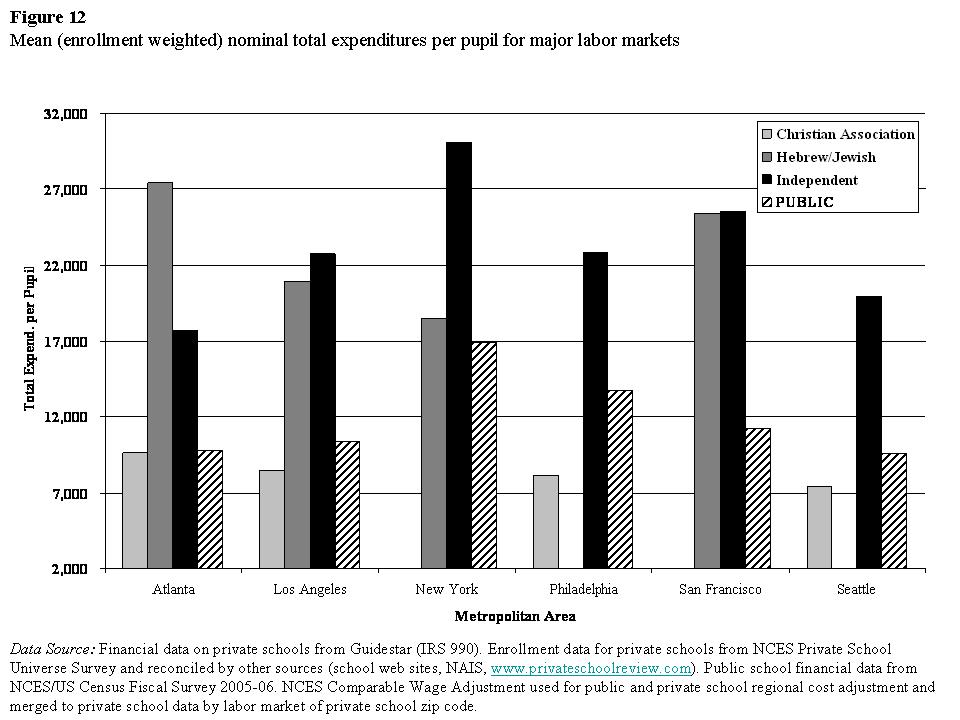
Private schools do not, by any stretch of the imagination, spend uniformly less than public schools per child. In fact, private independent day schools (a non-trivial segment of the private school marketplace) typically spend much more per pupil than public school districts operating in the same labor market. The school in NYC where I used to work continues to charge in tuition alone, nearly double the average expenditure (operating expense per pupil) of NYC public schools. Further, it is especially important to understand that private school tuition covers only a portion of actual cost.

How can this happen on the open marketplace for education? Shouldn’t market competition  drive these prices into line – bring them down well below public bureaucracy spending on education – and still yield better quality? Or, perhaps the tuition these schools charge and amount they spend to operate actually represent the competitive price of providing the excellent education many parents demand. Perhaps better quality (hard to compare), but at a higher, not lower cost!

Quite simply, when it comes to public or private education, you get what you pay for. Many private schools spend far more than the public schools in the same labor market – many spend roughly the same and some do spend less. And the quality of that schooling varies accordingly. I document this thoroughly in this lengthy report: http://www.greatlakescenter.org/docs/Policy_Briefs/Baker_PvtFinance.pdf

Here are a few highlight figures from the report:

Finally, and perhaps most interesting:

The punchline here is, as I’ve said above – You get what you pay for.  And on the private marketplace for education, high quality comes at high cost – much higher than the average public school cost.

  • Private independent day schools which provide small class sizes with highly academically qualified teachers spend well above nearby public schools.
  • Catholic schools, where they report their finances (not the crude survey summary data of tuition and expense compiled annually by the National Catholic Education Association) spend marginally less than nearby public schools (but charge much lower tuition than cost), perform about the same if given the same kids and have comparably qualified teachers in terms of academic preparation. Note that Catholic schools in trying to operate on a shoestring have been financially failing at an alarming rate. That is how markets work when you try to hard to price your product below the cost of maintaining quality (a more friendly spin being that the social service mission of urban Catholic schools has outpaced church philanthropy). I discuss this extensively in the report.
  • Conservative Christian schools (to the extent they can be lumped together) operate at much less per pupil than traditional public schools and have lower outcomes given the same students and have disturbingly academically weak teaching staff based on national survey data.

Again, you get what you pay for. The open market place for private schooling is simply more diverse than the more regulated public marketplace, on price to consumers, average overall spending and ultimately on quality.

It is entirely inappropriate to argue that the public would be better served by wholesale shifting of current public school students into only those private schools which presently do spend less than the public schools.  It is particularly twisted to suggest that for the price of Conservative Christian or Catholic education, we can provide kids with the equivalent of private independent school education. While pundits like Stossel or Coulson may not make this claim in this particular form, they imply as much by lumping all of these schools together as “private” and proclaiming that “private schools simply do more with less.” The reality – Some do more with more. Some do less with less. And yes, there are exceptions that do more with less, and less with more – just as in any analysis which involves thousands of points.

Private Public Schools – OK Idea – Bad Calculations

I read with curiosity today, the Fordham Institute’s new report on “Private Public” schools, or elementary schools where fewer than 5% of children qualify for free or reduced lunch and middle or secondary schools where fewer than 3% qualify. Not a bad idea on their part, but some of the numbers just didn’t match up with my reasonably sound knowledge of the NCES common core Public School Universe data.

For example, on Page 6, State Findings, the report indicates 70 private public schools in Illinois, and on page 7, the report indicates 402 such schools in New Jersey. These are two states where I have used the most recent available 3 years of NCES CCD data quite often. While the New Jersey numbers seem close to reasonable, the Illinois numbers are undoubtedly low – and quite honestly, wrong.

First, here’s my tally of total schools by grade level in Illinois and New Jersey:

|                 schlevel08
state_name | 1-Primary   2-Middle     3-High    4-Other |     Total
———–+——————————————–+———-
Illinois |     2,562        777        788        203 |     4,330
New Jersey |     1,547        453        425        158 |     2,583
———–+——————————————–+———-
Total |     4,109      1,230      1,213        361 |     6,913

(sorry for the messy layout)

Next, here’s my tally for total schools by grade level with less than 5% free or reduced lunch in 2007-08:

. tab state  schlevel08 if  pct_freereduced08<.05

|                 schlevel08
state_name | 1-Primary   2-Middle     3-High    4-Other |     Total
———–+——————————————–+———-
Illinois |       281         89         65          4 |       439
New Jersey |       273         98         94          7 |       472
———–+——————————————–+———-
Total |       554        187        159         11 |       911

And again in 2006-07:

. tab state  schlevel08 if  pct_freereduced07<.05

|                 schlevel08
state_name | 1-Primary   2-Middle     3-High    4-Other |     Total
———–+——————————————–+———-
Illinois |       302         90         60          3 |       455
New Jersey |       194         74         73          6 |       347
———–+——————————————–+———-
Total |       496        164        133          9 |       802

In either year, and many other years, Illinois has far more than 70 elementary schools alone (280 to 300) under 5% free or reduced price lunch. The New Jersey numbers, while close, can’t be reconciled that easily either.

Fordham includes a footnote which suggests that schools reporting no children qualifying for free or reduced lunch were dropped on an assumption of non-reporting/non-participation. This is likely an incorrect assumption and one that should be checked across multiple years.

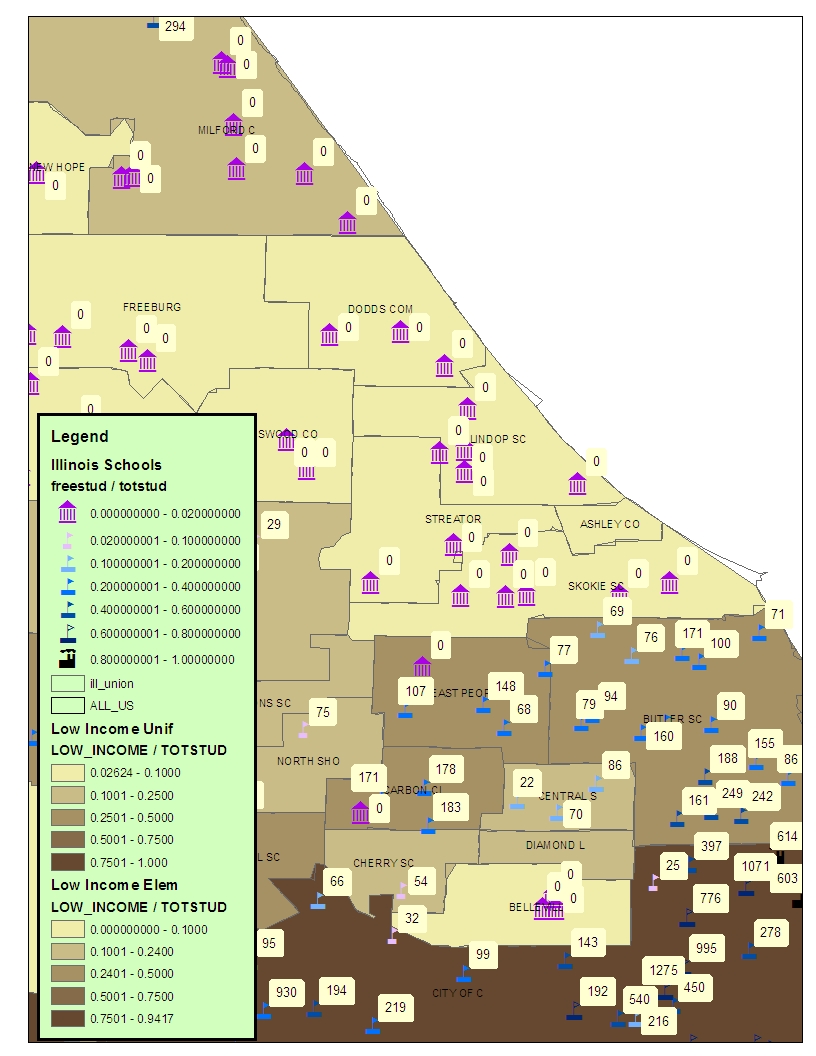
For example, here is a map of district level low income rates (background shading, based on state data source) and schools reporting “0” Free Lunch children (to NCES CCD) in North Shore areas near Chicago. Note that most of the “0” flags by schools are in very low poverty districts. These likely are “Private Public” schools by the Fordham definition, but were inappropriately excluded by their count method:

Here are some New Jersey “0” values for free or reduced lunch, against a backdrop of median family income. The “0” value schools here are in Franklin Lakes and Saddle River. I suspect that those “0” values for kids in poverty are real – not errors in the data.  There were likely better ways to handle these values than to simply exclude all “0” values. For example, checking across multiple years, or identifying “0” value schools in districts that show higher versus lower U.S. Census poverty rates (not subject to district level reporting). “0” values in low poverty districts are more likely to be correct where as “0” values for schools in high poverty districts are more likely reporting error.

  • Note: I just ran a quick test of this latter approach using Census Small Area Income and Poverty Estimates. About 198 of 341 Illinois “0” value schools are in districts with less than 5% poverty. About 303 of those 341 are in districts with less than 10% poverty – using Census poverty tabulations. These schools likely should have been included as “Private Publics” rather than excluded outright.

===== On a related note:

I should also point out that Fordham is among those organizations that has frequently pointed the finger at school districts as being the primary causes of persistent inequities, and not state education systems. Fordham does not point out in their report that  almost invariably, these private public schools are clustered in private public school districts. The low poverty schools are in low poverty districts often immediately adjacent to high poverty schools in high poverty districts. That is, the inequity the authors reveal in this report is largely a between not within district inequity and one that cannot be resolved by reshuffling resources within districts, as many of their previous reports have argued (most notably Fund the Child).

Here’s a fun map of New Jersey Private Public Schools in the Newark metro area:

Data for NJ and IL available on request.

NJ Surplus Drill-down Redux

This is a quick reply to NJ Left Behind’s highly suspect if not outright bogus NJ Surplus Drill-down. The crux of my response to NJ Left Behind’s summary of NJ school district surpluses, is that his/her analysis completely distorts the distribution of school district surpluses by not taking into account district size (enrollment). Of course the larger districts on average have larger surpluses. And Abbott districts on average are larger. Now, this is not uniformly the case, but for the most part, the largest surpluses are in larger districts (indeed there are some large districts with no surplus and some smaller districts with large surpluses).

The more appropriate way to look at these numbers is in per pupil terms. First, here are the per pupil Total Surpluses by district factor group and by Abbott status:

Interestingly, relative to districts in the same factor group (wealth-income category), Abbott districts seem to be carrying somewhat smaller per pupil surpluses. Further, total surpluses per pupil in Abbott districts on average are lower than surpluses in DFG J districts.

Here is the proposed state aid withholding (in other words, proposed CUTS) by district factor group and Abbott status:

Note in this case that state aid withholding is systematically higher in poorer district factor groups, though lower in Abbott districts relative to others in their factor group.

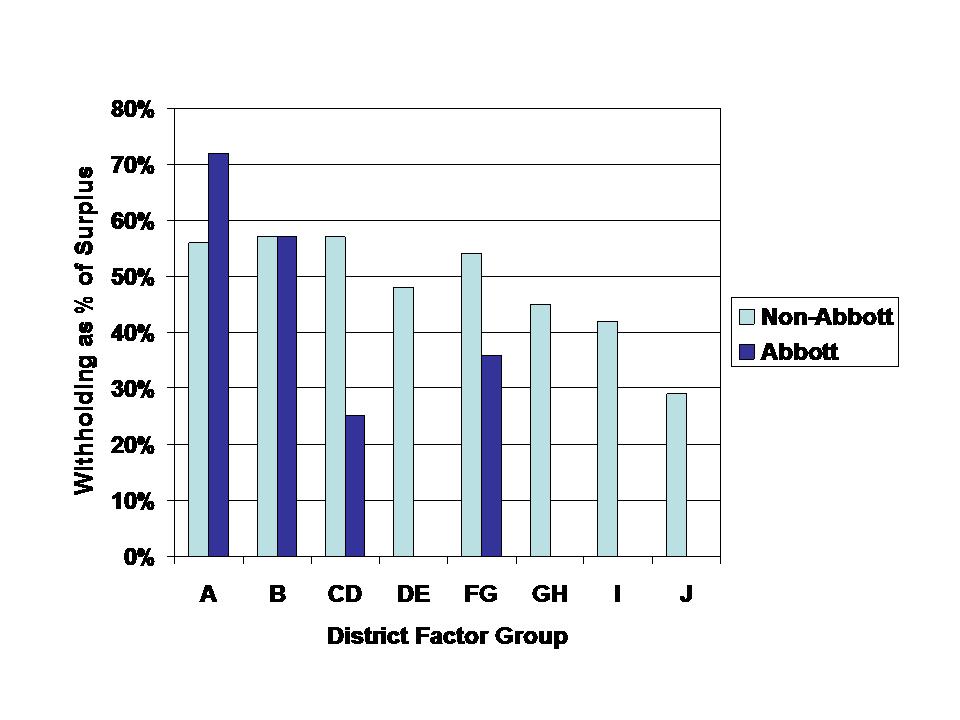
Finally, here is the withholding as a share of total surpluses:

So, the bottom line here is that the poorest Abbott districts are in fact taking the biggest hit in terms of the share of total surpluses that will be withheld from state aid. A somewhat different story from the deceptively oversimplified NJ Left Behind post.


Today’s fun maps: NYC charter school free lunch rates

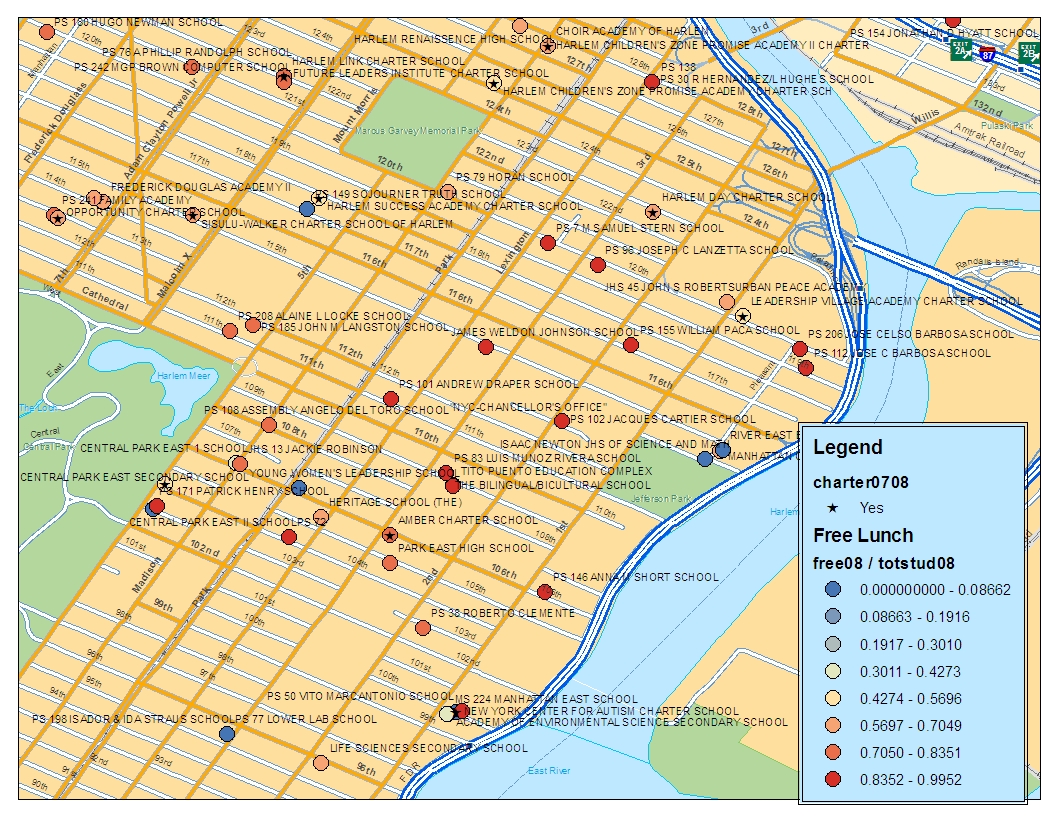
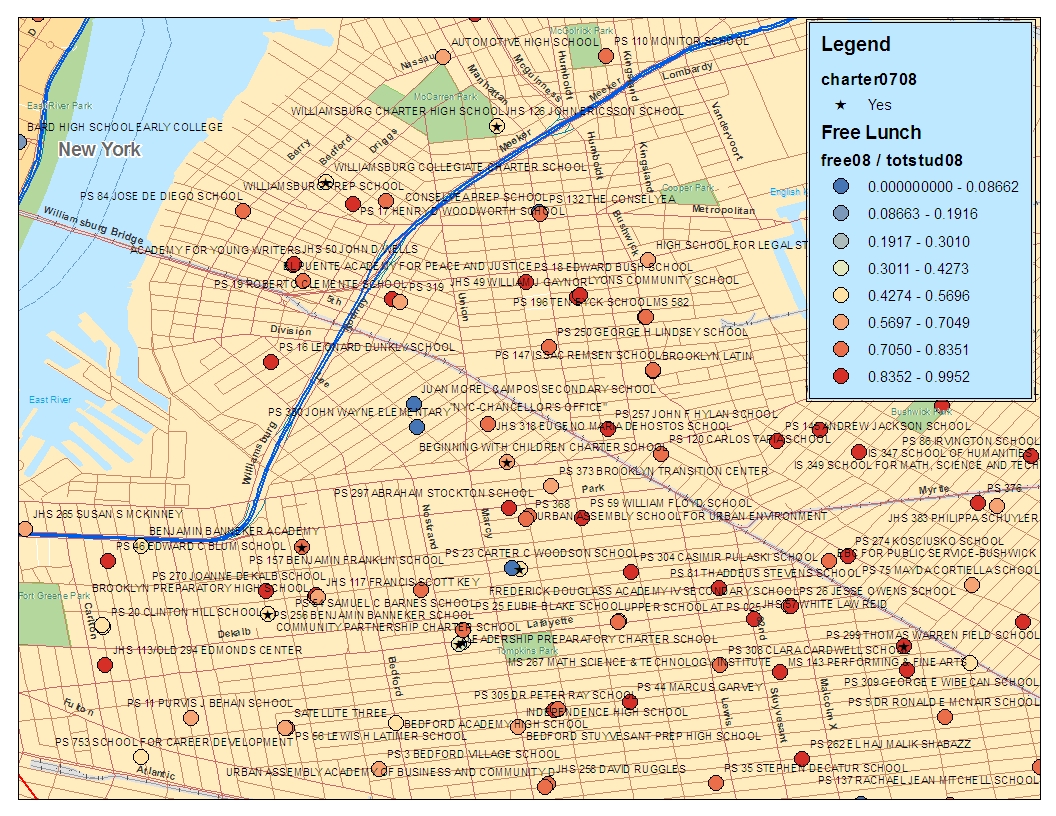
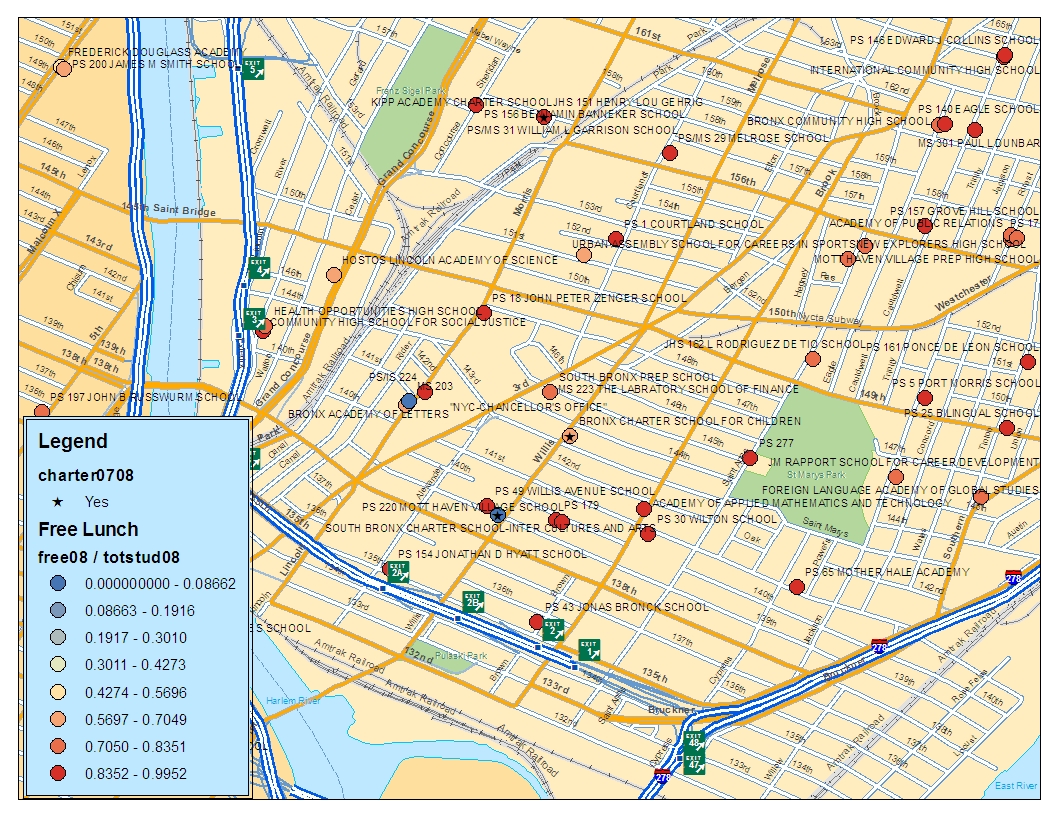
Just for fun, here are a few maps of New York City traditional public, special public and public charter schools. Charter schools are indicated with an asterisk. School level rates of children qualifying for free lunch are indicated by circle color.  Deep red circles have free lunch shares over 83.6%. Blue circles have very low free lunch shares. Free lunch shares and school locations (lat / lon) are from the National Center for Education Statistics Common Core – Public School Universe 2007-08. Note that as with my previous NJ charter slides, NYC charter schools tend to serve somewhat lower shares of children qualifying for free lunch than are served by many of the surrounding traditional public schools.

A closer look at New Jersey taxes

I often hear talk radio pundits ranting about New Jersey’s supposed highest in the nation taxes – that New Jersey’s taxes are driving people out of the state. I’ll tackle the migration issues in a later post, but any attempted link to tax policy as a single driver is a stretch, to say the least.  I have previously addressed the absurdity of the “Small Business Survival Index,” as a standard for measuring whether or not a business should or would locate in a particular state.

I have also pointed out that within New Jersey,  property taxes as a share of income remain lower in higher wealth suburban communities, despite claims that those communities are suffering at the hands of decades of state funding being driven disproportionately to poor urban communities. Indeed, property taxes in the wealthier communities might be lower if they received more state aid – but they are already inequitably low compared to middle and lower wealth communities.  I have pointed out before that these same communities – high wealth suburbs – remain in control of the teacher salary game.

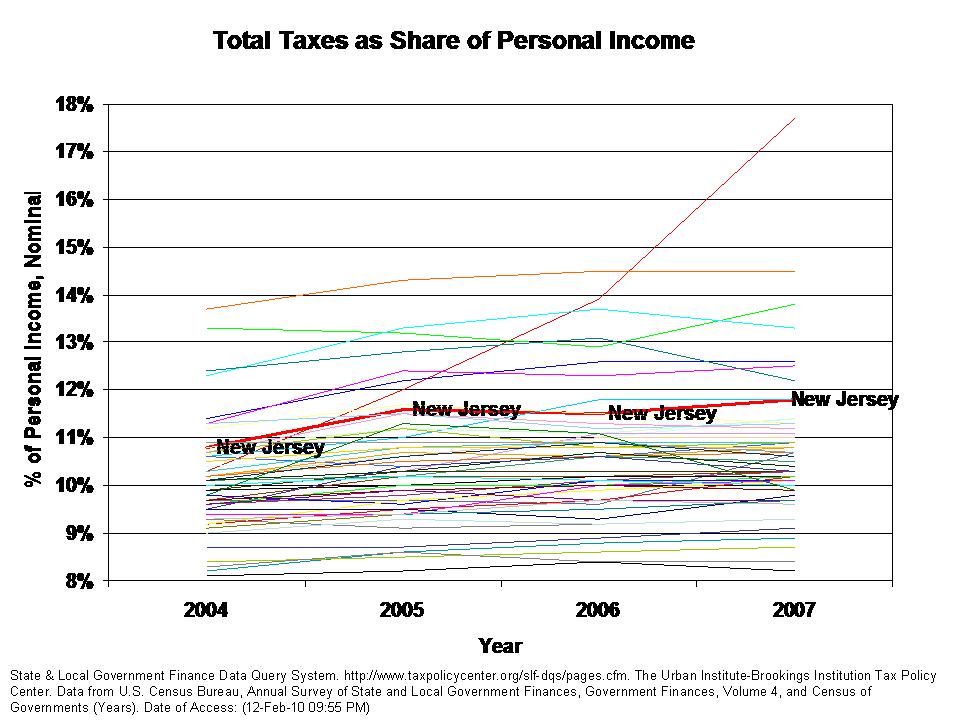
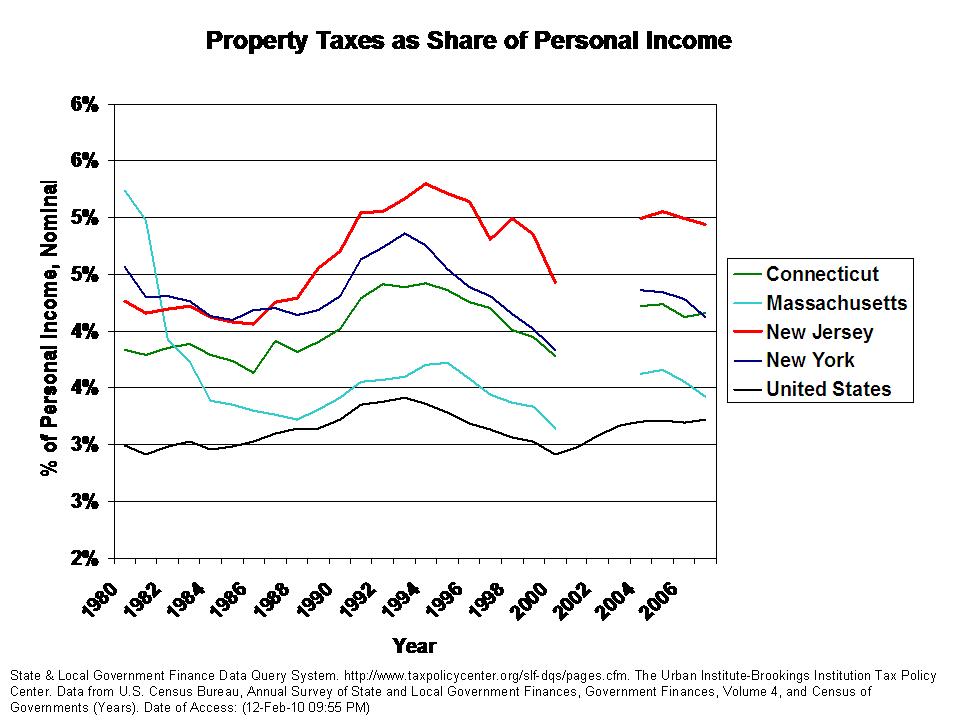
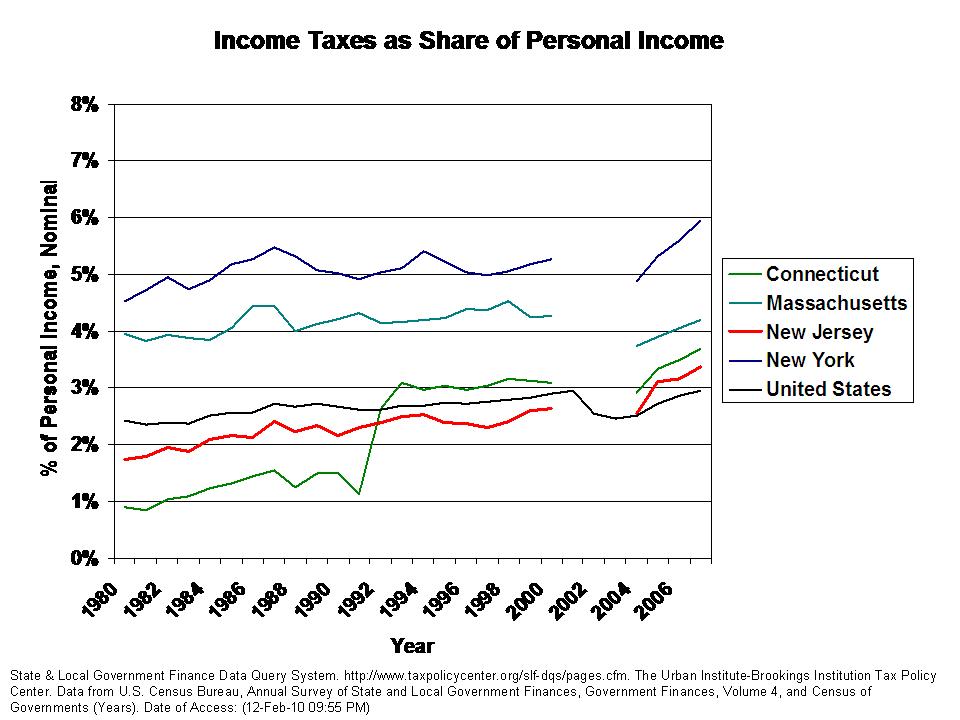
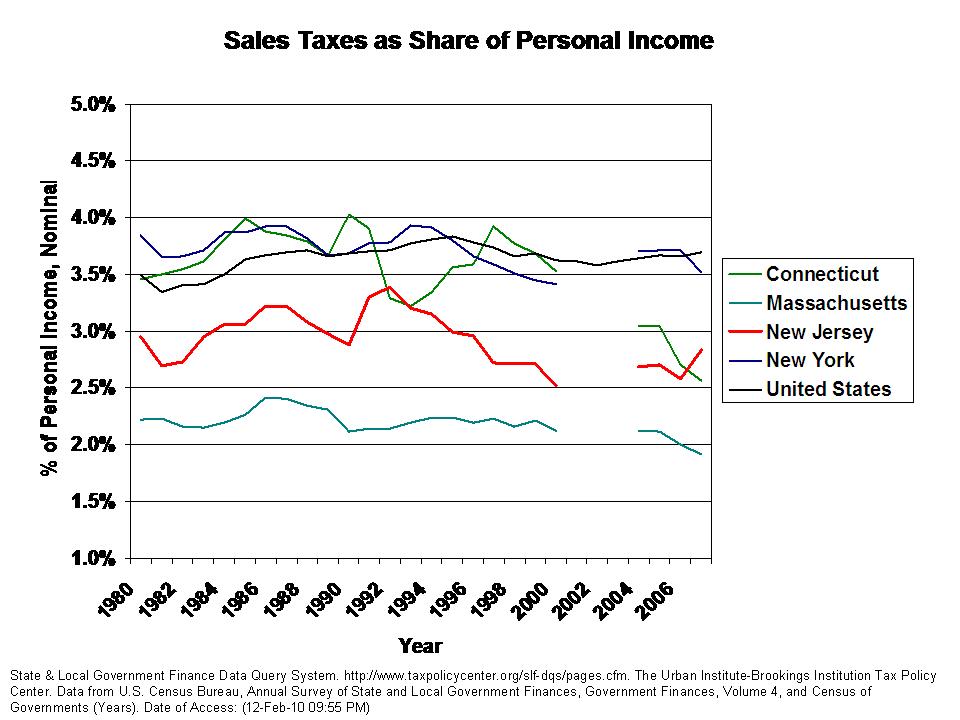
Those issues aside, here are a few graphs I made yesterday just out of curiosity using the data tool from taxpolicycenter.org.

So, what do we learn from these graphs?

1) When it comes to total taxes, New Jersey is not at the top. While higher than average, New Jersey is relatively close to the rest of the pack, and lower than some states. Overall, as in most other states, total taxes as a share of income have increased gradually over time.

2) When it comes to either sales or income taxes, New Jersey is not as high as other states in the region. Income taxes as a percent of income are, in fact, relatively low. Sales taxes as a percent of income are relatively low and have declined over time.

3) Property taxes as  a percent of income in New Jersey are highest in the figures above. Vermont and New Hampshire, not shown on property tax as percent of income, are both higher than New Jersey on that measure. New Jersey does not, by this measure, have the highest property taxes in the nation!

It is particularly important to understand that these three major sources of tax revenue should be considered collectively. It’s a package deal – a portfolio. Different states rely on different mixes of state level sales and income tax and local property tax (to oversimplify a bit). Local property tax revenues are responsive to different levels of aid received from the state to municipalities or local school districts (intergovernmental aid). Where local homeowner voters desire or expect a certain level of public service, but state aid comes up short, property taxes are typically used to make up the difference (though state imposed limits may restrict this option). Similarly, if increased aid is received but local spending preferences remain constant, local property taxes may be reduced in response to the aid.

Yeah… yeah… that’s the professor in me talking. The point here, as we know in New Jersey, is that property tax increases are used to make up for state aid shortfalls (whether municipal aid or school aid), and state aid increases can be used to slow growth in property taxes.

As the graphs above show, New Jersey is relatively high in its reliance on local property taxes. The reality is that this reliance on high property taxes reflects the demand for high quality public schools in those communities where local public schools are most reliant on property taxes (least reliant on state aid). In other words, the relatively high property tax burden in NJ is self-inflicted, and at a local level, across a multitude of relatively small municipalities – not large bureaucracies, but small communities.

Meanwhile, our state level taxes are far from out of line with neighboring states or the nation. And even when we add the property taxes to the state level taxes to evaluate our cumulative effort, New Jersey is not out of line, and certainly is not the most taxed state in the nation.

Note:

There is actually an upside to high reliance on property taxes to fund public schools. What we saw in the last, smaller, economic downturn (2001 to 2002) was that in states where education systems were most reliant on property taxes, public schools took a smaller budget hit than in states where education systems were most reliant on state general funds – especially where those general funds were heavily dependent on income tax revenues. Over time, state income tax receipts have become much more sensitive to economic downturn because a smaller share of income is wage income and a larger share is investment income & other non-wage income which tends to fluctuate more than wage income.  These days, state income tax receipts tend to drop most sharply in economic downturn, sales tax receipts much less, and local property tax revenues not much if at all. As such, it is a good idea for states to maintain a balanced portfolio of revenues. One might argue that New Jersey’s portfolio is a bit imbalanced. Heavy on property taxes and relatively light on sales taxes in particular.

Another interesting twist is that there exists little or no relationship between the percent of funding generated through local property taxes and the overall equity of a state’s school funding system. It all depends on how  the state aid allocations are distributed with respect to local revenues.

CAP’s Title I Myth

I just read a copy of “Spoonful of Sugar” from Center for American Progress in which they again propose fixes to Title I funding, which I have pointed out in the past are based on misguided assumptions and analyses (or lack thereof).

Please see my previous analysis here:

https://schoolfinance101.wordpress.com/2009/11/27/title-i-does-not-make-rich-states-richer/

The authors of this “spoonful” note:

Still other districts would see their allocations drop because the proposed formula
removes the current bias toward high-spending states that exert relatively low fiscal
effort in education funding.

(page 2)

The inclusion of an effort factor in this particular version of the CAP analysis appears to improve their proposal somewhat (perhaps… maybe?). But the proposal – or spoonful – still fails to address the poverty measurement problem which is substantial.  For example, the spoonful recommends much larger increases for Mississippi, Arkansas and Alabama than for New York, California or New Jersey (Figure 1). But, this figure shows that after correcting for poverty measurement and regional costs, the latter three states are much less well funded under Title I presently than the former three states.

My post above explains clearly and with data and with links to prior presentations and Census bureau analyses on this topic that this assumption by CAP that Title I funding favors rich states is simply wrong and based on bad analyses (rooted in mis-measurement of poverty differences across states).   Yes, it is illogical to drive money to states simply on their ability to spend more on their own. That portion of the current Title I formula is problematic (okay… just plain silly) on its face. But, the resulting distribution pattern is far less problematic and – once again – does not, on average favor Rich States over Poor States.

Apparently, I need to reinforce this point even more (from previous post):

Let me clarify that the same issue of mis-measurement of poverty plagues urban-rural comparisons within states. Rural poverty is, in relative terms, overstated compared to urban poverty. So too are rural costs (competitive wages) lower than urban costs. So, just as it is true that Title I does not necessarily overfund “rich” states, Title I also does not necessarily overfund urban districts at the expense of rural ones. Unfortunately, I do not yet have available a finer grained adjusted poverty measure which will allow me to easily display the urban/rural issue.

CAP’s spoonful brief is backed by their analyses here: http://www.americanprogress.org/issues/2010/02/pdf/bitter_pill.pdf

These analyses include faulty assumptions about rural-urban poverty distribution in an ill-conceived example applied to Missouri – a state on which I have conducted extensive research on school funding in the past.

Another “You Cannot Be Serious!”

Saw this today:

http://www.washingtonpost.com/wp-dyn/content/article/2010/01/29/AR2010012903405.html

Huffman opines:

I’m picking on New Jersey not because it has the worst plan (it doesn’t) but because it so perfectly embodies the old way of applying for federal education funding — lots of promises and ideas; little chance of change on the ground.

By contrast, Louisiana submitted a clear, concise, actionable plan to reform a large swath of its public schools.

The beauty of Louisiana’s reform model lies in its simplicity. The state has taken critical baseline steps, it proposes expanding projects that have shown promising results, and it has ensured that participating school districts will actually do the things that are in the application.

Louisiana already built and uses a data system that ties students’ test scores to the teachers who taught them and to the universities and programs that trained the teachers. In its application, Louisiana proposes expanding the use of data and using test-score results to count for 50 percent of teacher evaluations and to help drive decisions of hiring, retaining, and promoting teachers and principals.

Thankfully, because I have little time this morning, I’ve already addressed this issue in at least two posts.

I discuss Louisiana specifically here:

https://schoolfinance101.wordpress.com/2009/12/18/disg-race-to-the-top/

And the issue of whether state data systems alone can save a state that has generally abandoned its public education system here:

https://schoolfinance101.wordpress.com/2009/12/15/why-do-states-with-best-data-systems/

One might make the simple argument that New Jersey’s old way of doing things, including sufficient financial support for schools and wider participation in the public education system – actually works – at least when compared to many other states – and certainly when compared to Louisiana. That said, Louisiana is in far greater need of stimulating improvement- but until Louisiana actually makes a substantial state commitment to its public K-12 and higher education system  that’s not likely to happen.

You cannot be serious bonus clip on link above!

NCTQ Teacher Policy Ratings: Where’s the quality?

First, to the media – the National Council on Teacher Quality Ratings are NOT ratings of actual differences in Teacher Quality across states. They are ratings of supposed steps which can be taken in state policy in order to improve teacher quality. Here, the blame goes on the media spin, not on NCTQ.

NCTQ does make some reasonable attempts to explain the research basis for their policy elements.  However, NCTQ fails miserably at understanding the importance of context within which policies are applied. For example, under AREA 2, NCTQ cites the importance of increasing numbers of teachers from more competitive colleges, and cites expanding the teacher pool as a way to accomplish this, through policies such as alternative certification. My own work a few years back on charter school hiring in states with more and less relaxed teacher certification requirements provides some support for this notion. But, my research also shows that in some cases, expanding the pool weakens, on average, the academic credentials of teachers. Some states and some regions of the country simply don’t have more competitive colleges and universities.

As many of these rating/grading systems which strongly favor deregulatory policies (and the power of state data systems) do, the NCTQ policy ratings favor those states that in fact have the weakest overall public education systems including the academically weakest teachers – of all things. NCTQ only handed out Cs and Ds for grades (and a few Fs). A quick tally based on my prior analyses of Schools and Staffing Survey Data finds that 6 of the 8 states that got a C (the high grade) fall in the bottom half of states in the percentage of teachers who attended highly or most competitive colleges (a factor acknowledged by NCTQ as important, and as a factor that would supposedly improve as a function of expanding the teacher pool). Louisiana, Alabama and Arkansas are all in the bottom 10. Most of these states also fall in the bottom half of states, and 3 in the bottom 10 states for the change in percent of teachers (03-04 to 07-08) who attended highly or most competitive colleges. None of the states that received the high grade were even in the top 20 in change in % of teachers from highly or most competitive colleges.

You know – it’s possible that teacher salaries might also be a factor here (there’s some pretty good research on this-see link), and a limiting condition might actually be the available funding for schools which is sadly lacking in many of these states. So too might the supply of high quality public colleges and universities for preparing teachers. States like Louisiana have been taking the axe to their public higher education systems of late. Deregulatory strategies cannot trump these conditions, and in fact, may worsen teacher quality and ultimately school quality under these conditions.

Increased regulatory strategies like improved data for teacher evaluation systems (also advocated by NCTQ, and quite reasonably so) are simply window dressing for states that are choosing to avoid the more difficult and more expensive problems facing their public education systems.

On numerous occasions on this blog, I’ve discussed the systemic failures of the public education systems in states like Louisiana – their failure to serve even 80% of school-aged children – or their failure to provide reasonable overall funding or target any funding to higher need districts (across most of these states).

So, if the Teacher Quality Policy ratings have little to do with actual teacher academic preparation in a state, or overall quality of the state’s education system, then what do they tell us? Apparently not much!