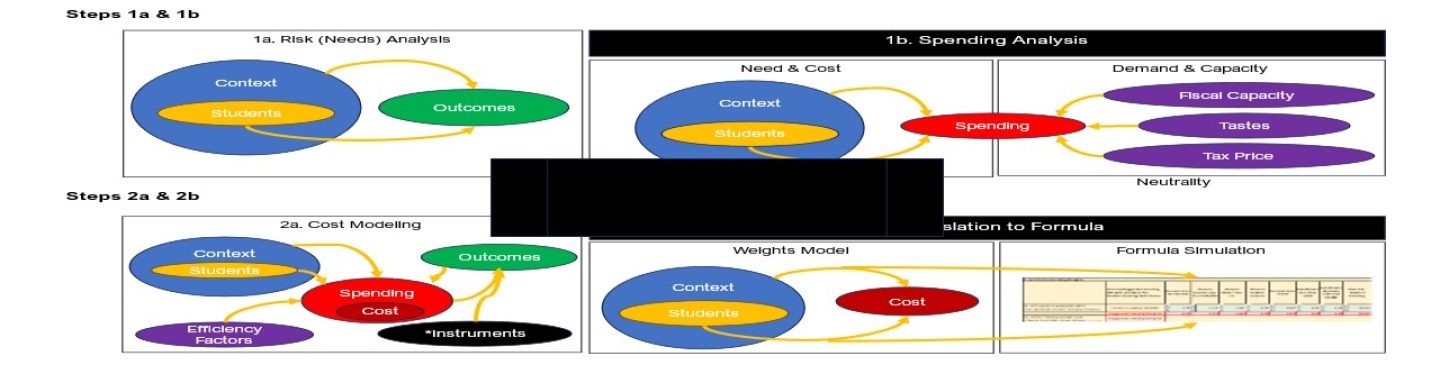
Three School Finance Rock songs on equal educational opportunity, built on the unified framework that Doug Atchison, Jesse Levin and I lay out in our EdWorkingPapers paper. Song 1 defines equal opportunity and adequacy. Song 2 asks who has to deliver it, and what happens when courts won’t make them. Song 3 shows how a state school finance formula should be designed to get there. Videos, explanations and full lyrics are below, with all the receipts at the end.
1. Same Finish Line
The definition. State standards set common outcome goals for all children, so with respect to those goals all children are similarly situated. Equal educational opportunity means every child, regardless of background or where they go to school, has the programs, services and resources needed to reach those common goals. Equal treatment is measured at the outcome goals, not at the inputs. Getting there means differentiating inputs, giving more to those who need more.
The kid and the community. Individual needs matter: English learners, students with disabilities, and children in poverty need different supports to reach the same goals. Context matters too. Where poverty is concentrated, reaching common outcomes costs more: smaller classes, competitive pay to recruit and keep strong teachers, pre-K, longer days, and counselors and nurses. Same kid, different school, different cost. Racial and economic segregation, through redlining, exclusionary zoning and district boundaries, concentrated the greatest needs where property tax bases are smallest. That’s the double whammy, and it’s why the state can’t leave school funding to the place.
Adequacy. Adequacy is achieved when the outcomes children can reach are sufficient for them to become productive, self-determined and civically engaged adults. We keep the two ideas separate on purpose. Even when the bar is set too low, or the money runs thin, equal opportunity should be preserved. A fair shot at a low bar is step one. A fair shot at a high bar is the job.
Verse 1
One kid rides the bus for an hour through the hills
One walks to school past a factory standing still
One's got a tutor and a big backyard
One just moved here, and the new language is hard
But the state wrote down what they're all supposed to know
Same standards, same goals, same place to go

Chorus
Equal opportunity! (Equal opportunity!)
It's not the same stuff for every kid, you see
It's whatever it takes to reach the common goal
Same finish line… but different roads!

Verse 2
Some folks say fair means everybody gets the same
Same room, same book, same dollars, same game
But a kid learning English needs some help with the words
A kid with a disability needs supports that work
A kid who's hungry needs a breakfast first
'Cause the kids aren't the same, but the goal's meant to be
Tilt the inputs toward the need, give more where it's due
That's how equal treatment gets measured all the way through!
(Treat 'em equal at the outcomes, kids. Not at the inputs!)

Verse 3
But it's not just the kid, it's the community too
When the needs all pile up in one school, here's what you do
Smaller classes, so a teacher can reach every one
Great teachers who stay till the job gets done
Pre-K, longer days, counselors and nurses in the halls
Same kid, different school, a different cost for it all
It's the child and the context, the part and the whole
Both have to count to reach the common goal!

Bridge
Now why's the need piled higher in some towns than the rest?
Lines drawn on the map by race and by wealth
Redlined blocks and district borders, didn't happen by itself
So the kids with the most need ended up side by side
Where the tax base was smallest, and the gaps grew wide
(Double whammy!) Highest costs, the smallest base
That's why the state can't leave it all to the place!

Adequacy
But wait! (Wait!) What if that finish line
Is set way too low, like "just sign on the line"?
An equal shot at not much at all?
That's equal, all right, but the bar's too small!
Adequacy! (Adequacy!)
Set the bar as high as the bar should be
Grown-ups who are productive, self-determined, free
Civically engaged in our democracy!

Verse 4
Now here's the clever part, so listen up close
Keep those two ideas apart, that helps the most
If the state sets the bar low, or the money runs thin
Equal opportunity still has to win!
A fair shot at a low bar? Well, that's step one
A fair shot at a high bar, now the job is done!

Final chorus
Equal opportunity (to reach a bar that's high enough!)
For every kid, in every town, that's the stuff!
Whatever it takes to reach the common goal
Same finish line, set way up high… different roads!
So who's gotta make it happen? (The state!) But that's another song…
2. Words on Paper
A positive right, on paper. In San Antonio ISD v. Rodriguez (1973), the U.S. Supreme Court held that education is not a fundamental right under the federal Constitution. That leaves the state constitutions. Nearly all have education clauses directing the legislature to provide a public school system: “thorough and efficient,” “general and uniform.” These are positive rights. The state must provide.
The enforcement map (as of April 2026). 23 states have high courts that enforced compliance (AK, AZ, AR, CA, DE, KS, KY, LA, MD, MA, MI, MT, NH, NJ, NM, NY, PA, TN, TX, VT, WA, WV, WY). 10 recognized the right but didn’t enforce it (CO, CT, GA, ID, MN, MO, ND, SD, VA, WI). 4 enforced and then withdrew (AL, NC, OH, SC). 7 declared adequacy claims non-justiciable (FL, IL, IN, NE, OK, OR, RI). 6 haven’t ruled (HI, IA, ME, MS, NV, UT).
Florida. Voters amended Article IX, Section 1 in 1998 to make education “a paramount duty of the state” and require “a uniform, efficient, safe, secure, and high quality system of free public schools.” In 2002 they added class-size limits and universal pre-K. In Citizens for Strong Schools v. Florida State Board of Education (2019), a sharply divided court held adequacy claims non-justiciable. The plurality found no manageable standard in “paramount duty” and “high quality,” and said “high quality” could reasonably be viewed as “puffing.”
Ohio. DeRolph found the system unconstitutional in 1997 and again in 2000. In 2002, DeRolph IV reaffirmed that it was unconstitutional and then relinquished jurisdiction. In 2003, State ex rel. State v. Lewis ended the litigation.
North Carolina. Leandro (1997) recognized a right to the opportunity for a “sound basic education.” In 2022, Leandro IV upheld an order to fund the agreed remedial plan, about $1.75 billion. After the court’s majority changed, it reheard the case. On April 2, 2026, by a 4–3 vote, it dismissed the case with prejudice and declared the 2022 ruling void. That isn’t walking away. It’s pretending the ruling never happened.
The fallout. I compare each district’s current spending to the SFID National Education Cost Model’s estimate of the cost of national-average outcomes (100% means spending equals cost), weighted by enrollment.
| Court treatment (n states) | All districts 2009 | All districts 2024 | High-poverty 2009 | High-poverty 2024 |
|---|---|---|---|---|
| Enforced compliance (23) | 121.0 | 98.3 | 95.8 | 80.3 |
| Right recognized, not enforced (10) | 122.3 | 92.6 | 94.4 | 77.3 |
| Enforced, then withdrawn (4) | 100.3 | 79.1 | 72.3 | 62.3 |
| Declared non-justiciable (7) | 108.8 | 88.2 | 81.7 | 76.2 |
| Not yet ruled on (6) | 107.8 | 86.8 | 118.6 | 104.7 |
| All states (50) | 116.7 | 93.4 | 92.8 | 79.1 |
Every category slid between 2009 and 2024. States where courts enforced compliance held up best, at 98% of cost. States whose courts quit the fight fell to 79%, and their highest-poverty districts spent only about 62% of what it would cost to reach national-average outcomes. These figures don’t adjust for other state characteristics and aren’t causal estimates. But the pattern is hard to ignore.
(Now kids, the U.S. Constitution doesn't say a word about schools.
So if you want a right to an education… you gotta look to your state.)

Verse 1
Some rights say "Government, leave me alone!"
That's a negative right, keep your hands off my home
But a positive right says "You've gotta provide!"
And nearly every state wrote one right there inside
"Thorough and efficient," "general and uniform"
"Sound basic education," that's the constitutional norm
(So the kids are all covered?) Well… don't celebrate just yet

Chorus
It's words on paper, words on paper
Pretty as a promise in a frame on the wall
Words on paper, words on paper
A right that no one enforces ain't a right at all!
Who's gonna make 'em do it? (Who?) Who's gonna make 'em pay?
It's the court that holds the hammer, or the words just fade away

Verse 2
Grab your crayons, kids, let's color in the map
Green's twenty-three states where the court said "Pay up, chap!"
Purple's ten that said "A right? Why sure, it's there…"
Then patted kids on the head and left 'em sittin' there
Gray is six that haven't ruled, still out to lunch
Orange is four who rang the bell, then walked off in a bunch
And red is seven states who said "Not our department, no"
Let's visit a few, kids… here we go!

Verse 3
Sunshine State, nineteen ninety-eight
Voters said schools are "a paramount duty of the state!"
"Uniform, efficient, safe, secure, high quality"
Two thousand two they voted more: small classes, pre-K, see?
So families took it to court: "Here's the words, now read 'em!"
Twenty-nineteen the court said (What?) "Eh… we don't need 'em"
"High quality"? That's just puffing, like a used-car ad
"No manageable standard!" Worst excuse we've had
(Sunshine State, kids. Plenty of sun. Lotta shade on the schools.)

Verse 4
Ohio's DeRolph: unconstitutional four times!
Then the court said "We relinquish" and walked away from the crime
North Carolina, Leandro, a "sound basic" right
Twenty-five years to get a plan, then "Fund it! Tonight!"
But the robes changed color, twenty-twenty-six
Four to three: "Dismissed! That last order? Never existed!"
They didn't just give up, kids
They pretended it never happened!

Bridge
Does enforcement matter? Pull up the chart
Spending over cost, district by district, that's the smart part
Nation was at one-seventeen back in two thousand nine
Ninety-three by twenty-four, every color slid down the line
Where the court kept the hammer, ninety-eight held up best
States that quit the fight? Seventy-nine, below the rest
And their poorest districts? (How low?) Sixty-two percent! (Whoa!)
(Descriptive, not causal, see footnote e.)
Sure, sure… but the pattern's hard to ignore!

Final chorus
It's words on paper, words on paper
A promise is a promise till it's broken by the court
Words on paper, words on paper
A right without a remedy is just a nice report!
Who's gonna make 'em do it? (The court!) And keep 'em on the hook?
Or the kids get high-quality puffing, and a right that's just a book
3. Cost Minus Capacity
What does it cost? Don’t start from last year’s budget plus inflation. Start from the outcome goals and work back to the resources every child needs to reach them. Good cost analysis, like outcome-based cost models estimated on years of district data, accounts for child poverty and its concentration, English learners, students with disabilities, the higher per-pupil cost of very small districts, and regional differences in what teachers cost.
Who can pay? At the same tax rate, districts raise very different amounts because their property tax bases differ. That’s capacity, not effort.
Cost minus capacity = state aid. Set each district’s cost of reaching the goals, expect a local fair share from a common tax rate on local wealth, and have the state fill the gap. Illustrative per pupil: Hilltop Heights (5% poverty) costs $14,000 and raises $13,000 locally, so it gets $1,000 in state aid. Riverside (40% poverty) costs $21,500 and raises $3,000, so it gets $18,500. A little for the rich town, a whole lot for the poor one. Watch for the tricks that break the cost–capacity link: hold-harmless provisions, minimum aid to wealthy districts, cost targets set to fit the budget, and pupil weights with no analysis behind them.
(So the state's on the hook. But how do you write a formula that does the job?
Two questions, kids: What does it cost? And who can pay?)

Verse 1
First you figure out the cost, and don't just guess
Don't take last year's budget and call it success
Start with the outcomes, then work your way back
What's it take for every kid to stay on track?
Kids in poverty, kids learning English too
Kids with disabilities need more to get through
Tiny rural districts where the scale's too small
Cities where the teachers cost more after all
Cost models, good data, years of evidence and proof
Not a number off a napkin, not a weight pulled from the roof!

Chorus
Cost! (Cost!) Minus capacity! (Capacity!)
That's how you figure the state aid, see
Take what it costs to get the kids to the goal
Subtract the fair share that the town can pay
And the state fills the hole!

Verse 2
Now Hilltop Heights has mansions on the hill
A penny of tax there fills the bucket up still
Down in Riverside the houses are small
Same tax rate there barely raises anything at all
It's not about effort, they're both trying hard
It's the size of the base in each district's yard
Same rate, same effort, a different haul
And the towns with the least often need the most of all!

Bridge
Picture it, kids, as a stack of bars
Blue on the bottom's what the locals raise
Tall in the rich town, short where it's poor
The line on top is cost, climbing as the need grows more
State aid's the stripes that go in between
Fill it up to the line! (Fill it up to the line!)
A little for the rich, a whole lot for the poor
That's not a handout, that's what the formula's for!

Verse 3
Now watch out for tricks the legislature tries
Hold-harmless, minimum aid, surprise!
Cost targets set low so the budget will fit
Weights made up with no analysis of it
Keep it honest: cost from evidence
Capacity at a common rate
And who fills the gap? (The state!)

Final chorus
Cost! (Cost!) Minus capacity! (Capacity!)
That's state aid, that's how equal opportunity is made
Take what it costs to get the kids to the goal
Subtract the fair share that the town can pay
And the state fills the hole!
Fill it up to the line… Same finish line!
Receipts
- Baker, B.D., Atchison, D., & Levin, J. A unified framework of equal educational opportunity and an empirical framework for evaluating state school finance systems. EdWorkingPapers, Annenberg Institute at Brown University (revised 2026). [ADD LINK]
- Baker, B.D., & Green, P.C. (2008, 2009, 2012). Earlier work on conceptions of equity, adequacy and equal educational opportunity, cited in the framework paper.
- Koski, W.S., & Reich, R. (2006). When “adequate” isn’t: The retreat from equity in educational law and policy and why it matters. Emory Law Journal, 56, 545.
- Clune, W.H. (1994). The shift from equity to adequacy in school finance. Educational Policy, 8(4).
- School Finance Indicators Database (SFID), National Education Cost Model. Albert Shanker Institute, University of Miami, and Rutgers Graduate School of Education. schoolfinancedata.org
- San Antonio Independent School District v. Rodriguez, 411 U.S. 1 (1973).
- Fla. Const. art. IX, § 1 (as revised 1998); 2002 class-size and universal pre-K amendments.
- Citizens for Strong Schools, Inc. v. Florida State Board of Education, 262 So. 3d 127 (Fla. 2019). Opinion (Justia)
- DeRolph v. State, 78 Ohio St.3d 193 (1997); 89 Ohio St.3d 1 (2000); 93 Ohio St.3d 309 (2001); 97 Ohio St.3d 434 (2002). State ex rel. State v. Lewis, 99 Ohio St.3d 97 (2003).
- Leandro v. State, 346 N.C. 336, 488 S.E.2d 249 (1997); Hoke County Bd. of Educ. v. State, 358 N.C. 605, 599 S.E.2d 365 (2004); Hoke County Bd. of Educ. v. State, 367 N.C. 156, 749 S.E.2d 451 (2013); Hoke County Bd. of Educ. v. State, 382 N.C. 386, 879 S.E.2d 193 (2022); Hoke County Bd. of Educ. v. State, No. 425A21-3 (N.C. Apr. 2, 2026). Coverage: EdNC, WFAE.
- Other withdrawn and non-justiciable states: Ex parte James (Ala. 2002); Abbeville County School District v. State (S.C. 2014; dismissal order 2017); Committee for Educational Rights v. Edgar (Ill. 1996); Bonner ex rel. Bonner v. Daniels (Ind. 2009); Nebraska Coalition for Educational Equity & Adequacy v. Heineman (Neb. 2007); Oklahoma Education Ass’n v. State (Okla. 2007); Pendleton School District 16R v. State (Or. 2009); City of Pawtucket v. Sundlun (R.I. 1995); Woonsocket School Committee v. Chafee (R.I. 2014).
- Baker, B.D. State Supreme Court Treatment of the Constitutional Right to Education, as of April 2026 (Figure 1), and Funding Adequacy by State High Court Treatment of the Education Clause, 2009 and 2024 (Table 1, revised November 2026). Author’s calculations from the SFID NECM/SEDA district file.


