Ed Schools

Ed schools seem to make an easy target in public policy debates over the quality of American public schooling and the American teacher workforce.

In many recent lopsided “ed school as the root of all evil” presentations, “Ed Schools,” are treated as some easily defined, static entity over time. In the book of reformyness (chapter 7, verse 2), “Ed Schools” necessarily consist of some static set of traditional higher education institutions – 4 year teachers colleges including regional state colleges and flagship universities – where a bunch of crusty old education professors spew meaningless theory at wide-eyed undergrads (who graduated at the bottom of their high school class) seeking that golden ticket to a job for life – with summers off.

In order to craft a clearly understandable (albeit entirely false) dichotomy of policy alternatives, pundits then present teachers who have obtained alternative certification as a group of individuals, nearly all of whom necessarily attended highly selective colleges and majored in something really, really rigorous and then received their certification through some more expeditious and clearly much more practical and useful fast-tracked option.

This was certainly the theme of a discussion (hashtag #edschools) at Thomas B. Fordham Institute actively tweeted the other day by Mike Petrilli and a few others.  What I found most interesting was that no-one really challenged the assumptions that “ed schools” are some easily definable group of traditional higher education institutions – that this has been unchanged over decades – and that teacher training is some consistent, exclusive domain of traditional public higher education institutions – specifically as an undergraduate degree granting enterprise? That there are and have always been, oh… about a thousand or so ed schools… that well… keep on doing the same damn thing over and over again (for the past 50 years, one participant tweeted) … and well… no one ever shuts down the bad Ed Schools… and that’s why we’re in such bad shape! It’s really that simple.

Because this characterization is simply assumed to be true, the obvious way to crack this broken and declining system is to expand alt. certification and allow more non-traditional, for profit and entrepreneurial organizations – especially non-university organizations to grant teaching credentials – heck – let’s let them actually grant degrees. Who needs brick-and-mortar colleges anyway? Given the assumed static nature of the declining and antiquated system of “Ed Schools” that has brought us to our knees, this is the only answer!!!!!

One of my favorite tweets from the event was from Mike Petrilli, relaying a comment by Kate Walsh:

Walsh: There are 1410 Ed schools in the country. NCTQ spent 5 years determining that number.

You know what Kate, by the time you were done figuring that out (however you did), the number had already changed. Also, FYI, there are actually some data sources out there that might have been helpful for tabulating the existing degree granting programs and the numbers of degrees conferred by those programs.

So, let’s take a look at some of the data on degrees conferred across all education fields in 1990, 2000 and 2010.

Let’s start with a quick look at the total degrees conferred in “education” as defined by degree classification codes (CIP Codes), across all institutions granting such degrees nationally. The interesting twist here is that bachelor’s degree production of education degrees has been relatively constant over time for about 20 years and perhaps longer. Doctoral degree production increased from 1990 to 2000, but stagnated after that. On the other hand, Master’s degree production has skyrocketed.

Now, one might try to argue that what that’s really about is all of those currently practicing teachers who are just accumulating those worthless master’s degrees to get that salary bump. I will write more on this topic at a later point, but that’s not likely the dominant scenario. Yes, many of the master’s degrees are obtained to broaden fields of certification in order to give current teachers more options – either assignment options in their current districts, or other job opportunities. AND, many of the masters degrees these days are initial credentials granted to individuals who did not receive their teaching credential as an undergraduate. Many initial teaching credentials are granted at the master’s, not bachelor’s level. A substantial amount of teacher training goes on at the master’s, not undergraduate level. No matter the case, the master’s degrees – of which there are so many – and so many more being granted than bachelors degrees – are the interesting story here.

Is it really that the same old traditional higher education institutions with crusty old, out of date professors, are now just spewing out masters degrees? Or is something else at work here?

Well, here are the top 25 MA producers in education back in 199o. Even at that time, the largest master’s degree granting institutions were not the top universities – or even the top teachers colleges. But, some of those schools were at least in the mix. Teachers College of Columbia University, Ohio State, Michigan State and Harvard all appear in the top 25 in 1990.

Here are the top 25 master’s producers in 2000. Here, the tide begins to shift a bit. Schools like NOVA Southeastern with their online programs, and National-Louis grow even bigger than they had been a decade earlier. Teachers College retains a top 25 spot, as does Ohio State, and University of Minnesota makes the list. Harvard is gone.

By 2009, “Ed Schools” are a substantially different mix. Not only that, but look at the volume of degree production. Back in 1990, Ed Schools at respectable major universities were putting out about 600 master’s degrees in education related fields per year. They held on to similar rates in 2000 and still in 2009. But by 2009, Walden University and U. of Phoenix were each cranking out 4,500+ master’s degrees per year. Grand Canyon U. comes in next in line. These are the entrepreneurial up-starts that are the product of minimized regulation of teaching credentials.

If there truly has been a decline in the quality of the teacher workforce, and if pundits truly believe that this supposed decline is related somehow to “Ed Schools,” then it might behoove those same pundits to explore the dramatic changes that have, in fact, already occurred in the “Ed School” marketplace.

If there has been a dramatic decline in teacher preparation, and in specialized training, it may be worth taking a look at those institutions that have emerged to dominate the production of education degrees and credentials in recent years. After all, Walden and Phoenix each produce 5 to 10 times the master’s degree credentials in education of major public universities. And, production of education master’s degrees is now nearly double the level of production of education bachelor’s degrees. And many of these entrepreneurial start-ups specifically frame their master’s programs as an option for individuals with a bachelor’s degree in “something else” to obtain a teaching credential.

Is even more deregulation and entrepreneurial teacher preparation what we really need? Can one really blame the traditional higher education institutions, whose share of production has declined steadily for decades, for declining teacher quality? Only if you ignore these trends, which I expect these pundits will continue to do.
 

Searching for Superguy in Jersey…

A short while back I did a post called Searching for Superguy in Gotham.  In that post, I tackled the assumption that Superguy was easily identifiable as a hero leader of charter schools – or at least that was one distorted portrayal of Superguy in Waiting for Superman. Now, I should point out here that I really don’t know of anyone actually out there running charter schools who wishes to portray him/herself in this way. So, to be absolutely clear, this post is in no way an attack on those who are out there just trying to do the best job they can for kids in need.

This post IS a criticism of the punditry around charter schools- the notion that charter schools are easy to pick out from the crowd of urban (or other) schools- because they are necessarily, plainly and obviously better. That classic argument that the upper half is better than average!

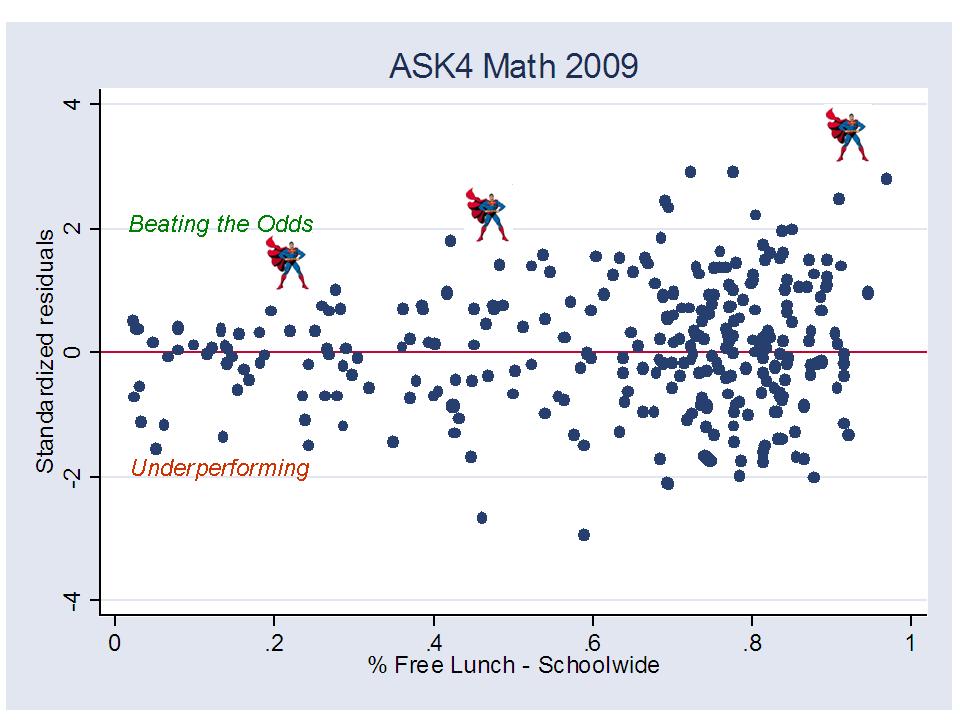
This was the basis of my Searching for Superguy in Gotham activity. In that activity, I estimated a relatively simple statistical model to determine which schools performed better than expected, given their students and location and which schools performed less well than expected, given their students and location. I had been planning all along to do something similar with New Jersey Charter Schools. Now is that time!!!!!

As I did with New York City charter schools, I have estimated a statistical model of the proficiency rates of each charter school and each other school in the same New Jersey city. In the model, I correct for a) free lunch rates, b) homelessness rates, c) student racial composition (Hispanic and black). AND, I compare each test – grade level and subject – to the same test across all schools. AND, I compare each school to other schools in the same city (by using a “city” dummy variable). I obtained all necessary variables from a) NJ school report cards (outcome measures) and b) NJ enrollment data file (free lunch, race, homelessness) and c) NCES Common Core of data for “city” location of school.

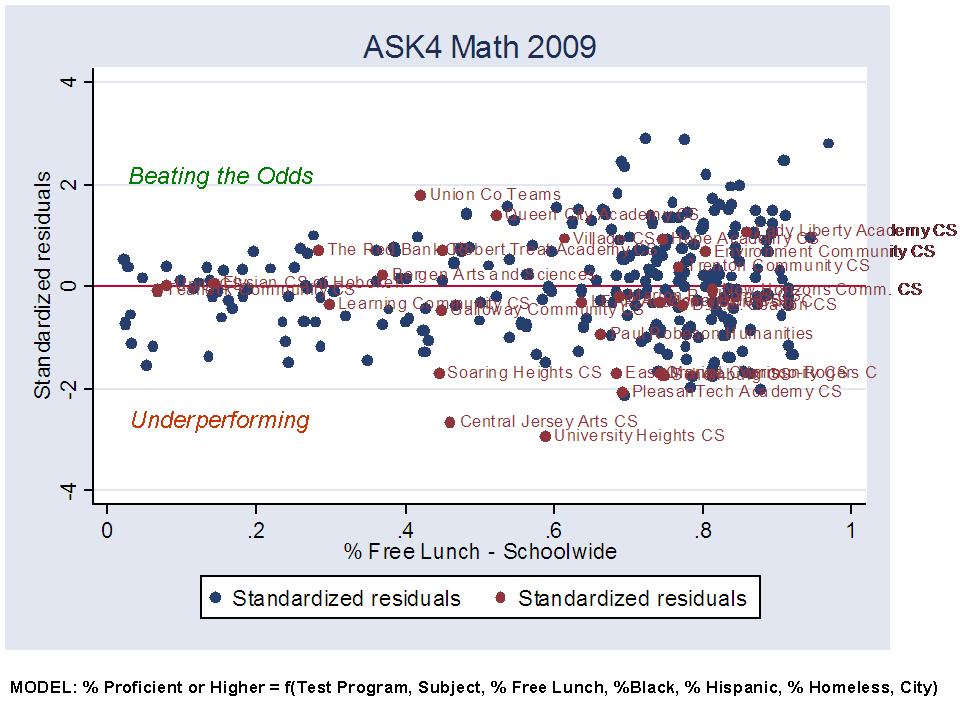
So now, the search for Jersey Superguy begins! Let’s start with 4th Grade Math performance in 2009. This scatterplot includes all schools with ASK4 Math scores in cities where charters existed in 2009. Schools above the red horizontal line are schools that “beat the odds.” That is, they are schools that had proficiency rates that were above the expected proficiency rates for that school, given its students, the test, and the location (city). Schools below the red line are schools that did not meet expectations. So, is superman (mythical super charter school leader) hiding in one of those dots way at the top of the scatter? Is he in a high-flying, high poverty school? Is he in a high-flying low poverty school? Certainly, he could not be down in the lower half of the graph.


CLICK HERE TO SEE WHICH SCHOOLS ARE CHARTERS AND WHICH ARE DISTRICT SCHOOLS

CLICK HERE FOR A CLOSE UP ON NEWARK SCHOOLS OVER AND UNDER THE LINE

NOTE: I’m in the process of fixing a data error that occurs on a few charter schools (affecting merging of data).  These figures still include the merge error, but the overall distributions are not affected. Schools affected include: Environment Community School, Liberty Academy, Hope Academy, International CS of Trenton, Jersey City Community CS and Jersey City Golden Door. I HAVE  NOW EXCLUDED MISMATCHED SCHOOLS.

The source of the error is the NJDOE enrollment file, which, for example identifies Environment Community School as both 80_6232_920 (county, district, school) and as 80_6235_900.  The first of these codes is correct. The second is for Liberty Academy CS (according to the School Report Card and according to NCES data).

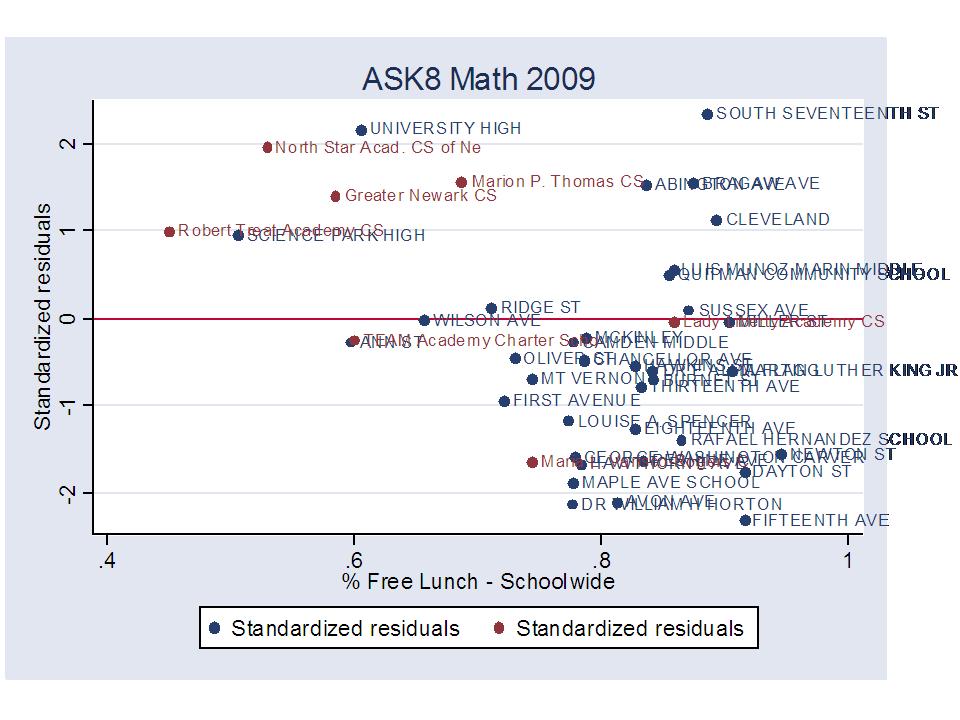
Now, let’s take a look at the 8th Grade Math outcomes. Here’s the statewide scatterplot:


Surely superguy must be hangin’ out in one of those high flyin’ dots way at the top of the scatter?

CLICK HERE TO SEE WHICH SCHOOLS ARE CHARTERS AND WHICH ARE DISTRICT SCHOOLS

CLICK HERE FOR A CLOSE UP ON NEWARK SCHOOLS OVER AND UNDER THE LINE

As you can see, there are plenty of charters and traditional public schools above the line, and below the line. The point here is by no means to bash charters. Rather, this is about being realistic about charters and more importantly realistic about the difficulty of truly overcoming the odds. It’s not easy and any respectable charter school leader or teacher and any respectable traditional public school leader or teacher will likely confirm that. It’s not about superguy. It’s about hard work and sustained support – be it for charters or for traditional public schools.

As I noted in my previous searching for superguy post:

Yeah… I’d like to be a believer. I don’t mean to be that much of a curmudgeon. I’d like to sit and wait for Superguy – perhaps watch a movie while waiting (gee… what to watch?). But I think it would be a really long wait and we might be better off spending this time, effort and our resources investing in the improvement of the quality of the system as a whole. Yeah, we can still give Superguy a chance to show himself (or herself), but let’s not hold our breath, and let’s do our part on behalf of the masses (not just the few) in the meantime.

TECHNICAL APPENDIX

Here is a link to the model used for generating the over/under performing graphs above

And here is a separate model  in which I test whether Charter schools on average outperform traditional public  schools in the same city. This model shows that they don’t, or at least that their 1 to 3 percentage point edge on proficiency is not statistically significant. But whether charters on average outperform – or don’t – traditional public schools is not the point. The point is that like traditional public schools – they vary – and it’s important for us to get a handle on how and why all schools vary in their successes and failures – charter or not.

Complete slide set here: New Charter Figures Nov 12

BONUS MAPS

Here are some updated maps of the demographics and adjusted performance measures of charter and district schools in Newark.

First, % Free Lunch 2009-10:

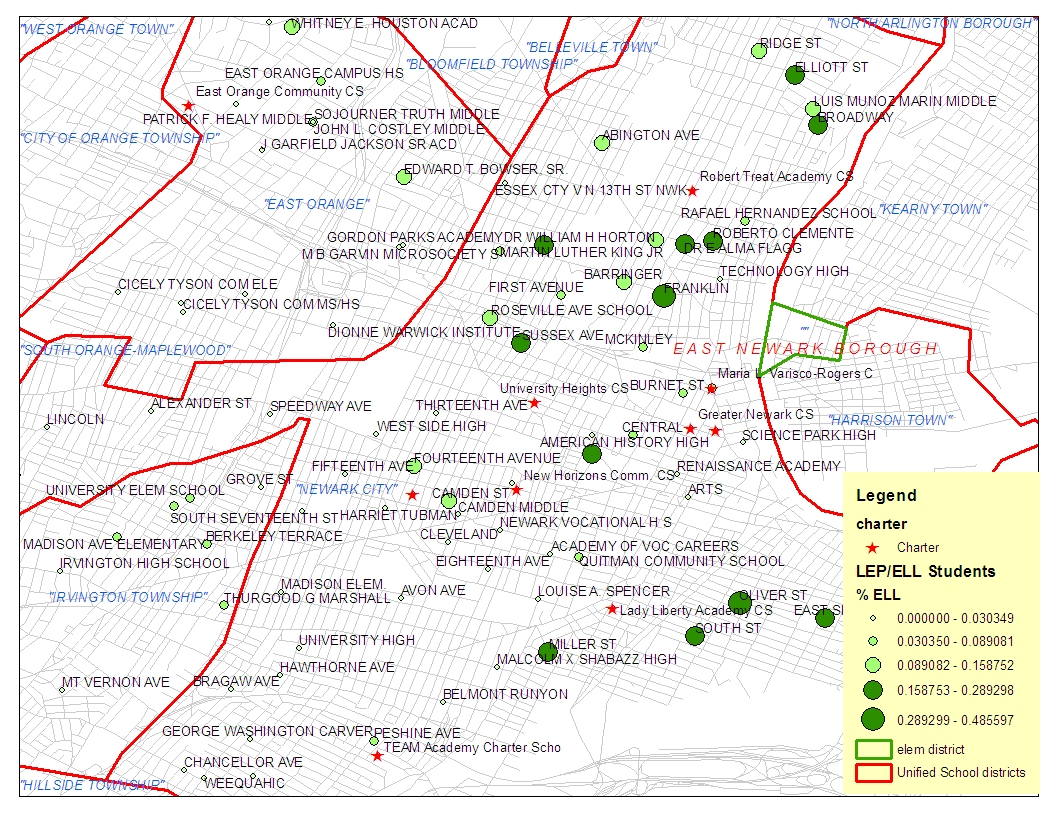
Next, a new one, % LEP/ELL – note that the % LEP/ELL for NWK charters is so low, therefore their dots are so small that the star indicating “charter” covers them entirely:

Finally, here are the Beating the Odds figures converted into color coded circles – with large purple circles being high performers – better than expectations – medium size pale dots being relatively average performers – and large yellow dots performing below expectations:

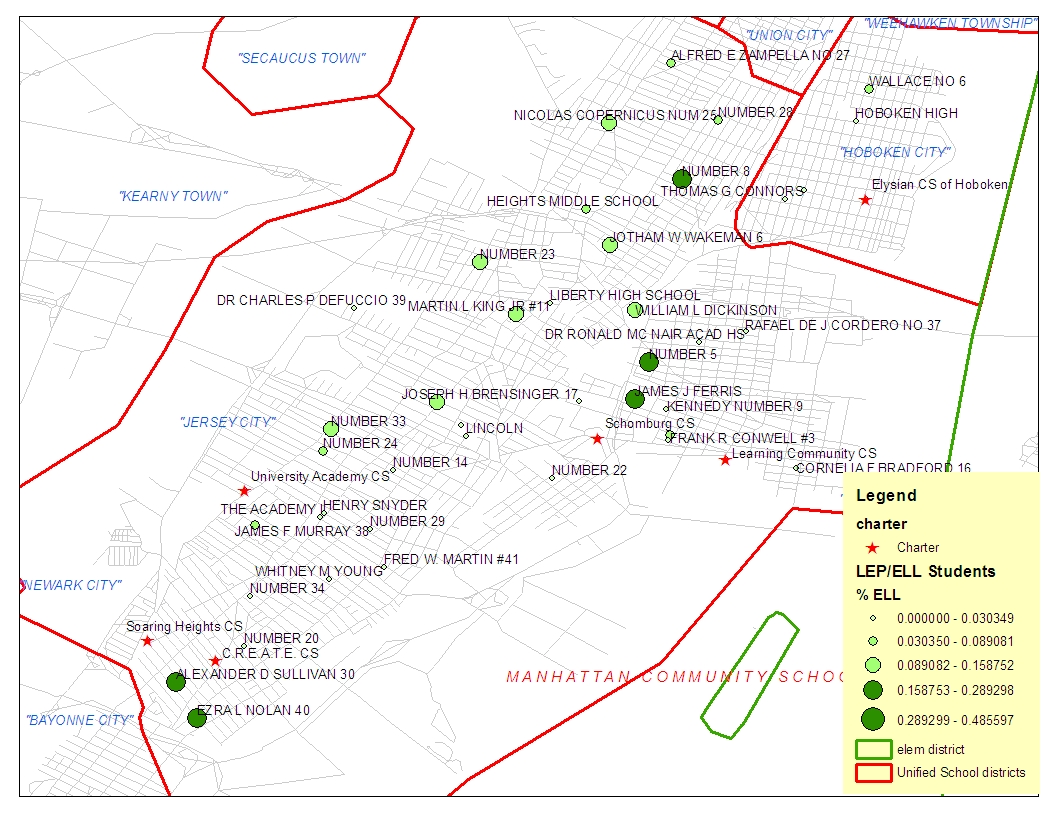
Jersey City % LEP/ELL

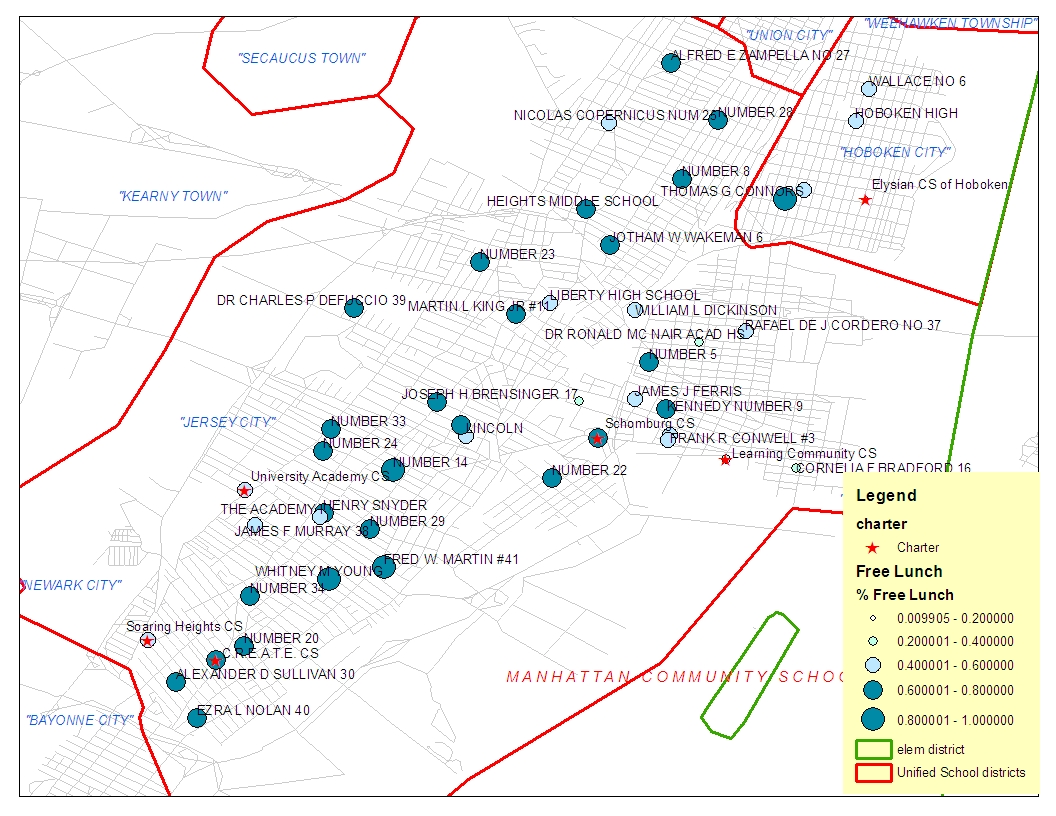
Jersey City % Free Lunch

Jersey City Performance Index

Getting all “bubbly” over that spending “bubble?”

Let me just say that I hate this graph!

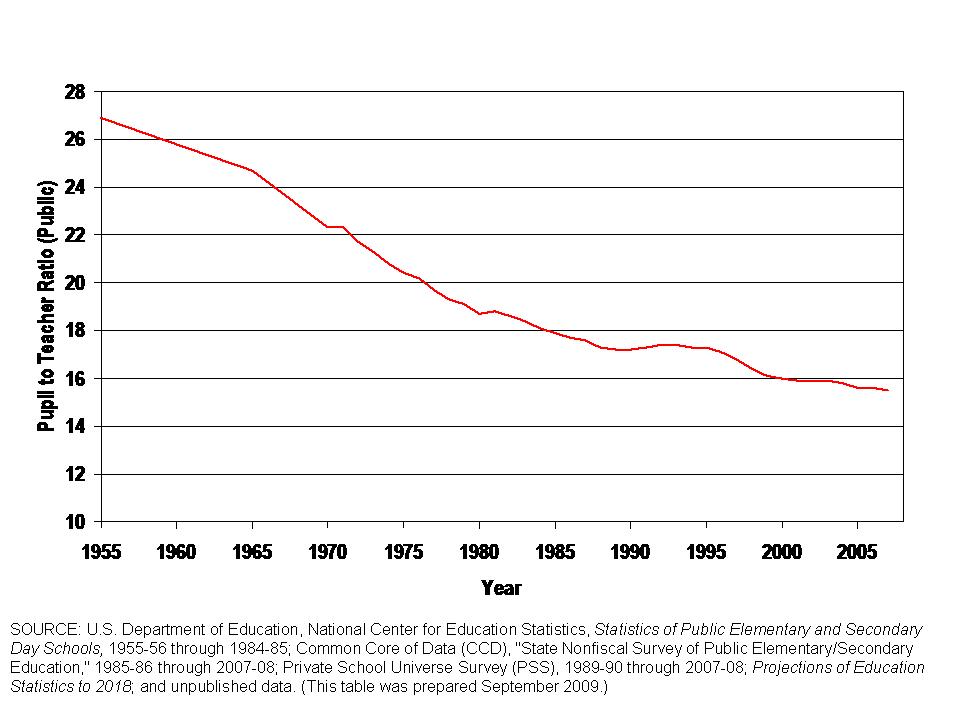
FIGURE 1 – NATIONAL TRENDS IN PUPIL TO TEACHER RATIOS

Why? Well, this is my own version of the graph… but it is a graph that has been used many times over, of late, to make the argument that American public schools have simply been drowning in an excess of public funding for decades and that public school districts nationally have leveraged all of that additional money over time to flood classrooms with additional staff. Of course, this framing is being used to set up the argument that it’s time for a logical correction – a return to sanity – a return to reasonable class sizes, etc. etc. etc.

First of all, even this national graph – which isn’t particularly meaningful – shows a reduction of slightly over 2 students per teacher over the past 25 years. Chop off the period prior to 1985 and the most dramatic shifts in pupil to teacher ratio are wiped away.

Second, national averages just aren’t that meaningful.  Claims like this one, from Mike Petrilli of Fordham Institute, misunderstand entirely the variation in resources across states and variation in effort across states:

The tough-love message to superintendents and school boards nationwide should be clear: The day of reckoning has arrived; let the de-leveraging begin. The spending bubble is over. No more adding staff at a pace that outstrips student enrollment; no more sweetheart deals on pensions or health insurance; no more whining about “large” class sizes of twenty-five. It’s time to live within our means.

http://www.edexcellence.net/flypaper/index.php/2010/11/welcome-to-a-new-era-of-restraint/

The new “reform” story line is that all states have been spending out of control they have taxed their citizenry to death and have spent most of that money hiring more and more teachers even while student populations have stagnated. Further, we have done all of this out of control spending and class size reduction while seeing absolutely no return for our dollar! Pretty simple!  Very compelling, eh? NO.

When one takes a look at individual states – in terms of relative tax burden, changes in tax burden over time – in terms of changes in pupil to teacher ratios over time – and in terms of student outcomes in relation to pupil to teacher ratios and tax burdens – it’s pretty damn hard to find states which actually fit that story line. And public K-12 education is largely a state and local endeavor, not a federal one.

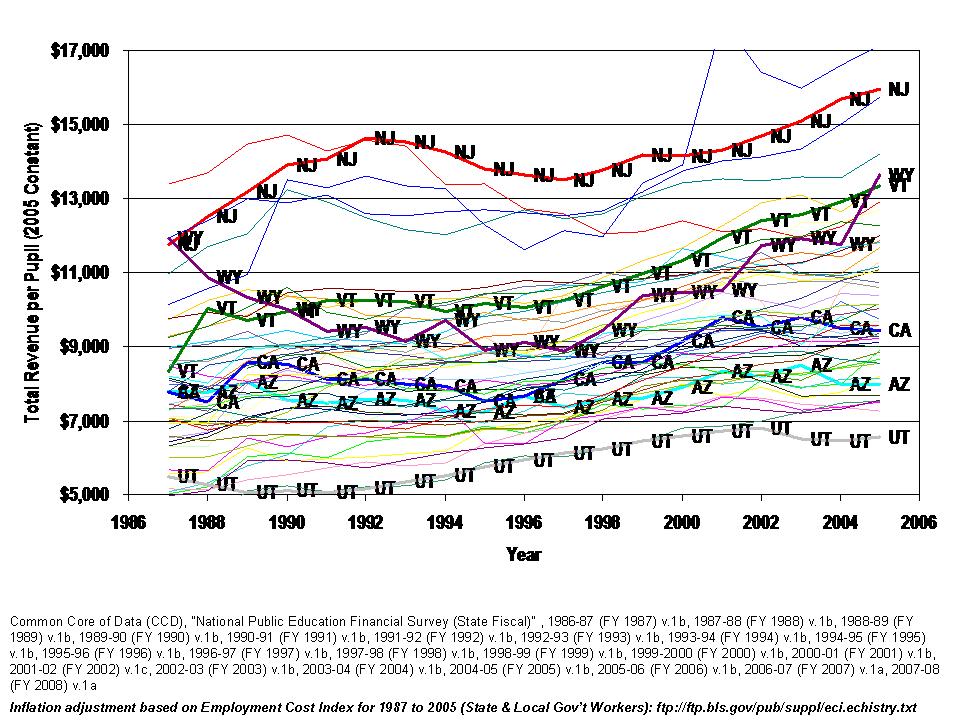
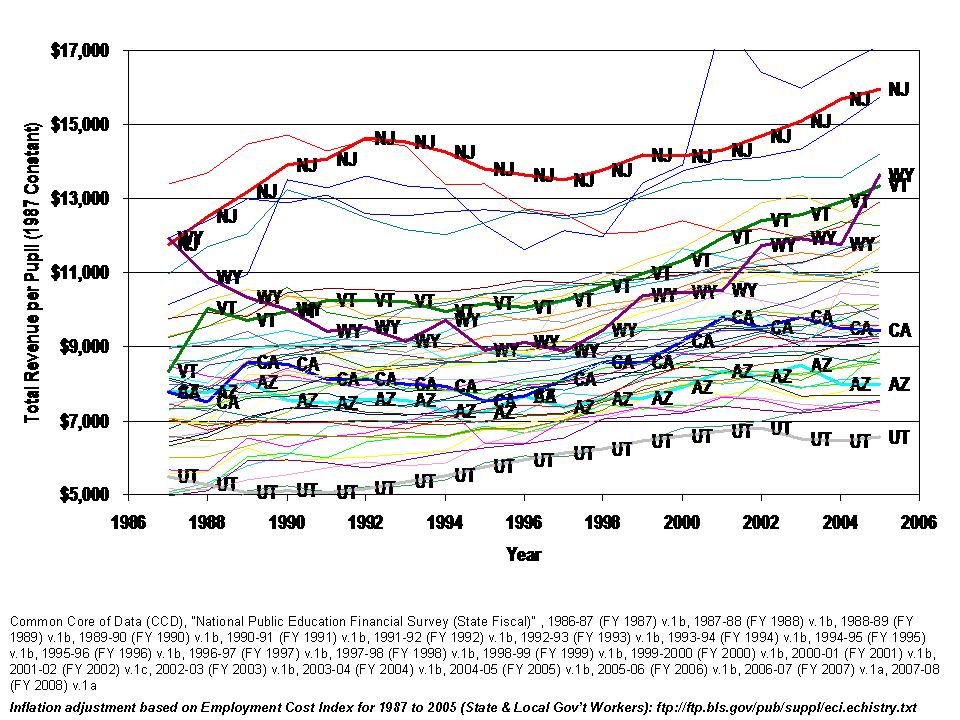
So, let’s take a state by state look. Let’s start here – with the total revenues per pupil – state aggregate – including state, local and federal sources. I’ve adjusted these for inflation (Employment Cost Index – Gov’t Workers), but not for regional variation. For more information on comparing across states, see THIS POST. (<–See this link if you want to know how states rank compared to one another on state and local revenues).

FIGURE 2 – TOTAL REVENUES PER PUPIL – INFLATION ADJUSTED, NOT REGIONALLY ADJUSTED (2005 Dollars)

What this shows us is that there’s quite a bit of variation in revenues for local public school districts across states, with some states investing a lot – like New Jersey, Vermont and Wyoming and some not so much – like Utah, Arizona and California. This graph also tells us that many states really didn’t see consistent spending/district revenue growth throughout the period. No massive… long term… uniform… spending bubble… from which they all benefited.

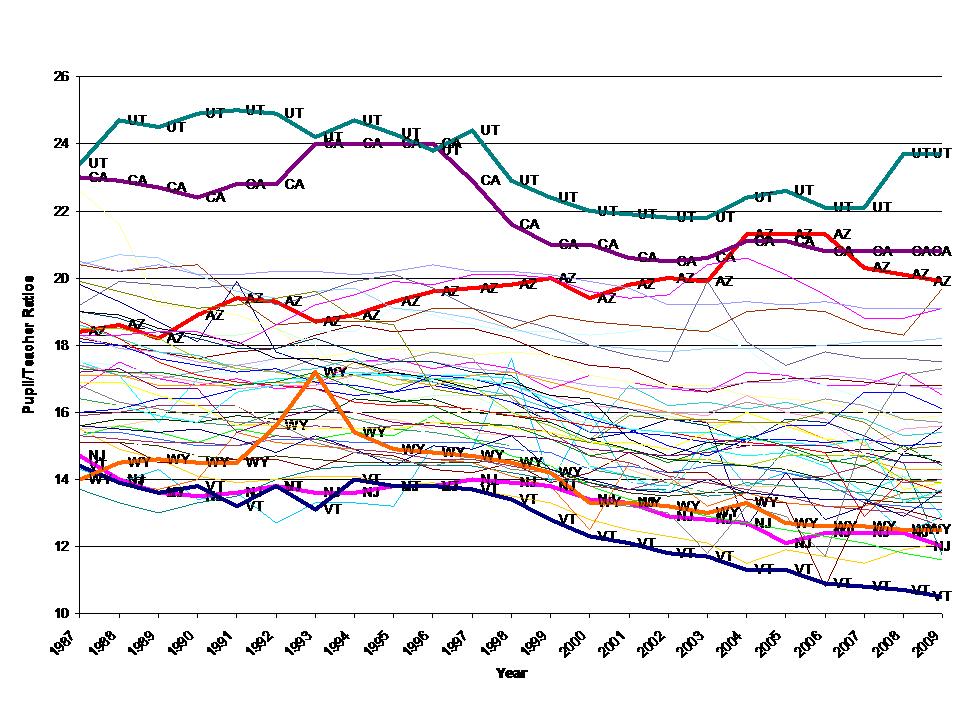
The patterns of revenue increases mirror patterns of pupil to teacher ratio change over time. Yes, some states like Vermont, Wyoming and New Jersey did see pupil to teacher ratios decline. But, not so for Utah, California (after 1998) or Arizona. In fact, in Arizona pupil to teacher ratios increased over time!

FIGURE 3 – PUPIL TO TEACHER RATIOS ACROSS STATES AND OVER TIME

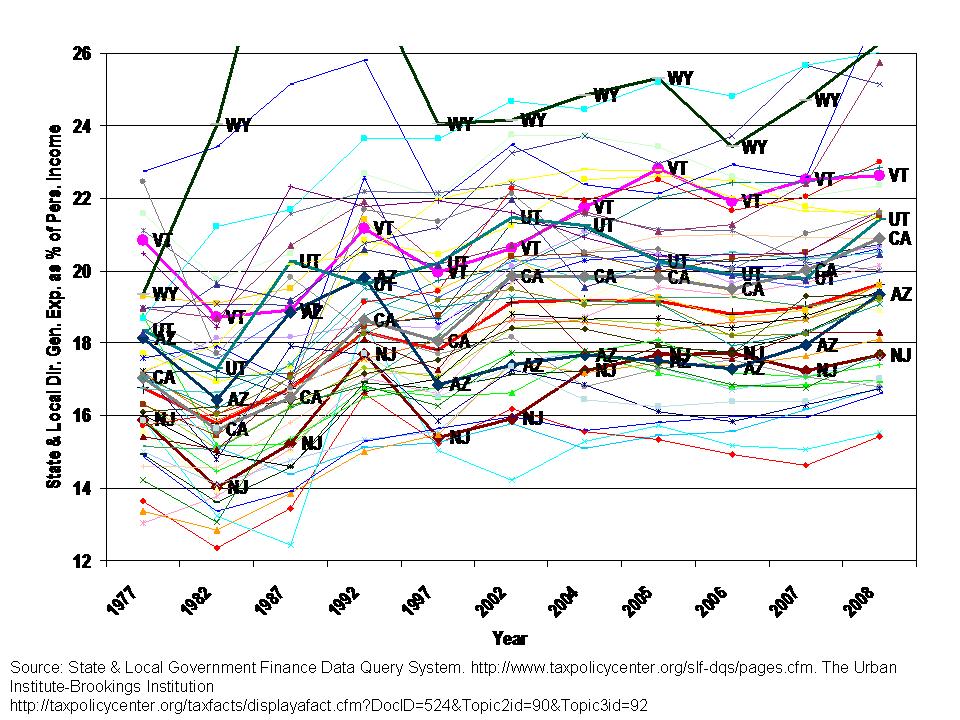
And, it is similarly foolish to assert that all states put themselves over the brink in terms of taxes to support all of this supposedly lavish spending. Here are the state and local direct expenditures as a percent of personal income across states:

FIGURE 4 – STATE AND LOCAL DIRECT EXPENDITURES (All, not just Educ.) AS A PERCENT OF PERSONAL INCOME

Look at New Jersey, which has provided relatively high levels of funding, with increases in the early 1990s and again from 1998 to 2003 (though lagging in the middle). New Jersey is not among highest at all on state and local direct expenditures as a percent of personal income – because incomes in New Jersey are quite high. Arizona is also relatively low and Utah and California only average – not high. The “high” state and local direct spending burden states in this mix are Wyoming and Vermont.

So then, what about that story line we’re being told applies across our nation’s schools –

  1. that they’ve been swimming in money for decades – a huge ongoing spending bubble – and
  2. that they’ve spent it all on pupil to teacher ratios – increasing teacher quantity not quality – and
  3. that they’ve taxed their state residents to death in the process – and
  4. got nothing for it in improved student outcomes.

Well, the only state that seems to come close here is Vermont (and perhaps Wyoming) – which does have high and growing public expenditure burden (and the highest “effort” index at www.schoolfundingfairness.org), increased education spending per pupil over time and continued decline in pupil to teacher ratios.

Of course, that last part of the story line about outcome failure doesn’t fit so well, because Vermont does very well on outcomes (See this article for discussion of empirical research on results of Vermont school finance reforms: https://schoolfinance101.com/wp-content/uploads/2010/01/doreformsmatter-baker-welner.pdf)

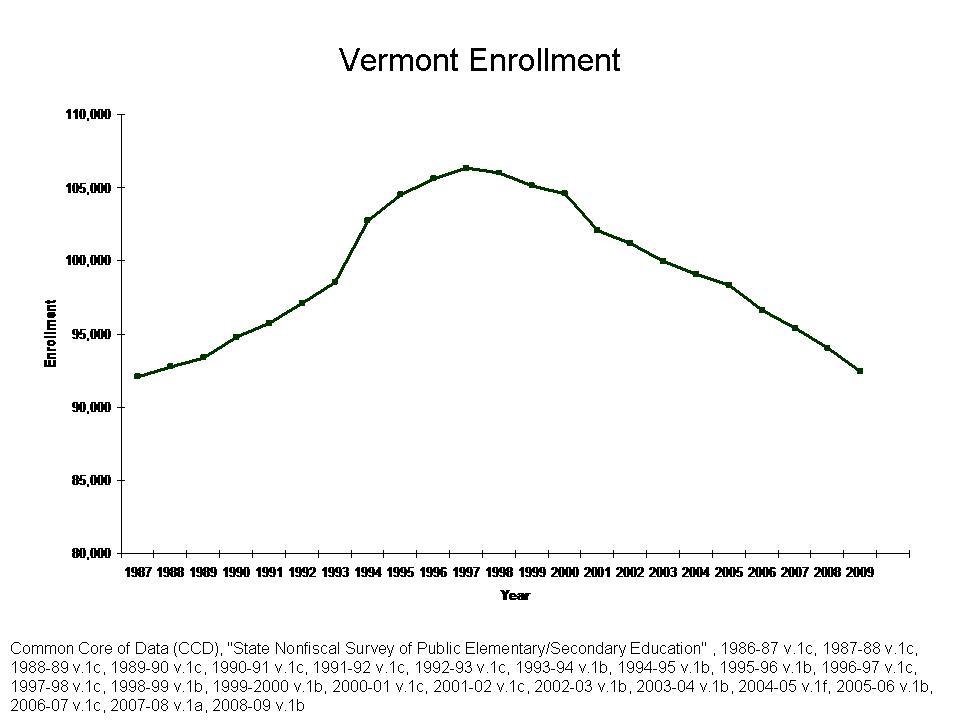
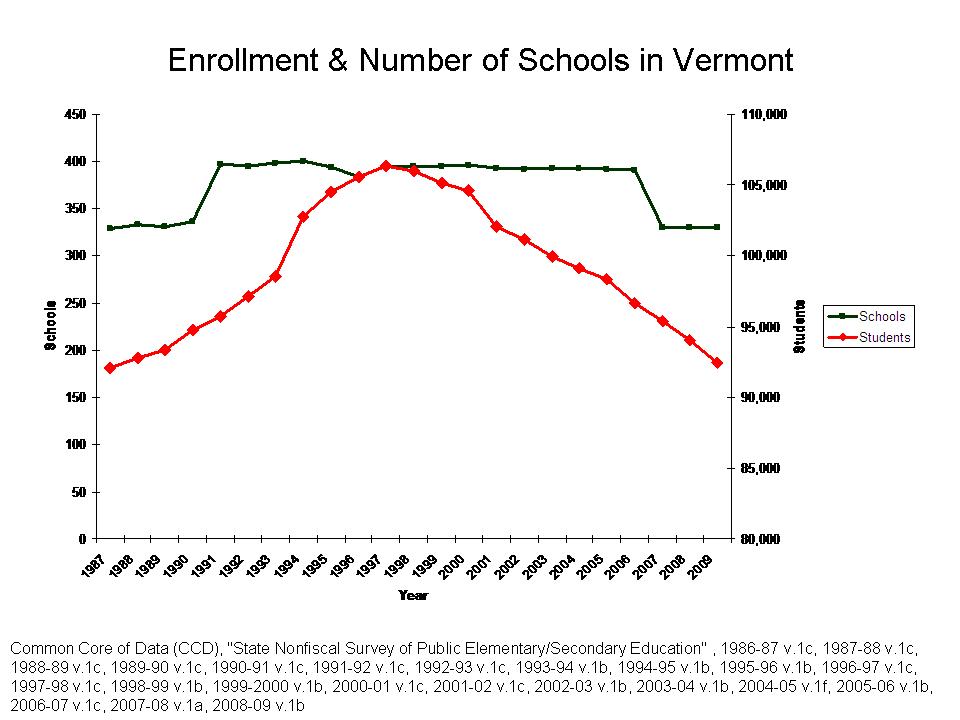
It also turns out that even Vermont’s “bubble” story isn’t so simple. Vermont really hasn’t been adding significant numbers of additional staff and spending a lot more in recent years. Rather, Vermont is experiencing a significant decline in student population – but has not adjusted its public education system accordingly – reorganizing into more efficiently organized schools and districts. You see, if you spend the same amount and retain similar numbers of teachers, when enrollments decline, pupil to teacher ratios decline and per pupil spending goes up. Yeah… same effect as a spending bubble – but very different cause. And yes, this is something that should be addressed. But again – somewhat different issue! Except for an infusion of funding in the late 1990s in response to school funding equity litigation – Vermont has not necessarily been on a wild education spending binge to reduce class sizes – Rather, the state is a victim of declining school-aged population, resulting in declining enrollment and declining pupil to teacher ratios.

Here’s Vermont enrollment over this same period.

FIGURE 5 – VERMONT ENROLLMENTS

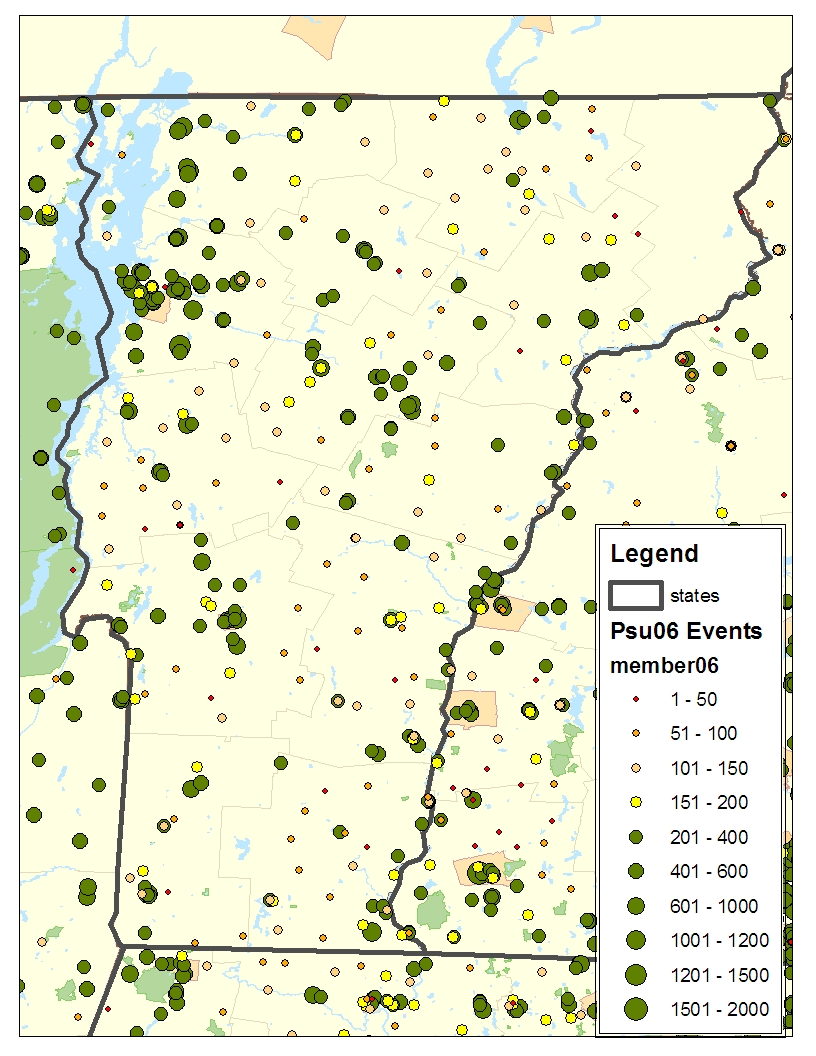
This map shows the locations and enrollment of Vermont schools. Small red dots are schools with 50 or fewer students and small orange/brown dots have 50 to 100.  In some areas of the state, you can find small red dots within a few miles of each other (many of which are small town schools – in separate towns – actually serving the same grade levels/ranges).

FIGURE 6 – LOCATIONS AND ENROLLMENT SIZES OF VERMONT SCHOOLS

Okay, so if this story line doesn’t even fit for Vermont, then who? Perhaps no-one! Arguments built on assumptions of “national trends” regarding financing, class size and/or most features of our public education systems – our 50 and then some systems – are generally unhelpful (if not entirely misguided).

Arguments that encourage state legislators across the nation – including those in states like Utah, Arizona and California that now is the time to cut, cut, cut, because we just went through decades of spend, spend, spend, are downright ignorant and irresponsible.

And please check out this post: https://schoolfinance101.wordpress.com/2010/10/27/when-schools-have-money/ where I explain that within states – especially inequitable states like NY or IL – if and when anyone did benefit from reduced pupil to teacher ratios and more importantly smaller class sizes, it was often those in the most affluent communities.

No more “sweetheart deals” for poor schools…

Fordham Institute’s Mike Petrilli is showing his “tough love” for public schools in these tough economic times:

The tough-love message to superintendents and school boards nationwide should be clear: The day of reckoning has arrived; let the de-leveraging begin. The spending bubble is over. No more adding staff at a pace that outstrips student enrollment; no more sweetheart deals on pensions or health insurance; no more whining about “large” class sizes of twenty-five. It’s time to live within our means.

http://www.edexcellence.net/flypaper/index.php/2010/11/welcome-to-a-new-era-of-restraint/

Of course, a major problem with this assertion for anyone who has read… well… much of anything about school funding in the past decade or so, is the underlying assumption that schools nationwide, uniformly and especially poor urban districts have simply been punch drunk on excess funding resources for the past few decades… with dramatic increases for all especially from the 1990s forward.

Now Mike Petrilli is actually better than many on this point, on most occasions.  But the problem with Petrilli’s statement above is that it fails to recognize the incredible variation that persists across states and school districts, and perpetuates the myth of school districts nationally and uniformly being punch drunk on the public dollar – the “bubble” is over. The “bubble” that everyone enjoyed!

Here are two recent sources which show the extent of persistent disparities across states and across districts within states by district poverty rates:

  1. Is School Funding Fair? www.schoolfundingfairness.org
  2. Baker, B.D., Welner, K.G. (2010) Premature celebrations: The persistence of inter-district funding disparities. Education Policy Analysis Archives. http://epaa.asu.edu/ojs/article/viewFile/718/831

In our report on Fair School Funding, we show just how large the funding disparities are across states and also show that in many states, higher poverty districts still receive systematically fewer resources per pupil – and that’s in dollars adjusted for regional wage variation, economies of scale and population density – no fancy weights to reduce spending for poverty differences themselves. Yes, in some, many states, higher poverty districts have far fewer resources than lower poverty ones! Shocking, I know.

Further, the first of these sources explains that much of the deprivation of resources that has occurred in certain states is a function of complete and utter lack of state financial effort – not lack of capacity.

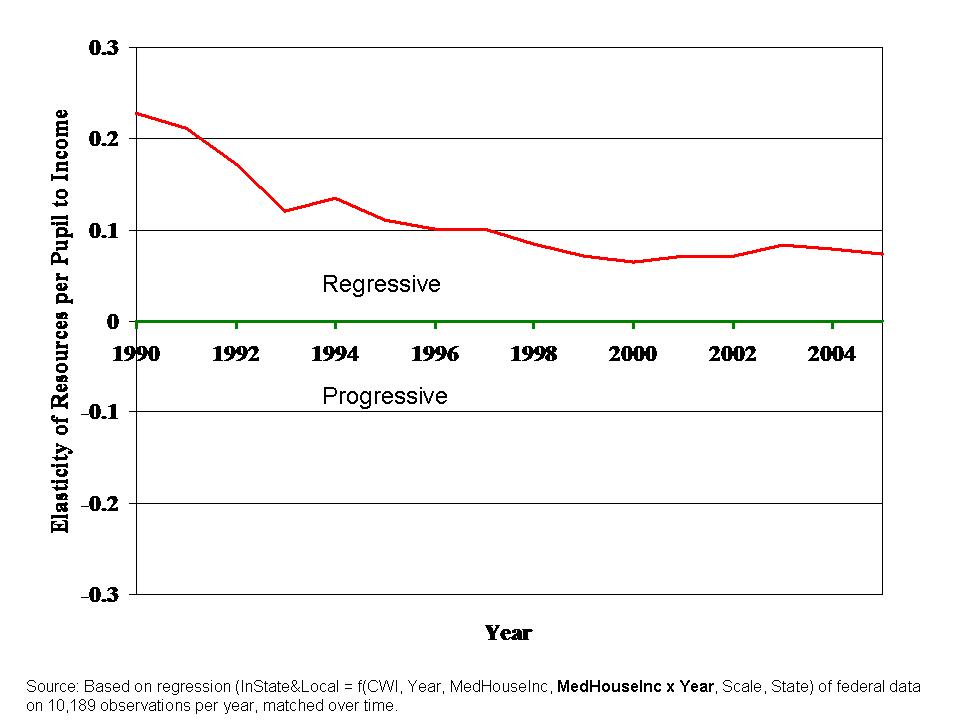
Additionally, in the second article above, Kevin Welner and I show by a similar method that overall, nationally, there remains a positive relationship between school district state and local revenues and resident income levels (across districts within states). Here’s a figure from our report, based on a regression model characterizing the relationship between median household income and state and local revenues per pupil over time.  Even by 2005, that relationship remained positive – and still does through 2008. Some progress was made through 1996, and then leveled off.

Figure 1

Relationship between Median Household Income and State & Local Revenues per Pupil (District Level) Nationally

More interesting, however, is the variation in support for schools generally, across states, and for higher poverty schools within states.

Yes, state budgets oscillate over time. There are good times and there are bad times. But some… if not many states… have chosen consciously to use the argument of “tough economic times” to throw their public education systems under the bus. Heck, many of these states used the good economic times to argue for throwing their education systems under the bus. Wouldn’t want to slow the economy by “overtaxing” and spending too much on schools.

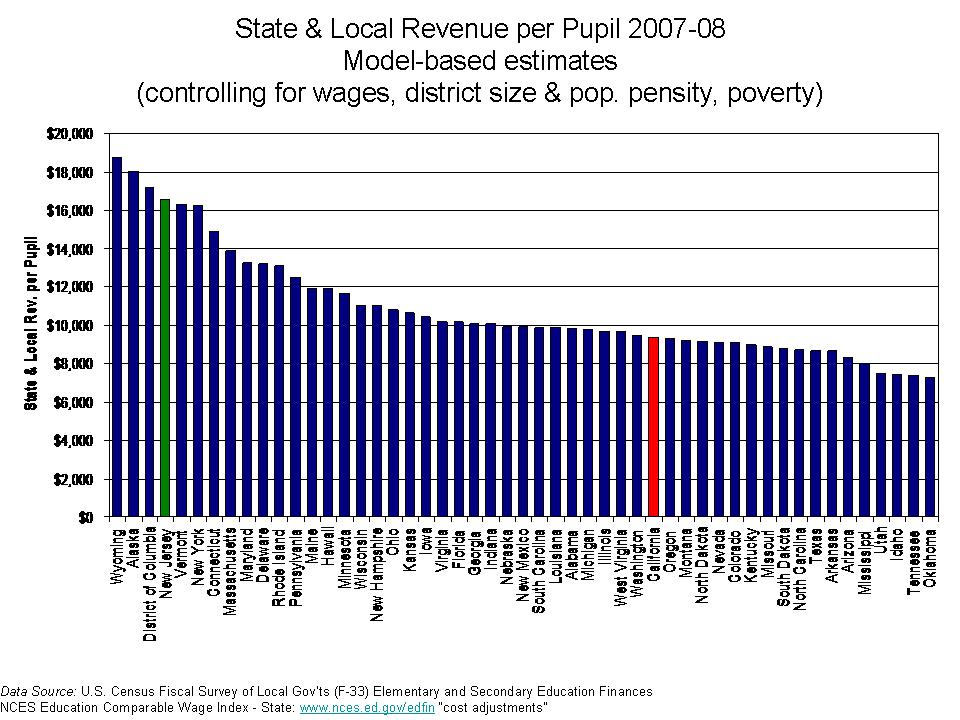
Here are some snapshots of state spending, from a recent post.

Figure 2

Figure 3

For more information on these graphs, see my earlier post on State Ranking Madness. Suffice it to say that not all states have put a lot of funding into their schools and these figures come from 2007-008, the front end of the downturn – or back side of the supposed bubble. Some states like Utah and Tennessee allocate very little to their public education systems. Perhaps those are poor states that simply can’t afford to do more? Perhaps they were “taxed to death” in the good times – during that bubble – and simply can’t sustain that in the bad times!  That’s simply not the case!

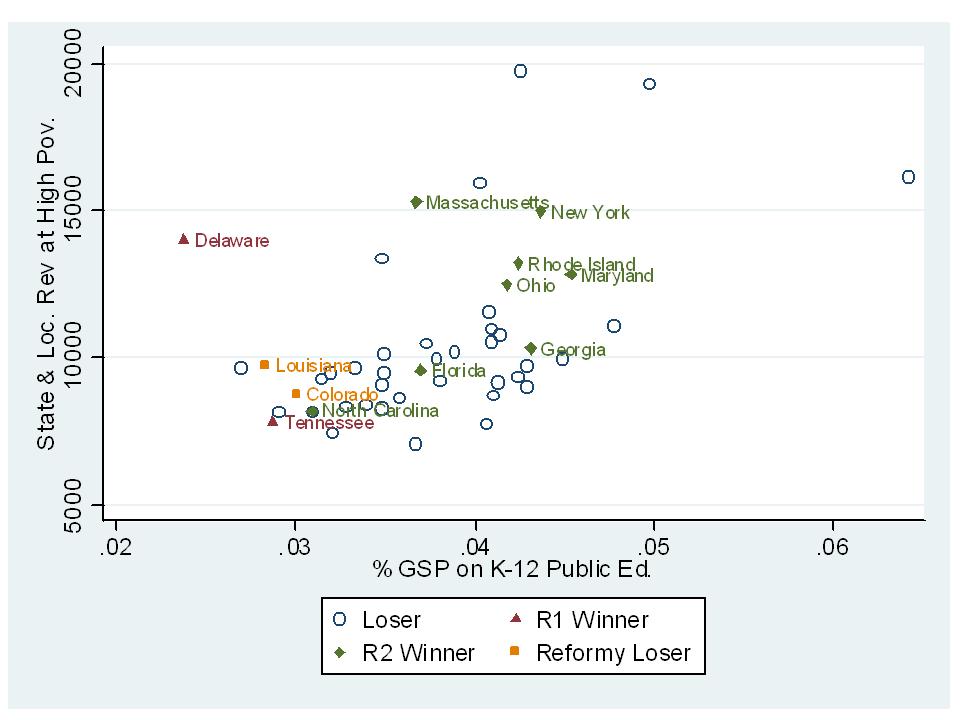
Figure 4 shows the relationship between state and local revenue levels and the percent of gross state product spent on schools (from an earlier post). Tennessee, which is near the bottom on state and local revenue is also near bottom on “effort,” along with Louisiana, Colorado and North Carolina. These states are using far less of their capacity to support public education. Their lagging resources are a function of political choices as much if not more than a function of economic conditions.

Figure 4

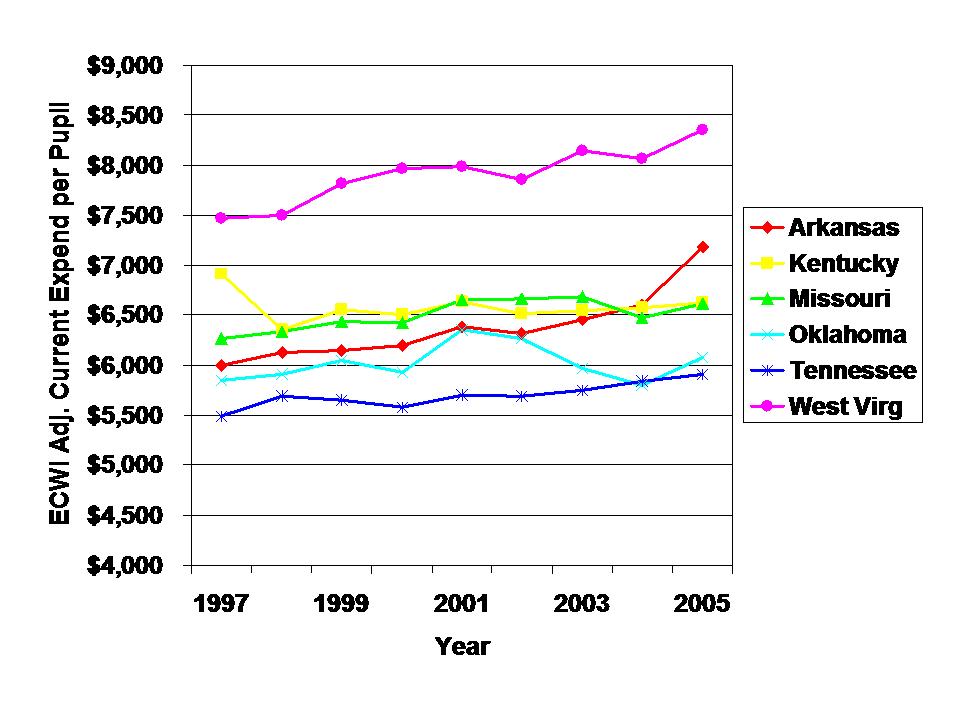
As it turns out, these states also somehow missed out on that whole bubble thing. Figure 5 shows the ECWI (Education Comparable Wage Adjustment) adjusted current operating expenditures per pupil from 1997 to 2005 (range for which ECWI is available) for states we classify as “highlands” in our fairness report. Adjusted for competitive wage growth (of non-teachers in same labor markets), per pupil spending in Tennessee stayed a) relatively flat and b) below all others in its region. Where’s their bubble? Where’s all of that punch drunk public spending? Well, perhaps if we could take it back to about 1920 or so. Then we’d find the bubble?

Figure 5

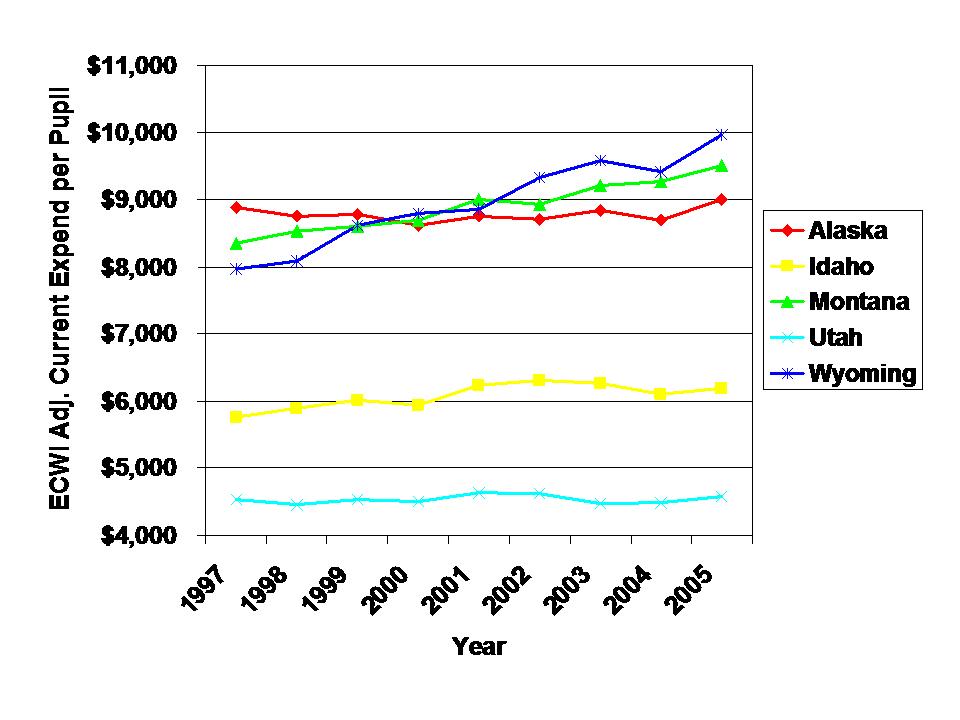
Utah is my new favorite standout these days, and is shown in this figure.Yeah… you have to look carefully to find Utah per pupil spending down their blending in with the horizontal axis of the graph. Utah per pupil spending is a) absurdly lower than all others around it and b) really, really, flat over time. Hey, where’s that bubble? Where’s all that punch drunk public expenditure? In fact, the only state with a really steady climb in spending here is Wyoming (perhaps Montana also).

Figure 6

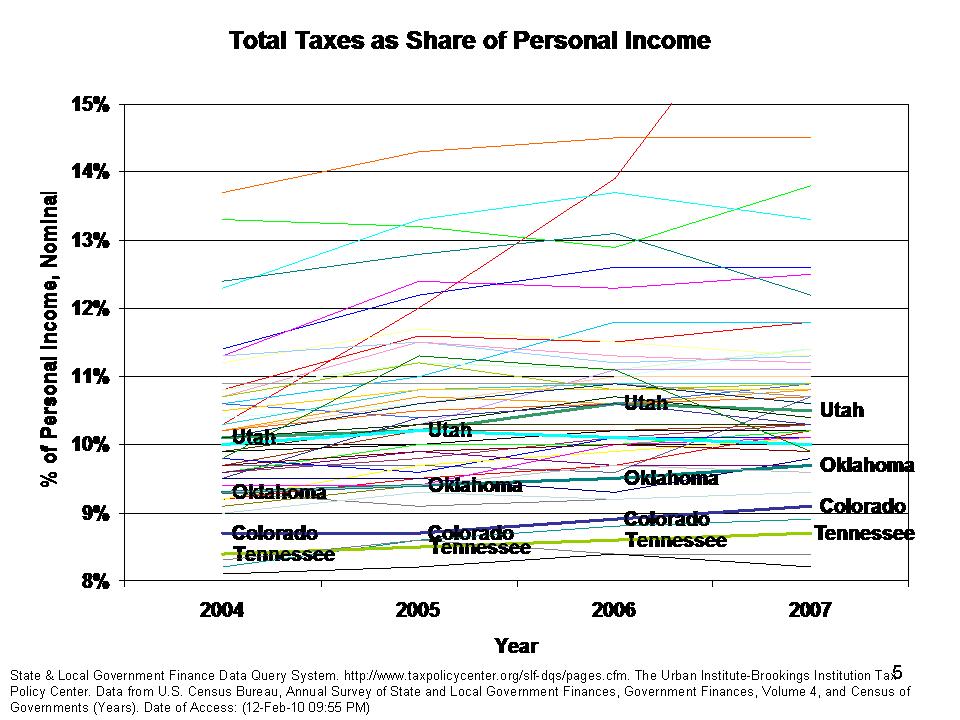
Oh, and back to that issue of how all of these states have taxed themselves to oblivion to support that punch drunk spending binge. This figure shows the cumulative taxes as a percent of income with a handful of states including Utah and Tennessee identified.  Note that for most states, these trends change little even if we take the graph back to 1980. While the above “effort” figure focuses only on public K-12 funding as a share of gross state product, this graph focuses on all tax revenues as a share of income. Yeah… Tennessee and Utah really taxed themselves to death to support their massive spending bubble (albeit my time line is slightly different… but heck… there wasn’t a bubble anyway). We really need to bring their taxes and spending back into line. Really!

Figure 7


I’d find it pretty hard to argue that schools – and the adult interests who run schools – in states like Louisiana, Utah, Colorado and Tennessee have been punch drunk  for decades and need to get with the program and learn how to live within their means! MAKING BROAD NATIONAL STATEMENTS TO THIS EFFECT IS DOWNRIGHT ABSURD, GIVEN THAT PUBLIC SCHOOL FINANCE REMAINS PRIMARILY A STATE AND LOCAL FUNCTION!

Just as spending levels vary across states, so do funding levels vary across children, schools and districts within states. That is the central concern in Is School Funding Fair? Funding fairness, like overall funding levels, varies widely across states, even within regions. Figure 8 shows that among the mid-atlantic states, only New Jersey reversed the relationship between household income and school district revenues. Even then, many affluent suburban New Jersey districts continue to outpace spending of their poorer urban neighbors. New York State remains among the most regressively funded states in the nation, with affluent districts continuing to far outspend New York City schools and schools in other poorer mid-size and small cities around the state.

Figure 8

Trends in Income-Revenue Relationships in Mid-Atlantic States

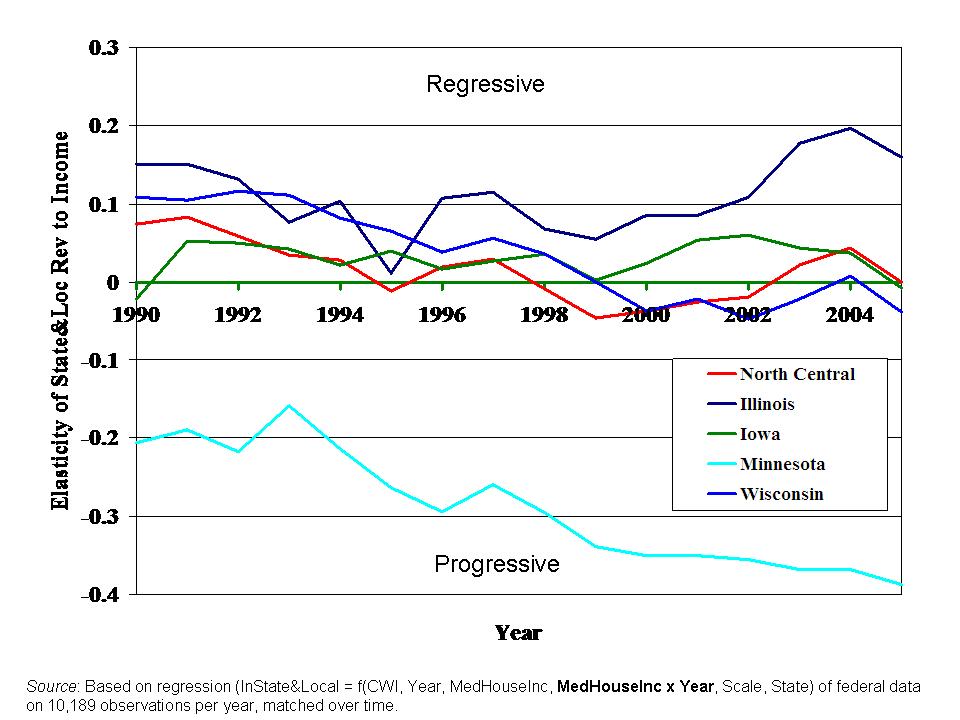
Figure 9 shows the same trends for North Central states, where Illinois is the standout of not only maintaining a regressive distribution of resources but actually increasing in regressiveness of funding from 1998 to 2005. Over time, affluent suburban Chicago school districts have continually outpaced state and local revenues of poorer urban, minority districts.

Figure 9

Trends in Income-Revenue Relationships in North Central States

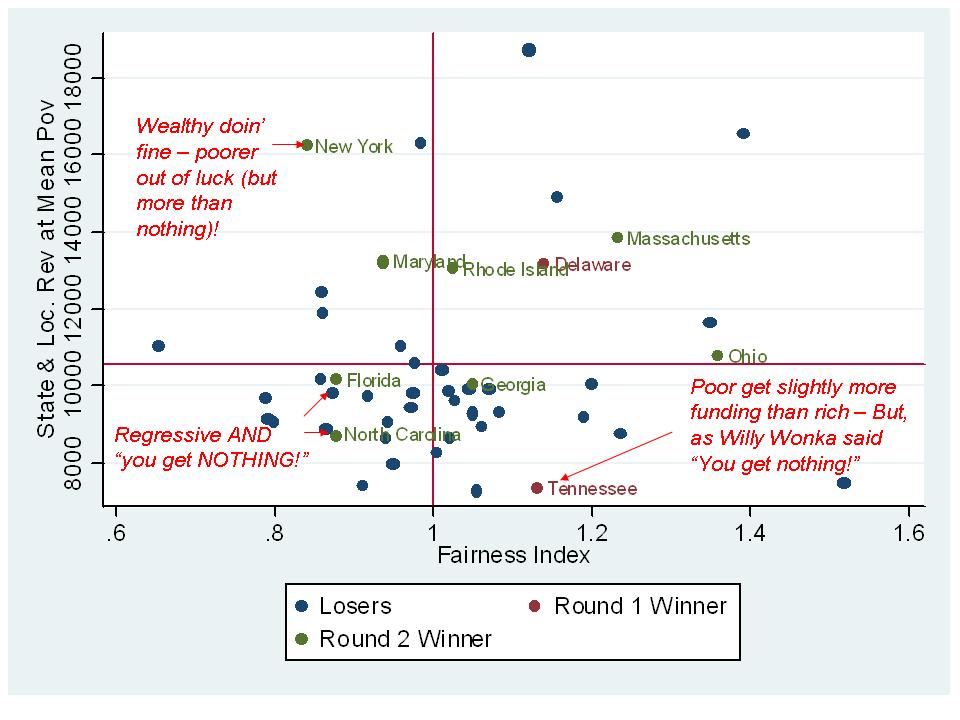
Figure 10 compares the within state fairness measure with the measure of overall support for public education. Some states like Florida and North Carolina simply spend little, while having reasonable capacity to spend more, and distribute what they have inequitably. Tennessee spends little – distributing those shares of near nothing relatively equitably – a strange variation on fairness.

Figure 10

Relationship between Fairness and Overall Support for Public Schooling

This argument that it’s time to accept reality, tighten our belts, etc. etc. etc. is essentially an argument that we should simply let class sizes climb back over 25 or 30 per classroom in poor urban districts and that we have no choice in the matter because there just isn’t enough money to do otherwise. There’s just no more money… in New Jersey, in Tennessee, in Louisiana, in Colorado, in Utah… you name it. They’ve all tried their hardest and spent themselves into oblivion while teachers, administrators and public education bureaucrats have been throwing extravagant parties on the public dime! That’s just how it is???????

I’m not buying it.  I assure you that within states, affluent suburban districts will be among the last to increase class sizes (as I discuss in When Schools Have Money) , unless state imposed spending limits force them to.  And I assure you that some states that already put up the least effort to support their public schools will proclaim most loudly the need to do even less – raising class sizes from 35 toward 40 (or cutting corners elsewhere).  The level of financial support provided to public education systems may, on average, be tied to general economic conditions. But the extent to which that support varies so widely across states and the extent to which states allocate those resources fairly across wealthier and poorer communities, is significantly if not predominantly in the control of states.

I close this with a favorite video clip – A Utah/Tennessee (and others) perspective on education funding!

Pondering the “Master’s Bump”

Last month, I wrote a post titled “The Research Question that Wasn’t Asked,” in which I questioned whether many of us have overstated the connection between research on teachers with advanced degrees and compensation policies that link compensation to advanced degrees.

I pointed out in my post that:

Studies of the association between different levels of experience and the association between having a master’s degree or not and student achievement gains have never attempted to ask about the potential labor market consequences of stopping providing additional compensation for teachers choosing to further their education – even if only for personal interest – or stopping providing any guarantee that a teacher’s compensation will grow at a predictable rate over time throughout the teacher’s career.

Many, like Rotherham but even more so, NCTQ, present this as a “research given.”  That clearly, it’s just dumb to pay teachers more who possess attributes we know are not associated with student achievement differences (across teachers). Is it possible, however, that changing these conditions could have significant labor market consequences? Perhaps good… but equally likely… unintended negative consequences.

Yes, teachers with any old masters degree or teachers with more than 10 years behind them might not, on average, be “measurably more productive.” But does the option to pay and recruit more experienced teachers or teachers with masters’ degrees enhance the likelihood that a district can attract teachers who are actually better teachers? I’m not so sure that the answer to this question unasked is so obvious that we need not ask it. So let’s stop pretending that it is.

In another recent post – When Schools have Money – I pointed out how all of the cool kids on the reform block have also come to the undisputed conclusion that smaller class sizes are an inefficient waste of resources and that we should instead focus our resources on hiring better rather than more teachers (as if a simple tradeoff) – even increasing class size to free up the money to increase wages (ignoring that larger student load is a working condition that might offset much of the competitive advantage gained from the higher wage).

In that post, I pointed out how one of the defining features of both high spending traditional public school districts and of high spending elite private schools is SMALLER CLASS SIZE. It’s a selling point for those private schools – appealing to parents choosing to pay the high tuition – and also appealing to parents of school aged children choosing a neighborhood to live in. Apparently, small class size is also a preferred strategy of the very high spending Harlem Children’s Zone charter schools (more on this at a later point).  In this post, I concluded:

For some reason these private schools and affluent public school districts – more specifically those who support these schools – exhibit a strong preference for small class size even when given wide latitude to choose differently. Perhaps they are on to something?

That got me to thinking – thinking about the potential relationship between these posts, in part based on my research findings using state data systems and studying the distribution of teacher and principal academic backgrounds and credentials. AND, considering the simple logic that … if both highly successful and unsuccessful school districts do these things (pay based on degrees and experience) can these things really be the primary cause of failure in the unsuccessful districts?

As mentioned in my first post above, I suspect that most school districts which offer a significant “bump” for teachers holding a master’s degree are not doing so on some assumption of a direct, simple, causal link between holding a master’s degree or not, and teaching effectiveness (measured exclusively by student achievement gains).

Yes, it would be one thing if the argument for offering a salary bump for a master’s degree was predicated entirely on the assumption of specific average achievement gains resulting from a teacher having a master’s degree.  Then one day, we find out that having a master’s degree isn’t associated with the assumed achievement gains. Problem identified. Therefore, we must stop providing the salary increment. Solution found.  Money saved. All is well and good. But very little is that simple, especially in complex social systems like teacher labor markets.

I suspect that the “master’s bump” more likely exists in many districts as a competitive recruitment/retention tool. Districts offer this bump (or agree to it, through negotiations) because they prefer the option to recruit teachers who have obtained higher degrees, for any number of reasons. In addition, districts offer this bump so that current teachers are incentivized to further their education (or to recruit teachers interested in pursuing further education). Districts may offer this bump knowing full well that many teachers will use it to get the degree, stick around for a few years at the higher salary, and then use their degree to pursue other opportunities. Even then, the district may have benefited from providing a favorable work environment that encouraged teachers to pursue further education and advance their own careers.

It may also be that the master’s bump saves districts money, in that they would otherwise raise all teachers’ wages to the level currently paid for a teacher with a master’s degree. Having a share of teachers with only a bachelor’s degree paid at a lower wage therefore reduces the total. That is, perhaps it’s not a master’s bump at all? Perhaps it’s a bachelors’ deduction?

The “master’s bump” is likely to be used more by some districts than others. My previous analyses suggest that more affluent school districts in metropolitan areas tend to offer a larger master’s bump. This is certainly the case in the Chicago metro area. Yep, there they go again – those highly successful, high spending districts – throwing their money at things that we know have no effect on student learning?

Here’s a quick snapshot of a) the distribution of master’s degree (or higher) salary premiums (master’s bump) across New Jersey districts, by wealth/income group (district factor group) and b) the distribution of teachers holding master’s degrees (or higher) by district wealth/income group.

FIGURE 1: Salary premium associated with holding a master’s degree for teachers in wealthier (District Factor Groups I&J) and poorer (District Factor Groups A&B) New Jersey school districts

So, what we see here is that districts in the wealthiest two factor groups provide the largest master’s bump. Are they just being wasteful? As with the preference for seemingly frivolous smaller class sizes, affluent districts in New Jersey, like elsewhere, tend to offer larger premiums for teachers with advanced degrees. It may be that there is simply public demand in these communities for small classes taught by teachers with advanced degrees. Perhaps the public has not been clued in that these preferences are misguided? Or once again, perhaps these affluent and generally successful school districts and their patrons are on to something?

FIGURE 2: Percent of teachers holding master’s degrees in wealthier (District Factor Groups I&J) and poorer (District Factor Groups A&B) New Jersey school districts

Figure 2 merely validates that the districts offering larger premiums for teachers with a master’s degree also seem to have more of them. It would be a stretch to try to link the two as a causal relationship, given that many other factors are in play. Nonetheless, the apparent preference for teachers with a master’s degree in high wealth districts is realized in the percentages that actually hold a master’s degree.

FIGURE 3: Comparison of wealthy district and poor district wages for a teacher with a master’s degree across experience levels in 2009-10

Figure 3 shows that at the master’s degree level, poorer districts even in New Jersey – which provides substantial additional support to those districts – just can’t keep up with affluent district teacher wages. And one reason is the larger master’s bump provided in the wealthier suburban districts.

Notably, the poorer districts in these graphs have fewer teachers holding master’s degrees and provide a smaller master’s bump. That is, these districts are not “wasting” as much money on frivolous degrees as their wealthier peers. Is it really logical then to suggest that the presence of the “master’s bump” is in any way clearly associated with the difficulties of improving performance in high poverty districts? Low poverty successful districts are doing it even more! Can we make any assertion in this regard at all? Do we really know that we could simply recapture money “wasted” by these districts on masters’ degrees and use that money more wisely to improve outcomes? I’m skeptical. In fact, one could equally logically argue that we should provide sufficient funds to the poorer districts to offer higher salaries and a larger master’s bump, to put them in better position to recruit and retain the teachers currently flocking to high wealth districts.

Does offering a substantial premium for teachers with higher levels of educational attainment allow districts to attract and retain better teachers than they might if they didn’t offer this bump?  We don’t know if it does (as far as I can tell), AND we don’t know that it doesn’t! Further, if some districts stopped offering the masters bump, would it affect, positively or negatively, the quality of teachers they could attract?  We don’t know (as far as I can tell). These are very different questions than the ones that have been addressed in existing research, and these are questions that have not been sufficiently explored. Thus, we should not be so quick to assume that we know the simple and obvious solutions.

Spotlight on Ideologies at the Extreme in New Jersey

About a week ago, I characterized “reformy” ideologies in a way that I myself even thought was extreme – so much so, that later on I added caveats to my description to say that this really isn’t what most “reformers” are advocating, but rather “reform” at the extremes.

  • Reformy Ideology #1: Teacher quality is the one single factor that has the greatest effect on a child’s life chances. Get a bad teacher or two in a row, and you’re screwed for life. The “best possible” way to measure teacher quality is by estimating the teacher’s influence on student test scores (value-added). Hiring, retention and dismissal decisions must, that is, MUST be based primarily on this information. This information may be supplemented, but value-added must play the dominant single role.
  • Reformy Ideology #2: Charter schools are the answer to most of the problems of poor urban school districts. Take any poor, failing urban school district, close those dreadfully failing schools and replace them as quickly as possible with charter schools and children in the urban core will have greatly expanded high-quality educational opportunities.

In that same post, I raised some questions about both ideologies, as I’ve done in many previous posts. In short, the “solution” part of reform ideology #1 is deeply problematic for a multitude of reasons and I urge you to read my entire thread on value-added models for assessing teacher effectiveness: https://schoolfinance101.wordpress.com/category/race-to-the-top/value-added-teacher-evaluation/

In addition to discussing the multitude of technical issues with value-added measures specifically, I also discuss extensively the potential labor market consequences for high poverty schools.

As I noted on my post the other day the problem with Reform Ideology #2 is not so much about specific charter schools or specific models and/or whether some work well or don’t, but rather about the idea that massive charter expansion is a panacea for the problems of poor urban districts. I’ve written much about his topic on this blog in the past: https://schoolfinance101.wordpress.com/category/charter-schools/

Who in their right mind would really argue that the solutions to all of our problems – or at least to urban education (code for poor and minority education) problems – is  as simple as charter school expansion, merit pay and tying teacher evaluation to test scores? Really, are there that many, or any, out there who still stick by this two-prong, unfounded, deeply problematic set of reform strategies?

Just when I thought I might have gone overboard and perhaps even been too unfair to the reform crowd, I read this editorial in New Jersey Spotlight today: http://www.njspotlight.com/stories/10/1024/1915/

Here are the conclusions of the editorial:

Here’s one way to get through the rational albeit provincial resistance from leaders of high-performing districts. Let’s just say, we have schools that are among “the very best in the nation.” But we also have schools that are among the nation’s worst. We’ve made this distinction for years, primarily through the State Supreme Court Abbott decisions, which mandate that we fund our poorest districts (recently revised to poorest students) at the same rate as our wealthiest. Why not take this acknowledgement of inequity to its logical conclusion and implement reform efforts — charter school expansion, school choice, higher compensation for great teachers, data-driven instruction — in our chronically failing districts?

Surely school leaders, legislators, New Jersey Education Association (NJEA) executives and the DOE can coalesce around charter school expansion in Pleasantville and Trenton; merit pay in Camden and Plainfield; or tying student growth to teacher evaluations in Newark and Asbury Park. While state-wide school reform will eventually come to New Jersey, our poorest students can’t wait. Targeting progressive educational strategies to failing schools may be politically distasteful, but it’s the only way to get those kids under that big white tent where they belong.

In short, the author is explaining in the first part of the editorial that many wealthy, successful New Jersey school districts haven’t supported aggressive statewide “reformy” strategies because they want no part in those strategies in their own districts. The same districts have been tentative about expanded choice for inter-district transfers. But, as this editorial argues, these districts should band together… should coalesce, to RAM DESTRUCTIVE, ILL-CONCEIVED POLICIES DOWN THE THROATS OF THEIR POOR URBAN NEIGHBORS. That’ll fix ’em! And without comparable adverse effects on their own districts!

I must say that this is about the most offensive call to arms I believe I’ve read in recent months. Yes, I’ve read some absurd arguments, like the argument that the “upper half of charters is better than average” or the argument that if current teacher evaluations are flawed, then the only answer is to replace them with student test scores (and other absurd false dichotomies).

The present NJ Spotlight argument begins with a deeply distorted, selective “factiness” about the failures of New Jersey’s urban districts (some of the nation’s worst! evidence?) and reasons for them (not enough charters, and no merit pay for teachers) and then jumps quickly to the most extreme and dreadfully oversimplified representation of the solutions (solutions, mind you, that may be far worse than the “disease”) to all of our – excuse me – their problems.

All when I thought that I might be getting too tough on the overly simplistic, bombastic and misguided logic of reform.

Money and the Market for High Quality Schools

This post is a revised version of my previous post – If money doesn’t matter…

Here is a draft set of slides to accompany this post: Resource Heterogeneity across Sectors

The theme du jour is that reform (very narrowly defined reform), not money will fix our schools. We’re already spending a lot, the pundits say. Too much in fact, for what we’re getting. We need more charter schools – which obviously do more with less – we need to treat teachers like workers in the private sector (?) by publicly ranking them based on their students’ test scores – and in general, we need to adopt “market” oriented strategies. But…

If money doesn’t matter then why do private independent schools (market driven schools?) spend, on average, so much more per child than nearby public schools?

First off, I am a supporter of private independent schools and former teacher in a private independent school in New York City – An exceptional school where tuition is now about $35,000 per child (where tuition covers only a portion of expense) in a city where the public system is being chastised by politicians and the popular media for spending about $20,000 per child. This despite the fact that the city school system must serve a more diverse and complex student population than the very selective private school where I taught.

About a year ago, I published a study on the private school marketplace in which I compiled the IRS financial filings of about 1,600 private schools around the country. And what did I find in this study? Among many other things, I found that private independent schools, a relatively large diverse sector of schools which includes many elite schools, and also some pretty average ones, spent on average 196% of public school average on same labor market (excluding boarding schools).

I also found that the pupil to teacher ratios in private independent day schools are about 8.8/1 (consistently from 2000 to 2008) compared to those of public schools at about 16.7/1 over the same period.

That is, private independent schools – ON AVERAGE – not just the elite of the elite – spend nearly double what public schools in the same area spend, and private independent schools leverage that money to purchase nearly double the teachers per child, offering much smaller class sizes, deeper and broader elective options, music, arts and other “frills” many public schools have seen evaporate with recent budget cuts.

I am by no means criticizing the choice to provide one’s own child with a more expensive education. That is a rational choice, when more expensive is coupled with substantive, observable differences in what a school offers. I am criticizing the outright hypocritical argument that money wouldn’t/couldn’t possibly help public schools provide opportunities (breadth of high school course offerings, smaller class sizes) more similar to those of elite private independent day schools, when this argument is made by individuals who prefer private schools that spend double what nearby public schools spend.

Private School Spending Study: http://nepc.colorado.edu/publication/private-schooling-US

If money doesn’t matter then why do venture philanthropists continue to throw money at charter schools while throwing stones at traditional public schools?

The standard rhetoric, touted in the media these days is that charter schools are not only doing better than traditional public schools, but that they are doing so with far fewer financial resources. The reality is that charter schools have widely varied resources, from state to state and even from block to block within New York City. Let’s focus on New York City charters for a moment, because New York City charter schools have received so much media attention.

A New York City Independent Budget Office report suggested that charter schools housed in public school facilities have comparable public subsidy to traditional NYC public schools, but charter schools not housed in public school facilities have to make up about $2,500 (per pupil) in difference. In forthcoming report, I explain how the much lower need populations served by NYC charter schools, compared to nearby NYC traditional public schools, more than offsets this difference.  That is, from the start, NYC charter schools are on relatively level financial playing field with the traditional public schools against which they supposedly compete. In fact, charters provided with physical space have a head start, and serve fewer low income children, few or no ELL children and fewer children with disabilities.

And then there’s the philanthropy. Kim Gittleson of Gotham Schools points out that in 2008-09, NYC Charter schools raised an average of $1,654 per pupil through philanthropy. In 2009, Venture Philanthropists granted over $30 million to 77 NYC charter schools, excluding major gifts to management organizations associated with many of the NYC charter schools.

Some NYC charter schools raised more than $8,000 per pupil, and depending on how you calculate it, Harlem Children’s Zone comes in as high as $60,000 per pupil. As a result, some charters – those most favored by venture philanthropists – spend on a per pupil basis much more than traditional NYC public schools.

One might argue that the Venture Philanthropists are trying to spend their way to success – To outspend the public schools in order to beat them!

In fact, a recent study funded by the New Schools Venture Fund indicated “The average CMO relies on philanthropy for approximately 13 percent of its total operating revenues, but many CMO central offices could not exist today without philanthropy.” That is, they need this level of infusion just to stay afloat, running each year in the red, with no sign of break even years in the near future.

But here’s the disconnect – These same Venture Philanthropists – who are committed to spending whatever it takes on charters in order to prove they can succeed, can be frequently heard arguing that public schools a) don’t need and b) could never use effectively any more money. They are trying to argue that charters are doing more with less, when some are doing more with more, others less with less, and some may be doing more with less, and others are actually doing less with more. Shouldn’t traditional public schools be given similar opportunity to do more with more? Blasphemy! Eh? And don’t give me that … “we’ve already tried that and it didn’t work” claim. I’ll gladly provide the evidence to refute that one!

If money doesn’t matter then why do affluent – and/or low poverty – suburban school districts continue in many parts of the country to dramatically outspend their poorer urban neighbors?

Last but not least, why do affluent suburban school districts in many states continue to far outspend poor urban ones? If there is no utility to the additional dollar spent and/or no effect produced by that additional dollar then why spend it?

In a recent article, co-author Kevin Welner and I point out that many pundits have prematurely argued that states have done away with – erased – differences in resources across wealthy and poor districts (article here: http://epaa.asu.edu/ojs/article/view/718) Really, anyone with a grain of information on this topic knows this assumption to be patently false. See also www.schoolfundingfairness.org.

Among other things Kevin Welner and I point out that nationally, there remains a positive relationship between school district spending per pupil and median household income but some progress was made through the early 1990s. It leveled off since. More importantly, that progress varies widely by state, with some states like New Jersey and Massachusetts providing more support in higher poverty settings, but many like Illinois or New York maintaining systems where affluent, predominantly white school districts continue to far outspend poor urban and urban fringe districts.

For example, in the New York Metropolitan area including only New York State districts (2007-08), lower poverty districts (those with fewer than 10% children below the poverty line) had state and local revenues per pupil ON AVERAGE, at about $23,000 to $24,000 per pupil, compared to those with over 20% poverty (census poverty rate) at just over $18,000 per pupil in state and local revenues in that same year. Yet pundits pick the $18,000 per pupil number out of context, call it too high, and argue they should get no more! No more I tell you! The waste is egregious! Kevin Welner and I identify 9 downstate suburban districts that spent more than $10,000 more per pupil than New York City in 2007-08.

If the waste in New York City, or in Newark, New Jersey is so gosh darn egregious – if we’re spending way beyond reasonable levels in poor urban districts, what about those districts spending so much more on kids who would do just fine on so much less? Isn’t that just a massive freakin’ waste? The people in these communities don’t seem to think so.

In conclusion…

Here’s the thing – I don’t believe that private independent schools or affluent local public school districts are just throwing money away. I believe they are trying to provide a high quality product to consumers who demand such a product and who expect such a product, be it through a system of local public financing or through a private market based system.

That’s the interesting twist in all of this. The “reformers” who are choosing expensive private schools for their own children and throwing money at charters are invoking the language of “market based reforms” for traditional public schools – market based reforms as a substitute for more money – because market based reforms will ALWAYS drive down per pupil spending. That’s what competition does, right?

Well, the one set of schools in this mix that are arguably most responsive to “market pressures” are the private independent schools. The schools most responsive to market pressures are the ones that a) spend the most, b) have the smallest class sizes and seem to use small class size in particular as a primary selling point, and c) I would venture to guess are least likely to be moving down the road of evaluating all of their teachers on the basis of test scores alone (most actually have relatively traditional experience driven step-scales). Yeah… yeah… but those are the luxury market products? Are small class sizes and diverse high school curriculum luxuries that should be reserved for only the few? I find this argument most offensive.

Really good education is expensive – and far more expensive than “reformers” are willing to admit or understand. If the “reform movement” is really about mimicking successful business models, these entrepreneurs should be paying close attention to the money being spent producing a high quality product – benchmarking against the “best” public and private schools, and then realizing that achieving comparable outcomes with more needy student populations will cost more – a lot more – not less. For some reason, in this case, they’ve ignored that conversation entirely!


On School Funding Fairness

I’ve been toying around for a while on this blog with different ways to compare state school finance systems. This new website presents a summary of much of that playing:

http://www.schoolfundingfairness.org/index.htm

After much discussion and debate, we landed on the following four indicators.

The Fairness Measures
All 50 states are evaluated on the basis of four separate, but interrelated, fairness measures:

  • Funding Level: Using figures adjusted to account for a variety of interstate differences, this measure allows for a comparison of the average state and local revenue per pupil across states. States are ranked from the highest to lowest per pupil funding.
  • Funding Distribution: This measure shows whether a state provides more or less funding to schools based on their poverty concentration. States are evaluated as “regressive”, “progressive”, or “flat” and are given letter grades that correspond to their relative position compared to other states.
  • Effort: This measures differences in state spending relative to the state’s fiscal capacity. States are ranked according to the ratio of state spending on education to per-capita gross domestic product.
  • Coverage: This measures the proportion of school-age children attending the state’s public schools and also addresses the income disparity between families using private, rather than public, schools. States are ranked according to both the proportion of children in public schools and the income ratio of private and public school families.

It is important to understand that two of these indicators are much more in control of the states than others – Effort and Funding distribution, or Fairness. States control the amount financial effort they put into their schools, as a percent of their capacity. States have less control over their overall funding level produced by that effort. I encourage you to look carefully at differences between states like Louisiana and Tennessee, compared to Mississippi. The first two simply don’t put up the effort. Hence my constant lambasting of Tennessee on this blog, especially in the context of RttT.

Coverage and funding level are not as controlled by states, but that’s not to say they are not significantly controlled by states. Funding levels vary about 50/50 on the basis of state wealth and on the basis of state effort. Effort seems to matter as much as wealth in predicting state spending levels, and that makes sense. Hence we grade on effort.

Coverage is included for a few reasons, and is included along with the ratio of family income of those in and not in the public education system. First, coverage is included because for many states this indicator shows just how many kids we are leaving out of our equity analysis by comparing revenues across only the public system. In a handful of states, the excluded share is around 20% and in some of those states that 20% are from much higher income households – likely increasing the “regressiveness” of the system as a whole (public/private schooling). Second, we include coverage because long term, systemic deprivation of the public system can, in fact, lead to significant flight from the public system. That should not be ignored and should not be treated, as one reader of a previous post argued (comments section), as a smart state policy decision toward further reducing long run costs- by encouraging more affluent families to independently finance their child’s education. Call it a value-laden decision, but we do not accept the argument that depriving the public education system to the point where more kids opt out, so we don’t have to use tax dollars to pay for them, is smart policy.

I also encourage readers not to try to make too much of the between state comparisons of overall spending level. I discuss many angles on these comparisons in a recent post: https://schoolfinance101.wordpress.com/2010/10/04/state-ranking-madness-who-spends-mostleast/ The bottom line is that it’s really hard to make reasonable comparisons of the cost differences of operating schools in Vermont versus Nevada. However, the within region comparisons may be more useful.

I especially encourage comparisons among the “profiles” or those sloped lines among states sharing regions. The New York/New Jersey profile comparisons are particularly interesting. New York affluent suburban districts have far more resources than New Jersey affluent suburban districts, but for poor urban districts, the differences flip.

Be sure also to check out the updated tables with the 2007-08 NCES data.

The research question that wasn’t asked

Recent discussions of the Vanderbilt University study on the effect of merit pay in Nashville raised a common and important issue pertaining to education policy research – or any research for that matter – What about the question that wasn’t asked? Or how important really is the question that was asked?

In the case of the Vanderbilt merit pay study, the researchers essentially asked whether providing sizable financial bonuses to randomly selected teachers could motivate those teachers to try harder and ultimately produce better student outcomes than teachers randomly selected to be in the group that could not get bonuses. That is, does the merit pay serve to make one randomly selected group of teachers produce better student outcomes than a control group?

Pundits quickly leaped on the question NOT ASKED – which was whether or not changing teacher compensation structures more generally – making teaching a profession based on rewards for performance or a profession where one could increase income over time by being a high performer would ultimately change the quality of individuals who would enter the teaching workforce.

That is, the study asked whether financial incentives could change the behavior of those already in the system, but not whether the existence of performance incentives would change those who choose to be in the system.

Now, when “reformy” types pointed to this question NOT ASKED, they also seemed to uniformly imply that we know the answer to the question not asked – and that is – “of course this would encourage better teachers to enter the labor market.” You know what – the question wasn’t asked. It wasn’t tested and we certainly do not know this to be the answer. For now, the answer is “we don’t know,” and it is likely fair to say that the answer is “it depends, on a variety of factors including how compensation is altered, the risk/reward ratios, etc. etc. etc.”

This brings me to a comment made by Andrew Rotherham in his recent Time Magazine post:

For example, it’s clear from abundant research that paying teachers only on the basis of their degrees and years of experience is not in the best interest of students or teachers. As the National Council on Teacher Quality, a research and policy organization whose board of directors I chaired for several years, put it, “the evidence is conclusive that master’s degrees do not make teachers more effective.”

Now, I think even this statement is a bit, well, overstated. The “research” Rotherham seems to draw on here (and NCTQ dreadfully overstates) is research that asked the following questions:

  1. Do teachers who hold general masters degrees, versus those who do not, scattered across a variety of settings, show differences in the average outcome gains of their students?
  2. Do teachers at varied levels of experience, scattered across a variety of settings, show differences in the average outcome gains of their students?

The first of these questions was beaten into the ground over and over in the 1990s, often using data from the National Education Longitudinal Studies (NELS ’88) with many of the studies showing no relationship between holding a masters or not and student outcomes, and at least a few showing positive effects of holding a content area masters in math/science (I’m doing this largely from memory).

The second of these questions has been addressed in a number of recent analyses, as well as some older ones. More recent studies have generally evaluated the average student value added ratings of teachers by their experience levels. Many of these studies find that teachers in their first two to three years tended to show smaller student achievement gains than teachers in their 4th, 5th or 6th years, but after that, things really kind of level off. Here’s an example of such analysis: http://www.urban.org/UploadedPDF/1001455-impact-teacher-experience.pdf

Interestingly, pundits pushing so hard for major changes to the risk/reward structure of teacher compensation who are so quick to point out the question not asked in the Vanderbilt merit pay study fail to recognize that similar labor market questions were never asked in these studies either.  Researchers asked whether teachers with certain attributes had better student outcomes than teachers with different attributes. As far as I recall, no one ever asked whether differential compensation on the basis of these attributes produced any desirable or undesirable labor market effects – changes to the applicant pool, etc.

Studies of the association between different levels of experience and the association between having a masters degree or not and student achievement gains have never attempted to ask about the potential labor market consequences of stopping providing additional compensation for teachers choosing to further their education – even if only for personal interest – or stopping providing any guarantee that a teacher’s compensation will grow at a predictable rate over time throughout the teacher’s career.

Many, like Rotherham but even more so, NCTQ, present this as a “research given.”  That clearly, it’s just dumb to pay teachers more who possess attributes we know are not associated with student achievement differences (across teachers). Is it possible, however, that changing these conditions could have significant labor market consequences? Perhaps good… but equally likely… unintended negative consequences.

Yes, teachers with any old masters degree or teachers with more than 10 years behind them might not, on average, be “measurably more productive.” But does the option to pay and recruit more experienced teachers or teachers with masters’ degrees enhance the likelihood that a district can attract teachers who are actually better teachers? I’m not so sure that the answer to this question unasked is so obvious that we need not ask it. So let’s stop pretending that it is.

Video Blog: School Finance & The Courts

This week, Bruce Baker from Rutgers University discusses his paper co-authored with Kevin Welner regarding research on school finance reform litigation. For more video, visit The Voice.

http://thevoice.pressible.org/edlabteam/school-finance-and-courts-does-reform-matter-and-how-can-we-tell