A trip to the Reformy Education Research Association?

So, as I head off to AERA in New Orleans, I’ve been pondering what it would be like if there was a special education research conference for reformy types.  What would we find at the Reformy Education Research Association, RERA? How would the research be conducted or presented? What kinds of research thinking might we see?

Well, here are a few examples.

Reformy Study #1

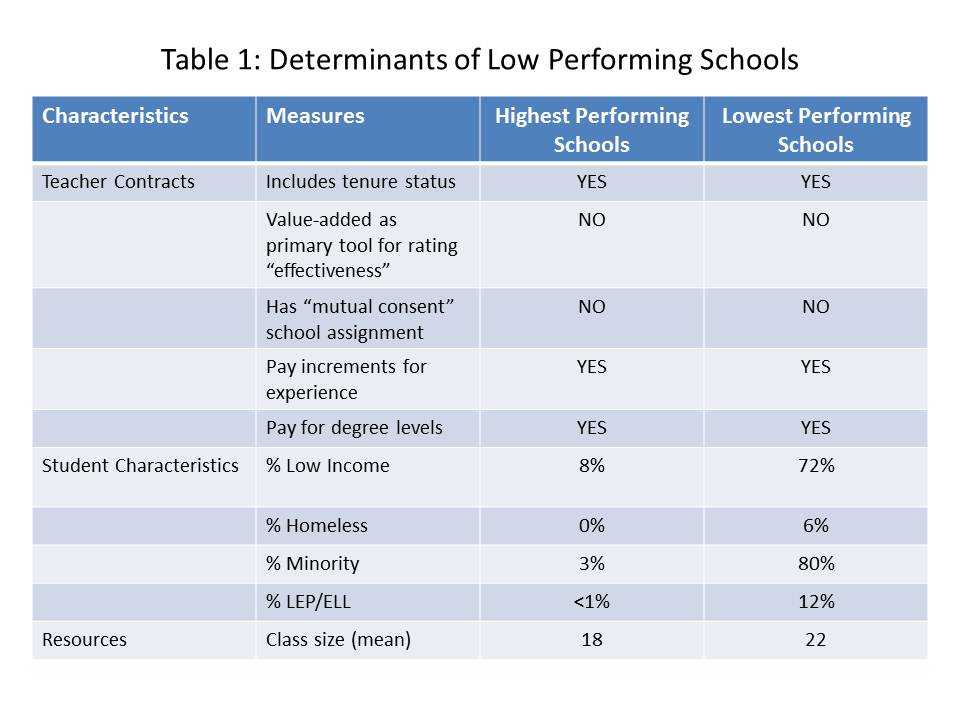
First, here’s a table from the widely distributed paper from a team of renowned authors at the Forum on Understanding Core Knowledge in EDucation.

As you can see, the study endeavors to identify the determinants of school failure, in part, to identify those specific policies that must be changed in order to eliminate failing schools from our society. Failing schools are, after all, an abomination.  The researchers ranked New Jersey schools from highest to lowest proficiency rates and took the top and bottom 10%. They then mined the content of the negotiated contractual agreements for each district, looking for key elements of those contracts for explanations for why some districts fail but others perform quite well (as good as Finland!). They also gathered basic demographic data on students, having been dinged by reviewer #3 (an outsider) on their proposal in which they had not included such data. The authors note, however, that including this data did not alter their original conclusions or policy implications.

Conclusion: The cause of some schools failing and others succeeding is clearly the absence of regular use of clear metrics for teacher evaluation and the absence of mutual consent school assignment policies. It is also likely that basing salaries on experience or degree level adds to the dysfunction of low performing schools.

Policy recommendation: Immediately implement a new teacher evaluation system based 50% on student assessment data. Prohibit the use of experience or degree level as a basis for compensation.

Reformy Study #2

In this next study, authors from the Belltower Institute for Technology Education and Modern Enterprise explore the scalability of a nationally recognized model for charter schooling. Specifically, the goal of the study is to determine whether the model, which has received accolades in major newspapers and on network television (Reformy Nation) over the past year, might be a useful model for replacing entire urban school systems.  Table 2 below shows the characteristics of one successful charter school (sufficient data unavailable on the 3 less successful charters in the same network) operating the model, and the characteristics of the urban host district of that charter school. Deliberations are under way in that district to grant the charter operators full control of all schools in the district. Data in the table focus specifically on children in Grades 6 to 8, the only grades served by the charter.

Clearly, the charter not only outperforms the host district schools in grade 6, but by an even larger margin in grade 8, which can only be interpreted (emphasis in original manuscript) as the charter school adding more value to students with each year that they stay (setting aside the possibility that large shares of those students who are nolonger in attendance by 8th grade may have been lower performers).

Again, original analyses included only student assessment scores, and no further information student population characteristics. Amazingly, the original proposal got dinged by the same reviewer #3 as the study above, but reviewers #1 and #2 found the proposal to represent the highest standards of reformy rigor.

The authors continue to maintain that this information is unimportant because the charter populations are necessarily representative of the host district because a lottery is used for admission to the charter. Nonetheless, the authors contend that the reported differences in student populations and cohort attrition are “trivial.”

Conclusion: Clearly, the charter school has proven that it is able to produce far better results than host district schools while serving the very same children (emphasis in original manuscript) as those served by host district schools, and by using its “no excuses” approach.  Further, children’s performance improves the longer they attend the charter school.

Policy recommendation:  Set in place a strategy to turn over all host district schools, across all grade levels to the charter operator.

Reformy Study #3

In the third and final paper, economists from the the Measuring Yearly Advancements in Social Science project released preliminary findings from a massive privately funded study on teacher effectiveness. Specifically, the study endeavors to determine the correlates of effective teaching, in order to guide public school district personnel policies – specifically hiring, retention and compensation decisions. The study involved 22,543 teachers (326 of whom had complete data on all observations) across 6 cities (4 of which failed to provide sufficient data in time for this preliminary release).  Using two years of data on students assigned to each teacher (using only the 4th grade math assessment data, because correlations on language arts assessments were too unreliable to report), the study investigated which factors are most highly related to a TRUE measure of teaching effectiveness – where true “effectiveness” was defined as the contribution of Teacher X, to achievement growth in 4th grade math on the STATE assessment for students S1 – Sy, linked to that teacher in the given year (Equation expressed in Appendix A, pages 69-74).  The same students were also given a second math assessment. School principals conducted observations 5 times during the year and filled out an extensive evaluation matrix based on teacher practices and student – teacher interactions. Students were also administered surveys, as were parents of those students, requesting extensive feedback regarding their perceptions of teacher quality. The correlations are shown in Table 3.

Conclusions & Implications: The strongest correlate of true teaching effectiveness was the estimate of teacher contribution to student achievement on the same test a year later. However, this correlation was only modest (.30). All other measures including effectiveness measures based on alternative tests and student, parent and administrator perceptions of teacher effectiveness were less correlated with the original value-added estimate, thus raising questions about the usefulness of any of these other measures. Because the value-added measure turns out to be the best predictor of itself in a subsequent year, this estimate alone trumps all others in terms of usefulness for making decisions regarding teacher retention (especially in times of staffing reduction) and should also be considered a primary factor in compensation decisions. Note that while it may appear that school administrators, students and their parents have highly consistent views regarding which teachers are more and less effective (note the higher correlations across administrator ratings of teachers, and student and parent ratings), we consider these findings unimportant because none of these perception-based ratings were as correlated with the original value-added estimate as the value-added estimate was with itself (which of course, is the TRUE measure of effectiveness).

School Funding Deception Alert! (in a CAN)

I’ve noticed a pattern in a few recent school funding proposals, mostly emanating from shoddy, haphazard proposals developed on behalf of the CANs (ConnCAN & its close relatives) and often with “technical support” of Bryan Hassel of Public Impact. Let’s call it school finance reform in a CAN.

These new simplified school funding formula proposals, framed under the “money follows the child” ideology are intended to make state school funding formulas more “transparent” and to allow for more equitable and predictable flow of funding to charter schools or other non-district schools.

In each proposal (ConnCAN’s Spend Smart & The Tab, or Rhode Island’s new formula [albeit laced with other problems unique to RI-see post]), among a variety of other major overlooked factors, arbitrary and unfounded recommendations, exists a seemingly innocuous proposal regarding how to target aid for variations in student needs across districts.

As the authors of ConnCan’s recent Spend Smart brief explain deeply embedded in a footnote… you really only need to use a single factor to get state aid targeted to the right schools and that factor is the share of children qualifying for FREE OR REDUCED PRICED LUNCH. There’s no need for a special factor for limited English proficient/English language learner populations, or anything else. It’s all pretty much correlated to free and reduced lunch. (Hassel’s previous report for ConnCan, The Tab, included a trivially small LEP/ELL weight instead of none at all).

First, this assumption is patently wrong to begin with and is never actually validated by the authors of these proposals. But let’s set that aside for the moment. I’ll have a future post where I use actual data to show just how freakin’ wrong the assumption is.

But why would they propose this anyway? Well, it turns out to be really simple. If a state has a fixed sum of money to distribute (generally how it works), the CAN game is to figure out on what basis might charter schools get the maximum share of that money – regardless of who really needs it most. That is, what measures CAN they choose for weightings which will drive money to charters. Charter schools do tend to operate in poorer communities (relative to state averages), but a) serve the less poor among the poor, b) serve few or no LEP/ELL children, and c) incidentally, also serve few or no children with disabilities (as has been addressed on my blog regarding NY and NJ charter schools, and will be addressed soon regarding CT charters – numbers already run, charts forthcoming).  I’ll set aside c) for now.

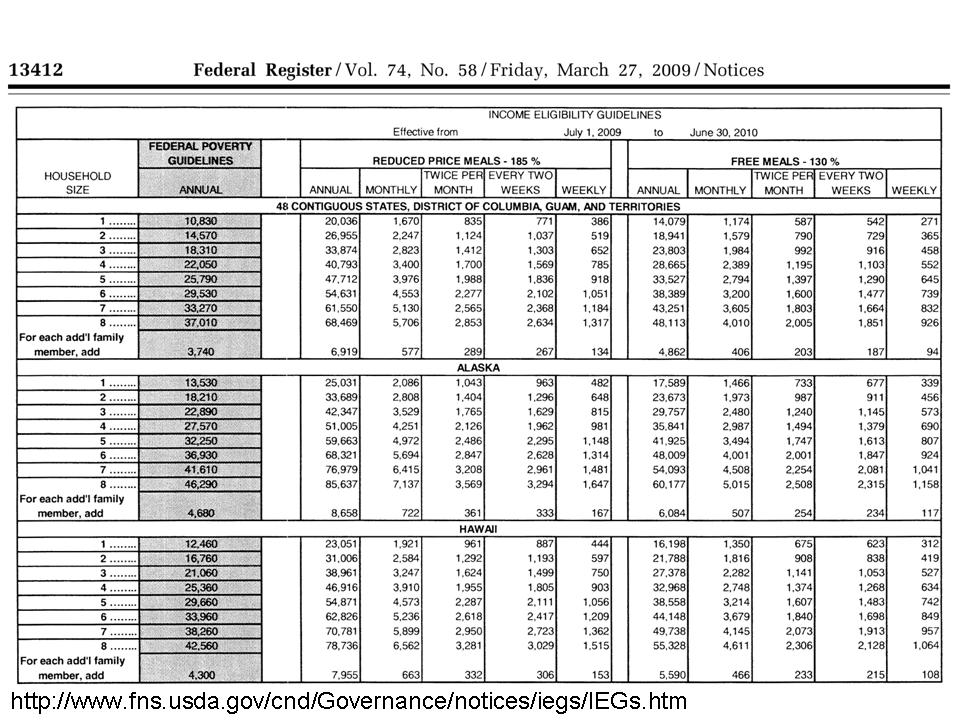
So, the way to maximize charter funding, is to give a single weight for children qualified for free OR REDUCED PRICE LUNCH, and to negate any weight for LEP/ELL children (or make it as small as possible). That way, charters will get the same weight for kids whose family income falls between the 130% poverty level and 185% poverty level as neighborhood schools get for children below the 130% poverty level (This distinction is NOT TRIVIAL), where neighborhood schools have far more of the lower-income children. Any money that would have gone to LEP/ELL children can be rolled into a bigger weight for free/reduced lunch children, channeling a larger share of the total funding available to charter schools.

While not specifically addressed in these proposals, one would imagine that the same pundits would also favor flat, lump sum, or census based funding for special education, not differentiated by disability type, such that every school or district gets a specific dollar amount for special education based on a fixed share of their enrollment – a) whether they serve any special education students at all, or b) whether they only serve mild specific learning disability students, and none more severe. Watch out for this one as well!

===

Note: I’m sure that many will respond to this post by arguing that charters get severely shortchanged on state aid anyway, and that even if they make out okay on these adjustments, the lack of funding for such things as capital outlay and facilities more than offsets the difference. That’s a topic for another day. But, suffice it to say, existing comparisons like those made in the recent Ball State/Public Impact (imagine that) study are grossly oversimplified (as I explain regarding NYC schools, here: http://nepc.colorado.edu/publication/NYC-charter-disparities (page 23)). For example, typical crude comparisons never address whether having few or no special education children (relative to averages for district schools) result in cost reductions (per pupil) that might actually be greater than facilities average annual expenses per pupil.

===

Follow up figure for those who asked:

Note that using only a weight on free or reduced lunch would drive the same amount of supplemental funding to Torrington as to Norwalk or Danbury, despite large differences in LEP/ELL populations. So too would any charter school that has comparable low income population to Danbury, Stamford or Norwalk, even if that school had no LEP/ELL children. There may be other valid differences that require additional attention. Even this graph is too crude to give us the full story. The bottom line is that one must at least evaluate the distributions of children by need categories across districts and settings before making such bold, but oversimplified policy recommendations.

Here’s Rhode Island:

The issue here is similar in that Central Falls in particular (imagine that) gets shafted by failure to independently address differences in ELL/LEP concentration. While RI has few districts, and has a specific cluster of high poverty districts, the rates of LEP/ELL children across those districts vary from 5% to 20%. But, as I’ve explained previously, the RI formula and logic behind it have numerous other empirical and logical gaps. see: https://schoolfinance101.wordpress.com/2010/07/01/the-gist-twists-rhode-island-school-finance/

Distilling Rhetoric & Research on NY State Education Spending

This is another one of those mundane school finance formula posts. This one is focused on media and political spin in New York State around the recently adopted state budget and proposed school aid cuts.

Yesterday, I had the displeasure of reading a New York Post piece in which New York Governor Cuomo and the Post were validating how and why the proposed budget cuts would not and should not compromise the quality of New York State public schools. But this article – both the Post explanations and especially the Governor’s spokespersons explanations present a massive distortion of how the proposed cuts actually affect different types of districts across New York State.

Let’s break it down:

Political Spin

Here’s the public appeal, political spin on why cutting state aid to schools in New York really causes no harm:

The state’s student population dropped to 2.7 million from 2.8 million — or 4.6 percent — during that period.

And during that same span, the number of rank-and-file teachers grew to 214,000 from 194,957 — a 9.8 percent increase.

As a result, overall public-school expenditures more than doubled, from $26 billion to $58 billion statewide.

And:

“The huge growth in school bureaucracy and overhead is disturbing, especially since many schools are threatening to fire teachers,” Cuomo spokesman Josh Vlasto said. “School districts clearly have more than enough to do more with less.”

Read more: http://www.nypost.com/p/news/local/supervisor_bloat_hikes_overhead_gnbt3xbRu6hnqPRqrCTZvO#ixzz1IkEkATFa

Very simple: New York State school districts have added a whole bunch of administrators they don’t need – administrators who are obscenely high paid, and really just a massive waste. That is, if we accept the numbers reported above. But I won’t go after those in this post, because the argument is flawed on so many other levels. I will say that it is a foolish stretch to argue that administrative bloat has caused a doubling of per pupil spending across New York school districts.

Essentially, the argument here is that since there is so much bloat and waste – REGARDLESS OF WHERE THAT BLOAT AND WASTE EXISTS, if we cut aid to districts, they can simply cut that bloat. Of course that logic doesn’t work so well if the proposal is to cut aid from districts which are not the ones with the reported bloat.

Academic Analysis on Relative Efficiency and State Aid in New York

It is indeed interesting that the NY Post and Governor’s office have chosen to focus on spending increases since 1997.  Spending in many New York school districts, teacher salaries and administrative salaries in many New York school districts did escalate over this period. But why? What’s going on there? In what districts and what parts of the state is spending increasing, and does state aid play any role in those increases? Perhaps most directly on the question above, are some of those increases in spending actually leading to inefficiency, and is there any component of state aid that might be encouraging inefficient spending in school districts? If that was the case, we’d probably want to look first at those state aid programs as a place to cut.

Here are some summaries of findings from studies on New York State’s STAR tax relief program, which provides a sizeable chunk of financial support in systematically larger amounts to affluent communities:

Eom:

We test this hypothesis by examining the introduction of New York State’s large state-subsidized property tax exemption program, which began in 1999. We find evidence that, all else constant, the exemptions have reduced efficiency in districts with larger exemptions, but the effects appear to diminish as taxpayers become accustomed to the exemptions.

http://bk21gspa.snu.ac.kr/datafile/downfile/%EC%97%84%ED%83%9C%ED%98%B8%28GSPA-SD%2907_1.6.8.pdf

Public Budgeting & Finance / Spring 2006

Eom & Killeen:

Similar to many property tax relief programs, New York State’s School Tax Relief (STAR) program has been shown to exacerbate school resource inequities across urban, suburban, and rural schools. STAR’s inherent conflict with the wealth equalization policies of New York State’s school finance system are highlighted in a manner that effectively penalizes large, urban school districts by not adjusting for factors likely to contribute to high property taxation. As a policy solution, this article presents results of a simulation that distributes property tax relief using an econometrically based cost index. The results substantially favor high-need urban and rural school districts.

http://eus.sagepub.com/content/40/1/36.full.pdf+html

Education and Urban Society November 2007

Rockoff:

I examine how a property tax relief program in New York State affected local educational spending. This program, which lowered the marginal cost of school expenditure to homeowners, had statistically and economically significant effects on local government behavior. A typical school district, which received 20% of its revenue through the program in the school year 2001- 2002, raised expenditure by 4.1% and local property taxes by 6.8% in response. I then examine how the preferences of various groups of local taxpayers affect educational spending by identifying systematic variation across districts in the response to fiscal incentives. These results support the hypothesis that homeowners are more influential on local expenditure decisions than renters, owners of second homes, or owners of non-residential property.

http://www0.gsb.columbia.edu/faculty/jrockoff/papers/local_response_draft_january_10.pdf

Recap of the Research

So, let’s recap. What do we know about NY state aid and the potential link to the supposed inefficiencies to which the NY Post article and governor’s spokesman refer:

  1. That STAR aid in particular is allocated disproportionately to more affluent downstate school districts;
  2. That STAR aid, by reducing the price to local homeowners of raising an additional dollar in taxes to their schools, encouraged increased local spending on schools;
  3. That when the relative efficiency of school districts is measured in terms of increases in measured test scores, given additional dollars spent, STAR aid appears to have encouraged less efficient spending. STAR aid enabled affluent suburban districts to spend on other things not directly associated with measured outcomes, but things those communities still desired for their schools.
  4. That STAR aid contributes to inequities across districts in a system that is already highly inequitable.

What’s happening now?

As I have shown here, in recent years, STAR aid continues to be allocated inequitably, benefitting systematically wealthier districts.

https://schoolfinance101.wordpress.com/2011/02/04/where%E2%80%99s-the-pork-mitigating-the-damage-of-state-aid-cuts/

https://schoolfinance101.com/wp-content/uploads/2011/02/figure3.jpg

Funding inequities persist across New York state districts, with affluent suburban districts far outspending their poorer urban neighbors.

See www.schoolfundingfairness.org

But, the proposed funding cuts are not targeted at the districts which are most likely contributing to “inefficient” spending growth (if it is really inefficient).

The state aid cuts are not targeted to the state aid which seems to be stimulating less efficient spending and exacerbating inequity.

Rather, the proposed state aid cuts fall disproportionately on general foundation formula aid for those districts which have already been left in the dust by their more affluent neighbors. https://schoolfinance101.wordpress.com/2011/02/04/where%E2%80%99s-the-pork-mitigating-the-damage-of-state-aid-cuts/

https://schoolfinance101.com/wp-content/uploads/2011/02/figure5.jpg

How does that make sense?

Quite honestly, the argument made in the Post, and by the governor’s spokesperson is really obnoxious and misguided, given the distribution of the planned cuts.

Analogy for the day

Let’s say we have a state aid program for personal transportation and we have some really rich communities and some really poor communities.

Let’s assume no mass transportation exists.

Let’s say we (the state) decide to give individuals in the poor communities $200 per month to help them purchase, insure and maintain a personal vehicle –  a freakin’ car… and pretty damn cheap car that is minimally functional and questionably reliable. The $200 per month is pretty much all they’ve got. They’ve got few or no personal resources to contribute to an upgrade, and pretty much live month to month on maintenance and insurance.

We use another pot of aid to give $100 per month to residents of the rich community, who’ve already gone out and purchased Bentleys and Ferraris, and mostly use that money for occasional detailing of their vehicles which they might otherwise forgo (perhaps not) or perhaps an enhanced satellite radio subscription they might not have otherwise chosen and one that includes channels the never really expect to use (typically, they would have gotten the most expensive subscription anyway. As the truly rich like to point out, no-one who’s truly rich would ever dare ask how much it costs to maintain a yacht).

All of the sudden, the state budget is tight and a new report from some think tank comes out showing that in the past 10 years, more and more NY residents are driving Ferraris and Bentleys and more and more of them get their cars detailed on a monthly basis and have the most expensive satellite radio subscription. It’s an abomination. Therefore, cutting aid certainly causes no harm.

So policymakers pass their first on-time budget in years, cutting 10% of that $200 per month that currently supports basic car purchases in the poor communities! They ignore entirely that the $100 per month to the rich communities even exists.

Of course, once we’ve cut that money and ignored the other, what we now have is a set of poor communities that is less able to insure and maintain their economy vehicles. And about those Ferraris and Bentleys? We haven’t even touched their detailing subsidy.

Public Impact’s Persistent Pattern of Shoddy Analysis

Alternative title: Why Hassel with research, data and facts?

I was called up on this past week to review a new policy brief on reforming Connecticut’s education funding system – or Education Cost Sharing formula. The brief, titled Spend Smart: Fix Connecticut’s Broken School Funding System seemed simple enough on its face, but as I looked deeper, ended up being among the most offensively shallow and poorly documented reports I have ever seen.

Further, some of elements of the report which were stated as fact, but entirely unsubstantiated would actually lead to funding policies that significantly disadvantage some of the state’s highest need children. Even worse, this brief was accompanied by submitted legislation that included these ill-conceived policies.

But this post is only partly about this new brief produced by ConnCan, with an eclectic mix of authors put forth in reformy manifesto style. Nearly every attempt to ground “facts” in the brief was tied to previous ConnCan briefs, which themselves included little or no substantiation.

The common denominator in this brief and those on which it relies, as well as the accompanying legislation, appears to be Bryan Hassel of Public Impact. Hassel has also played a role on previous haphazard manifesto-like school funding reports including Fund the Child. Bryan Hassel has also been mentioned as the outside expert to advocate on behalf of ConnCan for school funding reform in Connectictut, including testifying in favor of the proposed legislation. See: http://blog.ctnews.com/kantrowitz/2009/12/03/1208/, or the ConnCan tweet:

Brian Hassel, co-dir. Public Impact: SB 1195 would “catapult Connecticut into a national model for schools” #edreform #getsmartct

http://twitter.com/#!/conncan/status/51061576467361792

Tangentially, Bryan Hassel and Public Impact were also involved in the production of the deeply problematic analysis of charter school funding disparities released last year, which I critique in part, in my recent work on New York City charter schools.

There comes a point where I encounter enough different reports linked to single organization and author, where those reports are so shockingly bad that I simply can’t hold back anymore.

The following three examples, all connected back to Public Impact and Bryan Hassel, provide evidence of the utter methodological incompetence of this organization and their/his complete disregard for a) existing rigorous research, b) legitimate analytical methods and data, and perhaps most disturbingly, c) significant adverse consequences of performing shoddy analysis and making bold but haphazard policy recommendations.

Below are three of my related critiques of policy “research” (used as loosely as I can imagine) with ties to Public Impact and Bryan Hassel. I offer these critiques in particular to any policy makers who might believe it reasonable to rely on this junk, or the organization that produces it.

Example 1: Public Impact and ConnCan’s Funding Reform Proposals

http://nepc.colorado.edu/files/TTR-ConnCan-Baker-FINAL.pdf

Here are just a few examples from my review of Spend Smart. The Spend Smart brief essentially argues that the Connecticut finance system is broken (it may well be, and I think it is), and that it should be fixed with a simple school funding formula with a single weight on children qualified for free or reduced price lunch.

This particular brief stated a number of supposed “facts” about the status of the current system, few or none of which could be substantiated with information provided, and some which were clearly unchecked and simply wrong, with significant consequences.

Here are some quoted claims from the brief and a tracing of the factual basis for those claims:

Claim 2: “Moreover, our current system was designed to direct 33 percent more dollars to students in towns with high poverty, but actually provides only 11.5 percent more funding for these students.” (Page 2)

Claim 2 posits that the current ECS formula leads to an average of 11.5% additional funding per low-income child across Connecticut school districts. That claim is cited to a previous ConnCan report, The Tab, authored by Bryan Hassel of Public Impact (specifically Page 18 of The Tab). Page 18 of The Tab cites this claim in Footnote 18 as “Authors’ analysis using 2007-08 data from the State Department of Education.  See Appendix for Details.” However, the appendix of the report provides no such justification and no further reference to the 11.5 figure. Rather the appendix provides only listings of data sources supposedly used and no explanation of how those sources might have been used.[i]

Claim 5: “For example, students at Connecticut’s charter schools are funded at only 75 cents on the dollar compared with traditional public schools.” (page 3)

Claim 5 is perhaps most perplexing, and like Claim 1, an example of the evidentiary black hole. The claim that Connecticut charter schools receive, on average, about 75% of state average funding is cited to a previous ConnCan report [not a Hassel/Public Impact product] titled Connecticut’s Charter School Law and Race to the Top. [ii] This ConnCan report was previously reviewed by Robert Bifulco for NEPC, who explained:[iii]

“The brief provides no indication of how it was determined that charter schools end up with only 75% of per-pupil funding that districts receive, or how, if at all, this comparison accounts for in-kind services or differences in service responsibilities.” [p. 3, Bifulco Critique]

And finally, for now:

Claim 6:“The formula could also hypothetically provide weights for other student needs, such as English Language Learner status. However, data shared by Connecticut State Department of Education with the State’s Ad Hoc Committee to Study Education Cost Sharing and School Choice show that the measure for free/reduced price lunch also captures most English language learners. In other words, there is a very strong correlation between English language learner concentration and poverty concentration in Connecticut. In addition, keeping the formula simple allows a more generous weight for students in poverty.” (p. 7, FN 12)

Claim 6 is particularly disconcerting, both because it includes a statistical finding which is never validated and because it is used to inform a policy solution which would produce substantial inequities harmful to a specific student population – children with limited English language skills. The authors claim outright that there is no need for additional adjustment for districts serving large shares of limited English proficient children because:

“there is a very strong correlation between English language learner concentration and poverty concentration in Connecticut.” (p. 7, FN 12)

This finding is cited only ambiguously in a footnote to data shared by CTDOE.  In some states, a strong relationship between the two measures might warrant collapsing supplemental aid for LEP and low-income children into one student need factor – with sufficient additional support to meet the combination and concentration of needs. However, a quick check of the data in Connecticut shown in Figure 1 (below) reveals that several districts have disproportionately high LEP concentrations relative to their low-income concentrations – specifically Norwalk, Danbury, New London, Windham and New Britain. These districts would be substantially disadvantaged by a formula with no additional weighting for LEP children, coupled with an arbitrary, small weighting for low-income status. In fact, the proposal to include only a relatively small weight for free or reduced price lunch and ignore the concentrated needs of these districts is most likely a back-door way to reduce the overall cost of the formula, and limit the extent that the formula truly redistributes funding where it is needed.

Figure 1

Relationship between Subsidized Lunch Rates and ELL Concentrations 2009


Data source: CTDOE 2009, Student need (free or reduced lunch: http://sdeportal.ct.gov/Cedar/WEB/ct_report/StudentNeedDT.aspx) and LEP data files (http://sdeportal.ct.gov/Cedar/WEB/ct_report/EllDT.aspx)

Note: From 2005 to 2009, the r-squared for this relationship ranges from .25 to .62, and is generally around .5.

The bottom line – The authors clearly never checked. The authors clearly don’t know what they are talking about, even at the most basic level. Yet they are willing – all who signed on to this brief, including Hassel, Hawley-Miles and Paul Hill – to go out on a limb and make these proclamations – proclamations and policy proposals which are simply bad, wrong, misguided – and irresponsible.

Example #2: Public Impact ConnCan’s The Tab

Much of the content of the Spend Smart brief seems to be grounded in, and some of it directly cited to, the previous ConnCan finance report titled The Tab, on which Bryan Hassel was listed as lead author.

I have written previously about The Tab, which is of equal quality to Spend Smart. Here’s a copy and paste of my previous post on The Tab.

https://schoolfinance101.wordpress.com/2009/11/23/why-is-it-ok-for-think-tanks-to-just-make-stuff-up/

==========Original Blog Post

This topic comes to mind today because ConnCan has just released a report (http://www.conncan.org/matriarch/documents/TheTab.pdf)    on how to fix Connecticut school funding which provides classic examples of just makin’ stuff up (page 25). The report begins with a few random charts and graphs showing the differences in funding between wealthy and poor Connecticut school districts and their state and local shares of funding. These analyses, while reasonably descriptive are relatively meaningless because they are not anchored to any well conceived or articulated explanation of “what should be.” Such a conception might be located here or even here (Chapters 13, 14 & 15 are particularly on target)!

The height of making stuff up in the report is the recommended policy solution to the problem which is never clearly articulated. There are problems in CT, but The Tab, certainly doesn’t identify them!

The supposed ideal policy solution involves a pupil-based funding formula where each pupil should receive at least $11,000 per pupil (made up), and each child in poverty (no definition provided – just a few random ideas in a footnote) should receive an additional $3,000 per pupil (also made up) and each child with limited English language proficiency should receive an additional $400 per pupil (yep… totally made up). There is minimal attempt in the report (http://www.conncan.org/matriarch/documents/TheTab.pdf) to explain why these figures are reasonable. They’re simply made up.

The authors do provide some back-of-the-napkin explanations for the numbers they made up – based on those numbers being larger than the amounts typically allocated (not necessarily true). They write off the possibility that better numbers might be derived by way of a general footnote reference to a chapter in the Handbook of Research on Education Finance and Policy by Bill Duncombe and John Yinger which actually explains methods for deriving such estimates.

The authors of The Tab conclude: “Combined with federal funding that flows on the basis of poverty and (in some cases) the English Language Learner weight of an additional $400, the $3,000 poverty weight would enable districts and schools to devote considerable resources to meeting the needs of disadvantaged students.” I’m glad they are so confident in their “made up” numbers! I, however, am less so!

It would be one thing if there was no conceptual or methodological basis for figuring out which children require more resources or how much more they might actually need. Then, I guess, you might have to make stuff up. Even then, it might be reasonable to make at least some thoughtful attempt to explain why you made up the numbers you… well… made up. But alas, such thinking seems beyond the grasp of at least some “think tanks.” Guess what? There actually are some pretty good articles out there which attempt to distill additional costs associated with specific poverty measures… like this one, by Bill Duncombe and John Yinger: How much more does a disadvantaged student cost?

It’s not like the title of this article somehow conceals its contents, does it? Nor is the journal in which it was published (Economics of Education Review) somehow tangential to the point at hand. This paper, prepared for the National Research Council provides some additional insights into additional costs associated with poverty and methods for estimating those costs.

Rather than even attempt to argue that these figures are somehow founded in something, the authors of The Tab seem to push the point that it really doesn’t matter what these numbers are as long as the state allocates pupil-based funding.  That’s the fix! That’s what matters… not how much funding or whether the right kids get the right amounts. In fact, the reverse is true. The potential effectiveness, equity and adequacy of any decentralized weighted funding system is highly contingent upon driving appropriate levels of funding and funding differentials across schools and districts!

Example #3: Public Impact Charter Disparity Analysis

Finally, there’s the report done by Public Impact with Ball State University on charter school funding disparities, which remains fresh in my mind because it keeps coming back up again and again. And it is because of the connection between the shoddy methods of that report, and the absurdly shoddy analysis in The Tab and Spend Smart, that this post is focuses on Bryan Hassel and Public Impact.

When digging deeper on financial differences among charter and non-charter schools in New York City, and looking at what the Public Impact/Ball State study had said about New York charter schools, my coauthor and I were shocked at how poorly the Public Impact/Ball State study had been conducted. Here’s a short section of our critique:

From: Baker, B.D. & Ferris, R. (2011). Adding Up the Spending: Fiscal Disparities and Philanthropy among New York City Charter Schools. Boulder, CO: National Education Policy Center. Retrieved [date] from http://nepc.colorado.edu/publication/NYC-charter-disparities.

This section returns to the issue of disparities in funding between non-charter and charter schools. As already noted, the Ball State/Public Impact study identified New York State as having large financial disparities between traditional public schools and charter schools. In contrast, the NYC independent budget office concluded that charters with department of education facilities had only negligibly fewer resources than non-charter public schools. One of these accounts is incorrect.

Ball State/Public Impact study claims that NYC traditional public school per-pupil expenditures were $20,021 in 2006-07, and that charter school expenditures were $13,468, for a 32.7% difference.[iv] However, the first figure appears to be inflated; the only figure that closely resembles $20,021 is the total expenditure, including capital outlay expense. This amounts to 19,198,[v] according to the 2006-07 NCES fiscal survey.[vi] This amount includes spending that is clearly not for traditional public schools—it includes not only transportation and textbooks allocated to charter schools, but also the city expenditures on buildings used by some charter schools.[vii] In essence, this approach attributes spending on charters to the publics they are being compared with—clearly a problematic measurement.

After offering these figures and the crude comparisons, the Ball State/Public Impact study argues that the purportedly severe funding differential is not explained by differences in need, because on average 43.5% of the students in public schools in New York State qualify for free or reduced-price lunch, while on average 73.3% of those in charter schools in New York State do. But, as was demonstrated earlier, there are three problems: (a) the focus on state rates, rather than NYC rates; (b) the inclusion of reduced-price lunch rates rather than just free-lunch rates as a measure of poverty (when focused on comparisons within NYC); and (c) the failure to compare only schools serving the same grade-levels. When these details are addressed, a different picture emerges. At the elementary level in NYC, for example, charter school free lunch rates were 57% and non-charter public school rates were 68%.

The NYC IBO report offers figures that are more in line with the data. For 2008-09, traditional public schools are found to have expenditures of $16,678, while charters that are provided with facilities are at nearly the same level ($16,373). Public expenditures on charters not provided facilities are found to be about $2,700 per pupil lower ($13,661). But even this comparison is not necessarily the most precise or accurate that might be made, because it does not attempt to compare schools that are (a) similar in grade level and grade range and (b) similar in student needs. The IBO analysis provides a useful, albeit limited, comparison of charter schools in their aggregate to district schools in their aggregate. Importantly, the IBO charter school funding figures do not include funds raised through private giving to schools or monies provided by their management organizations.

Once the cost differences associated with student populations are factored in, the IBO analysis changes significantly. In fact, the cost associated with student population differences is the same as the per-pupil cost associated with lack of a facility: $2,500. After adding the $2,500 low-need-population adjustment to charters, those not in BOE facilities can be seen to have funding nearly equal to that of non-charters ($16,171 vs $16,678) while those in BOE facilities have significantly more funding than non-charters (see Table 3).[viii]

One might try to argue that these problems we identify with the NY estimates, which render them entirely meaningless, are specific to New York, but that the rest of the states are reasonably estimated. The reality is that when it comes to estimating these types of funding differentials, each state and each local district, depending on the charter funding formula has its own peculiarities. If the crude method used by Hassel and colleagues completely missed the boat on New York, it is highly likely that comparable problems exist across many other settings. Without further, more detailed an appropriate analysis it would be unwise to base any conclusions on the existing Ball State/Public Impact study.


[i] In the recent report Is School Funding Fair, 2007-08 update (http://www.schoolfundingfairness.org/SFF_2008_Update.pdf) , Baker, Farrie and Sciarra show that the differential between very high and very low poverty districts in Connecticut is about 15% (Table 1), however, it is important to understand that in Connecticut, these patterns are not systematic. Rather, as I show in Figure A3 of the appendix herein, there exist substantial irregularities in current spending per pupil with respect to poverty. Among high need districts in particular, funding levels vary widely. Arguably, in this regard the system is indeed broken. But the ConnCan reports fail to provide any legitimate evidence to this effect.

[ii] http://www.conncan.org/sites/default/files/research/CTCharterLaw-RTTT2010-Web-2.pdf.  Interestingly, the authors of the current brief, including Bryan Hassel, choose not to anchor this conclusion to other recent work co-authored by Hassel, which describes funding disparities between host districts – New Haven and Bridgeport – and charters in those cities as “severe.” However, Baker and Ferris (2011) explain substantial methodological flaws in the characterization of charter funding gaps by Hassel and colleagues, pertaining to their analysis of New York State and New York City charter schools. There is little reason to believe that Hassel and colleagues analyses of Connecticut are any more valid than those for New York. For the state and district summaries of charter disparities, see: Batdorff, M., Maloney, L., May, J., Doyle, D., & Hassel, B. (2010). Charter School Funding: Inequity Persists. Muncie, IN: Ball State University. see: p. 10-11,Table 5. For a thorough critique of Hassel and colleagues mis-steps in this report when characterizing charter disparities in New York, see: Baker, B.D. & Ferris, R. (2011). Adding Up the Spending: Fiscal Disparities and Philanthropy among New York City Charter Schools. Boulder, CO: National Education Policy Center. Retrieved [date] from http://nepc.colorado.edu/publication/NYC-charter-disparities.

[iii] Bifulco, R. (2010). Review of “Connecticut’s Charter School Law & Race to the Top!” Boulder and Tempe: Education and the Public Interest Center & Education Policy Re-search Unit. Retrieved [date] from  http://nepc.colorado.edu/files/TTR-ConnCan-Bifulco.pdf

[iv] See: Batdorff, M., Maloney, L., May, J., Doyle, D., & Hassel, B. (2010). Charter School Funding: Inequity Persists. Muncie, IN: Ball State University, bottom of Table 5

[v] Depending on how one chooses to calculate this figure, the range is from 19,199 to about 20,162. The reported total expenditures for the district are $20,144,661,000 and enrollment figures range from 999,150 (as reported in the fiscal survey) to 1,049,273 (implied enrollment from current expenditure per pupil calculation in fiscal survey).

[vi] From the Census Bureau’s Fiscal Survey of Local Governments, Elementary and Secondary Education, F-33.  http://www.census.gov/govs/www/school.html

[vii] The New York State Education Department reports several versions of expenditure figures. Total expenditures per pupil for NYC in 2007-08 were $18,977—much lower than the total reported by Batdorf and colleagues. But the IBO correctly points out some expenses would be appropriately excluded from this number. For instance, the NYC Department of Education provides facilities for about half the city’s charter schools as well as many other forms of support for some charter schools, including authorizer services, food service, transportation services, textbooks, and management services:

Pass-through Support for Charter Schools. Charter schools are eligible to receive goods such as textbooks and software, as well as services such as special education evaluations, health services, and student transportation, if needed and requested from the district. In NYC there is a long-established process for non-public schools to access these services, and charter schools have access to similar support from DOE. For these items, charter schools receive the goods or services rather than dollars to pay for them. Most of these non-cash allocations are managed centrally through DOE.

IBO report, 2010: Retrieved December 13, 2010, from
http://schools.nyc.gov/community/planning/charters/ResourcesforSchools/default.htm.

It is simply wrong to compare the city aggregate spending per pupil to the school-site allotment for charters, as was done by Batdorf and colleagues (who also use the most inflated available figure for the city aggregate spending). In 2007-08 (a year earlier than the IBO comparison figure, but likely a reasonable substitute), NYSED estimates for the instructional/operating expenditures per pupil in NYC were $15,065 (this uses the instructional expenditure share, including expenditures on employee benefits [IE2%, Col. AP] times the total expenditures.  Retrieved December 13, 2010, from http://www.oms.nysed.gov/faru/Profiles/datacolumns1.htm). This figure may be far more relevant than that chosen by Batdorf and colleagues, but is still potentially problematic.

[viii] Again, we are unable to adjust precisely for differences in special education populations, due to lack of sufficiently detailed data.

School Funding Myths & Stepping Outside the “New Normal”

I’ve been writing quite a bit lately about rather complex state school finance formula issues. That is much the point of this blog.  But it may be hard for some to see how my recent posts on school finance relate back to the broader reform agenda, and to understand the implications of these posts for state policies. Let me try to summarize these posts – posts on spending bubbles, the “New Normal” and school finance PORK.  My overarching goal in these posts is to explain that much of the reformy rhetoric about budget cuts and the “New Normal” is based on myth about how school funding works and what we should be doing in these catastrophic economic times.

Here are the myths and some of the realities.

Reformy myth #1: That every state has done its part and more, to pour money into high need, especially poor urban districts. It hasn’t worked, mainly because teachers are lazy and overpaid and not judged on effectiveness, measured by value-added scores. So, now is the time to slash the budgets of those high need districts, where all of the state aid is flowing, and fire the worst teachers. And, it will only help, not hurt.

Reality: Only a handful of states have actually targeted substantial additional resources to high need districts. See www.schoolfundingfairness.org. And the effort of states to finance their elementary and secondary education systems varies widely. Some states have in fact systematically reduced their effort to finance local public schools for decades. That is, the tax burden to finance public schools in some states is much lower now than it was decades ago. Very few states apply much higher effort than in the past.  See: https://schoolfinance101.wordpress.com/2010/12/23/is-it-the-new-normal-or-the-new-stupid/

Reformy myth #2: The only aid to be cut, the aid that should be cut, and the aid that must be cut in the name of the public good, is aid to high need, large urban districts in particular. The argument appears to be that handing down state aid cuts as a flat percent of state aid is the definition of “shared sacrifice.” And the garbage analysis of district Return on Investment by the Center for American Progress, of course, validates that high need urban districts tend to be least efficient anyway. Therefore, levying the largest cuts on those districts is entirely appropriate.

Reality: As I have discussed in my series of recent posts, if there are going to be cuts – if states really believe that cuts to state aid are absolutely necessary, many state aid formulas include aid that is more appropriate to cut. That is, aid to districts who really don’t need that aid. Aid to districts that can already spend well above all others with less local effort. Aid to districts that will readily replace their losses in state aid with additional local revenues (or even private contributions). That’s the pork, and that’s where cuts, if necessary, should occur.

Reformy myth #3: The general public is fed up and don’t want to waste any more of their hard earned tax dollars on public schools. They are fed up with greedy teachers with gold plated benefits and fed up with high paid administrators. They don’t care about small class sizes and…well… are just fed up with all of this taxing and spending on public schools that stink. As a result, the only answer is to cut that spending and simultaneously make schools better.

Reality: The reality is that local voters in a multitude of surveys rate their own local public schools quite highly and that local voters when given the opportunity, even during the recent economic downturn, show very high rates of support for school budgets – including budgets with significant increased property taxes (the most hated tax). As I noted in a previous post, when New Jersey handed down state aid cuts to 2010-2011 school budgets and when- for the first time in a long time- the majority of local district budgets statewide failed to achieve approval from local voters, it was still the case that the vast majority (72%) of local budgets passed in affluent communities – in most cases raising sufficient local property tax resources to cover the state aid cuts. In another case, local residents in an affluent suburban community raised privately $420,000 to save full day kindergarten programs. Meghan Murphy’s analysis of Hudson Valley school districts shows that New York State districts also have attempted to counterbalance state aid cuts with property tax increases, but that the districts have widely varied capacity to pull this off.  Parents in a Kansas district are suing in federal court requesting injunctive relief to allow them to raise their taxes for their schools (they use faulty logic and legal arguments, but their desire for better schools should be acknowledged!).

Reformy myth #4: None of this school funding stuff matters anyway. It doesn’t matter what the overall level of funding is and it doesn’t matter how that funding is distributed. As evidence of this truthiness, reformers point to 30+ years of huge spending growth coupled with massive class size reduction and they argue… flat NAEP scores, low international performance and flat SAT scores. Therefore, if we simply cut funding back to 1980 levels (adjusted only for the CPI) and fire bad teachers, we can achieve the same level of outcomes for one heck of a lot less money.

Reality: First of all, these comparisons of spending now to spending then are bogus. I address the various factors that influence the changing costs of achieving desired educational outcomes in this post: https://schoolfinance101.wordpress.com/2011/01/12/understanding-education-costs-versus-inflation/. Second, rigorous peer reviewed studies do show that state school finance reforms matter. Shifting the level of funding can improve the quality of teacher workforce and ultimately the level of student outcomes and shifting the distribution of resources can shift the distribution of outcomes. http://www.tcrecord.org/content.asp?contentid=16106 Similarly, constraining education spending growth over the long term can significantly harm the quality of public schools. See: https://schoolfinance101.wordpress.com/2010/04/22/a-few-quick-notes-on-tax-and-expenditure-limits-tels/

An opportunity for states?

I would argue that now… right now… represents a real opportunity for those states who actually want to step up, and really invest in the quality of their education systems and use the quality of their education systems to drive their economic futures.

I stumbled across this article http://www.foxnews.com/us/2011/02/13/states-offer-tax-breaks-guarantee-jobs/ on the Fox News website the other day, and it presents some useful insights for state policy makers regarding tax policy decisions and economic growth. I’ve written about the same point very early in my blogging (that the Small Business Survival Index in particular, misses some big points about location selection). Here’s a short section of the Fox News piece:

But there’s a catch to the anti-tax, pro-business rhetoric: Businesses consider a range of factors when deciding where to locate, including the quality of schools, roads and programs that rely on a certain level of public spending and regulation. And evidence suggests there is little correlation between a state’s tax rate and its overall economic health.

“Concerns about taxes are overstated,” said Matt Murray, a professor of economics at the University of Tennessee who studies state finance. “Labor costs, K-12 education and infrastructure availability are all part of a good business climate. And you can’t have those without some degree of taxation.”

States’ tax rates also do not predict their resilience during an economic downturn.

Arguably, no time is better than now. Other states are jumping on board with the “New Normal” reformy logic that slashing education budgets, increasing class sizes and narrowing curriculum around tested content areas is the only way to go. Yet, educated parents invariably want small class sizes (often topping the list of preferences for private or public schools) and want their children to have intellectually stimulating and broad, enriched curriculum. The current environment presents a great opportunity for some states to step outside the “New Normal” and truly race to the top with real investment in their public schooling systems.

Pork Hunting 101: Shredding the Pork

I love a good pulled pork sandwich. In fact, it’s one of my favorite foods. And the best damn pork sandwich I can think of is the Hog Heaven at Oklahoma Joe’s in the side of a freakin’ gas station in Kansas City, Kansas. I expect that this statement will perhaps be the most controversial statement I’ve made on this blog thus far.  Really… it’s awesome… and one of the few things I really miss about being in Kansas City.

That aside, I’ve been blogging lately about a different kind of PORK – school finance pork.  I started this pork campaign with a posting on state aid in New York after the announcement of Governor Cuomo’s proposed budget and education cuts. Despite large amounts of aid still being allocated to some of the wealthiest school districts in the nation, the good democratic Governor of New York decided it was somehow most appropriate to largely protect that aid, and instead slam the highest need, large urban, mid-sized city and poor rural districts in the state.

This post provides a primer on finding pork in state school finance formulas. It’s a two part process that begins with screening for pork, and then involves more intensive investigative research.

What is School Finance Pork? School finance pork is state aid that is currently being allocated to districts that otherwise don’t really need that aid. In this case, need is defined in terms of the needs of the students to be served AND in terms of the ability of the local public school districts and its residents and property owners to pay the cost of those services. In overly simple terms, some local public school districts can easily pay for the full cost of their needed educational programs and services on their own and with much less effort (tax effort) than others. Allocating state aid to these districts while depriving others with greater student needs and the inability to meet those needs is inexcusable. Cutting aid to needier communities who are unable to replace those lost revenues, while retaining aid to the wealthy is inexcusable. That’s PORK. And like other political pork-barrel spending, it exists because state legislators negotiate for state aid formulas that bring something home to their own districts.

How do legislators generate PORK? Pork can be generated by at least two different approaches. In the first approach, legislators actually try to manipulate the general state aid formula to find ways to argue that it’s actually more expensive to educate kids in wealthier communities, or alternatively that its cheaper to educate kids in poor communities. If legislators can raise the foundation funding targets to wealthy communities they can increase the likelihood that they can drive state support to those districts. Seems a bit of a stretch, but it’s been done by many. A second “within the formula” approach to generating pork is to adopt “minimum state aid” and/or hold harmless aid provisions that guarantee that no matter how wealthy a district is, that the state will still pick up X% of its formula funding. That is, the state will cover X% even if the district can raise double what it needs with very little tax effort. Another type of pork is Outside the Formula pork. It can be tricky (though not impossible) for legislators to sufficiently manipulate a state aid formula to provide more aid to wealthier districts. It’s relatively easy for state legislators to adopt outside the formula aid programs that allocate aid in very different ways – like flat allocations per pupil across all districts, regardless of local wealth, or even like New York’s property tax relief targeted to wealthier communities.

How do we screen for Pork? Here, I provide a few examples of screening for pork, using a national data set – the U.S. Census Bureau’s Fiscal Survey of Local Governments. As we stated in our Is School Funding Fair? A bare minimum goal of a state school finance formula would be to achieve a FLAT relationship between poverty and state and local revenue per pupil. Ideally, state school finance formulas would result in additional resources targeted to higher poverty districts – that is – systematically higher state and local revenue per pupil in higher poverty districts. One can take and state’s school finance data – here from 2007-08 – and make a graph of the a) local revenue per pupil, b) state aid per pupil and c) total revenue per pupil across districts by poverty. Here’s Texas:

I’ve dropped very small districts because they tend to scatter the pattern for a variety of legitimate cost related reasons.  Blue circles represent the state and local revenue per pupil, which on average in Texas has a slight downward slope. Red triangles are the local revenue. Clearly, the lower poverty districts are raising quite a bit in local revenue but the higher poverty districts aren’t raising much. On average the state aid in green squares is being allocated in inverse proportion to the local revenue… but not that aggresively. For example, if we look way to the upper left…. we’ve got some red triangles – local revenue per pupil – above $10,000 per pupil. That is, some of these very low poverty districts are able to raise on their own, over $10k per pupil. But look at the trajectory of the state aid allotments – those districts are still getting a significant amount of state aid – enough to still raise their totals even higher as pointed out by yellow arrows. Would it not make more sense for this aid to be allocated to the districts at the far right hand side of the picture? Amazingly, the state aid distribution slope in Texas is quite gradual – to be kind. It would appear to include significant “flat” distributions of either or both minimum aid and/or outside the formula aid which goes to lower poverty and/or higher wealth districts the expense of higher need, lower wealth districts. THAT’s PORK!

Here’s New York, when using the same data set:

And here’s Pennsylvania:

In Pennsylvania, minimum aid provisions and flat distribution of Special Education aid are partly to blame.

And here’s Illinois:

Illinois also has minimum aid provisions in the form of alternative formulas for districts otherwise too wealthy to receive aid through the primary foundation formula. And Illinois allocates numerous categorical aids outside the formula in ways that reinforce the aggregate disparities.

So, here are four states and in each one, total state and local revenue per pupil is slightly to significantly lower per pupil in higher poverty than in lower poverty districts. And in each state, the state aid is distributed in ways that guarantee the provision of at least some – sometimes significant – aid per pupil to districts that on their own are raising and spending significantly more money per pupil than their much higher need counterparts.

How do we identify the source of the Pork? This part is a bit harder, and requires much more detailed investigation of the state school finance formulas and of the “runs” of state aid programs. I hope to get a chance to provide more information on pork finding at a later point. But for those interested in exploring these issues on their own, there are two sources of information that are critical to the search – a) the documentation that  explains the calculations behind the allocation of state aid and b) much more importantly, what are called the “runs” of state aid allocations to local public school districts that are used by legislators to negotiate changes to the aid formula and/or the distribution of cuts. It’s that time of year – legislative session season. And legislators are interested to see which pieces of the aid formula will bring home pork, or how cuts will affect their districts. If you’re as warped as I am about this stuff… and actually really like digging through these numbers… contact your state legislators and find out who to get in touch with in order to get an electronic spreadsheet run of the various district by district state aid allocations. And be sure to get other basic district data, including wealth measures (property wealth and income) and enrollment characteristics (Total enrollments and student needs).  Play around with graphs of aid (divided by pupils – per pupil aid) with respect to wealth and need measures – and look for those aid programs in particular that appear to allocate systematically more aid to districts that are otherwise less needy. Feel free to e-mail me spreadsheets of those runs. If I get a chance, I’ll see what pork I can find!

Cheers.

And here’s to Pork!

Disparate thinking: The administration’s blind eye & racially disparate impact

Apparently the U.S. Department of Education has decided to take on public education policies that not only are intentionally racially discriminatory, but also state and local policies that happen to have a racially disparate impact on certain populations. Now, these are departmental regulations, not statutes and not a constitutional protection, so this doesn’t mean that advocates can start filing lawsuits on behalf of groups disparately affected by education policies (except where other state laws prohibiting disparate impact exist, like Illinois). But, it does mean that the U.S. Department of Education can use its biggest available threat – denial of funding – to pressure state and local education agencies to change policies that result in racially disparate impact.

Statistically, what disparate impact means is that the policy in question results in a disproportionate effect on one group of individuals versus another, where “groups” are defined by race, ethnicity or national origin. There are many occurrences in public education where racially disparate impact rears its ugly head. For example, racially disparate classification rates of children with disabilities, or racially disparate rates of disciplinary action. Identifying appropriate policy changes to reduce racially disparate impact in any of these areas, while not compromising other interests is indeed important – such as making sure that kids with legitimate special education needs still get identified and served, or making sure appropriate discipline is handed out where necessary.

The administration’s renewed interest in racially disparate impact was announced almost a year ago, and has apparently crept back into the conversation in the past few weeks.

Here’s the Education Week synopsis:

At the Feb. 11 briefing, Ricardo Soto, the deputy assistant secretary for the Education Department’s office for civil rights, elaborated on the office’s new policy, saying that the Obama administration is “using all the tools at our disposal,” including “disparate-impact theory,” to ensure that schools are fairly meting out discipline to students. Some research shows, for instance, that suspension rates for African-American males in middle school can be nearly three times as high as those for their white, male peers.

So, the interest here is specifically the racially disparate distribution of disciplinary actions. That’s all well and good. We should explore these issues and resolve them appropriately if we can. Once again, the usual target is local public school districts because when it comes to any of today’s education policy issues – in the eyes of the current administration and their closest advisers – only local public districts and local administrators can be to blame (even when it comes to funding disparities?).

But, as my readers know, this a school finance blog, and that means that eventually this topic is coming back around to school finance (okay, not always). Could it possibly be that some states actually continue to operate state school finance formulas that produce “racially disparate” effects? That is, that districts serving larger shares of minority children have systematically (statistically) less state and local revenue (the revenue under control of state policy) than districts with fewer minority children? And if so, which states might those be?

Clearly, substantial disparities in the quality of education received (funding, class sizes, teacher credentials, etc.) by minority children as a function of state policies to provide, or not, sufficient financial support to their schools is at least equally relevant to rates of discipline referrals of minority versus non minority children attending the same school or district.

In our report Is School Funding Fair?, We evaluated states in terms of whether they provided for systematically more or less state and local revenue per pupil in higher versus lower poverty districts.  Now, which states did the worst on this measure? Among the big ones, the most poverty disparate states in funding were Illinois, Pennsylvania and New York! New York makes this list largely because of its Pork barrel finance policies. And believe, me, Pennsylvania and Illinois have similar pork to shred. But poverty related disparities while important, don’t fall under this racially disparate impact umbrella. The real question here is which states have the largest racial disparities in school funding?

A few years back, Robert Bifulco, now at the Maxwell School at Syracuse, did a nice quick number crunch on black-white funding disparities nationally, in the Journal of Education Finance. On average, Bob found that without any corrections for costs related to student needs, or other costs, districts with higher concentrations of black enrollments had marginally higher per pupil spending. But after correcting for costs and needs, districts with higher black enrollments had lower per pupil spending. But, these findings, while interesting and useful, look at the nation as a whole, and, if I recall, do some breakouts by region.

Just like the poverty related variation we show in the fairness report, racial disparities in funding also vary widely across states. And those disparities occur for a variety of reasons. Yes, to some extent those disparities exist because of differences in local property wealth in blacker versus whiter communities and the state’s failure to allocate sufficient aid to offset those disparities. And in many places, those disparities in property values are largely a function of carefully planned racial segregation of housing stock and distribution of other property types (Brilliant article on real estate development in the Kansas City metro: http://www.tulane.edu/~kgotham/RestrCovenants.pdf)

BUT CAN A STATE LIKE NEW YORK REALLY CLAIM THAT THERE’S  JUST NOT ENOUGH AID AVAILABLE TO FIX THE RACIAL DISPARITIES WHEN IT IS DUMPING TAX RELIEF AID AND MINIMUM FOUNDATION AID INTO THE WEALTHIEST DISTRICTS IN THE COUNTRY? Redistributing the pork might not erase the disparities entirely, but it’s a start.

Other disparities actually exist by the design of the aid formulas, and various Tricks of the Trade that create racial disparities in funding – deceptively and arguably quite intentionally. Here’s an outstanding sarcastic, critical analysis of how Kansas legislators gamed their finance system to embed racially disparate effects over time: http://www.pitch.com/2005-04-14/news/funny-math/ (after reading this, consider the role of real estate development addressed in the Kansas City article above!)

Quick side-bar – This brilliant piece of school finance journalism is written by Tony Ortega, when he was in Kansas City (written from the perspective of a KC Strip Steak… it’s a Kansas City thing). Now, Tony is editor and chief of the Village Voice in NY. He Tony, how ‘bout that New York finance stuff? Subsidies for Scarsdale, while cutting Utica and Middletown, or Mt. Vernon? (even if from the perspective of a NY Strip Steak?)

There are lots of Tricks of the Trade used to reduce aid to high minority districts. A favorite choice of state legislators is to allocate aid based on average daily attendance rather than enrollment. Higher poverty, higher minority concentration districts tend to have lower attendance rates… thus reducing their aid, compared to what they would receive if the aid was allocated on the number of enrolled pupils.

There was a brief period in the late 1990s when three separate federal court challenges were filed against racially disparate state school finance systems – in Pennsylvania (Powell v. Ridge), in New York (AALDF v. State) and in Kansas (Robinson v. Kansas). These cases were cut off by a series of related decisions in the early 2000s (which basically said that an individual does not have a right to sue over racially disparate effects, because the language of “racially disparate” effects appears only in regulations and not in the Civil Rights statutes themselves).

Interestingly, around that time, the Illinois legislature countered with state legislation that prohibits policies having racially disparate effect (Illinois Civil Rights Act of 2003). And as it turns out, Illinois school districts are applying this law to challenge the Illinois school funding formula – a formula that is among the most racially disparate in the nation.

http://www.jenner.com/news/news_item.asp?id=15009924

So, what’s my point here? I’m doing a bit of rambling. Well, here’s my best shot at a synopsis.

1. Yes, it is important that the current administration explore the reasons for, and possible resolutions of racially disparate effects in such areas as discipline referrals or special education placement rates (although they appear focused on the former, not latter).

2. Yes, there exists the likelihood that local public school districts are engaged in practices that harm minority populations, ranging from the previously mentioned issues, to others such as highly tracked curricular offerings which result in significant within school and within district segregation, as well as attempts by some local boards of education to undo long running diversity plans.

3. But, I would argue, that while these issues are important, there are other at least equally important issues to be addressed – substantial racial disparities in funding and resulting programs and services – in some states far more than others. AND ILLINOIS IS ONE OF THOSE STATES!

4. And those racial disparities in funding are not entirely a result of not enough money to offset differences in local wealth, or neglect of the state aid formula (underfunding the formula) – WHICH IS BAD ENOUGH – but are largely a function of maintaining PORK in affluent communities at the expense of poor minority districts, and of Tricks of the Trade – or specific provisions in state school funding formulas that drive money to whiter districts and create or reinforce racial disparities.

READINGS

Green, P.C., Oluwole, J., Baker, B.D. (2010) Getting their hands dirty: How Alabama’s public officials may have maintained separate and unequal education. West’s Education Law Reporter 253 (2) 503‐
520

Green, P.C., Baker, B.D., Oluwole, J. (2008) Obtaining racial equal educational opportunity through school finance litigation. Stanford Journal of Civil Rights and Civil Liberties IV (2) 283‐338

Baker, B.D., Green, P.C. (2005) Tricks of the Trade: Legislative Actions in School Finance that Disadvantage Minorities in the Post‐Brown Era American Journal of Education 111 (May) 372‐413

Baker, B.D., Green, P.C. (2003) Commentary: The Application of Section 1983 to School Finance Litigation. West’s Education Law Reporter. 173 (3) 679‐696

Green, P.C., Baker, B.D. (2002) Circumventing Rodriguez: Can plaintiffs use the Equal Protection Clause to challenge school finance disparities caused by inequitable state distribution policies? Texas
Forum on Civil Liberties and Civil Rights 7 (2) 141 – 165

Where’s the Pork? Mitigating the Damage of State Aid Cuts

This is a very long and complicated post, so I’ll give you a few take home points up front…

Equity Center Radio on School Finance Pork: http://216.246.105.5/Audio_Recordings/2011-0053_ECRadio_Bruce_Baker_02-18-2011.mp3

Take home points

  1. Crude assumptions promoted by the “new normal” pundit crowd that across the board state aid cuts are a form of shared sacrifice are misguided and dreadfully oversimplified.
  2. State aid cuts hurt some districts and the children they serve more than others, even when those aid cuts are “flat” across districts. Districts with greater capacity will readily recover their losses (and then some) with other revenue sources. Those who can’t are out of luck.
  3. State aid cuts as a proportion of state aid are particularly bad because they take the most from those who need the most.
  4. Some might find it surprising that many state school finance formulas contain special provisions that allocate relatively large sums of aid to very affluent school districts – districts that could easily pay for the difference on their own and serve relatively low need student populations. One can readily identify hundreds of millions of dollars in New York State being allocated as aid to some of the nation’s wealthiest school districts.
  5. State legislators and Governors often protect this aid – which I refer to as school finance PORK – even while slashing away disproportionately at aid for the neediest districts.
  6. That’s just wrong!

Now for the lengthy post…

It’s budget proposal and state-of-the-state time of year right now. And Governors from both parties are laying out their state budget cuts, many refusing to consider any type of “revenue enhancements” (uh… tax increases). These include New York’s Governor Cuomo suggesting a 7% cut to state aid.

There exists a baffling degree of ignorance being spouted by pundits about school budget cuts. Stuff like – NY’s Governor cut school funding by 7%… Now, school districts need to figure out how to cut their spending by 7%! Everyone, 7% less, across the board! Shared sacrifice! It will make everyone better and more efficient in the long run (especially those high poverty districts that we know are least efficient of all)! Pundits argue – Cuts have to be made. Cuomo’s cuts are a perfect example of this reality (from a Dem. Governor). Everyone will be cut. Just suck it up and learn to deal with the New Normal.

Wrong – at so many levels it’s hard to even begin explaining reality to those pundits who’ve clearly never even taken the most basic course on public finance or public school finance and have absolutely no understanding of the interplay between “local” property tax revenues and state aid, or the process of school budget planning and adoption. More on this later.

Thankfully, most readers of my blog and many in the general public actually seem to understand this stuff better than the blowhards (bloghards and tweethards) leading the “new normal” campaign from their DC think tanks. Particularly astute are those families with children who have interest in the quality of their local public schools and live in states where local school district budget setting remains at least partially an open public budgeting process.

And there a few good education writers out there who have developed a solid grip on the interplay between state and local revenues and the resulting effects of state aid cuts. Meghan Murphy, in the Hudson Valley in New York State has done some particularly nice writing on the topic: http://www.recordonline.com/apps/pbcs.dll/article?AID=/20100426/NEWS/100429738

My reason for this post is to expand on a point made by Meghan Murphy in her writing on Hudson Valley Districts and by David Sciarra in this Education Week Article:

But David G. Sciarra, the executive director of the Education Law Center, argued that if states cut funding to school districts during this difficult financial period, the pain will be felt most by disadvantaged students. Impoverished districts have little local property-tax wealth to draw from, and so state aid is a lifeline, said Mr. Sciarra, whose Newark, N.J.-based group advocates for poor students and schools. He urged state officials to work cooperatively with districts in the years ahead to set budget priorities so that current inequities aren’t made worse.

State officials “have an obligation to look for better ways to spend money,” Mr. Sciarra said, but “they’ve got to be very careful in how they do this. Across-the-board cuts and freezes have a negative impact on schools in need.” Ideas about how to cut spending are often proposed at “30,000 feet,” he said, but officeholders need to “take a serious look at how [cuts] would play out in their state.”

Yes, that’s the point. Cuts don’t mean “cuts” or “across the board” uniform distribution, “shared sacrifice,” at least not as they are typically implemented. In general, cuts to state aid lead to increased inequity. They hurt some more than others. Some districts, in fact, have little problem overcoming cuts – rebalancing their budgets, while others, well, to put it simply – are screwed. In many states, those most screwed by aid cuts are those who’ve been most screwed all along.

The model underlying local school budgets is that local voter/citizen/parent/homeowners (not entirely overlapping) desire a certain level or quality of schooling, usually in tangible terms like class sizes or specific programs they wish to see in their schools. That is, the local voter may not be able to “guess” the per pupil expenditure of their district (nor is it particularly relevant if they can) and evaluate whether it’s enough, too much or too little, but the local voter can evaluate whether that per pupil dollar buys the programs and services – and class sizes that voter wants to see in his/her local school district and whether they are willing to add another dollar to that mix.

When the state cuts aid to local school districts the usual first local response is to figure out how to raise at least an equal sum of funding – plus additional funding to accommodate increased costs – so as to maintain the desired schooling (class sizes, programs, etc.). Few local voters seem to really want to cut back service quality. Depending on the state (or type of district within the state), district officials put together a budget requiring a specific amount of revenue – which in turn dictates the property tax rate required to raise that revenue – given the state aid allotted – and then the budget is approved by referendum – or other adoption (or back-up mediation) process.

Clearly some communities have much greater capacity than others to offset their state aid losses with additional local revenues!

For example, when New Jersey handed down state aid cuts to 2010-2011 school budgets and when- for the first time in a long time- the majority of local district budgets statewide failed to achieve approval from local voters, it was still the case that the vast majority (72%) of local budgets passed in affluent communities – in most cases raising sufficient local property tax resources to cover the state aid cuts. In another case, local residents in an affluent suburban community raised privately $420,000 to save full day kindergarten programs. Meghan Murphy’s analysis of Hudson Valley school districts shows that New York State districts also have attempted to counterbalance state aid cuts with property tax increases, but that the districts have widely varied capacity to pull this off.  Parents in a Kansas district are suing in federal court requesting injunctive relief to allow them to raise their taxes for their schools (they use faulty logic and legal arguments, but their desire for better schools should be acknowledged!)

Distribution of State Sharing

There’s a bit of important background to cover here. State aid formulas drive state funding – usually from income and sales tax revenues collected to the state general fund – out to local public school districts based on a number of different factors. Typically these days, state funding formulas start with a calculation of the amount of money – state and local – that should be available at a minimum in order to provide adequate public schools. That is, each district is assigned a target amount of state and local funding. That target amount usually varies by the types of students served in a district and by other factors such as regional labor costs and remote, rural locations. In any case, each district ends up with a different estimate of total funding needs.

Next, the aid formula includes a calculation of the amount of that funding target that should be paid for with local property taxes – a local fair share, per se, or local contribution. One approach is to determine how much each district would raise if each district adopted a uniform property tax rate. For those districts that raise more than their target funding with that tax rate alone, the state would kick in nothing. For those districts that implement the local fair share tax rate and still come up short of their target funding, the state would apply aid to cover the difference.

So, for example, you might have three districts in a state, where:

  • The first district has a very low need student population (almost all from affluent, educated families), and has significant taxable property wealth. That district might have a target funding per pupil of $10,000, and might be able to raise all of it with an even lower tax rate than would be required. In fact, if they put up the local fair share tax rate, they might raise $20,000 per pupil. And the school finance system might allow them to do that.
  • A second, “middle class” district that has a modest share of children in poverty in the district, leading to an estimated target funding of $12,000 per pupil. The district adopts the local fair share tax rate and raises $8,000. The state allocates the additional $4000.
  • And the third district, a high need district with weak property tax base, might end up with an estimated target funding of $15,000 per pupil and after adopting the local fair share tax rate only raises $2,000 per pupil, so the state allocates $13,000.

THAT’S THE BASIC STRUCTURE OF A ‘FOUNDATION AID’ FORMULA!!!!

Now, I should be very clear here that the relationship between student needs and tax base is not really that simple. Both parts of this puzzle are critical to the formula and don’t always move in concert. There exist districts with high value tax base and high need student population and vice versa, and for many reasons.

Here’s an example of the distribution of the basic “sharing ratio” for New York State school districts, with respect to district Income/Wealth (IWI) ratio. For the lowest income/wealth districts, the state share is about 90%. For wealthier districts, that ratio – in theory – drops to 0.

Figure 1: NY State Sharing Ratio by District Income/Wealth


Types of Cuts

When it comes to state aid cuts, there’s really nothing for the state to cut from the first district above – that is – unless for some reason the state is giving other money to that district that can raise double it’s need target with the same local tax rate and no state support. But that would be silly, right? More later on that. Here are the two most common approaches to handing out cuts:

Option 1: Cut state aid proportionately across the board

This is actually usually the worst option and most regressive. Let’s take our districts above. A 5% cut to state aid for our first district is, of course, nothing. A 5% cut for our middle class district is $200 per pupil. A 5% cut to state aid for our high need district is $650 per pupil. Yes – the biggest cut comes down on the highest need district.

This distribution of cuts is problematic for two reasons. First, the biggest cut falls on the neediest kids. Second, the biggest cut falls on the district with the least capacity to offset that cut. I’m assuming here that these districts have all adopted the local fair share property tax rate. That rate only raises $2,000 per pupil in revenue for the high need district whereas the same rate raises 4X as much in the middle class district. Clearly for this reason alone, even if the cuts were in equal amounts per pupil, the middle class district would have a much easier time replacing the aid cut with local resources. Further, there a plethora of additional factors that increase the likelihood that the middle class district can offset the cut more easily than the high need, low-income district.

Option 2: Cut funding targets proportionately across the board

A better, though still problematic approach is for the state to recalculate the funding targets – – to reduce that level by just enough to result in the same state aid savings. Taking this approach leads to a constant per pupil cut in state aid across districts, for those districts receiving at least as much state aid per pupil as is being cut.

This too is of no consequence for our district that needs no foundation aid. Let’s say this approach leads to a $400 per pupil across the board reduction in target funding. If we still assume that districts are to raise the same amount of local revenue (local fair share of the fully funded target amount, as opposed to raising the local share of the lowered amount), this would result in a 10% aid cut to the middle class district ($400/$4000) and a 3.1% cut to the high need district. The per pupil target funding change would be the same. But the middle class district would certainly complain that their cut as percent of aid is much larger. But again, that district has 4X the local revenue raising capacity on a dollar per pupil basis, and in this case, they still got less than 4X the per pupil cut.

Even this approach is likely to lead to larger average budget reductions in higher need districts.

Again, there are tons of additional factors involved, and various ways that states might cut aid differently to yield different distributional effects across districts.

State Aid Formulas have Lots of Parts! Some better than others!

The state aid cut scenarios presented above assume a logical and oversimplified world of state aid and local district budgets in many ways. The cut scenarios presented above adopt one really big assumption about state aid to local schools – an assumption that may not be and usually isn’t entirely true:

That the only state aid available to cut is aid that is allocated in proportion to wealth and need across districts. That because state aid is allocated in greater proportion – if not almost in its entirety to poor and need school districts, then those districts must necessarily suffer most from the cuts! As a result, the best you can do is to spread evenly those cuts across wealthy and poor, higher and lower need districts and live with the fact that some will bounce back easier than others.

The fact is that state aid formulas may at their core be built on a seemingly logical foundation funding structure with state and local sharing as described above.  But rarely these days does a state aid formula make it into law without a multitude of adjustments and other PORK added on. Yes, Pork! School finance pork and lots of it. Clearly state reps from those towns that would otherwise get nothing from the general aid formula are going to search for a way to bring home some pork.

Here are a few examples of school finance pork from the New York State school finance formula:

1) Minimum Foundation Aid: Like many state funding formulas, even though the first (and most logical) iteration of calculations for estimating the district state share of funding would end up providing 0% state aid to many districts, those formulas include a floor of funding – a minimum guarantee of state aid. That’s right, even our district above that could raise double their target funding by applying the local fair share tax rate would get something. Perhaps this is a reasonable tradeoff when the money is there. But do we really want to keep allocating that money to a district that’s a) fine on its own and b) could easily replace the money with modest increases to local taxes – and would do so.

Here, for example, is the effect of New York State’s minimum threshold factor on foundation aid. The red diamonds indicate the foundation state aid that would be received if districts got what is initially calculated to be their state share. State share hits 0 at an income/wealth index around 1.0 in the basic calculation. But, the actual calculation of state share includes a few adjustments shown in blue squares. First, between income/wealth ratios of about 1.0 to 2.0, the actual state share cuts the corner providing more gradually declining aid rather than going straight to 0. Then, above IWI of 2.0 it never hits 0, but rather levels off providing a minimum allotment of several hundred to about $1,000 per pupil to even the wealthiest districts in the state (which, by the way, are among the wealthiest in the nation!).

Figure 2: Application of Original Calculation and Adjusted Calculation for State Aid Share


Altogether, the adjustments – which also yield additional aid for New York City  – add up to nearly $3.8 billion dollars. That’s right… $3.8 billion (where’s that NY Mega Millions guy when you need him?). Now, assuming that it’s hard to get the sharing ratio correct for NYC to begin with and that it is a very high need district that in fact needs this aid, it’s really just over $2.0 billion in potential excess allocation that could be redistributed. That ain’t chump change.

But let’s go really conservative here, and just look at the minimum aid being shuffled out to the richest communities. That alone is still $134 million dollars.

At the very least, if you’re going to cut state aid, cut this first! If you’re not going to cut, consider redistributing this.

2) School Tax Relief Aid: Many state aid formulas include a variety of other types of aid, some which are distributed in flat amounts across all districts regardless of need, and some which may be even allocated in inverse proportion to what most would consider needs – either local capacity related needs or educational programming and student needs. Such is the politics of school finance. For those really interested in this stuff, see the following two articles:

Baker, B.D., Green, P.C. (2005) Tricks of the Trade: Legislative Actions in School Finance that Disadvantage Minorities in the Post-Brown Era American Journal of Education 111 (May) 372-413

Baker, B.D., Duncombe, W.D. (2004) Balancing District Needs and Student Needs: The Role of Economies of Scale Adjustments and Pupil Need Weights in School Finance Formulas. Journal of Education Finance 29 (2) 97-124

New York State’s piece de resistance is a program called STAR, or School Tax Relief program. In simple terms, STAR provides state aid in disproportionate amounts to wealthy communities to support property tax relief. Here’s the distribution of STAR aid with respect to district income/wealth ratios:

Figure 3: STAR Aid per pupil and District Income/Wealth Ratio


Excluding STAR aid to NYC, the aid program in 2008-09 provided $642 million in aid to districts with an income/wealth ratio over 1.0! Even in New York State, that’s not chump change. It’s over $150 million to the wealthiest districts. Add these hundreds of millions to those above and we’re getting somewhere.

Once again, at the very least, if you’re going to cut state aid, cut this first! If you’re not going to cut, consider redistributing this.

For more information on the equity consequences of STAR (as well as simulated solutions), see: http://eus.sagepub.com/content/40/1/36.abstract

A closer look at aid to the wealthy in New York State

Here’s a closer look at minimum foundation aid and STAR aid received by several of the state’s wealthier communities (at least statistically wealthier). Note that our recent report on school funding fairness (www.schoolfundingfairness.org) identified New York State (along with Illinois and Pennsylvania) as having one of the most regressively financed systems in the nation. On average, low poverty districts have greater state and local revenue than high poverty ones, yet the state is still allocating significant sums of aid to low poverty districts!

Table 1: Aid to the Wealthy in New York

This table shows that many of these wealthier communities are picking up millions in STAR aid and upwards to a thousand dollars per pupil in basic foundation aid. Yes, the state is subsidizing the spending – quite significantly – of some of the wealthiest districts in the nation, while maintaining a regressive system as a whole. And now, while cutting aid disproportionately from poor districts.

The distribution of proposed aid cuts

Here is the distribution of the Governor’s proposed cuts in foundation aid to NY State school districts, on a per pupil basis, with respect to Income/Wealth Ratios of school districts:

Figure 4: Governor’s proposed cuts to foundation aid and income/wealth ratios


The income/wealth ratio is along the horizontal axis. The per pupil cuts in aid are on the vertical axis. Here, I’ve represented district size by the size of the “bubble” in the graph. New York City is the bowling ball here! And NYC gets a larger per pupil cut than many much wealthier districts – wealthy districts that actually receive aid! Excuse me, PORK!

Yes, districts with very high income/wealth ratios will experience little cut at all. $100 per pupil or so will look like a big cut of their $1000 per pupil in foundation aid, but some low wealth districts will actually see their foundation aid cut by $1000 per pupil.

And with respect to the Pupil/Need Index:

Figure 5: Governor’s proposed cuts to foundation aid and pupil need index


In this figure, as student needs increase, per pupil cuts in aid increase. Yep, that’s right, districts that NY State itself identifies as having higher needs receive larger per pupil cuts in aid, even while the PORK… yes PORK is retained in the system! All the while, the state continues to allocate minimum foundation aid and STAR funding to wealthy districts.

Summing it up

Yes, it may suck for legislators or the Governor to tell Scarsdale, Pocantico Hills or Locust Valley that there’s just not enough aid to continue to subsidize their “tax relief” (PORK)  or to subsidize their very small class sizes and rich array of elective courses and special programs with add-ons such as minimum foundation aid. But aid programs for these districts are merely the bells and whistles – or PORK – of state school finance policies, the political tradeoffs which are often needed to get a formula passed. It’s not a politically easy task, but it’s time to collect that pork and redistribute it to where it’s actually needed.

Further, it is highly unlikely that these districts will actually go without those bells and whistles – that they will forgo their furs and Ferraris. Yes, we all know that school finance formulas are a complicated mix of political tradeoffs. The goal of this post is to make that painfully clear. Let’s call it what it is – school finance Pork. And let’s take that pork and make better use of it. And let’s make it absolutely clear that protecting the pork while slashing basic needs is entirely unacceptable.

There may not be enough pork in the system to either cover all of the proposed cuts, or to be redistributed to fully resolve the funding deficits of higher need districts. But in New York State and many others, there’s quite a bit – quite a bit of aid that could be either used to make the formula fairer to begin with or to buffer the neediest districts and children they serve from suffering the most harmful and real funding cuts.

Note: On Cuts and Caps

Now, some of what I discuss herein is complicated by the current bipartisan political preference to show affluent communities that we’re not going to push these costs off onto them in the form of property tax increases – or backhanded property tax increases through state aid cuts. Instead, we’ll tell them they simply can’t raise their property taxes to cover the difference. That’ll learn ’em!

Capping property taxes while cutting state aid, is simply lying about the true cost of the programs and services desired by local citizens, who invariably have supported tax increases for their local schools and have reverted to major private giving when tax increases were not feasible. There are legitimate reasons to control local spending variation – a topic for another day – and states need to have such policy tools available. But slash-and-cap policies are generally shortsighted and ill-conceived.

Cutting and limiting property taxes merely shifts the burden in yet a different direction – increased fees, private fundraising, volunteering etc. All of which increase inequities in access to quality schooling.

Yeah, I know… all of the pundity types are saying that voters are fed up… they totally underestimate what’s being spent on their schools and they’re totally fed up with paying higher taxes. They don’t want any more of this school spending – bloated bureaucracy, etc. I might buy that if the local voter behavior in affluent communities with preferences for high quality schooling actually supported that argument. But it doesn’t!

Understanding Education Costs versus “Inflation”

We often see pundits arguing that education spending has doubled over a 30 year period, when adjusted for inflation, and we’ve gotten nothing for it. We’ve got modest growth in NAEP scores and huge growth in spending. And those international comparisons… wow!

The assertion is therefore that our public education system is less cost-effective now than it was 30 years ago. But this assumption is based on layers of flawed reasoning, on both sides of the equation.

Here’s a bit of School Finance 101 on this topic:

First, what are the two sides of the equation, or at least the two parts of the fraction? The numerator here is education spending and how we measure it now compared to previously. The major flaw in the usual reasoning is that we are making our comparison of the education dollar now to then by simply adjusting the value of that dollar for the average changes in the prices of goods purchased by a typical consumer (food, fuel, etc.), or the Consumer Price Index.

Unfortunately, the consumer price index is relatively unhelpful (okay, useless) for comparing current education spending to past education spending, unless we are considering how many loaves of bread or gallons of gas can be purchased with the education dollar.

If we wanted to maintain constant quality education over time, the main thing we’d have to do is maintain a constant quality workforce in schools – mainly a teacher workforce, but also administrators, etc. At the very least, if quality lagged behind we’d have to be able to offset the quality losses with additional workers, but the trade-offs are hard to estimate.

The quality of the teacher workforce is influenced much more by the competitiveness of the wages for teachers, compared to other professions, than to changes in the price of a loaf of bread or gallon of gas. If we want to get good teachers, teaching must be perceived as a desirable profession with a competitive wage. That is, to maintain teacher quality we must maintain the competitiveness of teacher wages (which we have not over time) and to improve teacher quality, we must make teacher wages (or working conditions) more competitive. On average, non-teacher wage growth has far outpaced the CPI over time and on average, teacher wages have lagged behind non-teacher wages, even in New Jersey!

Now to the denominator or the outcomes of our education system. First of all, if we allow for a decline in the quality of the key input – teachers – we can expect a decline in the outcomes however we choose to measure them. But, it is also important to understand that if we wish to achieve either higher outcomes, or to achieve a broader array of outcomes, or to achieve higher outcomes in key areas without sacrificing the broader array of outcomes, costs will rise. In really simple terms, the cost of doing more is more, not less. And yes, a substantial body of rigorous peer-reviewed empirical literature supports this contention (a few examples below).

So, as we ask our schools to accomplish more we can expect the costs of those accomplishments to be greater. If we expect our children to compete in a 21st century economy, develop technology skills and still have access to physical education and arts, it will likely cost more, not less, than achieving the skills of 1970. But, we must also make sure we are adequately measuring the full range of outcomes we expect schools to accomplish. If we are expecting schools to produce engaged civic participants, we may or may not see the measured effects in elementary reading and math test scores.

An additional factor that affects the costs of achieving educational outcomes is the student inputs – or who is showing up at the schoolhouse door (or logging in to the virtual school). A substantial body of research (see chapter by Duncombe and Yinger, here) explains how child poverty, limited English proficiency, unplanned mobility and even school racial composition may influence the costs of achieving any given level of student outcomes. Differences in the ways children are sorted across districts and schools create large differences in the costs of achieving comparable outcomes and so too do changes in the overall demography of the student population over time. Escalating poverty, and mobility induced by housing disruptions, increased numbers of children not speaking English proficiently all lead to increases of the cost of achieving even the same level of outcomes achieved in prior years. This is not an excuse. It’s reality. It costs more to achieve the same outcomes with some students than with others.

In short, the “cost” of education rises as a function of at least 3 major factors:

  1. Changes in the incoming student populations over time
  2. Changes in the desired outcomes for those students, including more rigorous core content area goals or increased breadth of outcome goals
  3. Changes in the competitive wage of the desired quality of school personnel

And the interaction of all three of these! For example, changing student populations making teaching more difficult (a working condition), meaning that a higher wage might be required to simply offset this change. Increasing the complexity of outcome goals might require a more skilled teaching workforce, requiring higher wages.

The combination of these forces often leads to an increase in education spending that far outpaces the consumer price index, and it should. Cost rise as we ask more of our schools, as we ask them to produce a citizenry that can compete in the future rather than the past. Costs rise as the student population inputs to our public schooling system change over time. Increased poverty, language barriers and other factors make even the current outcomes more costly to achieve. And costs of maintaining the quality of the teacher workforce change as competitive wages in other occupations and industries change, which they have.

Typically, state school finance systems have not kept up with the true increased costs of maintaining teacher quality, increased outcome demands or changing student demography. Nor have states sufficiently targeted resources to districts facing the highest costs of achieving desired outcomes. See www.schoolfundingfairness.org. And many states, with significantly changing demography including Arizona, California and Colorado have merely maintained or even cut current spending levels for decades (despite what would be increased costs of even maintaining current outcome levels).

Evaluating education spending solely on the basis of changes in the price of a loaf of bread and/or gallon of gasoline is, well, silly.

Notably, we may identify new “efficiencies” that allow us to produce comparable outcomes, with comparable kids at lower cost. We may find some of those efficiencies through existing variation across schools and districts, or through new experimentation. But it is downright foolish to pretend that those efficiencies are simply out there (even if we can’t see them, or don’t know them) and we can simply squeeze the current system into achieving comparable or better outcomes at lower cost.

Readings

Baker, B.D., Taylor, L., Vedlitz, A. (2008) Adequacy Estimates and the Implications of Common Standards for the Cost of Instruction. National Research Council.  http://www7.nationalacademies.org/CFE/Taylor%20Paper.pdf

Duncombe, W., Lukemeyer, A., Yinger, J. (2006) The No Child Left Behind Act: Have Federal Funds been Left Behind? http://cpr.maxwell.syr.edu/efap/Publications/costing_out.pdf

This second one is a really fun article showing the vast differences in the costs of achieving NCLB proficiency targets in two neighboring states which happen to have very different testing standards. In really simple terms, Missouri has a hard test with low proficiency rates and Kansas and easy test with high proficiency rates. The authors show the cost implications of achieving the lower, versus higher tested achievement standards.

Thinking through cost-benefit analysis and layoff policies


If you’re running a school district or a private school and you are deciding on what to keep in your budget and what to discard, you are making trade-offs. You are making trade-offs as to whether you want to spend money on X or on Y, or perhaps a more complicated mix of many options. How you come to your decision depends on a number of factors:

  1. The cost – the total costs of the various ingredients that go into providing X and providing Y. That is, how many people, at what salary and benefits, how much space at what overhead cost (per time used) and how much stuff (materials, supplies and equipment) and at what market prices?
  2. The benefits – the potential dollar return to doing X versus doing Y. For example, how much dollar savings might be generated in operating cost savings from reorganizing our staffing and use of space, if we spend up front (capital expenses) to reorganize and consolidate our elementary schools where they have become significantly imbalanced over time?
  3. The effects – the relative effectiveness of doing X versus doing Y. For example, in the simplest case, if we are choosing between two reading programs, what are the reading achievement gains, or effects, from each program? Or, more pertinent to the current conversation (but far more complex to estimates), what are the relative effects of reducing class size by 2 students when compared to keeping a “high quality” teacher.
  4. The utility – The utility of each option refers to the extent that the option in question addresses a preferred outcome goal. Utility is about preferences, or tastes. For example, in the current accountability context, one might be pressured to place greater “utility” on improving math or reading outcomes in grades 3 through 8. If the costs of a preferred program are comparable to the costs of a less preferred program… well… the preferred program wins. There are many ways to determine what’s “preferred,” and more often than not, public input plays a key role especially in smaller, more affluent suburban school districts. As noted above, federal and state policy have played a significant role in defining utility in the past decade (and arguably, distorting resource allocation to a point of significant imbalance in resource-constrained districts)

This basic cost analysis framework laid out by Henry Levin back in 1983 and revisited by Levin and McEwan since should provide the basis for important trade-off decisions in school budgeting and should provide the conceptual basis for arguments like those made by Petrilli and Roza in their recent policy brief. But such a framework is noticeably absent and likely so because most of the proposals made by Petrilli and Roza:

  1. are not sufficiently precise to apply such a framework  largely because little is known about the likely outcomes (which may in fact be quite harmful); and
  2. because they have failed entirely to consider in detail the related costs of proposed options, especially up-front costs of many of the options (like school reorganization or developing teacher evaluation systems). Note that the full length book (from which the brief comes) is no more thoughtful or rigorous.

Back of the Napkin Application to Layoff Options

Allow me to provide a back-of-the-napkin example of some of the pieces that might go into determining the savings and/or benefits from the BIG suggestion made by Pettrilli and Roza – which is to use quality based layoffs in place of seniority based layoffs when cutting budgets. This one would seem to be a no-brainer. Clearly, if we layoff based on quality, we’ll have better teachers left (greater effectiveness) and we’ll have saved a ton money or a ton of teachers. That is, if we are determined to layoff X teachers, it will save more money to lay off more senior, more expensive teachers than to lay off novice teachers. However, that’s not the likely what-if scenario. More likely is that we are faced with cutting X% of our staffing budget, so the difference will be in the number of teachers we need to lay off in order to achieve that X%, and the benefit difference might be measured in terms of the change in average class size resulting from laying off teachers by “quality” measures and laying off teachers by seniority.

Let’s lay out some of the pieces of this cost benefit analysis to show its complexity.

First of all, let’s consider how to evaluate the distribution of the different layoff policies.

Option 1 – Layoffs based on seniority

This one is relatively easy and involves starting from the bottom in terms of experience and laying off as many junior teachers as necessary to achieve 5% savings to our staffing budget.

Option 2 – Layoffs based on quality

Here’s the tricky part. Budget cuts and layoffs are here and now. Most districts do not have in place rigorous teacher evaluation systems that would allow them to make high stakes decisions based on teacher quality metrics. AND, existing teacher quality metrics where they do exist (NY, DC, LA) are very problematic. So, on the one hand, if districts rush to immediately implement “quality” based layoffs, districts will likely revert to relying heavily on some form of student test score driven teacher effectiveness rating, modeled crudely (like the LA Times model).  Recall that even in better models of this type, we are looking at a 35% chance of identifying an average teacher as “bad” and 20% chance of identifying a good teacher as “bad.”

In general, the good and bad value-added ratings fall somewhat randomly across the experience distribution. So, for simplicity in this example, I will assume that quality based firings are essentially random. That is, they would result in dismissals randomly distributed across the experience range. Arguably, value-added based layoffs are little more than random, given that a) there is huge year to year error even when comparing on the same test and b) there are huge differences when rating teachers using one test, versus using another.

Testing this out with Newark Public Schools – Elementary Classroom Teachers 2009-10

At the very least, one would think that randomly firing our way to a 5% personnel budget cut would create a huge difference when compared to firing our way to a 5% personnel budget cut by eliminating the newest and cheapest teachers. I’m going to run these numbers using salaries only, for illustrative purposes (one can make many fun arguments about how to parse out fixed vs. variable benefits costs, or deferred benefits vs. short run cost differences for pensions and deferred sick pay, etc.).

We start with just over 1,000 elementary classroom teachers in Newark Public Schools, and assume an average class size of 25 for simplicity. The number of teachers is real (at least according to state data) but the class sizes are artificially simplified. We are also assuming all students and classroom space to be interchangeable.  A 5% cut is about $3.7 million. Let’s assume we’ve already done our best to cut elsewhere in the district budget, perhaps more than 5% across other areas, but we are left with the painful reality of cutting 5% from core classroom teachers in grades K-8. In any case, we’re hoping for some dramatic saving here – or at least benefits revealed in terms of keeping class sizes in check.

Figure 1: Staffing Cut Scenarios for Newark Public Schools using 2009-10 Data

If we layoff only the least experienced teachers to achieve the 5% cut, we layoff only teachers with 3 or fewer years of experience when using the Newark data.  The average experience of those laid off is 1.8 years. And we end up laying off 72 teachers (a sucky reality no matter how you cut it).

If we use a random number generator to determine layoffs (really, a small difference from using Value-added modeling), we end up laying off only 54 teachers instead of 72. We save 18 teachers, or 1.7% of our elementary classroom teacher workforce.

What’s the class size effect of saving these 18 teachers? Well, under the seniority based layoff policy, class size rises from 25 to 26.86. Under the random layoff policy, class size rises from 25 to 26.37. That is, class size is affected by about half a student per class. This may be important, but it still seems like a relatively small effect for a BIG policy change. This option necessarily assumes no downside to the random loss of experienced teachers. Of course, the argument is that more of those classes now have a good teacher in front of them. But again, doing this here and now with the type of information available means relying not even on the “best” of teacher effectiveness models, but relying on expedited, particularly sloppy, not thoroughly vetted models. I would have continued concerns even with richer models, like those explored in the recent Gates/Kane report, which still prove insufficient.

Perhaps most importantly, how does this new policy affect the future teacher workforce in Newark – the desirability for up-and-coming teachers to pursue a teaching career in Newark, where their career might be cut off at any point, by random statistical error? And how does that tradeoff balance with a net difference of about half a student per classroom?

What about other costs?

Petrilli and Roza, among others, ignore entirely any potential downside to the teacher workforce – those who might choose to enter that workforce if school districts or states al-of-the-sudden decide to rely heavily on error prone and biased measures of teacher effectiveness to implement layoff policies.  This downside might be counterbalanced by increased salaries, on average and especially on the front end. That is, to achieve equal incoming teacher quality over time, given the new uncertainty, might require higher front end salaries. This cost is ignored entirely (or simply assumed to come from somewhere else, like cutting benefits… simply negating step increments, or supplements for master’s degrees, each of which have other unmeasured consequences).

I have assumed above that districts would rely heavily on available student testing data, creating error-prone, largely random layoffs, while ignoring the cost of applying the evaluation system to achieve the layoffs. Arguably, even contracting an outside statistician to run the models and identifying the teachers to be laid off would cost another $50,000 to $75,000, leading to reduction of at least one more teacher position under the “quality based” layoff model.

And then there are the legal costs of fighting the due process claims that the dismissals were arbitrary and the potential legal claims over racially disparate firings. Forthcoming law review article to be posted soon.

Alternatively, developing a more rigorous teacher evaluation system that might more legitimately guide layoff policies requires significant up-front costs, ignored entirely in the current overly simplistic, misguided rhetoric.

How can we implement quality based layoffs when we’re supposed to be laying off teachers NOT teaching math and reading in elementary grades?

Here’s another issue that Petrilli, Roza and others seem to totally ignore. They argue that we must a) dismiss teachers based on quality and b) must make sure we don’t compromise class sizes in core instructional areas, like reading and math in the elementary grades.

Let’s ponder this for a moment. The only teachers to whom we can readily assign (albeit deeply flawed) effectiveness ratings are those teaching math and reading between grades 3 and 8. So, the only teachers who we could conceivably layoff based on preferred “reformy” quality metrics are teachers who are directly responsible for teaching math and reading between grades 3 and 8.

That is, in order to implement quality based layoffs, as reformers suggest, we must be laying off math and reading teachers between grades 3 and 8, except that we are supposed to be laying off other teachers, not those teachers. WOW… didn’t think that one through very well… did they?

Am I saying seniority layoffs are great?

No. Clearly seniority layoffs are imperfect and arguably there is no perfect answer to layoff policies. Layoffs suck and sometimes that sucky option has to be implemented. Sometimes that that sucky option has to be implemented with a blunt and convenient instrument and one that is easily defined, such as years of service. It is foolish to argue that teaching is the only profession where those who’ve been around for a while – those who’ve done their time – have greater protection when the axe comes down. Might I suggest that paying one’s dues even plays a significant role in many private sector jobs? Really? And it is equally foolish to argue that every other profession EXCEPT TEACHING necessarily makes precise quality decisions regarding employees when that axe comes down.

The tradeoff being made in this case is a tradeoff  NOT between “keeping quality teachers” versus “keeping old, dead wood” as Petrilli, Roza and others would argue, but rather the tradeoff between laying off teachers on the unfortunately crude basis of seniority only, versus laying off teachers on a marginally-better-than-random, roll-of-the-dice basis. I would argue the latter may actually be more problematic for the future quality of the teaching workforce!  Yes, pundits seem to think that destabilizing the teaching workforce can only make it better. How could it possibly get worse, they argue? Substantially increasing the uncertainty of career earnings for teachers can certainly make it worse.

Bad Teachers Hurt Kids, but Salary Cuts Have no Down Side?

The assumption constantly thrown around in these policy briefs is that putting a bad teacher in front of the kids is the worst possible thing you could do. We have to fire those teachers. They are bad for kids. They hurt kids.

But, the same pundits argue that we should cut pay for the teachers in any number of ways (including paying for benefits) and subject teachers to layoff policies that are little more than random. Since so many teachers are bad teachers – and simply bad people – these policies are, of course, not offensive. Right? Kids good. Teachers bad. Treat kids well. Take it out on teachers. No harm to kids. Easy!

I’m having a hard time swallowing that. That’s just not a reasonable way to treat a workforce (if you want a good workforce), no less a reasonable way to treat a workforce charged with educating children. In fact, it’s bad for the kids, and just plain ignorant to assert that one can treat the teachers badly, lower their pay, morale and ultimately the quality of the teacher workforce and expect there to be no downside for the kids.

Petrilli and Roza make the assumption that there is big savings to be found from cutting teacher salaries directly and also indirectly by passing along benefits costs to teachers.  That’s a salary cut! Or at least a cut to the total compensation package and it’s a package deal! This argument seems to be coupled with an assumption that there is absolutely no loss of benefit or effectiveness from pursuing this cost-cutting approach (because we’ll be firing all of the sucky teachers anyway). That is, teacher quality will remain constant even if teacher salaries are cut substantially.  A substantial body of research questions that assumption:

  • Murnane and Olson (1989) find that salaries affect the decision to enter teaching and the duration of the teaching career;
  • Figlio (1997, 2002) and Ferguson (1991) find that higher salaries are associated with better qualified teachers;
  • Figlio and Reuben (2001) “find that tax limits systematically reduce the average quality of education majors, as well as new public school teachers in states that have passed these limits;”
  • Ondrich, Pas and Yinger (2008) “find that teachers in districts with higher salaries relative to non-teaching salaries in the same county are less likely to leave teaching and that a teacher is less likely to change districts when he or she teaches in a district near the top of the teacher salary distribution in that county.”

To mention a few.

That is, in the aggregate, higher salaries (and better working conditions) can attract a stronger teacher workforce, and at a local level, having more competitive teaching salaries compared either to non-teaching jobs in the same labor market or compared to teaching jobs in other districts in the same labor market can help attract and especially retain teachers.

Allegretto, Corcoran and Mishel, among others, have shown that teacher wages have lagged over time – fallen behind non-teaching professions. AND, they have shown that the benefits differences are smaller than many others argue and certainly do not make up the difference in the wage deficit over time. I have shown previously on my blog that teacher wages in New Jersey have similarly lagged behind!

So, let’s assume we believe that teacher quality necessarily trumps reduced class size, for the same dollar spent. Sadly, this has been a really difficult trade-off to untangle in empirical research and while reformers boldly assume this, the evidence is not clear. But let’s accept that assumption. But let’s also accept the evidence that overall wages and local wage advantages lead to a stronger teacher workforce.

If that’s the case, then the appropriate decision to make at the district level would be to lay off teachers and marginally increase class sizes, while making sure to keep salaries competitive. After all, the aggregate data seem to suggest that over the past few decades we’ve increased the number of personnel more than we’ve increased the salaries of those personnel. That is, cut numbers of staff before cutting or freezing salaries. In fact, one might even choose to cut more staff and pay even higher salaries to gain competitive advantage in tough economic times. Some have suggested as much.  I’m not sold on that either, especially when we start talking about increasing class sizes to 30, 35 or even 50.  Note that class size may also affect the competitive wage that must be paid to a teacher in order to recruit and retain teachers of constant quality. Nonetheless, it is important to understand the role of teacher compensation in ensuring the overall quality of the teacher workforce and it is absurd to assume no negative consequences of slashing teacher pay across-the-board.

Take home point!

In summary, we should be providing thoughtful decision frameworks for local public school administrators to make cost-effective decisions regarding resource allocation rather than spewing laundry lists of reformy strategies for which no thoughtful cost-effectiveness analysis has ever been conducted.

Further, now is not the time to act in panic and haste to adopt these unfounded strategies without appropriate consideration of the up-front costs of making truly effective reforms.

A few references

Richard J. Murnane and Randall Olsen (1989) The effects of salaries and opportunity costs on length of state in teaching. Evidence from Michigan. Review of Economics and Statistics 71 (2) 347-352

David N. Figlio (1997) Teacher Salaries and Teacher Quality. Economics Letters 55 267-271.

David N. Figlio (2002) Can Public Schools Buy Better-Qualified Teachers?” Industrial and Labor Relations Review 55, 686-699.

Figlio (1997, 2002) and Ferguson (1991) find that higher salaries are associated with better qualified teachers

Ronald Ferguson (1991) Paying for Public Education: New Evidence on How and Why Money Matters. Harvard Journal on Legislation. 28 (2) 465-498.

Figlio, D.N., Reuben, K. (2001) Tax limits and the qualifications of new teachers Journal of Public Economics 80 (1) 49-71

Ondrich, J., Pas, E., Yinger, J. (2008) The Determinants of Teacher Attrition in Upstate New York.  Public Finance Review 36 (1) 112-144