Taxpayer rights under New Jersey’s current Education Policy Agenda

In light of recent controversy over the role of state appointed “emergency” managers in Michigan,   I’ve been pondering the state of taxpayer rights under the current education policy agenda(s) in New Jersey. For example:

  • The state of New Jersey seems determined to maintain its control over Newark Public Schools, which, in effect, at least partially (if not almost entirely) negates the voice of local taxpayers in decisions over the operations of their schools.  http://www.nytimes.com/2011/12/12/education/newark-school-district-in-debate-over-state-control.html
  • The State of New Jersey continues to maintain a charter authorization law which permits the state department of education to grant a charter to a school to operate in any district, and draw resources from that district, including those resources derived from local property taxes. But, local taxpayers have no authority in the distribution of local tax dollars to charter schools, authorized by the state.

By contrast, in Georgia, the state constitution grants authority to establish and maintain public schools within their limits exclusively to county and area boards of education (http://www.sos.ga.gov/elections/GAConstitution.pdf, page 60).  So, when the Georgia legislature approved a charter law granting authority to a state entity to approve charters (and draw on local resources), county boards of education challenged that provision in court and won.

One reasonable summary can be found here: http://www.accessnorthga.com/detail.php?n=238715, see also: http://www.earlycountynews.com/news/2011-05-18/Front_Page/Court_ruling_leaves_charter_schools_in_limbo.html

  • The legislature continues to debate the adoption of a Tuition Tax Credit act, known as the Opportunity Scholarship Act. Tuition Tax Credits (or quasi-vouchers) create an indirect tax subsidy of private schooling, primarily religious private schooling in practice and in likelihood in New Jersey, by providing full tax credits to corporations to gift money to a state approved entity (voucher governing body). Thus, a hole of “X” is created in the state budget. That hole is paid for by the fact that the state no-longer has to allocate state aid (>or= X) to local public districts where students accept the scholarship to attend private schools instead. Here’s the taxpayer twist. If the state was to adopt a direct subsidy program (voucher), providing state tax dollars to religious institutions, citizen taxpayers might be able to bring a legal challenge to the use of their tax dollars on religious institutions. They might lose that challenge, as in the Cleveland voucher model which the US Supreme Court determined to be religion neutral because vouchers were provided to parents who were then able to choose religious or non-religious options, as well as to choose to take a voucher or not. So, even though nearly all private school alternatives in Cleveland were religious, the system, by its design was determined neutral. NJ taxpayers might, for example, challenge the legislative choice to include an exclusively religious community among the locations for eligibility was not religion neutral (different from Cleveland). BUT THE KICKER WITH A TUITION TAX CREDIT PROGRAM – even if it would pass constitutional muster regarding the establishment clause – IS THAT TAXPAYERS DON’T EVEN HAVE STANDING TO CHALLENGE THE CONSTITUTIONALITY IN COURT. NO TAXPAYER RIGHT AT ALL! (and we’ve been yet to figure out a party that would have standing to challenge such a model)  That’s right, under this indirect subsidy approach NJ taxpayers likely would not have the right – the legal standing – to challenge NJOSA even if the legislature decided to operate the program exclusively for Lakewood? (we’d have to see how that would play out).

Do we see a theme emerging here?

I tend to be somewhat ambivalent about deference to local control arguments.  The more local we allow our education systems to be operated and financed, the greater the likelihood of substantial inequities, especially given the economically and racially segregated structure of housing stock & neighborhoods (which did not occur by chance!).  Clearly, there’s a time and place for state intervention, including state intervention in local tax policy.  After all, as I’ve explained previously on this blog, local tax authority often only exists as a function of state policy (often in state constitutions). Unfortunately, what I’ve realized over the years is that state governments have refined their own art of taking policies intended to improve equity (greater state financing) and have often used those policies to reinforce inequities as great as those which might exist without state intervention.

In fact, in our school funding fairness report we found absolutely no relationship between the share of revenues coming from state as opposed to local sources, and increased equity (figure 15). This is somewhat disheartening, and has me really questioning the optimal governance for achieving the appropriate balance between liberty and equity (to concepts often in tension with one another in policy design).

For now, I’m stumped, but stick by my basic assumption that an equitable distribution of sufficient levels of financial resources are necessary underlying conditions for achieving an education system that is both equitable and excellent (regardless of the balance of public-charter-private schooling in the mix). Further, I still believe that state courts (elected or appointed) have (and should use where necessary) the authority interpret equity and adequacy requirements of state constitutions pertaining specifically to education (and financing of schools), but I struggle with the best methods for managing the aftermath of those decisions. Either representative majority rule, or direct tyranny of the majority can, and does lead to policies that can only be rectified by a (quasi)independent judiciary. But I digress.

I am, at the very least, concerned at the apparent disregard for citizen/voter/taxpayer interests that seems to be emerging under New Jersey education policy.
Dear Mr. Mulshine – Please check your “facts”

I was reading this column by Paul Mushine yesterday in which Mr. Mulshine opines about the exorbitant property taxes being paid by our Governor. Now, personally, I’d prefer to keep our Governor out of this. This isn’t about him. It’s about an expensive house in a relatively wealthy suburban town in Morris County and the property taxes you have to pay when you live in an expensive house. Let’s keep it at that. Mulshine points to the rather eye-popping annual property taxes on the house which are over $37,000.

Mulshine attributes the high property tax bill to state policies which take suburban money and give it to poor urban cities and school districts, referring more than once to the state school finance formula.

As Mulshine argues:

Just when the heck is he going to demand we change the formula for handing out state property-tax relief?

Under the current formula, suburban taxpayers get socked to transfer wealth to the cities. And few suburbs fare quite as badly as Christie’s own home town, Mendham Township in Morris County. I like to bring that thorny fact up when I question him at press conferences.

http://blog.nj.com/njv_paul_mulshine/2011/10/youd_have_to_be_president_to_a.html

(emphasis added). Thorny fact? Really?

Mulshine seems to forget that the primary reason that a tax bill would be high is…well… because the tax is being paid on a property that has a very high taxable assessed value! In other words, the main reason someone pays a higher tax bill is because they live in a more expensive house. And, by the way, it has to be a pretty expensive house to generate a tax bill that high (over $2 million).

By Mulshine’s metric of fairness – property tax bill – the most disadvantaged people in the state must therefore be those who live in the most expensive houses – because those are the houses with the largest tax bills, even if we all paid the same tax rate on our homes.  So, owning an expensive house is the root of the greatest unfairness of New Jersey tax policy?

Let me offer up a few alternative metrics drawn from data (albeit a few years old) on municipalities and school districts from nj.com’s “jersey by the numbers.” Let’s take a look at two better measures across municipalities in Morris and Essex county. I’ve included Essex to bring some of the poorer urban communities into the picture, since Morris has few.

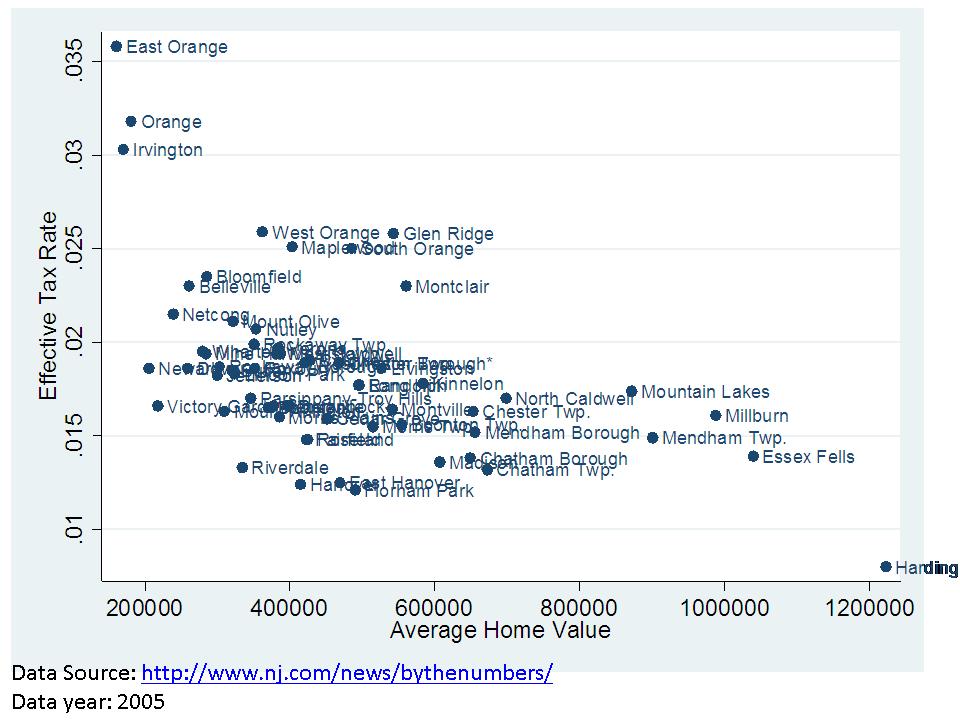
Let’s look first at the effective tax rate with respect to home values. That is, are towns with higher value homes paying a higher or lower percent of their home value in property taxes?

Now let’s look at whether individuals are paying a higher percent of their income in property taxes in towns with higher or lower income.

While these data are now somewhat old, there is little reason to believe that these patterns have shifted much if any, especially due to state tax and spending policies. First, these things tend to be relatively stable. Second, 2005 was around the peak of Abbott funding, the end of the major scaling up of funding from 1998 to 2005, prior to the new formula which actually spread money more widely.

Now, these are important metrics for evaluating Mulshine’s premise of the wrongs of current redistributive policies. Why? Because if current policies really do go overboard at redistributing suburban wealth to the urban core, then we should see that a) effective tax rates on properties are actually higher in the suburbs – that is the tax bill divided by the home value, and b) that property taxes paid as a share of income are higher in the suburban districts than the urban core.

Both of the above charts suggest that current NJ policies of school and municipal aid have not, in fact, over-corrected by driving too much relief into poor urban communities. In fact, effective property tax rates remain much higher in places like East Orange, Irvington and Orange than in Mendham or Essex Fells. Further taxes as a percent of income are much higher in East Orange, Nutley and Belleville than in Mendham.

But, Mendham and some other more affluent suburban communities do tend to be quite high on this measure and there are a few explanations for this. First, many of the towns high on this measure have very little commercial or industrial property to tax for public services. A tax equity oriented policy remedy to this problem is to require regional redistribution of property tax revenues from these non-residential properties (a topic of some academic literature in the past). Second, in some of these towns, we may see more individuals living beyond, or at least at the edges of their means – perhaps purchasing more house than their income can afford.

So, what is one to do if they are unhappy with a $37,000 annual property tax bill? The simplest answer is to move into a cheaper house.


Revisiting why comparing NAEP gaps by low income status doesn’t work

This is a compilation of previous posts, in response to the egregious abuse of data presented on Page 3, here: http://www.scribd.com/fullscreen/64717249:

Pundits love to make cross-state comparisons and rank states on a variety of indicators, something I’m guilty of it as well.[1] A favorite activity is comparing NAEP test scores across subjects, including comparing which states have the biggest test score gaps between children who qualify for subsidized lunch and children who don’t. The simple conclusion – States with big gaps are bad – inequitable – and states with smaller gaps must being doing something right!

It is generally assumed by those who report these gaps and rank states on achievement gaps that these gaps are appropriately measured – comparably measured – across states. That a low-income child in one state is similar to a low-income child in another. That the average low-income child or the average of low-income children in one state is comparable to the average of low-income children in another, and that the average of non-low income children in one state is comparable to the average of non-low income children in another.  Unfortunately, however, this is a deeply flawed assumption.

Let’s review the assumption. Here’s the basic framing adopted by most who report on this stuff:

Non-Poor Child Test Score – Poor Child Test Score = Poverty Achievement Gap

Non-Poor Child in State A = Non-Poor Child in State B

Poor Child in State A = Poor Child in State B

These conditions have to be met for there to be any validity to rankings of achievement gaps.

Now, here’s the problem.

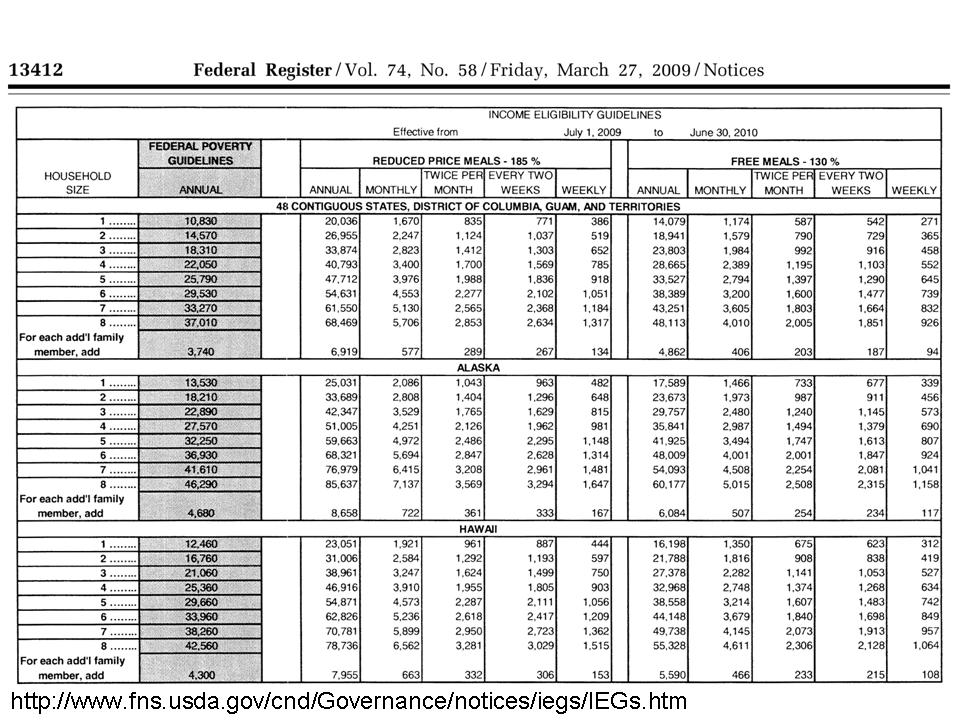
Poor = child from family falling below 185% income level relative to income cut point for poverty

Therefore, the measurement of an achievement gap between “poor” and “non-poor” is:

Average NAEP of children above 185% poverty threshold – Average NAEP of children below 185% poverty threshold = “Poverty” achievement Gap

But, the income level for poverty is not varied by state or region.[2]

As a result, the distribution of children and their families above and below the specified threshold varies widely from state to state, and comparing the average performance of the groups of children above that threshold and below it is not particularly meaningful.  Comparing those gaps across states is really problematic.

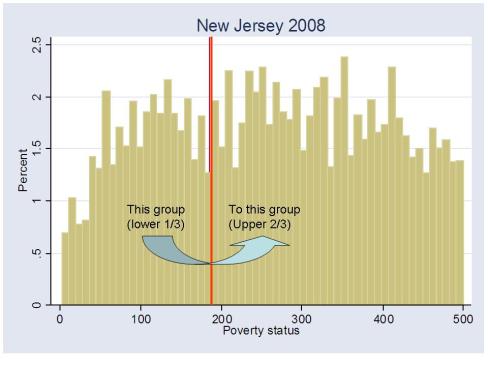
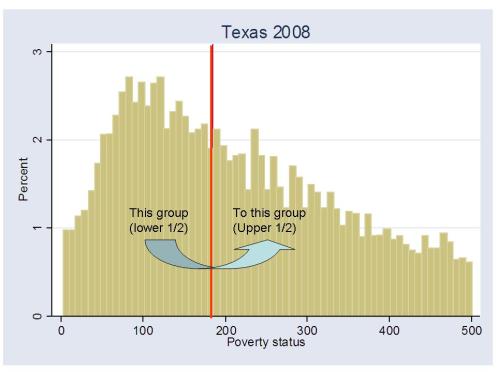
Here are graphs of the poverty distributions (using a poverty index where 100 = 100%, or income at the poverty level) for families of 5 to 17 year olds in New Jersey and in Texas. These graphs are based on data from the 2008 American Community Survey (from http://www.ipums.org). They include children attending either/both public and private school.

Figure 1

Poverty Distribution (Poverty Index) and Reduced Price Lunch Cut-Point


  Figure 2

Poverty Distribution (Poverty Index) and Reduced Price Lunch Cut-Point


To put it really simply, comparing the above the line and below the line groups in New Jersey means something quite different from comparing the above the line and blow the line groups in Texas, where the majority are actually below the line… but where being below the line may not by any stretch of the imagination be associated with comparable economic deprivation. Further, in New Jersey, much larger shares of the population are distributed toward the right hand end of the distribution – the distribution is overall “flatter.” These distributional differences undoubtedly have significant influence on the estimation of achievement gaps. As I often point out, the size of an achievement gap is as much a function of the height of the highs as it is a function of the depth of the lows.[3]

How does this matter when comparing poverty achievement gaps?

In the above charts, while I show how different the poverty and income distributions were in Texas and New Jersey as an example, those charts don’t explain how/why these distribution differences thwart comparisons of low-income vs. non-low income achievement gaps. Yes, it should be clear enough that the above the line and below the line groups just aren’t similar across these two states and/or nearly every other.

A logical extension of the analysis in that previous post would be to look at the relationship between:

Gap in average family total income between those above and below the free or reduced price lunch cut-off

AND

Gap in average NAEP scores between children from families above and below the free or reduced price lunch cut-off

If there is much (or any) of a relationship between the income gaps and the NAEP gaps – that is, states with larger income gaps between the poor and non-poor groups also have larger achievement gaps – such a finding would call into question the usefulness of state comparisons of these gaps.

So, let’s walk through this step by step.

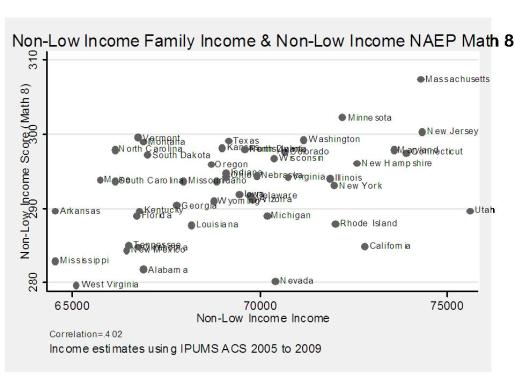
First, Figure 3 shows the relationship across states between the NAEP Math Grade 8 scores and family total income levels for children in families ABOVE the free or reduced cutoff:

Figure 3

There is a modest relationship between income levels of non-low income children and NAEP scores. Higher income states generally have higher NAEP scores. No adjustments are applied in this analysis to the value of income from one location to another, mainly because no adjustments are applied in the setting of the poverty thresholds. Therein lies at least some of the problem. The rest lies in using a simple ABOVE vs. BELOW a single cut point approach.

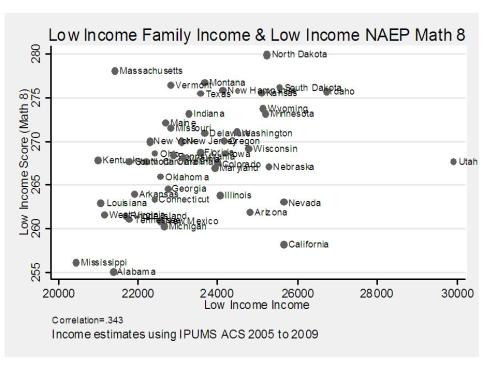
Second, Figure 4 shows the relationship between the average income of families below the free or reduced lunch cut point and the average NAEP scores on 8th Grade Math (2009).

Figure 4


This relationship is somewhat looser than the previous relationship and for logical reasons – mainly that we have applied a single low-income threshold to every state and the average income of individuals below that single income threshold does not vary as widely across states as the average income of individuals above that threshold. Further, the income threshold is arbitrary and not sensitive do the differences in the value of any given income level across states.  But still, there is some variation, with some stats have much larger clusters of very low-income families below the free or reduced price lunch threshold (Mississippi).

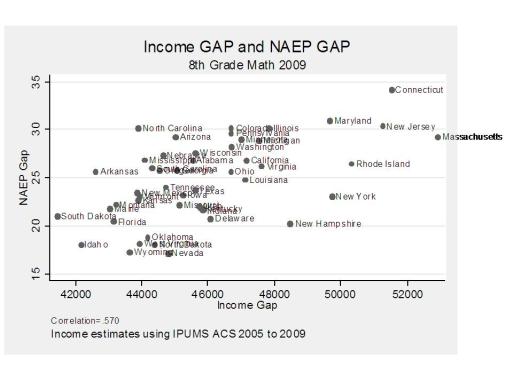
But, here’s the most important part. Figure 5 shows the relationship between income gaps estimated using the American Community Survey data (www.ipums.org) from 2005 to 2009 and NAEP Gaps. This graph addresses directly the question posed above – whether states with larger gaps in income between families above and below the arbitrary low-income threshold also have larger gaps in NAEP scores between children from families above and below the arbitrary threshold.

Figure 5

In fact, they do. And this relationship is stronger than either of the two previous relationships. As a result, it is somewhat foolish to try to make any comparisons between achievement gaps in states like Connecticut, New Jersey and Massachusetts versus states like South Dakota, Idaho or Wyoming. It is, for example, more reasonable to compare New Jersey and Massachusetts to Connecticut, but even then, other factors may complicate the analysis.

How does this affect state ranking gaps? Re-ranking New Jersey

New Jersey’s current commissioner of education seems to stake much of his arguments for the urgency of implementing reform strategies on the argument that while New Jersey ranks high on average performance, New Jersey ranks 47th in achievement gap between low-income and non-low income children (video here: http://livestre.am/M3YZ).

And just yesterday, a New Jersey Governor’s Task Force report used New Jersey’s egregious poverty achievement gap as the primary impetus for the immediate need for reform: http://www.scribd.com/fullscreen/64717249 (In my view, all that follows in this report is severely undermined by the fact that those who drafted the report clearly do not have even the most basic understanding of data on poverty and achievement!)

To be fair, this is classic political rhetoric with few or no partisan boundaries.

To review, comparisons of achievement gaps across states between children in families above the arbitrary 185% income level and below that income level are very problematic.  In my last post on this topic, I showed that states where there is a larger gap in income between these two groups (the above and below the line groups), there is also a larger gap in achievement.  That is, the size of the achievement gap is largely a function of the income distribution in each state.

Let’s take this all one more, last step and ask – If we correct for the differences in income between low and higher income families – how do the achievement gap rankings change? And, let’s do this with an average achievement gap for 2009 across NAEP Reading and Math for Grades 4 and 8.

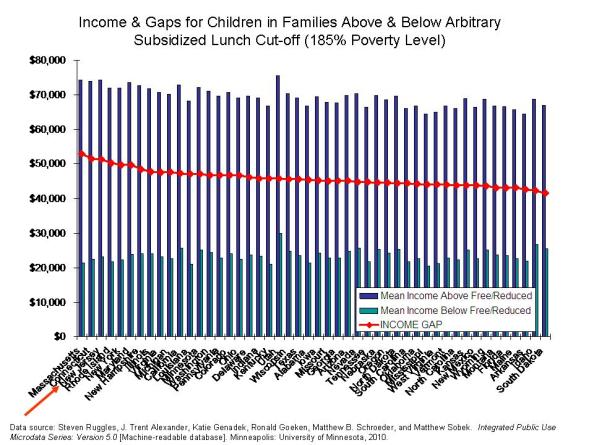
Figure 6 shows the differences in income for lower and higher income children, with states ranked by the income gap between these groups:

Figure 6


Massachusetts, Connecticut and New Jersey have the largest income gaps between families above and below the arbitrary Free or Reduced Price Lunch income cut off.

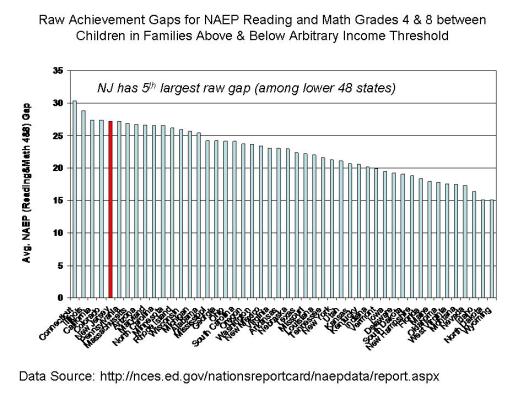
Now, let’s take a look (Figure 7) at the raw achievement gaps averaged across the four tests:

Figure 7


New Jersey has a pretty large raw gap, coming in 5th among the lower 48 states (note there are other difficulties in comparing the income distributions in Alaska and Hawaii, in relation to free/reduced lunch cut points). Connecticut and Massachusetts also have very large achievement gaps.

One can see here, anecdotally that states with larger income gaps in the first figure are generally those with larger achievement gaps.

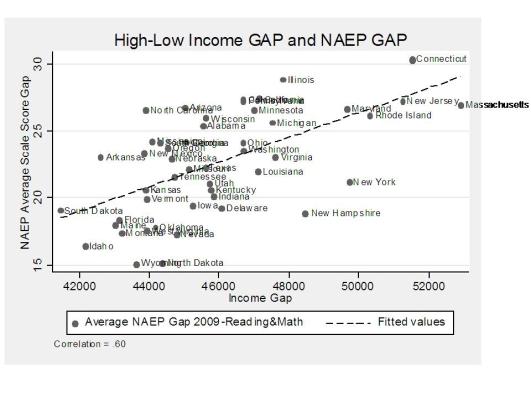
Here’s the relationship between the two (Figure8):

Figure 8

In this graph, a state that falls on the diagonal line, is a state where the achievement gap is right on target for the expected achievement gap, given the difference in income for those above and below the arbitrary free or reduced price lunch cut-off. New Jersey falls right on that line. States falling on the line have relatively “average” (or expected) achievement gaps.

One can take this the next step to rank the “adjusted” achievement gaps based on how far above or below the line a state falls. States below the line have achievement gaps smaller than expected and above the line have achievement gaps larger than expected. At this point, I’m not totally convinced that this adjustment is capturing enough about the differences in income distributions and their effects on achievement gaps. But it makes for some fun adjustments/comparisons nonetheless. In any case, the raw achievement gap comparisons typically used in political debate are pretty meaningless.

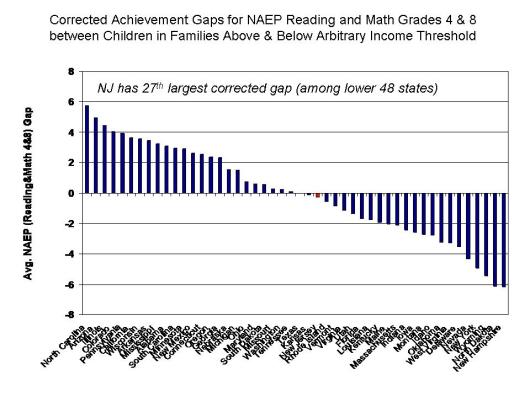
Here are adjusted achievement gap rankings (Figure 9):

Figure 9

Here, NJ comes in 27th in achievement gap. That is 27th from largest. That is, New Jersey’s adjusted achievement gap between higher and lower-income students, when correcting for the size of the income gap between those students, is smaller than the gap in the average state.


[3] For further explanation of the problems with poverty measurement across states, using constant thresholds, and proposed solutions see: Renwick, Trudi. Alternative Geographic Adjustments of U.S. Poverty Thresholds: Impact on State Poverty Rates. U.S. Census Bureau, August 2009. https://xteam.brookings.edu/ipm/Documents/Trudi_Renwick_Alternative_Geographic_Adjustments.pdf

Paul Mulshine, Amoral Self-Indulgence & New Jersey School Finance

On most days, I can simply laugh off a ridiculous Paul Mulshine column in the Star Ledger. Most of his claims regarding education, taxation and the intersection of the two range from flat-out incorrect to wacky and misguided. But Mulshine’s claims in his column on Wednesday June 22nd necessitate a response.

For several years, I have been a professor where one of my primary responsibilities has been to train future school administrators. I believe strongly that well-informed well prepared and knowledgeable school administrators can and should play a critical role in guiding public education policy.  As one might figure from the name of this blog, my emphasis is on teaching school finance – an inherently political and divisive topic that often pits one district against another or even one school against another. As a result, I believe it is particularly important that leading voices in education policy in a state understand not only how policies affect their own district and children but how those policies affect children statewide – that local school administrators can think beyond the boundaries of their own school district and local constituents, and be mindful of the good of the public as a whole.
Any local school administrator would likely want to find ways to manipulate the state formula for allocating aid in a way that drives more aid to their district. And over the years, I’ve seen many twisted and unethical arguments advocated and legislated to accomplish these goals – including Jackson Wyoming – the wealthiest district in Wyoming – arguing (successfully) that it needs 30% more funding than any other district in the state simply because it is so wealthy. Kansas similarly adopted provisions which provide for more funding in districts a) with higher priced houses and b) with more children attending school in new facilities. I’ve seen more money driven to wealthier districts in South Carolina on the argument that they have more gifted children. And I’ve seen more money targeted to white schools than black schools in Alabama (still in effect) on the basis that white schools have more teachers with advanced degrees and that teachers with advanced degrees cost more (built into the state aid calculation). I’ve written on this topic in peer-reviewed research.

I’ve often been frustrated to see local public school administrators in districts advantaged by these illogical policies either sit idly by, knowing the policies to be wrong, or advocate loudly on behalf of these policies, still knowing full well that the policies are built on flimsy if not absurd arguments.  In the politics of state school finance, self-interest is often hard to overcome.  It is a rare administrator who is able to balance these conflicts well – to not take the easy way out and accept an absurd or even unethical policy position simply because it drives more dollars to their constituents. Earl Kim of Montgomery Township is one of those rare administrators.

Mr. Mulshine’s view that the only role of the local public administrator is to get more for his or her constituents, and that local bureaucrats should never take any action to the contrary – regardless of ethical considerations – is not only absurd but is indicative of much of what is wrong in politics today and society in general.  Mulshine prefers his bureaucrats to be amoral sock puppets.

Here is a clip of what Mulshine had to say about Earl Kim:

“Let me offer a hint to this overpaid bureaucrat: An employee of the school board  has no say whatsoever in such public policy matters as the proper amount of property-tax relief.”

“If he did, however, he should not be advising his superiors to take a course of action that deprives the taxpayers of tens of millions of dollars that could lower their property taxes and help keep them in their houses.”

What Earl Kim understands and what Mulshine clearly doesn’t, is that while Doherty’s “Fair School Funding” plan might drive a lot more money into Earl Kim’s district, it would only do so at the expense of the system as a whole. And that is an ethical compromise that Earl Kim seems unwilling to support. To Mulshine, however, ethics seem inconsequential, when traded for millions of dollars.

Let’s actually take a simulated look at why Earl Kim might be concerned about the Doherty plan. Let’s start with a quick look at how school finance formulas work.

Local public school districts receive varied amounts of state aid based on two major types of factors:

  1. Differences in local school districts’ ability to raise local tax revenue to pay for schools;
  2. Differences in the needs and costs of providing adequate educational services to widely varied student populations.

In simple terms, the current formula – SFRA – accounts for both, and the Doherty plan accounts for neither.  Aw… what the heck, all that math is too complicated anyway!

In a typical state school finance formula, there is a target amount of revenue to be raised by each school district – based on the estimated differences in needs and costs of children attending each district and other factors such as variations in competitive wages for teachers. But, even if the target funding per pupil was the same for each district, the state aid share would be very different. Why? Because some districts have far greater capacity to raise local property tax revenues than others.

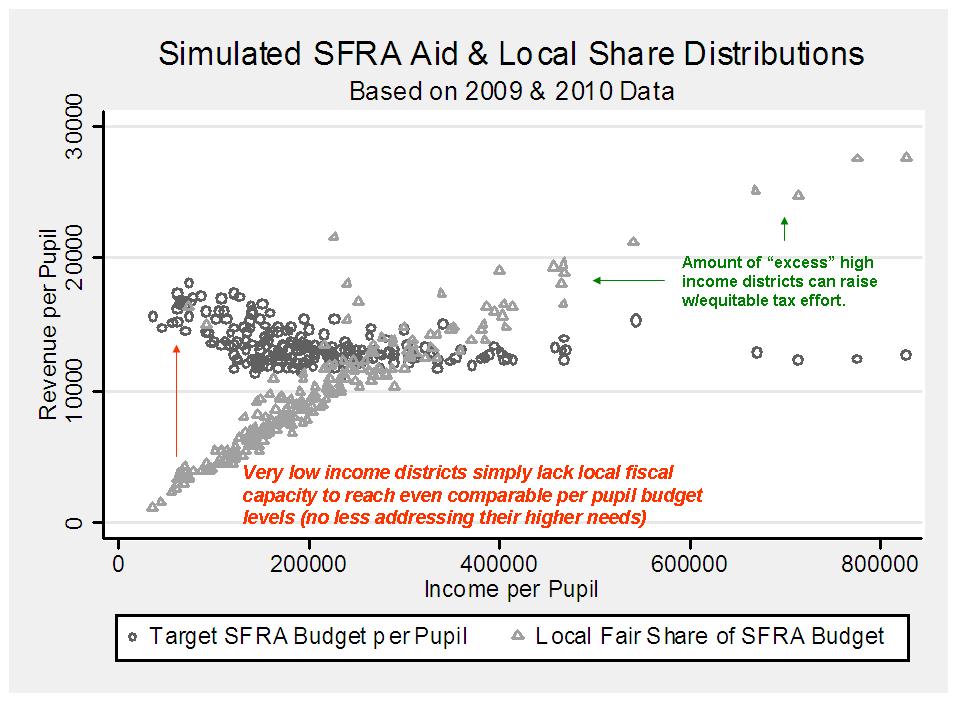
Here’s a New Jersey SFRA simulated (oversimplified) example using data from 2009 and 2010. Under the 2010 SFRA, the average target budget per pupil for an Abbott district was $16,387, based on the greater needs of children in these districts and the fact that the largest Abbott districts were also in higher cost north Jersey labor markets.

Applying equitable tax effort, Abbott districts are only able to raise about $4,300 per pupil compared to wealthy districts (to 2 deciles) which can raise, on average, over $13,000 (which is actually more than they would need).  State aid, as it currently stands in NJ (and in other states with similarly structured formulas) is used to fill the gap between what can be fairly raised locally, and what is estimated to be needed to provide an adequate education.

Expressed as effective tax rates, the local share for wealthy I&J districts appears to be slightly higher when expressed relative to property values, but these districts have the lowest effective rate with respect to income – even under SFRA. Overall, the distributions are relatively fair. I’ve written previously about this.

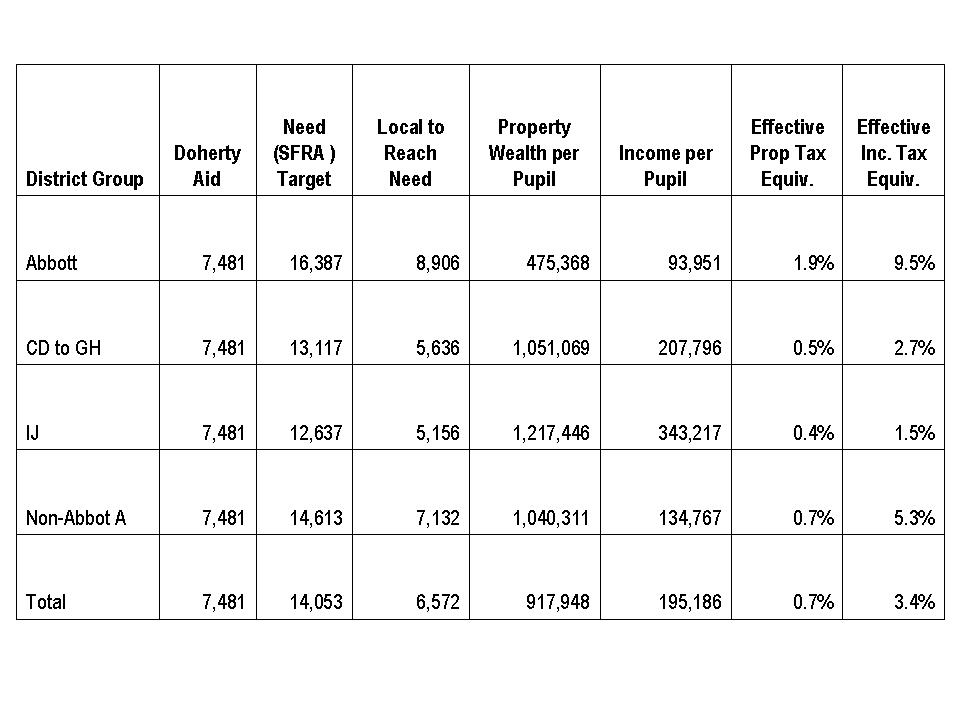
So then, how would it work to simply give every district the same amount of state aid per pupil? The Doherty plan argues for giving every district $7,481 per pupil a) regardless of need and costs and b) regardless of ability to raise local revenue. That would be unprecedented, even in Kansas, Alabama or Wyoming.*

This table shows one perspective on the Doherty plan – if the state simply gave every district the same amount of state aid per pupil, but if we then assumed that districts would need to raise the rest on their own if they really wanted to provide an adequate education (as estimated under SFRA). That is, if high need districts like Abbott districts still wished to try to raise what SFRA projected that they needed. Abbott districts would be expected to raise $8,906 per pupil toward their $16,387 and the wealthiest districts would be expected to raise on their own, about $5,000 per pupil. This creates a nearly nine-fold difference in the effective income tax equivalent across districts! And that’s “Fair School Funding?” One can understand Earl Kim’s concern, even if the proposal would bring home millions to Montgomery Township!

Here’s what it looks like in pictures. In the first picture, we see how SFRA operates pretty much like any state school finance formula built on a “foundation formula” approach. Each district has a target revenue per pupil. And the poorest districts – those with the least local fiscal capacity – are expected to raise the least toward this total. Wealthy districts even when applying equitable tax effort can raise far more than they need!

Here’s what the Doherty plan would look like. Here, every district gets the same regardless of need or capacity. This is rather like arguing that we should distribute food stamps and other financial assistance to residents of the estates of Far Hills in equal amounts to the distributions in Camden, or that we should pave well-conditioned and little used roadways with comparable frequency to heavily worn, highly traveled ones. When we place Doherty aid on top of 2009 local revenues per pupil, we see that the lowest income districts end up having combined state and local revenue per pupil well under $10,000 and that the wealthy districts now have combined state and local revenue per pupil approaching $25,000.

Here’s how it looks with respect to children qualifying for free or reduced price lunch. New Jersey’s school finance system has been praised in several national reports, including this one, for most effectively targeting additional resources toward greater needs. And there exists a significant body of research to validate that such school finance reforms actually do matter (regardless of political rhetoric to the contrary). Indeed the Doherty plan would turn New Jersey school finance on its head – making the system among the most regressive in the nation. That is, a system where higher need districts have systematically fewer resources per pupil.

Now, I don’t expect that this proposal really has much broad-based support, and I would not have typically bothered to critique or debunk it. I’ve stated my reasons above for why I needed to take this particular issue on at this time and under these circumstances.  It would simply make no sense for a well-informed local public school administrator like Earl Kim to advocate on behalf of a policy that is so clearly wrongheaded, so obviously unfair, simply because that policy would drive money into the pockets of his constituents.

(Finally, as an interesting aside, we also know from a series of studies of property tax relief aid for wealthy districts in New York State that increasing state aid to wealthy districts is among the surest ways to increase inefficiency in school district spending.  I often use the analogy that it’s like giving out $100 gift cards to Scarsdale residents to shop at Neiman Marcus. They take the $100 and spend $500 for something they didn’t really need. That is, these policies seem to encourage inefficient spending as much if not more than they provide tax relief. Meanwhile, we might have reallocated those $100 gift cards for basic needs in nearby Yonkers or Mount Vernon.)

*Note: It is conceivable that a state would attempt to create a fully state financed education system (that is, eliminate local share) in which case there is no need to correct for differences in capacity to raise local share. But, a completely flat allocation under these circumstances would fail to address differences in needs and costs.  Relying entirely on state source revenues (sales and income taxes) can, however, reduce the stability of revenue flow to schools (property tax revenues tend to be more stable in economic downturns).

Demystifying today’s Abbott Decision

First, let’s identify the players:

  1. New Jersey Legislature & Governor, or THE STATE
  2. Children attending Abbott school districts and their legal representation, or THE PLAINTIFFS
  3. THE COURT (NJ Supreme Court)
  4. Other school districts and the children they serve

Now, let’s not go too far back in history, and instead account for the last few years which really define where we are at today, and how this decision makes sense: http://www.judiciary.state.nj.us/opinions/supreme/M129309AbbottvBurke.pdf

Until a few years ago, the State of New Jersey was operating its school funding formula under a series of court orders specifically intended to ensure that children attending school districts known as Abbott districts received sufficient resources to provide them with a constitutionally adequate education (history here: http://edlawcenter.org/ELCPublic/AbbottvBurke/AbbottHistory.htm) .  The original Abbott v. Burke lawsuit was brought on behalf of PLAINTIFF children who resided in specific school districts.

A few years ago (2008-09), the New Jersey Legislature- THE STATE – adopted the School Funding Reform Act of 2008 in a legislative, pro-active attempt to move into a new era in New Jersey school funding, an era not driven by judicial mandates but rather by a legislatively adopted formula. An era where a unified state school finance formula would drive “adequate” (their words, not mine) funding to local public school districts, whether those districts were among those that had previously sued the state over funding or not.

PLAINTIFFS CHALLENGED that formula, saying it would not provide them with adequate resources and should not be considered constitutional.

THE STATE argued that the formula, SFRA, was essentially THE OPERATIONAL DEFINITION OF THEIR CONSTITUTIONAL MANDATE.  That SFRA, by its design and according to its planned implementation was necessarily constitutional.

THE COURT cut THE STATE a break, and indicated that while it wasn’t entirely sure that SFRA really was the operational definition of the constitutional mandate, it was a reasonable attempt and should be allowed to move forward. That is, the COURT was anything but activist, giving THE STATE an opportunity to move forward with their new school finance plan, but holding the STATE to their promise on a 3 year time frame. THE STATE WON, and THE PLAINTIFFS LOST.

Then, all hell breaks loose in the economy and THE STATE (which is now a different set of individuals/Governor/legislators, but that’s not relevant to the legal question at hand) pulls about $1.7 billion out of SFRA, relative to where it would have been if implemented as promised. Again, THE STATE had argued that SFRA implemented as promised was effectively THE OPERATIONAL DEFINITION OF THEIR CONSTITUTIONAL MANDATE.

So today, THE COURT had a really narrow, arguably boring question to answer. They didn’t have to answer the big question of whether SFRA in its current form meets the constitutional standard or what that constitutional standard really meant. They had decided in 2009 that SFRA as planned would meet the constitutional standard, and had accepted THE STATE’s argument to that effect.  Today, THE COURT merely had to decide if SFRA, in its current form – less $1.7 billion – was still implemented as planned? That’s a pretty simple NO.  Right or wrong in any broader sense, whether SFRA is a good formula or a sucky one, the legal question before this court was simply whether SFRA was implemented as planned. And it wasn’t.

Judicial activism? Let’s review. First a definition. Judicial activism is when the judicial branch applies the constitution to invalidate statutes passed by the legislature. While having negative connotations, judicial activism is clearly appropriate under some circumstances. Legislatures do adopt policies that violate individual rights and checks and balances are critical. I guess you could say that this decision invalidates recent budgetary decisions. BUT, and this is a big BUT, all that the court has done here is to uphold the state school finance formula that THE STATE asked them to uphold a few years ago.

The court is merely upholding a legislative action that it already upheld a few years ago (while granting significant deference to the legislature on how that formula would work).  That’s pretty mundane, if you ask me.

Are Abbott districts and Ed Law Center the big winners here? It’s really important to understand here that SFRA was considered to be a reasonable operational definition of the state constitutional obligation because THE PLAINTIFFS LOST in 2009. ELC and Abbotts did not want SFRA and felt that it didn’t provide sufficient additional resources to meet the needs of children in Abbott districts. They lost in 2009. THE STATE won, and SFRA was accepted. So, this time around, ELC and Abbotts had to suck it up and accept that SFRA was the standard, and argue that at least SFRA should be funded as planned and as accepted by the court – BECAUSE IT ALREADY WAS. This new decision today merely affirms the PLAINTIFF’s previous loss.

What about that whole bit about THE STATE only having to reinstate the cuts to Abbott districts – THE PLAINTIFFS? Perhaps this is a technicality, but children in Abbott districts are the original plaintiffs and the ones who continue to be represented in this case – THE PLAINTIFFS. So, it is technically correct in a legal sense that THE STATE would be obligated only to close those funding gaps.

BUT… and this is another BIG BUT… this does leave the door wide open to the possibility that all of those other districts whose current funding levels fall “below adequacy” under SFRA can bring separate lawsuits against the state to have their cuts restored as well (if THE  STATE were to choose to only restore cuts to Abbott districts). After all, THE STATE has said and THE COURT has accepted that SFRA as planned was constitutional. THE COURT has now said that funding below that level is a constitutional violation, seemingly making for a pretty straightforward argument for non-Abbotts below their target funding levels – adequacy funding – under SFRA.  Let the games begin!

Does New Jersey really need more small, segregated schools?

Political pundits and the media frequently point out two major concerns regarding the organization of public school districts in New Jersey.

  • First, that New Jersey, being the most population dense state in the nation, simply has far too many small schools and school districts (largely an artifact of municipal reorganization and alignment that occurred in the late 1890s and first decade of the 1900s).
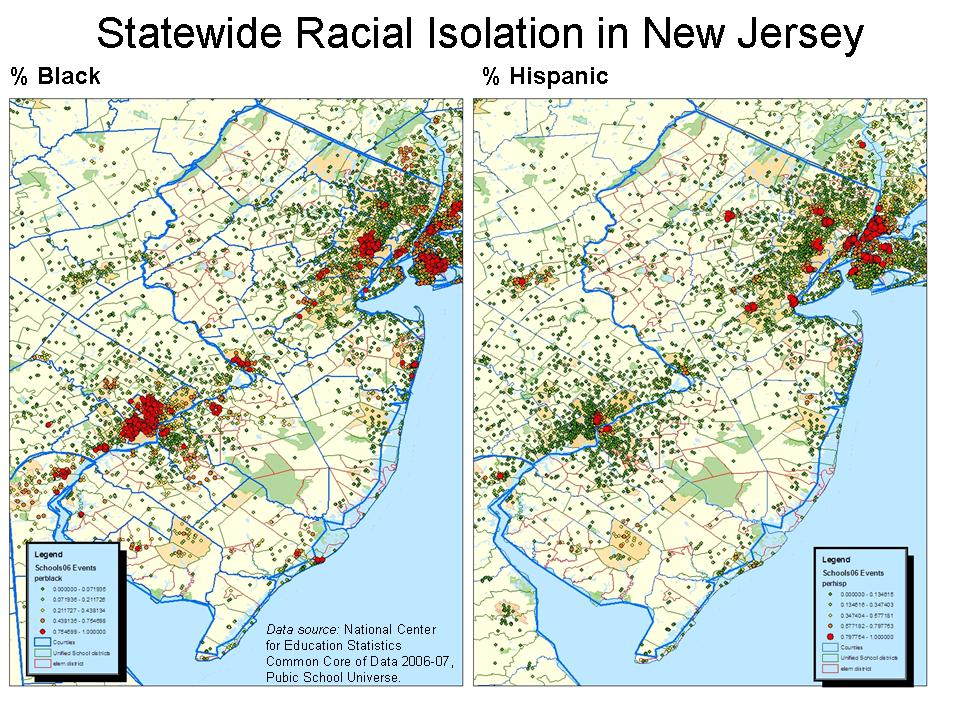
  • Second, that New Jersey is among the most racially and socioeconomically segregated states in the nation, or more specifically, that many urban communities in New Jersey suffer extreme racial isolation (high concentration of a single race/ethnicity).

I blogged about this topic way back when I first started this blog!

Here’s a snapshot:

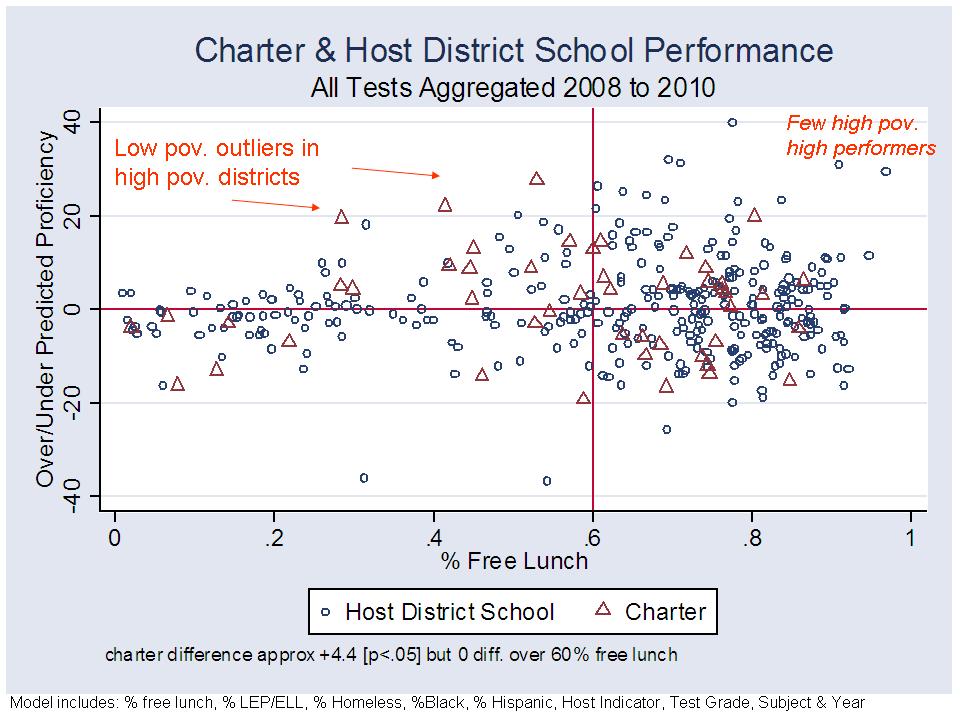
So then, one should ask how expansion of charter schools intersects with these two major policy concerns. It would be one thing if New Jersey Charter Schools simply had a track record of a) serving similar student populations and b) consistently outperforming traditional public schools in the same location. That is, one might argue that we can deal with a marginal increase in segregation and additional segmentation of our school system if it’s producing better results (therefore not compromising efficiency). But that’s not the case. New Jersey charter schools, on average, are average.  In particular, there are few if any high performing, high poverty charters. The figure below is from a recent post.

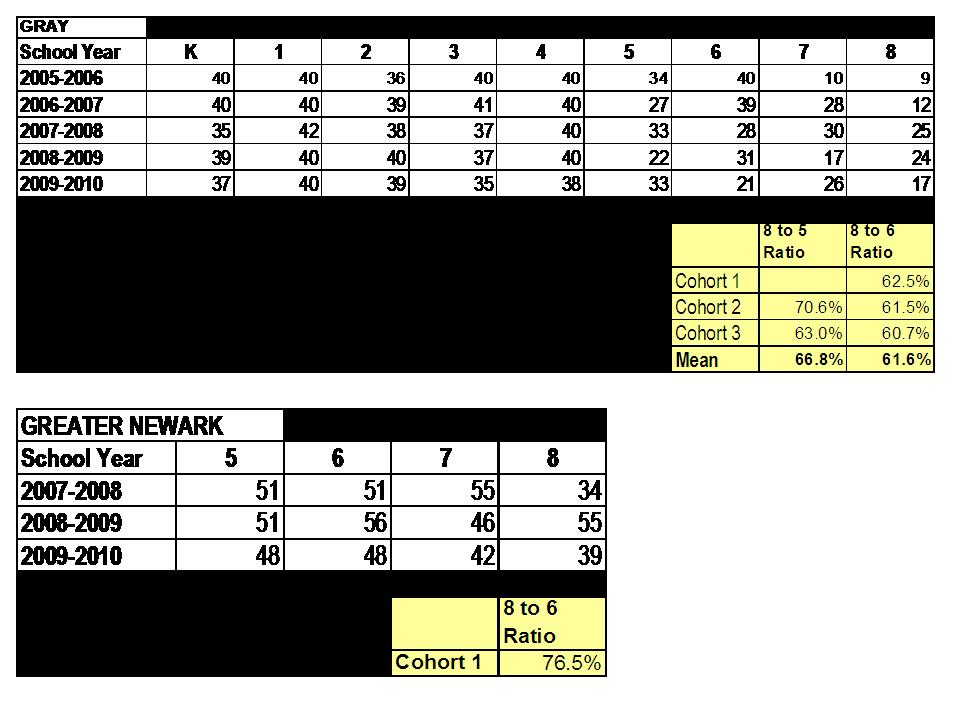
In fact, the NJ charters frequently cited as high flyers also tend to a) serve far lower shares of children qualifying for free lunch, b) serve far fewer LEP/ELL children, and c) some in particular have disproportionately high attrition rates in the middle grades.

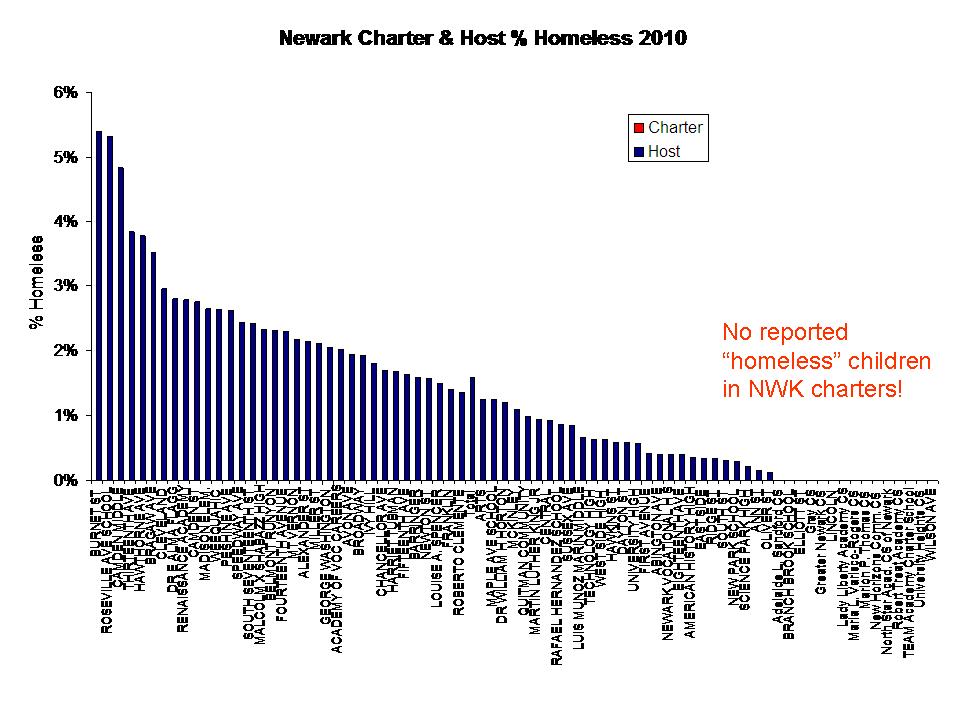
I’ve shown on many occasions on this blog, that NJ Charters serve far fewer children with greater educational needs.

But do NJ Charter schools contribute to racial and ethnic segregation in New Jersey? Given the break-even performance of NJ charters, it would make little sense to advance a policy agenda that has the tendency to increase segregation and racial isolation in a state already segregated and racially isolated.

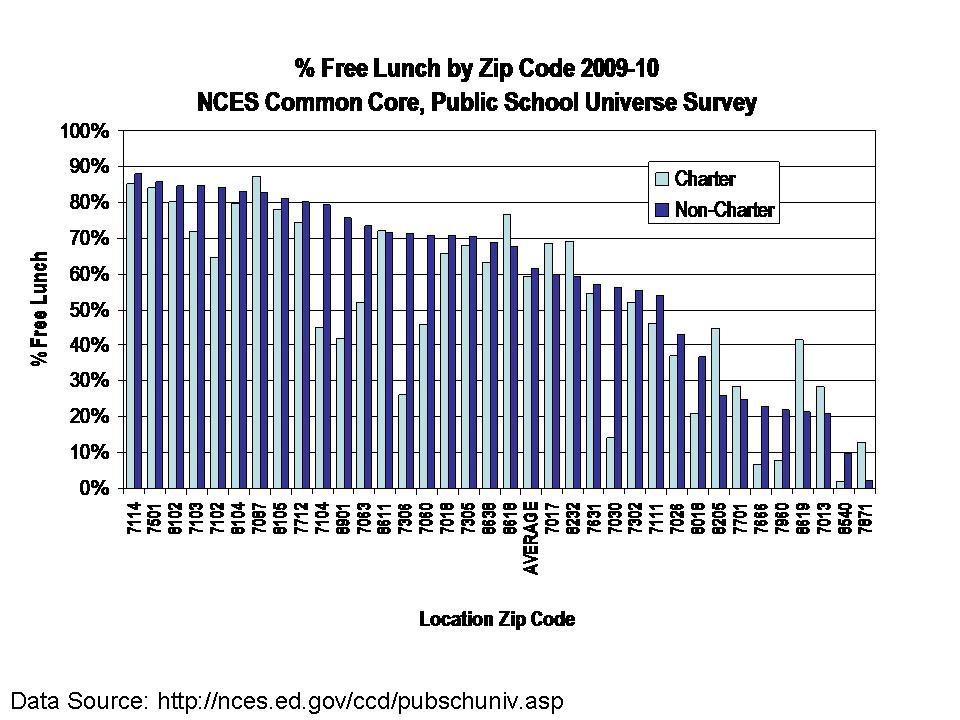
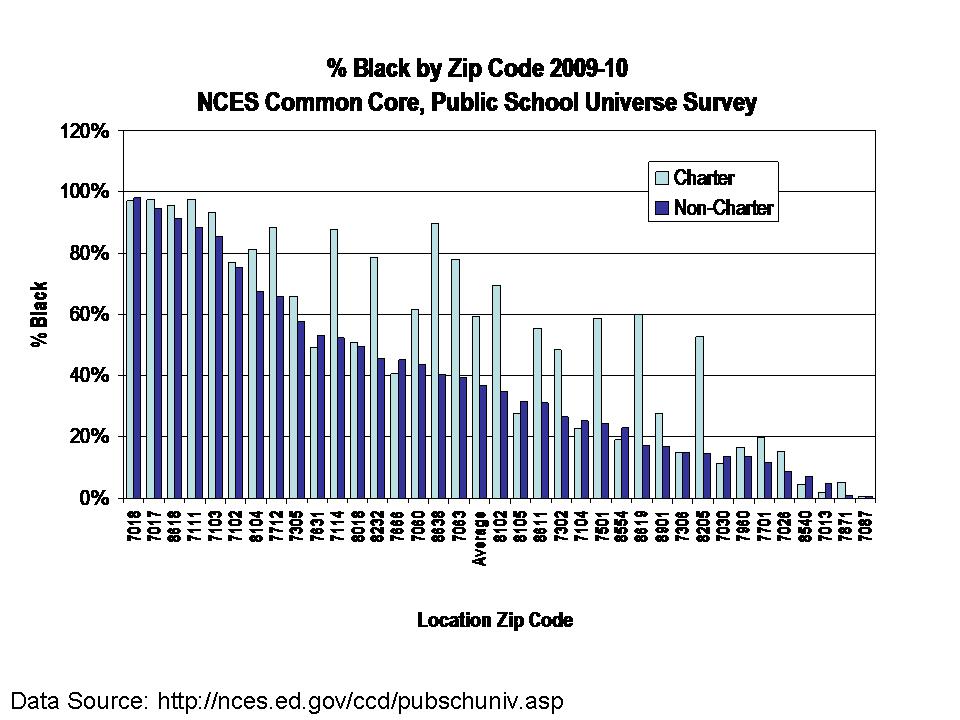
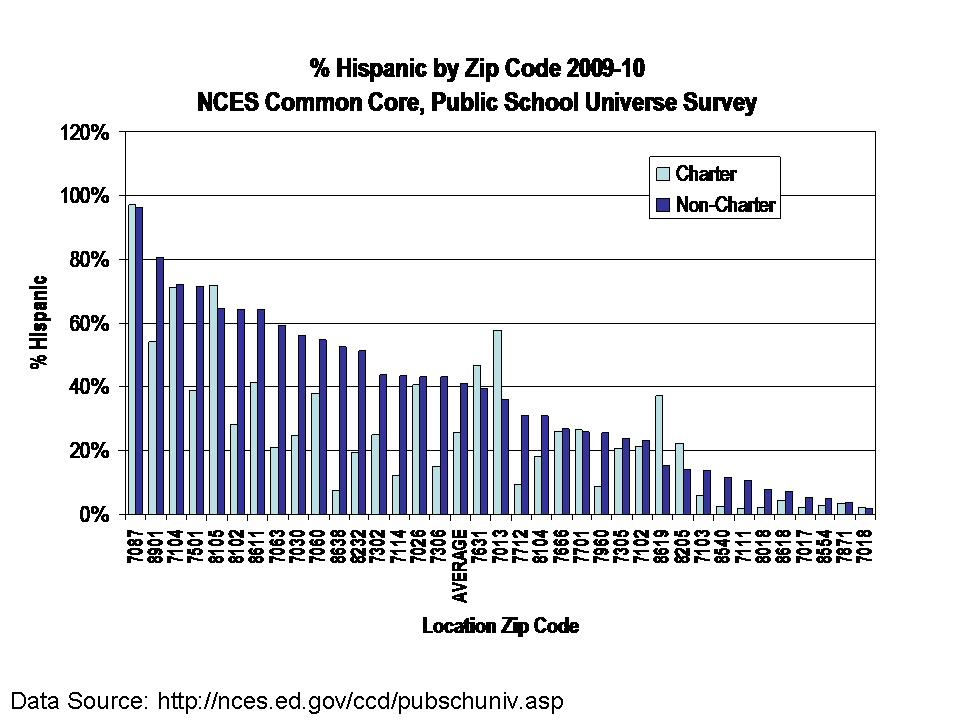
Here are the figures, based on the 2009-10 NCES Common Core of Data, Public School Universe Survey, based on the zip code of school location (LZIP).

I’ve included only elementary and middle schools in the following graphs.

First, here are the charter and non-charter averages for % Free Lunch by zip code:

While statewide averages are relatively comparable, as I’ve discussed numerous times, there are big differences in specific locations. Note the number of zip codes where charters serve far fewer children qualifying for free lunch (light blue bars way below dark blue bars). In a few cases, charters serve higher rates.

Second, here are the charter and non-charter % black populations by zip code:

In many cases, charters serve far higher concentrations of black students than surrounding schools.  This figure provides an intriguing contrast with the previous, suggesting that in fact, in many neighborhoods, Charters are serving the less poor among black populations specifically and are serving black populations almost exclusively in some otherwise mixed race neighborhoods.

Third, here is the distribution of Hispanic enrollments by zip code:

Charter schools seem to be largely underserving Hispanic populations. This may be consistent with their underserving of LEP/ELL children to the extent that there is overlap between LEP/ELL concentrations and Hispanic enrollments within Zip Codes. A few zip codes have higher concentrations of Hispanic children in charter schools but most have far fewer.

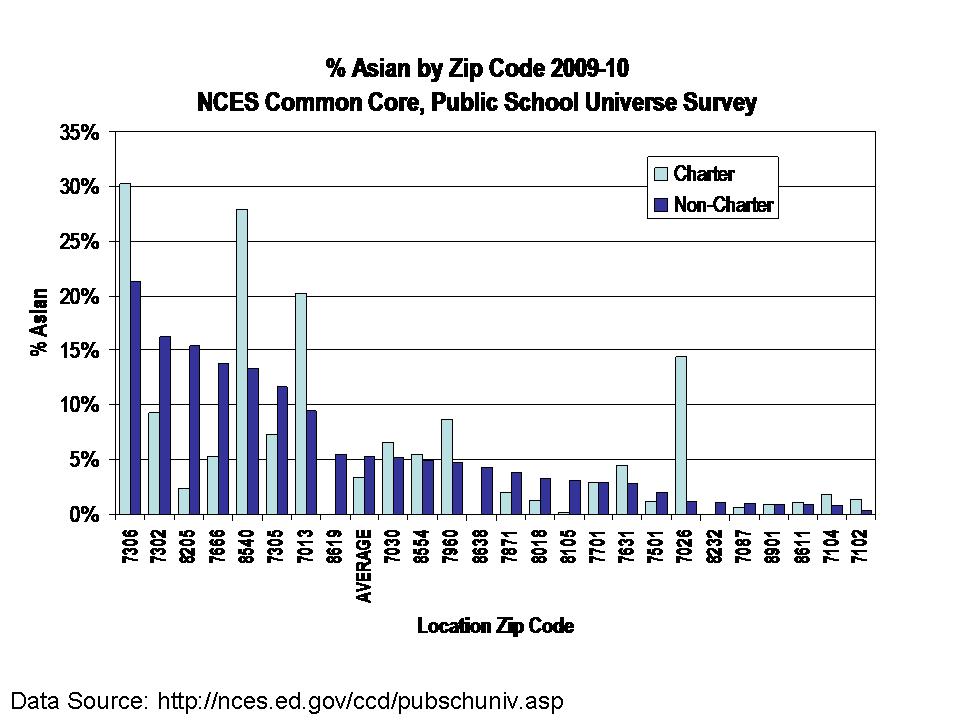
Finally, here is the concentration of Asian students by zip code:

A handful of NJ charter schools have highly disproportionate shares of Asian students.

These figures raise important questions about the contribution of charter schools in the broader education policy and public policy context in a state already grappling with significant segregation and racial isolation (and consolidation, or lack thereof). These concerns may be particularly relevant as increased numbers of culture (ethnicity) specific charter schools are proposed, dispersed throughout the state.

Raw Stata output of tabulations: Charter Segregation Raw Output

A Little NJ Private School Context

Our current NJ State Board of Education includes former representatives of the Boards of Trustees (or Governors) of two very highly respected private independent schools – Peck (a K-8 school in Morristown) and Newark Academy (in Livingston).

http://www.state.nj.us/education/sboe/boe/

Yes, I’ve chosen to look at these schools because of NJBOE member affiliations with them.  Further, I am familiar with both schools (in addition to many other similar schools).

I do NOT see as a problem, having supporters of excellent private schools on a state board of education whose policies affect primarily the public education system. In fact, I see it as an opportunity (For those trying to read too much into this and suggest I’m being manipulative or sarcastic. Don’t. I really do think it’s important to take a close look at various types of educational institutions as models. These are a unique set of institutions with long and successful track records. Again, my private school study can be found here: http://nepc.colorado.edu/publication/private-schooling-US)

There’s a lot of bluster in the current NJ public education policy debate – over such things as:

I’ve suggested on a number of occasions, taking a closer look the inner workings, spending, policies and practices of elite private schools in particular – those which are not church subsidized – and those which operate on the open market for private schools.  At the very least, one might consider information on these schools for contextual purposes. For example, when considering what we spend in Newark public schools on a population that is majority low income, substantially non-English speaking, and includes 14 to 18% children with disabilities (depending on year of data).

Here are the stats on the two private independent schools, drawn from their web sites and from IRS filings:


Notably, on their web sites – both schools – like nearly any private independent school I can think of – indicate their relatively small class size or low pupil to teacher ratio. Both talk about their levels of teacher experience!  Both spend substantially more per pupil than Newark public schools and both compensate their headmasters at a rate far above and beyond newly proposed public school administrator caps.  These are the realities of the marketplace in which these schools operate.

Questions regarding different practices (with emphasis on personnel policy here), which are not generally available on school websites or in other documentation include:

a) How do  these schools recruit and attempt to retain teachers or headmasters?

b) How is compensation structured? Is there additional pay for degree levels or experience?

c) Are all employees at will, year-to-year or is there some form of continuous contract (implicit or explicit)?

d) What benefits are provided?

e) How are contractual negotiations conducted?

f) How are teacher evaluations conducted? By whom? With what frequency? or Emphasis?

There are a variety of other questions to be asked about these or any types of institutions we might choose to view as models. I welcome any responses to the above questions from representatives of these, or similar institutions, as I have requested in the past.

Newark Acad 2010 990

Newark Academy ~ Quick Facts

Newark Academy ~ Affording NA

Peck 2010 990

The Peck School_ About Peck

The Peck School_ Admissions » Tuition

Debunking Myths: Characteristics of Stayers & Leavers in New Jersey

For this one, the graphs pretty much tell the story. I’ve had these data sitting around for a while and just never got around to making the graphs. I’ve used data on migration patterns across cities and states from the American Community Survey in the past. The American Community Survey data are annual survey data which, among other things, include information on employment status, place of residence, place of work, wage income, household income and a bunch of other useful stuff. Since 2000, ACS has been doing annual data collection and has increased sample sizes from 2005 to 2009, increasing the questions that can be addressed with the data. The ACS data also include questions regarding whether the respondent lived in a different location the previous year. Since you have the current year location, whether an individual lived elsewhere the previous year, and where they lived, it’s relatively easy to tabulate characteristics of individuals who a) live in New Jersey in the current survey year but lived elsewhere the previous year, (Moved In)  b) live in another state in the current year, but lived in New Jersey the previous year (Moved Out), or c) lived in New Jersey in the current and previous year (STAYER).

The idea for this post had come about a long time ago, when I kept hearing over and over again how New Jersey’s taxes (which I wrote about here)  are driving out the state’s highest income (and most productive) residents. As usual, this statement was spun in a number of ways referring loosely to wealth, or income, or “rich” versus poor, but always with the implication that those who otherwise would contribute most to state tax revenues by virtue of their income are the ones headed for the exit. These claims were typically based loosely on a highly questionable secondary report of an earlier study, using data from the earlier part of the decade.

Here’s my quick run at the ACS data on individuals between the ages of 25 to 65 – the majority of wage earners.

Note that the ACS doesn’t survey absolutely everyone. It’s based on a sample. A pretty big sample for these years, but a sample nonetheless. As a result, to project the findings to the total population, one has to use weightings provided in the data (person weight, in this case).

Figure 1. Total numbers of 25 to 65 year olds coming and going

The first figure shows roughly similar numbers of 25 to 65 year olds coming and going. If anything, a few more are coming each year than going.

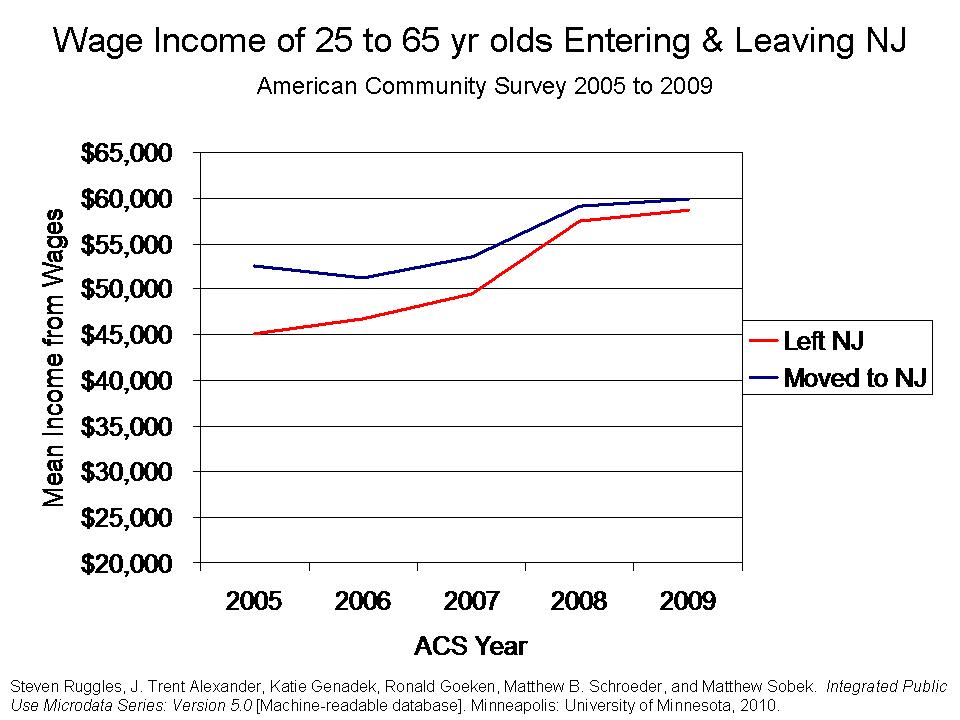
Figure 2. Income from Wages for those Coming and Going

Figure 2 shows that the income from wages for those coming in is slightly higher than for those leaving.

Figure 3. Household income for those Coming and Going

Household income is also marginally higher for those coming than for those leaving over time.

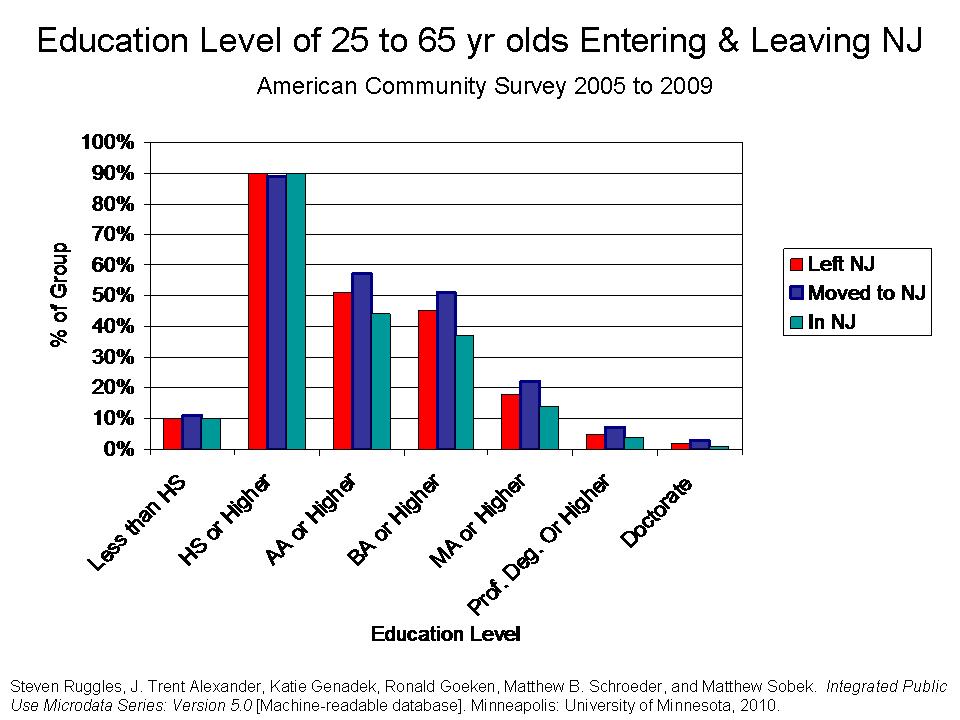
Figure 4. Education Level of those Coming and Going

This figure shows that on average, those coming into New Jersey have higher levels of education than those leaving. The blue bars, from associates degree or higher, through every higher level of education, are higher than the red bars. That is,those coming into New Jersey tend to be more likely to have a BA or higher, an MA or higher, or a professional or doctorate degree than those leaving New Jersey.

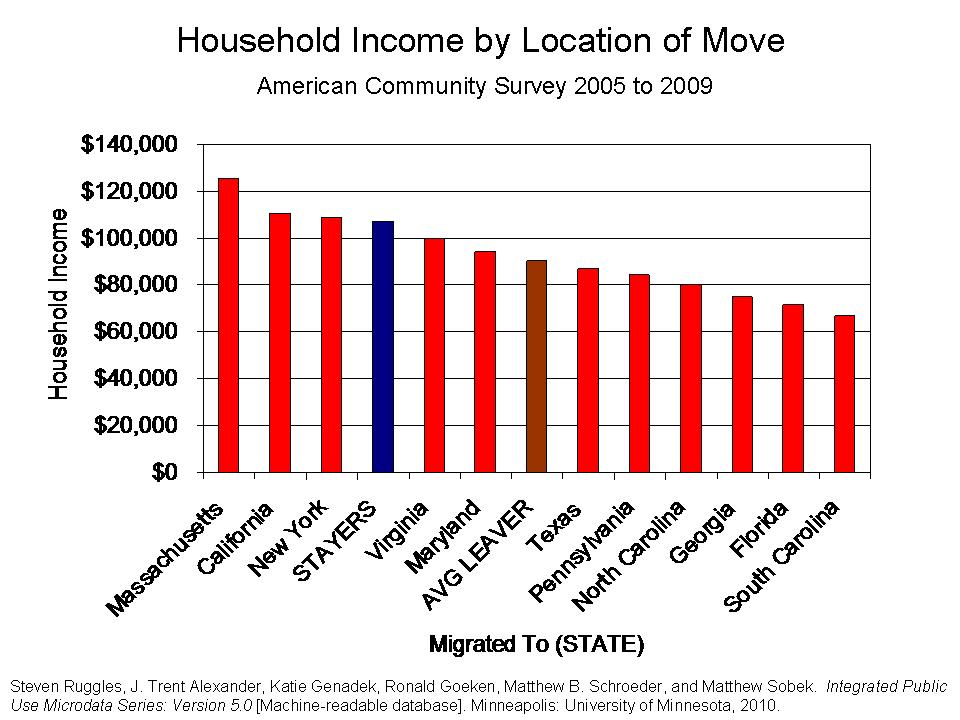
Figure 5. Household Income by State Moved To

Part of the rhetoric – mostly radio talk blather from NJ 101.5 – is that all of those high income earners headed to the exits are headed straight toward those lower tax burden and lower cost of living states like the Carolinas and Florida.  Well, as it turns out, the higher income earners that are leaving NJ – those that have higher household income than those who stay in NJ – happen to be moving to Massachusetts, California or New York – not states that one would typically call tax safe havens – but then again – most of the rhetoric regarding high and low tax states is misguided anyway. Those headed to Southern states and to Pennsylvania tend to have lower household income than those who stay in NJ and tend to have lower income than the average leaver.

TOTAL “MOVED TO” States

Note – The difficulty here is that with the ACS data, income is only reported for the current year, not previous income. So, income levels in this graph are income levels after the move, or in the state moved to and not the income level of the household when in NJ the previous year. That said, it is certainly the case that an income of $60k to $80 in those southern states would not otherwise be over $100k in NJ but for the supposed difference in total taxes. Yes, that lower income may provide comparable housing, etc., but that difference is largely a function of housing price and assessed value, not effective tax rate.

NPR Story: http://www.npr.org/blogs/money/2011/04/29/135813061/studies-rich-dont-flee-high-tax-states

Logic Gaps in the NJ Ed Reform Debate

Not much time for another full length post today. There are numbers to be crunched. But, I did feel it necessary to clear up a few issues regarding NJ Education Reform proposals, including those laid out yesterday focused on a) reforming teacher evaluation to focus on student assessment data, b) tying evaluation to compensation, tenure and dismissal policies, c) ending last in first out, and d) requiring mutual consent in placement/hiring of teachers to specific school locations.

And of course, these policy proposals are framed with the usual urgency.

Here are four overarching claims (and a few other things) based on reformy logic being applied in the New Jersey policy debate:

1. We must act now!

The argument goes that we must act now, before it’s too late, because things are so awful. First, it’s rather hard to argue with a straight face, and certainly not with any data, that NJ’s public education system is so awful. NJ performs at or near the top among states on national assessments, and NJ low-income students (qualifying for free lunch) also do quite well nationally and have risen over the years (one example here).  Typically, the great urgency argument is a ruse to get policymakers to act in haste, and adopt policies they and especially those who voted for them, will regret later.

2. We couldn’t possibly do worse!

The argument that we couldn’t possibly do worse! Clearly, New Jersey could do worse, since New Jersey does quite well. That’s not to say that we shouldn’t keep trying to do better, or that we shouldn’t be trying to do better specifically in those areas where we aren’t doing as well as we should. But, we could surely do worse, as the vast majority of states do!  See: http://nces.ed.gov/nationsreportcard/naepdata/dataset.aspx

3. Teacher evaluation, compensation and tenure reform are the key variables!

All of the current proposals center on what are argued to be necessary changes to teacher evaluation, compensation, tenure and dismissal. That is, the assumption is that we can improve all schools by making these changes and specifically that we can improve the 200 failing schools which serve over 100,000 students. For these changes to be reasonable, one would have to have some idea, some empirical basis perhaps, for why these policy changes might have any positive effect on either our highly successful districts or those supposedly dreadfully failing ones. Since the existing research literature provides no real substantive support for merit pay (as a way to either stimulate immediate, or long-term improvements), or using student test scores for teacher evaluation, one might logically look at the differences between NJ’s highest performing schools and NJ’s lowest performing ones. Of course, what we find there is that the teacher contractual agreements are quite similar in higher and lower performing schools in NJ. Of course, other things are different, most notably the demographics of those schools.

Let’s make this really simple – IT’S PLAINLY ILLOGICAL TO BLAME SUCCESS OR FAILURE ON A FACTOR THAT DOESN’T VARY ACROSS SUCCESSFUL AND FAILING SCHOOLS. That’s just middle school science logic. Perhaps we should fire the middle school science teachers who taught the current crop of ed reformers?

4. No business in their right mind would retain “ineffective” employees, so why should we let this happen in schools?

There’s also that fun argument that no business in their right mind would or should retain ineffective, low quality, employees? Why would they? Why do they? Well, it’s all relative. Now surely, anyone reading this has encountered at least a few employees of private companies or perhaps even colleagues who, well, just aren’t that good at what they do. Some people do better than others in any field, and there’s always a bottom rung. We ask ourselves, why do we retain these people? Why would a school retain an ineffective teacher? Why would a school grant tenure to such a large share of teachers, some of whom might not be that great. Sometimes the answer to this is pretty simple – That those waiting in line to apply to take those jobs at present salaries might not be any better, and in fact, might be worse! You don’t let go your bottom rung unless you are pretty sure you can replace them with something better.  Applied to the current NJ school reform debate: One cannot simply assume that if we force poor urban districts to lay off large numbers of teachers that we would consider “ineffective,” that there will be a long line of better teachers waiting to take those jobs. In fact, the alternatives might be worse in many cases, unless we significantly step up teacher pay and maintain quality benefits, including job stability and the potential for consistent income growth over time (potentially allowing a lower wage than would otherwise be required).

OTHER STUFF…

We must fix LIFO now!

That is, clearly, the most offensive policies that exist today across states and in district contractual agreements are those that protect old, crusty ineffective, uncaring curmudgeons while discarding – throwing out onto the streets – young energetic and caring teachers.

This one is really a smokescreen issue, especially when coupled with the immediacy claim. It makes for good sound bytes and has a catchy acronym – LIFO – which must be bad, because it sounds so bad! But when you dig deeper, even though it seems to make sense that quality should trump seniority in layoff decisions, it’s not that simple – nor is it huge money saver and job saver as some assert.

  • First, layoffs are here and now – in very tight budget times – and the supposed evaluations to be used don’t yet exist. So suggesting that this is a necessary immediate change is foolish.
  • Second, if we are relying heavily on test scores to decide quality – the only teachers who would have scores attached to them would be those in core content teaching in grades 3 to 8. But, layoffs are likely to occur in other areas first – and unlikely to reach core teaching in K-8 in many cases. In fact, schools and districts already have significant latitude to restructure programs and offerings leading to layoffs that may not all fall entirely on the basis of seniority (programmatic & position cuts).
  • Third, there is more research out there than is acknowledged in the present debate that actually does speak to the value of experience.
  • Fourth, replacing a not-so-great, convenience based (and perhaps turf protecting) measure like seniority with a potentially politically charged, manipulable and or random error prone alternative (like test score based evaluations) CAN ACTUALLY MAKE THINGS WORSE. While LIFO may not be great, the alternatives could be worse and could be an even greater deterrent to the recruitment of a talented teacher workforce.

A few other notes

Regarding what we know about mutual consent teacher hiring/placement policies: https://schoolfinance101.wordpress.com/2010/10/08/nctq-were-sure-it-will-work-even-if-research-says-it-doesnt/

Oh, and by the way, just to be absolutely clear, NEW JERSEY IS NOT THE HIGHEST SPENDING STATE IN THE NATION! https://schoolfinance101.wordpress.com/2010/10/04/state-ranking-madness-who-spends-mostleast/