Blog

CAP’s Title I Myth

I just read a copy of “Spoonful of Sugar” from Center for American Progress in which they again propose fixes to Title I funding, which I have pointed out in the past are based on misguided assumptions and analyses (or lack thereof).

Please see my previous analysis here:

https://schoolfinance101.wordpress.com/2009/11/27/title-i-does-not-make-rich-states-richer/

The authors of this “spoonful” note:

Still other districts would see their allocations drop because the proposed formula
removes the current bias toward high-spending states that exert relatively low fiscal
effort in education funding.

(page 2)

The inclusion of an effort factor in this particular version of the CAP analysis appears to improve their proposal somewhat (perhaps… maybe?). But the proposal – or spoonful – still fails to address the poverty measurement problem which is substantial.  For example, the spoonful recommends much larger increases for Mississippi, Arkansas and Alabama than for New York, California or New Jersey (Figure 1). But, this figure shows that after correcting for poverty measurement and regional costs, the latter three states are much less well funded under Title I presently than the former three states.

My post above explains clearly and with data and with links to prior presentations and Census bureau analyses on this topic that this assumption by CAP that Title I funding favors rich states is simply wrong and based on bad analyses (rooted in mis-measurement of poverty differences across states).   Yes, it is illogical to drive money to states simply on their ability to spend more on their own. That portion of the current Title I formula is problematic (okay… just plain silly) on its face. But, the resulting distribution pattern is far less problematic and – once again – does not, on average favor Rich States over Poor States.

Apparently, I need to reinforce this point even more (from previous post):

Let me clarify that the same issue of mis-measurement of poverty plagues urban-rural comparisons within states. Rural poverty is, in relative terms, overstated compared to urban poverty. So too are rural costs (competitive wages) lower than urban costs. So, just as it is true that Title I does not necessarily overfund “rich” states, Title I also does not necessarily overfund urban districts at the expense of rural ones. Unfortunately, I do not yet have available a finer grained adjusted poverty measure which will allow me to easily display the urban/rural issue.

CAP’s spoonful brief is backed by their analyses here: http://www.americanprogress.org/issues/2010/02/pdf/bitter_pill.pdf

These analyses include faulty assumptions about rural-urban poverty distribution in an ill-conceived example applied to Missouri – a state on which I have conducted extensive research on school funding in the past.

Another “You Cannot Be Serious!”

Saw this today:

http://www.washingtonpost.com/wp-dyn/content/article/2010/01/29/AR2010012903405.html

Huffman opines:

I’m picking on New Jersey not because it has the worst plan (it doesn’t) but because it so perfectly embodies the old way of applying for federal education funding — lots of promises and ideas; little chance of change on the ground.

By contrast, Louisiana submitted a clear, concise, actionable plan to reform a large swath of its public schools.

The beauty of Louisiana’s reform model lies in its simplicity. The state has taken critical baseline steps, it proposes expanding projects that have shown promising results, and it has ensured that participating school districts will actually do the things that are in the application.

Louisiana already built and uses a data system that ties students’ test scores to the teachers who taught them and to the universities and programs that trained the teachers. In its application, Louisiana proposes expanding the use of data and using test-score results to count for 50 percent of teacher evaluations and to help drive decisions of hiring, retaining, and promoting teachers and principals.

Thankfully, because I have little time this morning, I’ve already addressed this issue in at least two posts.

I discuss Louisiana specifically here:

https://schoolfinance101.wordpress.com/2009/12/18/disg-race-to-the-top/

And the issue of whether state data systems alone can save a state that has generally abandoned its public education system here:

https://schoolfinance101.wordpress.com/2009/12/15/why-do-states-with-best-data-systems/

One might make the simple argument that New Jersey’s old way of doing things, including sufficient financial support for schools and wider participation in the public education system – actually works – at least when compared to many other states – and certainly when compared to Louisiana. That said, Louisiana is in far greater need of stimulating improvement- but until Louisiana actually makes a substantial state commitment to its public K-12 and higher education system  that’s not likely to happen.

You cannot be serious bonus clip on link above!

NCTQ Teacher Policy Ratings: Where’s the quality?

First, to the media – the National Council on Teacher Quality Ratings are NOT ratings of actual differences in Teacher Quality across states. They are ratings of supposed steps which can be taken in state policy in order to improve teacher quality. Here, the blame goes on the media spin, not on NCTQ.

NCTQ does make some reasonable attempts to explain the research basis for their policy elements.  However, NCTQ fails miserably at understanding the importance of context within which policies are applied. For example, under AREA 2, NCTQ cites the importance of increasing numbers of teachers from more competitive colleges, and cites expanding the teacher pool as a way to accomplish this, through policies such as alternative certification. My own work a few years back on charter school hiring in states with more and less relaxed teacher certification requirements provides some support for this notion. But, my research also shows that in some cases, expanding the pool weakens, on average, the academic credentials of teachers. Some states and some regions of the country simply don’t have more competitive colleges and universities.

As many of these rating/grading systems which strongly favor deregulatory policies (and the power of state data systems) do, the NCTQ policy ratings favor those states that in fact have the weakest overall public education systems including the academically weakest teachers – of all things. NCTQ only handed out Cs and Ds for grades (and a few Fs). A quick tally based on my prior analyses of Schools and Staffing Survey Data finds that 6 of the 8 states that got a C (the high grade) fall in the bottom half of states in the percentage of teachers who attended highly or most competitive colleges (a factor acknowledged by NCTQ as important, and as a factor that would supposedly improve as a function of expanding the teacher pool). Louisiana, Alabama and Arkansas are all in the bottom 10. Most of these states also fall in the bottom half of states, and 3 in the bottom 10 states for the change in percent of teachers (03-04 to 07-08) who attended highly or most competitive colleges. None of the states that received the high grade were even in the top 20 in change in % of teachers from highly or most competitive colleges.

You know – it’s possible that teacher salaries might also be a factor here (there’s some pretty good research on this-see link), and a limiting condition might actually be the available funding for schools which is sadly lacking in many of these states. So too might the supply of high quality public colleges and universities for preparing teachers. States like Louisiana have been taking the axe to their public higher education systems of late. Deregulatory strategies cannot trump these conditions, and in fact, may worsen teacher quality and ultimately school quality under these conditions.

Increased regulatory strategies like improved data for teacher evaluation systems (also advocated by NCTQ, and quite reasonably so) are simply window dressing for states that are choosing to avoid the more difficult and more expensive problems facing their public education systems.

On numerous occasions on this blog, I’ve discussed the systemic failures of the public education systems in states like Louisiana – their failure to serve even 80% of school-aged children – or their failure to provide reasonable overall funding or target any funding to higher need districts (across most of these states).

So, if the Teacher Quality Policy ratings have little to do with actual teacher academic preparation in a state, or overall quality of the state’s education system, then what do they tell us? Apparently not much!

New Jersey Teacher Salaries: Spiraling out of Control?

Not long ago, the transition teams for our new governor released their reports including an extensive report on K-12 education reform strategies. In the area of school finance, the report recommended:

(great synopsis at: http://njleftbehind.blogspot.com/2010/01/cheat-sheet-for-christies-educational.html)

  1. Identify “immediate opportunities to eliminate waste and expenditures from practices…that are making no or only limited contribution to the quality of education for children.”
  2. Review the efficacy of Corzine’s School Funding Reform Act where, famously, “the money follows the child.” Establish an “expert task force” to assess N.J.’s “overall funding system.”
  3. Freeze salaries for all public employees, including pre K-12 teachers, for FY 2011.
  4. Support and adopt A-15/S-1861, which eliminates public votes on school budgets that come in below cap.
  5. Reduce costs in the “difficult area” of special education by limiting tuition increases at private out-of-district placements (currently 8-10% per year), shifting the burden of proof from local districts to parents when disputes arise regarding placements, and providing adequate state funding under IDEA to lift the financial burden off of local districts.
  6. When school districts and local bargaining units reach an impasse, allow districts the ability to invoke a “last best offer,” a practice in effect until the McGreevey administration.
  7. “Create regional salary guides to control escalating salary increases.
  8. Figure out how to fund recurring expenditures now underwritten by ARRA money. Closely track the 327 million dollars due Jersey of Phase II ARRA money in FY 2010 budgets.

I’ll probably have something to say on each of these topics at some point in time, but for now, what caught my eye was the emphasis throughout these recommendations on the notion that New Jersey teacher salaries are “escalating” out of control: http://www.northjersey.com/news/state/012210_Teacher_staff_salaries_may_be_frozen_Christie_says.html

There seems to be much finger pointing that the budget crunch faced by local public school districts in New Jersey is driven by our supposed tops-in-the-nation teacher salaries and inappropriate increases to teacher wages in tough economic times (where these increases have occurred as a function of an imbalanced mediation process).

Let’s take a reasoned, data-driven (since that’s what we’re supposed to do) look at the question of whether New Jersey teacher salaries have, in fact, escalated out of control, and if so, where – what school districts/locations – are New Jersey teacher salaries most out of line, or in line?

I offer the following comparison bases:

1) How do New Jersey teacher salaries compare presently and over time with salaries of comparably qualified teachers in other states sharing the same labor market? That is, how do Northern New Jersey salaries compare not with all of New York State, but with teachers in the New York metropolitan area within New York State? Similarly, how do teacher salaries compare in the Camden area with those in the Philadelphia metropolitan area?

Unfortunately most available reports only compare state averages, and it’s much harder to easily access comparable teacher data across states which share a labor market. One data set that makes this possible is the National Center for Education Statistics, Schools and Staffing Survey, which has been administered in 1987-88, 1990-91, 1993-94, 1999-00, 2003-04, 2007-08. This is a data set I use frequently, but one which requires a special license and involves disclosure approvals (so I can’t just go posting fun, detailed findings here. Darn!). I urge the current NJDOE to get a license for these data and explore the question of how NJ teacher salaries compare to those of comparable teachers in the same labor market. I’ve not looked yet at the Philadelphia labor market, but I have looked at NY, NJ, CT in the past and have generally found that NEW JERSEY TEACHER SALARIES AT COMPARABLE QUALIFICATIONS, LAG BEHIND NEW YORK SUBURBAN SALARIES, AND HAVE FALLEN FURTHER BEHIND OVER TIME. Recently, NJ salaries seem to have slipped behind Southern CT salaries. This is also true of administrator salaries. Ford Fessenden has written on this topic in the past:

http://www.nytimes.com/2007/06/10/nyregion/nyregionspecial2/10mainwe.html

As I noted to Ford Fessenden in this article, between 1998 and 2005 in particular, “The data suggest that New York is outbidding its neighbors for the best teachers and administrators.” (this was also based on analysis of statewide teacher database data, but my current NY data file only goes through 2003).

UPDATE: I finally got the chance to run some appropriate comparisons of NY and NJ teacher salaries which validate Ford Fessenden’s and my own previous findings. see: https://schoolfinance101.wordpress.com/2010/04/12/teacher-salaries-in-nj-and-ny-counties/

2)  How do New Jersey teacher salaries compare with salaries of non-teachers a) in the same labor market, b) at the same age, c) at the same degree level and d) for the same amount of hours worked per day and days worked per year?

I’ve blogged on this topic in the past, pointing out that in New Jersey, based on U.S. Census and American Community Survey data on income from wages, teachers in New Jersey actually used to be – at one time – compensated quite similarly to their non-teacher peers on an hourly basis. That is, back around 1990. But, over time, New Jersey teacher salaries have slid further behind their non-teacher peers  (though they have somewhat stronger average benefits packages. See my previous posts on teacher wages).

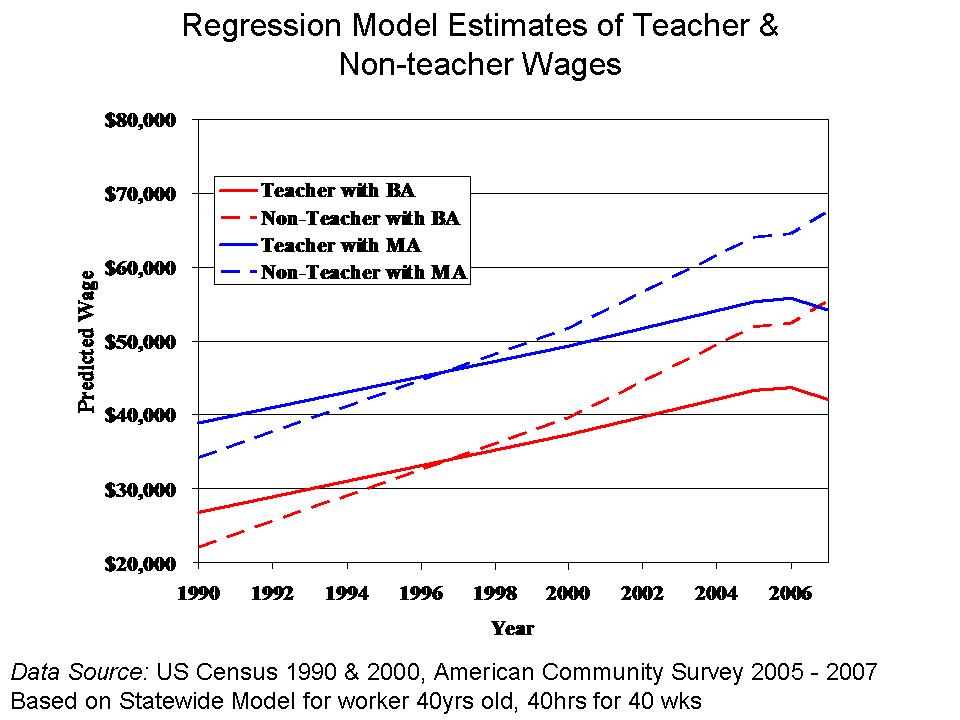
Here are my latest graphs on the topic – first, hourly wages over time by degree level and second, a modeled projection of teacher and non-teacher wages controlling for age, degree level, labormarket, hours worked and weeks worked. The first graph clearly shows that teacher salaries have slid from near 100% (near even) with non-teacher salaries back in 1990 for those with a BA only, to around 80% of the hourly wage of non-teachers with a BA. At other degree levels, teachers have fallen below 80%.

The second graph shows the projected annual wage for a 40 year old working 40 hours per week and 40 weeks per year, at the BA and MA level. This graph actually shows non-teachers with a BA surpassing teachers with an MA at the end of the period.

Note regarding benefits & bias: Corcoran and Mishel point out here: http://epi.3cdn.net/05447667bb274f359e_zam6br3st.pdf that

…overall K-12 teacher compensation was 27.5% greater than teacher wages alone, while overall professional compensation was 23.5% greater than professional wages. These differences in benefit shares translate into a benefits “bias”of 2.8 percentage points in 2006.

That is, benefits would close little of the overall gap in wages. Costrell and Podgursky show about a 5% (slightly less) differential (10% non-teachers, 15% teachers) in the value of pensions, a portion of benefits. This too would close only part of the teacher to non-teacher wage gap in New Jersey, even if we assume New Jersey benefits for teachers to be much greater than other employee benefits.

3) Where are those teacher salaries getting most out of line and what are the implications for property taxes? Is it really because the state has dumped so much funding into those Abbott districts? Or might it be because districts with high income families have chosen to adopt school district budgets which support higher salaries (essentially, canceling out the intended teacher recruitment edge produced by Abbott funding, if there ever was such a competitive edge)?

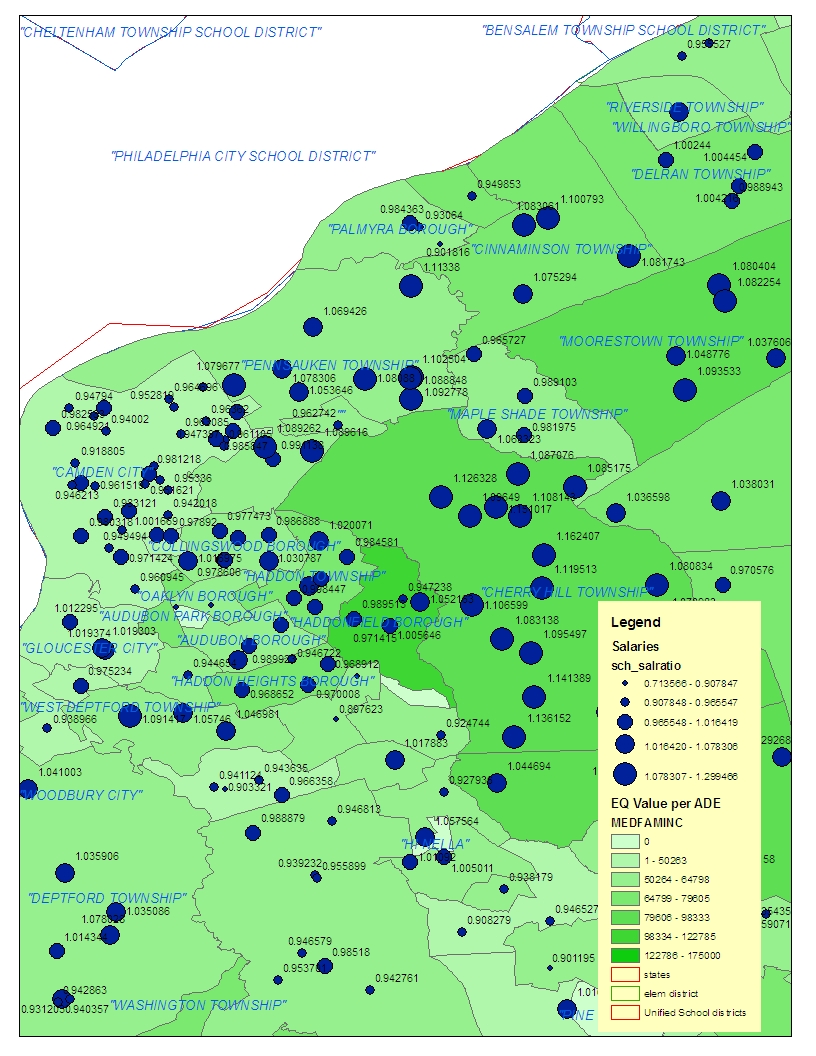
Because I love maps (see charter post), here are some maps of the school level relative competitiveness of teacher salaries – blue circles, overlaid on the median family income of school districts. The blue circles indicate the “relative competitiveness” of teacher salaries in a given school with a larger circle indicating that the actual salaries in that school are greater than the average predicted salaries for teachers with the degree and experience level of teachers in those schools. Schools are compared against others in their own labor market. So, a school identified as a large blue circle, or 1.05 value is a school where teacher salaries are 5% above the average expected salaries for those teachers in that labor market. Note that very low income, high minority urban schools would generally require higher salaries simply in order to recruit and retain comparable teachers. These maps, and competitiveness ratios include only New Jersey districts compared against other New Jersey districts. They do not include, for example, New York state districts which have much higher salaries for comparable teachers.

The first map shows the Newark area, and indeed Newark public schools do have relatively strong salaries, running at about 5% above expected. However, this margin is unlikely to yield teacher equity between Newark and its surroundings. Note that the many of the largest circles and highest competitiveness ratios – 1.12 to 1.14 – are in far more affluent suburbs like Millburn and Livingston. These self-inflicted higher salaries in districts that already provide more favorable working conditions create a competitive disadvantage for all other neighboring districts. The second map below shows the Camden area, where Camden teacher salaries are relatively non-competitive (as the district has increased quantities of staff rather than salaries over time) and where surrounding higher income suburbs have outpaced Camden city and other middle class suburbs.

This does all raise some fun questions regarding the property tax debate. One might argue that these high spenders are doing so on property taxes – high property taxes in fact. Actually, my previous analyses show that these wealthy communities with high teacher salaries actually have lower property taxes as a percent of income. If there is a squeeze going on here, that squeeze is at the juncture of the relatively lower teacher salaries and relatively higher local property tax burden (as a share of income) in middle to lower middle wealth communities who are trying to keep up with their affluent neighbors, but are less reliant on state aid than poor urban districts.

So, to conclude this rant – I’m having some trouble accepting the basic assumption that New Jersey teacher salaries are spiraling out of control, on either of the first two bases I discuss above. And further, I’m having some trouble accepting the notion that the spiraling salaries are a function of a statewide teachers’ union and strongly imbalanced mediation process. Rather, it would appear to me that very high income districts are simply choosing to spend what they can, and that it may be reasonable for these very districts to cut back, if their communities wish to do so. Actually, from a state policy perspective and especially from an equity perspective, if the current administration wishes to maintain the critical leverage provided by poverty-based funding to poor urban districts, the administration might wish to take a look at holding back the salary growth in the most affluent neighbors of the poorest urban districts. But, the notion that interventions are required to hold back all teacher salaries (with emphasis on those runaway urban districts) seems misguided.

See also: http://greatlakescenter.org/docs/Think_Twice/TT_Manhattan_Teacher%20Pay.pdf

for a discussion of technical problem’s with Jay Greene’s teacher salary analysis which is often used to argue that teachers are very well paid on an hourly basis. This is not directly relevant herein, because the analysis above deals with NJ teachers specifically, and uses more appropriate data for such analysis (the same data used by the National Center for Education Statistics for estimation of regional wage variation and for estimating teacher wages relative to other professional wages here: https://bush.tamu.edu/research/workingpapers/ltaylor/Comparing_Teacher_Salaries.pdf )

More Fun with New Jersey Charter Schools

LINK TO UPDATED SPREADSHEET OF FREE LUNCH AND SPECIAL ED DATA

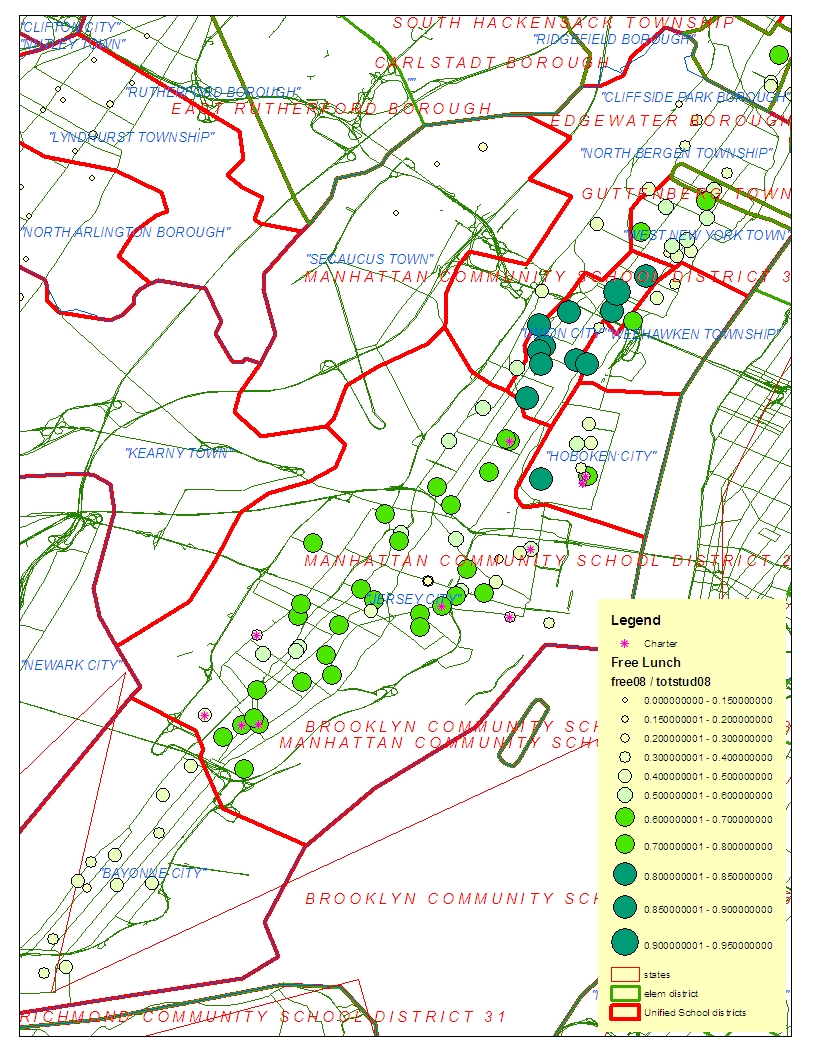
I love maps. I love GIS software. This is a particularly interesting one related to the shares of children who qualify for free (not free or reduced, but free only, a poorer population) lunch in traditional public schools and in charter schools in Newark. One reason why mapping is useful here is that it is important to compare school demographics with other nearby schools, rather than district average. This map of a portion of Newark pretty much speaks for itself. Click to enlarge the map (to read the free lunch ranges on the key). Clearly, two of the “high performers” among charters – North Star and Robert Treat, have noticeably lower free lunch rates than other schools around them (except for other special schools).(CS indicates Charter School)

Data for this map were acquired from the National Center for Education Statistics Common Core of Data – Public School Universe Survey for 2007-08. These data include latitude and longitude for schools, which may not be perfectly precise. But, they are pretty good overall.

While I’m at it – here are the Jersey City Charters – even more striking differences:

Stepping back a bit to see more charters and taking off the names for clarity, here’s what all of Newark looks like, including some other neighboring towns. Charters have a pink asterisk. Again, smaller circles in lighter shades are lower free lunch schools. There are a few charters that are moderate to higher poverty – similar to many Newark schools (bright green, medium size bubble). However, many charters are the lowest poverty schools to be found. The same is true in the second map below for Jersey City.

Recall from previous posts that Charters are even more different from their neighbors in terms of the numbers of special education and limited English proficient students they serve. Their one saving grace was that they did seem to have relatively high shares of students qualifying for free or reduced price lunch. But, as I have noted in previous posts, they seem, on average to be taking in the less poor among the poor – at least the “model charters” do.  That’s simply not scalable reform. Claims by NJ Charter advocates that these schools are serving the same, high poverty, needy student populations as other schools in their neighborhood are simply wrong – and not supported by any legitimate, fine-grained analysis (and it doesn’t even have to be that fine grained).

Note: One error in other analyses that compare charter school free or reduced lunch rates to district average rates is that those analyses fail to compare by grade level. Few charters in New Jersey are High Schools. High schools on average have lower rates of children qualifying for free/reduced lunch for a variety of reasons – primarily reporting issues. So, if you compare a bunch of elementary schools to a district average which includes high schools, you are likely to show that the elementary schools have higher average free/reduced lunch rate. But it’s not a correct comparison. Charter schools should be compared by grade level to their nearest neighboring and/or sending schools. I’ve not yet run the relevant spatial statistics above.

So, here are a few basic guidelines for future comparisons:

1) compare by relevant grade level because of the way in which subsidized lunch rates shift from elementary to secondary school;

2) while it’s okay to evaluate free and reduced shares, it is also important to slice those shares because children in these categories differ by family background. Looking only at the sum of free and reduced conceals substantial differences in student populations across charters and traditional public schools;

3) compare by location.

========

Here’s some follow-up data on New Jersey Charter School demographics. Here are the comparisons of disability rates and free lunch shares for Newark and Jersey City Public (Traditional Public) schools by grade level and the disability rates and free lunch shares for Charter schools often cited as outperforming the host district. Note that most claims that these schools outperform the host district use all kids’ test scores, not just general student test scores. So, differences in shares of children with disabilities make a huge difference in proficiency rates. I show this in previous posts on this thread (New Jersey Charter Schools).

Special Education

Note: A knowledgeable reader has informed me that the “0” value for Greater Newark Charter is actually “missing data,” for that year and has assured me that Greater Newark Charter does indeed enroll children with disabilities. At some point, I may get around to updating these analyses.

% Free Lunch

Note that the highest flyin’ charters (Treat and North Star) have substantially lower free lunch shares than the host district in addition to having very low special education rates. Only Marion P. Thomas has a relative high free lunch share, but has very few special education students.

Racial Achievement Gaps and Within-District Funding Inequity

I’ve written on this blog on a number of occasions, comments regarding the relative significance of within versus between district funding inequities. For example, I’ve explained (in response to an absurd claim by pundits from Education Trust) that southern states have not, in fact, substantively resolved between district funding disparities – leaving only district allocation policies to blame for persistent inequities.

A Center for American Progress report claims:

One of the most harmful manifestations of this is that local school district funding is allocated in a way that hurts poor and minority students. A study by the Thomas B. Fordham Institute found that educational funding is being allocated on the basis of “staff allocations, program-specific formulae, squeaky-wheel politics, property wealth, and any number of other factors that have little to do with the needs of students.”1

The outcome of such practices is predictable: A further widening of the dangerous achievement gap that has become endemic in American schools today.

http://www.americanprogress.org/issues/2008/06/pdf/comparability.pdf

Notably, some of the above concerns raised in the Fordham report are between, not within-district concerns (property wealth related disparities), but the CAP report focuses on within district disparities as the central issue.

I have a forthcoming article (which I will forward by request) which explains that the existing literature which claims that within-district disparities far outweigh between-district disparities is problematic at best, drawing premature if not entirely unfounded and overextended conclusions. This is not to deny the problem of within district disparities but rather to point out that between district disparities persist and must be addressed either simultaneously with or as a precursor to resolving within district disparities.

Many pundits who wish to shift focus entirely onto within district disparities, blaming districts instead of state funding policies, seem to base their arguments on the idea that within-district funding disparities are the reason for persistent racial achievement gaps. Their story goes… that over the decades through the 1990s, states fixed between district funding disparities and achievement gaps improved. Since that time however, improvement to achievement gaps has stagnated if not backslid (true), with pundits arguing that the persistent within district disparities are the cause (unlikely). That is, that individual school districts are now funding their non-poor, white schools well and depriving their poor minority schools. That districts are allowing their better teachers to transfer from the high poverty, black schools to their low poverty white schools. There are certainly cases where this is true (Cincinnati accomplishes this through its weighted student funding formula by weighting gifted children more than poor children).

As a broader policy concern, the above argument might make sense if, in fact, student populations across schools within districts varied widely but that student populations vary less between districts. That is, it might make sense to argue that between-school within-district funding disparities are causing racial achievement gaps if racial minorities and whites attended the same districts but not the same schools. But that’s not always, or often the case, especially in densely populated states and metropolitan areas which included many small school districts.

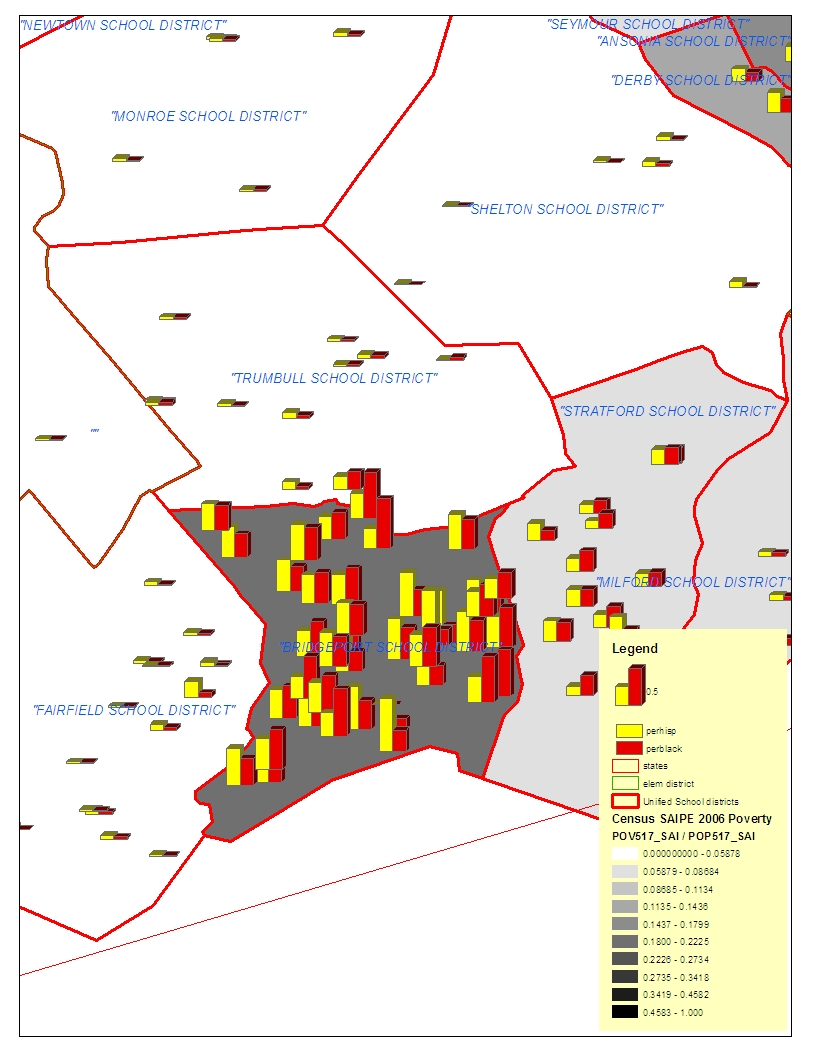
Allow me to use Connecticut – a state with among the largest racial achievement gaps – as an example. Here’s the racial composition (black enrollment share in red bars, Hispanic share in yellow bars) for Hartford area school districts (click to enlarge). Those flat bars in other districts are schools with few or no black or Hispanic children.

In Connecticut, like New Jersey or like the Chicago metro area, school districts tend to be either minority or white – not a balanced mix sorted across schools. Hartford, in this case, can only re-allocate resources across schools that are all approximately 99% poor, and either majority black (north end) or majority Hispanic (south end) schools (except for the magnet schools which serve relatively smaller portions of the district population).

New Britain, to the southwest of Hartford can allocate resources across predominantly Hispanic schools or other predominantly Hispanic schools.

Meanwhile, West Hartford, Simsbury, Avon, Newington, Wethersfield and others can allocate resources across white schools and other white schools (some in West Hartford having modest minority populations)

Here’s the New Haven area:

And the Bridgeport area:

So, at least in Connecticut, it would appear highly unlikely that within- district resource allocation across schools could be fueling their large achievement gaps. That’s because – for the most part – the minorities attend some districts and the whites attend other districts. That’s not to say there aren’t likely some pretty big within district funding disparities in these districts, but in some districts those disparities exist between blacks and Hispanics, or Hispanics and other Hispanics, blacks and other blacks and  in the other districts the disparities are between whites and other whites. For the most part, minority students attend minority districts and white students attend white districts in Connecticut. Patterns are similar in the Chicago metro area and in New Jersey.

Yes there are exceptions – racially integrated middle class inner-urban-fringe and suburban districts. But these exceptions do not account for the majority of minority or white students by any stretch of the imagination. And yes, in these exception districts, there are often very large achievement gaps even within schools. That is a separate and equally important (though smaller in magnitude) story.

It is an absurd stretch, however, to blame between-school within-district allocation policies for large achievement gaps in states like Connecticut, where minority students and white students attend different districts, much more so than different schools within the same districts.

See my previous post on between-district disparities in Connecticut here:

https://schoolfinance101.wordpress.com/2009/08/19/random-thoughts-on-ct/

Here are the scatterplots of the school level free/reduced lunch rates and black and Hispanic concentrations for the above urban CT districts – elementary schools. Dots in red are schools within the district in question. Blue dots are schools in all other districts, including the other urban districts. Note that in Hartford and Bridgeport in particular, all elementary schools are high poverty and high minority concentration. New Haven is more diverse, but still less diverse than the statewide (between district) distribution.

CT School Demographics-Elementary

Education Week Does it Again: Please STOP!

Education Week has again posted the problematic QUALITY COUNTS indicator system including grades for school finance across the states. And again, Education Week has paid little attention to producing high quality indicators for measuring …quality? Why doesn’t that surprise me? But, they’ve made my life easier because I can simply refer you to my critique of last year’s Quality Counts School Finance Indicators:

https://schoolfinance101.wordpress.com/2009/01/08/education-week-quality-lacks/

Here are a few quick summary points on issues that occur year to year:

  • Ed Week uses “range” measures and “coefficient of variation” measures in its equity analysis – measures which capture overall variations and high to low variations in current expenditures across school districts. The way that Education Week calculates these measures actually penalizes states which target funds to higher need school districts, including higher poverty school districts or very small remote districts. That is, if a state actually makes efforts to accommodate cost differences across districts, they get a lower equity grade from Education Week. THAT’S JUST WRONG! Education Week uses some “cost adjustments” including a regional wage index and a nominal (and completely arbitrary) poverty adjustment. But, states like New Jersey actually provide more poverty-based support than the Ed Week adjustment, resulting in a reduction in the Ed Week equity measures. Ed Week makes no adjustment for costs associated with economies of scale or population density – major factors affecting spending variation across school districts within states.
  • Ed Week continues to use peculiar (though traditional) school finance measures like the McLoone Index to evaluate the share of children within the state who are in districts near the median spending level. This was originally conceived as a within state relative adequacy measure. But, without appropriate consideration for needs or costs, a state can score well on the Ed Week McLoone index by simply having all of its low income children clustered together in one or a handful of districts that spend at the edge of the lower half of the distribution.

Education Week staffers – Please Stop! Quality Counts is very unhelpful because of the extent to which it misinforms. There may be, and in fact are, some good and useful indicators in the report, but there are at least equal numbers of indicators that are entirely misleading. One cancels out the other.

These indicators can have a serious negative policy impact because of the way in which and extent to which they misinform. Drawing from a forthcoming technical report (referring to both Ed Week and Ed Trust indicators):

To illustrate the potential negative impact of these two reports, in 2003 in the context of state school finance litigation in Kansas, attorneys defending the State submitted in defense of the school funding formula, both the Education Trust finding that higher poverty districts had higher revenue per pupil and the Education Week finding that Kansas showed a good McLoone index. The state’s attorneys and local news outlets did not understand why Kansas received good ratings on these indices nor did they care as long as those indices were from highly publicized, publicly recognized sources. Plaintiffs pointed out that Education Trust finding was not a function of systematic poverty related support, but rather a function of small rural school support which left out the poorer urban and large town districts and that the “good” McLoone index was a function of having nearly half of the state’s children and nearly all of the state’s poor minority children attending six districts with below average revenues. These points were difficult to make in the face of media accolades for state’s supposed achievements regarding school funding equity and adequacy. The district court and eventually Supreme Court of Kansas declared the state school finance system unconstitutional, but not without at least a few vocal critics chastising the judges who would give the legislature a failing grade for a school finance system that had received a grade of “B” from a leading national media outlet.

Education Trust is Flat-Out Wrong!!!!!

Sometimes I just get fed up with information spewed in the media which is simply FLAT OUT WRONG!!!! A  major source of FLAT OUT  WRONG information on school funding related issues these days seems to be the Education Trust, an organization which spins itself as an advocate for minority children and children in poverty. Here’s what I read this morning in the New York Times:

http://www.nytimes.com/2010/01/07/us/07south.html

On the other hand, Southern politicians are keenly aware of the need for an educated work force. Spurred in part by school financing lawsuits, more than half the 15 states included in the study already provide more state and local financing to heavily poor or minority districts than to affluent or low-minority ones, according to figures compiled by Education Trust, an advocacy group in Washington. But schools often layer programs on top of programs without analyzing which are effective, said Daria Hall, the trust’s director of K-12 policy.

Now, I can’t find the supposed list of 15 states (apparently, the list of fifteen is from this report)  which Education Trust considers “southern” states, but I can tell you that based on my own extensive analyses, very soon to be released, based on the most recent three years of national data on all school districts, that the claim that more than half of these states “already provide more state and local financing to heavily poor and minority districts than to affluent or low-minority ones” is FLAT OUT WRONG!!!!! I’ll gladly explain to anyone and send documentation of this fact as soon as available. But I assure you, it’s flat out wrong!

Let’s consider school funding at two levels: 1) between state differences for districts of similar characteristics and 2) within state differences in funding across districts based on district poverty level.

At both of these levels, southern states continue to do very poorly, some because they lack the capacity to do much better and others (Lousiana) because they simply don’t try, put up little fiscal effort and serve very few children in their public schools. On the point made by Education Trust – only Tennessee in my most recent analysis shows an upward slope in funding between lower and higher poverty school districts. But, this finding is countered by the fact that Tennessee, after adjusting for poverty differences, economies of scale, population density, etc. comes in DEAD LAST on overall level of funding!

Several southern states are neutral, or flat in their within state funding distributions, like Arkansas, Georgia, South Carolina or Kentucky and the relationship between poverty and funding across districts is not systematic one way or the other. And several southern states still maintain systems where higher poverty, higher minority concentration districts receive systematically less state and local revenue per pupil. I have a forthcoming article in West’s Education Law Reporter (with Preston Green and Joseph Oluwole) on how Alabama in particular has managed to maintain racial disparities.

Coupled with providing systematically less funding for high poverty, high minority districts, many southern states have among the lowest adjusted total state and local revenues per pupil, and have very high percentages of children not even attending the public schooling system (see my previous posts on Louisiana).

I find it absolutely baffling that a supposed advocate for equity in public schooling would make such an absurd and unfounded claim, and follow that claim with the charge that the poor, minority southern school districts have only themselves to blame and that their state legislatures have done their part. (Ed Trust argues above: “But schools often layer programs on top of programs without analyzing which are effective, said Daria Hall, the trust’s director of K-12 policy.”)

This kind of unfounded, ill-conceived, misguided rhetoric is not helfpful to anyone, especially the children in school districts for whom E d Trust claims to advocate.

Quick follow up on the “spurred in part by school funding lawsuits:” Here’s a map of where school funding lawsuits have been successful, where they have not, and where they have not been filed: http://www.schoolfunding.info/states/state_by_state.php3 Notice that in several southern states (all of the deep south), these funding lawsuits have been won by states or dismissed or never filed (Mississippi).

====

Just for fun, here are some graphs of the relative state and local revenue per pupil – relative to the labor market average for each district – for the southern 15 states referred to above. In the graphs, larger (enrollment) districts are represented by larger bubbles. What to look for: If a state really was systematically targeting significantly greater funding to higher poverty districts, districts on the right hand side of these figures would be systematically above the 1.0 line. That is, districts with high poverty would have more – systematically and substantially more – state and local revenue than the average for districts in their labor market. There are no additional adjustments made here (no poverty weights used, etc.). When Education Trust calculates its “Funding Gaps” it simply takes the average of of the top and bottom districts, ignoring all in between and ignoring whether those averages are representative of any actual pattern. Further, even if the average difference in funding per pupil is 50 cents for the high poverty versus low poverty group, apparently that would count as targeting to higher poverty. Here are the slides of the actual patterns for 2006-07.

Southern 15 States

Disg-RACE to the TOP?

Here’s how Dems for Ed Reform characterizes Louisiana’s education reform efforts in relation to the federal Race to the Top competition:

Louisiana. The state passed legislation by Rep. Walt Leger III (D-New Orleans) lifting its charter school cap in June at the end of its legislative session. Louisiana is also pioneering an accountability system that tracks graduates of teacher training programs so that they can be held accountable for the performance of the teachers they train and so that their programs can be improved and/or revamped. A “unified group” of education and community-based organizations launched a statewide RttT effort in August.

http://www.dfer.org/2009/12/who_would_have.php

Note that I’m merely using this description as an example. DFER is far from the biggest offender when it comes to heaping praise on Louisiana.

Most pundits seem to agree that Louisiana is a front-runner to receive race to the top funding primarily because of its efforts to increase data and link student data to teachers (for practical issues on this point, see: https://schoolfinance101.wordpress.com/2009/12/04/pondering-the-usefulness-of-value-added-assessment-of-teachers/) and for the state’s lack of caps on numbers of new charters which can be granted per year.

I continue to argue, however, that even if these to factors are signs of “innovation” or an environment to support “innovation,” that innovation without real investment or true commitment is doomed to fail. Louisiana is the perfect example of the insanity that is race to the top. I pick on Louisiana here because it is such an absurd case, and because it is illustrative of the myopic and misguided criteria being used to evaluate innovation, and even more so, illustrative of the utter lack of critical thinking and analysis by pundits and ill-informed media-junkies, ed-writers and twitterers (who seem to lack any ability to critically evaluate … anything… but will re-tweet anything that praises Louisiana’s RttT application).

Let’s take a look at Louisiana’s education system. Yes, their system needs help, but the reality is that Louisiana politicians have never attempted to help their own system. In fact they’ve thrown it under the bus and now they want an award? Here’s the rundown:

  • 3rd lowest (behind Delaware & South Dakota) % of gross state product spent on elementary and secondary schools (American Community Survey of 2005, 2006, 2007)
  • 2nd lowest percent of 6 to 16 year old children attending the public system at about 80% (tied with Hawaii, behind Delaware) (American Community Survey of 2005, 2006, 2007). The national average is about 87%.
  • 2nd largest (behind Mississippi) racial gap between % white in private schools (82%) and % white in public schools (52%) (American Community Survey of 2005, 2006, 2007).  The national average is a 13% difference in whiteness, compared to 30% in Louisiana.
  • 3rd largest income gap between publicly and privately schooled children at about a 2 to 1 ratio. (American Community Survey of 2005, 2006, 2007)
  • 4th highest percent of teachers who attended non-competitive or less competitive (bottom 2 categories) undergraduate colleges based on Barrons’ ratings (NCES Schools and Staffing Survey of 2003-04). Almost half of Louisiana teachers attended less or non-competitive colleges, compared to 24% nationally.
  • Negative relationship between per pupil state and local revenues and district poverty rates, after controlling for regional wage variation, economies of scale, population density (poor get less).
  • 46th (of 52) on NAEP 8th Grade Math in 2009. 38th of 41 in 2000. http://nces.ed.gov/nationsreportcard/statecomparisons/
  • 49th (of 52) on NAEP 4th Grade Math in 2009. 35th of 42 in 2000.

So, this is a state where 20% abandon the public system and 82% of those who leave are white and have income twice that of those left in the public system, half of whom are non-white. While the racial gap is large in Mississippi, a much smaller share of Mississippi children abandon the public system and Mississippi is average on the percent of GSP allocated to public education. Mississippi simply lacks the capacity to do better. Louisiana doesn’t even try. And they deserve and award?

I read an article the other day that was uncritically tweeted (http://www.washingtonpost.com/wp-dyn/content/article/2009/12/12/AR2009121202631.html), explaining how Louisiana has adopted this great new teacher evaluation system. But, hey, look above. Louisiana ranks right near the top of the pack on the percent of all public school teachers who attended the least competitive colleges (which matters). Why worry about a dysfunctional supply pipeline for teachers? You wouldn’t want to consider the possibility that improved teacher wages and working conditions and investment in higher education could possibly improve that pipeline? A good teacher evaluation system will wash that  supply problem away!

Quite simply, if you’ve got the academically weakest teachers to begin with and you’ve got a system where 20% of students, almost entirely white from households with twice the average income leave the system, and where you’re putting about the lowest share of your state productivity into schools, and where your kids continue to score near the bottom on national assessments, all the data and supposed accountability in the world is not going to make much difference. Throwing RttT money into this mess isn’t likely to help much either. Applying a business investment mindset, Louisiana schools are certainly not a product line in which I’d invest my own hard earned money (but wait, RttT is ours, isn’t it?). That is, if I bother to think critically for a minute or two.

While I sympathize with the 80% of children left in Louisiana public schools, it is not the federal gov’t via RttT that is going to begin to dig them out of the hole in which they’ve been buried for decades by their own political leadership. The state of Louisiana must step up first, and big-time. The state must invest sufficiently in public schools to improve quality to the point where some of the wealthier and whiter families might actually opt back into the public system. At the very least, the state should be required  to put up “average” fiscal effort (% of GSP to schools) if it wants an award and should be required to show that it has targeted money to the highest need schools and children. Louisiana needs a stick, not a carrot!

Heaping mindless tweeted and re-tweeted praise on Louisiana is incredibly unhelpful and quite honestly, a bit embarrassing!  State data systems and charter caps cannot alone solve the world’s problems and certainly can’t solve Louisiana’s self-inflicted ailments.

Let’s hope the federal government can see through the smokescreen that it is at least partially responsible for creating, and make good use of RttT funding. Dumping that funding into states such as Louisiana or Delaware, Colorado, or Illinois is probably not best use. See: https://schoolfinance101.wordpress.com/2009/12/14/racingwhere/)

I have written previously about Louisiana among other states, here: https://schoolfinance101.wordpress.com/2009/12/15/why-do-states-with-best-data-systems/

And here: https://schoolfinance101.wordpress.com/2009/02/25/public-schooling-in-louisiana-and-mississippi/

Why do states with the “best” data systems have the worst schools?

Okay, so the title of this blog is a bit over the top and potentially inflammatory, but let’s take a look at those states, which, according to the Data Quality Campaign, have achieved the best possible state data systems by having all 10 elements recognized by the campaign. I should note that I appreciate the 10 data elements, especially as a data geek myself. It’s good stuff and this post is not intended to criticize the Data Quality Campaign. Rather, this post is intended to question whether this focus – or obsession – we have had of late, to rate the quality of state education systems by two criteria alone – a) whether they have certain data linked to certain other data and b) whether they have caps on charter schools – has created an unfortunate diversion. This obsession has caused us to take our eye off the ball – to applaud states who have, in reality, put little or no effort into improving their education systems – states who have, over time, dreadfully under-supplied public schooling, and states who have consistently produced the lowest educational outcomes (not merely as a function of the disadvantages of their student populations).

So, here’s a quick run-down. First, let’s begin with a look at the number of data quality elements compiled by states in relation to the percent of Gross State Product (Gross Domestic Product by State) allocated in the form of State and Local Revenue per Pupil to local public schools. There’s no real tight relationship here, but as we can see, Delaware, Louisiana and Tennessee are 3 states which now have all 10 data elements – HOORAY – but have very low educational effort. Utah and Washington also have low educational effort.

This might be inconsequential if it was… well… inconsequential. That is, if there was also no relationship to educational outcomes. Here’s a plot of the mean NAEP Math and Reading Grades 4 and 8 for 2007 (% Proficient) along with # of Data Quality Elements. In this case, there’s actually some relationship. Yep, states with better data have lower outcomes. Maybe having better data will increase the likelihood that they figure this out. A somewhat unfair argument given that many of these states are relatively poor states, but it’s not all about poverty (in fact, higher poverty would require greater effort to improve outcomes – but it doesn’t play out that way for these states. See this post for a discussion of poverty variation across states). Low effort, low performing, but high data quality states include Lousiana and Tennessee.  Yet, somehow, when viewed through a data quality lens alone – these states become superstars!

This next figure looks at the predicted per pupil state and local revenue in each state for a district having 10% poverty (relatively average for U.S. Census Poverty rates). The point here is to compare a truly comparable state and local revenue figure corrected for poverty variation, regional wage variation, economies of scale and population density. Here, we see that Utah and Tennessee (again) are standouts – having the lowest state and local revenue per pupil. Recall that both are also low to very low effort. Their revenue to districts is not low because they poor, but rather because they don’t put up the effort. But hey, they’ve got great data!!!!!

Another relevant “effort” related point to consider is just how many children of school age in the state are actually even served by the public system. If we were discussing child health care across states or even pre-school, we would most certainly consider the extent of “coverage.” We tend to ignore “coverage” in k-12 education because we too often assume near universal coverage. But that’s not the case. And coverage varies widely across states. Here, I measure coverage by the % of 6 to 16 year olds (American Community Survey of 2007) enrolled in public schools.

Not only are Lousiana and Delaware very low in their effort for schools, and Lousiana low on outcomes, both are also very low on Coverage. They don’t even serve 80% of 6 to 16 year olds in their public school system (remember, charter schools are part of the public system)!!!! Yet somehow, having good data on those who remain in the public system is a substitute making the state worthy of praise!!!!!

One might speculate that these differences are mainly about the wealth of states – especially when it comes to the ability of states to spend on their schools and the outcomes achieved in those schools. This is indeed true to a significant extent. But, as it turns out, the effort a state puts up toward public school spending is actually more strongly related than wealth (per capita gross state product) to predicted state and local revenues per pupil. That is, states which put up more effort, do raise more per pupil for their schools. Yes, states like Mississippi are at a disadvantage because they lack wealth. Tennessee and Utah have much less excuse! Delaware’s unique economic position allows it to raise significant revenue with little effort.

Finally, the effort –> revenue relationship would be of little consequence if it was not also the case that the predicted state and local revenue differences across states are associated with those pesky NAEP outcomes. Yes, there does exist a modest relationship (with many entangled underlying factors) between state and local revenues and NAEP outcomes.

There is indeed a lot tangled up in the various relationships presented above. But one thing is clear – DATA QUALITY ALONE PROVIDES LITTLE USEFUL INFORMATION ABOUT THE QUALITY OF A STATE’S EDUCATION SYSTEM! Our obsession with comparing states on this basis has caused us and policymakers to take their eye off the ball (former tennis coach speaking here!). Applauding states and financially rewarding them (RttT) merely for collecting better data with little attention to the actual school systems and children served (or not served) by those systems is, at best, disingenuous. 

To quote John McEnroe – You cannot be serious!