Financing a High-Quality System of Free Public Schools for Florida’s Children

Press Release

Full Report

Slide Deck

Executive Summary

The report that follows draws on a) literature on how and why money matters for improving school quality and the quality of education systems as a whole, b) frameworks for understanding and evaluating state school finance systems, including systems for financing schools of choice, and c) data from national and state sources, on states across the nation, Florida school districts in the context of their national peers and Florida district and charter schools in their local contexts.  The data summarized herein illustrate the following.

First, regarding long term trends in Florida school funding, adequacy and efficiency:

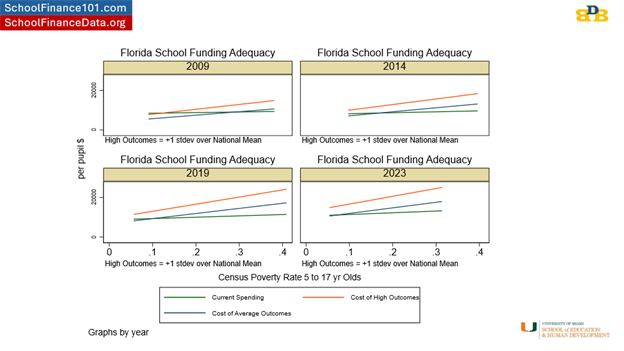
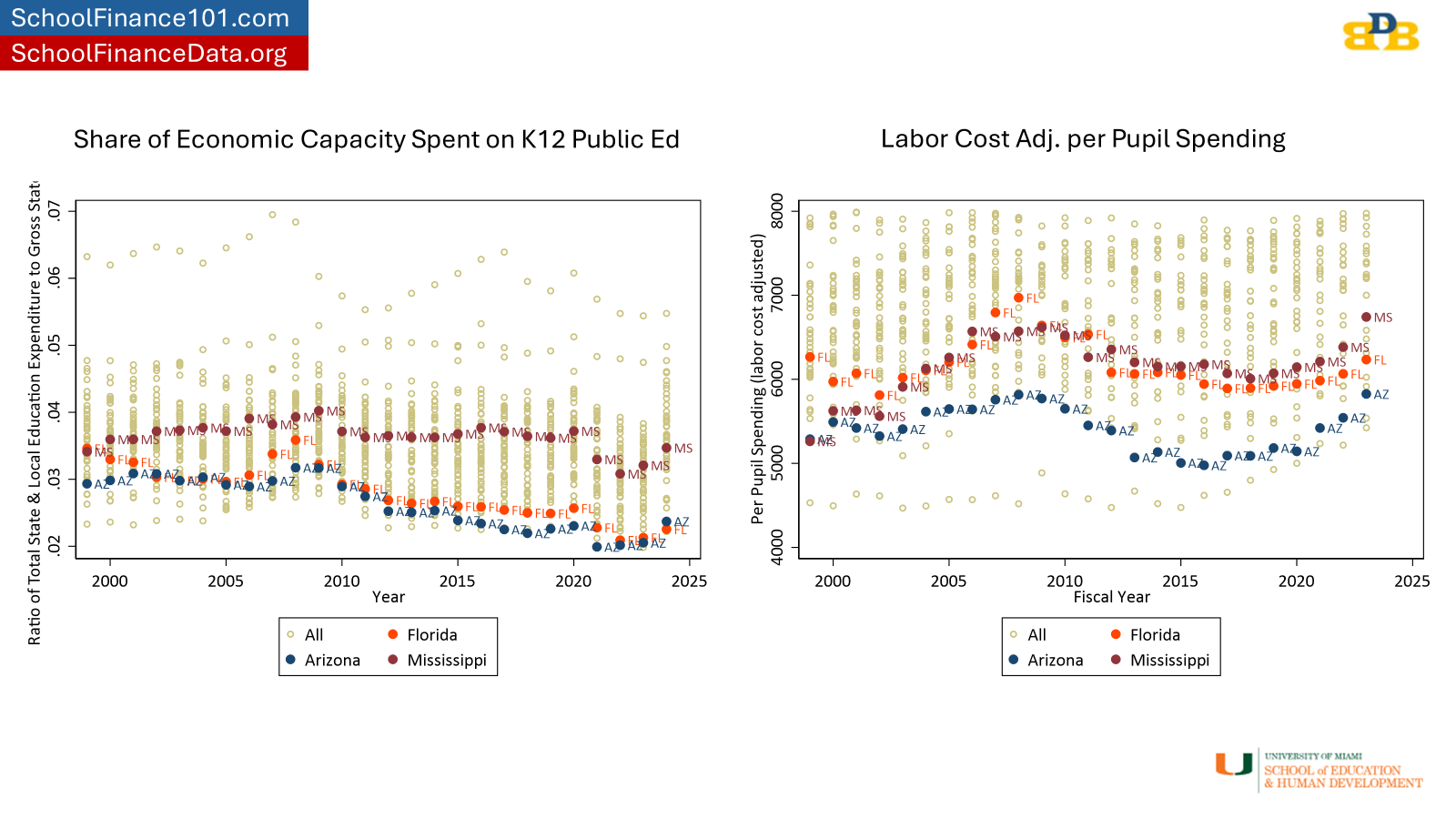
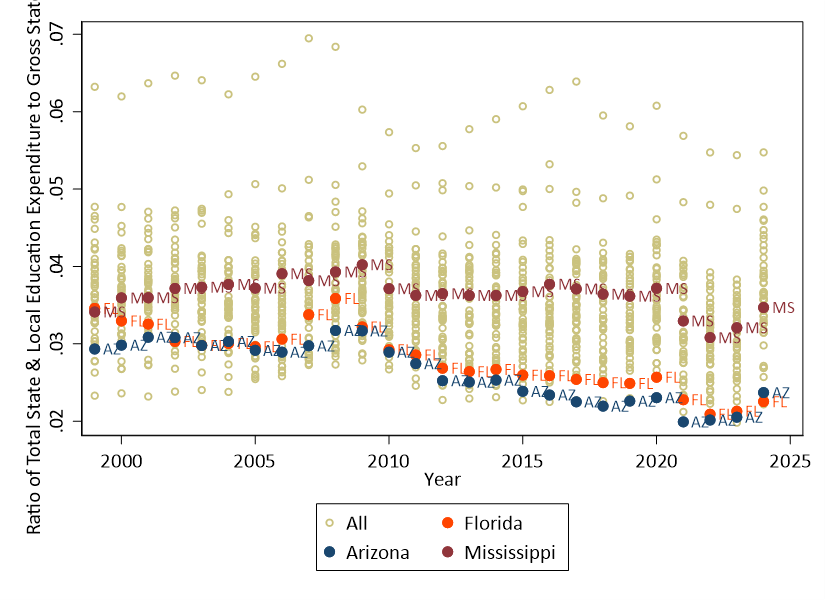
  • Florida schools have been squeezed by declining state aid since the early 2000s as the state has pursued a race to the bottom on taxpayer financing of public elementary and secondary schools, ranking near the bottom among all states in recent years.
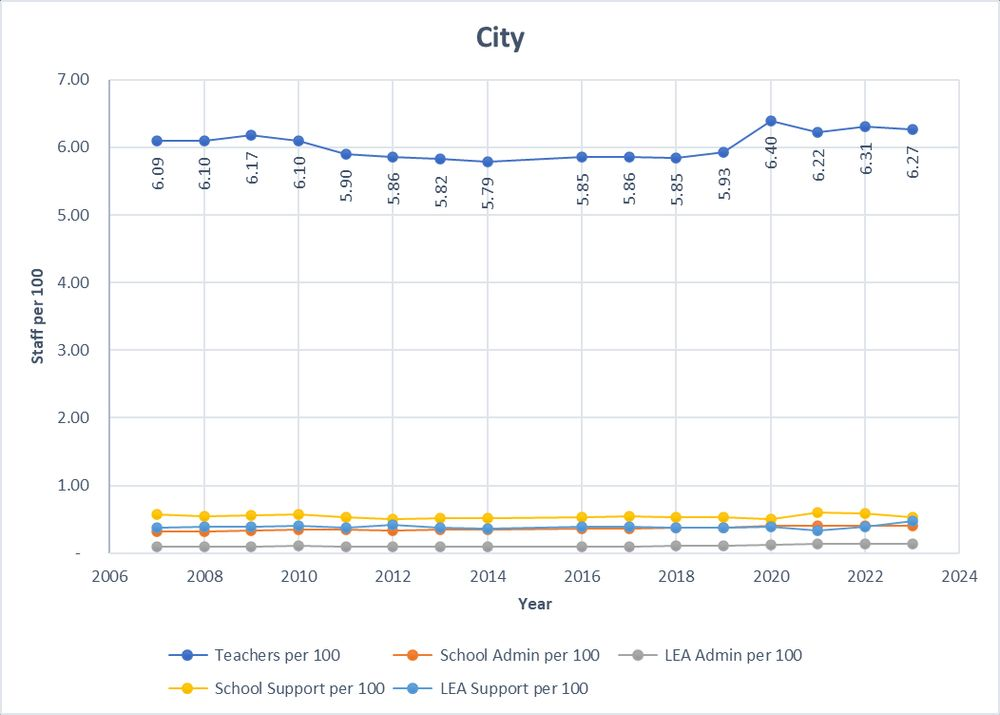
  • That squeeze has resulted in declining competitiveness of teacher wages over time and even more so, declining staffing ratios in schools, increasing the workload on those that remain.
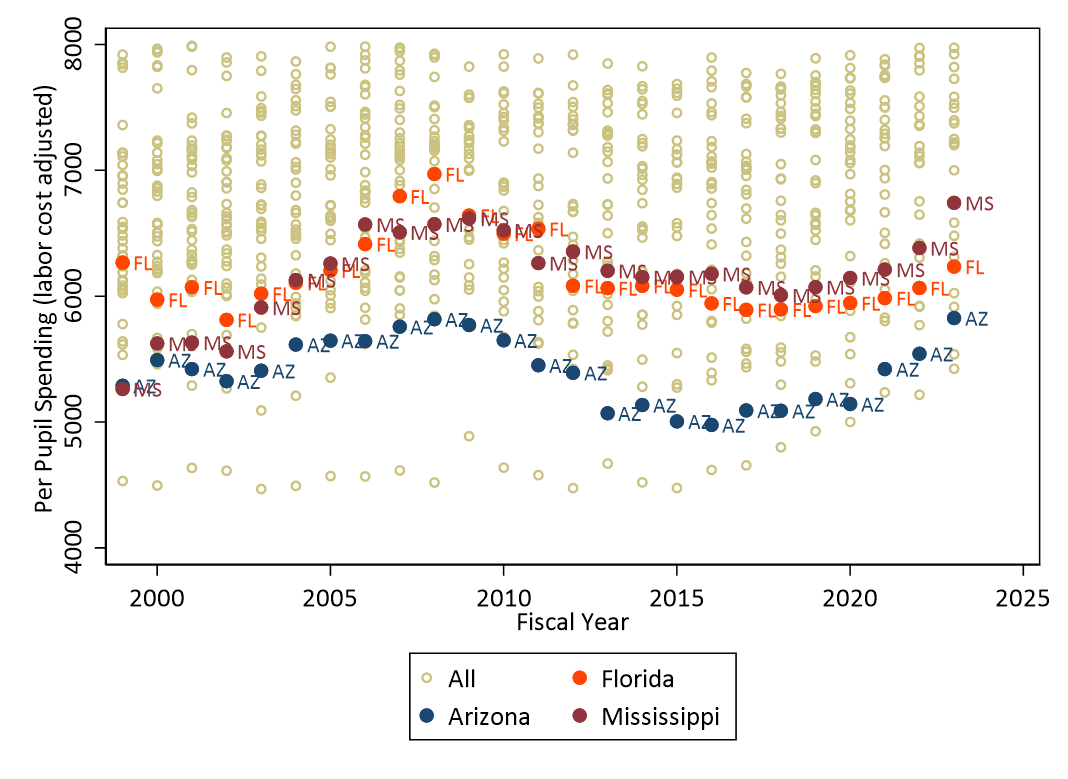
  • Adjusted for labor costs over time, school spending per pupil in Florida and in Miami-Dade specifically, is less than it was 30 years ago.
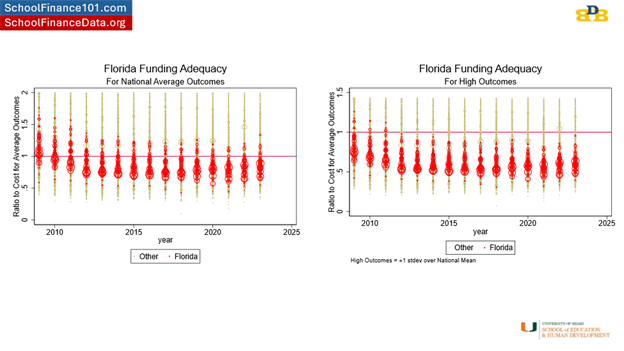
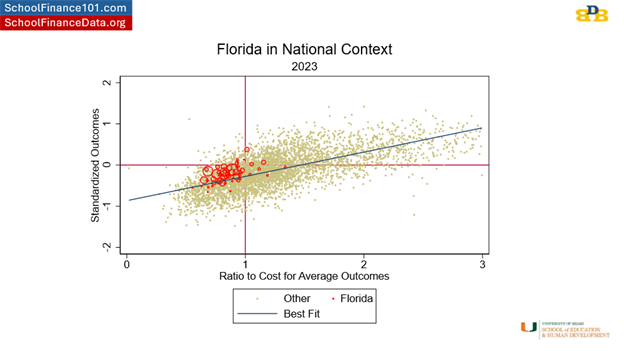
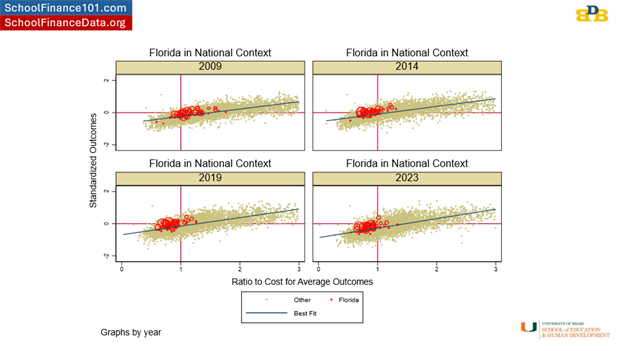
  • Florida school districts have responded by producing achievement levels beyond expectations given the resources they’ve been provided. Florida school districts are efficient when compared to school districts nationally, accounting for differences in costs.
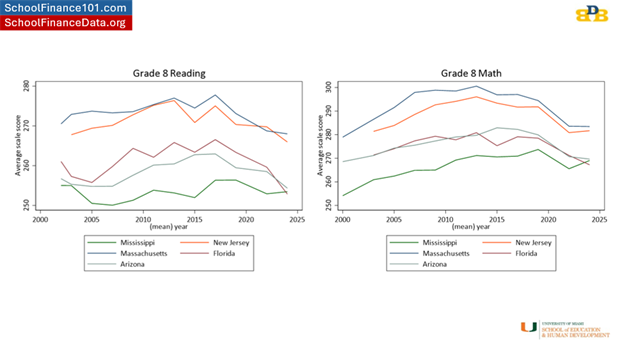
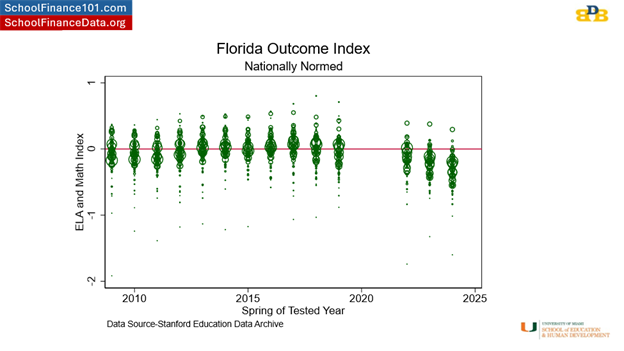
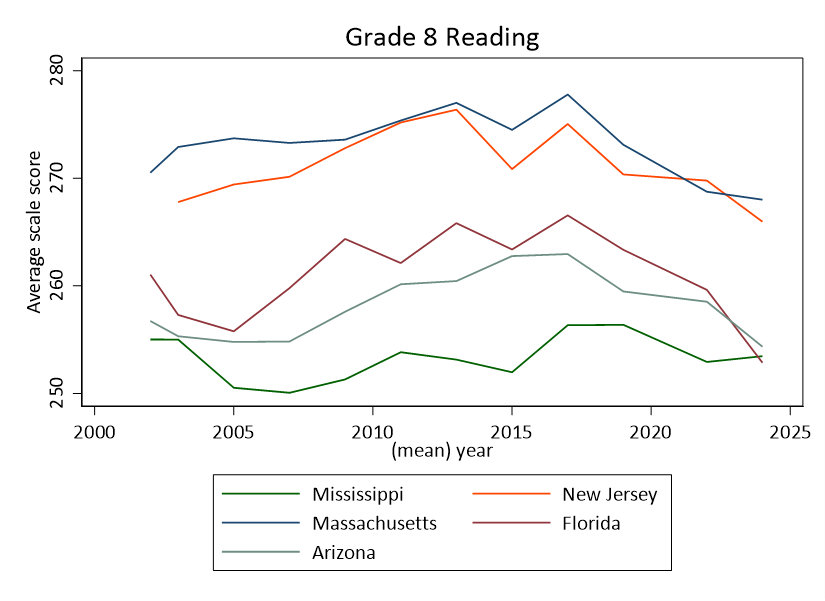
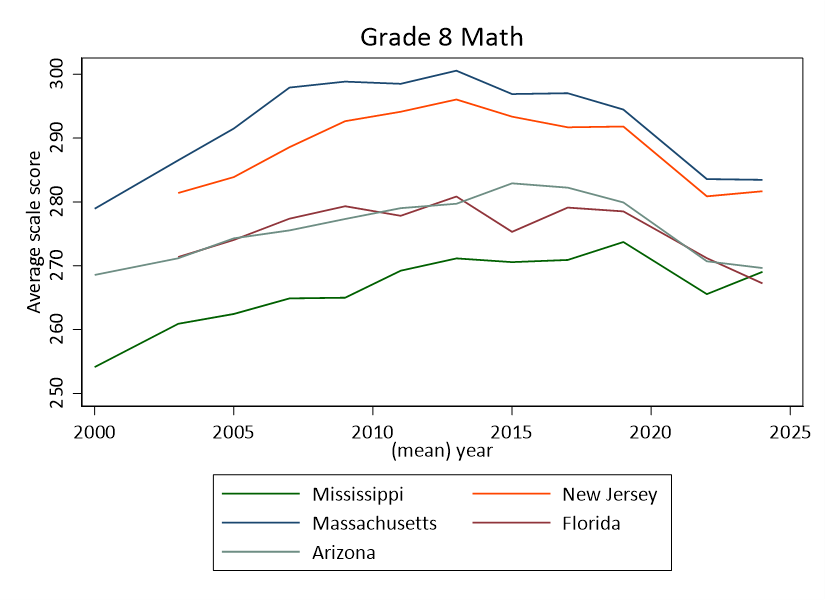
  • But because of the long slow reduction in effort, spending, staffing ratios and competitive wages, student outcomes in Florida have continued to decline, dropping among states and dropping in recent, post-COVID years as other states and the nation, on average, have begun to rebound.
  • As the state has reduced its share of funding for public schooling, local districts have been forced to make up the difference with increased property taxes, to mitigate further damage to student outcomes by slowing the erosion of competitive wages for teachers.

Second, regarding providing equal educational opportunity to all children in Florida:

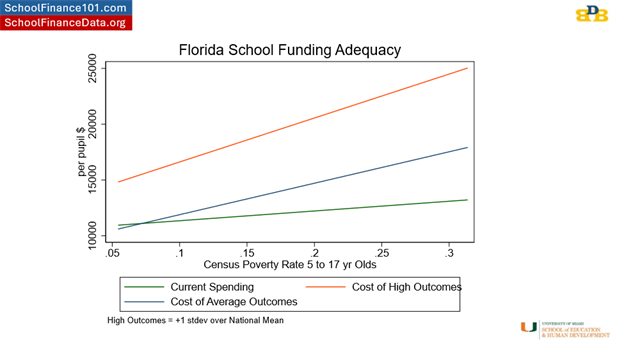
  • The state school finance system provides no discernable support to schools serving students with greater educational needs, outside of additional support for children with disabilities.
  • The state’s charter school sector exacerbates inequality across student populations by operating within low-income neighborhoods, but serving far fewer children from low-income families, fewer children who are English learners and fewer children with disabilities.
  • The state’s charter school sector also yields poor educational outcomes on state assessments when compared to traditional district schools or district magnet schools serving similar populations within the same district.

Finally, regarding spending for the greatest return on investment:

  • The state has currently budgeted $3.8 billion dollars to be spent on students attending private schools, approximately 70% of which will likely be spent on children from higher income families who had not previously attended public district schools. That 70% of $3.8 billion would likely yield far greater return on investment and greater public benefit, based on existing research, if invested in public district schools in high poverty settings.

These findings lead to a clear set of policy recommendations. As shown in this report, the state has the economic capacity to pursue these recommendations. Even at the state’s own prior (2000s) education effort, funding for public schools would be 28% higher than it is presently. Add to that, more efficient allocation of funds currently being diverted to the school voucher program, and much of the state’s public education adequacy gap could be eliminated. As such, we propose the following recommendations:

Recommendation #1 – Phase 1: Engage in the work of setting a manageable standard of “high quality” public schooling for Florida’s children by engaging in analyses of the costs associated with providing each and every child in Florida with equal educational opportunity to achieve high education outcomes.

  1. Establish a statewide commission on school funding.
  2. Engage stakeholders in setting standards of excellence for Florida children.
  3. Engage experts to estimate the costs associated with meeting those standards, applying appropriately rigorous methods.

Recommendation #1 – Phase 2: Guided by those estimates, reform the school finance formula and increase state aid to schools so as to provide them with the necessary resources for all children to have equal educational opportunity to achieve high education outcomes. That is, meet the constitutional standard ratified by Florida voters in 1998 and 2002. This should include estimates of commensurate funding for charter schools, based on needs and costs.

  1. Take eliminating or reducing property taxes off the table. The most effective form of property tax relief is increased state aid, as would occur under implementation of this recommendation.

Recommendation 2 – Part 1: Impose a moratorium on charter school expansion, including the Schools of Hope Program. The existing charter school sector in Florida is compromising equity, eroding efficiency and producing poor educational outcomes for those it serves. New York’s Success Academies have no proven track record of serving children like those they’d be called upon to serve in Miami-Dade, having served very few English learners and underserving Latino communities in New York. Like Miami-Dade’s current charter sector, they have also underserved low-income populations and children with disabilities. Introduction of Success Academies in Miami-Dade will likely exacerbate equity concerns that are already significant.

Recommendation 2 – Part 2: Establish new regulations for evaluating existing charter operators and vetting new charter operators to ensure improved equity in the distribution of students by their needs across schools. Adopt and enforce stricter regulations pertaining to student outcomes.

Recommendation 2 – Part 3: Adopt updated charter school legislation to ensure that charter schools are sufficiently “public,” required to operate as if “state actors,” protecting children’s constitutional rights and abiding by all relevant federal statutes.

Recommendation 3: Freeze expansion of the voucher program to free up state resources to support a fully funded, overhauled public school finance formula, to provide a uniform system of free public schools.

What’s up with New York State School Finance?

Full Report

Press Release

Slide Deck

Executive Summary

In this brief, I draw the following conclusions regarding New York’s Foundation Aid formula:

  • Conclusion 1: The current iteration of the Foundation Aid formula does not rationally determine what districts need to spend, or what they actually spend, in order to achieve adequate outcomes;
  • Conclusion 2: The foundation formula has continued to drift further, over time, from funding even its own (inadequate) hypothetical sound basic funding level;
  • Conclusion 3: Standards, goals and context of the education system have changed, with both broader and higher expectations and greater needs and cost pressures across the state.

These conclusions are supported by a series of calculations using publicly available data, showing that the foundation aid formula was built on measures and calculations that could never fully fund districts’ spending needs to meet desired outcome standards, even at the time of adoption. Failure to update the Foundation Aid base with respect to changes in instructional spending for successful, efficient school districts has led to increasing gaps between formula calculations and actual instructional spending needs.

The Foundation Aid formula requires both short term fixes and a longer term overhaul, driven by cost analyses to determine the spending levels needed to achieve today’s outcome standards, for all children across all districts and settings.

Short term fixes derived from the analyses herein include:

  1. Increasing base aid to better reflect general instructional expenditures of successful, efficient districts. The minimum increase justified herein would be 10.75% above next year’s inflation adjusted base. Were that to have been implemented for fy2026, the base would be $9,162 (10.75% above the adopted base of $8,273).
  2. Noting that adjustments for student needs were never based on any empirical analyses, and drawing on related work,[i] I would suggest adding and increasing adjustments for student needs, including adjustments for children from homeless, foster care and migrant families, and increasing weighting for English learners, with each weight being adopted or moved toward 1.0 additional funding. 

In the longer term, over the next year and a half, with intent to reform Foundation Aid for fy2028, the state should conduct a rigorous analysis of the spending required to achieve current desired outcome goals for all children. That analysis must identify a comprehensive spending measure – not merely general instructional spending – with appropriate adjustments for student needs and regional cost variations. Both the base and each adjustment should be grounded in rigorous empirical analysis, which was never done previously. Only by conducting such analysis to inform the calibration of a modern school aid formula can the state be confident that the formula meets the needs of all students, here and now.

Additional Resources

Folder with All AIR Report Briefs


[i] https://cee.tc.columbia.edu/media/centers-amp-labs/cee/publication-pdfs/AIR-Report-2–Student-Outcomes-and-Student-Need—Final-10-29-24-1-1.pdf

ICYMI: Reforming New Jersey School Funding in 2026

Mark Weber’s Summary Post at NJPP

Full Report

Summary

Report Finds New Jersey Must Recalibrate School Funding Formula to Meet Modern Educational Needs

Miami, FL — A comprehensive new study concludes that New Jersey’s two-decades-old school funding formula no longer reflects the costs of educating today’s students to the state’s higher standards—and requires a substantial recalibration to restore equity, adequacy, and effectiveness.

The report, Estimating the Costs of an Adequate Education in New Jersey: Recalibrating the School Funding Reform Act for the Next Decade, authored by Bruce D. Baker, Professor at the University of Miami, provides the first fully data-driven statewide cost model built using school-level expenditure and outcome data from 2019–2024.

Despite New Jersey’s longstanding reputation as a national leader in public education and school funding effort, the study finds that the School Funding Reform Act (SFRA)—enacted in 2008 using cost assumptions built from 2004 data—no longer aligns with current student needs, academic standards, or district demographics.

Key Findings

  • Higher standards and changing student populations have outpaced the funding formula. The current SFRA weights do not reflect the actual costs of meeting today’s academic expectations, especially for students experiencing poverty, multilingual learners, and students with disabilities.
  • Funding progressiveness has eroded dramatically. After two decades of rising equity, New Jersey’s funding distribution is now flatter than in the 1990s, leaving high-poverty districts without the resources needed to match the outcomes of their peers.
  • Many districts operate below the funding levels required to achieve statewide average outcomes. Cost modeling shows substantial gaps between what districts spend today and what is needed to achieve adequate outcomes—particularly in high-poverty communities.
  • Current spending patterns do not match need. The report finds only weak alignment between present school-site spending and the needs of economically disadvantaged students, multilingual learners, and others requiring additional support.
  • A modern cost model identifies the factors that drive the true cost of equal educational opportunity. These include poverty concentration, neighborhood conditions, disability incidence, English learner status, district size, competitive wage variation, and the effects of charter and private school market share.

Major Recommendations

The report outlines several pathways for recalibrating SFRA:

Short-Term (FY 2027)

  • Update and expand student need weights, particularly for economic disadvantage and multilingual learners.
  • Adjust base costs to reflect the actual spending required to achieve current outcome benchmarks.
  • Address underfunding in districts below adequacy.

Mid-Term (FY 2028–29)

  • Overhaul the economic disadvantage measure using a new Economic Disadvantage Index that more accurately captures the relationship between poverty and outcomes.
  • Revisit special education cost structures using updated disability prevalence and placement patterns.
  • Incorporate geographic cost adjustments based on modern wage data.

Longer-Term

  • Strengthen the Education Adequacy Report process to require rigorous, recurring cost analyses.
  • Ensure transparency and public access to data used in calculating formula adjustments.
  • Reassess the structural implications of school district size, population density, and charter expansion on efficiency and equity.

A Call to Action

“New Jersey’s students continue to be among the highest-performing in the nation,” said author Bruce Baker, “but the state’s commitment to equitable, adequate school funding has slipped. The data clearly show that to maintain excellence—and extend it to all children—New Jersey must realign its school finance system with the realities of today’s classrooms.”

The report urges state leaders to use this modeling framework to guide the 2026 Education Adequacy Report and upcoming legislative deliberations on school finance reform.

About the Author

Bruce D. Baker is a national expert in school finance and a professor at the University of Miami. He has led school funding adequacy and cost modeling studies in Vermont, New Hampshire, Delaware, Colorado, Oregon, and Texas, and is co-author of multiple national reports on educational resource equity.

Revisiting Deceitful Claims about School Funding and Outcomes (a thread)

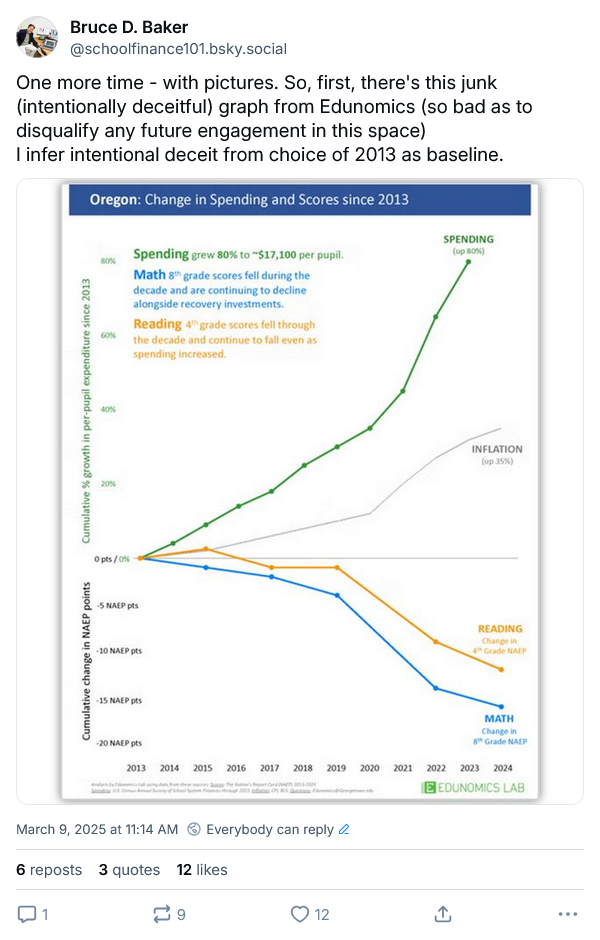
I’ve had enough. This has to stop. I’ve explained on at least a few occasions that there exists a cottage industry for whom their bread and butter is telling state legislatures and judges that money simply doesn’t matter for schools (Merchants of Doubt): That public schools all have more than enough to do what they need to do and they all just need to do better with what they have – especially those over-funded schools in high poverty settings.

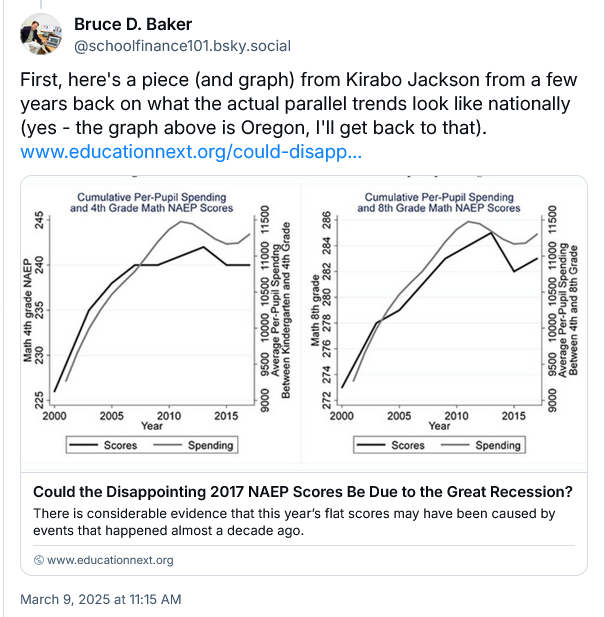
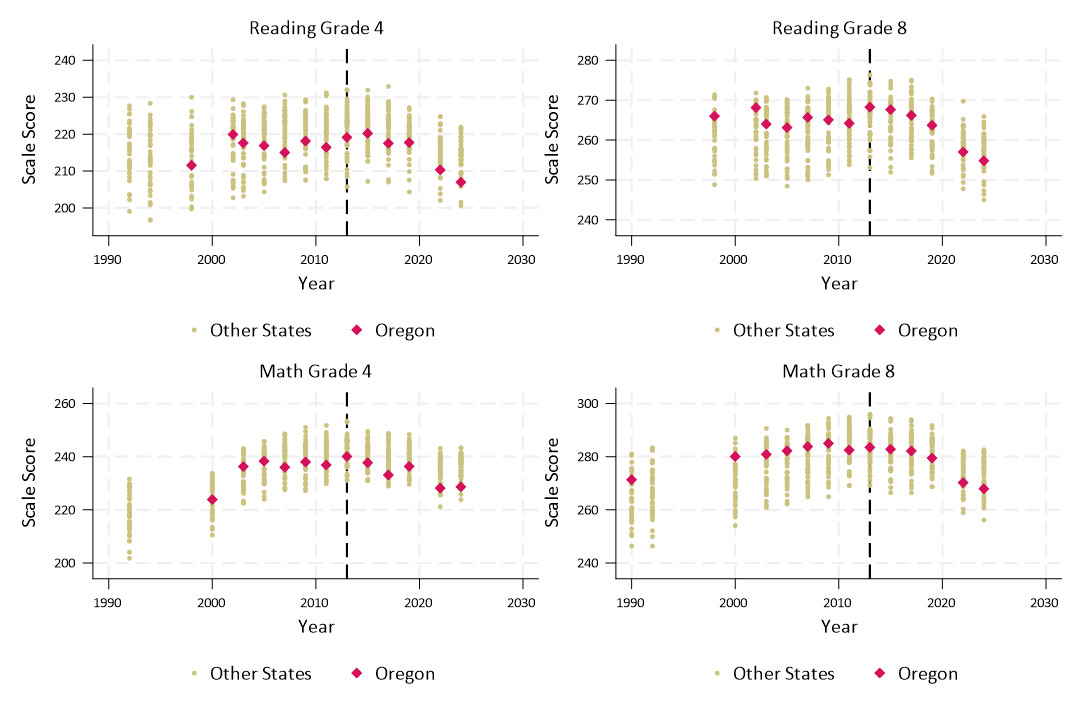
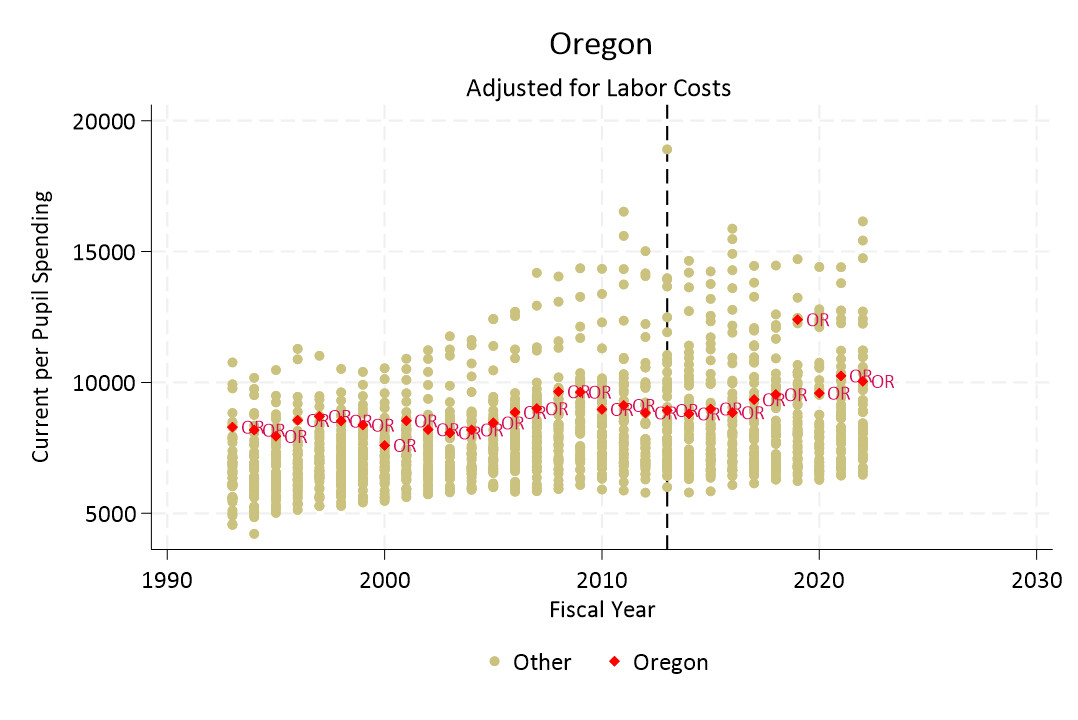
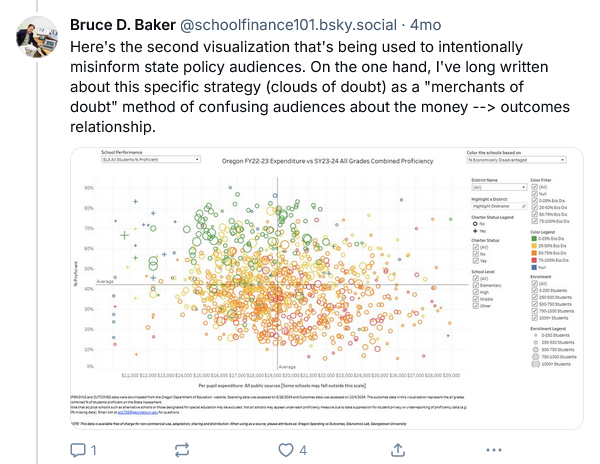
I’ve also explained that the two most disingenuous junk analyses oft used to “display” that money doesn’t matter are various forms of the “long term trend” graph (money went up, outcomes were stagnant or went down, so money can’t matter) and the “clouds of doubt” graphs (with money on the X and outcomes on the Y, there’s no apparent relationship). These bogus assertions and deceitful illustrations should have died a long time ago. Why? because they are bogus and deceitful and because those who now insist on continuing to use them have been informed, over and over again. So they are bogus and INTENTIONALLY deceitful. Period. Full Stop. (and not this author’s first offense by any means)

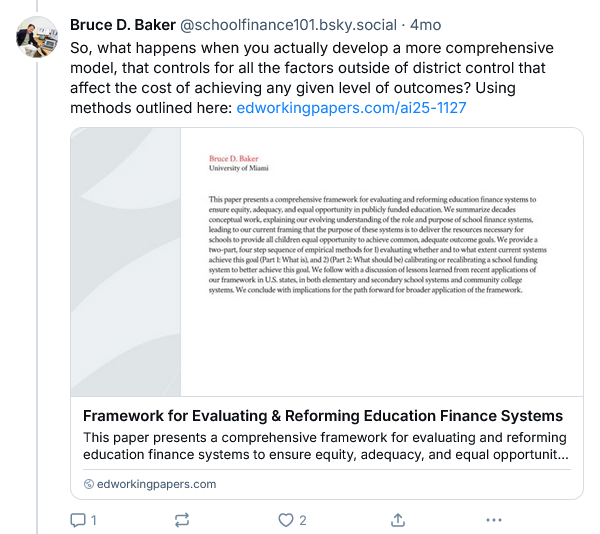
So, here’s a BlueSky thread from a short while back:

The link: https://www.educationnext.org/could-disappointing-2017-naep-scores-due-to-great-recession/

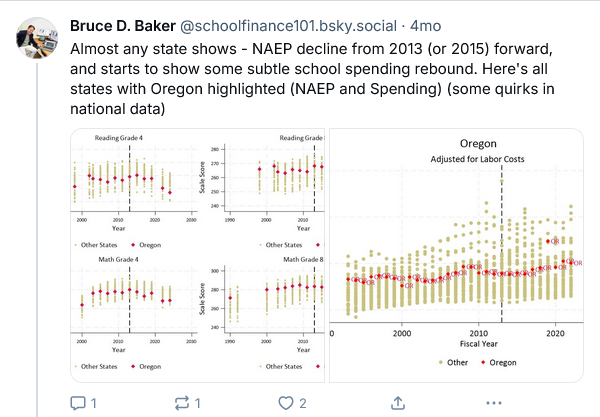
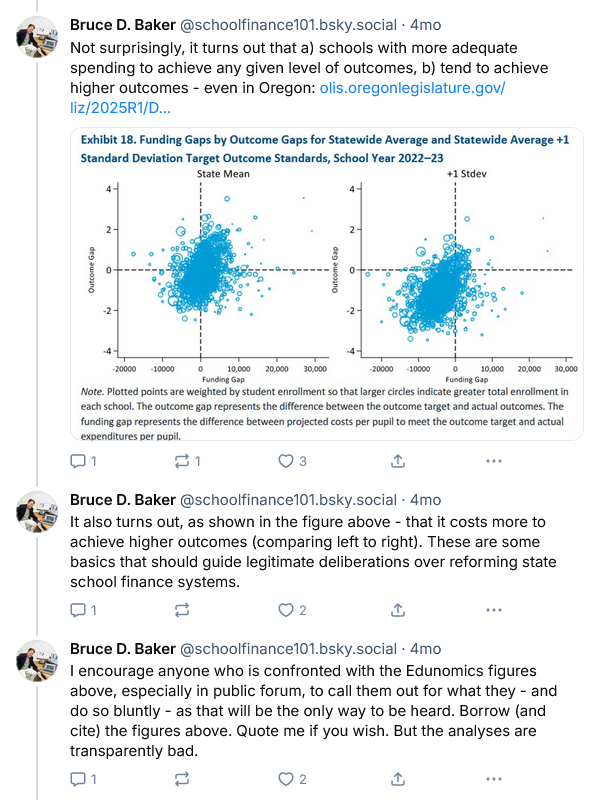
Here are those graphs – for Oregon, because we had to spend a stupid amount of time explaining why the Edunomics analysis was garbage to policymakers in that state:

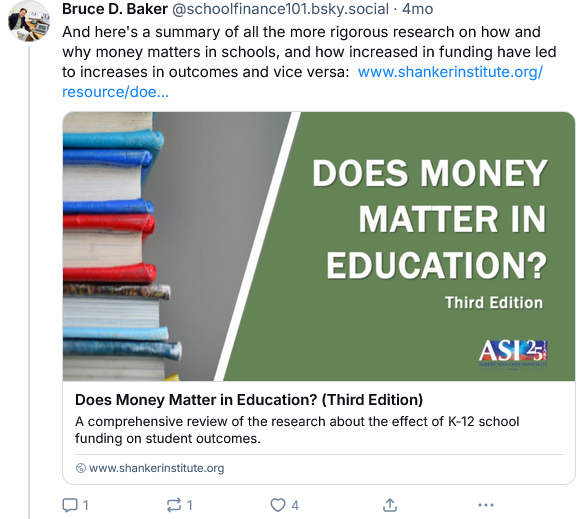
Link to that report: https://www.shankerinstitute.org/resource/does-money-matter-in-education

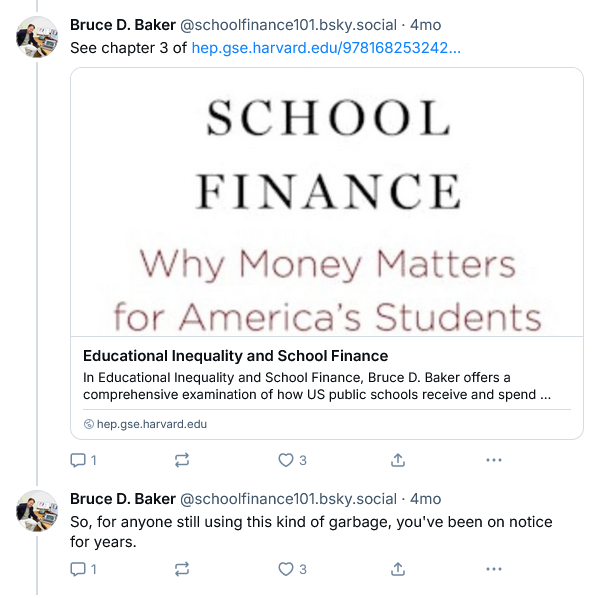
link to book: https://hep.gse.harvard.edu/9781682532423/educational-inequality-and-school-finance/ Full discrediting of “long term trend” AND “clouds of doubt”

Link to paper on how to conduct rigorous analyses of funding and outcomes: https://edworkingpapers.com/ai25-1127

Link to that report – which actually applies rigorous analyses: https://olis.oregonlegislature.gov/liz/2025R1/Downloads/CommitteeMeetingDocument/291280

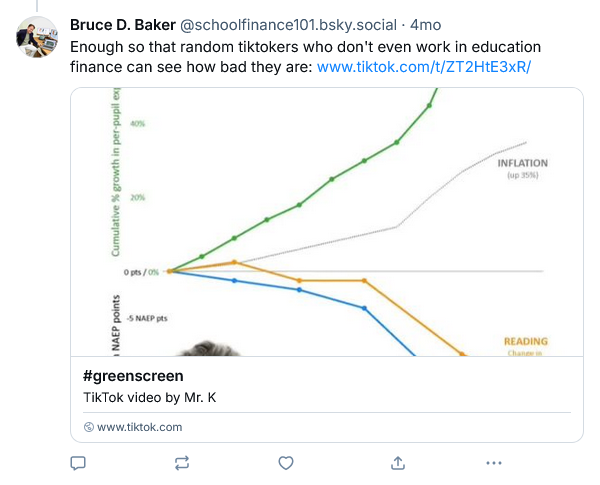
Even TikTokers an see through this flimsy stuff (and I don’t like much of what this guy posts):

Link: https://www.tiktok.com/@nicholasjkurian/video/7476603053466979614

Preserving an Educated Future for America (Short Term Plan)

Draft excerpt from forthcoming work:

The short-term plans presented here are focused primarily on mitigating damages inflicted by the current federal administration, focusing on states likely to fight back and pursue educational equity and excellence on their own. I have less short-term hope for other states that have been green-lighted and even incentivized to engage in additional erosion of public schooling. Mississippi is presently proposing elimination of its income tax, the primary source of funding for public education and Florida is discussing elimination of property taxes, the primary source of that state’s funding for public schools, meanwhile diverting substantial funds to voucher programs (Baker et al., 2025). Neither state’s high court has previously affirmed their own constitutional requirements to be enforceable, however strong or recent the constitutional language. Other low spending, generally low performing states are taking similar steps to erode their public education systems.[1] At the same time, federal aid is at risk and those same states are the most reliant on federal aid (Baker, 2025c). The short-term prospects for children in these states are bleak.

It may be that the best we can do for the next few years, while facing a federal administration hostile to public education and seeking actively to undermine it, is to work with states that remain committed to providing quality public schooling, such that they may be beacons as we emerge from these times.  Southern states resisted federal policies a) during reconstruction and b) during the civil rights era, adopting state policies to undermine the provision of more equitable and adequate education to all. The Education States (not exclusively “blue” or northern) as I will call them here, might use similar strategies this time around to advance education equity and equal opportunity, including racial equality, in the face of a federal administration which seeks to ban these very things and even the words that describe them. We might be wise to focus on those states where state courts have been willing to uphold AND enforce education quality and access standards, those states where legislators and governors have done so, whether court ordered or not and those that have already refused compliance with anti-equity demands of the current administration.

We are in an era where efforts to advance educational progress depend on states, state legislatures, governors and states’ own constitutional requirements (Corbin, 2025). Unfortunately, the current federal administration has not merely deferred to state’s own preferences but has chosen to weaponize federal aid to coerce states to oppose principles of equity and inclusiveness. As noted previously, the recent shift in federal policy has been a green-light for some states to go even further. Thus, the following short-term efforts might best focus on states: 1) that have maintained or reinstated effort to fund schools (or shown willingness to do so); 2) that have maintained or reinstated progressive funding (funding targeted to areas of greater need); and 3) where state high courts have enforced education rights in recent decades (and where legislatures have been responsive). Kansas, for example, despite being a “red” state, meets all three of these goals (Baker, 2022).

Antiregulations for the Modern Era

During the civil rights era in the 1960s, when the first significant direct federal aid to local public schools was introduced (under ESEA) and regulations adopted to enforce school integration, southern states adopted state aid adjustments, local tax policy changes and other resistance policies to support districts refusing desegregate (Bagley, 2018; Baker & Green, 2005; Milligan, 2018). These aid provisions were part of antiregulations acts, referring to opposition to federal regulations requiring desegregation.  Ironically, these are the states that are now most dependent on federal aid. By the time of this writing, several states and local district officials have responded to the current administration’s threats to withhold federal aid for any school or state promoting equity with a hard “NO.” These states should consider adopting into law, provisions that protect the revenues of their local public school districts by filling any temporary or permanent losses with additional state funds. The same strategy used during the civil rights era, to oppose civil rights, should now be used to protect them.

Federally tax-exempt state education endowments

Many if not most of the Education States are higher income and high GDP states which over the years have contributed more in federal taxes than they receive from the federal government in aid, programs and services. Taxpayers in northeastern states with strong public education systems, are subsidizing underfunded, increasingly oppressive, discriminatory (removing undocumented children), increasingly Christian nationalist (via voucher programs, religious charter schools and bibles in public district schools) school systems in states like Louisiana, Alabama, Mississippi and Oklahoma. These same taxpayers took an additional hit when the Federal tax code was revised to place caps on the deduction of state and local taxes (SALT deduction). Admittedly, these are equity-oriented tax provisions. These provisions lead to more progressive taxation and redistribution from wealthier to poorer states. That should be a good thing and would be necessary under my long-term plan (a later post, but also, earlier version here). But in the present times, these provisions are a) penalizing the Education States for having higher taxes and spending on schools and other state and local services and b) subsidizing the expansion of Christian Nationalist and other religious (and racially) exclusionary schooling in other states, through what has been proposed as a national voucher program .

Under the circumstances, to preserve public education in the national interest, I propose that the Education States establish federally tax-exempt Endowments for the Future of Education in which to hoard (yes, hoard, sadly, hoard) significant war-chests of (1 to 2% of GSP for the next 5 years) to stabilize elementary and secondary education funding in future years. The goal is to convince as many individual and corporate taxpayers to contribute as much as possible to these funds (reducing their federal taxable income) in support of their state’s education and economic future. That is, I am encouraging the Education States to be Harvard in this moment. It’s a substantial uphill climb to build an endowment of such magnitude. But in these states where so much personal and corporate wealth have been accumulated over time, it is not infeasible to build endowments that can, in four to five years’ time, generate hundreds to thousands of dollars per pupil to be directed toward the highest need schools and districts, and buffer the state’s schools from future economic uncertainty.[2]  

Significant public school endowment funds are not an unprecedented concept. For example: “The Texas Permanent School Fund (PSF) was created by Texas’ first Constitution in 1845 as a perpetual fund to support the state’s public schools and was seeded with $2 million in 1854. Since that time, the PSF has grown to comprise over $57 billion in assets and will distribute over $2.4 billion annually to Texas K-12 schools.”[3] Texas PSF is 57.3 billion in 2024 which is about 2.2% of GSP. It yields 2.4 billion per year to support the available school fund. Other states, including Alaska have similar funds.[4]

Expanding & Improving State Data Capacity

As continued collections of federal data erode, have gaps or are at risk of elimination, Education States should take steps to improve the quality of their own data and research capacity, including continuing and improving upon collections of statewide school level expenditure data and collections of a wider array of student outcomes, from assessments across additional content areas to more detailed measures of completion and dropout rates, chronic absence and more. Many states have already engaged with outside consultants to compile their data, construct comprehensive outcome measures, set goals and standards, and estimate statewide school level models of the costs of meeting those standards. The findings from these models have been increasingly consistent in recent years (Atchison et al., 2023; Atchison et al., 2025; Brooks et al., 2025).

Interstate consortia for the improvement of education data and evaluation could lead to improved data collections on measures including school revenue and spending and greater consistency on student outcome collections across states. These efforts may lead to improved federal data collections in the future (as those data collections typically occur through states, presently, with federal guidance and vetting of data), including improved methods for harmonizing and cross-walking revenue and spending measures across states.

Unblurring the Lines between Public and Private

I close here with a bleak foreshadowing of our Supreme Court’s next possible move in further dismantling church/state separation in public schooling in the United States. Chief Justice Roberts in Espinoza v. Montana Dept. of Revenue explained that if and only if a state does provide funding for private, non-state-actors to provide education, then that state cannot exclude religious providers. But, that’s only if the state chooses to provide funds to private providers. In his dissent in Espinoza, Justice Breyer pointed asked “what about charter schools?” noting the ambiguity of their status under widely varied state charter statutes.

The court is now considering this public/private status question in a case where an Oklahoma charter school wishes to operate openly as a religious school. If the court determines it to be private (non-state-actor), then a) it most certainly can, and b) other religious operators cannot be denied similar opportunity to apply for and run charter schools. As I’ve previously written, this opens the door to these same schools refusing (likely succeeding at the Supreme Court) to comply with any/all regulations they claim conflict with their religious views, including racial discrimination (Green, Eckes & Baker, 2024).

We are at a point where there is only one way to shut this down in states that wish to preserve strong, accessible, public education systems. Voucher programs are rare or small in what I have referred to here as the Education States. That is no coincidence. But charter schools have a significant presence in the Education States, and these states must either substantially tighten state charter school laws, allowing only government authorization and oversight, defining governing boards and board members of charter schools to be public officials (subject to all laws pertaining to public officials) and making all employees of those institutions public employees, perhaps under the contract of the local host district. While these changes may seem restrictive and unappealing to existing charter operators in those states (like New Jersey, New York, Massachusetts and Connecticut), the alternative is to eliminate charter schooling altogether, to ensure that religious and discriminatory charter schools cannot make their way into the state.

This also means that states like Vermont, Maine, New Hampshire and Connecticut which have long been home to “town academies,” many formed by private citizens and benefactors as centralized secondary schools in the early to mid-1800s to serve surrounding communities, will have to take steps to change the status of those schools. In Carson v. Makin, the court decided that these academies were enough of a crack in the door to require states to provide similar funding for religious alternatives. States that are home to these town academies will need to either eliminate funding for them or require academies to be sold to and/or absorbed by their local public school districts or the state. Unfortunately, the courts have left us with no alternative but to seal off that crack in the door as well.


[1] https://www.cbpp.org/research/state-budget-and-tax/tracking-the-fallout-from-state-tax-cuts

[2] We understand that it is likely that the current federal administration would seek to deny tax exempt status for these state created, privately governed endowment funds. That said, they are quite similar to pass through organizations used in state tuition tax credit and voucher programs. One strategy to counter this move is to declare these endowments to be religious organizations – Endowment for the Church of the Educated Public – wherein their mission is to support the provision of public schooling to all across their state. More details to be provided as needed in future writings. 

[3] https://texaspsf.org/

[4] https://pfd.alaska.gov/

Defining Productivity, Cost, and Efficiency

Recycled material here…

The central problem with US public schools is often characterized as an efficiency problem. We spend a lot and don’t get much for it; and over time we’ve spent more and more but our outcomes have remained virtually flat. Yet rarely are these claims accompanied by thorough analysis or empirical evidence of cost-effectiveness or efficiency.[i]

We must not get too caught up in the possibility of identifying the perfectly efficient school or district or the absolute minimum that might possibly be spent to achieve a given level of outcomes with x children under y conditions. Measuring such hypothetical extremes is impractical. That said, much can be learned by better understanding the average efficiency at which existing schools and districts produce certain outcome measures for their students and the deviations around those averages.

Some basic definitions are in order:

  • productivity: The output of our system of schooling, measured in terms of quantity of output or quality of output, or both. Quantity measures often include total numbers of students served or graduated; quality measures are often reduced to measures derived from standardized tests, usually of reading and mathematics achievement between grades 3 and 8. Increasingly, the quality of outcomes produced is measured in terms of changes in assessment scores over time associated with students’ time of attendance in a particular school or district (value-added estimates). Outcomes may also include longer-term outcomes, such as income or civic participation.
  • spending: Expenses (current and deferred) associated with the provision of educational programs and services and related supports (food, transportation, overhead), regardless of outcomes
  • cost: The minimum amount that would need to be spent to achieve a specific level of student outcomes, given the backgrounds of the students served and other potential contextual constraints (variations in the competitive wages for qualified employees, remoteness and population sparsity, economies scale, etc.). Cost necessarily connects spending with outcomes.
  • efficiency: Given the previous two definitions it is possible to spend more than would be needed to achieve a given level of outcomes. That margin of difference is inefficiency.

spending – inefficiency = cost

or

cost + inefficiency = spending

The margin of spending above cost is labeled inefficiency; but when we discuss measurable inefficiency of schools, the term takes on broad meaning, including spending on programs and services that may be valued but not measured as primary goals/objectives. For example, institutional expenditures may include expenditures on community-based programs and events, athletics, and arts that may marginally, if at all, contribute to student test scores. This is not to suggest, however, that these expenditures are unnecessary or inappropriate. Rather, they are simply not captured by the outcomes being measured because they serve a different, but still valued, purpose.

Often, when pundits talk about “cost-cutting” measures, they are really talking about spending reductions, whether they result in declining outcomes or whether outcomes remain constant. Actual cost cutting that holds outcomes constant—doing the same with less—would, theoretically, be efficiency improvement. By contrast, less spending leading to lower outcomes is a break-even on efficiency.


[i] Bruce D. Baker and Kevin G. Welner, “Evidence and Rigor: Scrutinizing the Rhetorical Embrace of Evidence-Based Decision Making,” Educational Researcher 41, no. 3 (2012): 98–101; Bruce D. Baker and K. G. Welner, Productivity Research, the US Department of Education, and High-Quality Evidence (Boulder, CO: National Education Policy Center, 2011), http://nepc.colorado.edu/publication/productivity-research.  

Time to Rein in Vouchers

Universal voucher programs have, in many states led to substantial budget stress (Baker, 2024;[1] Hager, 2024). Initial cost estimates in Florida were that the program would cost between $200 and $700 million, but by the 2023-24 school year, those costs had exploded to between $2.8 and $4.2 billion (Lieberman, 2023). Griffith and Burns (2024) explain that in Arizona “About 2.4% of Arizona’s school-age children took advantage of the ESA program in 2022–23, at a total cost of $587.5 million, which is a $398.7 million (211%) increase over the cost of the more targeted voucher the previous year” in 2022-23. Those costs have only continued to grow.

Some confusion exists in the public sphere as to how a voucher program for which the average voucher or ESA payment is less than the average per pupil expenditure in public districts could possibly increase total state expenditures on education? If a student leaves a district that spends $15,000 per pupil on that student, and takes a voucher for $8,000, that should naturally save $7,000 per pupil for each child who switches. But that’s a dreadful oversimplification in a vacuum. For example, Table A1 lays out more realistic numbers, compiled from a variety of sources, for Florida and Arizona. In Florida, just under 3 million children attend public districts and 300 to 400 thousand attend private schools, a higher share than many states. The state provides vouchers of $8,000 for private schooling and the average district expenditure is just over $10,000 per pupil. The average state funding per pupil, however, is less than half that amount, so the state funding for a voucher is greater than the state funding per pupil that flows to districts. The same is true in Arizona.

But the bigger piece of the puzzle is that most of the vouchers are being taken up by students already attending private school (nearly 70% of voucher recipients in the most recent cohort, or over 20% of current private school enrollments). The share of public enrollments shifting to private schools using vouchers is about 1.3%. So, even if there is “savings” to the public school system for the small number of switchers, it’s not much, and not immediately realized. More discussion on this point follows in our discussion of efficiency. 

The increase in state funding amounts to short run net (minus savings from those switching to private schools) increases in state spending around 7%, which is an unprecedented increase in state spending for these states – nearly a billion dollars for a single entering cohort in Florida and over $300 million for a single entering cohort in Arizona. But these cohorts come one after another and layer on one on top of another with accumulating annual gross increases in spending in the billions – above and beyond what was being spent previously in state aid to students enrolled in public schools – only a small share of whom take the voucher and run (See Table A1).

Why this matters

Increased public expenditure on k-12 education is not itself problematic, and can in fact be a good thing, especially in states like Arizona and Florida that have historically under-invested in public schooling. But increased public expenditure warrants careful scrutiny. When public, taxpayer dollars are spent:

  1. Those public expenditures should advance equity goals;
  2. Public spending should be done as efficiently as possible (while advancing equity goals);
  3. With public expenditures, should come accountability, including transparency, with particular attention to equity and efficiency goals.

It would certainly be foolish to spend additional taxpayer dollars on programs that exacerbate inequality and lead to lower outcomes, especially where more efficient and more equitable alternatives exist. For example, Rauscher and Shen (2022) found that investing new school spending in higher poverty public school settings has substantially greater effect than investing the same dollar in lower poverty settings. Jackson and Mackevicius (2023) found the same across several studies. But, more recently adopted and expanded voucher programs, drive public expenditures to higher income families whose children already attend private schools, and on average, lead to lower (and less equitable) outcomes:

  • Not only are most participants in these programs already enrolled in private school but they tend to be from the highest income brackets. That is, the universal vouchers are exacerbating inequity rather than improve equity.[2]
  • Further, subsidies are often going to schools that engage in discriminatory admissions of students, creating inequality of access.[3]
  • To the extent that researchers have studied and measured the academic outcomes of these programs, they have been dismal, yielding more damage to student outcomes in reading and math than major national disasters or the recent global pandemic.[4]

Why is this all occurring unchecked? Precisely because it is unchecked – Because there exists no accountability for the outcomes produced or for equitable access to quality choices for all children and families. Public dollars should be spent in the public’s interests, and to know that they are, we must evaluate the outcomes of that spending.

Designing more Equitable and Efficient Voucher Programs (or at least less inequitable and less inefficient ones)

Many inefficiencies and inequities that arise from school voucher programs are unavoidable. These should be addressed up front, before any such program is adopted. There just aren’t fair and equitable markets for schooling in every location and providers available for every child, nor will there ever be. Expanding choice increases enrollment volatility, decreasing district ability to centrally plan for efficient allocation of capital space (assigning kids to buildings) or human resources (assigning teachers and administrators to schools), or to plan for transportation. To the extent that fewer children are transported to local schools on buses, more cars are on the road, often for longer distances, during school drop off and pick up times.

Choice programs require entirely new administrative layers to both manage financial applications, distributions and enrollments. Setting aside these unavoidable structural inefficiencies of choosing choice, there are at least a few steps states can take to ensure that the additional public dollars provided for expanded choice at the very least, do less to expand inequality and increase inefficiency:

Vouchers should be means tested and tuition capped: Recent evidence from universal voucher programs suggest that from an equity perspective, providing the same voucher rate regardless of income simply induces inequality and permits institutions to raise tuition. Both should be regulated toward the goal of equity. Affluent families already have freedom of choice. If vouchers are being provided in the name of freedom of choice, they should be scaled by income and institutions accepting income qualified applicants should be subject to tuition rate regulation for those applicants. This includes fully financing the needs of children whose families have the greatest financial needs, including food and transportation costs, to the extent possible (and within equitable, efficient choice zones). These latter costs could be covered by means tested ESAs, while tuition costs would be supported with vouchers.

Voucher programs should be targeted toward markets where they can efficiently and equitably operate: Choice doesn’t work everywhere. Choice doesn’t work where there are no choices. Choice rarely yields equitable access anywhere. Even in more densely packed metropolitan areas, many low-income neighborhoods lack accessible choices and transportation to more distant choices comes with additional costs. States should establish parameters, and ensure infrastructure for equitable, efficient choice zones. Earlier voucher programs which yielded more positive outcomes for participating students operated in specific markets, providing means tested vouchers, with schools accepting students without additional tuition expense.   

Market Entry for Participating Schools: States must impose some statutory and regulatory standards on which schools may enter the choice market place. Availability of qualified schools in the marketplace should, in part, determine whether a viable marketplace exists.  State statutes and regulations should cover three areas:

Regulations on access: Participating schools should abide by non-discrimination policies for student admission, regarding race, ethnicity, national origin and religion.

Guarantees of rights: Participating schools should be required to abide by constitutional protections for which they would be otherwise exempt, including due process rights in cases of disciplinary actions, protection of free speech rights and free exercise of religion, protection against unreasonable searches and protection against discrimination (while in attendance), per standards established in case law pertaining to public schools.

Financial transparency and solvency: States should establish standard formats for the reporting of institutional revenues, expenditures, assets and liabilities, which will offer greater detail than non-profit tax returns, and be inclusive of participating religious providers. Financial condition should be evaluated as a condition for participating in the choice marketplace.

Ongoing oversight of Participating Schools

Establishing parameters for market entry is a starting point, but participating institutions must be subjected to ongoing oversight. This includes all institutions participating in any regional choice portfolio, from district schools, to charter schools and voucher receiving private schools. Oversight should include:

Financial transparency and solvency: It is in the public’s interest and the children’s interest to oversee the financial condition of schools. School closures most often result from fiscal stress, often mid-year, causing massive disruptions and irreparable harm to student learning. State officials cannot evaluate financial solvency and risk without the reporting requirements established above. The taxpayers’ dollars are at stake when any school has been funded with a share of those dollars and ceases to operate before fulfilling the duties associated with those dollars.

Student outcomes: All schools receiving state financial assistance should be required to participate in a system of state assessments which address basic competencies in reading, mathematics, civics/social studies and science. These systems should be less time consuming and burdensome than existing state assessment systems. Participating institutions may be provided the option to submit results from other standardized assessments for which statistical concordance is available. Institutions should also be required to report data on cohort progression and graduation rates, as well as disciplinary action including suspensions and expulsions. 

Curricular transparency: While we believe one of the benefits of choice is curricular specialization and flexibility, we also believe that both those making the choices and the taxpayers support the choices should have full access to the curriculum and materials being used/offered. This is one way in which the public can evaluate whether the broader public interests are being met and have a voice in the political process which governs the expenditure of taxpayer dollars. It should not take tedious, school by school investigative reporting as done by Klein (2017)[5] to uncover the providers of curricular materials used by private schools accepting public financing. States should maintain a searchable database. This would also enable more transparent market choices to be made by parents on behalf of their children.

Final Thoughts

A common retort among voucher and school choice advocates is that we should “Fund the child, not the system.” This claim is often used to imply incorrectly that it’s all about letting each parent take back their supposed tax dollars and spend them where they wish. First, it is not only parents who contribute to the pool of tax revenue, but rather a much larger “public.” Second, all contribute in different amounts. There is no basis whatsoever in assuming that each child is owed a specific share of the public’s tax dollars without public say, or interest in the matter. Such is the basis of democratically governed public-school systems – the basis in funding a system of schools that serve the children, rather than funding the child, per se. Redistributing the public’s funds to each child to be educated at the behest of his/her/their parents’ preferences presumes the sum of these collective, but pluralistic choices to be at least equal to more direct investment in the collective public interest. Human capital theory suggests otherwise.

Others have advanced the oversimplified view that we should fund a “system of (great) schools” rather than an implicitly mediocre “public school system,” wherein the former speaks to the mixed method (portfolio, sector agnosticism, etc.) of providing vouchers for private schools, state authorization of charter schools (often privately managed) and public district and magnet schools.  Importantly, providing a system of great schools involves a role for government accountability over those providing educational programs and services. However, lost in this conversation has been the diminished ability for government to regulate certain practices of non-government schools, especially where those regulations intersect with religion (Green, Baker & Eckes, 2024).  This is exactly what I am outlining and advocating for in this post – the appropriate regulatory framework for ensuring that a system of schools is held to some standards.

Finally, voucher advocates often argue that the precedent for providing vouchers in k-12 education is well established in U.S. higher education, through programs like Pell Grants and in the U.S. Healthcare system, which relies primarily on public subsidies for private healthcare providers, and choice of providers. Pell Grants are means tested and equity oriented. So too are Medicaid programs. Still, both are woefully insufficient at improving equity of access in U.S. higher education or healthcare access. Neither, the U.S. healthcare nor the U.S. higher education system are the models of equity and efficiency to which we should aspire for our children and future generations.


[1] https://nepc.colorado.edu/review/calculator

[2] https://www.brookings.edu/articles/arizonas-universal-education-savings-account-program-has-become-a-handout-to-the-wealthy/

[3] https://www.orlandosentinel.com/2020/01/24/not-welcome-gay-students-parents-are-denied-service-in-floridas-publicly-funded-voucher-schools-commentary/

[4] https://www.brookings.edu/articles/research-on-school-vouchers-suggests-concerns-ahead-for-education-savings-accounts/

[5] https://www.huffpost.com/entry/school-voucher-evangelical-education-betsy-devos_n_5a021962e4b04e96f0c6093c?ufa=

Jackson, C. K., & Mackevicius, C. L. (2024). What impacts can we expect from school spending policy? Evidence from evaluations in the United States. American Economic Journal: Applied Economics, 16(1), 412-446.

Rauscher, E., & Shen, Y. (2022). Variation in the relationship between school spending and achievement: Progressive spending is efficient. American Journal of Sociology, 128(1), 189-223

What can we learn by modeling existing variations in school spending and outcomes? (Reprise)

There are those in the ed reform world who would tell us that existing public schools and districts are simply inefficient in their use of existing funding. That all schools and districts have enough or more than enough funding to achieve whatever goals are demanded of them, but because most of the dollars flow into a system, for example, wherein teachers are paid according to years of experience and degrees accumulated, and not directly related to student outcomes they produce, improvements cannot be achieved by providing more funding.

However, this claim is built on mythical and unfounded assumptions that an alternative system, for example, based entirely on market competition, where teachers are paid, hired and fired by the outcomes they produce (where linking pay precisely to valid, measured outcomes is feasible) would propel U.S. schools to the top of international rankings, and for even less than we currently spend.

As I explain in a 2016 report:

“To summarize, despite all the uproar about paying teachers based on experience and education, and its misinterpretations in the context of the “Does money matter?” debate, this line of argument misses the point. To whatever degree teacher pay matters in attracting high-quality educators into the profession and retaining them, it’s less about how they are paid than how much. Furthermore, the average salaries of the teaching profession, with respect to other labor market opportunities, can substantively affect the quality of entrants to the teaching profession, applicants to preparation programs and student outcomes. Diminishing resources for schools can constrain salaries and reduce the quality of the labor supply. Further, salary differentials between schools and districts might help to recruit or retain teachers in high-need settings. In other words, resources used for teacher quality matter.”[1]

Recent studies finding positive effects of school finance reforms also find that additional funding (that yielded the positive effects) tended to go toward such things as more competitive wages for teachers or smaller class sizes.[2]

This claim is also used to argue that we can learn nothing about the actual costs of producing the outcomes we desire by studying spending and spending variation in existing schools. That is, how could we possibly learn anything about efficient costs of providing the services we desire from a system that includes no institutions that presently use resources efficiently? Again, this argument is built on a false and unfounded premise.

  • Existing schools and districts do, in fact, vary in the amounts of money they spend, the outcomes they achieve with that spending and efficiency with which they yield those outcomes.[3]
  • Existing schools and districts vary to some degree in the ways in which they allocate resources toward those goals.
  • Notably, even elite private independent schools operating on the “free market” tend not to attempt to compensate, hire or fire teachers based on student outcomes the produce. These same schools extol the virtues – from a marketing perspective – of providing particularly small class sizes.[4]
  • Similarly, charter school expansion – intended to promote innovation – has not led to substantive deviation either from the way in which teachers are paid, or from the basic ways in which resources are allocated within schools.[5]

To date, no radical substitutions to the way in which public, private and charter schools provide k12 have been identified and validated as substantially more productive or efficient than existing school systems. Good schooling of any kind remains a human resource intensive endeavor, requiring a sufficient quantity of sufficiently qualified adults interacting with children, with sufficient material resources, in quality education spaces. And students have to get there and be sufficiently well nourished to thrive.

There are indeed variations across schools, within and across sectors, and those variations permit researchers to better understand what works, where, for whom and at what expense. Researchers and/or policy analysts tend to use either of two general approaches to study education costs, identifying spending levels that should generally be sufficient for achieving desired outcomes and identifying how education costs vary from one location to another across districts within a state and how those costs vary by the needs of varied student populations. One approach involves gathering focus groups of informed constituents to specify the inputs to schooling they believe are needed to get the job done. These professional judgment panels are essentially proposing a hypothesis of the programs and services needed under varied conditions and for varied student populations to achieve desired outcomes.

The preferred alternative is to construct statistical models which estimate the relationship between current district spending levels and current student outcomes, with consideration for various factors that affect the cost of achieving desired outcomes (student characteristics, district characteristics, labor market pressures) and with consideration for factors that influence whether districts are more or less likely to spend inefficiently.

This approach, called education cost function modeling has been used extensively in peer-reviewed studies of education costs and cost variation.[6]  As Tom Downes, an economist from Tufts University explained back in 2004:

“Given the econometric advances of the last decade, the cost-function approach is the most likely to give accurate estimates of the within-state variation in the spending needed to attain the state’s chosen standard, if the data are available and of a high quality” (p. 9).[7]

Since that time, data quality and access have improved significantly.

The goal of education cost modeling – or any form of cost analysis – whether applied for evaluating equal educational opportunity or for producing adequacy cost estimates is to establish “reasonable marks” to provide guidance in developing more rationale state school finance systems. Only with reasonable marks in hand can one make informed judgments as to whether existing policies are wide of those reasonable marks.

Historically, funding levels for state school finance systems have largely been determined by taking the total revenue generated for schooling as a function of statewide tastes for statewide taxation and dividing that funding by the number of students in the system. That is, the budget constraint – or total available revenue – and total student enrollment have been the key determinants of the foundation level, or basic allotment. To some degree, this will always be true. But reasonable estimates of the “cost” of producing desired outcomes, given current technologies of production (the range of practices actually used/tested), may influence the taste for additional taxes by revealing that the preferences regarding taxation and the preferences regarding desired quality of public education are misaligned, meaning that one or the other should be adjusted. That is, if we find out that higher outcomes are going to cost us more, we can then have a more reasonable discussion of whether we are willing to pay that amount more for the expected gain in quality, or whether to lower our expectations. Alternatively, we can simply fly blind.

Reasonable estimates of cost may also assist courts in determining whether current funding levels and distributions are wide of a reasonable mark, or substantially misaligned with constitutional standards. Cost model estimates are not meant to be exact predictions of what student outcomes will necessarily occur next year if we suddenly adopt a state school finance system based on the cost model estimates. Cost models provide guidance regarding the general levels (predictions with error ranges) of funding increases that would be required to produce measured outcomes at a certain level, assuming that districts are able to absorb the additional resources without efficiency loss.

Studies of state school finance reform also suggest that the key to successful school finance reforms is that they are both substantive and sustained. If additional dollars to high need districts are best leveraged toward high quality preschool programs and/or early grades class size reduction, we are unlikely to see changes to college readiness outcomes the following year (or following five years). If the additional dollars are best leveraged toward increasing teacher salaries for teachers in their optimal years of experience, allowing districts to recruit and retain “better” teachers over time, we are also unlikely to see immediate returns in student test scores.

Importantly, cost model estimates are estimates based on the actual production technologies of schooling. They are based on the outcomes schools and/or districts produce under different circumstances, for different children – the actual children they serve, based on the actual assessments given, and based on the real conditions under which children attend school. Pure speculation that some alternative educational delivery system would produce better outcomes at much lower expense is certainly no basis for making a judicial determination regarding constitutionality of existing funding, and is an unlikely (though not unheard of) basis for informing statewide mandates or legislation.  Cost model estimates, as well as recommendations of professional judgment and expert panels can serve to provide useful, meaningful information to guide the formulation of more rational, more equitable and more adequate state school finance systems.


[1] Baker, B. D. (2016). Does money matter in education?. Albert Shanker Institute. https://files.eric.ed.gov/fulltext/ED563793.pdf
[2] Baker, B. D. (2017). How Money Matters for Schools. School Finance Series. Learning Policy Institute. https://files.eric.ed.gov/fulltext/ED606469.pdf
[3] Grosskopf, S., Hayes, K. J., & Taylor, L. L. (2014). Efficiency in education: Research and implications. Applied Economic Perspectives and Policy, 36(2), 175-210.

[4] https://schoolfinance101.wordpress.com/2017/09/10/reality-check-innovation-substitution-in-charter-private-schools/

[5] https://schoolfinance101.wordpress.com/2017/09/10/reality-check-innovation-substitution-in-charter-private-schools/

[6] Duncombe, W., Yinger, J. (2008) Measurement of Cost Differentials In H.F. Ladd & E. Fiske (eds) pp. 203-221. Handbook of Research in Education Finance and Policy. New York: Routledge.  Duncombe, W., Yinger, J. (2005) How Much more Does a Disadvantaged Student Cost? Economics of Education Review 24 (5) 513-532. Duncombe, W.D. and Yinger, J.M. (2000).  Financing Higher Performance Standards: The Case of New York State. Economics of Education Review, 19 (3), 363-86. Duncombe, W., Yinger, J. (1999). Performance Standards and Education Cost Indexes: You Can’t Have One Without the Other. In H.F. Ladd, R. Chalk, and J.S. Hansen (Eds.), Equity and Adequacy in Education Finance: Issues and Perspectives (pp.260-97). Washington, DC: National Academy Press. Duncombe, W., Yinger, J. (1998) “School Finance Reforms: Aid Formulas and Equity Objectives.” National Tax Journal 51, (2): 239-63. Duncombe, W., Yinger, J. (1997). Why Is It So Hard to Help Central City Schools? Journal of Policy Analysis and Management, 16, (1), 85-113. Imazeki, J., Reschovsky, A. (2004b) Is No Child Left Beyond an Un (or under)funded Federal Mandate? Evidence from Texas. National Tax Journal 57 (3) 571-588.

[7] T. Downes, What Is Adequate? Operationalizing the Concept of Adequacy for New York State (2004), http://www.albany.edu/edfin/Downes%20EFRC%20Symp%2004%20Single.pdf.

When Evidence Based Isn’t: Informing State School Finance Formulas to Provide Equal Educational Opportunity for All

First, a bit of review:

Goals of state school finance systems

  • The goal of state school finance systems is to provide all children, regardless of where they live or attend school, equal opportunity to achieve common, adequate outcome goals
  • Providing equal educational opportunity toward common goals costs different amounts in different settings, and across children (individually and collectively) by needs and contexts
    • State accountability systems set common goals and evaluate schools (and children) on whether they meet those goals.
    • A fair system requires funding sufficient to provide equal opportunity to meet these mandates (which are often used for articulating constitutional rights).

Two basic approaches to cost estimation

  • Input-oriented analyses identify the staffing, materials, supplies and equipment, physical space, and other elements required to provide specific educational programs and services capable of producing the desired educational outcomes for identified student populations being served in various settings.
  • Outcome-oriented analyses start with student outcomes that are generated by the programs and services offered by existing schools and districts. This type of analysis examines the relationship between spending on these programs and services and specific outcomes, while taking into account different student populations and the characteristics of the settings in which they are being served.

Limitations of Input-Based Approaches

  • As a general rule of thumb, input-based analyses (or input driven formulas) fail to capture the full additional costs to provide equal opportunity in high need settings, while often overstating the costs of meeting minimum standards in low need settings. In short, they tend to inflate the base and deflate the weights[1]
  • Differences in input-based approaches:
    • In one approach, panels of experts and practitioners are asked to populate templates of prototypical schools with resources they believe are needed to achieve a set of outcomes they’ve been provided.
      • Proposals of this type are useful but merely a hypothesis of what might be needed, lacking direct analysis of the relationship between those resources and outcomes
      • Panelists with experience in low need, well resourced districts are hesitant to suggest their districts (or prototypes like them) would need fewer resources to achieve less than they currently do, thus overstating base costs.
      • Panelists with experience in high need, but often under-resourced districts tend to underestimate the full needs/costs to meet outcome targets.
  • Supposed “Evidence-Based” approaches are even more problematic in this regard:
    • A single “evidence based” model of a prototypical school – designed to meet a state’s (in particular, every state?) specific outcome goals – simply doesn’t exist!
    • There is a dearth of evidence on staffing ratios, specific models and reforms to inform incremental differences in per pupil costs to achieve common (state adopted) outcomes.

Cost-Modeling is the only valid method for understanding cost variation with respect to outcomes

Put bluntly, outcome-based methods are the only methods which actually meet, or can meet the requirement of estimating costs associated with achieving common outcome goals.

  • Outcome based methods are the only methods which directly include the outcomes in question.
  • Outcome based modeling, or “cost function” modeling is also the only of these methods for which there exists a significant track record in peer reviewed literature, specifically around the question of understanding how much more or less it costs for one child versus another, in one location versus another toward achieving common outcome goals. [2]
  • Back in 2004, Tom Downes, an economist from Tufts University explained back in 2004: “Given the econometric advances of the last decade, the cost-function approach is the most likely to give accurate estimates of the within-state variation in the spending needed to attain the state’s chosen standard, if the data are available and of a high quality” (p. 9).[3] Since that time, data quality and access have improved significantly.

Informing state school finance policies with education cost models is a three-step process, but is relatively straightforward (more detailed policy briefs linked at each step).

  • Step 1: Goal Setting
    • Setting outcome goals and selecting measures of those goals for all students
    • Understanding the current position of students in the state with respect to outcome goals
  • Step 2: Modeling the cost of meeting goals
    • Using statistical modeling to understand the relationship between existing spending, students served, economic and geographic context, and outcomes attained.
      • Uses multiple years of actual data on school and/or district spending, outcomes, students and context to estimate spending associated with specific outcomes, under specific conditions.
        • Is state specific in terms of outcome measures, expectations and actual district spending and conditions
      • Using the fitted model to predict the spending associated with specific outcome goals (at average efficiency production)
  • Step 3: Translating cost model estimates to a weighted funding formula

How bad* are the results of an “evidence based” analysis?

*inequitable, inadequate and invalid

Unfortunately, it’s very easy with input-based analyses to advise state legislatures that they only need to do slightly more than they are currently doing, and that any new resources added to the system can be relatively evenly spread across schools, districts and the children they serve (meaning across political constituents). 

Consultants lose some control over this process when deferring to expert judgment panels. Consultants maintain the greatest control over their ability to tell legislators what they want to hear when using “evidence” based models, because the evidence simply isn’t there for specifying additional programs, services and staffing ratios associated with achieving common outcomes – and in particular, the state’s own outcome goals. The “evidence” is in the eyes of the “expert” consultant.

Figure 1 below compares a) current spending per pupil, b) the Illinois “Evidence Based” model per pupil costs, and c) two different cost model projections – costs to achieve national average outcomes and costs to achieve a higher outcome goal – Massachusetts average outcomes.

Presently, in Illinois (or at least historically), current spending per pupil has been systematically lower in higher poverty settings, despite substantial evidence that it costs more to achieve common outcome goals in higher poverty settings.[4] Illinois school finance has been “regressive” with respect to poverty. The Illinois “evidence based” formula adopted in 2017[5] conveniently suggests the need for only marginal increases in spending for the highest poverty districts, and only marginally above the average “cost” for much lower poverty districts.  It’s a politically palatable solution and it is better than the system it replaced. (a positive step for sure, after decades of none – but not at all what it claims to be!)

The new formula does not even come close to providing equal educational opportunity to achieve common outcome goals – especially in high need settings – whether low goals – like national averages on reading and math assessments, or higher aspirational goals like Massachusetts averages.

Figure 1.

Based on: FY22-Evidence-Based-Funding-Full-Calc (Final Adequacy Target per Student)

Table 1 puts some specific numbers on current spending versus cost targets from the state’s EB model and our National Education Cost Model. Sorted by poverty quintile, the Evidence Based model suggests only modest increases for the highest poverty quintile and does, on average, suggest that much lower poverty districts could get by with less than they presently spend.

But, the difference between the EB cost estimates for the highest and lowest poverty districts is only 22%. It is highly unlikely that the highest poverty districts could achieve common outcomes with the lowest poverty districts with only 22% additional funding. Typically, it would take more in line with 2x to 3x the per pupil funding to close these gaps, especially in a state with the extent of wealth and income inequality of Illinois. Less unequal states have less cost variation.

Compared against the low bar outcome standard of national average outcomes – an outcome exceeded on average in Illinois – the EB model underestimates costs by a modest but understandable margin. But the EB model especially fails to recognize just how little could be spent in the most affluent Chicago suburbs to merely achieve national average test scores. This is a political compromise and a political compromise paid for by reducing the additional “cost” estimate for high poverty districts. That is, depriving those children of equal opportunity!

Anyone who works with state legislatures to inform the reform of state school finance formulas knows that whatever comes out the back end of the political debate – whatever is eventually adopted – will involve political compromise. As I explain in my recent book on the state of Kansas, the goal is to toss the best possible empirical evidence into the political scrum such that what comes out the back side is “less bad than it might have otherwise been,” in the absence of that evidence.

Because of this, it makes little sense to throw into that political scrum, cost estimates that are pre-emptively politically compromised by expert consultants – based on what they believe legislators want to hear (and what we all know most of them do want to hear). Yes, nearly any state legislature wants two things in school finance reform: a) a revenue neutral solution and b) no losers. This is of course impossible, but many who advise state legislatures will find a way to tell them they only need to add a little more and they can spread it relatively evenly. This is rarely in line with valid estimates of equal educational opportunity and adequacy.

Table 1.

QuintileCurrent (2018)EB ModelECM National MeanECM Mass MeanCurrent Outcomes (Standard Deviations Over/Under National)
1-Lowest$16,347$12,771$6,899$11,9750.500
2-Low$16,492$13,340$8,844$15,3500.286
3-Middle$14,829$13,940$11,047$19,1740.000
4-High$15,219$14,405$13,062$22,671-0.149
5-Highest$14,517$15,525$17,815$30,921-0.365
Chicago$14,134$15,991$18,102$31,420-0.287
Wilmette$18,578$11,684$3,813$6,6190.862

Let’s take a look at where Chicago and Wilmette fall in our data visualizations of existing spending – compared to costs of national average outcomes – and actual outcomes. In short, just as the quintile average spending gaps above align with the outcome gaps (for our models, but not for the EB models), the City of Chicago is shown to fall in the lower left quadrant – spending less than needed to achieve national average outcomes (by several thousand per pupil) and fall below national average outcomes. By contrast, Wilmette spends well above what would be needed to achieve only national average outcomes, and far exceeds national average outcomes.

Figure 2
Figure 3

Validity Check

Here’s where it gets particularly fun. Here, I apply a validity check – a basic smell test – on the evidence based model compared to our national cost model. It would stand to reason that districts estimated to need more to achieve any specific outcome target likely currently fall below that target. Further, that districts with larger funding gaps would have larger outcome gaps – though an imperfect scatter.

The evidence based funding gaps – between 2018 per pupil actual spending and 2022 adequacy targets  – don’t comport even with this basic validity check. Yes, districts that far exceed the relatively flat cost estimates, do have much higher outcomes. But, there are nearly as many districts that were estimated to fall below their EB funding targets that already exceeded national average outcomes (upper left) as there are that fell below national average outcomes (lower left). And, as can be seen here, the EB model suggests relatively small, nearly the same increases in funding for the large number of above average outcome districts and below average outcome districts. This is simply nonsensical, unless you factor in that the recommendation itself – certainly the adopted version of it – is more political compromise than valid cost estimate. That is, the whole point was to argue some basis for giving lots of districts small  increases to politically appease, rather than providing what was actually needed to achieve common outcomes.

Figure 4.

By contrast, Figure 4 shows the relationship between our national cost model funding gaps and actual outcomes, Here, the relationship is much clearer (as it is in the data visualizations above). Districts with larger funding gaps also, not surprisingly, have larger outcome gaps. Because that’s what the actual connections – the underlying statistical relationships – in the data reveal.

Figure 5.

Why does this matter?

If the goal of a state school finance system, or the overarching state constitutional requirement is that all children shall have access to a basic set of prescribed inputs to their schooling, then input based methods absent outcome based validation may be appropriate. But this is rarely the case.

If states wish to impose common outcome requirements – standards and accountability – on public schools, as every state does and as federal statutes and regulations require – then states should be obligated to calibrate their funding formulas to provide all children equal opportunity to achieve those outcomes.

Anything less is inherently unfair and it is most certainly unfair to penalize children, their schools or teachers if appropriate, equitable and adequate funding, reasonably calculated to achieve those goals has not been provided.

It is irresponsible of those who should know better to continue to provide state legislators the political cover to continue depriving children – mainly low income black and brown children – equal opportunity to achieve common, adequate outcome goals.

We have common, widely accepted frameworks for understanding and evaluating equal educational opportunity and adequacy.

We have rigorous methods for estimating costs which comport with these frameworks.

Let’s use them and work toward not merely state systems, but a national system of public schooling that provides equal educational opportunity for all to achieve the outcomes we desire and they deserve.

Four Major Studies


[1] Baker, B. D. (2006). Evaluating the reliability, validity, and usefulness of education cost studies. Journal of Education Finance, 32(2), 170-201.

National Research Council. (2008). Common Standards for K-12 Education?: Considering the Evidence: Summary of a Workshop Series. National Academies Press.

[2] Duncombe, W., Yinger, J. (2008) Measurement of Cost Differentials In H.F. Ladd & E. Fiske (eds) pp. 203-221. Handbook of Research in Education Finance and Policy. New York: Routledge.  Duncombe, W., Yinger, J. (2005) How Much more Does a Disadvantaged Student Cost? Economics of Education Review 24 (5) 513-532. Duncombe, W.D. and Yinger, J.M. (2000).  Financing Higher Performance Standards: The Case of New York State. Economics of Education Review, 19 (3), 363-86. Duncombe, W., Yinger, J. (1999). Performance Standards and Education Cost Indexes: You Can’t Have One Without the Other. In H.F. Ladd, R. Chalk, and J.S. Hansen (Eds.), Equity and Adequacy in Education Finance: Issues and Perspectives (pp.260-97). Washington, DC: National Academy Press. Duncombe, W., Yinger, J. (1998) “School Finance Reforms: Aid Formulas and Equity Objectives.” National Tax Journal 51, (2): 239-63. Duncombe, W., Yinger, J. (1997). Why Is It So Hard to Help Central City Schools? Journal of Policy Analysis and Management, 16, (1), 85-113. Imazeki, J., Reschovsky, A. (2004b) Is No Child Left Beyond an Un (or under)funded Federal Mandate? Evidence from Texas. National Tax Journal 57 (3) 571-588.

[3] T. Downes, What Is Adequate? Operationalizing the Concept of Adequacy for New York State (2004), http://www.albany.edu/edfin/Downes%20EFRC%20Symp%2004%20Single.pdf.

[4] Duncombe, W., & Yinger, J. (2005). How much more does a disadvantaged student cost?. Economics of Education Review, 24(5), 513-532.

[5] https://www.isbe.net/Pages/EvidenceBasedFunding.aspx

Fixing the Vermont School Finance Mess

Bruce D. Baker, Rutgers University

PDF Version:

Purpose of state school finance formulas

The goal of modern state school finance formulas is to ensure that schools and districts throughout a state have the ability to provide their children equal opportunity to achieve common, adequate outcomes.  That is, by way of ensuring sufficient funding, providing that children regardless of where they live or attend school, or their own personal or family backgrounds are provided the resources they need to succeed – to be prepared for college or the workforce. The state’s own school accountability standards demand as much. To achieve a level playing field with respect to those standards, the state must calibrate school funding accordingly and deliver on that promise. Vermont has the information to calibrate such a formula, but has failed to deliver.

Vermont’s school finance system is upside down

Instead of guaranteeing that all Vermont school children are provided the resources they need to have equal opportunity to achieve some level of outcomes, the Vermont school finance formula provides local property owners equal ability to raise the funding that would be needed. But the choice is theirs. Further, without adoption of the weights we estimated in our 2018 report, taxpayers aren’t provided equal opportunity to raise sufficient funding to provide equal educational opportunities for their children. It makes little sense to try to fix this problem by simply attaching categorical grants as flotation devices to the upside-down system.[1] The system must be flipped and overhauled.

The bottom line is that it should not be a choice of local property owners whether they wish to uphold children’s state constitutional rights to equitable and adequate education.  If we take these state constitutional rights seriously at all, the state must guarantee that all districts have sufficient resources to provide their students equal opportunity to achieve a sufficiently high and broad set of outcomes. More importantly, it’s just the right thing to do.

How state school finance formulas are intended to work

State school finance formulas are generally designed to achieve two simultaneous goals:

  • Account for differences in the costs of achieving equal educational opportunity across schools, districts, and the children they serve (e.g., some districts serve larger shares of disadvantaged students than others).
  • Account for differences in fiscal capacity, or the ability of local public school districts to pay for the cost of education (e.g., their ability to raise local revenue, mostly via property taxes).

Municipalities and school districts differ with respect to the populations they serve, which manifests itself in differential needs for educational programming and services to offer similar opportunities to students (the first bullet). In addition, they vary widely in terms of wealth, which means their capacity to raise revenues through property taxes also varies widely (the second bullet). Often, although not always, these two factors are linked. That is, districts having less local taxable wealth are also likely to have higher concentrations of child poverty in their schools, and child poverty is a determining factor of the cost of providing children with equal opportunity to achieve common outcome goals.

What a state school finance system should look like:

Figure 1.

A well-designed state school finance system would begin by setting a need and cost adjusted target level of funding for each local public school district to achieve the first objective above. In most cases, that need and cost adjusted “foundation level” of funding is created by setting a basic funding level (the costs of achieving the desired outcomes in the lowest cost setting), and then applying weights and other “cost” adjustments to address the different costs associated with achieving a common set of outcome goals across settings and children. These weights and cost adjustments should be reasonably calculated toward these goals.

As shown in the figure, school funding formulas rely on layers of revenue sources, from local property taxes, to state aid derived primarily from a mix of income and sales tax revenues to federal aid derived from federal tax sources (such as income taxes). A downside of this layered system is that finding the “right” way to combine these revenue sources, and layered taxing decisions to achieve equitable funding is complicated. Property tax revenues across local communities are vastly inequitable for a variety of reasons. But property tax revenues are also a much less volatile revenue source and help to balance the public school revenue portfolio.

In a state school finance system like the one depicted above, the goal is to determine the “local fair share” or “local required effort” to be paid by local communities toward the cost target. This contribution is usually determined with respect to the taxable property wealth of the communities and income of taxpaying residents. For districts that do not hit their cost per pupil targets with local revenue alone, state aid is allocated to make up the difference (most districts fall in this category).

To date, the vast majority of federal aid has been allocated on the basis of child poverty concentrations through the Title I program. The effect of that formula is that larger slices of aid do tend to go to districts with both greater needs and costs and less local capacity of their own.

Doing school finance right in Vermont

One path, the most logical path, toward achieving equal educational opportunity through school finance in Vermont is to mandate that all local communities pay a common, wealth equalized local share toward funding the estimated costs of providing equal opportunity. Every measure needed for doing these calculations and implementing such a policy is already included in the 2018 UVM weighting study. In fact, we, as the authors of that study had to take additional steps to back out the upside-down logic of the way Vermont chooses to fund schools.

Our 2018 study generates empirical estimates of the per pupil costs to achieve statewide average outcomes, across every district in the state. We then convert those cost estimates into a weighted calculation formula. If that outcome is presumed sufficient, we can start there for setting the foundation level of funding needed in each district to achieve that goal, which is exactly what we did. Presently, some districts spend enough to achieve that goal and their students exceed that goal, while others do not. Actual spending compared to our cost targets, generated by applying our weights, looks like this (in 2018):

Figure 2.

On average, districts serving higher poverty student populations would need to spend more to provide equal opportunity. Notice that our simulated costs represented by orange dots tilt upward as poverty rates increase. But actual spending doesn’t. Because current spending per pupil across Vermont districts does not provide for equal opportunity. Children in the state’s highest poverty districts lack the funding necessary to provide them equal opportunity. That shouldn’t be a decision left to local communities, even if we provide them greater capacity to reach their cost targets. Rather, the formula should make sure they do reach those equal opportunity cost targets – that all Vermont children are provided equal educational opportunity. A different view is presented here, showing the differences between current spending levels and cost targets for equal opportunity:

Figure 3.

Children in Woodstock get to attend schools with well over what is needed for them to achieve merely state average outcomes. But children in Winooski, where the poverty rate is several times higher, would need an increase of over $10,000 per pupil simply to provide them equal opportunity to achieve state average outcomes. Even with our weighting adjustments – which would provide Winooski taxpayers the ability to raise those funds with comparable equalized tax rate – it’s not likely that Winooski would increase spending to reach their target. And thus, the children of Winooski would still be deprived of equal educational opportunity. It simply should not work that way.  The state should guarantee that the children of Winooski have the same educational opportunities as others across the state. The path to doing so is the path used in so many other traditional state school finance formulas, from New Jersey to Kansas.

  1. Use the UVM weighting study to calculate weighted per pupil cost of average outcomes for every district statewide[2];
  2. Mandate a minimum local contribution (equalized for wealth) and allocate state aid to fill the remaining gaps.

The evidence is already there

Where Vermont is ahead of other states is that Vermont has rigorously estimated targets, by the best and most appropriate methods available, of the spending levels needed to achieve state average outcomes. The model estimated in the 2018 UVM study can also be easily updated and can be used to simulate per pupil costs for every district to achieve higher or lower than current average outcomes.


[1] Duncombe, W., & Yinger, J. (2011). Making do: State constraints and local responses in California’s education finance system. International Tax and Public Finance, 18(3), 337-368.

[2] That number is available in the simulation: 64 – Total Funding PP (If distributed according to weights)