Who needs that other 35% anyway?

This particular article in the Lawrence Journal World includes a quote by a legislative leader that perpetuates one of the standard myths of education funding – that somehow, any funding that is not “going to the classroom” is necessarily wasteful funding.

http://www2.ljworld.com/news/2009/jan/06/education-budget-cuts-very-likely-lawmakers-say/?city_local

This argument relates back to a “movement” of a few years ago in which pundits bankrolled by Overstock.com CEO Patrick Byrne were wining and dining conservative state legislators to get them to introduce legislation that would mandate that 65% of each education dollar be spent in the classroom! Thankfully, this movement came to a grinding halt when the motives of this movement came out in a memo (exposed by the Austin Statesman) by the movement’s main pundit – Tim Mooney.

Anyway, a colleague – Douglas Elmer – and I have a new article out on this topic, and Off the Shelf school finance reforms (in Educational Policy, vol 23, #1, Jan. 2009).

From our recent article, here’s a quick run-down on what research studies say on this particular topic:

===========

The core assumption of the 65% solution is that increasing the share of spending to areas labeled as “instruction” will improve student outcomes without increasing overall levels of education spending. Implicit in this argument, and highlighted by some anecdotal examples provided on the FCE web site, is the notion that schools are presently wasting too much money in areas such as administration. FCE argues the districts can reallocate that money to instruction. In the 1990s, while schools endured the aftermath of A Nation at Risk and the subsequent criticisms of rising education spending and stagnant outcomes, many policy analysts conducted studies on education spending. These studies made the forgone conclusion that central administrative expenses were necessarily inefficient and therefore harmful for students, and that higher percentages of dollars allocated “to the classroom” were efficient, and therefore beneficial to students. Programmers developed software for school districts to track dollars to the classroom[1] and studies reported instructional expenditures in New York City schools at only 21.9% in an attempt to validate the inefficiency of large urban school districts (Speakman et al., 1996). However, few methodologically strong studies were able to directly link student outcomes to the ratio of resources districts allocated to administrative and other non-instructional expenses and classroom instructional expenses.[2]

A significant point of confusion in the literature on instructional spending relates to the difference between instructional spending levels and instructional spending as a share of total spending. For example, proponents of the 65% Solution point to a policy brief prepared for Texas legislators (Patterson, 2005) citing the research of Wenglinsky (1997) as finding a positive relationship between instructional spending and student outcomes. Wenglinsky, however, does not evaluate tradeoffs between instructional and other spending an outcomes, but rather finds that either instructional or administrative spending increases, both of which appear related to increased overall staffing and class size reduction, lead to improved educational outcomes.

Like Wenglinsky (1997), Ferguson and Ladd (1996) find in Alabama that instructional spending has a positive effect on test scores. Using data from Oklahoma school districts, Jacques and Borsen (2002) evaluate the effects of spending levels on student outcomes across a variety of categories, finding “Test scores were positively related to expenditures on instruction and instructional support, and are negatively related to expenditures on student support, such as counseling and school administration.” (p. 997) The authors raise concerns however with deriving causal implications from their findings, noting: “It could be that schools with problems hire more administrators and counselors.” (p.997) Taken together, these findings suggest that when policy makers add new money to education systems, adding that money to instruction areas while holding other areas constant may improve outcomes. In each case, however, researchers evaluated the level of resources allocated to schools, but not tradeoffs or potential reallocation of existing levels of resources. A core tenet of both the 65 and 100% solutions is not that states raise the level of funding for schools, but rather that lawmakers’ require districts to reallocate existing funds.

Bedard and Brown (2000), in an unpublished working paper, attempt the leap from evaluating levels of spending across categories to evaluating relative proportions, and find that reallocation from administration specifically toward classroom instruction might lead to increased outcomes. “Either the reallocation of $100 from administrative to classroom spending, with no change in overall expenditures, or an $100 increase aimed directly at the classroom moves the average California high school approximately 5 percentage points higher in the state test score rankings.” (p. 1) But, Taylor, Grosskopf and Hayes (2007) also in an unpublished working paper, using data on Texas schools to test directly the 65% solution, find that “the analysis suggests that schools that spend a larger share of their budgets on instruction are significantly less efficient than other public schools.” (p. 1)

Two other published, peer reviewed studies specifically examine the relationship between administrative expenses and student outcomes also yielded conflicting findings. In one, Brewer (1996) found little relationship between non-instructional expenses and student outcomes. Marlow (2001), contrasting with Brewer’s findings to an extent, found that: “While numbers of teachers do not influence performance measures, numbers of administrators are shown to positively affect performance — results that suggest that too many teachers, but too few administrators, are employed.”[3]

Finally, Huang and Yu (2002) combine NAEP data with NCES Common Core expenditure data to evaluate whether current expenditures per pupil and/or the difference between an individual district’s instructional spending rate and the state average instructional spending rate (called DDR in their study) relate to student outcomes in 1990, 1992 and 1996. The authors found overall positive effects of current spending on outcomes but “Net of relevant district factors, DDR was found unrelated to districts’ average 8th grade math performance.” This test is similar to testing whether districts over or under a 65% instructional spending threshold perform better or worse. The difference is that each district’s instructional share is benchmarked against its own state mean.

Probably the best, and most direct recent test of the 65% solution can be found here:

Taylor, L., Grosskopf, S., Hayes, K. (2007) Is a low instructional share an indicator of school inefficiency? Exploring the 65 percent solution. Bush School of Government and Public Service. Texas A&M University. Working Paper # 590

[1] Entire states such as Rhode Island adopted these resource tracking systems (IN$ITE)

[2] However, several methodologically weak production function studies did find cross-school correlations between percentage of expenditures on instruction and school aggregate test scores.

[3] Marlow’s finding seems counterintuitive and may be explained by factors overlooked in Marlow’s analysis. Among other things, studies that are more recent have shown that districts with higher overall spending or higher fiscal capacity to spend tend to spend proportionately more on administration. Many of those same higher spending, higher fiscal capacity school districts also serve more advantaged student populations and/or benefit from stronger community support.
Education Week Grading System Gets a Failing Grade

It’s that time of year again. Time for Education Week Quality Counts to grade the states on a number of education policy issues – ranging from accountability systems to school finance systems. But, once again, Education Week’s Quality Counts ratings of state school finance policies simply lack understanding of the goals of today’s state school finance policies and methods for better understanding and evaluating state school finance policies. We have been working diligently to develop an alternative set of indicators to be released sometime in the near future. I will attempt to provide my critique of the Ed Week indicators herein without divulging to much detail about our alternatives – yet.

Here is a blurb I wrote a short while ago in which I lay  out the initial critique of two popular state school finance rating systems:

====

Two existing reports are disseminated annually and highly publicized. The first is the Education Trust Funding Gap Report which has as its focus, characterizing the differences in average per pupil state and local revenues between high and low minority concentration districts and between high and low poverty concentration school districts within states. The report appears to have significant traction in policy circles but is methodologically problematic and deceptive in a number of ways. First, the report calculates its funding gaps with respect to “need adjusted” estimates of state and local revenues per pupil. In order to generate these need adjusted estimates, the authors must adopt a set of weights that prescribe how much more a child from impoverished background is expected to need and how much more a child with disabilities is expected to need. That is, the method requires an a priori assumption of the magnitude of differential need for certain populations.

Second, the Funding Gap report overlooks entirely other major factors that affect the costs of providing equal educational opportunity, leading to misinformed conclusions. For example, the report fails to account for differences in costs associated with economies of scale and the interplay between district size and poverty distributions within states across small rural and larger urban and suburban districts. For example, in Kansas, many very small rural districts show elevated poverty rates even when compared to poor urban districts in the state. Small districts in Kansas have much higher revenues per pupil as a function of the state aid formula which favors small districts (but not necessarily high poverty districts). The higher revenues of small districts in Kansas has, in many years of the Education Trust report led to a favorable gap in poverty related funding in contrast to the state’s large unfavorable gap in minority related funding. Education Trust has acknowledged this apparent discrepancy and its cause but has not attempted to reconcile it in subsequent reports.

Education Week also publishes equity analyses of state school finance data in their annual report Quality Counts. Education Week also adopts a set of a priori “cost/need” adjustment factors (for student characteristics and for regional wage variation), and then from their cost adjusted revenue measure, calculates a series of standard school finance equity indices including coefficients of variation and McLoone Indices to characterize each states’ school finance data. These analyses also can lead to misinformed conclusions. For example, a McLoone Index measures the extent to which the average resources of the lower half of the students in a system are approaching the median level of resources. Education Week uses this index as an Adequacy measure. States like New York and Kansas which have very large minority funding gaps in the Education Trust Report often have among the best McLoone Indices in the Education Week report – precisely because all of the states’ poorest minority students are clustered in one or a handful of districts whose revenues are the lower half of the distribution and include or approach the median.

To illustrate the potential negative impact of these two reports, in 2003 in the context of state school finance litigation in Kansas, attorneys for the State submitted in defense of the school funding formula, both the Education Trust finding that higher poverty districts had higher revenue per pupil and the Education Week finding that Kansas showed a good McLoone index. The state’s attorneys and local news outlets did not understand why Kansas received good ratings on these indices nor did they care as long as those indices were from highly publicized, publicly recognized sources. Plaintiffs pointed out that Education Trust finding was not a function of systematic poverty related support, but rather a function of small rural school support which left out the poorer urban and large town districts and that the “good” McLoone index was a function of having nearly half of the state’s children and nearly all of the state’s poor minority children attending six districts with below average revenues. These points were difficult to make in the face of media accolades for state’s supposed achievements regarding school funding equity and adequacy. The district court and eventually Supreme Court of Kansas declared the state school finance system unconstitutional, but not without at least a few vocal critics chastising the judges who would give the legislature a failing grade for a school finance system that had received a grade of “B” from a leading national media outlet.

======

Education Week’s 2009 version uses pretty much the same indicators they used in reports that I previously critiqued including the McLoone Index and Coefficient of Variation. And again, states like New York, where large shares of poor and minority children are clustered in a single, relatively underfunded school district, do quite well on the McLoone Index. Also, states that have aggressively differentiated funding to meet varied needs and costs across districts, like New Jersey, fair poorly on the Coefficient of Variation – a measure of raw variation in spending levels across districts without sufficient accounting for need and cost variation across districts. The bottom line is that there are two types of variations in resources across public school districts – good variations (cost and need related variations) and bad variations (variations related to wealth and/or fiscal capacity variations among school districts). A good school finance system might/should have a great deal of variation in resources across schools and districts, assuming that needs and costs vary across schools and districts.

Education Week also attempts to compare spending of districts in each state to national average spending –  using the percent of children in districts at or above national average as an “adequacy benchmark.” But, just as districts within states vary, so too do states. The average poverty level in some states is much higher than in others – and the concentrations of limited English proficient children also higher. Further some states have far more children served in concentrated urban poverty settings and some states have far greater shares of children served in remote rural settings and necessarily small schools. All of these factors affect the costs of equitable and adequate education.

Our general strategy to rating state school finance systems is (a) to evaluate whether those state school finance systems do, in fact, attempt to target greater resources to school districts having greater costs associated with educational needs such as poverty (and controlling for all of the other costs noted above) and (b) to estimate the expected per pupil state and local revenue levels for a district with X, Y and Z characteristics in each state – that is, what is the predicted level of resources for a school district of 2,000 students in an average wage labor market, at a specific poverty level, and other student needs.

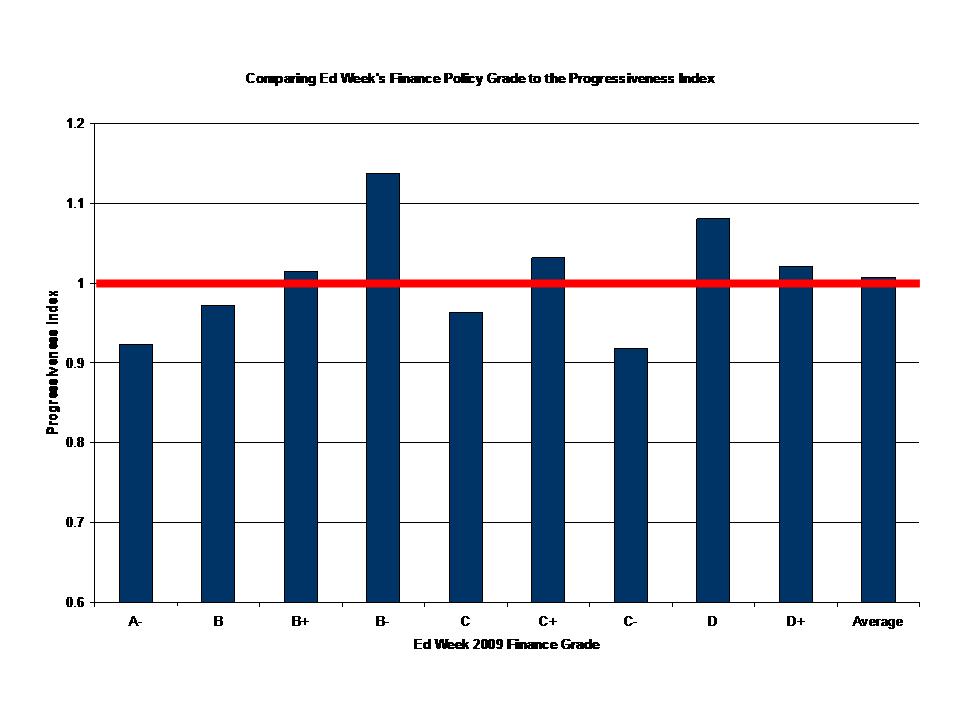
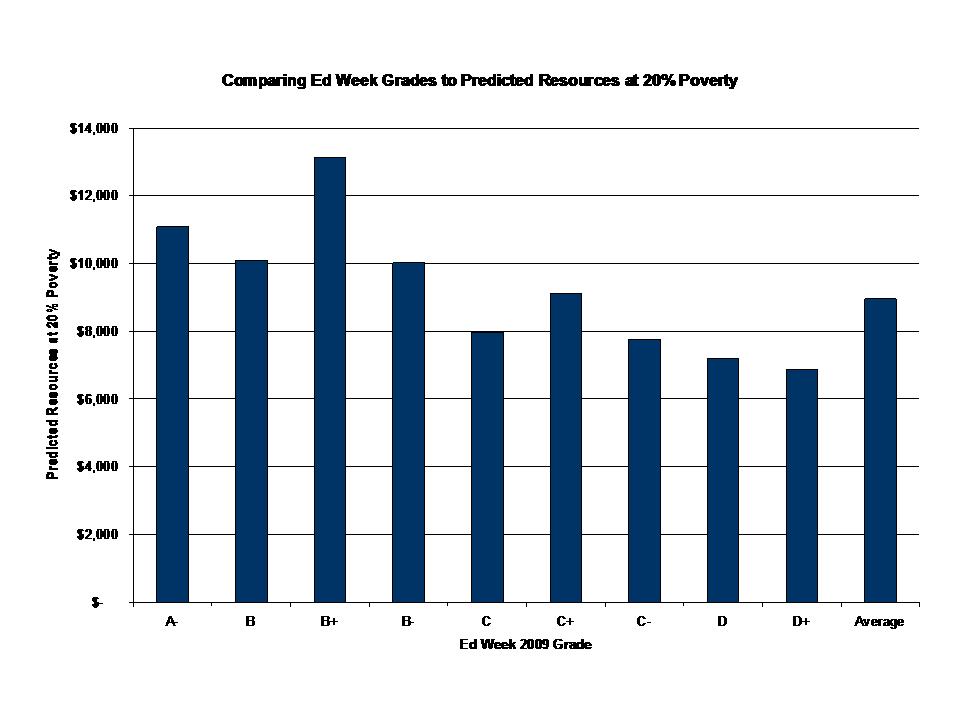
Without giving you the technical details, here’s how our factors line up with Ed Week’s 2009 grades.

This first figure shows the average “poverty sensitivity” or progressiveness scores for states by their Ed Week grades. That is, did the state provide, on average, more or less resources to higher poverty districts after controlling for other factors. A progressiveness index below 1.0 indicates “regressive” funding – higher in lower poverty districts and an index above 1.0 indicates “progressive” funding. Interestingly, Ed Week’s highest grades went to states that were, on average “regressive.”

slide11

This second figure provides the average “predicted spending” for a district with 20% poverty (census poverty) holding other cost factors constant. It’s a sort of – relative adequacy – measure – focused on relatively high poverty (but constant across states) districts. In this case, we also see that the “relative adequacy” of funding in those states receiving the highest grades from Ed Week is lower than the relative adequacy of funding in those states receiving some lower grades.

slide21

So, if Ed Week’s grading system (a) doesn’t capture the extent to which state school finance systems target resources to those districts where they are needed most, and (b) doesn’t capture the true “relative adequacy” of resources across states (accounting for wage, scale and need differences), then what does it capture? I’m just not sure.

Cheers!

State Rankings, Small Businesses, School Quality and Economic Productivity

On a daily basis, in print media and on talk radio, I read and hear a lot of bombastic rhetoric about state rankings of small  business competitiveness  – the most frequent references of late to the Small Business Survival Index (SBSI).

Click to access sbsi%202008%5B1%5D1.pdf

Nearly every component of this index deals with the tax and regulatory environment imposed by states. That is, it is assumed that the major reason one would want to start a business in one location versus another – New Jersey versus North Dakota – is the favorable state tax policy and regulation (minimum wage, etc.).

It would seem to me that this is a relatively limited if not utterly useless perspective. Indeed, among bordering states and within commutable regions at state boundaries such comparisons might be relevant. An individual who wishes to live in a particular region and/or recruit employees with specific skills that may be obtained within that region, might choose to open shop a few streets or miles away in the more favorable state.

However, from a broader, national perspective, issues such as access to human capital, intellectual and cultural environment are critical to at least some if not many small business and entrepreneurial endeavors.

Let’s consider, for the moment, the relationship between 3 different measures –

1. Small Business Survival Index

2. Gross State Product per Capita

3. The Percent of High Schools Achieving a Silver or Gold Rating from U.S. News

Across states, the correlations between these figures look like:

GSP and SBSI (higher is bad) = .1662

A weak correlation, but a positive one, suggesting that on average, states more “hostile” to small business have higher gross state product per capita. Hmm… how can that be?

GSP and % of High Schools Gold or Silver = .4406

A reasonable positive correlation and statistically significant.  Indeed states with more resources may be able to allocate more resources to providing high quality schools. That means taxes. Alternatively, and related, states with highly educated and productive adult populations may emphasize the importance of high level education to their children leading to not only higher participation but higher success rates on AP and IB tests (the underlying elements of the U.S. News HS Rankings).

SBSI and % of High Schools Gold or Silver = .3554

This is also a reasonably positive and statistically significant correlation, indicating that states with more high-end high schools have, on average, less favorable tax policy for small business.

Now… If I’m thinking of starting a small business that relies on intellectual capital and/or creative energy, and if I’m unlike most people and can choose to locate that start-up business anywhere in the country, then I get to make the trade-off decision as to whether I prefer favorable tax climate or intellectual capital and creative energy.

I may be wrong, but it strikes me that the latter is far more important to building a successful business. One might argue that the heavier tax burden is, in part, a premium one pays in order to be in a region with the creative, intellectual work force I need.

Further, if I want to recruit and retain an adult workforce that is going to stick with the business, I need to be recruiting them to work in an area where they feel comfortable raising their children and sending them to school.

In other words, I’m picking Massachusetts, New Jersey or California before South Dakota or Nevada, in spite of the wisdom presented by the authors of the Small Business Survival Index. Quite simply, small business survival is far more contingent on the quality (relevant qualities) of one’s workforce than on the marginal differences in tax policy.Small Business Surival and Educational EffortEducational Effort and % of HS Achieving Gold/Silver (US News)Small Business Survival Index and % Gold/Silver HS

KS Liberty Cluelessness…

I almost hate to waste so much time dealing with such utterly absurd and ignorant rhetoric as appears daily in “news” outlet Kansas Liberty. But, they’re at it again:
https://www.kansasliberty.com/liberty-update-archive/22dec2008/salina-comes-back-for-more-money#1229435964
Again, they raise the point that it has now been proven that the massive infusion of cash over the past 10 years has led to no improvement in results. See my post below where I explain that there was no massive infusion of cash.
In their latest story, the raise two new points:
Regarding the lawsuit filed by Salina and Dodge City in 1999, eventually found in their favor, they note in the most recent article:
“The suit gave the Kansas Supreme Court the opportunity to order the  Legislature to provide substantial funding increases for schools.”

This phrasing suggests that the court was simply waiting to be fed such an opportunity. In fact, the initial response of the trial court was to dismiss the case on the grounds that the same formula had been found constitutional in 1994 (USD 229 v. State). The Supreme Court did accept plaintiffs argument that enough things had changed since that time that a trial was warranted. Neither the trial court nor supreme court seemed enthusiastic to address the issue at the time, since it was still relatively soon after all of the 1990s reforms and court rulings.

They also note that the huge increases in funding are now responsible for the state budget situation:

“The increases are widely blamed for being the primary culprit in creating the state’s growing financial crisis.”

… or could it just be the economy… stupid. States are facing large budget deficits. That’s just how it is right now.

Now, the states facing the biggest deficits are those most dependent on income tax revenues to fill their general fund budgets and support public services. Those facing the biggest problems in education funding are those most reliant on state general funds to support education. This is because income tax returns drop off more quickly than sales tax returns, and property tax revenues are the most stable of the mix.

So, why is this relevant? Well, Kansas’ difficulties with education funding and the impact of education funding on the state budget are largely a function of the reductions in the statewide general fund mill levy from 35 mills to 20 mills in the late 1990s. The legislature created an imbalanced revenue portfolio for itself at that time, leading to the difficult school funding circumstances from 2001 to 2003, and again now. Had the legislature not cut this more stable revenue source from the system, they’d be much better off right now. Yes, unlike the 2001-2003 downturn where only income tax revenues declined, this downturn is hitting other revenues, even potentially property tax revenues. That said, property tax revenues are still more resilient (less elastic).

I’m simply mind-blown by the level of ignorant rhetoric I see in this supposed news outlet.