Should NJ really try to be like DE, MD, MO, GA & WA?

I had relatively modest expectations for the Gannett series in New Jersey on state taxes to begin with. Sadly, this series managed to fall way short of these expectations by trying too hard to construct the point that New Jersey’s taxes are simply way out of line and that, for example, NJ would much better off if it behaved like all of those  smart, business friendly states out there like Delaware, Maryland, Missouri, Georgia and Washington. These states are indeed strange bedfellows.

http://www.app.com/article/20091002/NEWS/310020010/NJ+Tax+Crush++How+five+states+keep+their+tax+burden+down

First, lets get some numbers squared away. I like the fact that this article listed in the right margin, the average state and local per capita taxes, the average state per capita expenditure, and the average per capita income. Note that this second number should have been state and local spending. More importantly, the article failed to do the last calculation and related ranking – state and local taxes as a percent of personal income (perhaps I missed it). That is, how does our effort compare, given our income?  http://www.taxpolicycenter.org/taxfacts/displayafact.cfm?Docid=531

Typically, when looking at taxes as a share of income, NJ is not among the top few states. Above average, yes, but not the top. More specifically on the question of public education spending… state and local… NJ does rank second in the percent of Gross State Product spent on K-12 public school districts. By the way, Vermont is way ahead of us. But, as I have previously argued, to a large degree though not entirely, you get what you pay for. And the five states listed in the article as model states seem to get what they pay for.

On this previous post, I explain how “small business friendly” states tend to have particularly weak public school systems, if we assume small business friendliness to be only a function of low taxes and not high quality services. https://schoolfinance101.wordpress.com/2008/12/17/state-rankings-small-businesses-school-quality-and-economic-productivity/

As far as I’m concerned, having good schools is probably a critical element of business friendliness at least if you have any dreams of recruiting and retaining well educated employees who want their children to also be well educated.

So, what about those miraculous low tax states identified in this article? Within their regions, all but Georgia (which has less competition for bragging rights, and is relatively average) have relatively poorly funded public education systems and to a large extent, the outcomes to go with it.

Delaware has the lowest percent of school aged children even in the public school system. Only 77.6% of 6 to 16 year olds in Del. attend the public schools according to American Community Survey data from 2005 to 2007.  Delaware’s education spending, however, is relatively average or slightly better than average among states (after adjustments for competitive wages, size, location and relative poverty) and its outcomes are relatively average too. Yes, NJ spends more on schools than Delaware, and NJ serves a large share of its children in those schools, and NJ children generally outperform DE children on a variety of assessments.

http://www.nces.ed.gov/nationsreportcard/statecomparisons/Default.aspx?usrSelections=1%2cMAT%2c4%2c0%2cwithin%2c0%2c0

Quite surprisingly, Washington operates one of the least well funded state school finance systems in the nation. And Washington provides negligible additional support for higher poverty and urban schools (not always one and the same). And, Washington also does less well on outcome measures.

(I have some graphs here from an earlier post on LA and MS: https://schoolfinance101.wordpress.com/2009/02/25/public-schooling-in-louisiana-and-mississippi/)

Yes, within region, combining South Atlantic and Gulf Coast states, Georgia is relatively well funded (though again, not supporting poor and urban districts) compared to its peers and does outperform many states in its low performing region. But, Georgia performs much less well than NJ (okay… not a fair comparison… but that’s partly the point). GA also performs less well than Texas or Kentucky for that matter (in graphs in LA & MS post above).

Missouri, like Pennsylvania has made some efforts of late to straighten out their school funding mess into a more logical formula. But the fact remains that poor inner urban fringe and poor rural districts in Missouri have been starved of educational resources for decades and have the outcomes to match. On average, Missouri falls into that consistently below average category on inputs and outcomes. The bigger story in Missouri are the disparities – not so much with the major urban centers themselves (though they are part of the picture) but with those others noted above.

Maryland is another state with fewer than 80% of 6 to 16 year olds even in the public school system. Maryland’s spending is relatively average as are its outcomes. Which is, perhaps fine for Maryland.

By contrast, as I have pointed out here – https://schoolfinance101.wordpress.com/2009/06/17/vacuous_bowdon/

New Jersey, perhaps in part because of its high investment in public schooling – a major public expense, has strong performance measures either compared against other states or if treated as a separate country as I discuss in my previous post. Yes, much is cyclical here. NJ is a richer and more educated state that, as a result, values education and has the money to pay for it, compared to these states.

Do we really want to be like DE, MD, MO, GA or WA? I do like the seafood in WA better. I just moved back to NJ (no not the other way) from living a few yards away from the state line with MO and had the pleasure of both working for MO on their formula redesign and testifying against them on the remaining disparities. But I’m glad to be back.

Sadly, I think that one of the main things that would be learned from mimicking the taxing behavior of these states is that you can have lower taxes if you simply want to sacrifice the quality of your public services – primarily public education.

That said, I will continue to rant against certain major organizational inefficiencies in New Jersey public schooling and government services – that is, the multiple municipal madness issue, which I have written about and speak about (slides here)  https://schoolfinance101.wordpress.com/2009/08/14/small-districts-racial-isolation-and-new-jersey/

Indeed there is real progress to be made on reducing organizational inefficiencies in local governance. I’m not sure that I hold out much hope for resolution here.

======

PS: I hope at some point in the near future to post some detailed numbers on the characteristics of individuals moving into and out of NJ. Last I checked, while there were net exits of middle to lower income families, there was a net inflow of individuals with graduate level education. This would conflict with the unfounded rhetoric I heard spewed on the radio the other morning that NJ is losing all of its hard working small business types and replacing them will undocumented immigrants. Then again, the undocumented part may be a bit hard to track.

Dollars for Disabilities? What do we know?

In this article, Jay Greene and Marcus Winters present a grossly oversimplified perspective of what we really know about the relationship between state school finance systems – special education aid formulas – and state special education classification rates.

http://www.ajc.com/opinion/funding-may-push-special-145257.html?printArticle=y

This supposed problem plays out at two levels. First, it is assumed that states which allocate funding based on local school district rates of classifying special education students will see greater overall growth in special education student populations than states that a) provide flat funding per fixed share of students in each district, b) cap the number of students classified for which funding will be provided or c) use some other better measures of local district resident rates of children with “real” disabilities – a  measure outside the influence of local district classification procedures. Second, some go so far as to assume that not only are state average disability rates different solely because of local responses to differences in state fiscal incentives, but that local rates of disability classification within states also vary largely because of differences in the extent to which local school officials play the special education fiscal incentives game. Green and Winters seem to be speaking primarily on the first point – state average differences and headcount incentives.

There is a small body of research, some of which is pretty solid, that supports the notion that there is a relationship between fiscal incentives and classification rates. That is not to say, however, that such incentives explain most or all of the differences, as implied by Greene and Winters in their absurd Maine to California anecdote. Second, studies that show that classification rates are partially responsive to fiscal incentives do not address whether the incentivised classification rate may actually be closer to the true rate of disabilities than the non-incentivised rate. Without a measure of true prevalence it is difficult to make the leap that the incentive is necessarily a bad one – one that distorts inappropriately the classification rates and services for children with disabilities.

Further, removing the fiscal incentives entirely does not necessarily bring to a grinding halt the overall statewide growth in classification rates or the variations across districts – even if capitation or flat funding does create modest statistical differences in growth rates between states. Pennsylvania has provided flat, census based funding since the early 1990s, yet classification rates grew dramatically since that time and rates continue to vary widely across Pennsylvania districts, from about 5% to over 30%.

Further, as with most demographic characteristics, families of children with mental or physical disabilities are simply not uniformly distributed across neighborhoods, cities and towns within states or across states making it very difficult to say that the typical school district or state should have only X% of such children. Complicating the issue is that the uneven distribution of families of children with disabilities is endogenous to the quality of services available across communities within states and across states. So, for example, if a state provides generous funding based on actual needs of students and that funding leads to higher quality services for students, families of children with disabilities are more likely to consider relocating to those states. The same applies to more local moves where services vary across districts. And parents of children with disabilities may make these decisions based on more than the services provided by the school district alone. Large towns and small cities in otherwise rural areas tend to have elevated disability rates in part because of greater availability of social services and health-care services less available in surrounding areas.

So perhaps a state can export its children with disabilities to a neighboring state by adopting school finance policies that ensure low quality programming and limit district incentive to pursue diagnostic testing. And perhaps some of the differences we see across states – especially between neighboring states – are a function of these programming and service quality differences. This question is yet to be thoroughly addressed in the literature.

In any case, it is a huge unwarranted stretch to argue that state limitation of funding for special education necessarily leads to a more correct identification rate of children in need while holding constant (or even improving) the quality of programs and services and while not exporting children with disabilities.

The problem for state policymakers is to find the correct balance between sensitivity to the needs of individual children as identified by those charged with providing their educational services (local school districts, etc.), and measures of population differences across cities, towns and school districts within states that can serve as a guide in the distribution of resources while avoiding the wrong incentives.

I have written about this topic in the attached research article.

Baker.Ramsey.CBased.JEFSubmit.May28_09

Fact Check: Washington School Finance

I read this today:

http://www.ncpa.org/sub/dpd/index.php?Article_ID=18464

And was especially intrigued by the first bullet point: “Schools receive more than $10,000 per pupil per year, about one-third more than private schools spend per student.”

Having just completed my study of private school tax returns, this statement seemed a bit out of line and there was absolutely no support for it, not even in their main report: http://www.washingtonpolicy.org/Centers/education/policybrief/06_finne_schoolfunding.pdf

They do argue (but do not validate) in this report that the typical Washington private school spends about $6,000 per pupil.

So, I went back to my data set of private schools. Note that the main finding of my report was that private school spending varies widely and varies especially as a function of the affiliation of the schools. The lowest spending schools in my set of 1500 tax returns were those which are members of the major Christian Associations. My sample included 26 such schools in Washington state, which spent in 2007, on average about $6,656 per pupil. So, even the lowest spending group of private schools in Washington spend more than $6k per kid. The largest group filing their IRS 990 returns in Washington were private independent day schools. These schools spent, on average, $19,283 per kid per year.  Hey, that’s about twice what the posting said was the allocation for public schools. Sadly, only 2 catholic schools reported their IRS 990 in Washington, and those schools spent about $13k per kid per year, but are not necessarily representative of all Catholic schools in Washington.

A busy day in school finance…

Just checking my news alerts today. A lot going on:

Massachusetts formula review: http://www.wickedlocal.com/gloucester/news/education/x786214932/Lawmakers-seek-review-of-18-year-old-education-funding-formula

Kansas meeting among potential plaintiffs in response to aid cuts: http://www.dodgeglobe.com/education/x402527694/Schools-for-Fair-Funding-meeting-in-Dodge-City

New lawsuit brewing in Arizona: http://www.kold.com/Global/story.asp?S=11138528

Comments on these at a later point.

Random thoughts on CT

I picked this article up on twitter: http://www.courant.com/news/education/hc-education-commissioner-0819.artaug19,0,3631152.story

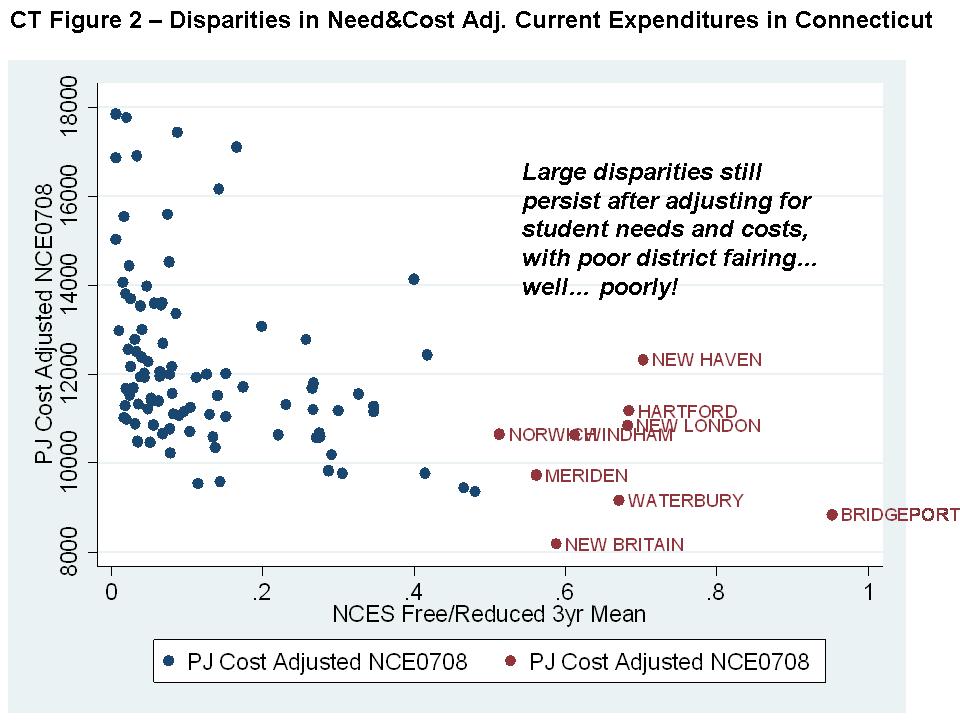
From these figures below, it looks to me like Connecticut has some other issues to deal with. This is  a perfect example of just how illogical state aid distribution and state school finance formulas can be.

Variation in Nominal Expenditures

Variation in Need & Cost Adjusted Expenditures

Private School Spending

New out today (copy of press release):

Ground-breaking study has major implications for public school spending and voucher programs

Contact: Teri Battaglieri – (517) 203-2940; greatlakescenter@greatlakescenter.org
Bruce Baker – (732) 932-7496 ext. 8232; bruce.baker@gse.rutgers.edu

EAST LANSING, Mi., (August 18, 2009) – Private school spending varies far more widely than spending on public education, a new report finds. Further, the differences in spending among different parts of the private school sector reflect clear patterns with major implications for voucher policies and even for spending levels in the public sector.

Those are some of the findings in a first-ever, comprehensive examination of some 1,500 private schools nationally conducted by Rutgers University associate professor and school finance expert Bruce D. Baker.

The report, Private Schooling in the U.S.: Expenditures, Supply, and Policy Implications, is based on a review of financial and enrollment information contained in IRS tax returns combined with data from the National Center for Education Statistics. It was released today by the Great Lakes Center for Education Research and Practice.

Baker presents comparisons of expenditures among different types and affiliations of private schools, and compares those expenditures with public school expenditures for districts in the same state and labor market. Results indicate that (1) the less-regulated private school sector is more varied in many key features (teacher attributes, pay and school expenditures) than the more highly regulated public schooling sector, (2) these private school variations align and are largely explained by affiliation—primarily religious affiliation—alone, and (3) a ranking of school sectors by average spending correlates well with a ranking of those sectors by average standardized test scores.

“On average,” Baker explains, “the private schools studied spend more than public schools in the same metropolitan areas (and nationally), although some spend much less. Some private schools have lower pupil-to-teacher ratios than public schools, while others have comparable ratios. Some have comparable teacher salaries, and some pay their teachers much less. And, some have teachers with stronger academic qualifications than public school teachers, while others have teachers with weaker academic qualifications.”

What’s “most striking” about such patterns, Baker observes, is that they are largely explained by religious affiliation alone. Christian Association Schools have the lowest spending, the lowest salaries, teachers with the weakest academic records, and the highest pupil-to-teacher ratios. Moreover, earlier research concludes that these schools have the lowest student test scores. Catholic schools tend to approximate public schools in all these areas. Hebrew schools and independent day schools (generally not religiously affiliated) have higher spending – often substantially higher – and this is reflected in these resource categories.

Baker’s findings may provide some insights into why research on voucher programs has yielded mixed results regarding student achievement levels for participating low income students. The potentially high-performing parts of the private school sector are the ones that spend much more than available voucher subsidies. In fact, they spend much more than public schools. Private independent day schools—which have the academically strongest teachers and the smallest classes among private schools—will, Baker points out, “remain well out of reach of voucher recipients.” In many markets, such schools on average spend twice what public schools spend, which in turn is often twice the voucher levels allocated. Thus, even under a voucher scheme that paid what public schools receive per pupil, these private schools would have to subsidize half the total cost of teaching voucher students to match what they spend on their non-voucher students.

Baker recommends that policy makers who would look to private schools for lessons on how to improve public education begin with a clear awareness of the stark differences among subsets of private schools, avoiding policy recommendations based on averages or isolated instances. He also points to the importance of understanding the differences between private school spending and tuition, given that spending is often subsidized by outside resources (which themselves are often taxpayer subsidized). Regarding voucher policies, policy makers need to understand the tradeoff between attempts to craft policies with a limited impact on the public treasury and to craft policies that provide real choice to voucher recipients. Current policies appear to sacrifice choice for fiscal prudence, but this report demonstrates that the result is access to only a couple parts of the private sector, both of which have strong religious affiliations and neither of which appears to offer academic benefits over public schools.

Find Bruce Baker’s report, Private Schooling in the U.S.: Expenditures, Supply, and Policy Implications, on the web at: http://www.greatlakescenter.org.

Small Districts, Racial Isolation and New Jersey

Attached are some slides from a presentation I’ve done around the state on the question of how school district size affects education costs. I’ve added to this slide set a few additional slides on the effects of racial composition on education costs, which come from the same statistical model of NJ school district costs, at constant outcomes.

Race & Cost in NJ

The Administrative Blob in Schools: How much does it matter?

A common assertion among public education critics is that public schools simply spend too much on administration and too little “in the classroom.” For example, this was the basis of a reform promoted a few years back which was called the 65 cent solution (which turned out to be a divisive scam as exposed by reporters from the Austin American Statesman in Texas).  One reader of my blog recently commented that he/she thought that Bob Bowdon was in fact making a reasonable argument that the problem with public schools is the administrative bloat, or blob as it has been referred to by others. I do not know whether Bowdon explicitly makes this particular argument or not. But it again raises the question of whether it even makes sense to make this argument in light of what the best empirical research actually says on this topic.

Here’s an excerpt of  a literature review from one of my recent articles in Educational Policy (detailed citations available on request) –

=====

The core assumption of the 65% solution is that increasing the share of spending to areas labeled as “instruction” will improve student outcomes without increasing overall levels of education spending. Implicit in this argument, and highlighted by some anecdotal examples provided on the FCE web site, is the notion that schools are presently wasting too much money in areas such as administration. FCE argues the districts can reallocate that money to instruction. In the 1990s, while schools endured the aftermath of A Nation at Risk and the subsequent criticisms of rising education spending and stagnant outcomes, many policy analysts conducted studies on education spending. These studies made the forgone conclusion that central administrative expenses were necessarily inefficient and therefore harmful for students, and that higher percentages of dollars allocated “to the classroom” were efficient, and therefore beneficial to students. Programmers developed software for school districts to track dollars to the classroom  and studies reported instructional expenditures in New York City schools at only 21.9% in an attempt to validate the inefficiency of large urban school districts (Speakman et al., 1996). However, few methodologically strong studies were able to directly link student outcomes to the ratio of resources districts allocated to  administrative and other non-instructional expenses and classroom instructional expenses.
A significant point of confusion in the literature on instructional spending relates to the difference between instructional spending levels and instructional spending as a share of total spending. For example, proponents of the 65% Solution point to a policy brief prepared for Texas legislators (Patterson, 2005) citing the research of Wenglinsky (1997) as finding a positive relationship between instructional spending and student outcomes. Wenglinsky, however, does not evaluate tradeoffs between instructional and other spending an outcomes, but rather finds that either instructional or administrative spending increases, both of which appear related to increased overall staffing and class size reduction, lead to improved educational outcomes.
Like Wenglinsky (1997), Ferguson and Ladd (1996) find in Alabama that instructional spending has a positive effect on test scores. Using data from Oklahoma school districts, Jacques and Borsen (2002) evaluate the effects of spending levels on student outcomes across a variety of categories, finding “Test scores were positively related to expenditures on instruction and instructional support, and are negatively related to expenditures on student support, such as counseling and school administration.” (p. 997) The authors raise concerns however with deriving causal implications from their findings, noting: “It could be that schools with problems hire more administrators and counselors.” (p.997) Taken together, these findings suggest that when policy makers add new money to education systems, adding that money to instruction areas while holding other areas constant may improve outcomes. In each case, however, researchers evaluated the level of resources allocated to schools, but not tradeoffs or potential reallocation of existing levels of resources. A core tenet of both the 65 and 100% solutions is not that states raise the level of funding for schools, but rather that lawmakers’ require districts to reallocate existing funds.
Bedard and Brown (2000), in an unpublished working paper, attempt the leap from evaluating levels of spending across categories to evaluating relative proportions, and find that reallocation from administration specifically toward classroom instruction might lead to increased outcomes. “Either the reallocation of $100 from administrative to classroom spending, with no change in overall expenditures, or an $100 increase aimed directly at the classroom moves the average California high school approximately 5 percentage points higher in the state test score rankings.” (p. 1) But, Taylor, Grosskopf and Hayes (2007) also in an unpublished working paper, using data on Texas schools to test directly the 65% solution, find that “the analysis suggests that schools that spend a larger share of their budgets on instruction are significantly less efficient than other public schools.” (p. 1)
Two other published, peer reviewed studies specifically examine the relationship between administrative expenses and student outcomes also yielded conflicting findings.  In one, Brewer (1996) found little relationship between non-instructional expenses and student outcomes.  Marlow (2001), contrasting with Brewer’s findings to an extent, found that: “While numbers of teachers do not influence performance measures, numbers of administrators are shown to positively affect performance — results that suggest that too many teachers, but too few administrators, are employed.”
Finally, Huang and Yu (2002) combine NAEP data with NCES Common Core expenditure data to evaluate whether current expenditures per pupil and/or the difference between an individual district’s instructional spending rate and the state average instructional spending rate (called DDR in their study) relate to student outcomes in 1990, 1992 and 1996. The authors found overall positive effects of current spending on outcomes but “Net of relevant district factors, DDR was found unrelated to districts’ average 8th grade math performance.” This test is similar to testing whether districts over or under a 65% instructional spending threshold perform better or worse. The difference is that each district’s instructional share is benchmarked against its own state mean.

=====

So, as it turns out, the best empirical research on this topic (into which I would put Lori Taylor’s work) tends not to show negative effects of administrative expense, or positive effects of instructional expense on student outcomes when addressed as internal shares of total budgets.

But what about New Jersey – that high spending, heavy administrative blob state? And especially those Abbott districts? Well, as I have discussed in previous posts, it turns out that New Jersey administrative salaries are actually relatively non-competitive if compared with (a) private school heads within New Jersey or (b) superintendents in other states like Illinois or Texas. I have also shown that Abbott district administrative shares and administrative expenses per pupil are in line with other New Jersey districts. My forthcoming research also shows that private independent schools spend much larger shares on administration than public schools in the same state. (post on this is forthcoming)

I have not yet checked on total administrative shares in NJ versus other states… but you see… the literature would suggest that administrative shares of spending are not, in fact, a huge drag on student outcomes. Rather, one might counter based on the available information that higher administrative expense and specifically administrative salaries might be warranted in New Jersey in order to begin attracting a stronger leader pool – especially in the schools and districts where they are most needed.

Pennsylvania, Illinois and the Stimulus – What is Duncan thinking?

So… I read these two stories this past week as I get more deeply involved in understanding the impact of the stimulus funding for public schools, specifically, the general stabilization money  around which there seems to be increased controversy of late.

In the first story which appeared in many locations, here is one:

http://www.bloomberg.com/apps/news?pid=20601103&sid=aRx4YhYdDW3E

Duncan takes aim at Pennsylvania for not dipping into its rainy day fund to increase education spending – with stimulus included. Duncan sends a letter to the PA governor explaining that the state’s stabilization money might be jeopardized.

In this second story, Duncan appears to apologize to Illinois for previously being critical of their lack of movement on education funding and reform. For some reason, he now believes they’ve made progress.

Here’s my back story on these two states. I repeatedly run state-by-state analyses of the relative levels of spending and more importantly the progressiveness and regressiveness of state and local resources across school districts in states. Progressively funded systems are those that allocated systematically greater support to districts with greater measurable costs and student needs. Regressive states do the opposite.

Through 2006, Pennsylvania and Illinois have been the most regressively funded states in the country, with Philadelphia the least well funded (relative to low poverty surroundings) and Chicago second least well funded major city in the country. Okay… so PA was last and IL second to last. Arne’s critique makes sense? Well, no! Because PA actually adopted a new funding formula which will – if actually implemented over time – change the distribution of resources across PA districts quite significantly, and approporiately. The latest run I have of district by district state aid allotments for PA districts from the PDE web site indicates that the 2009-10 allotments move ever so slightly in the right direction over the 2008-09 allotments. These are March 2009 estimates (http://www.pdeinfo.state.pa.us/education_budget/lib/education_budget/BEF0910_Mar09_Web.xls)

Please… someone out there correct me if I’m wrong, but as far as I can tell, Illinois has done little or nothing to resolve the plight of Chicago Public Schools and perhaps even more importantly, the plight of many even poorer inner urban fringe districts around Chicago. Now that PA has taken some steps to move forward on school funding reform, IL is well positioned to be dead last on measures of “equal educational opportunity” as provided through funding. Is these really deserving of Duncan’s apologetic approach to his old stomping ground?

The article on Duncan’s apology to Illinois specifically goes further to say that Chicago should be able to pay differential wages to teachers in positions where the district is likely to be losing teachers to surrounding districts. Indeed this makes sense, but this problem is directly related to the fact that Chicago simply has less competitive overall resource levels than it’s more affluent neighbors which are also able to provide more desirable working conditions. Rhetoric about differential teacher pay – as a “progressive” strategy – distracts from the main point that Chicago Public Schools and surrounding poor inner urban fringe districts simply don’t have sufficient resources to compete with surrounding affluent suburbs.

Implying that Pennsylvania is a scofflaw for not using rainy day funds (while implementing significant reforms) and exonerating Illinois despite complete inaction on school funding reform – seems inconsistent at best.

I may be wrong… I’m shooting from the hip this morning without my hard drive of data archives.

WHAT MATTERS HERE IS THE ACTUAL TOTAL AMOUNT OF REVENUE PER PUPIL [FED, STATE, LOCAL] AVAILABLE IN EACH LOCAL SCHOOL DISTRICT AND SCHOOL… NOT WHERE THE MONEY COMES FROM AND NOT THE TOTAL – AGGREGATE – AMOUNT SPENT BY THE STATE.

I ASSURE YOU THAT THOSE IN THE TRENCHES AND THE CHILDREN THEY SERVE ARE MORE CONCERNED WITH THEIR LOCAL BUDGET AND THE EDUCATION IT CAN BUY, THAN WITH SOME 9 TO 10 FIGURE STATE BUDGET WHICH IS LARGELY A POLITICAL ABSTRACTION.

A STATE COULD MEET THIS REQUIREMENT OF INCREASING TOTAL FUNDING SIMPLY BY ALLOCATING LARGER SHARES TO AFFLUENT SUBURBS. A STATE COULD CREATE A LESS EQUAL, LESS FAIR SYSTEM, AND IT SEEMS THAT THAT WOULD BE OKAY? DRIVING THE STIMULUS MONEY THROUGH THE CURRENT GENERAL AID FORMULA IN MANY STATES DOES JUST THAT.

Update on PA here:

http://www.heraldstandard.com/site/news.cfm?newsid=20334428&BRD=2280&PAG=461&dept_id=480247&rfi=6

The Intellectually Vacuous Bob Bowdon’s “Cartel”

See updated post on this topic: https://schoolfinance101.wordpress.com/2010/04/16/cartel-recap/

===== Old post

Had a busy week, so I haven’t posted, but saw a new report yesterday which relates nicely back to the shallow logic of Bob Bowdon’s intellectually vacuous Cartel movie.

The Cartel movie is based on the premise that (a) public schools nationally are failing, (b) public schools in the US spend a ton of money to achieve little, (c) New Jersey is the perfect example of a state which spends a ton of money and fails. All of this, of course, occurs because of a self-interested, self-indulgent cartel of teachers unions and greedy bureaucrats (here’s how their salaries stack up to those “real world” “private sector” workers in NJ). I’ll avoid this latter piece for now, and take a closer look at the logic of points “a” through “c.”

Bowdon cherry picks some national average results from the PISA international assessment of 15 year old students to show that the US compared poorly on math in 2003 and worse in 2006. Of course, any national averages in the U.S. combine the performance of children in states that have largely thrown their public schooling system under the bus  – like Louisiana and Mississippi among others – with those that have done quite well like Massachusetts and New Jersey (indeed it is somewhat unfair to compare directly LA and MS to MA and NJ).

As I have shown in recent posts, there does exist at least some relationship between state aggregate spending (controlling for a variety of factors) and national assessment performance – albeit a relationship heavily entangled with socioeconomic conditions and adult population education levels in states.

Further, as I have also explained previously, an extensive body of research on the effects of school finance reforms including infusion of new resources into poor schools, shows significant positive effects.

A new study out this month from the American Institutes for Research seeks to make more appropriate statistical comparisons of student math performance on another international assessment – TIMSS (Trends in International Math and Science Study). The authors construct a statistical cross-walk between NAEP state assessment scores and TIMSS scores which can be used for international comparisons.  From this analysis, the authors are able to evaluate where individual states stack up against countries participating in TIMSS. This is important because of the variance in state level performance and differences in state policies, fiscal effort and students served.

For starters, on international comparisons, the US on average scored just below the mean for OECD (organization for economic cooperation and development) countries at the 4th and 8th grade level (we do lag from 4th to 8th, an issue of concern). At both 4th and 8th grade on math, the US average is well above the international mean for all TIMSS participants. Now, we may wish to do better – and should. AIR assigns grades to the score ranges for each country and points out that we don’t perform at the levels we should. But this is far from the absurd, apocalyptic (and simply irresponsibly misguided) view presented by Bowdon.

But wait, Bowdon’s premise is that states like New Jersey are the perfect example of inefficiency – spending so much yet producing these terrible national averages. Certainly, New Jersey can’t be blamed for the national average – which carries with it the baggage of states like Louisiana and Mississippi.

How does New Jersey compare to the OECD average? New Jersey ranks 3rd among states on 4th grade math with 25 states beating the OECD average performance. Not bad for Jersey, along with Massachusetts and Minnesota! Louisiana, Alabama, New Mexico, California and Mississippi carry up the bottom end of the rankings, falling below the OECD mean, but above the overall international mean. That is, even Mississippi and Louisiana beat the international mean.

New Jersey drops a little on 8th grade math (consistent with other NAEP based analyses of NJ), but still does well, coming in 6th among the 27 states which perform above the OECD mean. Again, even Louisiana and Mississippi exceed the international mean, but well below the OECD mean.

I am by no means arguing for complacency  – saying – hey – that’s good enough. Rather, my point here is to re-emphasize that the US has a wide variety of education systems in place across states – some which spend a great deal and in fact perform very well, even in international comparisons. New Jersey is among them. We also in this country have some states that have seriously neglected their education systems, spent little, and shifted large shares of (primarily upper class) children in private schooling (schools that spend more, not less than the public schools in those states) where their performance goes unmeasured in these international and even state by state comparisons (in fact, these may be the children who do well in those states, but we don’t know). WHAT THESE STATES HAVE DONE IS A NATIONAL CONCERN!

It is foolish stretch of logic to blame New Jersey’s high spending (and the Cartel that demanded it) for the poor national average performance on select international comparisons. Yes, New Jersey spends on education, and in fact, New Jersey does quite well with that spending compared to other states and on international comparisons.

Certainly, spending alone is not the solution. But little is added to the debate by producing bombastic, misguided, poorly conceived and irresponsible slick-production rhetoric posing as documentary.