Inkblots and Opportunity Costs: Pondering the Usefulness of VAM and SGP Ratings

I spent some time the other day, while out running, pondering the usefulness of student growth percentile estimates and value added estimates of teacher effectiveness for the average school or district level practitioner. How would they use them? What would they see in them? How might these performance snapshots inform practice?

Let’s just say I am skeptical that either VAMs (Value Added Models) or SGPs (Student Growth Percentiles) can provide useful insights to anyone who doesn’t have a pretty good understanding of the nuances of these kinds of data/estimates & the underlying properties of the tests. If I was a principal, would I rather have the information than not? Perhaps. But I’m someone who’s primary collecting hobby is, well, collecting data. That doesn’t mean it all has meaning, or more specifically, that it has sufficient meaning to influence my thinking or actions. Some does. Some doesn’t. Keeping some of the data that doesn’t have much meaning actually helps me to delineate. But I digress.

It seems like we are spending a great deal of time and money on these things for questionable return. We are investing substantial resources in simply maximizing the links in our data systems between individual student’s records and their classroom teachers of record, hopefully increasing our coverage to, oh, somewhere between 10% and 20% of teachers (those with intact, single teacher classrooms, serving children who already have a track record of prior tests – e.g. upper elementary classroom teachers).

At the outset of this whole “statistical rating of teachers” endeavor, it was perhaps assumed by some economists that we would just ram these things through as large scale evaluation tools (statewide and in large urban districts) and use them to prune the teacher workforce and that would make the system better. We’d shoot first… ask questions later (if at all). We’d make some wrong decisions, hopefully statistically more “right’ than wrong, and we’d develop a massive model and data set for large enough numbers of teachers that the cost per unit (cost per bad teacher correctly fired, counterbalanced by the cost per good teacher wrongly fired) would be relatively low. We’d bring it all to scale, and scale would mean efficiency.

Now, I find this whole version of the story to be too offensive to really dig into here and now. I’ve written previously about “smart selection” versus “dumb selection” regarding personnel decisions in schools. And this would be what I called “dumb selection.

But, it also hasn’t necessarily played out this way… thankfully… except perhaps for some large city systems like Washington, DC, and a few more rigidly mandated state systems (though we’re mostly in wait-and-see mode there as well). Instead, we are now attempting to be more “thoughtful” about how we use this stuff and asking teachers to ponder their statistical ratings for insights into how they interact with children? How they teach? And we are asking administrators to ponder teachers’ statistical estimates for any meaning they might find.

In my current role, as a researcher of education policy, I love equations like this: http://graphics8.nytimes.com/images/2011/03/07/education/07winerip_graphic/07winerip_graphic-articleLarge-v2.jpg

I like to see the long lists of coefficients (estimates of how some measure in the model relates to the dependent variable) spit out in my Stata logs and ponder what they might mean, with full consideration of what I’ve chosen to include or exclude in the model, and whether I’m comfortable that the measures on both sides of the equation are of sufficient quality to really tell me anything… or at least something.

The other evening,  I thought back to my teaching days (considered a liability as an education policy researcher), at whether I thought it would have been useful to me to simply have some rating of my aggregate effectiveness – simply relative to other teachers. Nothing specific about the performance of my students on specific content/concepts. Just some abstract number… like the relative rarity that my students scored X at the end of my class given that they scored X-Y at the end of last years class? Or, some generalized “effectiveness” rating category based on whether my coefficient in the model surpassed a specific cut score to call me “exceptional” or merely “adequate?” Something like this.

Would that be useful to me? to the principal? if I was the principal?

Given that I typically taught 2 sections of 7th grade life science and 2 of 8th grade physical science (yeah… cushy private school job), with class sizes of about 18 students each, which rotated through different times of day, I might also find it fun to compare growth of my various classes. Did the disruptive distraction kid really cause my ratings in one life science section to crash (you know who you are!)? Was the same kid able to bring her 8th grade teacher down the next year (hopefully not me again!)?

I asked myself… would those ratings actually tell me anything about what I should do next year (accepting that the data would come on a yearly cycle)? Should I go watch teachers who got better ratings? Could I? Would they protect their turf? Would that even tell me a damn thing? Besides, knowing what I do now, I also know that large shares of the teachers who got a better rating likely got that rating either because of a) random error/noise in the data or b) some unmeasured attribute of the students they serve (bias). Of course, I didn’t know that then, so what would I think?

My gut instinct is that any of these aggregate indicators of a teacher’s relative effectiveness, generated from complex statistical models, with, or without corrections for other factors, are little more than ink blots to most teachers and administrators. And I”m not convinced they’ll ever be anything more than that. They possess many of the same attributes of randomness or fuzziness of an ink blot. And while the most staunch advocate might wish them to appear as an impressionist painting, I expect they are still most often seen as ink blots – not even a Jackson Pollock. More random than pattern. And even if/when there is a pattern, the average viewer may never pick it up.

I anxiously (though skeptically) await well crafted qualitative studies exploring stakeholders’ interpretations of these inkblots.

But these aren’t just any ink blots. They are rather expensive ink blots if and when we start trying to use them in more comprehensive and human resource intensive ways through local public schools and districts and if we weigh on them the burden that we MUST use them not merely to inform, but rather to DRIVE our decisions – and must find significant meaning in them to justify doing so.  That is, if we really expect teachers and principals to log significant hours trying to derive meaning from them, after consultants, researchers, central office administrators and state department officials have labored over data system design, linking teachers to students, and deciding on the most aesthetically pleasing representation of teacher performance classifications for the individual reporting system. Using these tools as quick screening, blunt instruments is certainly a bad idea. But is this – staring at them for endless hours in search of meaning that may not be there – much better?

It strikes me that there are a lot more useful things we could/should/might be spending our time looking at in order to inform and improve educational practice or evaluate teachers. And that the cumulative expenditure on these ink blots, including the cost of time spent musing over them, might be better applied elsewhere.

More on the SGP debate: A reply

This new post from Ed News Colorado is in response to my critique of Student Growth Percentiles here: https://schoolfinance101.wordpress.com/2011/09/02/take-your-sgp-and-vamit-damn-it/

I must say that I agree with almost everything in this response to my post, except for a few points. First, they argue:

Unfortunately Professor Baker conflates the data (i.e. the measure) with the use. A primary purpose in the development of the Colorado Growth Model (Student Growth Percentiles/SGPs) was to distinguish the measure from the use: To separate the description of student progress (the SGP) from the attribution of responsibility for that progress.

No, I do not conflate the data and measures with their proposed use. Policy makers are doing that and doing that based on ill advisement from other policymakers who don’t see the important point – the primary purpose – as Betebenner, Briggs and colleagues explain.  This is precisely why I use their work in my previous post – because it explains their intent and provides their caveats.

Policymakers, by contrast are pitching the direct use of SGPs in teacher evaluation. Whether they intended this or not, that’s what’s happening. Perhaps this is because they are not explaining as bluntly they do here, what the actual intent/design was.

Further, I should point out that while I have marginally more faith that a VAM could, in theory be used to parse out teacher effect than an SGP, which isn’t even intended to, I do not have any more faith than they do that a VAM actually can accomplish this objective. They interpret my post as follows:

Despite Professor Baker’s criticism of VAM/SGP models for teacher evaluation, he appears to hold out more hope than we do that statistical models can precisely parse the contribution of an individual teacher or school from the myriad of other factors that contribute to students’ achievement.

I’m not, as they would characterize, a VAM supporter over SGP, and any reader of this blog certainly realizes that. However, it is critically important that state policymakers be informed that SGP is not even intended to be used in this way. I’m very pleased they have chosen to make this the central point of their response!

And while SGP information might reasonably be used in another way, if used as a tool for ranking and sorting teacher or school effectiveness, SGP results would likely be more biased even than VAM results… and we may not even know or be able to figure out to what extent.

I agree entirely with their statement (but for the removal of “freakin”):

We would add that it is a similar “massive … leap” to assume a causal relationship between any VAM quantity and a causal effect for a teacher or school, not just SGPs. We concur with Rubin et al (2004) who assert that quantities derived from these models are descriptive, not causal, measures. However, just because measures are descriptive does NOT imply that the quantities cannot and should not be used as part of a larger investigation of root causes.

The authors of the response make one more point, that I find objectionable (because it’s a cop out!):

To be clear about our own opinions on the subject: The results of large-scale assessments should never be used as the sole determinant of education/educator quality.

What the authors accomplish with this point, is permitting policymakers to still assume (pointing to this quote as their basis) that they can actually use this kind of information, for example, for a fixed 90% share of high stakes decision making, regarding school or teacher performance, and  certainly that a fixed 40% or 50% weight would be reasonable. Just not 100%. Sure, they didn’t mean that. But it’s an easy stretch for a policymaker.

If the measures aren’t meant to isolate system, school or teacher effectiveness, or if they were meant to but simply can’t, they should NOT be used for any fixed, defined, inflexible share of any high stakes decision making.  In fact, even better, more useful measures shouldn’t be used so rigidly.

[Also, as I’ve pointed out in the past, when a rigid indicator is included as a large share (even 40% or more) in a system of otherwise subjective judgments, the rigid indicator might constitute 40% of the weight but drive 100% of the decision.]

So, to summarize, I’m glad we are, for the most part, on the same page. I’m frustrated that I’m the one who had to raise this issue in part because it was pretty clear to me from reading the existing work on SGP’s that many were conflating the measure with its use. I’m still concerned about the use, and especially concerned in the current policy context. I hope in the future that the designers and promoters of SGP will proclaim more loudly and clearly their own caveats – their own cautions – and their own guidelines for appropriate use.

Simply handing off the tool to the end user and then walking away in the face of misuse and abuse would be irresponsible.

Addendum: By the way, I do hope the authors will happily testify on behalf of the first teacher who is wrongfully dismissed or “de-tenured” on the basis of 3 bad SGPs in a row. That they will testify that SGPs were never intended to assume a causal relationship to teacher effectiveness, nor can they be reasonably interpreted as such.

Friday Afternoon Maps: New Orleans, Race & School Locations

A few weeks back, I noticed several tweets about this recent article in Harvard Education Review which takes a look at racial politics and the rebuilding of New Orleans in the Post-Katrina era.

Here’s the dropbox link tweeted by Diane Ravitch:

http://dl.dropbox.com/u/11116752/Buras_2011-Race_Charter_Schools_Conscious_Capitalism.pdf.pdf

The article is by Kristen Buras of Georgia State University. Buras, like at least a few others, points out that Hurricane Katrina forced the greatest housing displacement in poor black neighborhoods of New Orleans. But, perhaps more disturbing was that in the post Katrina period, redevelopment… and especially redevelopment of the new, mixed delivery schooling system largely ignored those same areas, leading to a system where access to schooling is very disparately distributed geographically.

In her article Buras went to the painstaking steps of hand plotting the locations of post-Katrina schools (See her Figure 3, page 321) to make her point about school locations, and that map certainly does so, though a good before-after might be even clearer.

I’ve been meaning to do some pre-post Katrina school mapping for some time now, but wasn’t quite sure what I wanted to look at, or how I might organize the information. Well, here’s what a little Friday afternoon play has yielded.

First, I used US Census 2000 and American Community Survey 2005 data to set up my background. The background carves New Orleans into Public Use Micro Data Areas (PUMAS, from http://www.ipums.org, boundary files from http://www.census.gov). For the background shading, I used IPUMS data to estimate the percent of resident 5 to 17 year olds in each PUMA that were Black in 2000 and 2005 – pre-Katrina conditions. Those red areas to the right hand side, over toward the lower 9th ward and to the Northeast are almost entirely black, for school aged population. While the entire city has relatively high shares of black population, as Buras notes, uptown and the Garden District are certainly somewhat less black than other parts of the city.

In the first map here, I show the locations and total enrollments of schools (indication of available slots) for the year 2000. I use yellow triangles to indicate if a school is a charter school. There were a few, even in 2000. School locations are based on latitude and longitude data from the National Center for Education Statistics Common Core of Data (www.nces.ed.gov/ccd).

Map 1. Year 2000 distribution of traditional public and charter schools in New Orleans


In the first figure, there are a significant number of decent size schools in the deeper red (higher % black) areas of the city. Citywide, there are a handful of charters scattered around.

Now, here’s the distribution of charters and traditional public schools in 2010. Yes, the city as a whole lost a lot of population (but did rebound somewhat between 2006 and 2010, hence the interest in 2010). Quite strikingly, there are simply very few schools of any size now available in those deep red zones (shading still based on pre-Katrina population). And while there are charters scatted throughout the city, even the highest concentration of those schools is in areas with marginally lower pre-Katrina black populations. There are generally more schools and more larger schools in those neighborhoods.

Again, circle size indicates enrollment size, and if the circle has a yellow triangle over it, the school is a charter school.  Further, I’ve kept the size scaling of circles on the same scale in this map as in the previous one. So, if a circle is smaller, it’s enrollment is smaller.

Map 2. Year 2010 distribution of traditional public and charter schools in New Orleans

Now, it is indeed hard to untangle supply from demand here. One can make the argument that the population didn’t return, therefore there is no demand for schools in those areas previously inhabited by the city’s lowest income black populations. Alternatively, one can as reasonably (and more so after reading Buras) argue that the dearth of available public services may provide some explanation for why families have not returned, or have not been able to return.

One might argue that because there exist so many “schools of choice” throughout the city, that geographic location doesn’t really matter. Ya’ just got to travel a bit. Sign up for one of those great schools over there! But research has consistently shown that even in “choice’ models geographic location/proximity is central to enrollment decisions.  Location matters. And having quality options nearby is important. In fact, parents will often favor location over publicly available “quality” measures, continuing enrollment in schools identified as persistently failing if/when other options are simply not geographically accessible. Then again, those “quality” measures aren’t always particularly meaningful.

This population density map for individuals 18 and under suggests comparable population densities in those areas where school density (especially charter school density) has remained much lower: http://www.gnocdc.org/LossOfChildrenInNewOrleansNeighborhoods/Map3.html

Authors such as Henry Levin have explained on numerous occasions that for a choice model to yield equitable distribution of opportunity, consumers must have equitable access to information on schools and equitable mobility among options. Clearly, equitable geographic access is out the window in Post-Katrina New Orleans. Yeah, I think we already knew this from various media reports. But sometimes I have to play with the data and map them myself for it to really sink in. Whether driven by geographic assignment or by choice enrollment, the distribution of educational opportunities in Map 2 above is troublesome.

Far more troublesome is that so many have publicly pitched this New Orleans mixed delivery model as the key to the future of urban education.

Like Buras, I’m pretty damn skeptical that an education system that has redistributed educational opportunity in the ways seen between Map 1 and Map 2 above is all that.  Just pondering and mapping on a Friday afternoon as the sun finally emerges in the rain-soaked Northeast.

Related maps on school aged population loss here: http://www.gnocdc.org/LossOfChildrenInNewOrleansNeighborhoods/index.html


Should there be a Constitutional Right to Unlimited Property Taxation?

A Reply to Dunn and Derthick in Education Next

Anyone who has read my previous work knows I’m not generally a fan of tax and expenditure limits. A significant body of empirical research does show that strict tax and expenditure limits can cause significant damage to state school finance systems over the long haul. For example, Author David Figlio in a study of Oregon’s Measure 5 (National Tax Journal Vol 51 no. 1 (March 1998) pp. 55-70) finds that: Oregon student-teacher ratios have increased significantly as a result of the state’s tax limitation. David Figlio and Kim Rueben in the Journal of Public Economics (April 2001, Pages 49-71) find: Using data from the National Center for Education Statistics we find that tax limits systematically reduce the average quality of education majors, as well as new public school teachers in states that have passed these limits. In a non-peer reviewed, but high quality working paper, Thomas Downes and David Figlio “find compelling evidence that the imposition of tax or expenditure limits on local governments in a state results in a significant reduction in mean student performance on standardized tests of mathematics skills.” (http://ase.tufts.edu/econ/papers/9805.pdf)

Despite my general concerns over tax and expenditure limits, I have even greater concern over legal arguments like those posed by an affluent suburban school district in Kansas, summarized by Joshua Dunn and Martha Derthick in the Fall 2011 issue of Education Next. As Dunn and Derthick explain, beginning in the 1990s Kansas imposed limits on the amount of revenue local public school districts can raise above and beyond the revenue they are guaranteed through the state general fund aid formula. One affluent suburban district outside of Kansas City recently filed a legal challenge to those limits in Federal District Court, and that legal challenge was the subject of Dunn and Derthick’s recent column. Dunn and Derthick explain the legal arguments as follows:

Citing Supreme Court decisions in Meyer v. Nebraska (1923) and Pierce v. Society of Sisters (1925), which held that the liberty guaranteed in the Fourteenth Amendment’s Due Process Clause includes a right of parents to control the education of their children, the plaintiffs charged that the local cap infringes on that right. As well, by forbidding additional taxes it limits their right to use their property as they wish. Still more inventive, they invoked the First Amendment right of assembly, saying that the cap prevents voters from expressing their collective wishes at the ballot box. These violations together, they contended, constitute a denial of equal protection of the law.

http://educationnext.org/trouble-in-kansas/

So then, what’s wrong with considering the individual liberty to unlimited property taxation? If such liberties apply to campaign contributions or other forms of assembly, then why not to the choice to levy whatever property tax one sees fit? And what’s wrong with linking the notion of complete “local” control over property taxation to the notion of parental control over the education of one’s own children? Ah, if it was only so simple. But it’s not, and here’s a primer on why.

A Little Background Tax and Expenditure Limits (TELs)

State imposed limitations on the taxing behavior of state recognized intermediate and local jurisdictions fall into a broad category of state fiscal management policies known as Tax and Expenditure Limits, or TELs. Tax and expenditure limits have been around for decades and exist in one form or another across nearly every state.

Arguably, the modern era of Tax and Expenditure Limits began with the adoption by statewide referendum of California’s Proposition 13 in 1978, which included a series of limits to the taxable assessed values of properties and changes in those assessed values and included an overall tax rate cap.  Daniel R. Mullins and Bruce A. Wallin (2004) note that “Within two years of the passage of Proposition 13 (a California initiative), 43 states had implemented some kind of property tax limitation or relief.” [1]  By 2004, Mullins and Wallin indicate that Forty-six states have some form of constitutional or statutory statewide limitation on the fiscal behavior of their units of local government.

Statewide limitations on local property taxes exist in multiple forms across states.

Overall Property Tax Rate Limits: Mullins and Wallin note that limits on property tax rates are the most common form of Tax and Expenditure Limit. Overall property tax rate limits restrict the total (municipal, school and other) property tax rate which can be adopted by local jurisdictions. Overall property tax rate limits may but do not necessarily include an option for local override votes. That is, property tax rates are limited but may be exceeded by local voter approval, often including such restrictions as requiring a super-majority vote to achieve override. Mullins and Wallin note that 33 states have imposed property tax rate limits, with 31 limiting municipalities, 28 counties, 26 school districts and 23 all three types (p. 7).

Specific Property Tax Rate Limits: Specific property tax rate limits apply limitations to tax rates for one component of local public goods or services, for example a rate limit on municipal taxes only or a rate limit on property taxes for  operating revenues for local public schools, or for capital outlay revenues for local public school. Again, override options may or may not be included.

Property Tax Revenue Limit: Property tax revenue limits place limits on the revenue that may be derived from property taxes in a given year, regardless of the rate applied. Revenue limits may either be applied to the total revenue allowable (revenue level) or, more commonly to the rate of increase in revenue allowable.

Assessment Increase Limit: Because property tax revenues collected, and tax bills paid by property owners are a function of both the tax rate applied and the assessed value of properties, constraints placed on the allowable growth in assessed value also operate as property tax limitations.

General Revenue or Expenditure Limit: States also place caps on the total amount of revenue that can be raised from property taxes for specific purposes, or alternatively on the amount of property tax revenue that can be raised and expended in a given year. Like other limits, these may be placed on either the total level or revenue or expenditures or on the annual growth in revenue or expenditures, and may or may not be coupled with override options (where those override options are also specified in state laws).

Finally, many states include complex combinations of the above property tax and expenditure limits, such as including both a limit on the rate at which assessed property values may grow and the a limit on the property tax levy.

Property Taxation and TELs in Kansas

The above descriptions of tax and expenditure limits reveal some of the complexity of how these limits work. For example, state imposed limits on growth in property value assessments are a property tax limit to the same extent as limiting the tax rate than can be applied to those properties.  Property taxes include multiple moving parts, or multiple policy levers, the vast majority of which in most states are creations of and controlled within state constitutions and statutes. Below is a non-exhaustive list of the moving parts of the property tax revenue equation:

  1. The boundaries of taxing jurisdictions:  Taxing jurisdictions are government subdivisions within states, defined in state statutes and/or constitutions. They are creations of the state, even if granted home rule or limited home rule. Taxing jurisdictions may or may not be as simple as “cities and towns” or “municipalities.” In some states, municipal taxing jurisdictions are reasonably aligned with local school taxing jurisdictions, but in others like Kansas, they are not. The lack of contiguity between local public school district boundaries and municipal boundaries in Kansas is largely a result of school district consolidations that occurred under state statutes adopted in the 1960s, concurrent with (shortly before)  rewriting of the education article of the state constitution. In many states, the geographic spaces defined as taxing jurisdictions and enrollment areas for local public school districts continue to be redrawn, as in the case of the northeastern section of Kansas City Missouri School District which was recently annexed to Independence School District through a procedure created (specifically for that circumstance) under a recent Missouri statute.  Further, school district boundary determinations (under state laws) are often linked to a long history (including recent history) of institutionalized and state sanctioned racial discrimination in housing markets.[2] The defined geographic boundaries of a taxing jurisdiction determine the properties that are included in or excluded from that jurisdiction. Those boundaries ultimately determine the total values of property within the bounded space, and in turn the amount of revenue that can or cannot be generated by applying any given tax rate to those properties.


Figure 1

School District (green) Boundaries and Cities and Towns in the Kansas City Metro


  1. Definitions of Property Types: Different types of property exist within any taxing jurisdiction, including residential properties, residential properties owned by non-residents (second homes), commercial properties, industrial properties, utilities and farm properties. In Kansas and elsewhere property types are defined in the State Constitution (Article 11). The definition of property types influences substantially the application of “local” property taxes because each defined jurisdiction contains a different mix of property types – some with more commercial property than others – some more residential – and others more farm property. And the different values applied to different types of properties become a significant factor influencing the local revenue raising capacity of communities. Note that in Kansas, as elsewhere, the highest aggregate property values per child enrolled in school are not those in school districts with the highest valued houses, but are those in communities like Burlington, Moscow and Rolla which each include non-residential properties of significant value.
  2. Valuation Procedures: Procedures for determining the taxable value of properties are also defined in state statutes and constitutions, and in Kansas, in Article 11 of the constitution. Those valuation procedures operate as a form of tax and expenditure limitation. Residential properties are defined to have a taxable value of 11.5% of fair market value, agricultural land 30%, vacant lots 12%. States adopt such structures out of state policy interest in creating certain types of incentives or controls, including incentives to either preserve or develop farm property or vacant lots, or buffer commercial interest from escalating taxes. These differential assessment ratios are effectively limits to the revenue raising capacity from any applied tax rate.
  3. Property Tax Exemptions: States also control, typically via statute, the extent to which intermediate or local jurisdictions may grant exemptions to property taxes, including the duration over which an exemption may be granted or types of properties that may be granted exemptions. States also may impose exemptions such exempting from property taxes, a proportion of the value of residential properties owned by senior citizens, in the policy interest of protecting seniors on fixed income from escalating property taxes. As a tax equity measure, Kansas in the late 1990s adopted and exemption to the first $20,000 in taxable value of a residential property for property taxes applied to General Fund Revenues for schools (a statutory provision).
  4. Tax Rate Setting & Referendum Procedures: States also regulate the procedures by which local school district budgets are determined and/or tax rates are set. In some states with constitutional property tax limits which include override provisions, the referendum procedure for override is in the constitution, and may include a requirement of super-majority vote to achieve an override. Requirement of a super-majority is a limit. In other states, statutory provisions permit local authorities to raise taxes (or resulting revenues) to specific levels without voter approval and above those levels with voter approval. In some cases, those limits are absolute and cannot be exceeded.
  5. Debt Ratio Ceilings on Bonded Indebtedness: States also impose various limitations on the amount of debt “local” jurisdictions may accumulate toward the financing of capital projects. Kansas, like other states, imposes a limit – measured as a percentage of total taxable assessed valuation – on the amount of debt that can be accumulated through issuance of general obligation municipal bonds for the financing of new school construction or major renovations.

Each and every provision above and each and every element of the property tax system is controlled by and exists only as a function of state constitutional provisions and statutes. Further, each piece of the property tax puzzle imposes limitations – state controlled limitations – on the ability of state sanctioned local jurisdictions to raise revenues with property taxes.

Extreme Implications of a constitutional protection for complete, unregulated local citizen control over property taxation

Taken at its extreme, the assumption that local residents of any geographic space in the State of Kansas possess a Constitutional right to unlimited control over property taxation for “their” local public schools means that those local residents would have control over each and every parameter above, as each parameter above is a critical determinant of the revenue generated for local public schools by adoption of a specific property tax levy (a rate multiplier). Set any parameter – or multiplier to “0” – and the whole equation shuts down. No one piece is more important than another at determining the amount of money that can be raised for “local” public schools.

Taken at its extreme, any group of citizen residents of the state of Kansas should be able to organize themselves, and define a geographic area that they consider to be their taxing jurisdiction. They would then have the authority to define the types of properties in their jurisdiction and the method for determining the taxable value of those properties. Further, they would have the right to decide whether a mere majority or super majority vote is required in order to adopt any particular tax rate to apply to those properties.

If local citizens control only the single parameter of tax rate setting (the “mill levy”), the state could simply alter rules for adopting rate increases, such as requiring a super-majority vote. Or the state could adopt legislation which effectively reduces the taxable value of properties or exempts certain types of properties for raising additional school revenue above current local option budget limits. For example, the state could exempt all commercial and industrial properties from additional taxation (much like the 20% exemption on residential properties for General Funds Budgets). Such state controls, while not limiting the levies adopted, would limit the revenue that could be generated by those levies. Each of these rules only presently exists as a function of prior state, not local actions.

Assuming that there exists only a constitutional right to adopt higher tax levies, but those levies are to be adopted within an otherwise completely state controlled policy framework, is illogical. If such constitutional freedoms do exist, then they must apply to each and every relevant parameter limiting revenue.

Clearly, however, assuming that local groups of citizens have unlimited rights to determine each and every parameter in the property tax revenue generating equation is absurd, would moot numerous Kansas statues, Article 11 of the Kansas Constitution, and similar constitutional and statutory provisions across nearly every other state.

The state interest in regulating taxes imposed on non-resident property owners

As school district boundaries are presently organized, especially in the Kansas City metropolitan area, school districts each consist of many types of properties. Implicit in the assumption that there exists a constitutionally protected individual right to raise additional funds, through property taxation, for the education of one’s own children is that there exists an overly simplistic 1 to 1 to 1 ratio between children to be educated, the parents of those children and homeowner taxpayers of the jurisdiction. That is, each taxpayer homeowner is also a parent with interest in the quality of education provided to his or her child at the collective expense.  Such would be true if the group of parents organized to start a private school and used their private resources to finance the operations of that school to a level suitable to their own tastes.

This assumption crumbles when applied to local property taxation for public schools and when we consider the mix of property types, property owners and taxpayers that fall within any school taxing jurisdiction in Kansas. For example, owners of commercial and industrial properties within the jurisdiction may not be residents of the jurisdiction. Taxes paid by these individuals may be affected significantly by the decisions of a simple majority share of local residents of the district. The state has a legitimate interest in and may see fit to limit such impact. And one method for doing so is the maintenance of existing tax and expenditure limits.

It seems absurd to assume that a group of resident citizens of a jurisdiction have a constitutional right to unlimited taxation of someone else’s property without the option of state intervention.

The state interest in regulating taxes imposed on vulnerable minority voting blocks

Senior citizens who currently no-longer have children attending local public schools and are living on fixed income may be outnumbered at the polls in some jurisdictions when school budget (levy referenda) votes are held. Many states have policies exempting portions of the value of properties owned by senior citizens in order to provide some protection against escalating taxes. Those exemptions are a state imposed limit to property taxation.

As noted above, if we accept the assumption of a constitutional right for a group of local residents in a taxing jurisdiction to levy unlimited taxes on the rest of the jurisdiction, we must also accept that those same residents have control over each and every parameter in the property tax revenue generating equation that might limit their revenue raising capacity. A simple majority of residents could then negate exemptions. The state has a legitimate interest in protecting the rights of local minority voter populations, such as senior citizens, through such policy mechanisms as property tax exemptions.

The state interest in maintaining school funding fairness

Finally, the state also has an interest in the maintenance of equity in the provision of public education and in access to equal educational opportunity, and one mechanism the state has adopted in order to maintain equity is the limitation to supplemental local spending through property taxation.

Why is it problematic from an equal educational opportunity perspective for local public school districts to have unlimited ability to raise their property taxes and spend as they see fit on their local public schools? How, for example, does it harm the children of Kansas City, Kansas if the parents in Shawnee Mission or Blue Valley School Districts choose to substantially outspend Kansas City over the next several years and provide far higher quality local public schools?

Given the vast student  population differences across school districts in the Kansas City area and specifically between Kansas City and Shawnee Mission which are immediate neighbors, there exist very large differences in the actual cost of providing children with equal educational opportunity. Professor William Duncombe (Syracuse University), on behalf of the Kansas Legislative Division of Post Audit in 2006, estimated that if the cost of a specific quality of education for the state average district was set to 100 (100%), the cost of achieving equal opportunity for students in Kansas City would be about 35% higher than that average, and in Shawnee Mission would be about 12% lower than that average. Presently, the state school finance formula provides for much less difference in funding than would actually be needed to achieve more equal educational opportunity (See Table 1). In fact, when all state and local revenues are considered, Kansas is rated as having a regressive to flat state school finance system – one where higher poverty districts have systematically lower (or, at best, nearly comparable) resources per pupil than lower poverty districts – in a recent national report (as of 2007-08).[3]

The differences in cost of equal educational opportunity estimated by William Duncombe are a function of many factors, most notably vast differences in the backgrounds and needs of children attending local public school districts (See Table 2). More needy students require a wider array of services, including more specialized personnel, smaller class sizes and specific educational and support programs. The state has both an interest and a constitutional obligation to provide equal educational opportunity.

There are at least two major reasons why states have an interest in the maintenance of equity and equal educational opportunity across local public school districts.

First, education is a positional good. Access to economic opportunity, including access to higher education for children in Kansas City, Kansas depends not only on the absolute level of educational expenditure in their own public schools but on the relative quality of education they receive compared to that of other children competing for the same slots in local public and private colleges and universities.

Second is that the quality of schooling in any given location depends largely on the quality of teacher workforce that may be attracted to teach in any given location.  It is well understood that in any given labor market, working conditions – most notably student population characteristics – substantially influence teacher job choice, most often to the disadvantage of the neediest students. It would take not only equal, but significantly higher wages to recruit and retain teachers of comparable qualification to teach in Kansas City as it would to recruit and retain similar teachers to teach in Shawnee Mission, Blue Valley or Olathe. The competitive wage for teachers of specific qualifications in any given area are driven by the wages paid by each district’s nearest neighboring competitors and by the differences in working conditions across districts.

At present, teacher salaries in Kansas City, Kansas are already much lower than those in Shawnee Mission and other Johnson County districts (Table 3). They are lower partly because the state already allows Johnson County districts to levy a special “cost of living” tax (see Table 4) which falsely assumes that teachers in districts with more expensive houses are therefore more expensive to hire. Providing further opportunity for Johnson County districts to widen the salary gap, by removing state imposed tax limits, would likely lead to even greater disparities in teacher qualifications across wealthy and poor districts serving lower and higher need student populations in the Kansas City metropolitan area.

If Shawnee Mission and other Johnson County parents have the right to raise their property taxes in order to recruit and retain better teachers, don’t Kansas City parents have the same right? While they might have a similar right, they do not have similar capacity. Granting this right does not require that the state adopt any measures to equalize the capacity to compete.

For every additional mill on the local tax levy, Shawnee Mission can raise an additional $117 per pupil, whereas Kansas City can raise only $38, a greater than 3X difference (see Table 5). Even under present circumstances, with imposed limitations to the local option budget, Kansas City salaries lag behind Johnson County districts, and Johnson County districts have already been provided a local taxing opportunity to widen the gap, an option some have used.

TABLES AVAILABLE IN PDF VERSION: Fast Response Brief on Individual Liberty and Tax Limits


[1] Daniel R. Mullins and Bruce A. Wallin (2004) Tax and Expenditure Limitations: Introduction and Overview Public Budgeting and Finance (Winter) 2 – 15

[2] See Kevin Fox Gotham (2000) Urban Space, Restrictive Covenants and the Origins of Racial Residential Segregation in a U.S. City. 1900 to 1950. International Journal of Urban and Regional Research 24 (3) 616-633

The When, Whether & Who of Worthless Wonky Studies: School Finance Reform Edition

I’ve previously written about the growing number of rigorous peer reviewed and other studies which tend to show positive effects of state school finance reforms. But what about all of those accounts to the contrary? The accounts that seem so dominant in the policy conversations on the topic. What is that vast body of research that suggests that school finance reforms don’t matter? That it’s all money down the rat-hole. That in fact, judicial orders to increase funding for schools actually hurt children?

Beyond utterly absurd graphs and tables like Bill Gates’ “turn the curve upside down” graph, and Dropout Nation’s even more absurd graph, there have been a handful of recent studies and entire books dedicated to proving that court ordered school finance reforms simply have no positive effect on children. Some do appear in peer reviewed journals, despite egregious (and really obvious) methodological flaws. And yes, some really do go so far as to claim that court ordered school finance reforms “harm our children.”[1]

The premise that additional funding for schools often leveraged toward class size reduction, additional course offerings or increased teacher salaries, causes harm to children is, on its face, absurd. Further, no rigorous empirical study of which I am aware actually validates that increased funding for schools in general or targeted to specific populations has led to any substantive, measured reduction in student outcomes or other “harm.”

But questions regarding measurement and validation of positive effects versus non-effects are complex. That said, while designing good research analyses can be quite complex, the flaws of bad analyses are often absurdly simple. As simple as asking three questions: a) whether the reform in question actually happened? b) when it happened and for how long? and c) who was to be affected by the reform?

  • Whether: Many analyses argue to show that school funding reforms had no positive effects on outcomes, but fail to measure whether substantive school funding reforms were ever implemented or whether they were sustained. Studies of this type often simply look at student outcome data in the years following a school funding related ruling, creating crude classifications of who won or lost the ruling. Yet, the question at hand is not whether a ruling in-and-of-itself leads to changes in outcomes, but whether reforms implemented in response to a ruling do. One must, at the very least, measure whether reform actually happened!
  • When: Many analyses simply pick two end points, or a handful of points of student achievement to cast as a window, or envelop around a supposed occurrence of school finance reform or court order, often combining this strategy with the first (not ever measuring the reform itself). For example, one might take NAEP scores from 1992 and 2007 on a handful of states, and indicate that sometime in that window, each state implemented a reform or had a court order. Then one might compare the changes in outcomes from 1992 to 2007 for those states to other states that supposedly did not implement reforms or have court orders. This, of course provides no guarantee that states from the non-reform group (a non-controlled control group?) didn’t actually do something more substantive than the reform group. But, that aside, the casting of a large time window and the same time window across states ignores the fact that reforms may come and go within that window, or may be sufficiently scaled up only during the latter portion of the window. It makes little sense, for example to evaluate the effects of New Jersey’s school finance reforms which experienced their most significant scaling up between 1998 and 2003, by also including 6 years prior to any scaling up of reform. Similarly, some states which may have aggressively implemented reforms at the beginning of the window may have seen those reforms fade within the first few years. When matters!
  • Who: Many analyses also address imprecisely the questions of “who” is expected to benefit from the reforms. Back to the “whether” question, if there was no reform, then the answer to this question is no-one. No-one is expected to benefit from a reform that didn’t ever happen. Further, no-one is expected to benefit today from a reform that may happen tomorrow, nor is it likely that individuals will benefit twenty years from now from a reform that is implemented this year, and gone within the next three years. Beyond these concerns, it is also relevant to consider whether the school finance reform in question, if and when it did happen, benefited specific school districts or specific children. Reforms that benefit poorly funded school districts may not also uniformly benefit low income children who may be distributed, albeit unevenly, across well-funded and poorly-funded districts. Not all achievement data are organized for appropriate alignment with funding reform data. And if they are not, we cannot know if we are measuring the outcomes of who we would actually expect to benefit.

In 2011, Kevin G. Welner of the University of Colorado and I published an extensive review of the good, the bad and the ugly of research on the effectiveness of state school finance reforms.[2] In our article we identify several specific examples of empirical studies claiming to find (not just “find” but prove outright) that school funding reforms and judicial orders simply don’t matter. That is, they don’t have any positive effects on measured student outcomes. But, as noted above, many of those studies suffer from basic flaws of logic in their research design, which center on questions of whether, when and who.

As one example of a whether problem, consider an article published by Greene and Trivett (2008). Greene and Trivitt claim to have found “no evidence that court ordered school spending improves student achievement” (p. 224).  The problem is that the authors never actually measured “spending” and instead only measured whether there had been a court order. Kevin Welner and I explain:

The Greene and Trivitt article, published in a special issue of the Peabody Journal of Education, proclaimed that the authors had empirically estimated “the effect of judicial intervention on student achievement using standardized test scores and graduation rates in 48 states from 1992 to 2005” and had found “no evidence that court ordered school spending improves student achievement” (p. 224, emphasis added). The authors claim to have tested for a direct link between judicial orders regarding state school funding systems and any changes in the level or distribution of student outcomes that are statistically associated with those orders. That is, the authors asked whether a declaration of unconstitutionality (nominally on either equity or adequacy grounds) alone is sufficient to induce change in student outcomes. The study simply offers a rough indication of whether the court order itself, not “court-ordered school spending,” affects outcomes. It certainly includes no direct test of the effects of any spending reforms that might have been implemented in response to one or more of the court orders.

Kevin Welner and I also raise questions regarding “who” would have benefited from specific reforms and “when” specific reforms were implemented and/or faded out. In our article, much of our attention regarding who and when questions focused on Chapter 6, The Effectiveness of Judicial Remedies of Eric Hanushek and Alfred Lindseth’s book Courting Failure.[3] A downloadable version of the same graphs and arguments can be found here: http://edpro.stanford.edu/Hanushek/admin/pages/files/uploads/06_EduO_Hanushek_g.pdf.  Specifically, Hanushek and Lindseth identify four states, Kentucky, Massachusetts, New Jersey and Wyoming as states which have by order of their court systems, (supposedly) infused large sums of money into school finance reforms over the past 20 years. Given this simple classification, Hanushek and Lindseth take the National Assessment (NAEP) Scores for these states, including scores for low income children, and racial subgroups, and plot those scores against national averages from 1992 to 2007.

No statistical tests are performed, but graphs are presented to illustrate that there would appear to be no difference in growth of scores in these states relative to national averages. Of course, there is also no measure of whether and how funding changed in these states compared to others. Additionally, there is no consideration of the fact that in Wyoming, for example, per pupil spending increased largely as a function of enrollment decline and less as a function of infused resources (the denominator shrunk more than the numerator grew).

Setting these other major concerns aside, which alone undermine entirely the thesis of Hanushek and Lindseth’s chapter, Kevin Welner and I explain the problem of using a wide time window to evaluate school finance reforms which may ebb and flow throughout that window:

As noted earlier, the appropriate outcome measure also depends on identifying the appropriate time frame for linking reforms to outcomes. For example, a researcher would be careless if he or she merely analyzed average gains for a group of states that implemented reforms over an arbitrary set of years. If a state included in a study looking at years 1992 and 2007 had implemented its most substantial reforms from 1998 to 2003, the overall average gains would be watered down by the six pre-reform years – even assuming that the reforms had immediate effects (showing up in 1998, in this example). And, as noted earlier, such an “open window” approach may be particularly problematic for evaluating litigation-induced reforms, given the inequitable and inadequate pre-reform conditions that likely led to the litigation and judicial decree.

There also exist logical, identifiable, time-lagged effects for specific reforms. For example, the post-1998 reforms in New Jersey included implementation of universal pre-school in plaintiff districts. Assuming the first relatively large cohorts of preschoolers passed through in the first few years of those reforms, a researcher could not expect to see resulting differences in 3rd or 4th grade assessment scores until four to five years later.

Further, as noted previously, simply disaggregating NAEP scores by race or low income status does not guarantee by any stretch that one has identified the population expected to benefit from specific reforms. That is, race and poverty subgroups in the NAEP sample are woefully imprecise proxies for students attending districts most likely to have received additional resources. Kevin Welner and I explain:

This need to disaggregate outcomes according to distributional effects of school funding reforms deserves particular emphasis since it severely limits the use of the National Assessment of Educational Progress – the approach used in the recent book by Hanushek and Lindseth. The limitation arises as a result of the matrix sampling design used for NAEP. While accurate when aggregated for all students across states or even large districts, NAEP scores can only be disaggregated by a constrained set of student characteristics, and those characteristics may not be well-aligned to the district-level distribution of the students of interest in a given study.

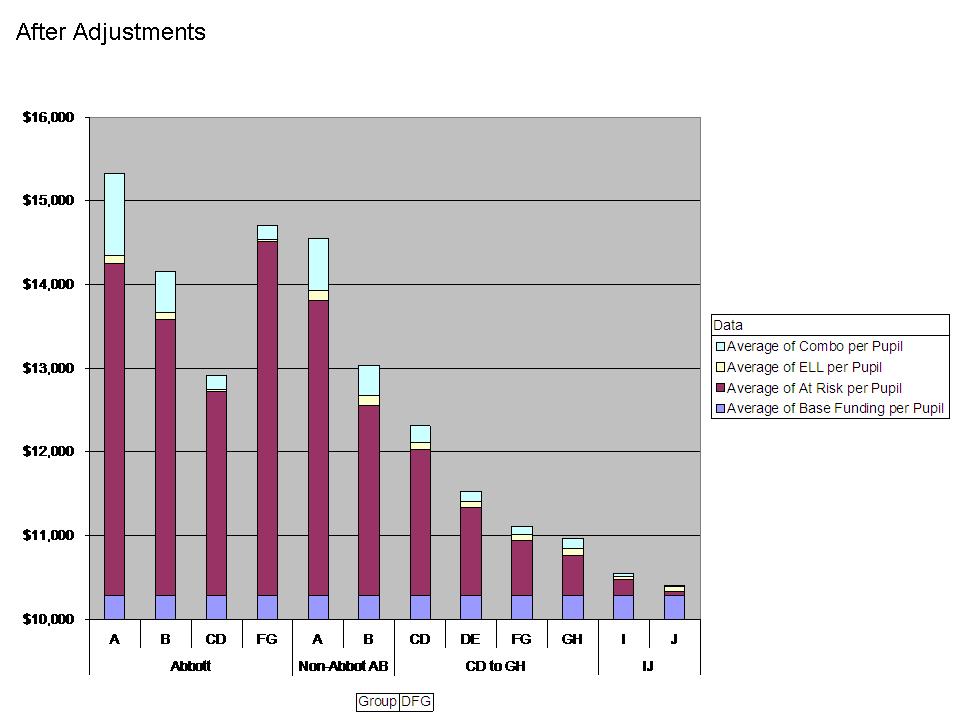
Consider, for example, New Jersey – one of the four states analyzed in the recent book. It might initially seem logical to use NAEP scores to evaluate the effectiveness of New Jersey’s Abbott litigation, to examine the average performance trends of economically disadvantaged children. However, only about half (54%) of New Jersey children who receive free or reduced-price lunch – a cutoff set at 185% of the poverty threshold – attend the Abbott districts. The other half do not, meaning that they were not direct beneficiaries of the Abbott remedies. While effects of the Abbott reforms might, and likely should, be seen for economically disadvantaged children given that sizeable shares are served in Abbott districts, the limited overlap between economic disadvantage and Abbott districts makes NAEP an exceptionally crude measurement instrument for the effects of the court-ordered reform.16

Hanushek and Lindseth are not alone in making bold assertions based on insufficient analyses, though Chapter 6 of their recent book goes to new lengths in this regard. Kevin Welner and I address numerous comparably problematic studies with more subtle whether, who and when problems, including the Greene and Trivitt study noted above.  Another example is a study by Florence Neymotin of Kansas State University, which purports to find that the substantial infusion of funding into Kansas school districts which supposedly occurred between 1997 and 2006 as a function of the Montoy rulings never led to substantive changes in student outcomes. I blogged about this study when it was first reported. But, the most relevant court orders in Montoy did not come until January of 2005, June of 2005 and eventually July of 2006. Remedy legislation may be argued to have begun as early as 2005-06, but primarily from 2006-07 on, before its dismantling from 2008 on. Regarding the Neymotin study, Kevin Welner and I explain:

A comparable weakness undermines a 2009 report written by a Kansas State University economics professor, which contends that judicially mandated school finance reform in Kansas failed to improve student outcomes from 1997 to 2006 (Neymotin, 2009).13 This report was particularly egregious in that it did not acknowledge that the key judicial mandate was issued in 2005 and thus had little or no effect on the level or distribution of resources across Kansas schools until 2007-08. In fact, funding for Kansas schools had fallen behind and become less equitable from 1997 through 2005.14 Consequently, an article purporting to measure the effects of a mandate for increased and more equitable spending was actually, in a very real way, measuring the opposite.[4]

Kevin Welner and I also review several studies applying more rigorous and appropriate methods for evaluating the influence of state school finance reforms. I have discussed those studies previously here. On balance, it is safe to say that a significant body of rigorous empirical literature, conscious of whether, who and when concerns, validates that state school finance reforms can have substantive positive effects on student outcomes including reduction of outcome disparities or increased overall outcome level.

Further, it is even safer to say that analyses provided in sources like the book chapter by Hanushek and Lindseth (2009), or research articles by Neymotin (2009), Greene and Trivett, provide no credible evidence to the contrary, due to significant methodological omissions. Finally, even the boldest, most negative publications regarding state school finance reforms provide no support for the contention that school finance reforms actually “harm our children,” as indicated in the title of a 2006 volume by Eric Hanushek.

Sometimes, even when a research report or article seems really complicated, relatively simple questions like when, whether and who allow the less geeky reader to quickly evaluate and possibly debunk the study entirely.  Sometimes, the errors of reasoning regarding when, whether and who, are so absurd that it’s hard to believe that anyone would actually present such an absurd analysis. But these days, I’m rarely shocked. My personal favorite “when” error remains the Reason Foundation’s claim that numerous current reforms positively affected past results! http://nepc.colorado.edu/bunkum/2010/time-machine-award. It just never ends!

Further reading:

B. Baker, K.G. Welner (2011) Do School Finance Reforms Matter and How Can We Tell. Teachers College Record. http://www.tcrecord.org/content.asp?contentid=16106

Card, D., and Payne, A. A. (2002). School Finance Reform, the Distribution of School Spending, and the Distribution of Student Test Scores. Journal of Public Economics, 83(1), 49-82.

Roy, J. (2003). Impact of School Finance Reform on Resource Equalization and Academic Performance: Evidence from Michigan. Princeton University, Education Research Section Working Paper No. 8. Retrieved October 23, 2009 from http://papers.ssrn.com/sol3/papers.cfm?abstract_id=630121(Forthcoming in Education Finance and Policy.)

Papke, L. (2005). The effects of spending on test pass rates: evidence from Michigan. Journal of Public Economics, 89(5-6). 821-839.

Downes, T. A., Zabel, J., and Ansel, D. (2009). Incomplete Grade: Massachusetts Education Reform at 15. Boston, MA. MassINC.

Guryan, J. (2003). Does Money Matter? Estimates from Education Finance Reform in Massachusetts. Working Paper No. 8269. Cambridge, MA: National Bureau of Economic Research.

Deke, J. (2003). A study of the impact of public school spending on postsecondary educational attainment using statewide school district refinancing in Kansas, Economics of Education Review, 22(3), 275-284.

Downes, T. A. (2004). School Finance Reform and School Quality: Lessons from Vermont. In Yinger, J. (ed), Helping Children Left Behind: State Aid and the Pursuit of Educational Equity. Cambridge, MA: MIT Press.

Resch, A. M. (2008). Three Essays on Resources in Education (dissertation). Ann Arbor: University of Michigan, Department of Economics. Retrieved October 28, 2009, from http://deepblue.lib.umich.edu/bitstream/2027.42/61592/1/aresch_1.pdf

Goertz, M., and Weiss, M. (2009). Assessing Success in School Finance Litigation: The Case of New Jersey. New York City: The Campaign for Educational Equity, Teachers College, Columbia University.


[1] See, for example: E.A. Hanushek (2006) Courting Failure: How School Finance Lawsuits Exploit Judges’ Good Intentions and Harm Our Children. Hoover Institution Press.  Reviewed here: http://www.tcrecord.org/Content.asp?ContentId=13382

[2] Baker, B.D., Welner, K. (2011) School Finance and Courts: Does Reform Matter, and How Can We Tell? Teachers College Record 113 (11) p. –

[3] Hanushek, E. A., and Lindseth, A. (2009). Schoolhouses, Courthouses and Statehouses. Princeton, N.J.: Princeton University Press.

[4] B. Baker, K.G. Welner (2011) Do School Finance Reforms Matter and How Can We Tell. Teachers College Record. http://www.tcrecord.org/content.asp?contentid=16106

Who would really want to spend more than that? (Ed Next & Spending Preferences)

When Paul Peterson asks “Do we really need to spend more on schools?” we already know what he thinks the answer is – an unequivocal NO!  Knowing the answer you desire always makes it easier to frame the questions, and like previous years, this year’s Education Next survey of attitudes toward public education provides few surprises.

Before I even gained full access to Peterson’s most recent WSJ Op-ed (e-mailed to me by a family member), I was able to guess pretty much where he was going with it.  Here’s how Peterson explains the Ed Next public opinion survey findings:

At first glance, the public seems to agree with this position. In a survey released this week by Education Next, an education research journal, my colleagues and I reported that 65% of the public wants to spend more on our schools. The remaining 35% think spending should either be cut or remain at current levels. That’s the kind of polling data that the president’s political advisers undoubtedly rely upon when they decide to appeal for more education spending.

Yet the political reality is more complex than those numbers suggest. When the people we surveyed were told how much is actually spent in our schools—$12,922 per student annually, according to the most recent government report—then only 49% said they want to pony up more dollars. We discovered this by randomly splitting our sample in half, asking one half the spending question cold turkey, while giving the other half accurate information about current expenditure.

Later in the same survey, we rephrased the question to bring out the fact that more spending means higher taxes. Specifically, we asked: “Do you think that taxes to fund public schools around the nation should increase, decrease or stay about the same?” When asked about spending in this way, which addresses the tax issue frankly, we found that only 35% support an increase. Sixty-five percent oppose the idea, saying instead that spending should either decrease or stay about the same. The majority also doesn’t want to pay more taxes to support their local schools. Only 28% think that’s a good idea.

So there is the nation’s debt crisis in a nutshell. If people aren’t told that nearly $13,000 is currently being spent per pupil, or if they aren’t reminded that there is no such thing as a free lunch, they can be persuaded to think schools should be spending still more.

In other words… yeah… the ignorant general public thinks they want to spend more on schools, but only because they don’t realize how much we are already wasting on public schools! When we clue them into the egregious… no… outrageous… exorbitant spending already going on … and hold a gun to their head… and phrase our question just right… pointing out to them just how stupid we think they are… and how smart we are… then the fix their answer… and become much, much more reasonable!

This explanation is problematic at a number of levels.  First, let’s explore the basic model of local voter preferences for spending on local public schools – specifically the information on price and quality that informs those preferences. First, local public school revenue comes from two primary sources – local property taxes paid on various types of properties within school districts and state general funds derived largely from state sales and income taxes. The mix varies widely from state to state. Residential property owners frequently pay their property taxes embedded in monthly mortgage payments and renters pay their landlords’ property taxes embedded in rent prices. Homeowners and renters have at least some feel for the reasonableness of their aggregate monthly housing payments, and some feel for the quality of public services they receive (schools, fire, police, parks, etc.) for the aggregate price they pay. They also have some feel for a) whether they would like those services improved and b) whether they are willing to pay a bit more to support those improvements. In short, a typical taxpayer/survey respondent has a reasonable gut feel regarding their “tax price” paid for the quality of public service provided.

The local taxpayer/voter/survey respondent sufficiently involved with local public schools (having children in the schools, working in the schools, having children who are recent graduates of the schools, or having recently graduated themselves) probably has some indicators of schooling quality in his/her head that guide his/her preference to pay more (or less). Has class size risen, or does it just seem too large? Has the district cut visible programs like music, arts or athletics of late, or has the district increased fees to cover the costs of these programs? As a result, the respondent is at least somewhat able to piece together whether they wish to spend a little more to decrease class sizes, expand programs or reinstate programs previously cut.

But, the typical taxpayer/voter/survey respondent likely a) doesn’t give a damn about and b) is generally unable to contextualize the meaning of the Total per Pupil Expenditures for a local public school district. It’s an abstract concept. A number that relates in a meaningful sense only to those who really spend their days steeped in such numbers. A number most likely to do little more than bias a response in this case, and it seems to, though it is hard to know precisely why.

Even worse is when those numbers are used totally out of context, as in Peterson’s argument above. Peterson’s description above is actually even worse than the methods description provided at Ed Next (Interestingly, Peterson also adds over $600 per pupil to the average spending figure, and then rounds it up to $13,000 by the end of his op-ed, compared to the information in the paragraph below from Ed Next):

A segment of those surveyed were asked the same ques­tion except that they were first told the level of per-pupil expenditure in their community, which averaged $12,300 for the respondents in our sample. For every subgroup con­sidered, this single piece of information dampened public enthusiasm for increased spending. Support for more spend­ing fell from 59 percent to 46 percent of those surveyed. Among the well-to-do, the level of support dropped dramati­cally, from 52 percent to 36 percent. Among teachers, sup­port for expenditure increases fell even more sharply—from 71 percent to 53 percent (see Figure 7).

Surely, it would be completely absurd to ask (as implied by Peterson’s op ed) the average person in Tennessee if their schools should spend more, after telling that person what the average district spends nationally – implying to the respondent that the figure represents Tennessee spending (as seemingly implied by Peterson’s Op-Ed, and as in the online survey at Ed Next).  It is only marginally more useful, however to ask the average respondent in Tennessee whether they should spend more or less, given a completely out of context representation of their local spending per pupil.

Here’s how the 2008-09 actual national mean per pupil spending compares to the distribution of per pupil spending across Tennessee districts:

(national mean current spending per pupil in 2008-09 was $10,209.83 [w/outliers excluded])

Now, it might be interesting to show the average voter respondent in Tennessee this graph and then ask him/her whether they think more should be spent in Tennessee? This graph provides some context. Context that is completely absent when informing a Tennessee respondent either of their own local district spending WITH NO OTHER CONTEXT AVAILABLE or of the national spending WITH NO OTHER CONTEXT AVAILABLE.

Put very simply, a per pupil spending figure out of context is meaningless.  $17,000 I say! $17,000… an abomination I say. It’s  a huge number! Why would we ever consider spending more than that per pupil in New York City? Well, what if it just happened to turn out that in the same year, that $17,000 per pupil was lower, on average, than most of the surrounding districts with much less needy student populations? What if that $17,000 was only approximately 50% of what was being spent in private independent schools operating within the city?  It doesn’t sound so big any more does it?  How would survey respondents in New York City change their answer if this information was provided?

The Ed Next survey, while fun to ponder each year, isn’t particularly helpful for really understanding voter’s preferences or awareness regarding spending on public schools or perceived quality.

Actual data on local budget votes, including those involving tax increases (increasing the more voter-distasteful local property tax) tend to be a much more useful barometer and even in the worst of economic times, local voter support – especially where voters have the financial capacity to provide that support – remains overwhelmingly positive  (Example NY State Data & previous NJ Blog Post [over 70% pass rate in wealthy districts in worst year]).  Matt Di    Carlo provides further discussion of this topic here, explaining the general voter preferences. It is also worth noting that even the most poorly constructed and phrased polls do not find significant shares (if any) responding that less should be spent.  Yet that is precisely the argument advanced by many pundits in response to these surveys.

More Flunkin’ out from Flunkout Nation (and junk graph of the week!)

Earlier today I stumbled across this brilliant post by RiShawn Biddle over at Dropout Nation.

Biddle boldly claims:

Despite the arguments (and the pretty charts) of such defenders as Rutgers’ Bruce Baker, there is no evidence that spending more on American public education will lead to better results for children.

Now, regarding the “no evidence” claim, I would recommend reading this article from Teachers College Record, this year, which summarizes a multitude of rigorous empirical studies of state school finance reforms finding generally that increased funding levels have been associated with improved outcomes and that more equitable distributions of resources have been associated with more equitable distributions of outcomes.

In fact, even the Spring 2011 issue of the journal Education Finance and Policy includes an article by Joydeep Roy supporting the positive results of state school finance reforms (using Michigan data).

Proposal A was quite successful in reducing interdistrict spending disparities. There was also a significant positive effect on student performance in the lowest-spending districts as measured in state tests.(from abstract)

As Kevin Welner and I point out in our article, this study is not unique in its findings. Here are a few others:

Card & Payne (2002)

Using micro samples of SAT scores from this same period, we then test whether changes in spending inequality affect the gap in achievement between different family background groups. We find evidence that equalization of spending leads to a narrowing of test score outcomes across family background groups. (p. 49)

Deke (2003)

Using panel models that, if biased, are likely biased downward, I have a conservative estimate of the impact of a 20% increase in spending on the probability of going on to postsecondary education. The regression results show that such a spending increase raises that probability by approximately 5% (p. 275).

Papke (2001)

Focusing on pass rates for fourth-grade and seventh grade math tests (the most complete and consistent data available for Michigan), I find that increases in spending have nontrivial, statistically significant effects on math test pass rates, and the effects are largest for schools with initially poor performance. (Papke, 2001, p. 821.)

Downes (2004) on VT

All of the evidence cited in this paper supports the conclusion that Act 60 has dramatically reduced dispersion in education spending and has done this by weakening the link between spending and property wealth. Further, the regressions presented in this paper offer some evidence that student performance has become more equal in the post–Act 60 period. And no results support the conclusion that Act 60 has contributed to increased dispersion in performance. (p. 312)

Downes, Zabel & Ansel (2009) on Mass

The achievement gap notwithstanding, this research provides new evidence that the state’s investment has had a clear and significant impact. Specifically, some of the research findings show how education reform has been successful in raising the achievement of students in the previously low-spending districts. Quite simply, this comprehensive analysis documents that without Ed Reform the achievement gap would be larger than it is today. (p. 5)

Guryan (2003) on Mass

Using state aid formulas as instruments, I find that increases in per-pupil spending led to significant increases in math, reading, science, and social studies test scores for 4th- and 8th-grade students. The magnitudes imply a $1,000 increase in per pupil spending leads to about a third to a half of a standard-deviation increase in average test scores. It is noted that the state aid driving the estimates is targeted to under-funded school districts, which may have atypical returns to additional expenditures. (p. 1)

Goertz & Weiss (2009) on NJ

State Assessments: In 1999 the gap between the Abbott districts and all other districts in the state was over 30 points. By 2007 the gap was down to 19 points, a reduction of 11 points or 0.39 standard deviation units. The gap between the Abbott districts and the high-wealth districts fell from 35 to 22 points. Meanwhile performance in the low-, middle-, and high-wealth districts essentially remained parallel during this eight-year period (Figure 3, p. 23).

I could go on. But that’s a fair share of evidence right there.

And what does Biddle provide as counter evidence to this – apparent lack of evidence I summarize above (I’ve sent the article link to Biddle on more than one occasion, but he apparently doesn’t read this kind of academic stuff)?

Biddle counters with a link to this graph – a true gem (I’ve added some annotation, not in his original)!

Yes, Biddle’s entire counter to the body of research he has not and will not read, is to use this graph of “promoting power” by student race group for Jersey City, NJ in 2004 and 2009. Note that the infusion of additional funds in NJ occurred mainly from 1998 to 2003, leveling off thereafter. But that’s a tangential point (not really).  So, Biddle’s absolute verification that more money doesn’t matter is to simply assert without verification that Jersey City got a whole lot more money and then to use this graph to argue that nothing improved!

First of all, that analysis wouldn’t pass muster in as a master’s degree level assignment (I teach a class on this stuff at that level), no less major research conclusions. From a graphing standpoint, I often criticize my students’ work for what I refer to as gratuitous use of 3d – especially where the use of 3d bars actually obscures the comparisons by making it hard to see where they align on the axis.

But, the really funny if not warped part of this graph is that there appear to be significant gains for black males between 2004 and 2009, but those gains are obscured by hiding the 2009 black male score behind the 2004 black female score.

Note that the graph also contains no information regarding the actual shares of the student population that fall into each group? Not very useful. Pretty damn amateur. Certainly fails to make any particular point, and certainly doesn’t refute the various citations above – all of which employ more rigorous analytic methods, apply to more than a single district, and most of which appear in rigorous peer reviewed journals.

References:

Card, D., and Payne, A. A. (2002). School Finance Reform, the Distribution of School Spending, and the Distribution of Student Test Scores. Journal of Public Economics, 83(1), 49-82.

Deke, J. (2003). A study of the impact of public school spending on postsecondary educational attainment using statewide school district refinancing in Kansas, Economics of Education Review, 22(3), 275-284.

Downes, T. A. (2004). School Finance Reform and School Quality: Lessons from Vermont. In Yinger, J. (ed), Helping Children Left Behind: State Aid and the Pursuit of Educational Equity. Cambridge, MA: MIT Press.

Downes, T. A., Zabel, J., and Ansel, D. (2009). Incomplete Grade: Massachusetts Education Reform at 15. Boston, MA. MassINC.

Goertz, M., and Weiss, M. (2009). Assessing Success in School Finance Litigation: The Case of New Jersey. New York City: The Campaign for Educational Equity, Teachers College, Columbia University.

Guryan, J. (2003). Does Money Matter? Estimates from Education Finance Reform in Massachusetts. Working Paper No. 8269. Cambridge, MA: National Bureau of Economic Research.

Papke, L. (2005). The effects of spending on test pass rates: evidence from Michigan. Journal of Public Economics, 89(5-6). 821-839.

Roy, J. (2003). Impact of School Finance Reform on Resource Equalization and Academic Performance: Evidence from Michigan. Princeton University, Education Research Section Working Paper No. 8. Retrieved October 23, 2009 from http://papers.ssrn.com/sol3/papers.cfm?abstract_id=630121(Forthcoming in Education Finance and Policy.)

Private Choices, Public Policy & Other People’s Children

I don’t spend much if any time talking about my personal decisions and preferences on this blog. It’s mostly about data and policy.  There’s been much talk lately about whether a Governor’s or President’s choice to send their children to elite private schools, or where Bill Gates, Mark Zuckerberg or prominent “ed reformers” attended school are at all relevant to the current policy conversation around  “reforming” public schools.  When those choices have been questioned publicly, they’ve often been met with the backlash that those are personal choices of no relevance to the current policy debate – just dirty personal attacks about personal, rational choices.

I have no problem with these personal choices. But, these personal choices may, in fact be relevant to the current policy debate.  I do keep in mind my own personal choices and preferences as I evaluate what I believe to be good policy for the children of others. And, I try to keep in mind what I know from my background in research and policy when I make my personal choices.   Like these prominent politicos and pundits, I too choose private independent schools – relatively expensive ones – for my children, and I have my reasons for doing so. As I’ve noted on my blog on a number of occasions, I taught at an exceptional private independent school in New York City, and have relatives and friends who continue to be involved in (and with) high quality private independent schools as teachers, administrators and parents. I did not, however, attend private school. I attended public school in Vermont, followed by private college (Lafayette College).

Why do I personally prefer private independent schools, which often come with a high price tag?  Here are a few reasons:

  1. The responsiveness that comes from a close-knit small community with not only small class sizes but also lower total student load for teachers (at middle and secondary level in particular)
  2. The depth and breadth of curricular offerings ranging from Latin in the middle school, to a diverse array of social science, advanced science and math courses at the high school level and a plethora of opportunities in the arts and athletics.
  3. The lack of emphasis on standardized testing – bubble tests and overemphasis on tested curricular areas and state standards.

Yes, I do consider it important that these schools are not test-whipped, specifically that they are not obsessed with basic reading and math bubble tests alone, or even more disturbing, tests of science and social studies content where the balance (or absence) of content is a function of partisan preferences of ill-informed politically motivated elected officials (e.g. Kansas science standards, or Texas social studies/history standards – thankfully, I’m not in KS anymore).

These days, I consider it especially important that my children not be in a school where teachers have to hang their hopes of achieving a living wage (or getting a bonus to afford cosmetic surgery as in “Bad Teacher”[hope to see that one soon!]) on whether or not my child gains X+Y points on those reading or math tests. In fact, these may now be my main reasons for opting out.

So yes, you might try to call me a hypocrite for preferring private schools for my own children while apparently being such a staunch defender and supporter of the public system (including voting yes on local district budgets, even when encouraged to vote no by public officials). But that would be a dreadful oversimplification and misrepresentation of my position.

I have worked in both public and private schools – one good and one bad of each – over a 10+ year period prior to my life in higher education.  I’ve studied and compared public and private schools in various locations and of various types for over 15 years and published numerous articles, papers and reports. What I’ve learned most from these studies is that private and/or less regulated markets are simply more varied than public and/or more regulated markets. Neither better nor worse on average – simply more varied.

Top notch private schools spend much more, and many financially strapped, relatively average to very low academic quality private schools do spend much less. Much more and much less than one another, and much more and much less than nearby public schools.  It is a massive bait and switch to suggest – look how great Sidwell Friends (DC),  Dalton or Fieldston (NYC) are compared to public schools, and look how much the average Catholic parish elementary school spends compared to the urban public district?  Of course, it’s never as obviously phrased as a bait and switch – suggesting that you can get a Sidwell or Dalton education at an urban Catholic elementary school price.  You can’t! Yes, the average Catholic parish elementary school likely spends less per pupil than the public district. But that school is no Sidwell, Dalton or Fieldston, which spend closer to and in excess of double the public schools in their area.

Private schools do not, as many assume, spend only about half what public schools do. This is urban legend, drawn from dated analyses that were misrepresented to begin with (over 10 years ago).  My extensive report on private school supply and spending covers these issues quite extensively.

To reiterate a major finding from my study of private school costs, private independent schools of the type I am talking about here (members of NAIS or NIPSA), spend ON AVERAGE, 1.96 times the average per pupil amount of public schools in the same labor market! (and have half the pupil to teacher ratio)

I am quite convinced that many of the policy makers who choose elite private schools for their own and advocate for scaling back the public system, really don’t understand the difference. They really don’t know that their private schools outspend nearby traditional public schools – by a lot – despite serving more advantaged student populations. Heck, I’ve talked to administrators in private independent schools who feel that their own budgets are tight (legitimately so), and assume that the public schools around them spend much more per child. But they are simply naïve in this regard (while wise in many other ways). No intent to harm. They’ve simply bought into the misguided rhetoric that private schools spend less and get more and they’ve never double-checked the facts. But even a few minutes of pondering their own budgets and looking up local public school spending brings them around. (Part of this perception is likely driven by differences in access to funding for capital projects, where heads of private schools recognize the heavy lifting of major fundraising campaigns, and envy the taxing authority of public school districts for these purposes).

In my view, the hypocrisy lies in what those who choose elite private schools for their own argue are the best solutions for public education for the children of others.  If the preferences are the same, there is no hypocrisy. The problem is when those preferences are vastly different – completely at odds – as they tend to be in the present “ed reform” and “new normal” debate.

It is hypocritical for pundits who favor for their own children, expensive schooling with diverse curriculum, small class size and little standardized testing (freeing teachers to be professionals), to argue for less money, class size increases and increased standardized testing (and teacher evaluation based on those tests) when it comes to other peoples’ children.

Yes, I too personally favor expensive private schooling for the reasons I’ve indicated above. And yes, my private school significantly outspends both the elite suburban public school district where I live and New Jersey’s reasonably well funded urban districts (compared to other states, see: http://www.schoolfundingfairness.org).   The way I see it, I would not just be a hypocrite, but a complete a-hole if I used my pulpit (what little pulpit I have) as a school finance expert to argue that we should be spending less on others, advocating different policies for others than I desire for myself.  But it’s precisely because I spend my day buried in data on school finance and education policy that I see this glaring hypocrisy.

The difference is that I believe that other children – those whose parents are not able to make this expensive choice – should have access to well-funded schools that also provide small class sizes, diverse curriculum, and for that matter, place less emphasis on standardized tests, and treat teachers as responsible, knowledgeable professionals (not script reading stand-ins and test proctors).

To clarify, this is not a criticism of individuals with personal preferences for high quality education for their own children who are otherwise unconcerned with (or oblivious to) the broader public policy questions pertaining to the children of others. Rather, this is a direct criticism of those public officials and vocal “ed reformers” who prefer high quality, well funded education for their own and then loudly and publicly advocate for a very different quality (and type) of education for the children of others.

If we could actually close the gap between public school resources and resource levels of elite private schools, there might be less demand for those elite private schools (though some would indeed respond with an arms race to outpace public schools).  Presently, however, elite private schools stand to benefit significantly from the “ed reform” and “new normal” movement which will likely make more public schools – including those in more affluent ‘burbs – even less desirable for parents currently on the fence.

So, here’s my challenge to all those policymakers who also prefer elite private independent schools for their children.  I urge you to make a list of all of the reasons why you chose a private independent school. Notably, many if not most parents list class size as a major factor (and most schools advertise class size as a major benefit).  Make a list of the specific attributes of your private school including:

  1. Average class size
  2. Teacher education levels
  3. Numbers and types of elective and advanced course offerings
  4. Numbers and types of extracurricular activities
  5. Whether they pay more experienced teachers more than less experienced ones (or more for teachers holding advanced degrees?)
  6. Whether they emphasize student test scores when evaluating or compensating teachers?

and whatever else you might think of. (here are a few sample NJ private schools)

Get a copy of the school’s IRS 990 tax filing from the school (or from:  http://foundationcenter.org/, or http://www.guidestar.org) to find out roughly how much your school spends each year, and divide that by the number of total enrolled pupils.

Then, gather similar information on surrounding public schools. Make your own comparisons. And after you’ve done so, let me know if you’re still comfortable making bold public proclamations that we need to reign in the absurd spending of public schools, increase class sizes and slash all of those frivolous extracurricular programs for other people’s children, but certainly not our own!

Video Extra:

And a Song:

Paul Mulshine, Amoral Self-Indulgence & New Jersey School Finance

On most days, I can simply laugh off a ridiculous Paul Mulshine column in the Star Ledger. Most of his claims regarding education, taxation and the intersection of the two range from flat-out incorrect to wacky and misguided. But Mulshine’s claims in his column on Wednesday June 22nd necessitate a response.

For several years, I have been a professor where one of my primary responsibilities has been to train future school administrators. I believe strongly that well-informed well prepared and knowledgeable school administrators can and should play a critical role in guiding public education policy.  As one might figure from the name of this blog, my emphasis is on teaching school finance – an inherently political and divisive topic that often pits one district against another or even one school against another. As a result, I believe it is particularly important that leading voices in education policy in a state understand not only how policies affect their own district and children but how those policies affect children statewide – that local school administrators can think beyond the boundaries of their own school district and local constituents, and be mindful of the good of the public as a whole.

Any local school administrator would likely want to find ways to manipulate the state formula for allocating aid in a way that drives more aid to their district. And over the years, I’ve seen many twisted and unethical arguments advocated and legislated to accomplish these goals – including Jackson Wyoming – the wealthiest district in Wyoming – arguing (successfully) that it needs 30% more funding than any other district in the state simply because it is so wealthy. Kansas similarly adopted provisions which provide for more funding in districts a) with higher priced houses and b) with more children attending school in new facilities. I’ve seen more money driven to wealthier districts in South Carolina on the argument that they have more gifted children. And I’ve seen more money targeted to white schools than black schools in Alabama (still in effect) on the basis that white schools have more teachers with advanced degrees and that teachers with advanced degrees cost more (built into the state aid calculation). I’ve written on this topic in peer-reviewed research.

I’ve often been frustrated to see local public school administrators in districts advantaged by these illogical policies either sit idly by, knowing the policies to be wrong, or advocate loudly on behalf of these policies, still knowing full well that the policies are built on flimsy if not absurd arguments.  In the politics of state school finance, self-interest is often hard to overcome.  It is a rare administrator who is able to balance these conflicts well – to not take the easy way out and accept an absurd or even unethical policy position simply because it drives more dollars to their constituents. Earl Kim of Montgomery Township is one of those rare administrators.

Mr. Mulshine’s view that the only role of the local public administrator is to get more for his or her constituents, and that local bureaucrats should never take any action to the contrary – regardless of ethical considerations – is not only absurd but is indicative of much of what is wrong in politics today and society in general.  Mulshine prefers his bureaucrats to be amoral sock puppets.

Here is a clip of what Mulshine had to say about Earl Kim:

“Let me offer a hint to this overpaid bureaucrat: An employee of the school board  has no say whatsoever in such public policy matters as the proper amount of property-tax relief.”

“If he did, however, he should not be advising his superiors to take a course of action that deprives the taxpayers of tens of millions of dollars that could lower their property taxes and help keep them in their houses.”

What Earl Kim understands and what Mulshine clearly doesn’t, is that while Doherty’s “Fair School Funding” plan might drive a lot more money into Earl Kim’s district, it would only do so at the expense of the system as a whole. And that is an ethical compromise that Earl Kim seems unwilling to support. To Mulshine, however, ethics seem inconsequential, when traded for millions of dollars.

Let’s actually take a simulated look at why Earl Kim might be concerned about the Doherty plan. Let’s start with a quick look at how school finance formulas work.

Local public school districts receive varied amounts of state aid based on two major types of factors:

  1. Differences in local school districts’ ability to raise local tax revenue to pay for schools;
  2. Differences in the needs and costs of providing adequate educational services to widely varied student populations.

In simple terms, the current formula – SFRA – accounts for both, and the Doherty plan accounts for neither.  Aw… what the heck, all that math is too complicated anyway!

In a typical state school finance formula, there is a target amount of revenue to be raised by each school district – based on the estimated differences in needs and costs of children attending each district and other factors such as variations in competitive wages for teachers. But, even if the target funding per pupil was the same for each district, the state aid share would be very different. Why? Because some districts have far greater capacity to raise local property tax revenues than others.

Here’s a New Jersey SFRA simulated (oversimplified) example using data from 2009 and 2010. Under the 2010 SFRA, the average target budget per pupil for an Abbott district was $16,387, based on the greater needs of children in these districts and the fact that the largest Abbott districts were also in higher cost north Jersey labor markets.

Applying equitable tax effort, Abbott districts are only able to raise about $4,300 per pupil compared to wealthy districts (to 2 deciles) which can raise, on average, over $13,000 (which is actually more than they would need).  State aid, as it currently stands in NJ (and in other states with similarly structured formulas) is used to fill the gap between what can be fairly raised locally, and what is estimated to be needed to provide an adequate education.

Expressed as effective tax rates, the local share for wealthy I&J districts appears to be slightly higher when expressed relative to property values, but these districts have the lowest effective rate with respect to income – even under SFRA. Overall, the distributions are relatively fair. I’ve written previously about this.

So then, how would it work to simply give every district the same amount of state aid per pupil? The Doherty plan argues for giving every district $7,481 per pupil a) regardless of need and costs and b) regardless of ability to raise local revenue. That would be unprecedented, even in Kansas, Alabama or Wyoming.*

This table shows one perspective on the Doherty plan – if the state simply gave every district the same amount of state aid per pupil, but if we then assumed that districts would need to raise the rest on their own if they really wanted to provide an adequate education (as estimated under SFRA). That is, if high need districts like Abbott districts still wished to try to raise what SFRA projected that they needed. Abbott districts would be expected to raise $8,906 per pupil toward their $16,387 and the wealthiest districts would be expected to raise on their own, about $5,000 per pupil. This creates a nearly nine-fold difference in the effective income tax equivalent across districts! And that’s “Fair School Funding?” One can understand Earl Kim’s concern, even if the proposal would bring home millions to Montgomery Township!

Here’s what it looks like in pictures. In the first picture, we see how SFRA operates pretty much like any state school finance formula built on a “foundation formula” approach. Each district has a target revenue per pupil. And the poorest districts – those with the least local fiscal capacity – are expected to raise the least toward this total. Wealthy districts even when applying equitable tax effort can raise far more than they need!

Here’s what the Doherty plan would look like. Here, every district gets the same regardless of need or capacity. This is rather like arguing that we should distribute food stamps and other financial assistance to residents of the estates of Far Hills in equal amounts to the distributions in Camden, or that we should pave well-conditioned and little used roadways with comparable frequency to heavily worn, highly traveled ones. When we place Doherty aid on top of 2009 local revenues per pupil, we see that the lowest income districts end up having combined state and local revenue per pupil well under $10,000 and that the wealthy districts now have combined state and local revenue per pupil approaching $25,000.

Here’s how it looks with respect to children qualifying for free or reduced price lunch. New Jersey’s school finance system has been praised in several national reports, including this one, for most effectively targeting additional resources toward greater needs. And there exists a significant body of research to validate that such school finance reforms actually do matter (regardless of political rhetoric to the contrary). Indeed the Doherty plan would turn New Jersey school finance on its head – making the system among the most regressive in the nation. That is, a system where higher need districts have systematically fewer resources per pupil.

Now, I don’t expect that this proposal really has much broad-based support, and I would not have typically bothered to critique or debunk it. I’ve stated my reasons above for why I needed to take this particular issue on at this time and under these circumstances.  It would simply make no sense for a well-informed local public school administrator like Earl Kim to advocate on behalf of a policy that is so clearly wrongheaded, so obviously unfair, simply because that policy would drive money into the pockets of his constituents.

(Finally, as an interesting aside, we also know from a series of studies of property tax relief aid for wealthy districts in New York State that increasing state aid to wealthy districts is among the surest ways to increase inefficiency in school district spending.  I often use the analogy that it’s like giving out $100 gift cards to Scarsdale residents to shop at Neiman Marcus. They take the $100 and spend $500 for something they didn’t really need. That is, these policies seem to encourage inefficient spending as much if not more than they provide tax relief. Meanwhile, we might have reallocated those $100 gift cards for basic needs in nearby Yonkers or Mount Vernon.)

*Note: It is conceivable that a state would attempt to create a fully state financed education system (that is, eliminate local share) in which case there is no need to correct for differences in capacity to raise local share. But, a completely flat allocation under these circumstances would fail to address differences in needs and costs.  Relying entirely on state source revenues (sales and income taxes) can, however, reduce the stability of revenue flow to schools (property tax revenues tend to be more stable in economic downturns).

School Finance through Roza-Tinted Glasses: 5 School Funding Myths from a single Misguided Source

I’ve reached a point after these past few years where I feel that I’ve spent way too much time  critiquing poorly constructed arguments and shoddy analyses that seem to be playing far too large a role in influencing state and federal (especially federal) education policy. I find this frustrating not because I wish that my own work got more recognition. I actually think my own work gets too much recognition as well, simply because I’ve become more “media savvy” than some of my peers in recent years.

I find it frustrating because there are numerous exceptional scholars doing exceptional work in school finance and the economics of education whose entire body of rigorous disciplined research seems drowned out by a few prolific hacks with connections in the current policy debate.It may come as a surprise to readers of popular media, but individuals like Mike Petrilli, Eric Osberg, Rick Hess (all listed on the USDOE resource web site) or Bryan Hassel wouldn’t generally be considered credible scholars in school finance or economics of education. I’d perhaps have less concern – and be able to blow this off – if many of the assertions being made by these individuals – and others – weren’t so often completely unsupported by reasonable analysis and if those assertions didn’t lead to potentially dangerous and damaging policies.

This post is specifically about the body of methodologically flimsy research produced in recent years by Marguerite Roza, previously of the Center on Reinventing Public Education and currently an advisor to the Gates Foundation.

Why this post now? I’ve simply lost my patience.

This post is in part a response to the recent unveiling of the U.S. Dept. of Education web site on improving educational productivity http://www.ed.gov/oii-news/resources-framing-educational-productivity. Amazingly, this site lists primarily non-peer reviewed, shoddy work by Marguerite Roza and colleagues and bypasses entirely more serious research on educational productivity or methods for evaluating it.  The quality of some of the examples on this site is particularly abysmal. Yet it is presented as “the work of leading thinkers in the field.” (interesting that “thinkers” is used in place of “researchers.”) Among the worst examples, this site lists as a credible resource the Center for American Progress Return on Investment analysis. (by Ulrich Boser, a great writer on the topic of art theft, but in this case, a bit out of field).

I don’t mind so much that this stuff exists. But it certainly doesn’t belong in a serious policy conversation, nor does it represent “the work of leading thinkers in the field.”

Let’s start with a few common attributes of the worst-of-the-worst types of policy research floating around out there and warping and misguiding the education policy debates in general and school finance debates in particular. For lack of a better term, let’s just call it “hack research.”

Perhaps most importantly, hack research fails to recognize all of the credible work that’s already been done on a topic, typically because the research hack who produced it lacks entirely the discipline to bother to understand that body of work and how to build on it in order to come to new, credible findings and conclusions.

Further, hack research displays little regard for the connection between rigorous analysis and conclusions that may be drawn from it. This stems in part from the lack of discipline to actually conduct rigorous analyses.

Particularly effective hacks will not just ignore the body of existing scholarship but will do so belligerently, proclaiming that no good work has ever been done, no credible methods of analysis do exist, and therefore the time is right for their own creative and new perspective! The hack research method substitute is usually some seemingly intuitive, completely shallow, poorly conceived back-of-the-napkin approach. In other words, the hack research motto is that we must think outside the box, because it’s just too much work to open and unpack that box!

Many of us start as hacks, but eventually grow out of it as we realize that there’s a lot of great stuff out there to read and exceptional scholars from which to learn. And, some non-hacky researchers will occasionally hack. Hack happens. It’s only really problematic when it’s a persistent pattern of hackyness or even gets worse over time.

The most dangerous hacks use their shtick to influence policy with catchy anecdotes, convincing policymakers and major players that they need look no further (at real research, for example) than their own hacky “research.”  And the most effective hacks can spin findings that never were into pure urban legend – well-accepted myths turned realities – with serious policy implications!

Let’s take a look at a number of mythical findings from shoddy research produced by Marguerite Roza in recent years, including a few sources cited on the USDOE resources page.

Myth #1: States have largely solved between district funding disparities and within district disparities are the remaining problem of the day.

Sources of the myth: See references in Baker/Welner article (cited below)

A now common myth in school finance reiterated in numerous sources produced by the Education Trust, Center for American Progress and other DC think tanks and pundits is that states have largely resolved disparities in funding between districts and that persistent disparities are primarily within districts, between schools – a function of illogical district allocation formulas.

In a recent article Kevin Welner and I tackle this argument and dig deeply into the sources behind this argument, which invariably find their way back to Marguerite Roza, then of the Center on Inventing Research Findings – excuse me – Center for Reinventing Public Education (CRPE).

Kevin and I conclude in our article:

 Two interlocking claims are being increasingly made around school finance: that states have largely met their obligations to resolve disparities between local public school districts and that the bulk of remaining disparities are those that persist within school districts. These local decisions are described as irrational and unfair school district practices in the allocation of resources between individual schools. In this article, we accept the basic contention of within-district inequities. But we offer a critique of the empirical basis for the claims that within-district gaps are the dominant form of persistent disparities in school finance, finding instead that claims to this effect are largely based on one or a handful of deeply flawed analyses.

Kevin Welner and I dissect in detail the problematic, “non-traditional” methods Roza and colleagues use for conducting their analyses (ignoring real methods used by real researchers in real publications), but perhaps more interesting are those cases where a narrow, measured finding pertaining to one specific estimate in one specific context becomes a national trend, a dominant reality soon thereafter. Op-Ed columns by Roza on the topic of within versus between district funding disparities include particularly egregious examples. Kevin Welner and I explain:

Following a state high court decision in New York mandating increased funding to New York City schools, Roza and Hill (2005) opined: “So, the real problem is not that New York City spends some $4,000 less per pupil than Westchester County, but that some schools in New York [City] spend $10,000 more per pupil than others in the same city.” That is, the state has fixed its end of the system enough.

This statement by Roza and Hill is even more problematic when one dissects it more carefully. What they are saying is that the average of per pupil spending in suburban districts is only $4,000 greater than spending per pupil in New York City but that the difference between maximum and minimum spending across schools in New York City is about $10,000 per pupil. Note the rather misleading apples-and-oranges issue. They are comparing the average in one case to the extremes in another.

In fact, among downstate suburban[1] New York State districts, the range of between-district differences in 2005 was an astounding $50,000 per pupil (between the small, wealthy Bridgehampton district at $69,772 and Franklin Square at $13,979). In that same year, New York City as a district spent $16,616 per pupil, while nine downstate suburban districts spent more than $26,616 (that is, more than $10,000 beyond the average for New York City). Pocantico Hills and Greenburgh, both in Westchester County (the comparison County used by Roza and Hill), spent over $30,000 per pupil in 2005.[2] These numbers dwarf even the purported $10,000 range within New York City (a range that we agree is presumptively problematic); our conclusion based on this cursory analysis is that the bigger problem likely remains the between-district disparity in funding.

For the full take down, see:

Baker, B. D., & Welner, K. G. (2010). “Premature celebrations: The persistence of interdistrict funding disparities” Educational Policy Analysis Archives, 18(9). Retrieved [date] from http://epaa.asu.edu/ojs/article/view/718

Myth #2: America’s public school system suffers from something called Baumol’s disease, therefore the only solutions must be found outside of public education

Source: Curing Baumol’s Disease: In Search of Productivity Gains in K–12 Schooling Paul Hill, Marguerite Roza

While I don’t think this one really ever caught on, it’s so absurd that it must be addressed. Further, it’s actually cited on the USDOE resources in educational productivity page despite the fact that it offers no useful guidance whatsoever on the topic.

The objective of this policy brief by Paul Hill and Marguerite Roza of CRPE is to explain how American public education suffers from Baumol’s disease, or “the tendency of labor-intensive organizations to become more expensive over time but not any more productive.” Hill and Roza’s attempt at empirical validation that American public education suffers from Baumol’s disease is presented in two oversimplified figures, a graph showing increased number of staff who are not core teachers (Figure 1) and a graph showing that student test scores on the National Assessment of Educational Progress have remained flat over time (Figure 2).  The latter claim that we’ve seen no improvement in NAEP scores over time is contested.[1] And the former claim, when aggregated nationally is not particularly meaningful. The authors provide no empirically rigorous link between the two.

Rather, the casual reader is simply to assume that public schools have added a lot of non-teaching staff and have, on average, nationally seen no yield for that increase costs. Hill and Roza posit:

“While these indicators clearly point to increased costs for education, efforts to quantify productivity changes have been hampered by measurement challenges on the outputs side of the equation. By most accounts, key indicators of outcomes have not shown comparable gains. A thirty-year look at NAEP performance for seventeen year-olds, for instance, suggests that test scores have changed very little.” (p. 3)

While this may, in fact, not be entirely untrue, the authors provide no rigorous validation that “Baumol’s Disease” is a persistent problem of American public schools.

However, without a disease with a catchy name, there would be little reason for their proposed cure. But the proposed cure is no more thoroughly vetted or precisely articulated than the disease.  A central assumption in the Baumol’s disease policy brief is that American public education systems take on one single form, as represented by national averages in the TWO graphs provided, that there is little or no variation within the public education system in terms of resource use or outcomes achieved (e.g. that it all suffers Baumol’s disease), and that therefore the only possible cures are those that come from outside the public education system or at its fringes. That is, that we have nothing to learn from variation within the public education system itself, because there is no such variation. Instead, for example, the authors suggest a closer look at “home schooling, distance learning systems, foreign language learning, franchise tutoring programs, summer content camps, parent-paid instructional programs (music, swimming lessons, etc.), armed services training, industry training/development, apprentice programs, education systems abroad.” (p. 10)

Numerous more credible researchers have spent a great deal of time learning from the heterogeneity of how schools, school districts, and charter schools operate, as well as across states, including studying the relative efficiency of schools that either operate differently or change how they operate. The assumption that the only solutions must come from outside the system is patently absurd, when the “system” consists of 51 policy contexts, over 100,000 schools, 5,000 charter schools and about 15,000 public districts. And it’s just lazy, hack thinking.

While one might gain insights from other labor-intensive industries, or education at the fringes of the current public system, it would be foolish to ignore the extent of variation within the current American public education system, and across traditional public, magnet, charter and private schooling. Arguably, the authors present the view that there is little or nothing to learn from the current system specifically in order to avoid the need for conducting rigorous analysis of it. Further, while such policy briefs may be generously considered as useful conversation starters, we take serious issue with the U.S. Department of Education’s identification of sources of this type, which are purely speculative, and severely lacking in intellectual or empirical rigor, as “Key Readings on Educational Productivity.”

Myth #3: Poor, failing school districts have plenty of money but are squandering too much on Cheerleading and Ceramics when they need to be spending on basics!

Original Source of (the anecdote behind the) myth: “Now is a Great Time to Consider the Per Unit Cost of Everything in Education.”

As I explain in my recent conference paper:

Authors including Marguerite Roza and colleagues of the Center for Reinventing Public Education encourage public outrage that any school district not presently meeting state outcome standards would dare to allocate resources to courses like ceramics or activities like cheerleading. To support their argument, the authors provide anecdotes of per pupil expense on cheerleading being far greater than per pupil expense on core academic subjects like math or English.

  • Imagine a high school that spends $328 per student for math courses and $1,348 per cheerleader for cheerleading activities. Or a school where the average per student cost of offering ceramics was $1,608; cosmetology, $1,997; and such core subjects as science, $739.1

These shocking anecdotes, however, are unhelpful for truly understanding resource allocation differences and reallocation options, and are an unfortunate and unnecessary distraction. For example, the major reason why cheerleading or ceramics expenses per pupil are seemingly high is the relatively small class sizes, compared to those in English or Math. In total, the funds allocated to either cheerleading of ceramics are unlikely to have much if any effect if redistributed to reading or math.

Now, this myth is a rather strange one, because the source from which it comes, which is authored by Marguerite alone, really isn’t totally unreasonable. It’s not useful in any way shape or form, but it’s not unreasonable either. This wacky anecdote about cheerleading and ceramics spending comes from a piece in which Roza is trying to explain the importance of comparing unit costs of providing specific programs/opportunities. This is a rather “no duh” idea, and the working paper and eventual book chapter is built on uninteresting anecdotes, at best. The original point of the paper is that if administrators look at the per unit cost of everything, they might find some things that stand out, and some things that might be reasonably reorganized to be offered at a lower unit cost (for example, the cost of cheerleading was reduced by moving it from a class period drawing on salaried time, to an after school activity, paid by small stipend).

But, the spin from this piece has been that this is all that low performing, poor urban districts need to do. They’ve all got enough. They themselves are responsible for the most persistent inequities – not the states. And they are the ones wasting way too much on things like cheerleading and ceramics. Given that this spin has had far more traction than the more reasonable paper behind it, one might assert that this is precisely what Roza intended.

In my paper, I conclude:

Rather, the emergent story from the data in both states was the contrast between high spending, high outcome districts, and low spending low outcome districts and their respective high schools. On average, high spending, high outcome districts were as one might expect much lower in student poverty concentration and low spending, low outcome districts much higher in poverty. That is, after applying thorough cost adjustment including adjustments for differences in student needs. Interestingly, the most striking differences between these groups of districts were not in the availability of assigned teachers or courses in the arts, but rather in the distribution of advanced versus basic course offerings in curricular areas such as math and physical science.

Note that to begin with, low spending, low outcome schools had fewer teacher main assignments and fewer course assignments per pupil. As such, they were, from the outset, more constrained in their allocation options. Further, there is at least some evidence that when evaluating district wide resource allocation, low resource, low outcome districts see greater necessity or feel greater pressure to allocate a larger overall share of resources to elementary classrooms (based on Illinois findings).

More thorough analyses of this issue see:

Baker, B.D. (2011) Cheerleading, Ceramics and the Non-Productive Use of Educational Resources in High Need Districts: Really? Paper presented at the Annual Meeting of the American Educational Research Association, New Orleans, LA 2011

Myth #4: High schools in Washington State pay math and science teachers less than other teacher despite public interest and state policies which encourage paying them more

Source: Washington State High Schools Pay Less for Math and Science Teachers than for Teachers in Other Subjects Jim Simpkins, Marguerite Roza, Cristina Sepe

This is one that suffers from both major issues identified at the beginning of this rant. First, the disconnect between the “study” and the press release:

The Press Release
http://www.crpe.org/cs/crpe/view/news/111

The analysis finds that in twenty-five of the thirty largest districts, math and science teachers had fewer years of teaching experience due to higher turnover—an indication that labor market forces do indeed vary with subject matter expertise. The subject-neutral salary schedule works to ignore these differences.

The Study
http://www.crpe.org/cs/crpe/download/csr_files/rr_crpe_STEM_Aug10.pdf

That said, the lower teacher experience levels are indicative of greater turnover among the math and science teaching ranks, lending support to the hypothesis that math and science teachers may have access to more compelling non-teaching opportunities than do their peers. (p. 5)

That is, the conclusions of the study itself and the press release are, well, not consistent. But this pattern of behavior is entirely consistent for Roza and CRPE.

In a previous post I address just how ridiculous the methods in this analysis are, in which she compares STEM teacher salaries with non-STEM teacher salaries without any controls for other factors that affect salaries (on the argument that salaries shouldn’t be based on those things – experience and degree level – anyway).

All that Roza really found in this paper was that STEM teachers tend to be younger and as a result have lower average salaries than non-STEM teachers. From that, she spun the argument that because STEM teachers don’t earn more than other teachers, but STEM fields are more competitive, STEM teachers must be leaving teaching at a higher rate, leading to a less experienced pool and lower average salaries (a vicious cycle indeed! But one that’s never validated by the ridiculous analysis).

In my post, I actually evaluate several years of teacher level data on all teachers in Washington State, finding most of her conclusions to be flat out wrong. Here’s the figure on mean STEM and non-STEM teacher salaries over time: https://schoolfinance101.com/wp-content/uploads/2010/08/slide42.jpg

I also point out that credible researchers like Lori Taylor of Texas A&M have actually done better analyses of Washington teacher wages and addressed variations in labor market competitiveness by field:

Report on Taylor Study:

http://www.wsipp.wa.gov/rptfiles/08-12-2201.pdf

Taylor Study:

http://www.leg.wa.gov/JointCommittees/BEF/Documents/Mtg11-10_11-08/WAWagesDraftRpt.pdf

Somehow, not surprisingly, Roza was unaware of either this better research or the more credible methods used in this research.

For the full take down, see: https://schoolfinance101.wordpress.com/2010/08/20/new-from-the-center-on-inventing-research-findings/

Myth #5: With our handy-dandy basket of reformy fixes, we can cut significant funding from American public schools and dramatically increase productivity!

Source: Petrilli and Roza

Stretching the School Dollar (Brief)

http://www.edexcellence.net/publications-issues/publications/stretching-the-school-dollar-policy-brief.html

In their policy brief on Stretching the School Dollar, Mike Petrilli of Thomas B. Fordham Institute and Marguerite Roza of the Gates Foundation provide a lengthy laundry list of strategies by which school districts and states might arguably increase their productivity at lower expense, or “stretch the dollar” so to speak.  This policy brief is an extension of the Frederick Hess (American Enterprise Institute) and Eric Osberg (Fordham Institute) edited book by the same title.  We highlight this source because of repeated specific references to this source in Secretary Duncan’s “New Normal” speeches during the Fall of 2010.[2]

Because this policy brief and book specifically list strategies that are intended to improve productivity at comparable or lower expense, it would be particularly relevant for the book or brief to either provide directly or summarize from other sources, rigorous cost-effectiveness analysis of these options, or relative efficiency comparisons of schools and districts employing these options.   But that is apparently asking way too much of Roza or Petrilli. I’ll cut Mike some slack here, because he isn’t the one actually presenting himself as a school finance expert/scholar. That’s Roza’s role in this partnership, therefore the burden falls on her.  But after reading enough work by Roza and colleagues, I’m no-longer convinced that she is even aware that there is a body of research out there on Cost-effectiveness analysis or relative efficiency (more on this later). I certainly encourage her to go buy a copy of Hank Levin and Patrick McEwan’s book, not so subtly titled Cost-Effectiveness Analysis: Methods and Applications. It’s a relatively easy, non-academic read.

I’ll offer a primer on these methods and their application to these questions in a future post. There’s no need to beat a dead horse on this topic. I’ve taken down Roza and Petrilli’s reformy gift basket in two previous posts to which you can refer.

For the full take down, see:

Part 1 – Stretching the Truth, Not Dollars: School Finance in a Can: Unproven and Unsubstantiated Dollar-Stretching State Policies

Part 2 – Stretching the Truth, Not Dollars: Considering the Application of Cost-Benefit Analysis to Teacher Layoff Alternatives