Revisiting the Foolish Endeavor of Rating Ed Schools by Graduates’ Value-Added

Knowing that I’ve been writing a fair amount about various methods for attributing student achievement to their teachers, several colleagues forwarded to me the recently released standards of the Council For the Accreditation of Educator Preparation, or CAEP. Specifically, several colleagues pointed me toward Standard 4.1 Impact on Student Learning:

4.1.The provider documents, using value-added measures where available, other state-supported P-12 impact measures, and any other measures constructed by the provider, that program completers contribute to an expected level of P-12 student growth.

http://caepnet.org/commission/standards/standard4/

Now, it’s one thing when relatively under-informed pundits, think tankers, politicians and their policy advisors pitch a misguided use of statistical information for immediate policy adoption. It’s yet another when professional organizations are complicit in this misguided use. There’s just no excuse for that! (political pressure, public polling data, or otherwise)

The problems associated with attempting to derive any reasonable conclusions about teacher preparation program quality based on value-added or student growth data (of the students they teach in their first assignments) are insurmountable from a research perspective.

Worse, the perverse incentives likely induced by such a policy are far more likely to do real harm than any good, when it comes to the distribution of teacher and teaching quality across school settings within states.

First and foremost, the idea that we can draw this simple line below between preparation and practice contradicts nearly every reality of modern day teacher credentialing and progress into and through the profession:

one teacher prep institution –> one teacher –> one job in one school –> one representative group of students

The modern day teacher collects multiple credentials from multiple institutions, may switch jobs a handful of times early in his/her career and may serve a very specific type of student, unlike those taught by either peers from the same credentialing program or those from other credentialing programs. This model also relies heavily on minimal to no migration of teachers across state borders (well, either little or none, or a ton of it, so that a state would have a large enough share of teachers from specific out of state institutions to compare). I discuss these issues in earlier posts.

Setting aside that none of the oversimplified assumptions of the linear diagram above hold (a lot to ignore!), let’s probe the more geeky technical issues of trying to use VAM to evaluate ed school effectiveness.

There exist a handful of recent studies which attempt to tease out certification program effects on graduate’s student’s outcomes, most of which encounter the same problems. Here’s a look at one of the better studies on this topic.

  • Mihaly, K., McCaffrey, D. F., Sass, T. R., & Lockwood, J. R. (2012). Where You Come From or Where You Go?

Specifically, this study tries to tease out the problem that arises when graduates of credentialing programs don’t sort evenly across a state. In other words, a problem that ALWAYS occurs in reality!

Researchy language tends to downplay these problems by phrasing them only in technical terms and always assuming there is some way to overcome them with statistical tweak or two. Sometimes there just isn’t and this is one of those times!

Let’s dig in. Here’s a breakdown of the abstract:

In this paper we consider the challenges and implications of controlling for school contextual bias when modeling teacher preparation program effects. Because teachers from any one preparation program are hired in more than one school and teachers are not randomly distributed across schools, failing to account for contextual factors in achievement models could bias preparation program estimates.

Okay, that’s a significant problem! Teachers from specific prep institutions are certainly not likely to end up randomly distributed across a state, are they? And if they don’t, the estimates of program effectiveness could be “biased.” That is, the estimates are wrong! Too high, or to low, due to where their grads went as opposed to how “good” they were. Okay, so what’s the best way to fix that, assuming you can’t randomly assign all of the teacher grads to similar schools/jobs?

Including school fixed effects controls for school environment by relying on differences among student outcomes within the same schools to identify the program effects.  However, the fixed effect specification may be unidentified, imprecise or biased if certain data requirements are not met.

That means, that the most legit way to compare teachers across programs is if you can compare teachers whose first placements are in the same schools, and ideally where they serve similar groups of kids. And, you’d have to have a large enough sample size at the lowest level of analysis – comparable classrooms within school – to accomplish this goal. So, the best way to compare teachers across prep programs is to have enough of them, from each and every program, in each school, teaching similar kids similar subjects at the same grade level, across grade levels. Hmmmm…. How often are we really likely to meet this data requirement?

Using statewide data from Florida, we examine whether the inclusion of school fixed effects is feasible in this setting, the sensitivity of the estimates to assumptions underlying for fixed effects, and what their inclusion implies about the precision of the preparation program estimates. We also examine whether restricting the estimation sample to inexperienced teachers and whether shortening the data window impacts the magnitude and precision of preparation program effects. Finally, we compare the ranking of preparation programs based on models with no school controls, school covariates and school fixed effects. We find that some preparation program rankings are significantly affected by the model specification. We discuss the implications of these results for policymakers.

With “no school” controls means not accounting at all for differences in the schools where grads teach. With “covariates” means correcting in the model for the measured characteristics of the kids in the schools – so – trying to compare teachers who teach in similar – by measured characteristics – schools. But, measured characteristics often fail to catch all the substantive differences between schools/classrooms.  And where “school fixed” effects means comparing graduates from different institutions who teach in the same school (though not necessarily the same types of kids!).

Okay, so the authors tested their “best” methodological alternative (comparing teachers within schools, by school “fixed” effect) with other approaches, including making no adjustment for where teachers went, or making adjustments based on the characteristics of the schools, even if not matched exactly.

The authors found that the less good alternatives were, to no surprise, less good- potentially biased. The assumption being that the fixed effect models are most correct (which doesn’t, however, guarantee that they are right!).

So, if one can only legitimately (though really not in this case either) compare teacher prep programs in cases where grads across programs are concentrated in the same schools for their first jobs, that’s a pretty severe limitation. How many job openings are there in a specific grade range in a specific school in a given year – or even over a five year period? And how likely is it that those openings can be filled with one teacher each from each teacher prep institution. But wait, really we need more than one from each to do any legit statistical comparison – and ideally we need for this pattern to be replicated over and over across several schools. In other words, the constraint imposed to achieve the “best case” model in this study is a constraint that is unlikely to ever be met for more than a handful of large teacher prep institutions concentrated in a single metropolitan area (or very large state like Florida).

Other recent studies have not found VAM particularly useful in parsing program effects:

We compare teacher preparation programs in Missouri based on the effectiveness of their graduates in the classroom. The differences in effectiveness between teachers from different preparation programs are very small. In fact, virtually all of the variation in teacher effectiveness comes from within-program differences between teachers. Prior research has overstated differences in teacher performance across preparation programs for several reasons, most notably because some sampling variability in the data has been incorrectly attributed to the preparation programs.

Koedel, C., Parsons, E., Podgursky, M., & Ehle, M. (2012). Teacher Preparation Programs and Teacher Quality: Are There Real Differences Across Programs? (No. 1204).

http://econ.missouri.edu/working-papers/2012/WP1204_koedel_et_al.pdf

Example from Kansas

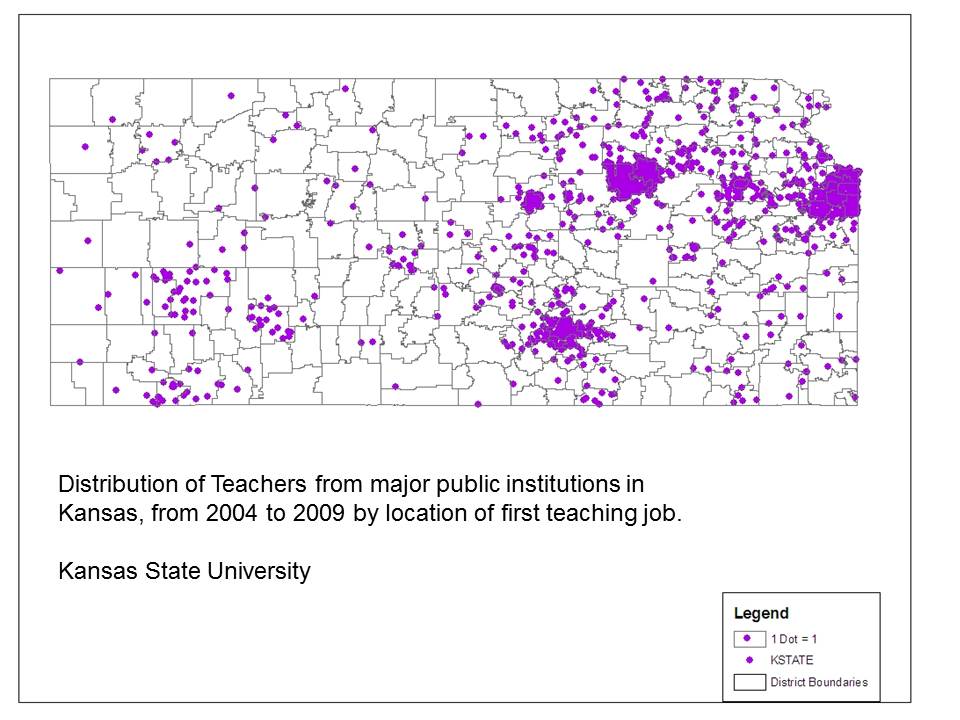
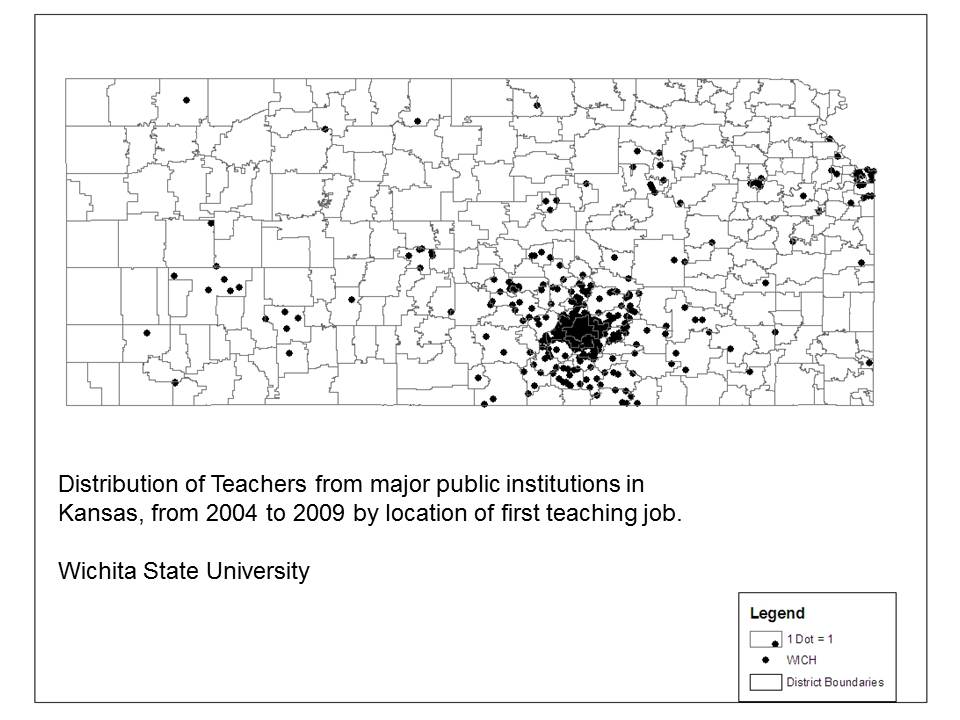
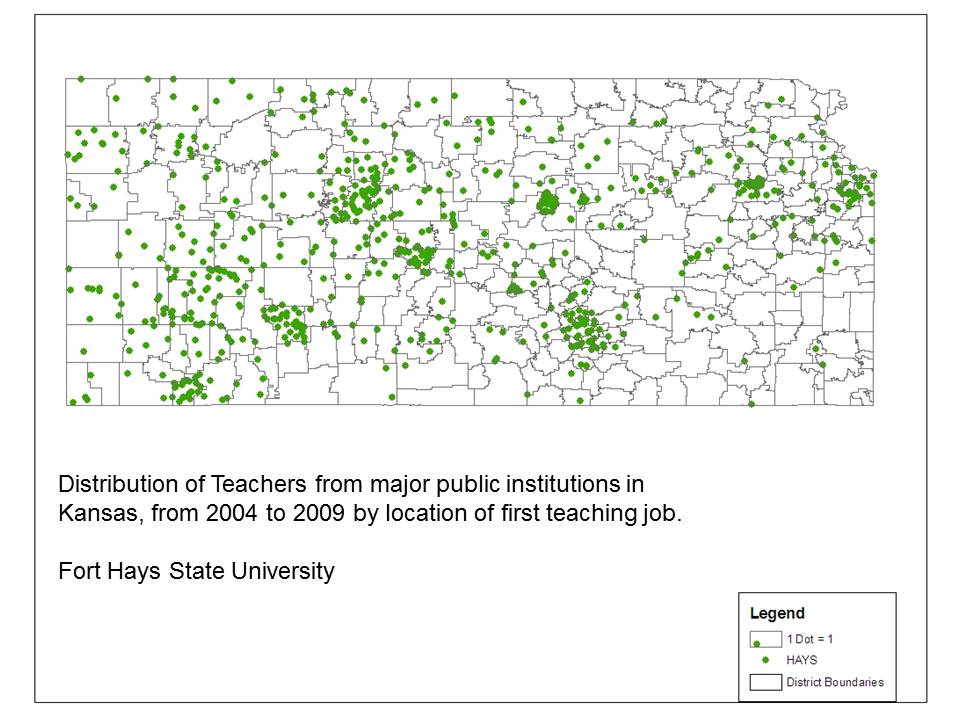
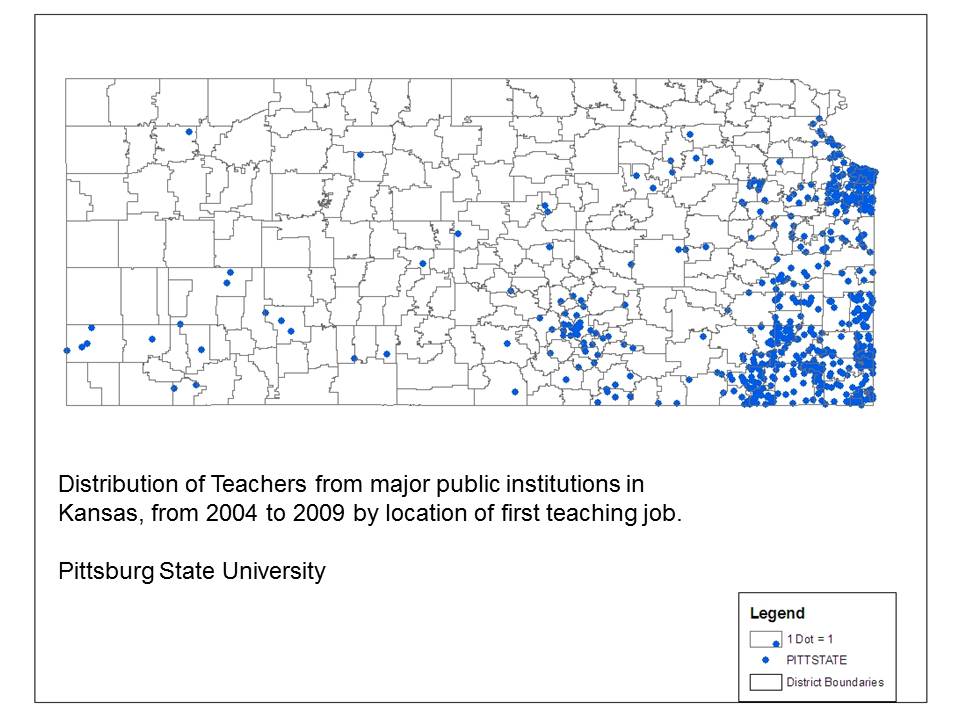
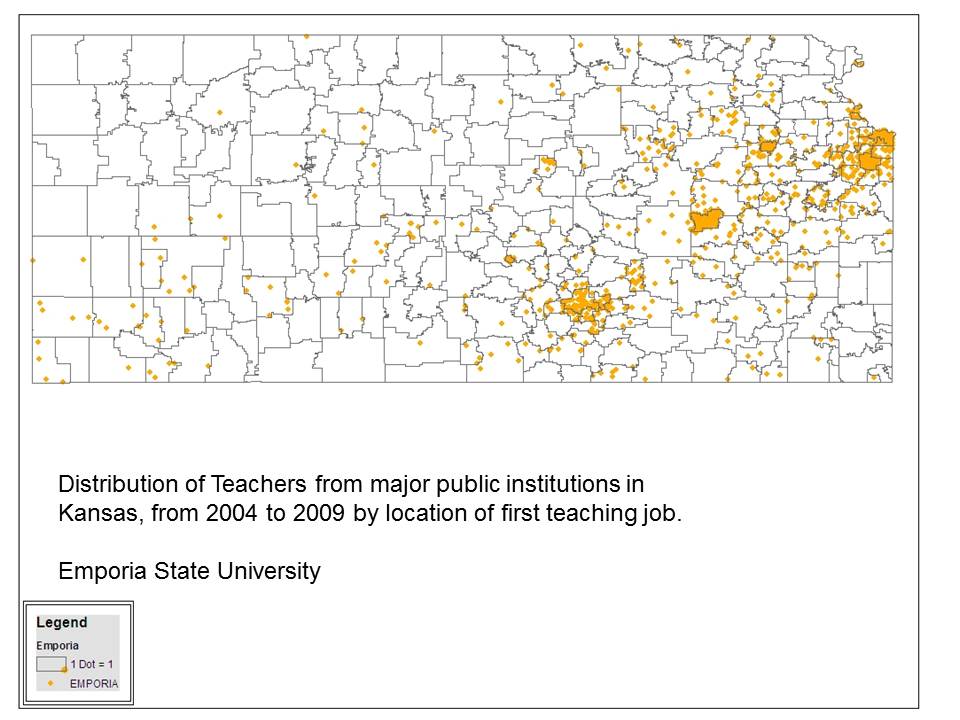
Let’s use the state of Kansas and graduates over a five year period from the state’s major teacher producing institutions to see just how problematic it is to assume that teacher preparation institutions in a given state will produce sufficient numbers of teachers who teach in the same schools as graduates of other programs.

All programs

Slide3

Specific programs

Slide4

Slide5

Slide6

Slide7

Slide8

Slide9

Indeed, the overlap in more population dense states is somewhat more significant, but still unlikely sufficient to meet the high demands of the fixed effects specification (where you can only essentially compare when you have graduates of different programs working in the same school together, in similar assignments… presumably similar number of years out of their prep programs).

Strategically Gaming Crappy, Biased Measures of “Student Growth”

In practice, I doubt most schools of ed, or state education agencies will actually consider how to best model program effectiveness with these measures. They likely won’t even bother with this technically geeky question of the fixed effects model, and data demands to apply that model. Rather, they’ll be taking existing state provided growth scores or value-added estimates and aggregating them across their graduates.

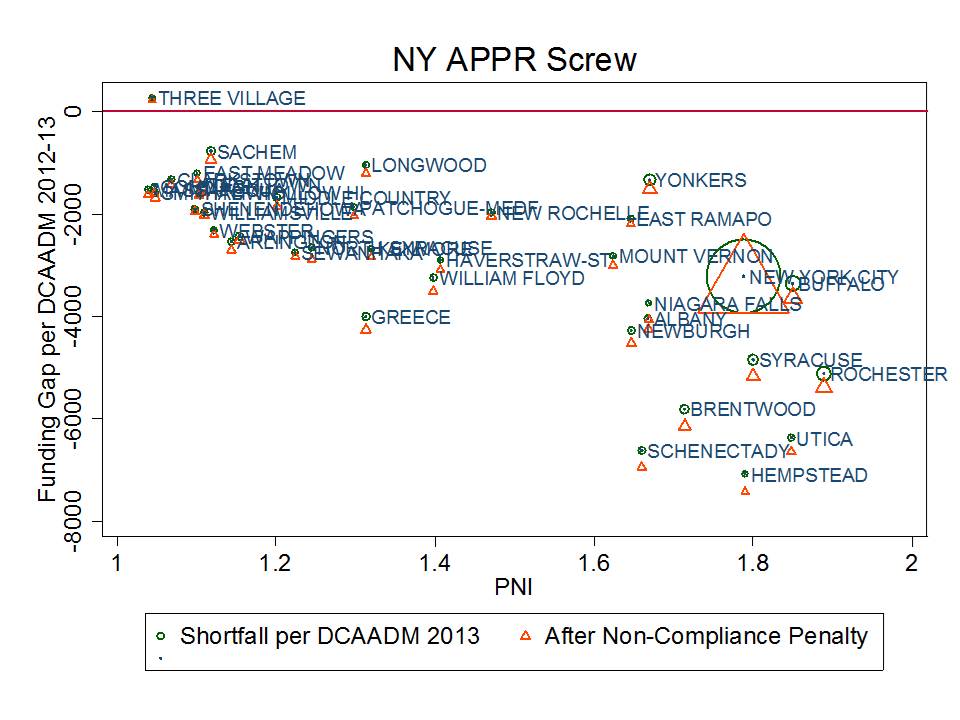
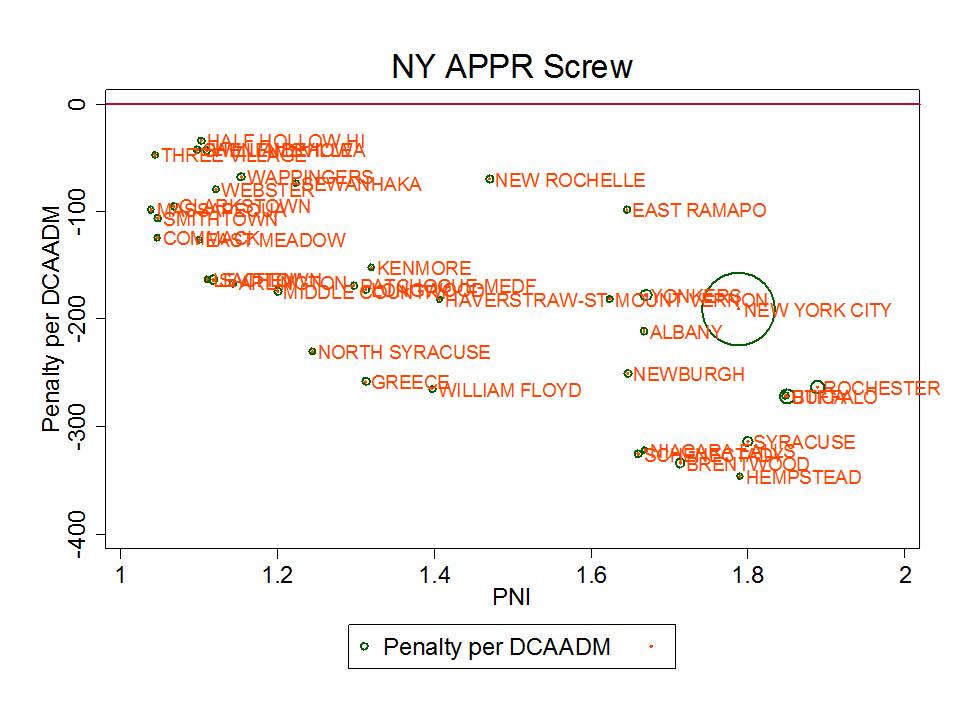
Given the varied, often poor quality of state adopted metrics, the potential for CAEP Standard 4.1 to decay into absurd gaming is quite high. In fact, I’ve got a gaming recommendation right here for teacher preparation institutions in New York State.

We know from the state’s own consultant analyzing the growth percentile data that:

Despite the model conditioning on prior year test scores, schools and teachers with students who had higher prior year test scores, on average, had higher MGPs. Teachers of classes with higher percentages of economically disadvantaged students had lower MGPs. (p. 1) https://schoolfinance101.com/wp-content/uploads/2012/11/growth-model-11-12-air-technical-report.pdf

We also know from this same technical report that the bias appears to strengthen with aggregation to the school level. It may also strengthen with aggregation across similar schools. And this is after conditioning the model on income status and disability status.

As such, it is in the accreditation interest of any New York State teacher prep institution to place as many grads as possible into lower poverty schools, especially those with fewer children with disabilities. By extension, it is therefore also in the accreditation interest of NY State teacher prep institutions to reduce the numbers of teachers they prepare in the field of special education. As it turns out, the New York State growth percentiles are also highly associated with initial scores – higher initial average scores are positively associated with higher growth. So, getting grads into relatively higher performing schools might be advantageous.

With a little statistical savvy, a few good scatteplots, one can easily mine the biases of any state’s student growth metrics to determine how to best game them in support of CAEP standard 4.1.

Further, because it is nearly if not entirely impossible to use these data to legitimately compare program effects, the best one can do is to find the most advantageous illegitimate approach.

Are these really the incentives we’re looking for?

A drop in a half empty bucket? In defense of deprivation in NY

First, here’s a primer and reading list on the Empire State of School Finance:

  1. New York State maintains one of the least equitable state school finance systems in the nation
  2. New York State actually allocates a ton of state aid to districts that need it least, exacerbating the disparities
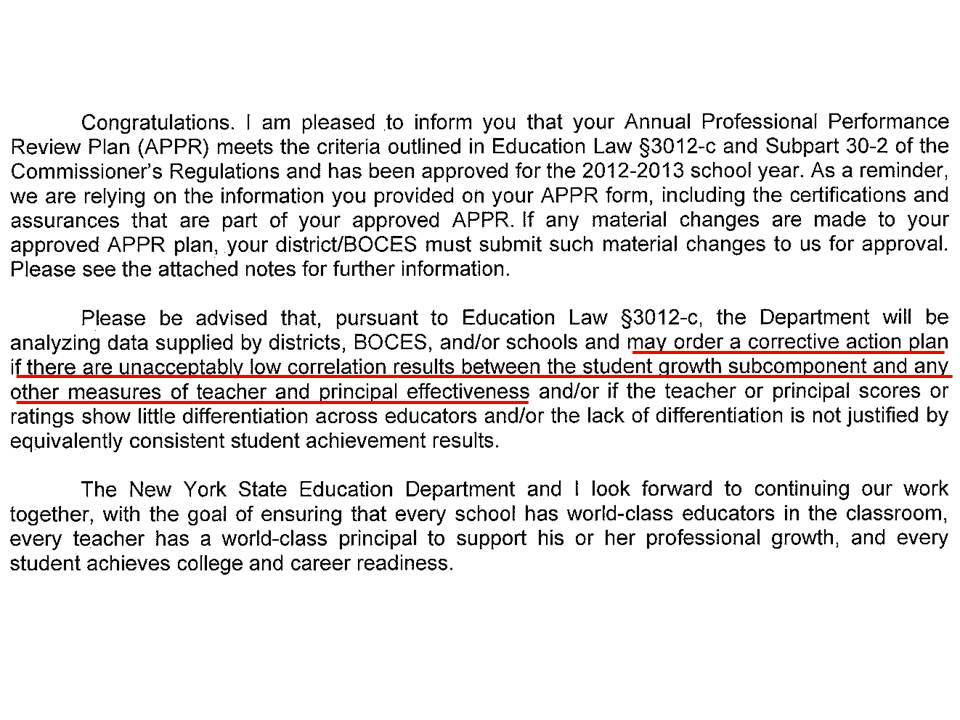
  3. Reformy types in New York State thought, under these circumstances, it would be really cool to make any additional state aid a district receives contingent on adopting a teacher evaluation scheme based on their documented deeply flawed metrics!
  4. To ice that reformy cake, the legislature saw fit to – after slashing state aid year after year – impose a local property tax limit on districts so that they are unable to even raise the funds they would need to provide a sound basic education, if they could raise those funds locally.

ohhh… but I’m just getting started here.  Then came the lawsuits. That’s what makes this so fun and interesting to watch.

Now, there is already a pending lawsuit challenging the overall adequacy of state funding in New York specifically for high need cities (brought by the state’s small city school districts).

More recently however, we’ve been hearing of two separate cases.

First, we have the state teacher’s union (as reported) suing the state over the imposition of the property tax cap, which, in effect prohibits many districts from making up the difference from the aid they’ve been screwed out of for the past several years – the aid that in theory – by the state’s own definition of its foundation formula – would provide for a sound basic education. That formula was implemented specifically to comply with a previous court order in Campaign for Fiscal Equity. 

Next, we have the lawsuit brought on behalf of children in New York City schools challenging the state’s authority to reduce the city’s funding by $250 million for non-compliance with adopting a teacher evaluation policy.

So far, it would appear that this argument has achieved a positive, immediate response from the judge, who a this stage has blocked the state funding reduction.
As laid out in full here: http://schoolfunding.info/wp-content/uploads/2013/02/Memorandum-of-Law-in-Opp-to-App-for-Prelim-Inj1.pdfAnd as characterized here: http://schoolfunding.info/2013/02/miriam-aristy-v-state-of-new-york/

Assistant Attorney General Steven Schulman described the $250 million that the state will cut from NYC schools as a “drop in the bucket” and argued that it was not great enough to have any effect on schools’ ability to provide a sound basic education.

The state’s defense of its actions is essentially that $250 million really isn’t that much money for New York City and certainly doesn’t deprive NYC schoolchildren of receiving their constitutionally mandated sound, basic education. And that forcing the state to provide the $250 million would undermine their authority. That is, their authority to deprive kids of their constitutionally mandated sound basic education! ? ! ? huh? Now, this is all part of legal maneuvering. Yeah… it would be difficult for NYC to show that holding back this additional 3.3% state funding tips the scales on whether the city can provide a sound basic education. As such, how can the court reason intervening and forcing the state to give this money back?
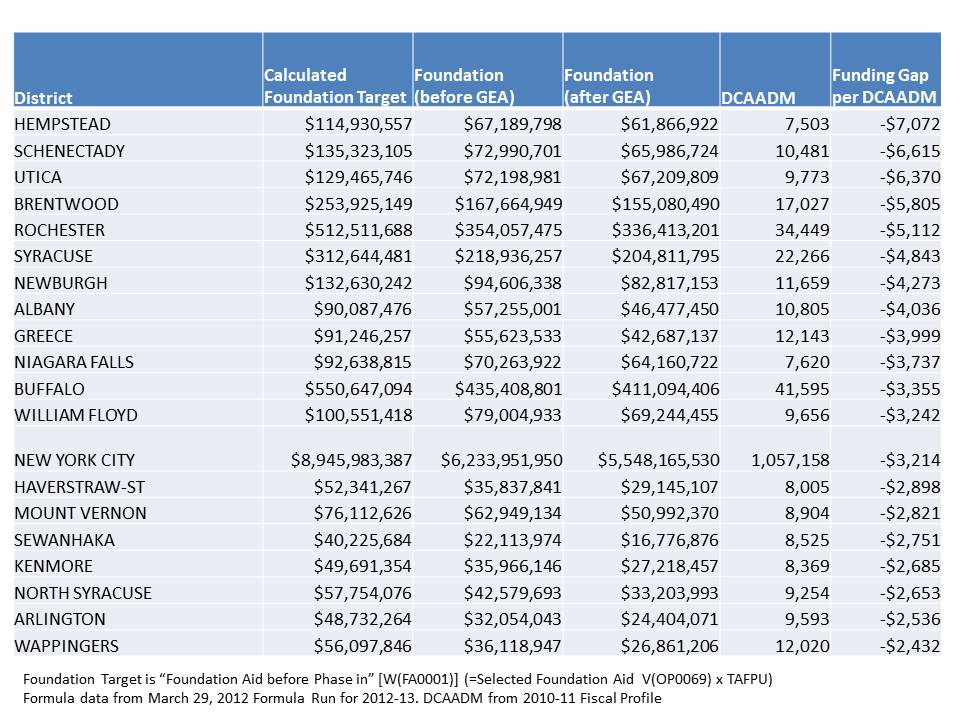
But that’s only if we set aside that the state of New York is already depriving New York City schoolchildren of 38% of the aid that should be allocated to the city based on the state’s own formula for what the city needs to provide a sound basic education. And that was a bogus, low-balled estimate to begin with. Here’s my quick run down on state aid shortfalls in 2012-13 – with respect to the state’s own estimates – for small city districts and for New York City:

Foundation Aid, Foundation after GEA expressed in Thousands (‘000s)Slide1New York City is being shorted about 3.4 billion in aid to achieve what the state has defined as “sound basic” funding. That’s about 38% of their total foundation aid.  That share is even larger for some small city districts. This next table shows that this amounts to thousands per pupil. Slide2 Sure, the loss from the teacher evaluation debacle amounts to a few hundred per pupil. But hey, what’s the harm? NYC is already being shorted over $3,000 per pupil.By the state’s logic, we, and the sitting judge are asked to ignore that the bucket into which that drop is to fall (or not) is nearly half empty (no, not half full… well… actually… about 62% full) to begin with.  That the murder who stabs to death a victim one day, and comes back to stab the already dead body one more time the next, is not guilty of any marginal crime for his actions on the second day.Perhaps not in the final legal analysis. I’ll leave that for the judge to figure out. But in my view, it’s still pretty damned offensive.

Dismantling Public Accountability & Transparency in the Name of Accountability & Transparency?

This post comes about as a follow up to a previous post where I critiqued the rationale of the Students First policy agenda.  It should be noted that the Students First policy agenda is anything but unique. Like DFER, SFER, ALEC or any policy advocacy organization, the SF policy agenda is little more than an aggregation of largely non-original, template policy prescriptions.

Now, I’m not one who goes all in for the lingo of “corporate reform” or one who perceives “privatization” or “market” mechanisms to be inherently evil and contrary to the public good. However, I am someone who believes we should consider carefully the multitude of tradeoffs involved in shifting between publicness and privateness in the governance and provision of schooling.

What I have found most intriguing over time is that the central messaging of these reformy template policy prescriptions is that they will necessarily improve accountability and transparency of education systems, and that they will do so largely by improving the responsiveness of those intractable systems through altered governance and finance, including but not limited to “market” based choice mechanisms.

The standard list of strategies that are supposedly designed to increase accountability and transparency of our education system include, among other things:

  1. Expansion of charter schools, coupled with multiple charter authorizers (including private entities) and minimized charter regulation
  2. Adoption of tuition tax credit programs providing individuals and corporations the option to forgo paying a portion of taxes by contributing that amount to a privately governed entity (or entities) that manages tuition scholarships to privately governed/managed schools.
  3. Parent trigger policies that permit a simple majority of parents of children currently attending any school within a district to mandate that the local board of education displace the entire staff of the school and potentially turn over governance and management of school’s operations (and physical/capital assets?) to a private management company to be operated as a charter school.

It is argued that current large bureaucratic public education systems are simply intractable, non-responsive and can’t be improved – That they are simply not accountable to anyone because they are run by corrupt self-interested public officials elected by less than 2% of eligible voters (turnout for board elections) and that they have no incentive to be responsive because they are guaranteed a constantly growing pot of revenue regardless of performance/quality/responsiveness.

Whatever problems do exist with the design of our public bureaucracies, I would argue that we should exercise extreme caution in accepting uncritically the belief that we could not possibly do worse, and that large scale privatization and contracting of private entities to provide the public good is necessarily a better and more responsive, more efficient, transparent and accountable option.

Let’s take a walk-through of some of the key aspects of current preferred reforms by comparison to traditional public governance of our education systems.

Privately Governed/Managed Charter Schools vs. Local Education Agencies

Let’s begin with the push for less regulated, expansion of charter schooling with particular emphasis on expansion of privately governed and managed charter schools, and perhaps even charter schools authorized by independent private authorizers (granted authority to operate by a private entity given that authority by the state).  To be absolutely clear, no-matter how many reformy pundits proclaim from their soapbox that Charter Schools are PUBLIC Schools… it just isn’t that simple.  In many critically important ways, under many critically important conditions Charter Schools SIMPLY ARE NOT PUBLIC in every important traditional or legal sense!  See this post for further elaboration!

Note – this varies widely from state to state, depending on whether state charter statutes specifically spell out requirements of privately governed charter schools. 

Let’s explore how/why this might be important when it comes to evaluating whether and how expanded, less regulated chartering either increases or decreases public accountability.

Table 1. Chartering vs. Traditional District Schooling

Dimension Local Education Agency Privately Governed Charter (Non-State Actor)
Governance Governed by public officials (with all rights & immunities)Elected or appointedNecessarily subject to open public records & open meetings lawsNecessarily required to comply with public bidding requirementsNecessarily required to disclose publicly employee contracts Governed by appointed (self-appointed) board of private citizensMay not be subject to open records or meetings lawsMay not be required to engage in public contract/bidding requirementsPrivate appointed board may hire private management firm
Finance Required to disclose finances (reported relatively consistently in most state data systems, including detailed AFRs (annual financial reports) & public posting of budgets) Usually required to report expenditure of public funding. State data systems spotty and inconsistent on charter school revenue/spending data (may be required to disclose IRS filings [form 990])
Disclosure Public officials subject to open meetings laws.All documents/employee contracts/financial documents & communications between officials subject to open records laws. Board members & managers may not be subject to open meetings. Many documents/contracts with private manager, etc. considered private/proprietary.
Employees Public employees with key constitutional and statutory protections Private employees, forgoing certain rights to bring legal challenges against their employer
Students Retain rights to not have their government (school) infringe on various constitutional and statutory rights, and to uphold key statutory obligations. Students may forgo numerous rights under privately governed discipline codes.

These differences are not trivial, yet few are discussing them as critical factors for shaping future education policy. Rather, day after day, week after week, we are subjected to more and more vacuous punditry by self-proclaimed “expert” pundits displaying an astounding ignorance of education law and callous disregard for our system of government and the U.S. Constitution.

For example, it would appear that charter schools that are not “state actors” (which may include most that are governed by boards of private citizens and especially those managed by private companies/EMOs or CMOs) may require students to abide by disciplinary/conduct codes which involve compelling those students to recite belief statements about the school (mottos, pledges, loyalty oaths), obligatory participation in indoctrination activities and imposition of financial penalties for disciplinary infractions, none of which would be permissible in traditional public schools. Government entities – state actors – may not compel speech and especially may not compel statements of belief.

So then, what is a family to do when no traditional public schools are available to them (as is practically the case in many areas of New Orleans and increasingly the case in other higher charter market share cities)? Should parents have to choose which rights to forgo? [picking the school with the financial penalties over the one requiring daily recitation of a loyalty oath?]

Can (as some belligerent civic illiterate,  pundits believe) entire urban school systems be replaced with charter schools – or the traditional public schools adopt the lessons of “chartering” which involve infringement of constitutional rights? Is it reasonable to assume that the entire student population of a city would be placed in a position of necessarily forgoing their rights to free expression, free exercise?

I hear those reformy pundits cry… “but who cares about a little constitutional protection here and there if we can squeeze out an extra point or two on state assessments [via selective attrition of low performing peers]? They’ll be better for it in the long run!”

Yeah… sure… that’s all well and good for someone else’s kids. I for one believe the constitution continues to have a purpose and that constitutional rights should be equally available to all people’s children. I believe that constitutional protections are a key element of an accountable education system available to all – not just some.

This is a big freakin’ deal. An important policy trade-off to consider, if you will. This is a critically important tradeoff to consider when adopting policies that expand non-state-actor charter schooling, even if some marginal academic gain can be achieved.

Indeed, under our current public schooling system constitutional battles over free exercise, free speech, discrimination, etc. persist (as any good pro-school-choice libertarian will frequently argue – I, being a former card carrying member in my NH days!). It’s a never ending tension between the preferences of the majority vs. the rights and interests of the minority. Such arguments are often used as the basis for saying that all students/families should simply have the right/option to choose where to attend school – where they can each be their own majority.  The value of our current public (gov’m’nt) system is that the minority does have the right to challenge their mistreatment and that collective participation in the public system forces public debate over these issues (even if/when they end up being handled poorly). It ain’t perfect, but I’m not willing to replace it with a system that requires large numbers of children to forgo these rights in order to participate in schooling.

Poor and minority children should not be disproportionately required to forgo constitutional protections (and a variety of statutory protections) to gain access to those few additional test score points. Further, no-one is telling them that they even have rights to begin with – especially those pitching the charter expansion policies (constantly spewing the rhetoric of the “publicness” of charter schooling).

Charter Schooling & The Market for Lemons

In theory, the accountability and efficiency advantage of charter schooling is driven by the market for choice of one school over another. Increasingly, state education agencies have moved from being impartial technical assistance agencies and accountability reporting agencies to strongly promoting the charter sector. This advocacy behavior corrupts the state agency role and creates what economists refer to as an “asymmetry of information” – in the extreme case a “market for lemons.”

Markets fail when the consumer is misled to believe that the product they are being sold is a miracle product (without counterbalancing information available to the “customer”). Asymmetry of information occurs where the seller has more information on the quality of the product than the buyer and is able to extract from the buyer a higher price than is warranted given the product’s true quality. In this case, we are talking about the parents’ choice to apply their child’s gov’t subsidized education credit, per se, at a charter versus the traditional public school.  They’ve got one credit to spend for each child and the SEA endorsed spin these days is that that credit is nearly always best spent in a charter school (even when it clearly is not).

Taken to the extremes, State Education Agency and public media flaunting of chartery miracles has created a distorted market for those charters that are least proven on the market (perhaps in some cases, lemons), with those charters that are most proven already over-subscribed and not needing to compete openly. So, those most available on the market are those whose actual performance/quality is far lower than that which is capturing the headlines and receiving accolades from state officials. [not quite a true market for lemons since the price – education “credit” is fixed … though perhaps I can expand on this at a later point].

It is the absurd punditry, intentional obfuscation and complete disregard for legitimate data/analysis on charter schooling that have perhaps soured my taste for the movement more than anything else (bearing in mind that I was a founding member of the AERA special interest group on Charter School research and, at the time, was largely an advocate myself).

Tuition Tax Credits & Vouchers vs. Conventional LEA Governance

Next up, let’s talk about tuition tax credits and vouchers. Now, I would argue that in many ways, tuition tax credits and vouchers which provide the option for children to attend schools that are well understood to be private, that not state actors are at least more honest with respect to student and employee rights.

It is understood (or should be more clearly understood) that when choosing a private school or choosing to be employed by a private employer that one’s rights may differ. On very few occasions have I actually heard the rather absurd argument that private schools receiving students on publicly financed scholarships are “public” (yes, they did, without understanding the implications, make this claim in Louisiana when their voucher model was overturned by the state courts).

Now, let’s parse the governance and accountability differences between traditional public LEAs, Vouchers and Tuition Tax Credits.

Table 2. Vouchers & Tuition Tax Credits vs. Traditional District Schooling

Element LEA Voucher Tuition Tax Credit
Revenue Raising Raises local tax revenue (subject to local voter approval) & receives state aid (through legislation/formula adopted by state elected officials) Permits/requires the transfer of a set per pupil amount of funding from state and/or state/local sources to pay for private school tuition of students Permits corporations to pay funds to a privately governed, state approved/created/appointed entity (school tuition organization) in lieu of paying taxes.
Governance

(records/

meetings)

Required to disclose minutes of meetings and related documents pertaining to budget, financial report and any/all contractual agreements. Assuming voucher program governed by local or state board/public officials, related requirements apply. Entity governed by appointed private citizens, not public officials.  (thus, may not be required to disclose records, open meetings)
Disclosure Required to report/disclose annual budget (for approval by either/both local elected officials and/or local voters)Required to report/disclose annual financial report (usually with independent external audits) Financial disclosure of funds expended (from public agency) on vouchers subject to all public expenditure laws [that is, total allocated to vouchers from budget]Voucher receiving schools not likely required to provide detailed disclosure (non-religious non-profit pvts file with IRS, religious privates not required) May/may not be subject to disclosure requirements of public officials.If non-religious, organized as non-profit, may be required to report limited finances to IRS.
Use of Funds Expended directly by publicly governed entities (public officials) Comingled with all other operating funds of private school entity Comingled with all other operating funds of private school entity
Governance of Schools Publicly governed Private once $ reaches school Private once $ collected to tuition organization
Student/

Employee Rights

Public Private, not state actor Private, not state actor
Taxpayer/

Public Rights

Right to political participation (electing officials, etc.)Right to bring limited legal challenges regarding use of funds

Right to request disclosure

Right to bring limited legal challenges regarding use of funds Limited state legislative options (can try to vote in new legislators)[taxpayers lose right to challenge objectionable use of funds because the funds are not considered tax dollars]

The simple part here is that under either the tuition tax credit or voucher program, the schools that children attend are clearly private. It is (or at least should be) understood that students and employees forgo certain rights. As such, it would be plainly illogical to use such a model as the model for an entire city or state, meaning that children would not even have the option of attending a school where they are protected from discrimination and other forms oppression. [notably, while children/families may be oppressed and/or discriminated against by the ruling “majority” in a public school setting, they have a constitutional right to challenge their mistreatment – a right that ceases to exist where only private providers are available].

Other more nuanced delineations here are between the voucher and the tuition tax credit model. The more popular TTC approach is far more convoluted, and in being so, creates additional layers of opaque to non-existent accountability, ultimately negating altogether taxpayer legal rights.

Under a voucher model, like the Cleveland voucher model, taxpayers do have the right to challenge that their tax dollars are being allocated to religious education. Indeed, when such a challenge was brought, the U.S. Supreme Court decided that the voucher mechanism in place was sufficiently neutral (reliant on parental choice) that it did not violate the establishment clause of the U.S. Constitution. But, taxpayers at least had the right to bring this challenge even if they did lose.

What I find most objectionable (in terms of public accountability) about the TTC approach is that when a similar challenge was brought against the Arizona tuition tax credit model, the U.S. Supreme Court determined that the dollars being expended effectively weren’t the taxpayers’ dollars and thus the taxpayer had no right to bring a legal challenge to the policy (no taxpayer “standing”). Quite simply no taxpayer standing means NO taxpayer legal accountability. No taxpayer legal recourse. Arguing that TTC models increase public accountability is absurd.

Further, that these systems rely on creating non-public, non-publicly accountable entities to manage these funds diverted from the public coffers further reduces public accountability.

Parent Trigger vs. Conventional Local Education Agency Governance

Parent trigger is quite possibly the most ludicrous corruption of public governance and accountability on the education reformy education policy table.  Put simply, parent trigger is the most ill-conceived subversion of governance I’ve seen out there in the reformy playbook. Let’s give it a walk-through.

Table 3. Parent Trigger vs. Traditional District Schooling Governance

Element Traditional LEA Parent Trigger
Primary Control Elected or appointed board of public officials:Public disclosure requirements as addressed above Permits simple majority of parents of children currently attending any school within an LEA to require that the LEA change the management/operations of that school, to include transfer of governance to a private entity
Financial Governance Public officials govern annual budget and accumulated assets of LEA in accordance with public budgeting and finance statutesExpenditure of funds and/or transfer of assets subject to public approval & required public disclosure Small minority of district voter population may obligate district to allocate funds to/contract with private provider/charter manager against preferences of elected officials
Public control/accountability “Public approval” applies to all eligible voters whose primary residence lies within the geographic boundaries of the LEA (whose tax dollars support the annual operations and contributed to purchase and/or maintenance of assets)Board elections held on regular cyclesBudget approval may also require public vote and held on regular election cycleSpecific requirements apply for incurring municipal bond debt for capital investment Provides no recourse for property owners/taxpayers who have no children currently attending the schoolProvides no recourse for parents of children who would be attending the school in future years, until the point at which they would attendMay or may not occur on defined timeline – specific election cycle
Student/teacher rights Student and teacher constitutional and statutory rights as addressed above Students and employees forgo constitutional/statutory rights if converted to privately governed/managed school


The most substantive reductions of public accountability, transparency and governance occur when the simple majority of parents of children in one school decide that there school must be converted to a privately managed charter school, which may in turn adopt policies that deprive both children and employees of constitutional and statutory rights. Indeed, the district would likely be required to find a school for the displaced minority of students who don’t wish to forgo these rights. But the simple majority of parents in that school at that point in time should not be granted the authority to displace a minority of students in their school. Further, a simple majority of parents in a school in a district should not be granted the authority to dictate local board funding or contracting policies without input of the broader eligible voter population.

Among other things, Parent Trigger policies assume that the public at large who reside and own property within a school district have no stake in the accountability of that school system. School closures, school quality, school location, etc. affect the value of residential properties by affecting quality of neighborhood life. Quite likely (an open empirical question) conversion to exclusive and/or specifically themed charter schools creates unique effects on property values and neighborhood quality of life, and not necessarily always positive effects.

Finally, schools/school buildings and property are public assets having a lifespan far exceeding that brief moment in time when that trigger pulling simple majority has children attending the school and the public that has invested in those schools over time should thus have some say in their operation, maintenance and management.

The idea that this particular subversion of traditional governance somehow heightens public accountability is simply ridiculous.

Closing Thoughts

Love it or hate it, we’ve got a pretty well defined, reasonably functional system of public governance in this country, with the overarching rule of the land being our U.S. Constitution. I’m not trying to oversell here. I’m not saying it’s perfect, always responsive to all and never intractable, opaque or corrupt. But I am saying that we could certainly do worse and many proposals on the table are likely to do just that.

Importantly, state laws might be written to close many of the gaping holes in student and employee rights identified above, public disclosure requirements and clarify the delineation between publicness and privateness. But the current trend is not necessarily in that direction!

Our current system defines the roles and responsibilities of public officials, holding them to public accountability standards vetted by our federal and state judicial branches for over two centuries. Yeah, I know, many of these reformy pundits would also simply do away with that meddling judicial branch. I for one, think that our courts continue to play a critical role in protecting rights.

Modern education reform efforts, in the name of supposed increased accountability and transparency largely seek to subvert our system of government as we know it and in many cases seek to strip large shares of poor and minority children and the employees in schools of poor and minority children of constitutional protections. And we’re all supposed to be okay with that?

Friday Ratings Madness: Quality Counts, Students First & Funding Fairness

It’s been a fun week for grading the states. First we had the wacky ratings from Students First which graded states largely on the extent to which they had adopted the preferred policies of that organization. Then we had the old-standard Education Week Quality Counts. When it comes to their finance rating system, little has changed in recent years. These two reports, of course, produced substantially conflicting results.

One might argue that both reports and ranking systems, like our School Funding Fairness report, include several indicators intended to identify policy conditions for success. This has been the standard response of Students First when they have been criticized on the basis that the states that they have applauded most tend to have pretty low average outcomes.  But, the Students First report, Quality Counts and our Funding Fairness report differ quite substantially on what we consider to be policy conditions for success. 

Students First has put policy conditions into three categories – 1) elevating the teaching profession, 2) parent empowerment and 3) finance and governance.  Students first gives no consideration across any of these categories to whether teacher wages, for example are sufficient to recruit/retain high quality candidates into teaching or whether wages are specifically competitive in high need schools. Students First gives no consideration to whether funding, overall, is sufficient to provide either/both competitive wages or reasonable class sizes, generally, or specifically in high need schools.  It would appear to be their opinion (as was rather clearly expressed by Eric Lerum in a video conference) that overall level or distribution of funding isn’t the issue – but rather that their preferred policies are what matters, regardless of funding (since the only funding/resource equity considerations in their rankings pertained to whether charter schools received what they consider equal funding – no validation provided!)

Education Week goes old school especially on their school finance rankings. I don’t have time/space to address all of their rankings. As I will show below, some of their old-school measures seem to capture relatively useful information, but others do not. Let’s quickly summarize the measures they use.

  • Fiscal Neutrality: Fiscal neutrality measures the relationship between district spending and district wealth. State school finance formulas are partly intended to disrupt this relationship – reduce the likelihood that wealthier districts spend systematically more. This measure is often still useful, but may be complicated by the fact that school finance formulas also try to address differences in student needs and costs. To the extend that higher need kids live in poorer districts (not always the case that taxable property wealth and student need are tightly associated), this indicator may work to partly capture both.
  • McLoone Index: Named for school finance legend Gene McLoone! This index tells us how close, on average, the per pupil spending of districts in the lower half (serving the lower half of kids) are to the median. That is, to what extent does the state formula succeed in “leveling up” the bottom half to the middle. A McLoone of 100 would mean that the lower half is equal to the middle. But this index in particular can produce some screwy results. Say for example a state has one or a few very large districts with high need populations and those districts constitute both the lower half and the middle (they have nearly or all of the bottom half of kids). A state with one or a handful of high need large districts with spending lower than everyone else (the upper half) might still get a McLoone of 100. But it would be a really crappy school finance system! (with all due respect to Gene!)
  • Coefficient of Variation: The coefficient of variation simply measures the extent of variation in per pupil spending as a percent of the mean per pupil spending. A CV of 10% indicates that 2/3 of children attend districts with per pupil spending within 10% of the mean. The problem with the CV is that, while it measures variation, it doesn’t capture the difference between GOOD variation and BAD variation. Modern state school finance formulas try to create variation in funding to accommodate differences in student needs. Education Week uses nominal weights to “adjust” for differences in student needs, but some state school finance systems actually adjust more aggressively for needs than do their weights. Those states are penalized in the CV.
  • Spending Index & Percent at/Above National Mean: A few reports back Education Week wanted to construct a form of “spending adequacy” figure to compare spending levels across states and the shares of kids with access to what they considered more “adequate” spending. So they adopted this measure and index based on the percent of children in each state who attended districts that spent at least the same as the national average district (spending adjusted for regional wage variation). This figure does generally capture spending level differences across states – adjusted for wage variation – but doesn’t, for example capture spending level differences corrected for student population differences, or the shares of students who might be attending very small, remote rural districts.

Ed week includes a few additional indicators like the restricted range – or difference in spending between the 95th and 5th %ile district, but these are largely redundant with the CV & McLoone and suffer the same problems of not accounting for other cost factors – or state aid formulas that aggressively adjust for needs and costs.

We had set out to correct for many of the problems in the Ed Week approach when we started work  on our Funding Fairness report. Specifically, we wanted to make comparisons that better accounted for differences in needs and costs across districts and states and that could be used to characterize state school finance policies consistently, without suffering some of the problems of old-school indicators like the CV or McLoone Index. We also look at spending level – using a statistical model based on 3 years of data to project the per pupil state and local revenue of a district with a) average poverty rate, b) in an average wage labor market and c) with 2,000 or more students and average population density. That is, our projected state and local revenue figures are adjusted for poverty, competitive wages, size and population density. We use the same model to then evaluate whether, on average – and in a predictable pattern – state and local revenues are systematically higher (progressive) or lower (regressive) in higher poverty districts (relative to lower poverty districts). That is, does the system overall target resources to higher poverty districts – controlling for the other factors.

That prerequisite discussion aside, let’s take a look at how all of this stuff lines up – How the Ed Week Indicators line up with the Funding Fairness Indicators and how both line up with the Students First Indicators. Finally, I look at how all line up with various outcome measures.

Again… all of these funding related indicators are about policy conditions for success, rather than success itself.

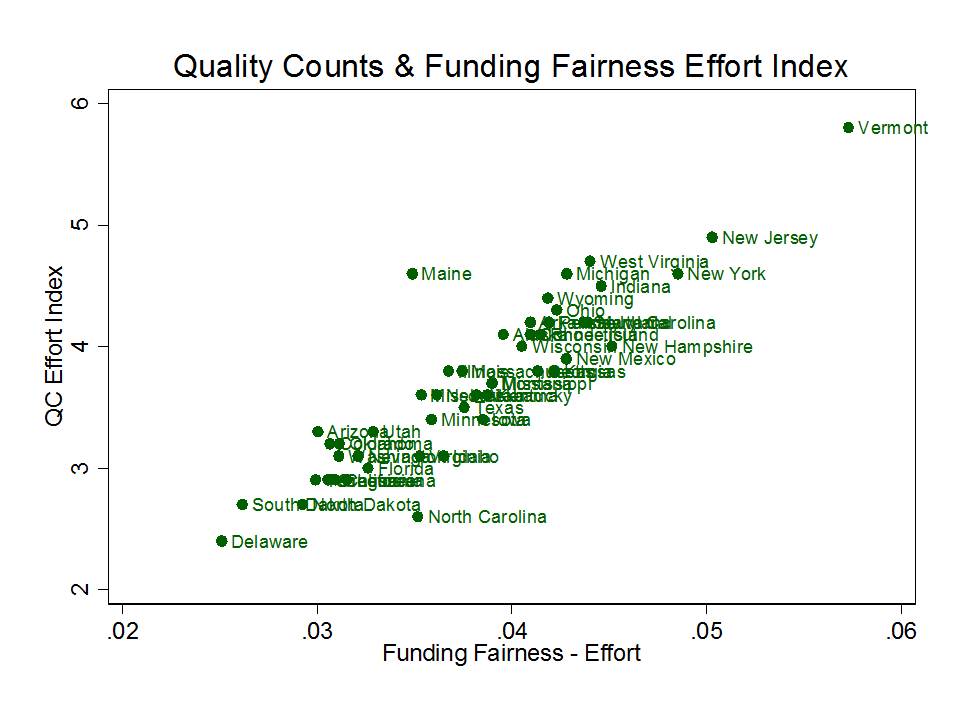
First up – and here’s a relative no-brainer – both our funding fairness report and Ed Week Quality Counts include an indicator of state funding effort – or share of state capacity allocated to elementary and secondary education.  I can’t speak for Ed Week, but we include ours to acknowledge that some states spend more than others (do better on our spending level measure) because they can and that we should grade them at least partly on their effort.  Figure 1 shows that our effort measure and Ed Week’s effort measure are pretty highly correlated.

Figure 1

Slide1

Figure 2, by contrast, shows that the Students First funding GPA isn’t related at all with the Ed Weeks effort indicator, and by extension with ours. Ed Week (and we) consider funding effort to be an underlying policy condition for success, apparently, Students First doesn’t .

Figure 2

Slide2

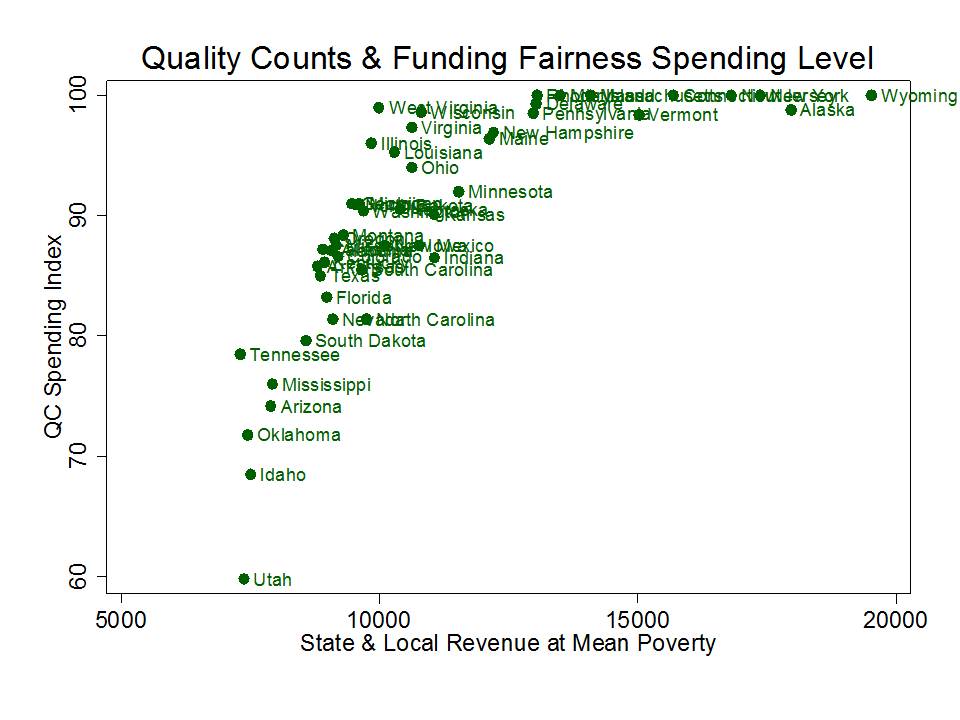
Figure 3 compares our funding level indicator and Education Week’s spending index – or relative adequacy indicator. Clearly the two are highly related… but the Ed Week indicator caps out at 100% – or where 100% of the children attend districts above the national average spending. Personally, I prefer indicators that capture the full range of variation.  But again, our spending level measure and Ed Week’s spending index are picking up much of the same information – relative spending differences across states.

Figure 3

Slide3But, Figure 4 shows that Students First finance rating scheme really doesn’t relate at all to Education Week’s spending index, suggesting that overall availability of resources – like the effort to raise them – is inconsequential in the eyes of Students First.

Figure 4

Slide4Figure 5 shows the relationship between our funding progressiveness indicator and Ed Week’s fiscal neutrality indicator. For many states, the two are picking up similar things. In states like New Jersey or Utah, where higher poverty districts have more resources than lower poverty ones, the systems have also achieved fiscal neutrality (disrupted the relationship between wealth and spending). By contrast, in states like Illinois or North Carolina, the wealth-spending relationship remains strong and positive (higher wealth – higher spending) and higher poverty districts receive systematically fewer resources!

Figure 5

Slide5

Recall that Illinois received one of the best grades on finance from Students First. Apparently, in addition to effort and spending level, fiscal neutrality and need based funding are also inconsequential to Students First when it comes to funding issues. Figure 6 shows the relationship between funding progressiveness and Students Firsts funding related GPA. Note that all of Students First’s funding superstars (Illinois, New York, Rhode Island and Michigan) are less than stellar on funding fairness.

Figure 6

Slide6

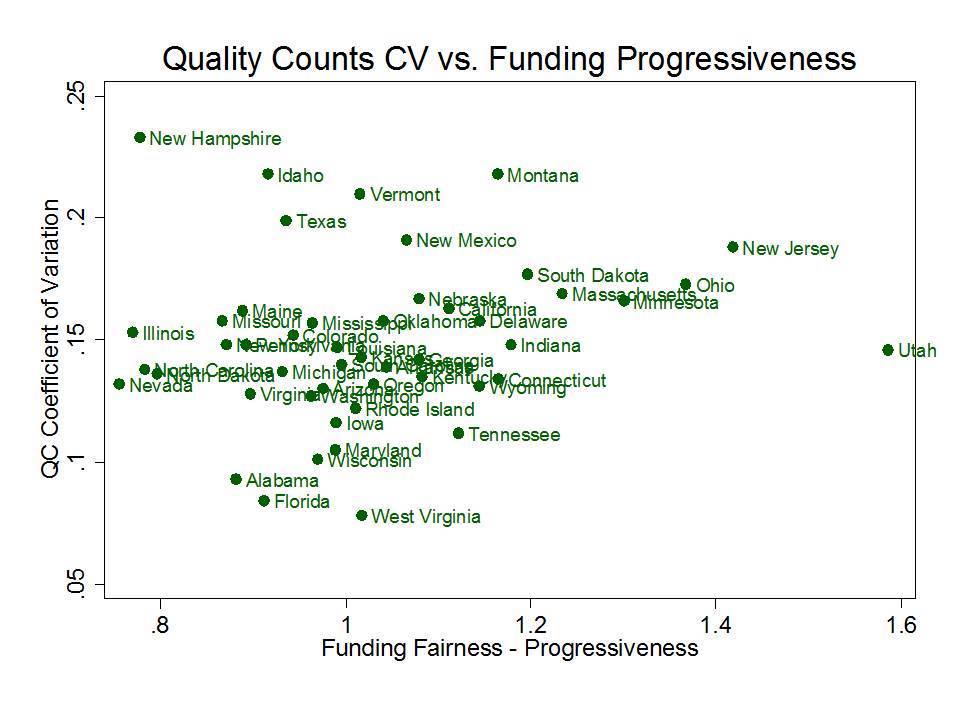
Figure 7 relates the Ed Week CV to our funding fairness measure, showing that states with progressive funding distributions including New Jersey, Ohio and Massachusetts are actually penalized by this measure.  The CV does not differentiate between need based variation as occurs in these states and wealth-drive variation as occurs in New Hampshire.  We all seem to agree – Ed Week, Students First and us… that New Hampshire’s funding is…well… not so good!

Figure 7

Slide7

Moving on, here’s the relationship between our funding fairness measure and the McLoone Index! Not much going on here… and but for a few specific examples… it’s actually hard to tell what the McLoone really captures these days in complex state school finance systems. At least it captures that New Hampshire school funding… well… sucks! But other than that, the McLoone really doesn’t capture much valuable additional information regarding equity.

Figure 8

Slide8

So then, how do these various policy conditions for success relate to various outcome measures. In this table and the following graphs I explore that question, using the following outcomes:

  1. Reduction in % below proficient (from http://www.hks.harvard.edu/pepg/PDF/Papers/PEPG12-03_CatchingUp.pdf)
  2. Annual Standardized Gain (NAEP, from http://www.hks.harvard.edu/pepg/PDF/Papers/PEPG12-03_CatchingUp.pdf)
  3. Adjusted (for initial level) Annual Standardized Gain
  4. Reading and Math NAEP 8th Grade 2011
  5. Reading and Math NAEP 8th Grade for Lowest Income Group (Free Lunch) 2011

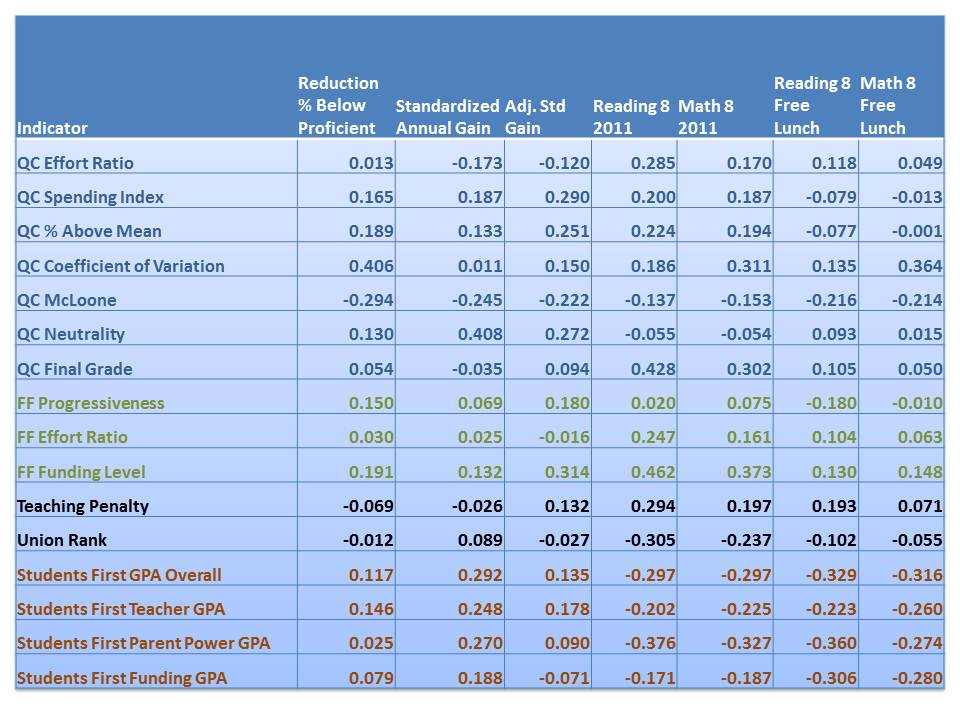
Table 1 shows the correlations between each of the indicators addressed above and the outcome measures listed above.  Note that each of these correlations a) is relatively modest to non-existent and b) merely represents a relationship whereby when X is higher, so too is Y. Underlying causal relationships involve a complex web of factors including socio-economic and demographic conditions, etc.

Table 1

Slide9

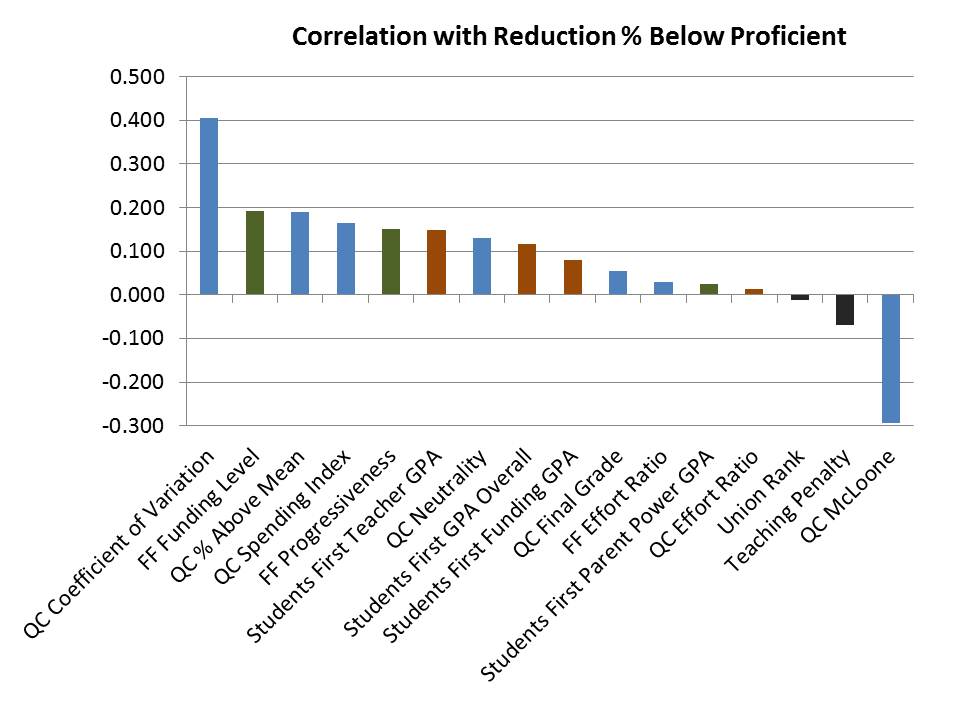
Figure 9 ranks the correlations between policy conditions and reduction in % below proficient at the 8th grade level. Interestingly, variation (inequity – bad and good) in spending is most positively associated with reduction in % below proficient. Beyond that, our funding level indicator and the two funding level indicators from Ed Week are next in line.  Students First’s teaching profession indicator is next… but their funding indicator further down. The figure seems to suggest that higher spending states, even where that spending is unequal, are doing okay on reducing % below proficient – but this is a pattern that can clearly be influenced by regional variation.

Figure 9

Slide10

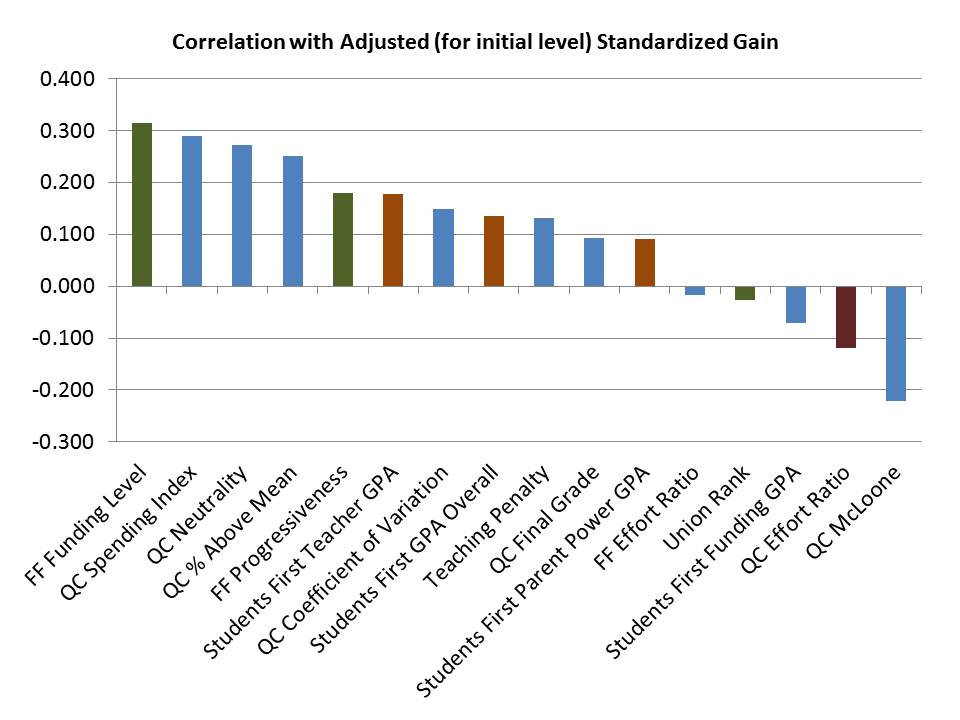
Figure 10 shows the correlations – ranked high to low – between each policy condition and adjusted standardized gain. In this case, adjusted standardized gains are most highly correlated with our spending level indicator, the Ed Week spending adequacy indicator, and our progressiveness indicator and Ed Week’s neutrality indicator. One might infer from this that more equitable and adequate funding is associated with greater long term average gains on NAEP… but again, regional differences may drive this to an extent. To get an idea of which states have better “adjusted annual gains” see the figure in Appendix A. Higher adjusted gains are states above the trendline and lower adjusted gains are those below the trendline.  Not all states are included (in the graph or correlations) for lack of baseline data year (I may work on updating this with multiple baseline years & tests. This is just a start).


Figure 10

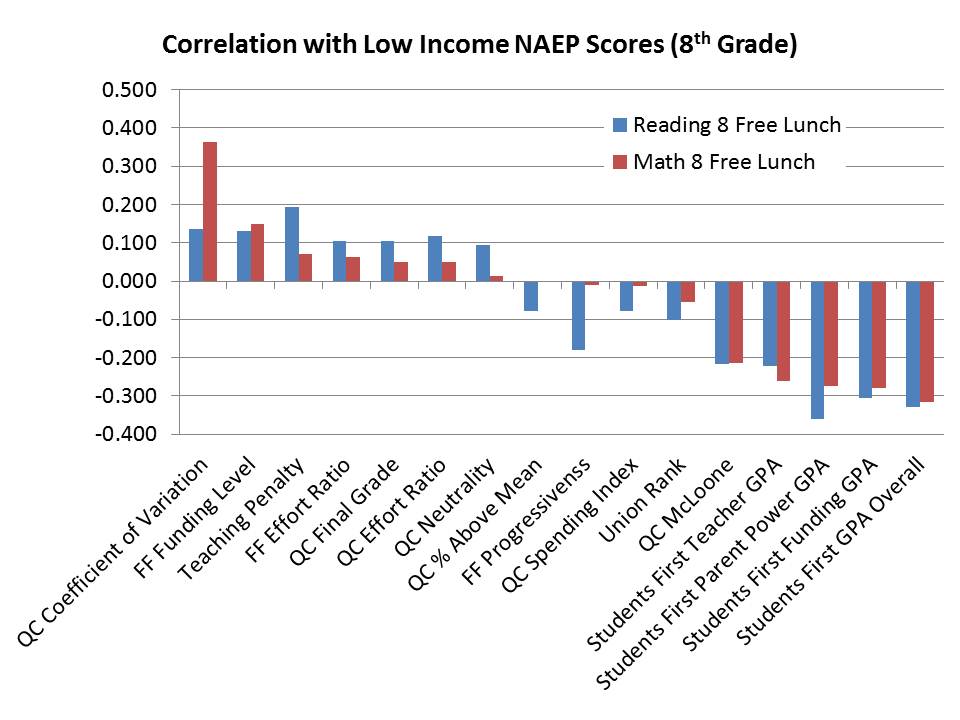
Slide12Finally, we have Figure 11, which compares correlations with the NAEP scores of the lowest income children (which across states were not associated with the average income of the families of those children). These are children in families below the 130% income level for poverty.  As in Figure 9, states with the greatest spending variation seemed to have higher low income NAEP scores. Beyond that however, funding level, effort and wage competitiveness (Teaching Penalty data) seem to be positively correlated with low income NAEP scores. That is, states with higher funding levels, that put up more funding effort, and that have more competitive teacher wages (weekly, relative to non-teachers) have higher low income NAEP scores.

In Figure 11, all of the students first indicators (GPAs) are negatively associated with low income student NAEP scores. That is, low income children are doing much worse in states that got good grades from Students First.  That said, many of the conditions Students First included as setting the state for future success are policies only recently implemented in these states.

Figure 11

Slide13

So that’s it… my run down of the relationship between this week’s state rankings data, how they relate (or not) to our School Funding Fairness Report and how they relate to various outcome measures. I’ll let the rest of you run with it from here! Cheers!

Data Sources:

Students First Report Card

School Funding Fairness

Ed Week Quality Counts (Finance)

Teaching Penalty

Relevant Additional Readings

Appendix A: NAEP Standardized Gains and 1990 Scores

Slide11

RheeFormy Logic & Goofball Rating Schemes: Comments & Analysis on the Students First State Policy Grades

On Monday, the organization Students First came out with their state policy rankings, just in time to promote their policy agenda in state legislatures across the country. Let’s be clear, Students First’s state policy rankings are based on a list of what Students First thinks states should do. It’s entirely about their political preferences – largely reformy policies – template stuff that has been sweeping the reformiest states over the past few years. I’ll have more to say about these preferred policies at the end of this post.

Others have already pointed out that Students First gave good grades to states like Louisiana and Florida, and crummy grades to states like New Jersey or Massachusetts – but that states like Louisiana have notoriously among the worst school systems – lowest test scores – in the nation – whereas states like New Jersey and Massachusetts have pretty darn good test scores and well respected school systems. I’ll go there as well, but not as my primary focus. Clearly there’s  more behind the test score differences than policy context. New Jersey and Massachusetts certainly have more educated, more affluent adult and parent populations than Louisiana, and that makes a difference.

I’ll anxiously await the day good reformers like Mike Petrilli pack their bags and leave their suburban Washington DC districts to move their kids to the amazing future schools of Louisiana!  Heck, given these new Students First ratings, any Louisiana school has to be better- or at least have far more potential – than any school in Montgomery County Maryland, run by that curmudgeonly anti-reformer Suprintendent Joshua Starr!  In fact, in my ideal world, Louisiana would become a reformy wonderland… magnet for all the reformy types… where they could go live in peace – rate their teachers by value-added models, fire 10 to 20% each year – pay them nothing – get rid of any retirement benefits, make every school a charter school (operating primarily with imported Turkish and/or Filipino labor), engage in at least 50% online learning (sitting at a computer doing test prep modules), and provide tuition tax credits to all of the reformies who prefer a purely religious perspective interwoven across subjects. Of course, this must all be done with Lousiana’s current level of financial commitment to public schooling.

But I digress… Now back to the Students First ratings.  Students First created 3 broad categories of preferred policies for their ratings – policies that it believes:

  1. Elevate teaching
  2. Empower parents
  3. Spend wisely and govern well

By elevate teaching, Students First means the usual basket of reformy options including elimination of traditional salary schedules, teacher evaluations based heavily on student test scores, reduction of retirement benefits and reduction or elimination of due process rights, and pay based primarily on test-score driven evaluation systems. They also prefer to expand alternative routes into the teaching profession. Of course, there’s not a whole lot of transparency into how these various elements are factored into the final grades. But there is a rubric!

By empowering parents, Students First essentially means increasing use of school report cards (more school grades & ratings – yes, a report card that endorses use of … report cards!), reporting to parents when their child is assigned to a teacher with a low rating (driven by test scores), and adoption of policies such as Parent Trigger. And of course, charters should be provided everywhere and anywhere… so everyone has the choice to attend one.

Finally, by spend wisely and govern well… I’m quite honestly not even sure what the hell they mean? They include a broad statement about all kids receiving equitable funding, but seem to imply that this means that charter kids get the same funding as district kids – a pretty narrow interpretation of fairness (and an incalculable one in states with no charters). No actual data seem to be used to rate state funding systems. Fairness is also determined by the provision of publicly finance facilities space to charter schools. Somehow, their ratings of funding totally ignore the vast majority of schools and children across which funds are distributed. In their view, Mayors, not local school boards should govern schools, and schools should report their expenditures uniformly – in a way that shows how the spending affects achievement (good luck with that as a reporting requirement/mechanism).

Every item on their list is somehow mysteriously scored on a “0” (you suck) to “4” (wow… you are REFORMERIFIC!) scale without using any actual data (apparently) to inform that ordinal rating. Then in a wonderful leap of number abuse, these ordinal scale data are averaged to create a grade point average for each broad category – on a 0-4 GPA like scale, where most values of course lie in the imaginary spaces between the original ordinal ratings (like kinda-semi-almost-reformerific = 3.49).

That said, let’s dig into those grades, and other stuff that may or may not correlate with them.

RheeFormy Funding Indicators vs. Real Funding Indicators

Let’s start with the funding grades which I will relate to two of our primary indicators in our annual report on school funding fairness. First, let’s look at the relationship between the RheeFormy GPA for funding/governance and our rating on the percent of gross state product allocated to K-12 education. Top scorers on RheeFormy funding are Michigan, Rhode Island, New York, Alaska and Illinois. Right away this is rather absurd since New York and Illinois are quite well known to have among the least equitable school funding systems in the nation…. but that’s the next graph. RheeFormy winners Florida and Louisiana are not particular standouts on their funding effort to education, whereas the states of New Jersey and Massachusetts, despite being much richer to begin with, allocate a much larger share of their economic productivity to elementary and secondary education. But hey, why would anyone want to count how much effort a state actually puts into funding its schools? right? how could that matter?

Figure 1.

Slide2

Figure 2 compares the RheeFormy finance GPA to our indicator of funding fairness. Our indicator of funding fairness compares the projected state and local revenue of high poverty school districts to that of low poverty school districts. A value of greater than 1.0 indicates a progressive system where more resources are allocated to higher poverty districts and a value of less than 1.0 indicates a regressive system. Not surprisingly, the RheeFormy standouts of Florida and Louisiana and especially New York and Illinois (which are among the top in RheeFormy finance) are all highly regressive states. Uh… that’s bad… not good. High poverty districts get the shaft in these states. But that’s apparently just fine with Students First. In fact, it seems preferable! Way to go!

Meanwhile, New Jersey and Massachusetts, along with Ohio, are relatively progressive on finance. Yes, Utah is too, but that’s because Utah spends next to nothing on most schools and slightly more than next to nothing on lower income schools.

So, apparently, RheeFormy logic dictates that to really make progress on achievement in low income communities, money really doesn’t matter. State school finance systems don’t matter, and in fact, spending less on districts with more poor children is the way to go. Good for New York and Illinois! NOT!

Figure 2.

Slide3

What we know about school finance reforms, funding level & distribution & student outcomes

…sustained improvements to the level and distribution of funding across local public school districts can lead to improvements in the level and distribution of student outcomes. While money alone may not be the answer, adequate and equitable distributions of financial inputs to schooling provide a necessary underlying condition for improving adequacy and equity of outcomes. That is, if the money isn’t there, schools and districts simply don’t have a “leverage option” that can support strategies that might improve student outcomes. If the money is there, they can use it productively; if it’s not, they can’t. But, even if they have the money, there’s no guarantee that they will. Evidence from Massachusetts, in particular, suggests that appropriate combinations of more funding with more accountability may be most promising.

See: http://www.shankerinstitute.org/images/doesmoneymatter_final.pdf

Put bluntly – equitable and adequate financing for the education of all children is a prerequisite condition for achieving equitable and adequate outcomes. The Students First rating system misses this point entirely – measuring neither the equity nor adequacy – nor effort to raise these prerequisite resources.

No, the Students First ratings don’t pretend to measure these things. But, they seem to argue that their ratings measure the prerequisite conditions for reforming education systems – where I must assume they mean making those systems better. But the reality is that the ratings focus on trivial and tangential reformy preferences, leading them to praise states that are among the worst in the nation on school funding and chastise states that are among the best.

RheeFormy Teacher Quality Indicators vs. Competitive Compensation

Next up are the RheeFormy ratings on elevating the teaching profession, where quite clearly, having competitive wages for teachers (relatively to the workforce of similarly educated workers) is a non-issue. Figure 3 shows the relationship between the relative weekly wage of teachers – compared to same education level non-teachers – and the elevating teaching GPA.  Teachers in Louisiana have among the largest “teaching penalties” earning only about 70% of the weekly wage of non-teachers. That’ll certainly elevate the profession! They are right up there with other stellar reformy states including Colorado and Tennessee.  Teachers in Florida do a bit better. Teachers in Massachusetts don’t do that well either, but Massachusetts is a state where non-teacher wages are quite high. So being relatively low in Massachusetts might not be as bad as being relatively low in Louisiana or Tennessee! (They also have the benefit of being able to send their own kids to pretty good public schools.) Teacher wages in New Jersey are more competitive, even in their higher non-teacher wage competitive context.

Figure 3.

Slide5

In really simple terms – competitive wages are the first step toward elevating the teaching profession. Given what we actually know from research on “elevating the teaching profession” I don’t expect to see America’s best teachers flocking to Louisiana, Colorado and Tennessee anytime soon. But, I certainly hope to see those reformers in their caravan, moving their families to those reformy promise lands!

What we know about policy conditions for a strong teacher workforce

A substantial body of literature has accumulated to validate the conclusion that both teachers’ overall wages and relative wages affect the quality of those who choose to enter the teaching profession, and whether they stay once they get in. For example, Murnane and Olson (1989) found that salaries affect the decision to enter teaching and the duration of the teaching career,[i] while Figlio (1997, 2002) and Ferguson (1991) concluded that higher salaries are associated with more qualified teachers.[ii] In addition, more recent studies have tackled the specific issues of relative pay noted above. Loeb and Page showed that:

“Once we adjust for labor market factors, we estimate that raising teacher wages by 10 percent reduces high school dropout rates by 3 percent to 4 percent. Our findings suggest that previous studies have failed to produce robust estimates because they lack adequate controls for non-wage aspects of teaching and market differences in alternative occupational opportunities.”[iii]

In short, while salaries are not the only factor involved, they do affect the quality of the teaching workforce, which in turn affects student outcomes.

Research on the flip side of this issue – evaluating spending constraints or reductions – reveals the potential harm to teaching quality that flows from leveling down or reducing spending. For example, David Figlio and Kim Rueben (2001) note that, “Using data from the National Center for Education Statistics we find that tax limits systematically reduce the average quality of education majors, as well as new public school teachers in states that have passed these limits.”[iv]

Salaries also play a potentially important role in improving the equity of student outcomes. While several studies show that higher salaries relative to labor market norms can draw higher quality candidates into teaching, the evidence also indicates that relative teacher salaries across schools and districts may influence the distribution of teaching quality. For example, Ondrich, Pas and Yinger (2008) “find that teachers in districts with higher salaries relative to non-teaching salaries in the same county are less likely to leave teaching and that a teacher is less likely to change districts when he or she teaches in a district near the top of the teacher salary distribution in that county.”[v]

And what do we know about the effectiveness of the preferred Students First policies of providing performance based pay? For recent studies specifically on the topic of “merit pay,” each of which generally finds no positive effects of merit pay on student outcomes, see:

  • Glazerman, S., Seifullah, A. (2010) An Evaluation of the Teacher Advancement Program in Chicago: Year Two Impact Report. Mathematica Policy Research Institute. 6319-520
  • Springer, M.G., Ballou, D., Hamilton, L., Le, V., Lockwood, J.R., McCaffrey, D., Pepper, M., and Stecher, B. (2010). Teacher Pay for Performance: Experimental Evidence from the Project on Incentives in Teaching. Nashville, TN: National Center on Performance Incentives at Vanderbilt University.
  • Marsh, J. A., Springer, M. G., McCaffrey, D. F., Yuan, K., Epstein, S., Koppich, J., Kalra, N., DiMartino, C., & Peng, A. (2011). A Big Apple for Educators: New York City’s Experiment with Schoolwide Performance Bonuses. Final Evaluation Report. RAND Corporation & Vanderbilt University.
RheeFormy States are NOT a Model for our Nation!
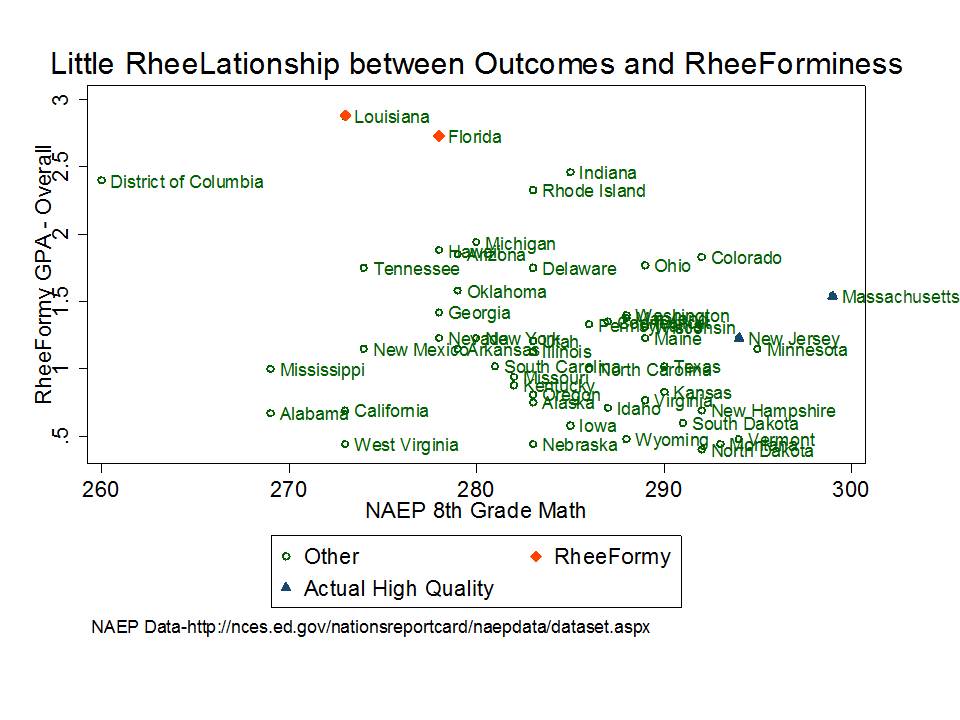
Now for that discussion of outcomes I mentioned previously. Well, here’s what it looks like. The new RheeFormy ratings applaud the likes of Louisiana, Florida… Tennessee and even Washington DC. These are anything but stellar performers on national assessments, as shown in Figure 4 and Figure 5. But indeed, these are also states (and a city) with relatively high child poverty rates.
Figure 4.
Slide7
Figure 5.
Slide8
Others have argued that states like Louisiana and Florida in particular – while being low performers – have posted impressive gains on NAEP over the past 20 years (most of which predates adoption of these new RheeFormy policies). Figure 6 uses the standardize annual NAEP gains reported in THIS REPORT.  It would appear here that overall winners on the Students First Ratings do have pretty good NAEP gains over time. But, Massachussetts and New Jersey – RheeFormy losers actually posted gains on NAEP similar to those of Louisiana and Florida!
Figure 6.
Slide9
Even more impressive, New Jersey (and also Massachusetts, but 1990 scores were not available) posted strong NAEP gains despite being relatively high to begin with. As it turns out, Louisiana had nowhere to go but up. And it appears that starting out with very low NAEP scores is a pretty strong determinant of how much a state gained over time. The lower your starting point, the more you gained. But that Non-reformy New Jersey – curmudgeonly high spending, fair spending state of New Jersey – posted gains similar to Louisiana even though it started out already among the highest performing states!
Figure 7.
Slide10
And what else about those outcomes in those stick-in-the-mud union dominated states of Massachusetts and New Jersey? As it turns out, while they were working on spending their money fairly on lower income kids they were also making significant gains in reducing the percent of children scoring below proficiency on NAEP (again using data from the PEPG Catching Up report!)  Yep, there they are, flying pretty high on funding fairness and on improving the outcomes of the lowest performing students. Louisiana and Florida… well… not so much!
Figure 8.
Slide11

A Comment on Accountability, Empowerment, Transparency & Students First Preferred Policies

Finally,  I close with a topic that should be another blog post altogether, and likely will be at some point. I’ve been struck by the logic that the preferred policies in the Students First report are intended – by their framing – to increase accountability, empowerment and transparency. Yet, in all likelihood, most of these proposals accomplish precisely the opposite – substantially eroding public accountability and oversight and compromising statutory and constitutional rights of children, employees and local taxpayers.

Now, we may have our differing perspectives on the structure of our American government and operation of government entities. But, our government has a defined structure with reasonably well conceived overarching laws.

The U.S. Constitution, state constitutions and various federal and state statutes provide important protections to students and employees and the taxpayers that finance public institutions. Importantly, our constitution protects individuals from certain treatments by our government and agents of our government. Public schools – government schools to borrow from libertarian rhetoric – fall under that umbrella, and must, for example, provide children due process before depriving them the right to attend, and must respect – to a limited extent – students rights to free expression, etc. Government schools also cannot promote/endorse a particular religious viewpoint (proselytize).  Other protections, many protections of both children and employees of government institutions are invoked through Section 1983 of the U.S. Code which applies to entities that are ‘state actors’ (uh… government entities). Further, many state laws apply to government entities and to ‘public officials.’

We have a representative system of government with multiple levels, where public officials are elected by (and accountable to) voters (albeit often a small share of those eligible), and where additional layers of public officials may be appointed by elected public officials. And, as noted above, many laws, especially those pertaining to public disclosure, public meetings and public records apply to ‘public officials.’

The Students First state policy rating system – like many other reformy manifestos – implies that the road to ACCOUNTABILITY and TRANSPARENCY is necessarily (perhaps exclusively) paved through shifting larger numbers of students and teachers and larger shares of public funding over to the management of non-government entities and non-public officials, as well as creating entirely new layers of ‘public decision making’ by referendum/petition (Parent Trigger).  Whatever gripes we may have regarding the efficiency or responsiveness of government operated services, we must think this one through carefully.

Unless detailed accountability requirements are explicitly spelled out in a whole new layer of state and federal laws, the preferred policies laid out in the Students First and by other reformy institutions are more likely to lead to less public accountability and transparency rather than more. For example:

  1. Shifting substantial numbers of students into private schools or privately managed charter schools means that larger shares of students will have limited constitutional and statutory protections.  When students are educated under privately managed schools – including charters – they do not (unless explicitly laid out in state charter laws) have the same constitutional protections with respect to discipline policies and they lack other important statutory protections that apply only to “state actors” (government institutions). Indeed, parents have a choice of whether to forgo these rights for their children. BUT…. advocates of these policies are deceitfully selling charter schooling as ‘public’ (with all the rights, privileges, etc.) to an unknowing public.
  2. Shifting substantial shares of public financing to entities governed by appointed boards of private citizens (not public officials), private management firms and private subcontractors reduces financial transparency because these institutions and individuals may – and most often do when challenged – invoke that they are not subject to open meetings, open records and other disclosure laws that necessarily apply to government entities.

Further, specific policies including parent trigger policies and ‘opportunity scholarship’ tuition tax credits may also substantially erode public accountability.

  1. Parent trigger attempts to subvert traditional elected representative local government by granting disproportionate power to a temporary class of citizens – parents of children attending a school at a given moment in time – to make relatively permanent decisions, by simply majority rule, regarding operations of public assets, public programs and services, including the option to make them no-longer public. But these assets, programs and services belong to and serve directly and indirectly the larger community of eligible voters who put in place their elected school board (or city government officials that appointed a portion or all of that board).
  2. Establishment of privately governed  entities to manage funds collected through a tax credit program [Opportunity Scholarship Vouchers] is comparable to simply handing over an equivalent sum of funds collected as tax dollars to that entity, except that taxpayers lose any/all rights/accountability over the use of those funds! As with private management firms and schools, private entities of this type are not governed directly by public officials and therefore may not be similarly legally accountable. They may not be subject to the same level of public records or meetings disclosure, etc. This mechanism [Tuition Tax Credit] has been used as a means to get around constitutional concerns over allocation of public tax revenues to religious institutions. That is, this mechanism was created specifically to negate taxpayer standing to mount legal challenges over the use of funds. The U.S. Supreme Court has determined that when tax credit programs are structured in this way, taxpayers have no right [no standing] to bring constitutional (or likely any) challenges over the use of these funds. [http://www.supremecourt.gov/opinions/10pdf/09-987.pdf]

So yes – Students First has their policy preferences – and they’re certainly entitled to that. They’ve built their entire rating system on their idea of what’s good policy. They’ve not tried to justify their policy preferences in any research basis on effectiveness or efficiency of these policy preferences, nor could they.  There simply is no research basis to support the vast majority of their preferences. Even where Charter school policy is concerned, findings of successful charters seem to occur most often where authorizers are few and tightly regulated, and where charter market share is low (as in NYC or Boston).  This is in direct contrast with the SF preference for further deregulating and expanding the sector (as in states with relatively poor charter performance).   So, in short, there’s simply no research based reason to follow the policy agenda of Students First.  But the reasons they provide – accountability, transparency, blah… blah… blah… are also not consistent with their policy agenda.

As a school finance researcher in particular, I’ve been increasingly frustrated by the lack of detailed consistent financial reporting on charter schools, and I’ve written much on this topic. I’ve also written on private school financing, which is even more sparsely reported. The more kids who are shifted into charters, the fewer kids on which we have reliable, comprehensive information on finances, teacher contracts, compensation packages etc. (as charters management companies repeatedly invoke that their employee contracts are private, not public documents).  Similarly, financial arrangements involving land deals and capital financing are more opaque than ever – far more opaque and inaccessible than the public financing world of municipal bond financed infrastructure. And I don’t see any legitimate effort to make these institutions more transparent – NONE!


[i] Richard J. Murnane and Randall Olsen (1989) The effects of salaries and opportunity costs on length of state in teaching. Evidence from Michigan. Review of Economics and Statistics 71 (2) 347-352

[ii] David N. Figlio (2002) Can Public Schools Buy Better-Qualified Teachers?” Industrial and Labor Relations Review 55, 686-699. David N. Figlio (1997) Teacher Salaries and Teacher Quality. Economics Letters 55 267-271. Ronald Ferguson (1991) Paying for Public Education: New Evidence on How and Why Money Matters. Harvard Journal on Legislation. 28 (2) 465-498.

[iii] Loeb, S., Page, M. (2000) Examining the Link Between Teacher Wages and Student Outcomes: The Importance of Alternative Labor Market Opportunities and Non-Pecuniary Variation. Review of Economics and Statistics 82 (3) 393-408

[iv] Figlio, D.N., Rueben, K. (2001) Tax Limits and the Qualifications of New Teachers. Journal of Public Economics. April, 49-71

See also:

Downes, T. A. Figlio, D. N. (1999) Do Tax and Expenditure Limits Provide a Free Lunch? Evidence on the Link Between Limits and Public Sector Service Quality52 (1) 113-128

[v] Ondrich, J., Pas, E., Yinger, J. (2008) The Determinants of Teacher Attrition in Upstate New York. Public Finance Review 36 (1) 112-144
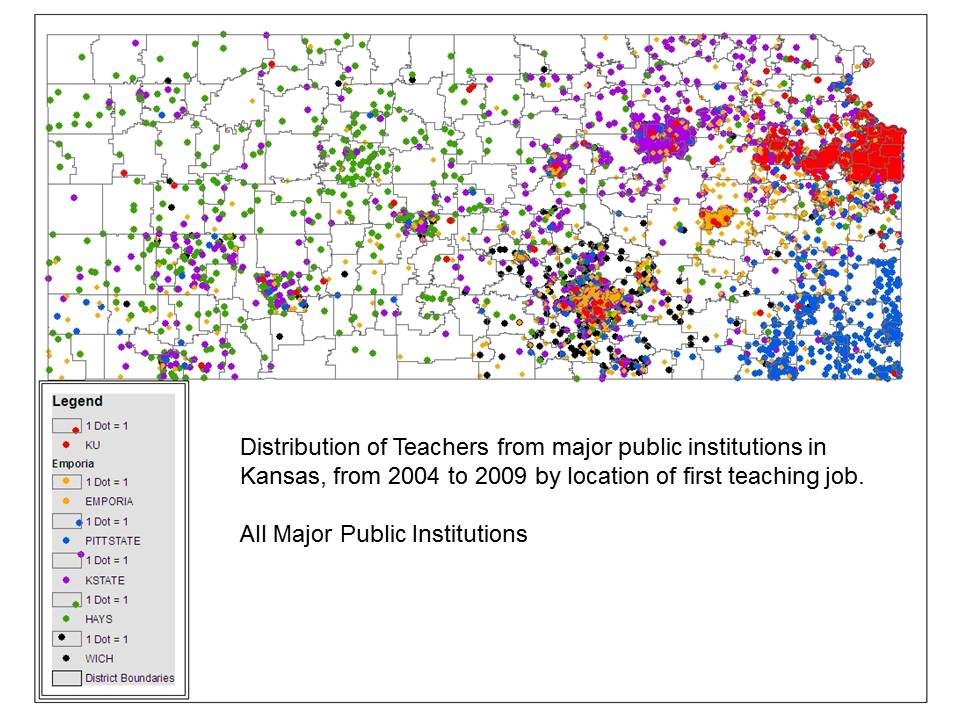
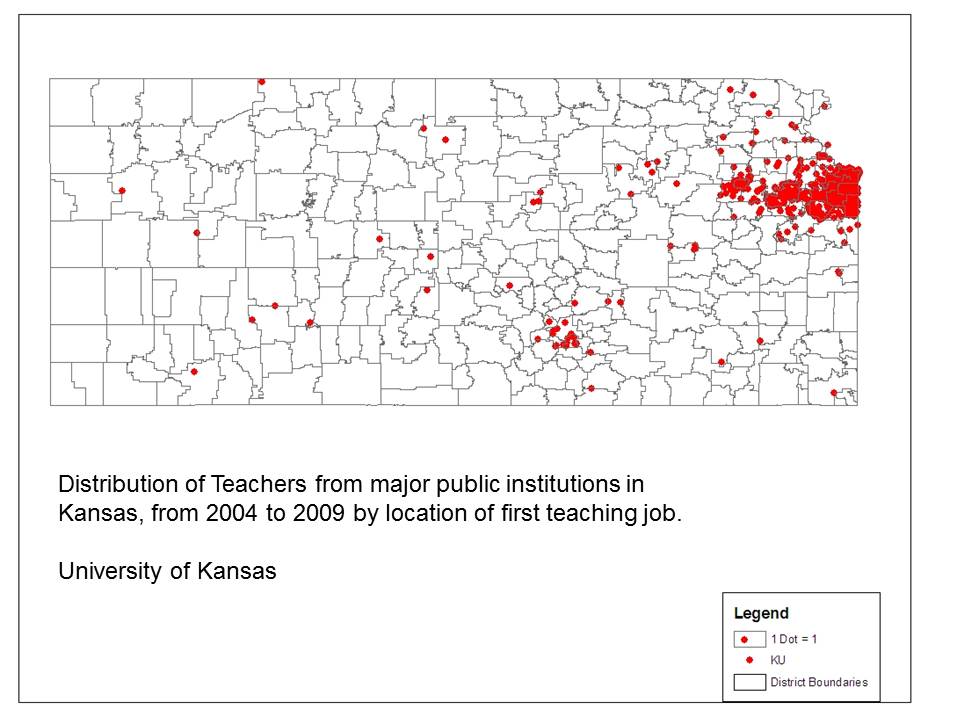
Thoughts on “Randomized” vs. Randomized Charter School Studies

There’s much talk in education research about Randomized Control Trials and truly “experimental” research being the “gold standard” for determining whether a specific intervention “works” or not. Thus is the basis for the Institute for Education Sciences What Works Clearing House. It is often argued that randomized, or experimental studies are “good” and decisive, and that other approaches simply don’t match up. Therefore, if someone really wants to know what works or doesn’t with regard to a specific intervention or set of interventions, one need only review those randomized, experimental studies to identify the consensus finding.

There’s so much to discuss on these issues, including the extent to which truly randomized experiments can actually shed light on how interventions might play out in other settings or at scale. But I’ll stick to a much narrower focus in this post, and that is, just how randomized is randomized? Most recently, this question came to mind after reading this post addressing “experimental” vs. “non-experimental” studies of charter schools by Matt Di______Carlo at Shanker blog, and this post over at Jay P. Greene’s blog on RIGOROUS charter research (meaning experimental, or randomized).

There tend to be two types of studies done to determine the relative effectiveness of “charter schools” versus traditional “district schools.” The basic idea of either type of study is to determine the effect that “charter schooling” or some specific set of policies/practices and instructional models and strategies about “charter schooling”, has on students’ outcomes, when compared to kids who don’t receive those strategies. That is, exposure to “charter schooling” is assumed to be a treatment, and non-exposure, whatever that constitutes, is the control.

One type of study tries to identify after the fact, otherwise similar kids (matched pairs) attending a set of charter schools and a set of district schools in the same city, and then compares their achievement growth over time. These studies often fall short in two important ways.

The other type of study is often referred to as meeting the gold standard – as being a randomized study – or lottery-based study. It is assumed, since these studies are declared golden, that they therefore necessarily resolve both above concerns. And it is possible, that if these studies truly were randomized (or even could be) that they could resolve the above concerns. But they don’t (resolve these concerns), because they aren’t (really randomized).

First, what would a randomized study look like? Well, it would have to look something like this – where we randomly take a group of kids – with consent or even against their will – and assign them to either the charter or traditional school option. The mix of kids in each group is truly random and checked to ensure that the two groups are statistically representative (using better than the usual measures) of the population.  Then, we have to make sure that all other “non-treatment” factors are equivalent, including access to facilities, resources, etc. That is, anything that we don’t consider to be a feature of the treatment itself. This is especially important if we want to know whether expanding elements of the treatment are likely to work for a representative population.  This is a randomized, controlled trial.

Slide1

So then, what’s randomized in a randomized charter school study? Or lottery-based study?  One might sketch out a lottery-based study as follows:

Slide2

Here, the study is really only randomized at one point in a long complicated sequence – the lottery itself. Students and families have to decide they want to enter the lottery – that they are interested in attending a charter school, which will ultimately affect the composition of the charter school enrollments. Then, among those selecting into the pool, students are randomly chosen to attend the charters along side others randomly chosen to attend (from a non-random pool of lottery participants), and the others randomly selected, to go, well, somewhere else… with a group of peers non-randomly chosen to end up in that same somewhere else.

So, while the studies compare the achievement of kids randomly chosen to those randomly un-chosen (thus comparing only those who tried to get a charter slot), the kids are shuffled into settings that are anything but randomly assigned, containing potentially vastly different peer groups and a variety of other differences in setting. Add to this the likelihood of non-random student attrition, further altering peer group over time.

As such, I very much prefer these studies to be referred to as “lottery-based” rather than randomized or experimental. These studies are randomized at only one step in this process, potentially conflating setting/peer effects with treatment effects, thus substantially compromising policy implications.

As with those matching studies, the types of variables used to check and/or correct for peer composition and non-randomness of attrition are often too imprecise to be useful.

One fun alternative would be to pull a switch, whereby the charter teachers, their model, instructional strategies etc. would be traded with the district schools’ teachers, model and strategies, as a confirmatory test to see whether the charter model effects are actually transferable (assuming there were effects to begin with).

Slide5

Clearly, I’m asking way too much to assume that charter school, or most other program/intervention research in education be based on real RCTs. That’s not going to happen. And I’m not convinced it would be that useful for informing policy anyway. But, my point in this post is to make it clear that the difference between the types of matched student studies done by CREDO, for example, and the studies being (mis)characterized as “gold standard” randomized studies is far more subtle than many are willing to admit and NEITHER ARE WHAT THEY’RE REALLY CRACKED UP TO BE!

Dumbest “School Finance” Tweet Ever?

Critics say only public systems can focus 100% on the children, but vast majority of K-12 $$ goes to employees not kids bit.ly/SLrNUn

— AEI Education(@AEIeducation) December 18, 2012

How Modern School Finance/Education Policy Works: Lessons from New York

I’ll admit that the more I do this stuff, the more I write about today’s education policy environment and especially the environment around school funding, I do get more cynical. And few states have done more to encourage my cynicism than New York, of late. But I suspect that the tales from the trenches in many other states might be quite similar. So let me use New York as a prototype of the twists and turns and warped logic of modern state education policy.  New York education policy has followed a four step process:

Step 1: Slither out from court order by rigging low-ball foundation aid formula

As I noted on another recent post, several years back the New York Court  of Appeals ordered that the state legislature provide sufficient funding (specifically to New York City) to achieve a “sound basic education” which was ultimately equated with a “meaningful high school education.”  The city and governor’s office presented to the court alternative estimates of what that would cost. The state (governor/legislature/regents), as might be expected sought a “less expensive” option. And the court largely took their side. That is, the court ordered that the system be fixed, but largely (uncritically, but for some dissenting minority opinion) accepted the state’s proposal to fix it.

The state achieved their low-ball estimate by pulling a few classic tricks, some of which have been used in other states. First, the state based their minimum funding level on average spending of existing districts meeting the state standards – but had set a relatively low bar for those standards (a bar most were already surpassing anyway). Then they chose to look only at the “instructional” spending share of current spending (lopping off a large chunk of spending that’s actually needed to operate a school).  Rhode Island recently pulled the same garbage, but instead of looking at instructional spending for districts within Rhode Island they used instructional spending in the neighboring states of Massachusetts, Connecticut and New Hampshire (okay… NH doesn’t border RI… does it… but don’t tell their Commissioner… ‘cuz including NH allowed them to bring the average down! See link above).

The final step in their low-ball analysis was to look only at the average spending of the lower half spending districts that meet the state standards – assuming those districts to be the “efficient” ones, better reflecting minimum “costs.” Of course, what this does in New York State is to eliminate from the calculation nearly every district in the Rockland, Westchester, NYC and Long Island regions. So… base level of funding is essentially the average instruction-only spending of the lower half spending districts that have at least somewhat below current average outcomes, and lie somewhere between Syracuse and Buffalo. That makes sense right? That should give us a reasonable ballpark cost for New York City, Mount Vernon or Yonkers, right?

Even for my 2012-13 analyses below, the foundation level per pupil is set to only $6,570, where it is assumed that the average instructional spending per pupil needed in a New York State to achieve state standards.  So then, how does that stack up against alternative cost estimates of what would actually be needed to achieve specific state outcome targets?

I don’t have time to explain the chart below in great detail, but I do provide complete analysis/explanation in this report on New York State school finance.

In short, what Figure 1 shows us is in PURPLE, the foundation level, or target funding calculated to be needed by districts in each poverty quintile under the state’s own proposed remedy to their constitutional violation.  The PURPLE is the amount of money a district would have under the foundation aid formula, as a combination of state aid and levying the minimum required local effort.

The blue bars come from a cost model produced a few years back by William Duncombe of Syracuse University in which he used that model to estimate the average spending actually required to achieve a 90% proficiency rate on state assessments (where the average had drifted over time, making the 80% standard relatively meaningless – again, see report).  The red arrows show the gap between estimated costs of reasonable outcome goals and guaranteed funding under the foundation formula.

Figure 1:

Slide1

The point here is simply to show a) how much the state low-balled the target funding using their approach vs. a more rigorous approach, and b) how those funding gaps increase quite dramatically for higher poverty districts. In fact, the target funding level is not that far off for low poverty districts, but it’s only slightly better than half of the cost of comparable outcomes for high poverty districts.

Step 2: Conjure annual excuses for why the state can’t afford to fund even its own low-balled targets for local districts

Given figure 1 above, it might be bad enough if the state did follow through and fund its formula. The formula itself was/is grossly insufficient, determined by bogus calculations and filtrations (exclusions) of data all toward the end goal of generating the lowest possible politically palatable estimate of the cost of providing a sound basic education in New York.

But no… no… low-balling the cost wasn’t nearly far enough for the NY legislature and Gov(ernors) to go. The next step was to say – We can’t afford it (they were saying this even before the economy tanked, and they set out a multiyear phase in)!  We can’t afford our own low-ball estimate (while decrying that the estimate was somehow actually overly generous?).

Did they cut back just a little from their target? Oh… say… give districts about 90% or 80% (uh… that would actually be a lot of cut) of what the formula said they needed? Nope. They went much deeper than that. In fact, as I showed in one recent post, as student population needs escalate (according to the state’s own Pupil Need Index) under-funding with respect to foundation targets grows in some cases to over $4,000 per pupil and in New York City to over $3,000 per pupil.

Figure 2.

Slide1

As I showed in that same post, among the most screwed large districts in the state, several receive from the state in general foundation aid only about half (or less) of what they should receive under the STATE’S OWN LOW-BALL FORMULA!

Figure 3.

Slide2

Let’s be clear here. I’m not talking about shortfalls from the relatively high cost targets in that first graph. I’m talking about state aid shortfalls relative to the STATE’S OWN LOW-BALL Foundation Aid model – the model represented by the purple bars in the first graph.  Note also that the state in proposing this foundation model that they’ve subsequently underfunded, essentially declared that low-ball model to be the empirical manifestation of their own state constitutional obligation. It’s their own freakin’ definition of their constitutional obligation…. And they’ve chosen to ignore it.

Step 3: Pretend that it’s all the teachers’ fault and use that as a basis for holding hostage additional funding that should have gone to high need districts years ago!

Oh… but it doesn’t end there!

Riding the national, Duncanian wave of new normalcy (which I’ve come to learn is an extreme form of innumeracy) & reformyness, the only possible cause of lagging achievement in New York State  is bad teachers –greedy overpaid teachers with fat pensions – and protectionist unions who won’t let us fire them. Clearly, the lagging state of performance in low income and minority districts in New York State has absolutely nothing at all to do with lack of financial resources under the low-balled aid formula that the state has chosen to not even half fund for the past 5 years? Nah… that couldn’t have anything to do with it. Besides, money certainly has nothing to do with providing decent working conditions and pay which might leveraged to recruit and retain teachers.

And we all know that if New York State’s average per pupil spending is high, or so the Gov proclaims, then spending clearly must be high enough in each and every-one of the state’s high need districts! (right… because averages always represent what everyone has and needs, right? Reformy innumeracy rears its ugly head again!).

So it absolutely has to be the fact that no teacher in NY has ever been evaluated at all, or fired for being bad even though we know for sure that at least half of them stink. The obvious solution is that they must be evaluated by egregiously flawed metrics – and we must ram those metrics down their throats.

In fact, the New York legislature and Governor even found it appropriate to hold hostage additional state aid if districts don’t adopt teacher evaluation plans compliant with the state’s own warped demands and ill-conceived policy framework.

As I understand it, legislation passed this past year actually tied receipt of state general aid to compliance with the state teacher evaluation mandate. That, in order to receive any increase in state general/foundation aid over prior year, a districts would have to file and have accepted their teacher evaluation plan.

That’s it – we’ll take away their general state aid – their foundation aid – the aid they are supposed to be getting in order to comply with that court order of several years back. The aid they are constitutionally guaranteed under that order. I’m having some trouble accepting the supposed constitutional authority of a state legislature and governor to cut back general aid on this basis – where they’ve already failed to provide most of the aid they themselves identified as constitutionally adequate under court order? But I guess that’s for the New York Court system to decide.

If nothing else, it is thoroughly obnoxious, arbitrary and capricious and grossly inequitable treatment. I hear the reformers (who understand neither math nor school finance) whine… But why… why is it inequitable to require similarly that poor and rich districts follow state teacher and principal evaluation guidelines. Setting aside the junk nature of that evaluation system and the bogus measures on which it rests (and the fact that the reformers’ fav-fab-charters have largely rightfully ignored the eval mandate), it is inequitable because districts serving higher poverty children stand to lose more money per child as a result of non-compliance. And they’ve already been squeezed.

And here’s how that plays out. As I understand it, if districts don’t comply by January, they face the threat of losing the small increase in state aid they received for the current year (compared to 11-12). So, they’d lose it retro-actively, part way through this year. And guess what? Because higher need districts received a marginally greater increase in state aid, they’d lose more per pupil. But the gaps shown above actually already include that oh-so-generous increase! That’s right, the poorer you are, the bigger the financial penalty for non-compliance with the teacher evaluation mandate – and the bigger the financial hole the state has put you in to begin with!

Figure 4. State aid Per Pupil Before and After Non-Compliance Penalty by Student Need

Slide4
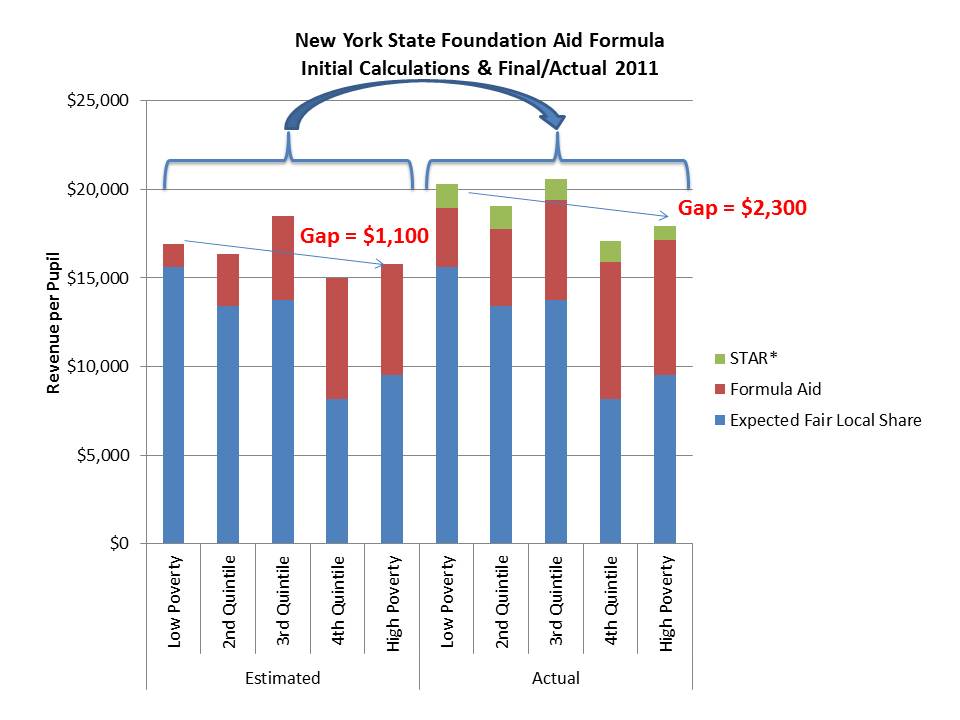
Figure 5. Compliance Penalty by Student Need

Slide5This recent article explains that Hempstead, already underfunded by the largest per pupil amount of any large district in the state, stands to lose another $3.5 million in aid if it does not come to agreement on a teacher evaluation plan. State general aid is for the general provision of education to these kids – to pay for enough teachers, classrooms etc. It’s about the day to day operations of schools to ensure the provision of a sound basic education.  This funding shouldn’t be held hostage over reformy whims.

Note that for many districts I have likely understated the amount of aid they would lose because I have counted only changes to general, foundation aid, including “gap elimination adjustment” and partial restoration of those funds. (it would appear, for example, that the potential losses to Hempstead reported in the news are closer to that districts total aid change, not just foundation/GEA change).

Step 4: Protect billions in state aid still being allocated to districts with far fewer additional student needs/costs

And let us not forget that New York State was one of the shining stars – a poster child – of my report with Sean Corcoran for the Center for American Progress where we chronicled how states actually use their aid systems to make equity worse, not better.  While the NY Gov and Legislature have continued to shed elephant tears (in purely political terms) about their fiscal dire straits, the state persists in protecting billions in state direct aid and indirect tax relief subsidies that largely support the states lower  and lowest need local public school districts.

Figure 6 shows that if we look at state general aid, based on initial calculations to local districts by poverty (left hand panel), even after allocating state general aid, there remains an $1,100 per pupil gap in state and local revenue between high and lower poverty districts. But, after the state “tweaks” the  state general aid distribution to provide minimum aid to the wealthiest districts and increase aid to middle/upper middle class districts, and then adds on “tax relief” subsidies, the gap between higher and lower poverty districts increases to $2,300 per pupil. Yep – NY state is actually using billions in state funding to make the system less equitable!  Read the report below for more thorough explanation/analysis!

Figure 6. School Finance Pork in New York!

Slide6

Baker, B.D., Corcoran, S.P.(2012) The Stealth Inequalities of School Funding: How Local Tax Systems and State Aid Formulas Undermine Equality. Washington, DC. Center for American Progress. http://www.americanprogress.org/wp-content/uploads/2012/09/StealthInequities.pdf

And that is how modern state education policy works!

Forget the $300m Deal! Let’s talk $3.4 billion (or more)!

Sometime last week or so, Sockpuppets for Ed Reform marched on City Hall in NY demanding that the city and teachers union come to a deal on a teacher evaluation system compliant with the state’s new regulations for such systems, so that the district could receive an approximately $300 million grant payment associated with the implementation of that system. Well, actually, it was more about trying to enrage the public that the evil teachers union in particular was at fault for holding hostage and potentially losing this supposedly massive sum of funding.

As one can see by the signs the SFER protesters were displaying, the protest was much less clearly articulated than I’ve described above. On would think, from looking at stuff like this: http://nyulocal.com/wp-content/uploads/2012/11/DSC_0841.jpg that this protest was actually about obtaining funding for the district – funding that would provide for substantive and sustained improvement to district programs/services.

But hey, far be it for SFER to actually carry placards that are in any way accurate or precise (or to have any clue what they are talking about). At this particular event in NYC, they even convinced a 15 year old that the fight was really about funding.

So, we’ve got a protest that is presented as being about funding, but is really about a teacher evaluation system driven by student test scores, being carried out by a group that clearly has little or no understanding of either.

You know, I would typically give a group of undergrads a break on stuff like this.  Hey, they’re undergrads and have time to learn/develop the discipline/understanding of these complex topics. Heck, I was anything but a disciplined undergrad myself.  But unfortunately, this group has thus far displayed to me the worst attributes of the most intellectually lazy of today’s college students – a persistent pattern of copying and pasting low quality content from web sites and presenting it as novel content of their own. It’s as if their placards, and their entire website was generated by lifting content from “reformy-pedia.”

So then, what is the real story on what’s goin’ on with Teacher Evaluation and School Funding in New York State?

The State Evaluation System/Guidelines

I’ve written several posts recently about the state metrics for teacher evaluation and the state department of education push to get districts on board. I also wrote about the letter from the Chancellor of the Board of Regents which appeared in the NY Post, encouraging NYC in particular to get on board with that $300m RAW deal!

In my humble opinion, no-one should sign on to a deal to implement a teacher evaluation system under the current NYSED guidelines, given the evidence I’ve laid out over the past few weeks. No-one. Just say NO.

First, the state’s consultants designing their teacher and principal effectiveness measures find that those measures are substantively biased:

Despite the model conditioning on prior year test scores, schools and teachers with students who had higher prior year test scores, on average, had higher MGPs. Teachers of classes with higher percentages of economically disadvantaged students had lower MGPs. (p. 1) https://schoolfinance101.com/wp-content/uploads/2012/11/growth-model-11-12-air-technical-report.pdf

But instead of questioning their own measures, they decide to give them their blessing and pass them along to the state as being “fair and accurate.”

The model selected to estimate growth scores for New York State provides a fair and accurate method for estimating individual teacher and principal effectiveness based on specific regulatory requirements for a “growth model” in the 2011-2012 school year. p. 40 https://schoolfinance101.com/wp-content/uploads/2012/11/growth-model-11-12-air-technical-report.pdf

The next step was for the Chancellor to take this misinformation and polish it up as pure spin as part of the power play against the teachers in New York City (who’ve already had the opportunity to scrutinize what is arguably a better but still substantially flawed set of metrics). The Chancellor proclaimed:

The student-growth scores provided by the state for teacher evaluations are adjusted for factors such as students who are English Language Learners, students with disabilities and students living in poverty. When used right, growth data from student assessments provide an objective measurement of student achievement and, by extension, teacher performance. http://www.nypost.com/p/news/opinion/opedcolumnists/for_nyc_students_move_on_evaluations_EZVY4h9ddpxQSGz3oBWf0M

Then send in the enforcers…. This statement came from a letter sent to a district that did decide to play ball with the state on the teacher evaluation regulations. The state responded that… sure… you can adopt the system of multiple measures you propose – BUT ONLY AS LONG AS ALL OF THOSE OTHER MEASURES ARE SUFFICIENTLY CORRELATED WITH OUR BIASED MEASURES… AND ONLY AS LONG AS AT LEAST SOMEONE GETS A BAD RATING.

The department will be analyzing data supplied by districts, BOCES and/or schools and may order a corrective action plan if there are unacceptably low correlation results between the student growth subcomponent and any other measure of teacher and principal effectiveness… https://schoolfinance101.wordpress.com/2012/12/05/its-time-to-just-say-no-more-thoughts-on-the-ny-state-tchr-eval-system/

This is a raw deal, whether attached to what appears to be a pretty big bribe or not. And quite honestly, while $300 million is nothing to sneeze at, it pales in comparison to what the city schools are actually owed under the state’s own proposal for how it would fund its schools to comply with a court order of nearly a decade ago.

THE REAL ISSUE in NY State

Meanwhile, at the other end of the state – well sort of – a different protest was going on. This protest in Albany actually was about funding and the fact that the state of New York has repeatedly cut state aid from local public school districts each of the past few years, has systematically cut more per pupil funding from districts serving needier student populations and has never once come close to providing the funding levels that the state’s own funding formula suggest are needed (actually, were needed back in 2007!).

Here’s a quick run-down on the state of school funding in New York:

  1. New York continues to maintain one of the least equitable school finance systems in the country, where districts serving higher concentrations of children in poverty have systematically less state and local revenue per pupil.
  2. New York State accomplishes these patterns of egregious disparity not merely by lack of effort, but by actually allocating substantial state resources – disproportionate state resources – toward buying down the tax rates of the state’s wealthiest districts and making other politically convenient state aid allocations to economically advantaged districts, at the expense of children in poverty.
  3. Even though the state was ordered by the NY court of appeals nearly a decade ago to provide adequate resources to children attending high need districts, and even though the court accepted the state’s own proposed funding formula to meet that goal (which was much lower than more rigorously determined spending targets), the state has chosen to not even come close to funding those targets and in recent years has systematically cut more funding from children with greater needs.

So, how does this all affect districts across New York State and NYC in particular? I’m going to set a really low bar here for my comparisons. In response to court order in the Campaign for Fiscal Equity case the state of New York proposed a new school finance formula – a foundation aid formula – to begin implementation in 2007. It was actually a pretty lame, relatively low-balled funding formula to begin with, as explained here!

But even that low-balled estimate of what districts were supposed to get has never been close to fully funded. Several large districts, including Albany, for example, receive in 2012-13, less than half of the state aid they are supposed to receive if the formula was implemented.

The formula provides a target level of funding for each district based on student needs and regional costs. Then, the formula determines the share of that target funding that should come from the state. Then, the formula as actually implemented, ignores all of that and provides a marginal increase or decrease (over what districts have historically received) maintaining the persistent inequities of the system.

The first figure below shows the difference between actual state foundation aid per pupil (after applying this trick they refer to as gap elimination adjustment) and the aid calculated to be needed according to THE STATE’S OWN FORMULA for addressing regional costs and student needs. Districts are organized from low need (left) to high need (right) using the state’s own pupil need index. Bubble size indicates district enrollment size. NYC is the BIG ONE! And, we can see, by eyeballing the middle of that bubble, that NYC is being shorted between $3,000 and $4,000 per pupil. At 1 million kids, that’s about $3.4 billion … each year… every year… over time.  No, not a $300m implementation grant, but $3.4 billion in annual operating funds. Yeah… the stuff that actually provides for smaller class sizes, decent teacher pay, up to date materials, supplies and equipment, and arts, music and all that other stuff!

Slide1

The table below provides a closer look at districts with the largest funding gap between what the formula calculates is needed and what districts actually receive in state aid.

Slide2

So, instead of talking about a one shot $300m bribe to implement a bad system based on bad data, at a cost that may exceed the amount of grant to begin with, perhaps it would make more sense to focus on that $3.4 billion deal! You know, the one state officials themselves promised in response to that court order all those years ago.

And when we do start taking more seriously this much bigger funding issue, don’t forget to send me a cool lookin’ knit protest hat!

Readings

Policy Brief on State Aid in New York (Summer 2011) NY Aid Policy Brief_Fall2011_DRAFT6

Baker, B.D., Welner, K.G. (2012) Evidence and Rigor: Scrutinizing the Rhetorical Embrace of
Evidence-based Decision-making. Educational Researcher 41 (3) 98-101

Baker, B.D., Welner, K. (2011) School Finance and Courts: Does Reform Matter, and How Can We
Tell? Teachers College Record 113 (11) p. –

Baker, B.D., Corcoran, S.P.(2012) The Stealth Inequalities of School Funding: How Local Tax
Systems and State Aid Formulas Undermine Equality. Washington, DC. Center for American
Progress. http://www.americanprogress.org/wp-content/uploads/2012/09/StealthInequities.pdf

Baker, B.D., Sciarra, D., Farrie, D. (2012) Is School Funding Fair? Second Edition, June 2012.
http://schoolfundingfairness.org/National_Report_Card_2012.pdf

Baker, B.D. (2012) Revisiting the Age Old Question: Does Money Matter in Education. Shanker
Institute. http://www.shankerinstitute.org/images/doesmoneymatter_final.pdf

Baker, B.D., Welner, K.G. (2011) Productivity Research, the U.S. Department of Education, and
High-Quality Evidence. Boulder, CO: National Education Policy Center. Retrieved [date] from
http://nepc.colorado.edu/publication/productivity-research.

Friday Thoughts on Data, Assessment & Informed Decision Making in Schools

Some who read this blog might assume that I am totally opposed, in any/all circumstances to using data in schools to guide decision-making. Despite my frequent public cynicism I assure you that I believe that much of the statistical information we collect on and in schools and school systems can provide useful signals regarding what’s working and what’s not, and may provide more ambiguous signals warranting further exploration – through both qualitative information gathering (observation, etc.) and additional quantitative information gathering.

My personal gripe is that thus far – especially in public policy – we’ve gone about it all wrong.  Pundits and politicians seem to have this intense desire to impose certainty where there is little or none and impose rigid frameworks with precise goals which are destined to fail (or make someone other than the politician look as if they’ve failed).

Pundits and politicians also feel the intense desire to over-sample the crap out of our schooling system – taking annual measurements on every child over multiple weeks of the school year when strategic sampling of selected testing items across samples of students and settings might provide more useful information at lower cost and be substantially less invasive (NAEP provides one useful example). To protect the health of our schoolchildren, we don’t make them all walk around all day with rectal thermometers hanging out of…well… you know?  Nor do political pollsters attempt to poll 100% of likely voters.  Nor should we feel the necessity to have all students take all of the assessments, all of the time, if our goal is to ensure that the system is getting the job done/making progress.

In my view, a central reason for testing and measurement in schools is what I would refer to as system monitoring,  where system monitoring is best conducted in the least intrusive and most cost-effective way – such that the monitoring itself does not become a major activity of the system!  We just need enough sampling density in our assessments to generate sufficient estimates at each relevant level of the system.

I know there are those who would respond that testing everyone every year ensures that no kids fall through the cracks. If we did it my less intrusive way… kids who weren’t given all test questions in math in a given year might fall through some hypothetical math crack somewhere. But it is foolish to assume that NCLB-every-student-every-year testing regimes actually solve that problem. Further, high stakes testing with specific cut scores either for graduation or grade promotion violates one of the most basic tenets of statistical measurement of student achievement – that these measures are not perfectly precise. They can’t identify exactly  where that crack is, or which kid actually fell through it! One can’t select a cut score and declare that the child one point above that score (who got one more question correct on that given day) is ready (with certainty) for the next grade (or to graduate) and the child 1 point below is not. In all likelihood these two children are not different at all in their actual “proficiency” in the subject in question. We might be able to say – by thoughtful and rigorous analysis – that on average, students who got around this score in one year, were likely to get a certain score in a later year, and perhaps even more likely to make it beyond remedial course work in college. And we might be able to determine if students attending a particular school or participating in a particular program are more or less likely (yeah… probability again) to succeed in college.

Thoughtful analysis and more importantly thoughtful USE of testing data in schools requires a healthy respect for what those numbers can and cannot tell us… and nuanced understanding that the numbers typically include a mix of non-information (noise/unexplainable, non-patterned information), good information (true signal) and perhaps misinformation (false signal, or bias, variation caused by something other than what we think it’s caused by).

These issues apply generally to our use of student assessment data in schools and also apply specifically to an area I discuss often on this blog – statistical evaluation of teacher influence on tested student outcomes.

I was pleased to see the Shankerblog column by Doug Harris a short while back in which Doug presented a more thoughtful approach to integrating value-added estimates into human resource management in the schooling context. Note that Doug’s argument is not new at all, nor is it really his own unique view. I first heard this argument in a presentation by Steve Glazerman (of Mathematica) at Princeton a few years ago. Steve also used the noisy medical screening comparison to explain the use of known-to-be-noisy information to assist in making more efficient decisions/taking more efficient steps in diagnosis. That is, with appropriate respect for the non-information in the data, we might actually find ways to use that information productively.

Last spring, I submitted an article (still under review) in which I, along with my coauthors Preston Green and Joseph Oluwole explained:

As we have explained herein, value-added measures have severe limitations when attempting even to answer the narrow question of the extent to which a given teacher influences tested student outcomes. Those limitations are sufficiently severe such that it would be foolish to impose on these measures, rigid, overly precise high stakes decision frameworks.  One simply cannot parse point estimates to place teachers into one category versus another and one cannot necessarily assume that any one individual teacher’s estimate is necessarily valid (non-biased).  Further, we have explained how student growth percentile measures being adopted by states for use in teacher evaluation are, on their face, invalid for this particular purpose.  Overly prescriptive, overly rigid teacher evaluation mandates, in our view, are likely to open the floodgates to new litigation over teacher due process rights, despite much of the policy impetus behind these new systems supposedly being reduction of legal hassles involved in terminating ineffective teachers.

This is not to suggest that any and all forms of student assessment data should be considered moot in thoughtful management decision making by school leaders and leadership teams. Rather, that incorrect, inappropriate use of this information is simply wrong – ethically and legally (a lower standard) wrong. We accept the proposition that assessments of student knowledge and skills can provide useful insights both regarding what students know and potentially regarding what they have learned while attending a particular school or class. We are increasingly skeptical regarding the ability of value-added statistical models to parse any specific teacher’s effect on those outcomes. Further, the relative weight in management decision-making placed on any one measure depends on the quality of that measure and likely fluctuates over time and across settings. That is, in some cases, with some teachers and in some years, assessment data may provide leaders and/or peers with more useful insights.  In other cases, it may be quite obvious to informed professionals that the signal provided by the data is simply wrong – not a valid representation of the teacher’s effectiveness.

Arguably, a more reasonable and efficient use of these quantifiable metrics in human resource management might be to use them as a knowingly noisy pre-screening tool to identify where problems might exist across hundreds of classrooms in a large district. Value-added estimates might serve as a first step toward planning which classrooms to observe more frequently. Under such a model, when observations are completed, one might decide that the initial signal provided by the value-added estimate was simply wrong. One might also find that it produced useful insights regarding a teacher’s (or group of teachers’) effectiveness at helping students develop certain tested algebra skills.

School leaders or leadership teams should clearly have the authority to make the case that a teacher is ineffective and that the teacher even if tenured should be dismissed on that basis. It may also be the case that the evidence would actually include data on student outcomes – growth, etc. The key, in our view, is that the leaders making the decision – indicated by their presentation of the evidence – would show that they have used information reasonably to make an informed management decision. Their reasonable interpretation of relevant information would constitute due process, as would their attempts to guide the teacher’s improvement on measures over which the teacher actually had control.

By contrast, due process is violated where administrators/decision makers place blind faith in the quantitative measures, assuming them to be causal and valid (attributable to the teacher) and applying arbitrary and capricious cutoff-points to those measures (performance categories leading to dismissal).   The problem, as we see it, is that some of these new state statutes require these due process violations, even where the informed, thoughtful professional understands full well that she is being forced to make a wrong decision. They require the use of arbitrary and capricious cutoff-scores. They require that decision makers take action based on these measures even against their own informed professional judgment.

My point is that we can have thoughtful, data informed (NOT DATA DRIVEN) management in schools. We can and should! Further, we can likely have thoughtful data informed management (system monitoring) through far less intrusive methods than currently employed – taking advantage of advancements in testing and measurement, sampling design etc. But we can only take these steps if we recognize the limits of data and measurement in our education systems.

Unfortunately, as I see it, current policy efforts enforcing the misuse of assessment data (as illustrated here, here and here) and misuse of estimates of teacher effectiveness based on those data (as illustrated here) will likely do far more harm than good.  Unfortunately, I don’t see things turning corner any time soon.

Until then, I may just have to stick to my current message of Just say NO!