Comment on Property Tax Limits and Consolidation

One of the new arguments in favor of implementing the 2.5% constitutional limit on property taxes for New Jersey municipalities and school districts is that it would not only force these municipalities and school districts to operate within their means and much more efficiently (an unfounded argument I address here), but that the caps would also encourage consolidation because of the fiscal constraints. This logic is wrongheaded for a variety of reasons, a few of which I will touch on here.

For starters, I have written on the topic of consolidation and potential cost savings on several previous posts and have spoken on this issue around the state. There are certainly savings to be found by consolidating very small school districts – especially those with fewer than 300 students. My slides on this topic, and its relation to racial isolation of towns in NJ can be found here: https://schoolfinance101.com/wp-content/uploads/2009/08/race-cost-in-nj1.ppt

What we know about property tax limits with an override option from states like Massachusetts is that those property tax limits tend to highlight the differences in property taxing capacity of towns and of the ability of local voters to override caps if they wish to maintain high quality schooling or other public services. Some towns hit the cap sooner than others, having little ability to improve services within the cap and other towns have much more latitude to raise revenues before hitting their cap. Some towns have little difficulty overriding the cap, while others find it near impossible.  In New Jersey, even without these caps differences in tax base and voter behavior (preferences for public service quality) are relatively obvious to local voters in adjacent municipalities that fall into different categories. As it is, these differences create substantial barriers, insurmountable barriers to consolidation when left to votes among each municipality.

The cap would make these differences far more apparent and, as a result, would decrease the likelihood that a municipality that has room under its cap and/or the ability to override if necessary would ever consider merging with a town that would reduce its cap flexibility and/or dilute its pool of “yes” votes on an override.

Even if towns did consider merging while caps are in place, it would only be in the interest of affluent towns to merge with other similarly affluent towns (or towns in similar position with respect to the caps and public service preferences), reinforcing the already striking patterns of inter-district racial and socio-economic segregation.

Good schools, low taxes and no activist judges! (?)

….Why Massachusetts is so much cooler than New Jersey… REALLY? (nothing against Mass. Go Celtics!)

Perplexing claims and contradictory information seem to be flooding the New Jersey media of late. Here’s my summary and critique of two of those claims:

  • The claim that the problem with New Jersey schools is that the New Jersey Supreme Court for decades meddled where they didn’t belong, squeezing taxpayers to flood poor urban districts with billions of dollars, none of which ever produced any gains in school quality. It’s still a wretched system! Wretched, I say!
  • The claim that if New Jersey were to implement a property tax cap like Massachusetts, New Jersey schools which currently achieve nearly the same as Massachusetts could do a lot better, and for much less money. That is, the property tax cap implemented by Massachusetts in 1980 is responsible for the slightly higher “quality” and marginally lower spending of Massachusetts schools. (actually, the ever-morphing claim is that Mass blows us away on test scores and spends 26% less per pupil. I debunk those claims in the link above).

Of course, the first contradiction here lies in the acknowledgment that New Jersey schools sit right near the top of the pack along with Massachusetts (and both rank very high in international comparisons as well).

The second contradiction however is far more ironic. In fact, extensive analysis and review of empirical research presented in this forthcoming study shows that New Jersey and Massachusetts are in fact among the national success stories of implementing effective school finance reforms in response to judicial intervention. Yes – increased funding in response to judicial intervention!

Massachusetts 1990s successes in improving educational outcomes and achieving greater equity in educational outcomes across public school districts were a function of sweeping finance and accountability reforms, implemented in response to a court order. In fact, one can argue that a major reason that the Massachusetts courts needed to intervene to improve equity and adequacy of education funding was the property tax limits.

Here are a few excerpts from the forthcoming study. Regarding other recent studies and reports from Think Tanks, Dr. Welner and I conclude:

We conclude that there is arbitrariness in how research in this area appears to have shaped the perceptions and discourse of policymakers and the public. Methodological complexities and design problems plague finance impact studies. Advocacy research that has received considerable attention in the press and elsewhere has taken shortcuts toward desired conclusions, and this is troubling.

Among the studies Dr. Welner and I review in the forthcoming study are a handful on the specific effects of New Jersey and Massachusetts reforms:

For Massachusetts, two independent sets of authors have found positive reform effects. Most recently, Downes, Zabel and Ansel (2009) found:

  • The achievement gap notwithstanding, this research provides new evidence that the state’s investment has had a clear and significant impact. Specifically, some of the research findings show how education reform has been successful in raising the achievement of students in the previously low-spending districts. Quite simply, this comprehensive analysis documents that without Ed Reform the achievement gap would be larger than it is today. (p. 5)

Previously, Guryan (2003) concluded:

  • Using state aid formulas as instruments, I find that increases in per-pupil spending led to significant increases in math, reading, science, and social studies test scores for 4th- and 8th-grade students. The magnitudes imply a $1,000 increase in per-pupil spending leads to about a third to a half of a standard-deviation increase in average test scores. It is noted that the state aid driving the estimates is targeted to under-funded school districts, which may have atypical returns to additional expenditures. (p. 1)

Turning to New Jersey, two recent studies find positive effects of that state’s finance reforms. Alexandra Resch (2008), in research published as a dissertation for the economics department at the University of Michigan, found evidence suggesting that New Jersey Abbott districts “directed the added resources largely to instructional personnel” (p. 1) such as additional teachers and support staff. She also concluded that this increase in funding and spending improved the achievement of students in the affected school districts. Looking at the statewide 11th grade assessment (“the only test that spans the policy change”), she found “that the policy improves test scores for minority students in the affected districts by one-fifth to one-quarter of a standard deviation” (p. 1).

The second recent study was originally presented at a 2007 conference at Columbia University, and a revised, peer-reviewed version was recently published by the Campaign for Educational Equity at Teachers College, Columbia University (Goertz and Weiss, 2009). This paper offers descriptive evidence that reveals some positive test results of recent New Jersey school finance reforms:

  • State Assessments: In 1999 the gap between the Abbott districts and all other districts in the state was over 30 points. By 2007 the gap was down to 19 points, a reduction of 11 points or 0.39 standard deviation units. The gap between the Abbott districts and the high-wealth districts fell from 35 to 22 points. Meanwhile performance in the low-, middle-, and high-wealth districts essentially remained parallel during this eight-year period (Figure 3, p. 23).
  • NAEP: The NAEP results confirm the changes we saw using state assessment data. NAEP scores in fourth-grade reading and mathematics in central cities rose 21 and 22 points, respectively between the mid-1990s and 2007, a rate that was faster than the urban fringe in both subjects and the state as a whole in reading (p. 26).

On balance, Dr. Welner and I find that high quality empirical studies taken collectively support the conclusion that sustained, well designed school finance reforms including those which follow state judicial orders, generally lead to improvements to either or both the level of student outcomes and equity in the distribution of student outcomes. Further, New Jersey and Massachusetts are both examples of these successes.

No, it wasn’t the Massachusetts tax limits that created successful schools. And the only reason those tax limits did not undermine entirely the 1990s successes is that a) the state court was willing and able to intervene and b) the state was able to provide the additional state support needed to implement the reforms. This, however, left Mass schools much more vulnerable to economic downturns and state aid cuts in more recent years (2001-02 downturn and current).

Just trying to get the story straight!

Studies cited above:

Downes, T. A., Zabel, J., and Ansel, D. (2009). Incomplete Grade: Massachusetts Education Reform at 15. Boston, MA. MassINC.

Guryan, J. (2003). Does Money Matter? Estimates from Education Finance Reform in Massachusetts. Working Paper No. 8269. Cambridge, MA: National Bureau of Economic Research.

Goertz, M., and Weiss, M. (2009). Assessing Success in School Finance Litigation: The Case of New Jersey. New York City: The Campaign for Educational Equity, Teachers College, Columbia University.

Resch, A. M. (2008). Three Essays on Resources in Education (dissertation). Ann Arbor: University of Michigan, Department of Economics. Retrieved October 28, 2009, from http://deepblue.lib.umich.edu/bitstream/2027.42/61592/1/aresch_1.pdf


Manhattan Institute Study Provides Bogus Interpretation of Massachusetts Prop 2 ½

Printer friendly draft: Policy Brief – Tax Limits in Massachusetts

Media reports this week touted a Manhattan Institute Study supported by the Common Sense Institute of New Jersey. The “study” (using the term loosely) can be found here:

http://www.manhattan-institute.org/html/cr_62.htm#05

The “study” provides no reference to the vast body of peer-reviewed literature in high quality journals that has addressed the effects of tax and expenditure limits on public expenditures and consequences for public sector service quality. Instead, the “study” pretends to provide definitive evidence, on its own, to a question the authors apparently assume has not already been addressed by more competent researchers. Sadly for them but luckily for the general public, this question has been addressed many times over, in high quality, peer-reviewed publications.

Below are some findings from empirical research studies on the relationship between tax limits and school quality. Perhaps the most notable examples of the effects of TELs (Tax and Expenditure Limits) are in Colorado (under their TABOR) and California (Prop 13). But, TEL’s have been implemented in a number of forms across states, including Massachusetts’ Proposition 2 ½.

This list of research findings is only a start, but illustrates an important point that choosing to limit taxes and expenditures likely means choosing to reduce service quality – increase class sizes and reduce teacher quality in particular. Again, that’s a choice. But we should be well aware of the consequences of these choices.

Other literature also suggests that while TELs reduce service quality by constraining state and local budgets, those service quality reductions are not necessarily accompanied by increased economic growth. This may be because regional economic growth is as related to regional service quality as it is to regional tax environment.

Author David Figlio in a study of Oregon’s Measure 5 (National Tax Journal  Vol 51 no. 1 (March 1998) pp. 55-70) finds that: Oregon student-teacher ratios have increased significantly as a result of the state’s tax limitation.

David Figlio and Kim Rueben in the Journal of Public Economics (April 2001, Pages 49-71) find: Using data from the National Center for Education Statistics we find that tax limits systematically reduce the average quality of education majors, as well as new public school teachers in states that have passed these limits.

In a non-peer reviewed, but high quality working paper, Thomas Downes and David Figlio “find compelling evidence that the imposition of tax or expenditure limits on local governments in a state results in a significant reduction in mean student performance on standardized tests of mathematics skills.” (http://ase.tufts.edu/econ/papers/9805.pdf)

Context also matters. The effects of tax and expenditure limits may differ if implemented during bad rather than good economic times. Andy Reschovsky, in a 2004 article in State and Local Government Review (volume 36, pp. 86-102) suggests that the existence of fiscal constraints created by tax limitations could serve to exacerbate the impact of downturns on education spending, both by limiting the ability of localities to respond to state aid cuts and by shifting local revenue away from a stable source, the property tax, to less stable sources.

Of particular interest in New Jersey are the effects of Massachusetts Proposition 2 ½ implemented in 1980. A handful of studies have explored various aspects of that particular property tax limit which included an option for local communities to override the cap.

Katherine Bradbury and colleagues, in a 1998 article in the New England Economic Review (July/August Issue 3-20) point out several interesting direct and indirect effects of Proposition 2 ½ in Massachusetts. First, they find that the share of the potential student population served by the public schools is lower in districts in which more initial cuts were necessary when the limits were first imposed. This result suggests that the limits could increase dropout rates or could result in students switching from the public to the private sector. Second, they find that Proposition 21⁄2 made constrained communities relatively less attractive to families with children, both in the early 1980s and the early 1990s.  Bradbury and colleague note that the distortive effects of the property tax limits on mobility of families into and out of different municipalities and school districts were “troubling.”

Finally, in a policy brief from the Center on Budget and Policy Priorities [http://www.cbpp.org/archiveSite/5-21-08sfp.pdf ] (which might be characterized as left leaning), an admittedly non-peer reviewed source, Phil Oliff and Iris Lav provide some useful insights regarding the transferability of Massachusetts reforms in the 1980s to New Jersey now. Among other things, Oliff and Lav point out that tax caps can be particularly harmful if implemented in a weak economy, noting that “Proposition 2½ took effect during a period of extraordinary economic growth — the “Massachusetts Miracle.” This is entirely consistent with the findings of Andy Reschovsky noted above. State revenues were rising, which allowed the state to boost aid to compensate for constrained property taxes, and construction was expanding, which allowed communities to raise their property tax revenue by more than 2.5 percent per year.” Further, they note that:  “The adoption of Proposition 2 ½ coincided with a decline in Massachusetts’ K-12 enrollment, allowing schools to operate with less revenue.” Neither of these conditions exist in present day New Jersey.

Comparing Massachusetts and New Jersey Education Systems

So then, how does Massachusetts accomplish this dramatic rise to the top in public education while spending so much less than New Jersey? And why didn’t the tax and expenditure limits impede the Massachusetts miracle?

Let’s clear up a few basic factual errors here. First, the expenditure differences between Massachusetts and New Jersey are nowhere near as large as implied by the Manhattan Study. Here’s what per pupil spending looks like between the two states with and without adjustments for regional cost variation.

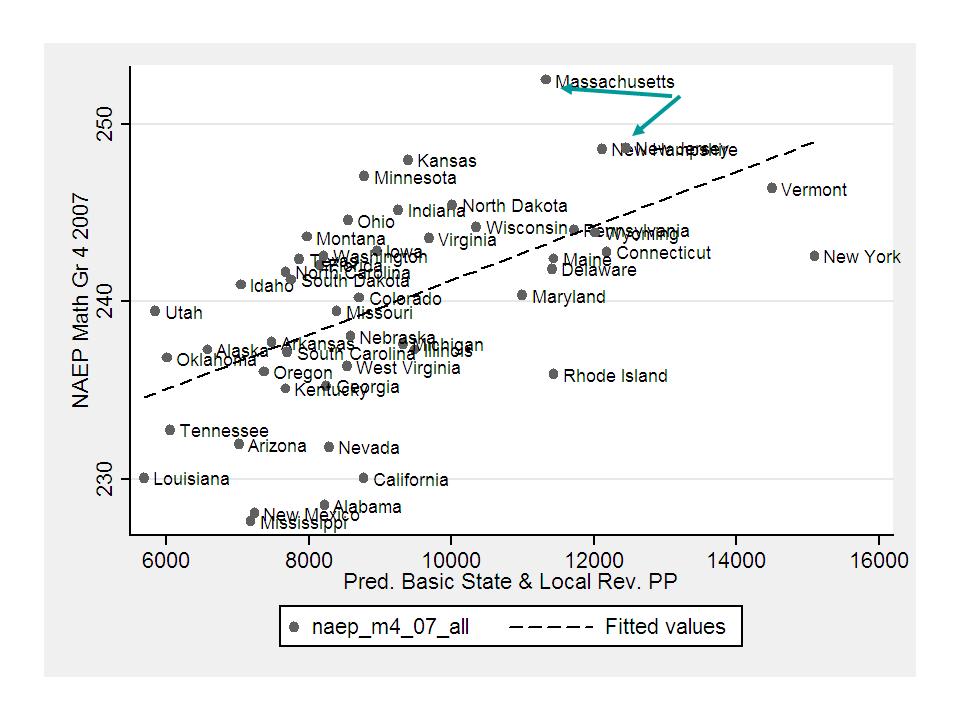
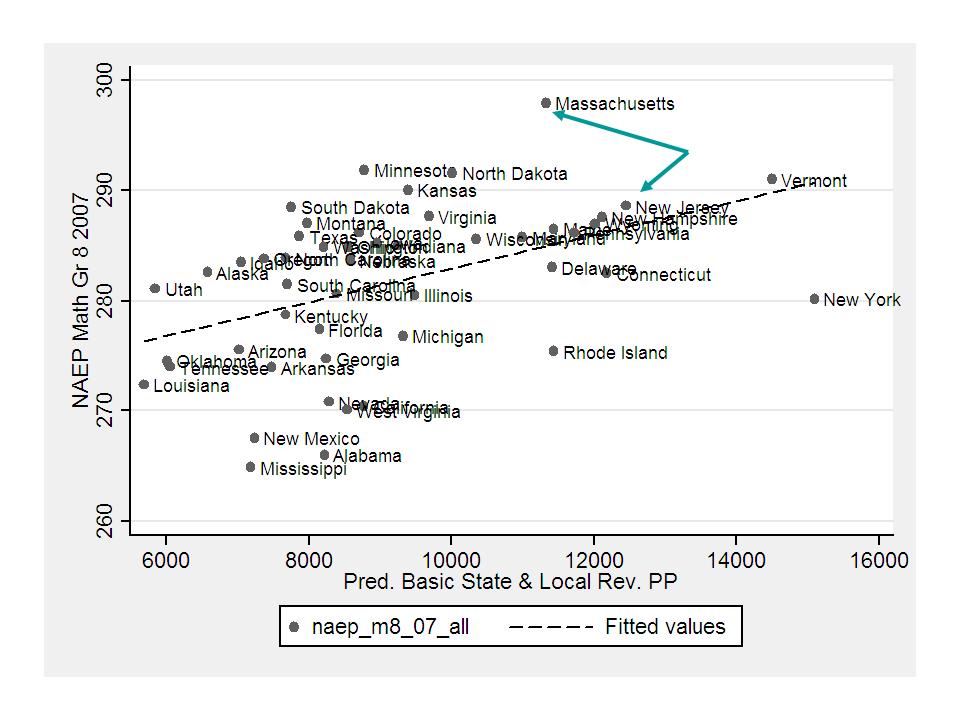
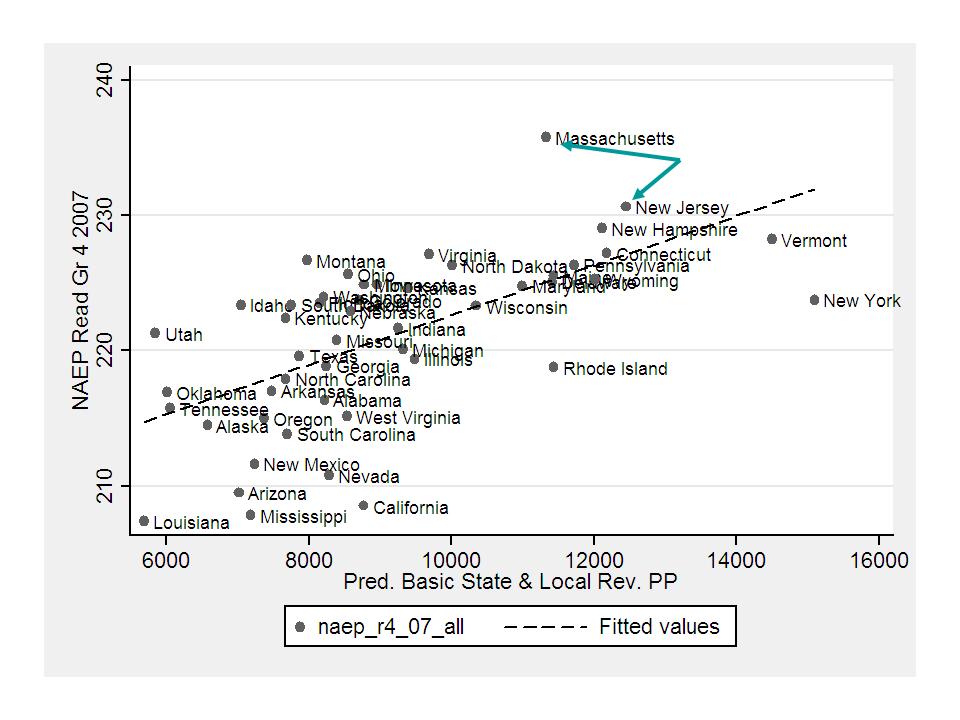
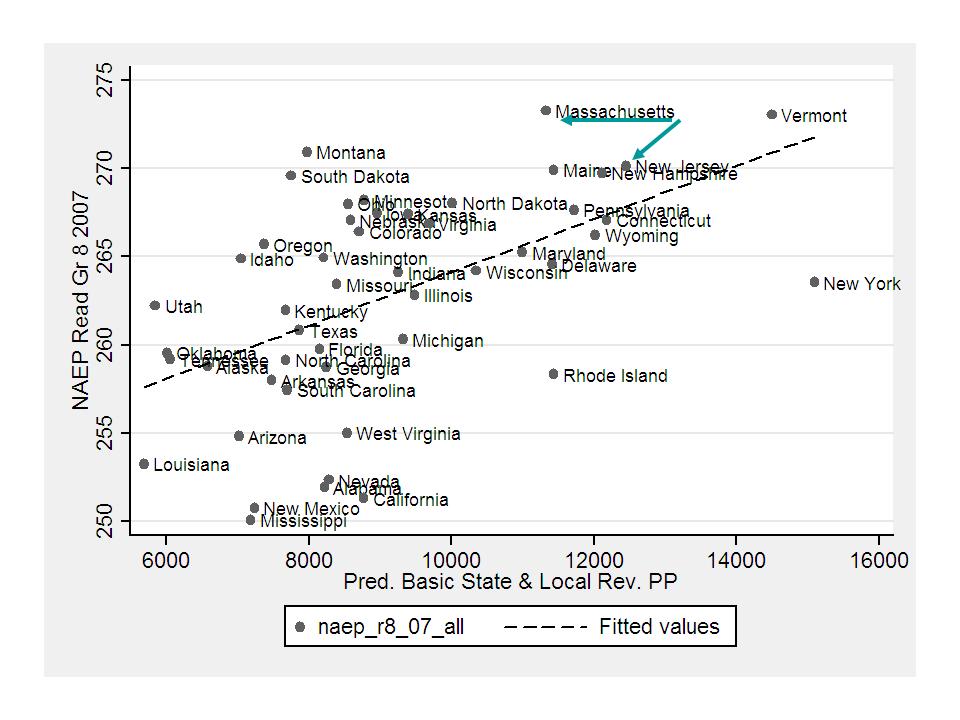
And here’s what the performance differences look like in 2007, in relation to the funding differences. Yes, Massachusetts is slightly outperforming New Jersey (more so on 8th grade math) and spending marginally less. But there is hardly a striking contrast between either the spending or the performance measures and a plethora of potential factors that might explain these differences.

So, how did those tax limits make Massachusetts schools so darn good? Well, maybe they didn’t. Let’s put the timeline together a little better here. The tax limits were imposed around 1980. Massachusetts schools saw significant improvements beginning in 1993. Is it possible that some other intervening factor played a role in this 13 year period?

Well, as it turns out, as towns faced fiscal constraints under Prop 2 ½ during the 1980s and as many poorer towns suffered from lagging local revenues and insufficient state support, lawsuits concerning the equity and  adequacy of Massachusetts school funding were filed. Schoolfunding.info provides this summary:

“In the Massachusetts education finance case, McDuffy v. Secretary (1993), Massachusetts students claimed that their own less affluent school districts were unable to provide them with an “adequate” education. Based on an analysis of the Massachusetts Constitution’s “Encouragement of Literature” clause, the Supreme Judicial Court concluded that the Commonwealth has an obligation to educate all of its children and held that children in less affluent communities “are not receiving their constitutional entitlement of education as intended and mandated by the framers of the Constitution.” Moreover, the court adopted the guidelines set forth by the Supreme Court of Kentucky in Rose v. Council for Better Education to define the standard of education that the Commonwealth must provide.

At about the same time that the court issued its McDuffy decision, the legislature passed and the governor signed the Education Reform Act (ERA) of 1993, which established a “foundation budget” for each school district to be phased in over seven years.”

Wait… so, in fact, Massachusetts improved its school system, in terms of both equity and adequacy as a result of legislation enacted in 1993 in response to a court order to fix a system that had fallen into disarray during the decade following Prop 2 ½!  That’s not the story told by the Manhattan study. They infer that Prop 2 ½ itself led to improved efficiency of Massachusetts schools and that the decreased spending growth coupled with accountability pressures created the improvement.  The Manhattan Institute study makes absolutely no mention of the court ruling and gives minor addendum mention to the reforms that followed.

So, what do we actually learn from Massachusetts and Proposition 2 1/2 ?

  • First, if you’re going to impose property tax limits at all, it should be done during a strong not weak economy.
  • Second, the state must be prepared to offset losses to property tax revenue with increased state aid, but this makes public school funding even more susceptible to future economic downturn.
  • Third, the public should be prepared for and acknowledge the risk that service quality will decline. Class sizes will likely increase. Teacher quality may decline and student outcomes may follow.
  • Fourth, judicial intervention may be required to straighten out the resultant mess in the end, to insure that all children continue to have access to equitable and adequate educational opportunities.

That’s a somewhat different story than provided by the Manhattan Institute.

For more information regarding school finance reforms in Massachusetts and New Jersey, read: DoReformsMatter_Formatted

NJOSA & the Lakewood Effect

UPDATE: As I understand it, NJOSA has now been revised to specifically target Lakewood as a pilot site for the vouchers (1 of 8 locations). Consider the analysis below in that light. This revision potentially allows for a greater share of overall NJOSA funding to flow specifically to Lakewood students. Further, this revision raises fun/interesting legal questions.

Yes, it is true that the Zelman case found that the Cleveland voucher program did not violate the establishment clause of the first amendment by providing vouchers to children who in large numbers chose to attend religious schools. The court acknowledged that the voucher policy itself was neutral w/respect to religion. However, not too long before Zelman, in Kiryas Joel (NY), the court found that the State of New York had violated the establishment clause when it singled out Kiryas Joel Village in a statute altering the boundaries of local public school districts to specifically serve the exclusively religious community.

So, for example, if a the state of NY were to decide to operate a voucher program, and specifically pilot test that program in Kiryas Joel Village, would such a policy be considered religion neutral, as under Zelman? Or might that policy violate the establishment clause because of the exclusively religious community selected (Kiryas Joel)? Clearly Cleveland (and its private school sector) is far more diverse than Kiryas Joel, providing at least some argument in favor of neutrality. Now, Lakewood is less homogeneous than Kiryas Joel, but clearly more like Kiryas Joel than it is like Cleveland. Thoughts from my legal scholar friends? (consider demographic & pvt. school sector analysis below – written in response to different iteration of NJOSA).


SLIDES: Lakewood Effect Slides

The New Jersey Opportunity Scholarship Act (NJOSA) is being proposed on the basis that $6,000 vouchers for children in grades k-8 and $9000 vouchers for children in grades 9-12 would a) provide much-needed financial relief for financially ailing urban Catholic schools and b) would provide poor and minority children the opportunity to escape chronically under-performing, poor urban New Jersey schools. Implicit in Part B of the claims is that the primary beneficiaries of the voucher program – aside from urban Catholic schools — would be poor and minority children attending so-called “failing” schools in the state’s major urban centers, such as Camden, Newark, Paterson or Jersey City.

I have previously disposed of the first claim – that these vouchers would help financially sustain private schools in New Jersey – here: https://schoolfinance101.wordpress.com/2010/03/23/would-8000-scholarships-help-sustain-nj-private-schools/ Another study that reaches the same conclusion is a 2009 report which found  Milwaukee Vouchers are not yielding big financial benefits for the city’s Catholic schools, even where the voucher level exceeded $6,300 in 2005-06 (see: http://www.edexcellence.net/doc/catholic_schools_08.pdf)

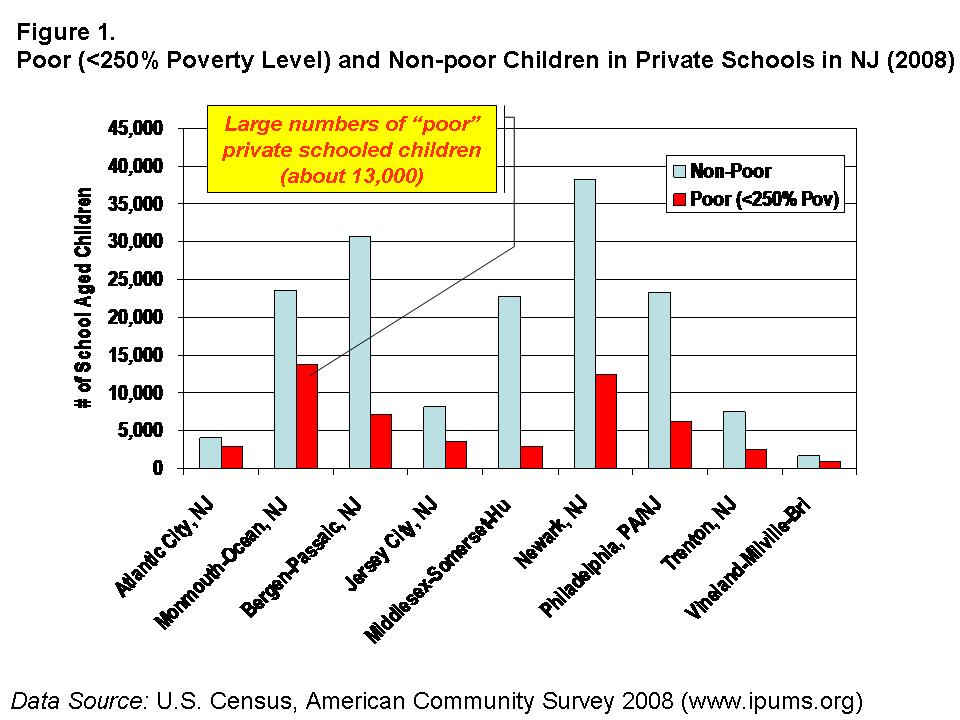
But let’s take a closer look at who will really benefit if the New Jersey voucher proposal becomes law.    Where are most children in New Jersey already in private school?  More specifically, where are most New Jersey children already in private school with a family income  low enough (below 250% of the poverty level) to qualify for the NJOSA vouchers?  It may seem highly unlikely that many low-income children would already be attending private schools. Indeed, NJOSA is not “intended” to underwrite the education of children already in private schools, but rather to assist children “trapped” in low performing public schools to attend nearby private schools.  But, NJOSA includes from the outset a provision that would allow low-income families whose children already attend private schools to access the vouchers, setting aside  at least 25% of the total available voucher resources in any given year for such children (as I understand it).

First, where are the largest numbers of private school children in New Jersey?

As it turns out, the largest total numbers of privately schooled children are indeed in the Newark area and the second largest number in Bergen-Passaic (combined).  The third largest total numbers of private schooled children are in the Lakewood (Ocean County) area.  However, when one looks only at those children who would qualify for the NJOSA vouchers, the largest total number are in Lakewood – over 13,000 in 2008.  Lakewood has more  than Newark, more  than Jersey City, and more  than anywhere else in New Jersey, despite having much smaller total population.  Here are the data:
The next data we look at are from Public Use Micro-data Areas, or PUMAs – a construction of U.S. Census – which are smaller than metropolitan areas and allow for a relatively precise focus on the areas such as Lakewood. (PUMAs have populations of at least 100,000)

Because the Newark metropolitan area has far more than 100,000 residents, Newark would be carved into multiple PUMAs, whereas Lakewood would fall within one. But, the total populations of the areas would be more similar than comparing metro areas like those above.

Ranking PUMAs by private school enrollment, we find that the largest total private school enrollment –  BY FAR – occurs in Lakewood’s PUMA, with about 17,000 children between 5 and 18 in private schools.  About 8% of private schooled children statewide are in this PUMA.  More striking however are the numbers of private schooled children who would qualify for the NJOSA vouchers.  In Lakewood’s PUMA, that number exceeds 10,000 children. The next highest PUMA has under 1,500 who would qualify.  Bottom line: Lakewood’s PUMA has over 20% of the state’s poor children who currently attend private schools.

The following tables present the data:
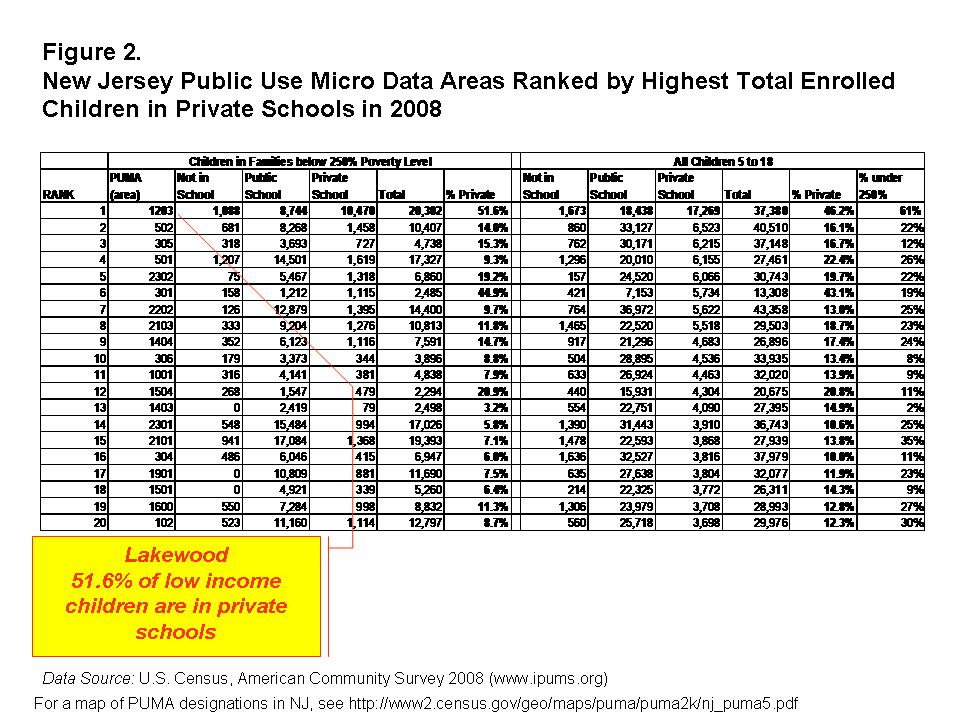
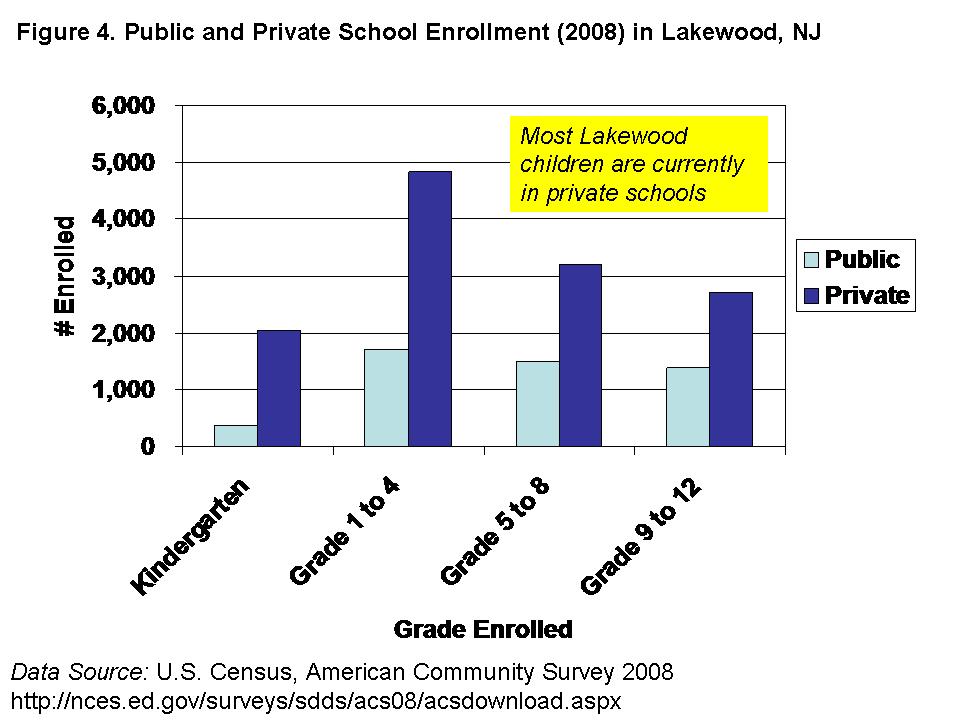
But this is only the beginning of the Lakewood story.   As it turns out, the vast majority of children in Lakewood are in private, not public schools, which occurs nowhere else (to this extreme) in the state of New Jersey.

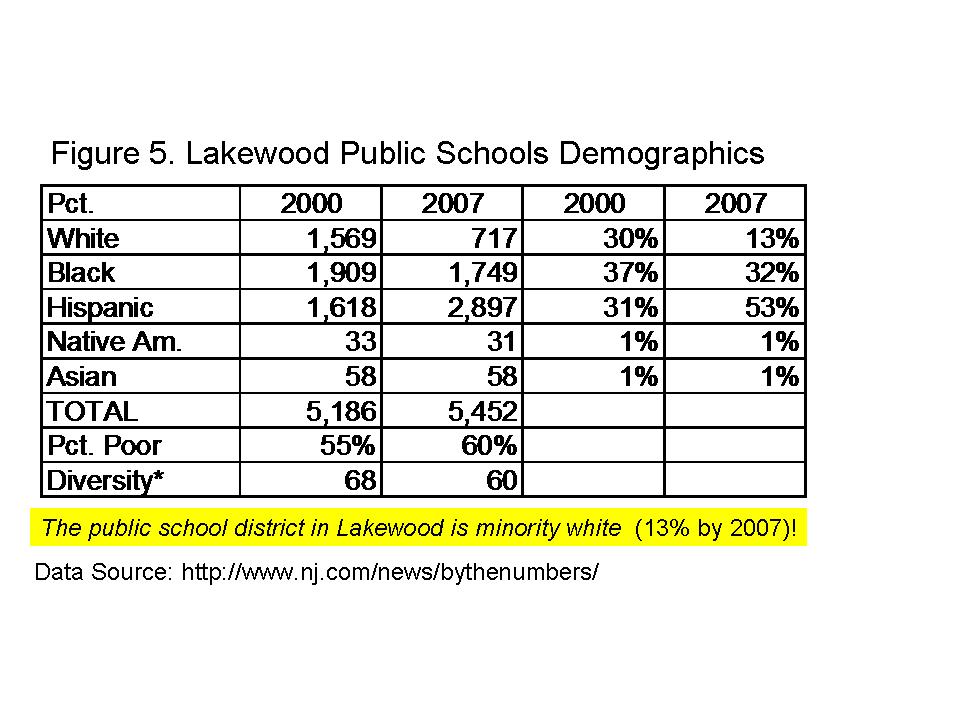
And, as it turns out, Lakewood’s public schools are currently “majority minority” (Black and Hispanic students:
And, there are many, many private schools in Lakewood. The vast majority of those schools and the students who attend them are Orthodox Jewish schools which are almost invariably 100% homogenous – listed as “white” – in sharp contrast with the majority minority makeup of the township’s public school system.
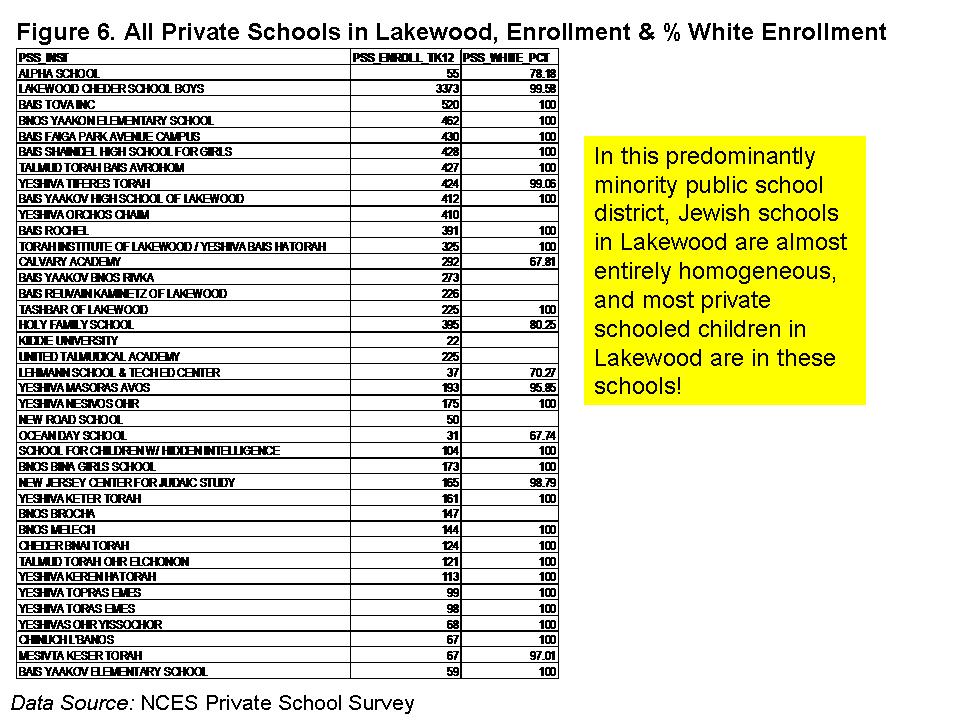
As it turns out, the sum total of children attending the Jewish schools in Lakewood is approximately the same as the sum total of the low income (<250% poverty level) children attending private schools in Lakewood, or about 11,000. Needless to say, there is likely significant overlap between the children in Lakewood in private schools from low income families and the children in the Orthodox schools in Lakewood .

Note that 10,395 of the reported 10,470 (99.2%) poor, private schooled children in Lakewood PUMA were listed as “white” in the Census American Community Survey data from 2008. Only Lakewood’s Jewish schools match that demographic (in that geographic area).  And they are nearly (if not entirely) all identified as low-income.

So who cares? Why does matter? What are the implications? Well, as it turns out this intriguing distribution of low-income private schooled children would potentially qualify Lakewood’s Orthodox Jewish schools for a sizeable revenue windfall from the NJOSA voucher program.  It may not necessarily be enough to cover actual “costs” of operating these schools, but the publicly funded vouchers might go a long way to when combined with other resources.

Setting aside phase-in limits on the amount of total voucher funding under NJOSA, if all future children attending Lakewood Orthodox schools received vouchers each year, and if those schools maintained roughly the same enrollment as in 2008, the public revenue provided through vouchers could generate over $60 million per year for these schools.

Let’s sum up.  One of if not the biggest beneficiary of NJOSA is not a) the children trapped in poor urban (Newark, Camden, Jersey City) schools, or b) cash-strapped urban Catholic Schools (which lack sufficient other private contribution support to keep afloat), but rather, the highly racially and religiously segregated Lakewood Orthodox Jewish community and its schools. They constitute the largest number – by far – of “income qualified” current private school enrolled children in the state

This is not quite the narrative about the NJOSA voucher proposal I’ve been hearing about.

NJ Opportunity Scholarship: Must Read Items

Very little time today. Big deadlines and lots of data to analyze. Since the debate is now heating up over the NJ Opportunity Scholarship Program, I thought I’d put out there a few items which really should be part of the debate on this topic.

1) The April 2010 report on the long run effectiveness of the Milwaukee Voucher Program: http://www.uark.edu/ua/der/SCDP/Milwaukee_Eval/Report_15.pdf This report concludes:

The primary finding in all these comparisons is that, in general, there are few statistically significant differences between levels of MPCP and MPS student achievement growth in either math or reading two years after they were carefully matched to each other. In one of the ways of estimating these results, focusing only on those students who have remained in the public or private sector for all three years, private, voucher students are slightly behind MPS students in mathematics achievement growth.

2) My Summer 2009 report on the “cost” and supply of private schooling: http://epicpolicy.org/files/PB-Baker-PvtFinance.pdf It is important to understand that my point in this report was NOT that private schools are either more or less expensive than public schools in the same labor market. They are simply more varied. They are more varied in what they spend, what they provide and what they can achieve. With private schools, you get what you pay for.

I write about the specifics of the New Jersey context here: https://schoolfinance101.wordpress.com/2010/03/23/would-8000-scholarships-help-sustain-nj-private-schools/, pointing out that claims that average private school costs in NJ are $6,000 (elem) and $9,000 (secondary) are entirely unfounded.

Here, I provide a quick snapshot of cost/quality issues in private schooling in response to other recent media reports: https://schoolfinance101.wordpress.com/2010/02/20/stossel-coulson-misinformation-on-private-vs-public-school-costs/

The premise that children will be saved from failing public schools with these paltry payoffs to low-end private schools is a stretch at best. Good private schools are expensive, and often more expensive than even the highest spending nearby public schools. The Milwaukee studies provide useful insights as well, showing little or no effect after much more than a trial period.

A few quick notes on Tax and Expenditure Limits (TELs)

Below are some clips from abstracts of empirical research studies on the relationship between tax limits and school quality. I address this topic because of current policy discussions in New Jersey regarding a Massachusetts-style Prop 2 1/2 limit to local property taxes (and state expenditures). Perhaps the most notable examples of the effects of TELs are in Colorado (under their TABOR) and California (Prop 13). But, TEL’s have been implemented in a number of forms across states.

This list of research findings is only a start, but illustrates an important point that choosing to limit taxes and expenditures likely means choosing to reduce service quality – increase class sizes and reduce teacher quality in particular. Again, that’s a choice. But we should be well aware of the consequences of these choices.

Other literature also suggests that while TELs reduce service quality by constraining state and local budgets, those service quality reductions are not necessarily accompanied by increased economic growth. This may be because regional economic growth is as related to regional service quality as it is to regional tax environment.

In any case, here’s a sampling of a) literature that links directly tax limits and school quality factors, b) literature on perceptions of Prop 2 1/2 in Massachusetts and finally, c) some bullet points from a non-peer reviewed report on Prop 2 1/2 from the Center for Budget and Policy Priorities (often characterized as “left-leaning”). Note that the first several articles here are from highly respected peer reviewed academic journals – Journal of Public Economics, National Tax Journal.

David N. Figlio

SHORT-TERM EFFECTS OF A 1990S-ERA PROPERTY TAX LIMIT: PANEL EVIDENCE ON OREGON’S MEASURE 5

National Tax Journal  Vol 51 no. 1 (March 1998) pp. 55-70

I use a comprehensive panel of school districts from Oregon and Washington, with annual data from before and after Oregon imposed its limitation in 1990. Controlling for unobserved heterogeneity, I find that Oregon student-teacher ratios have increased significantly as a result of the state’s tax limitation.

David M. Cutlera ,*, Douglas W. Elmendorfb, Richard Zeckhauserc

Restraining the Leviathan: property tax limitation in Massachusetts

Journal of Public Economics 71 (1999) 313–334

Proposition 2 ½, a ballot initiative passed in Massachusetts in 1980, sharply reduced local property taxes. We examine why voters supported Proposition 2 ½, using data on votes for the Proposition and for overrides of it a decade later. We find two reasons for the Proposition’s support: people perceived agency losses from the difficulty of monitoring government, and people judged government to be inefficient because their tax burden was high. By the 1990s, people either regretted the severity of the Proposition’s constraints or felt that its mission was accomplished.

David N. Figlioa and Kim S. Rueben

Tax limits and the qualifications of new teachers

Journal of Public Economics Volume 80, Issue 1, April 2001, Pages 49-71

This paper examines the impact of local tax limits on new teacher quality. Using data from the National Center for Education Statistics we find that tax limits systematically reduce the average quality of education majors, as well as new public school teachers in states that have passed these limits. The average relative test scores of education majors in tax limit states declined by ten percent as compared to the relative test scores of education majors in states that did not pass limits. This relationship is strengthened if we control for school finance equalization reforms or examine tax limits passed in two different periods.

Downes and Figlio working paper:

http://ase.tufts.edu/econ/papers/9805.pdf

In this paper, we find compelling evidence that the imposition of tax or expenditure limits on local governments in a state results in a significant reduction in mean student performance on standardized tests of mathematics skills.

Phil Oliff and Iris J. Lav

HIDDEN CONSEQUENCES: LESSONS FROM MASSACHUSETTS FOR STATES CONSIDERING A PROPERTY TAX CAP

http://www.cbpp.org/archiveSite/5-21-08sfp.pdf

  • A tax cap won’t make government services cost less. A cap does not prevent employee health insurance costs, special education costs, or other costs beyond localities’ control from rising much faster than the cap allows. Nor does it hold down the cost of heating buildings, buying gas for police and fire vehicles, and operating schools buses when the world price of oil is skyrocketing. When these things occur, as they have in Massachusetts, other services have to be cut to fit total expenditures under the cap.
  • Claims that caps will produce large savings through “efficiencies” are overblown. There are fewer efficiencies to realize from squeezing down revenues than cap proponents generally suggest. One person’s “efficiency savings,” such as the elimination of a police or fire station, may represent the loss of a critical service for another person. Ultimately, a property tax cap is highly likely to lead to reductions in basic community services and a deterioration in the quality of life in many communities — particularly in communities that cannot routinely override it.
  • Tax caps can be particularly harmful if adopted during a weak economy. Proposition 2½ took effect during a period of extraordinary economic growth — the “Massachusetts Miracle.” State revenues were rising, which allowed the state to boost aid to compensate for constrained property taxes, and construction was expanding, which allowed communities to raise their property tax revenue by more than 2.5 percent per year. If a state were to adopt a property tax cap during an economic slowdown or a period of weak state revenue growth, a major sustained infusion of state aid would not be possible and property tax revenue growth would be more constrained. As a result, schools and other services dependent on the property tax would have to be cut much more severely than in Massachusetts.
  • State aid can’t be relied upon to fill the gap. Even when state policymakers fully intend to expand state aid to fill local funding gaps created by a cap, a recession or fiscal crisis will usually derail this plan. State aid to localities in Massachusetts has fluctuated greatly with the business cycle and with state policy decisions. In any other state that might implement a cap, local government and school budgets are likely to become more volatile.
  • Changes in school enrollment can have a big impact. The adoption of Proposition 2 ½ coincided with a decline in Massachusetts’ K-12 enrollment, allowing schools to operate with less revenue. If another state adopted a property tax cap during a period of steady or rising enrollment, it would be forced to impose much more extensive cutbacks in teachers, classes, and programs than those seen in Massachusetts.
  • Without effectively targeted state aid, low-income communities will fall even further behind. Massachusetts has a highly targeted system of aiding local governments. The influx of state aid seems to have shielded low-income communities somewhat from Proposition 2 ½’s tendency to exacerbate differences in services between high- and low-income communities. But when state aid has receded as a result of economic downturns or state policy decisions, the poorest communities have had to make the largest budget cuts. In states that do not have a system of school aid that is targeted as effectively as Massachusetts’, students in low-income communities are likely to fall increasingly behind students in schools that have greater resources.
  • Wealthier communities will override a tax cap more frequently than poorer ones. This has contributed to a growing spending gap between local governments in high-income communities and all other communities, despite Massachusetts’ progressive system of state aid. This is likely to occur in other states that implement a cap.

NJ Budget Referenda Snapshots

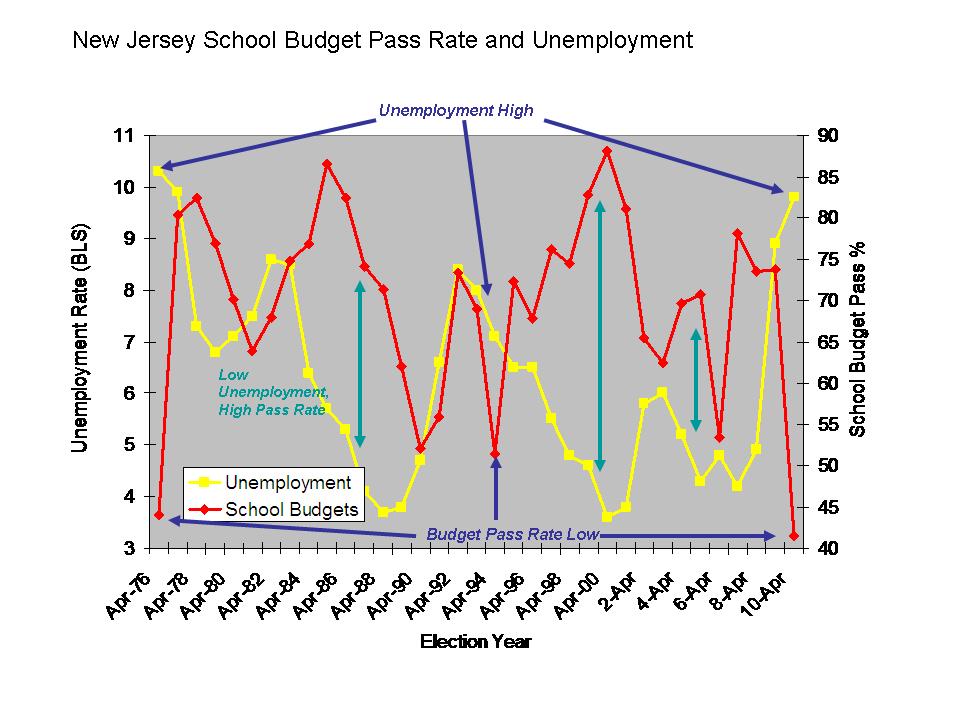
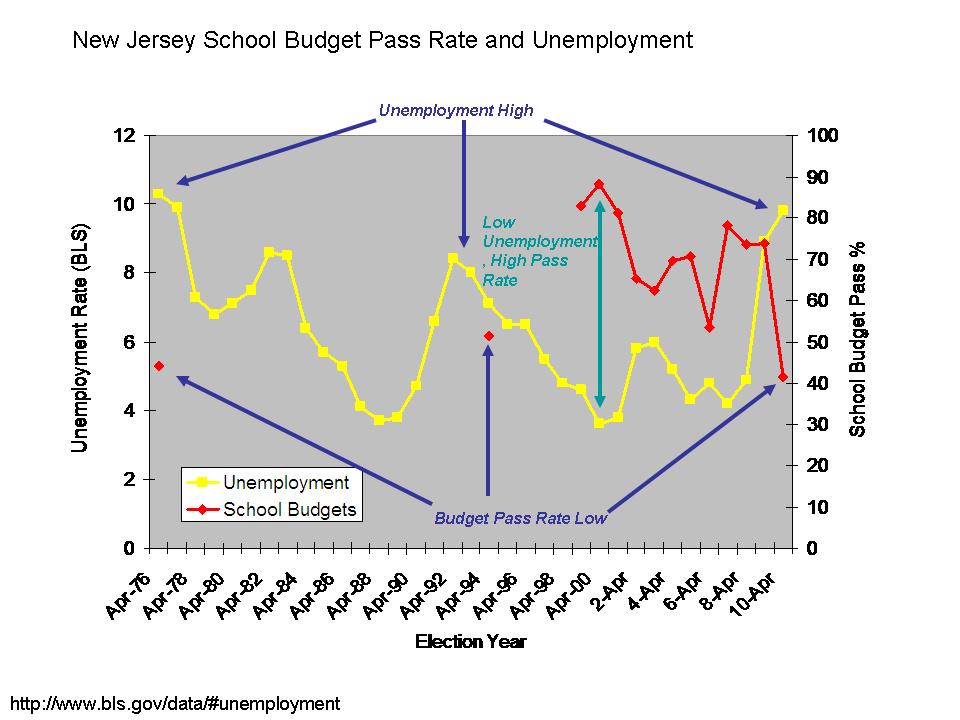
The media seems to be making much of the relatively low pass rate of school district budgets this week – 41%. Being a data geek, my first instinctive question was whether this low pass rate really was out of line with expectations given the current economic conditions. The media has generally described the “expected” pass rate as 75% by saying that 75% of budgets typically pass in a given year. My quick glance at the data suggested that this assumption alone is not necessarily true, and also that pass rates fluctuate quite a bit, and do so in predictable ways.  Here’s a quick look based on the historical data I could easily acquire. First, the trend over time in NJ unemployment and NJ school budget pass rates.


Not surprisingly, using unemployment as a general indicator of economic climate and likely predictor of voter sentiment on tax and budget issues, when unemployment goes up – and especially when it peaks – budget pass rates tend to go down quite a bit. And, when unemployment goes down, budget pass rates get very high.


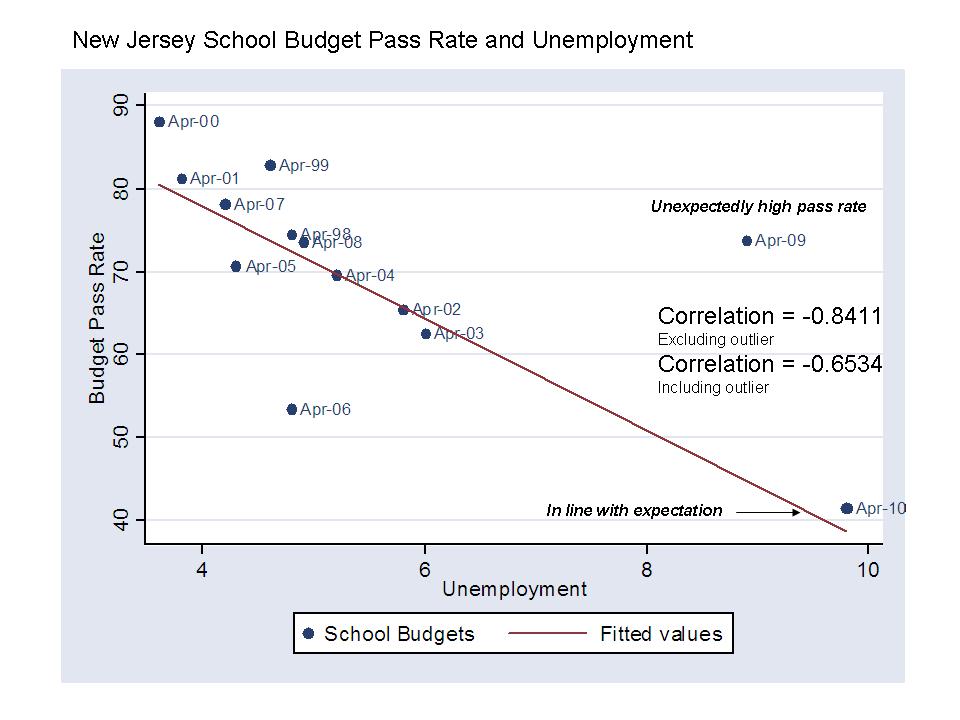
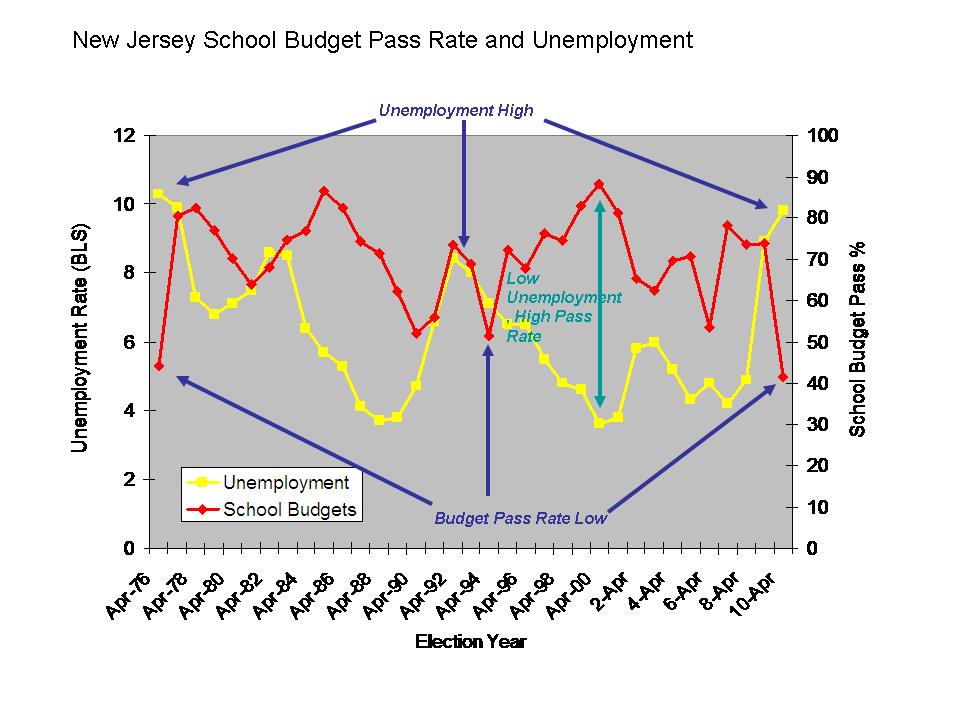
This second graph shows just how strong this relationship is for the past 13 years (post 1998 Abbott reforms):


So, basically, NJ school budget votes seem to fluctuate very much in sync with unemployment over the past decade (as a broad economic indicator). This relationship does erode somewhat during periods in the early 1990s and certain time periods in the 1980s.

In most cases, the outlier years can likely be traced to significant changes to the distribution of state aid to schools. For example. In the early 1990s while unemployment was high, there are a few years where budget pass rates were also high, likely because of the infusion of aid. The 2009 results may, in part, relate to the implementation of the new school finance formula SFRA – which distributed more aid across middle-wealth districts – many of which had great difficulty passing budgets in the past.

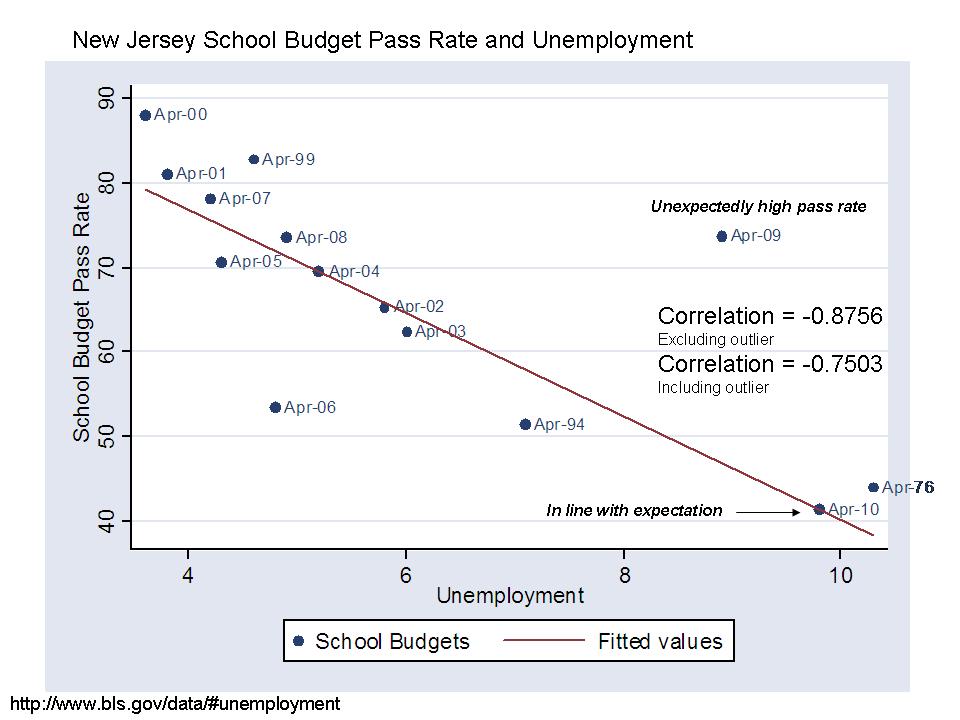
In 2009, budgets passed at a very high rate – out of line with expectations. Unemployment was already climbing but most budgets still passed.  In 2006, budget pass rates were below expectations despite a reasonably good economy. Excluding the 2009 result, the correlation between unemployment and pass rates in the years available was nearly .85 (negative, because when one goes up, the other goes down). Further, the 2010 result falls right near the trendline. That is, the 2010 result is entirely expected given the current economic climate – regardless of political rhetoric.

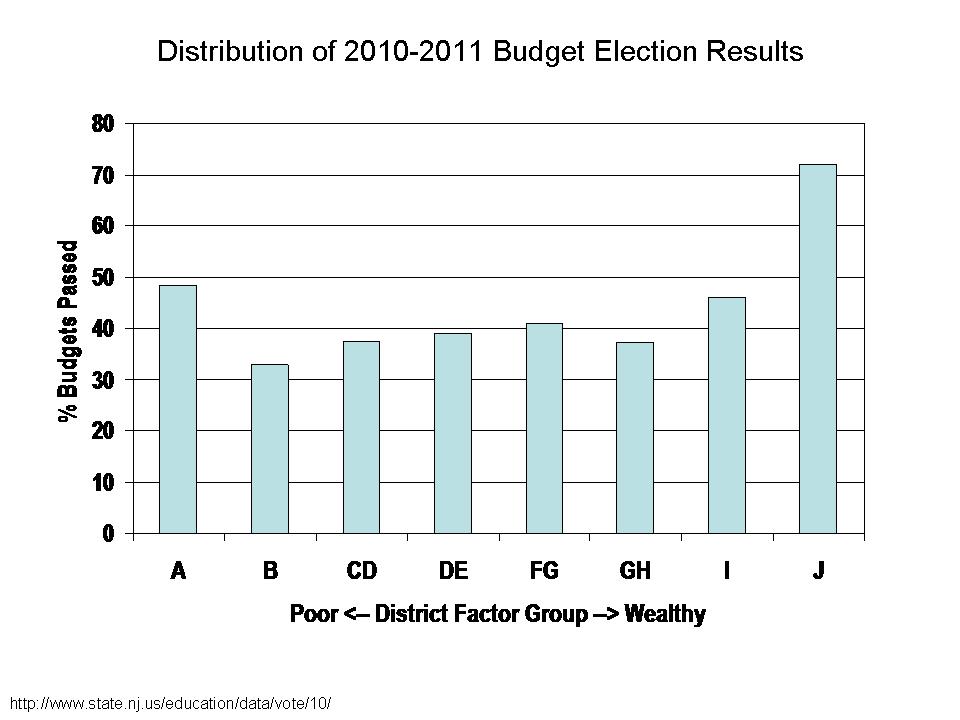
This final graph addresses a separate issue and one that is common in school budget referenda – school budgets are simply more likely to pass in more affluent communities where residents have the additional resources to spend. School budgets may also be more likely to pass in communities where the state picks up a larger share of total school costs, reducing the burden on local property taxes. In New Jersey, this results in a “squeeze on the middle.” I’ve made this graph using NJ’s District Factor Group classification system which roughly rates districts based on wealth/income factors also correlated with education levels, etc. DFG A tend to be poor, urban (smaller and larger city) districts and DFG J tend to be very affluent, generally small, suburban districts. The chart shows that pass rates were by far the highest in the most affluent districts in the state, and somewhat higher than average in the poorest districts. As, expected, the middle got squeezed.

Nice follow-up by NJ.com: http://www.nj.com/news/index.ssf/2010/04/shooting_down_school_budgets_nj.html

Cartel Recap

This is an old post which I have moved forward in time on my blog because of the national release of this absurd film.

For series of posts on this topic, see: https://schoolfinance101.wordpress.com/category/the-cartel-movie-schlockumentary/

Okay… so a few people meandering through my posts over time have sought some synthesis of my gripes about Bob Bowdon’s Cartel Movie. First of all, here’s a link to a pretty good review of the film which I just found yesterday: http://www.nj.com/entertainment/tv/index.ssf/2009/10/the_cartel_movie_review_docume.html

  • The divisive, emotional and complicated debate now raging over powerful public teachers unions and “school choice” — a catchphrase that encompasses support for vouchers, charter schools and a variety of other reforms — could use a comprehensive sorting-out by a diligent observer. Bob Bowdon’s smarmy diatribe isn’t it.
  • In taking to task the sorry state of our public schools, former New Jersey TV personality Bob Bowdon employs the three R’s of bad filmmaking: righteousness, revilement and redundancy.

And these glowing reviews accept as a given, Bowdon’s “statistical” argument validating the crisis of schooling in New Jersey.

Here’s my own synopsis of the arguments behind the film – the Crisis that necessitates the Solution.

The Crisis (Bowdon’s Crisis)

There’s a crisis in education in America and more specifically in New Jersey. Quite simply, every country in the world is handing us a beating as a nation and as a state, despite the massive amount of money we are throwing down the rat-hole of our public education system.

Bowdon’s evidence of a crisis:

Bowdon complains of our lagging national performance by making comparisons of international assessments such as PISA to other countries (critique of the relevance of PISA here). Here, Bowdon twists the argument to specifically blame states like New Jersey, which are not only a part of this substandard American education system, but are emblematic of it, by spending obscene amounts of money for these failures. Okay… so here’s the basic logic:

  • Our national average test scores are bad compared to other countries
  • New Jersey spends a lot on schools, and is part of this terrible national system
  • Therefore, spending is bad, our schools are terrible nationally, and New Jersey is even worse

But, as I discuss here: https://schoolfinance101.wordpress.com/2009/06/17/vacuous_bowdon/

New Jersey actually performs very well even on international comparisons, in a legitimate, rigorous statistical analysis by the American Institutes for Research (http://www.air.org/files/International_Benchmarks1.pdf) And, our national average is only as low as it is because of our many very low spending states that have chosen to throw their public education systems under the bus. Can’t blame New Jersey’s high spending for Louisiana and Mississippi’s low performance Bob. (some useful comparisons on this more recent post: https://schoolfinance101.wordpress.com/2010/02/23/common-standards-and-the-capacity-to-achieve-them/)

In an effort to further the argument that New Jersey schools in particular are an abomination, Bowdon points out how New Jersey is by a long shot (okay, I’m exaggerating his point here), first in the nation (if not the world) in spending on schools. Yet, if you correct NJ graduation rates to count only those kids who pass the NJ state tests, we’re only 24th on graduation rate. Yep, mediocre at best for all that money. Down the rat-hole. Clearly, the kids who graduate high school in all those other states, like Tennessee for example, must be able to pass the NJ state tests. Oh wait, they don’t take the NJ tests, do they? Another really dumb comparison Bob (a comparison originally generated by E3, but in the context of a broader critique of graduation rates).

This new report (as well as an older version) shows that the NJ tests aren’t really the least rigorous tests out there: http://nces.ed.gov/nationsreportcard/pubs/studies/2010456.asp. Not great. But not the worst either. Yes, if we’re going to have tests, we should expect kids to pass them. No excuses there. But the graduation rate comparison is still completely bogus. I address this topic in greater detail here: https://schoolfinance101.wordpress.com/2009/10/16/more-cartel-garbage-bowdon-still-an-idiot/. Oh, and by the way, as I point out in that same post, NJ is in good company on per pupil spending, rarely actually topping the list.

The icing on the cake is the analysis Bowdon originally presented as part of his “Facts and Figures” to support his “crisis” case . This still stands as the absolute dumbest analysis I have seen or read pretty much anywhere in my years working in education policy research (okay, this one comes close: https://schoolfinance101.wordpress.com/2009/05/13/should-think-tanks-be-licenced-to-think-and-when-should-a-license-be-revoked/) . Here, Bob Bowdon explains his brilliant revelation that states which spend more on their schools have lower SAT scores – so spending more lowers SAT scores… or at least those states that do spend more simply waste it so badly that SAT scores go down… for some reason. I tackle this outright stupidity in my first post on the topic: https://schoolfinance101.wordpress.com/2009/05/30/idiot-of-week-award-the-cartel-check-this-out/ (While Bowdon has removed much of this completely ridiculous content from the movie site, the logic of his current site content remains the same, and these absurd comments/arguments represent the level of Bowdon’s thinking at the time the movie was initially released. I saved copies of the original SAT graphs. They make great teaching examples of deeply flawed reasoning!)

The solution to the crisis that may not exist:

Okay, so if Bowdon can’t concoct his crisis, there’s really no need for a solution to it. You know, it might not actually be that hard to do a reasonable run through some real numbers to point out some serious problems, inequities and inadequacies in our education system as a nation and in New Jersey schools. They are certainly far from perfect. But, Bowdon can’t seem to string together even one set of legitimate, well argued facts to make such a case. So, I could stop here. By Bowdon’s absurd evidence, no crisis actually exists, therefore, no need for solution. But of course, Bob has one:

The only possible two solutions – Charter schools and Vouchers to private schools – with emphasis on the former. Everyone knows that money doesn’t solve education problems, Charters and Vouchers do (only if they’re well funded, though). Now, let me qualify here that I am a fan of charter schools having been a founding member of the special interest group on charter school research of the American Education Research Association and having written research articles which find favorable results for charter schools regarding academic quality of teachers (http://epx.sagepub.com/cgi/content/abstract/20/5/752) . I’m also a fan of private schools, having taught in one of NYC’s most elite independent day schools and having written on private school finances (http://www.epicpolicy.org/files/PB-Baker-PvtFinance.pdf) . But sadly, my actual knowledge of Charters and Private schools makes it harder, not easier to accept Bowdon’s poorly conceived arguments.

On Charters: Bowdon points to a few specific charter schools that are doing very well compared to other schools. Great. Some schools do better than others. I’m good with that. But, Bowdon seems to argue that because these few schools are good, all charters are good – certainly better than any traditional public school. Therefore, it is an outrage that the state of NJ won’t simply throw the doors wide open to more charters to accommodate the tear filled rooms of parents awaiting their chance at the opportunity to send their kids to one of the many outstanding charter schools. Here’s the glitch in this logic. I explain here (link below) that the average performance of Charter schools is statistically no different from the average performance of poor traditional public schools in NJ. Yes, some are better and many, many are much worse. The chances that a student in a charter is not in a low performing school are only marginally (very marginally) better than for students in the poorest (comparably poor) traditional public schools. While some charter school research shows strong positive results, the balance of that research shows a break-even, on average (see my post: https://schoolfinance101.wordpress.com/2009/10/20/a-few-quick-nj-charter-school-facts-figures/) and NJ charters are no different.

For updated and more extensive analysis of NJ charter schools, see: https://schoolfinance101.wordpress.com/category/new-jersey-charter-schools/

Convincing inner city families that Charter schools will save their children simply because they are charter schools and therefore they must be better than traditional public schools is disingenuous at best. I have no problem whatsoever arguing that parents should have the option to choose a “better” school and should be provided reasonable information to aid them in choosing a legitimately better option for their children. Information is the ultimate equalizer here. Contributing to and/or concocting misinformation – creating a “market for lemons” by distorting information – when the stakes are this high – merely to advance a political agenda and build reputation as a supposed “documentary” film producer is morally repugnant.

Finally, on the private school voucher side of the argument: Like I said, I’m a big fan of private schools and I’ve seen what money can buy in the best of private schools. By the way, I report here on the actual per pupil spending of private schools by the affiliation of those schools (https://schoolfinance101.wordpress.com/2009/08/18/private-school-spending/). When it comes to private schools, like Charter schools or traditional public schools, you get what you pay for, and the average per pupil spending (not tuition, but actual spending) in private independent day schools in New Jersey hovered around $25,000 to over $30,000 in 2007. Urban Catholic school per pupil spending is on par with Charter spending, and only conservative religious schools spend much less. Note that Catholic schools, like Charter schools are struggling these days to operate at such low expense (around $12k per pupil). Providing vouchers at levels similar to charter funding would ensure that the only choices available to parents would be financially struggling Catholic schools or conservative religious schools. There would be no religious neutrality in the options available. Private independent schools would remain well out of reach. Double the voucher level and you might get somewhere, but demand for slots would likely far outpace supply (see for a fun paper on price elasticity and private school attendance: http://www.nber.org/~dynarski/w15461.pdf). Under-subsidized vouchers are a cruel hoax, like distorting information on the true variance in charter school quality.

There are other potential forms of choice here, which are noticeably absent in Bowdon’s arguments (unless I’m missing something). Hey, look at my graph of school performance by DFG in my charter school post:  https://schoolfinance101.com/wp-content/uploads/2009/11/updated-charter-rel-performance.jpg Wouldn’t it be nice to provide open enrollment choice options for kids from the urban core to attend the high performing affluent suburban schools? Why should we only let them choose from the relatively average, under-resourced charter or religious private schools? Seems a little unfair, don’t you think? Seems a little disingenuous to argue that choice will solve our problems as long as we only let the poor minority children in the urban core attend start-up charter schools in church basements and other makeshift rental properties (since the slots in the elite, high performing charters are taken) and low tuition, low spending exclusively religious private schools. You wouldn’t want to include all of those higher performing traditional public schools a few NJ transit stops away.

Summary

So, here it is in a nutshell:

  1. Even if there is a crisis, Bowdon provides no legitimate evidence of one, and in fact, provides laughable claims that make it hard to take him seriously at all;
  2. Since there is no validated crisis, there is no need for a solution, but Bowdon offers one anyway;
  • Instead of attending NJ’s dreadful traditional public schools, students should flock to NJ’s outstanding charter schools, which, it turns out, have average performance the same as the poorest NJ traditional public schools, or
  • NJ children should be provided vouchers at levels that will allow them only to select from cash strapped urban religious private schools.

Seems reasonable enough. Ill-conceived? Intellectually vacuous? Schlockumentary? I must stop myself.

As a professor of school finance who lives every day immersed in national and state databases on school funding and student outcomes and who has advised many national organizations on the development of indicator systems for comparing schools/districts and states, Bowdon’s presentation of “shocking statistics” is quite honestly the most offensive, absurd and amateur presentation I have ever witnessed – regardless of political angle.

Cheers.

Teacher Salaries in NJ and NY Counties

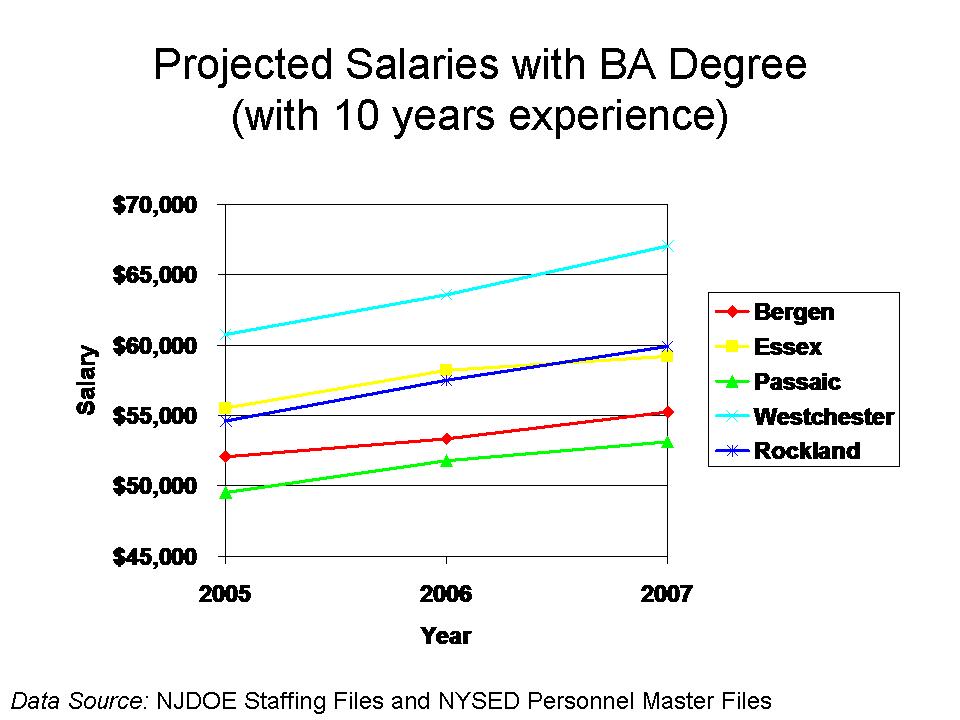
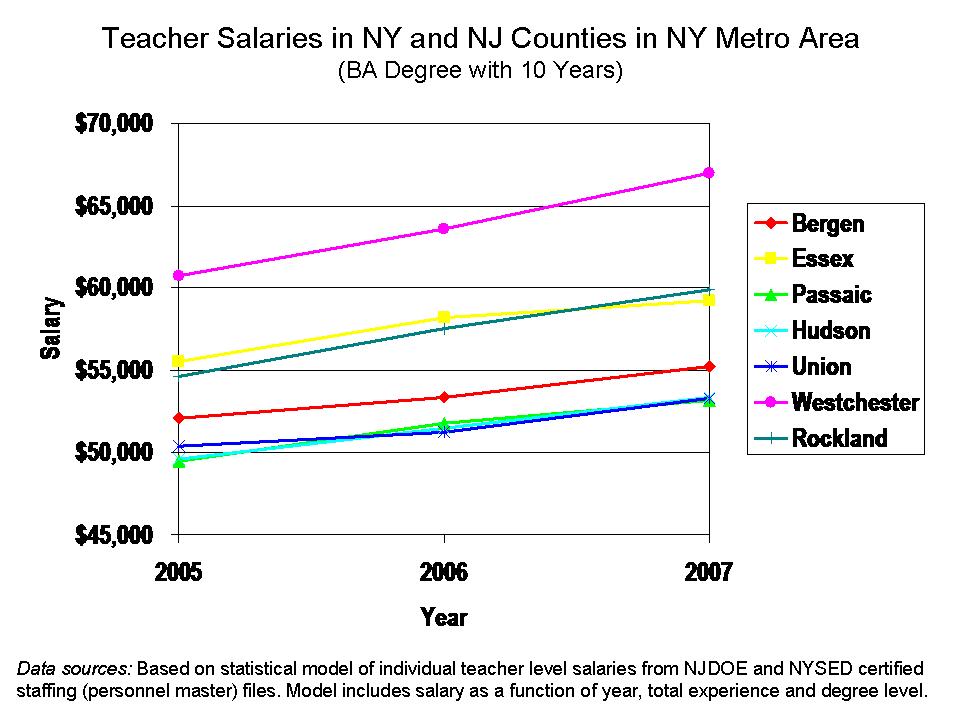
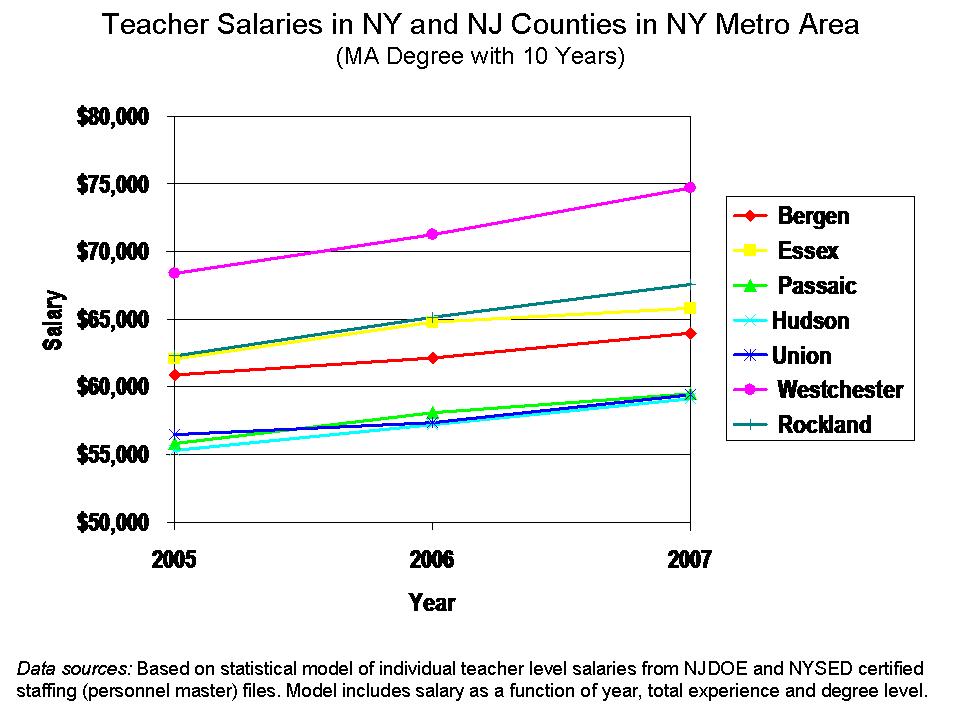
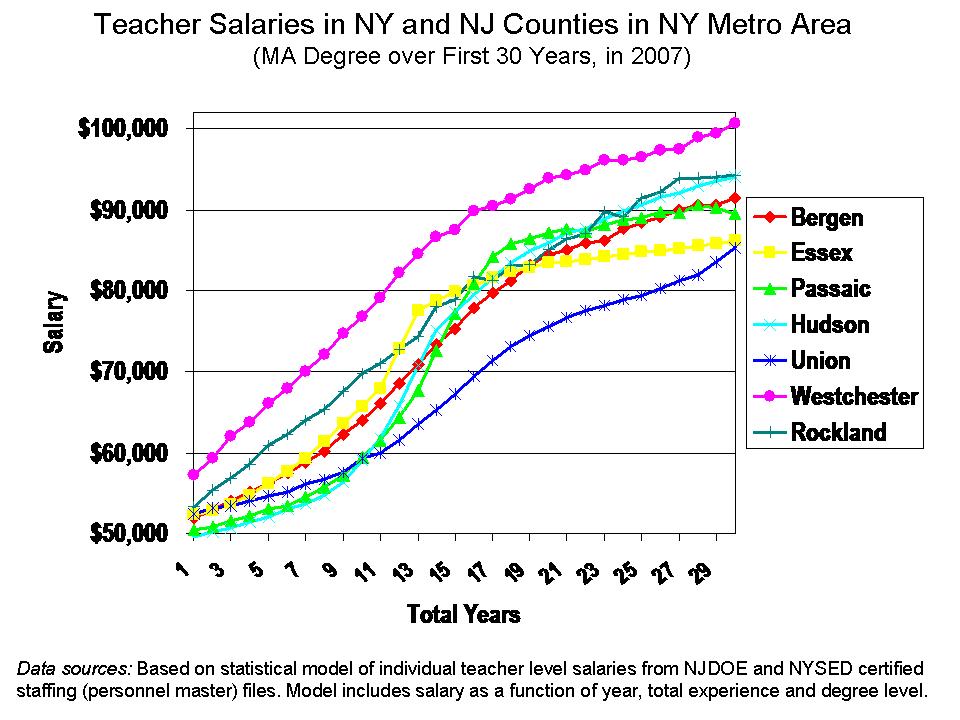
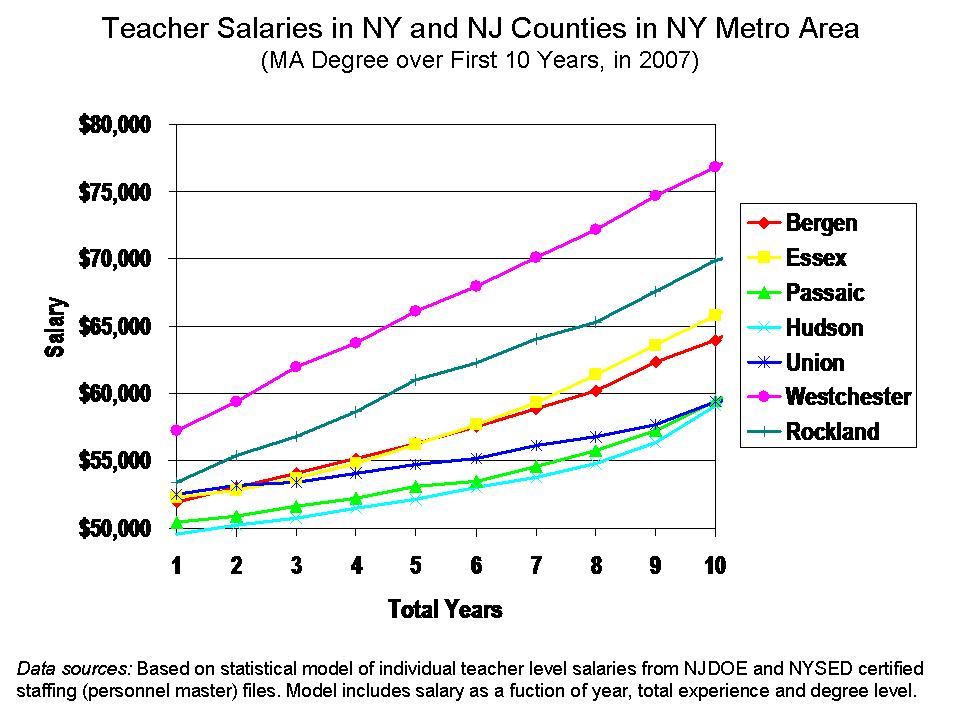
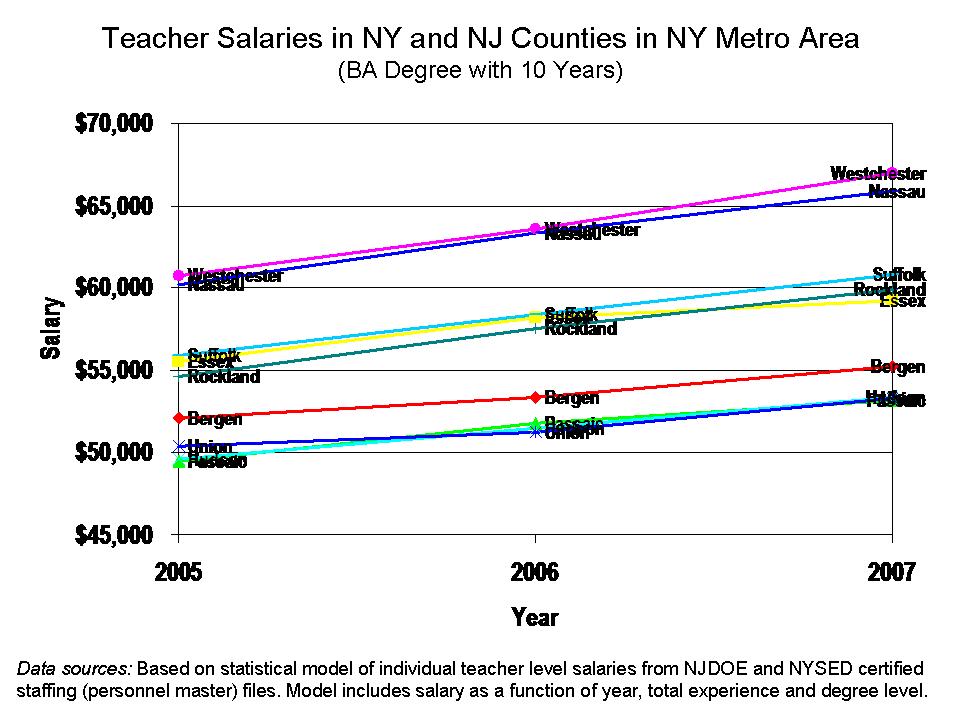
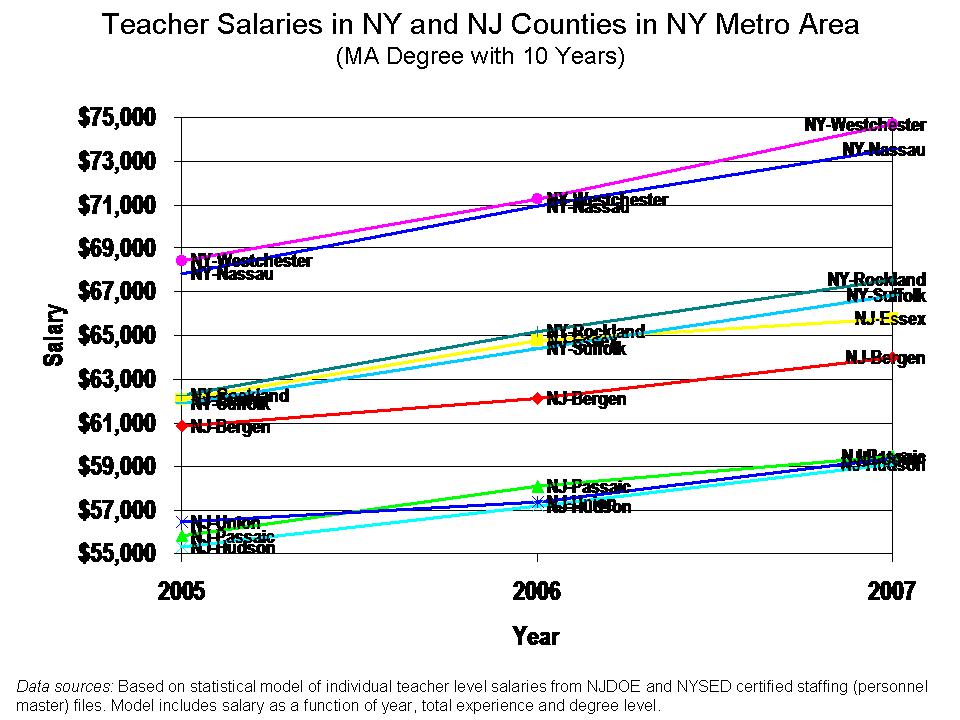
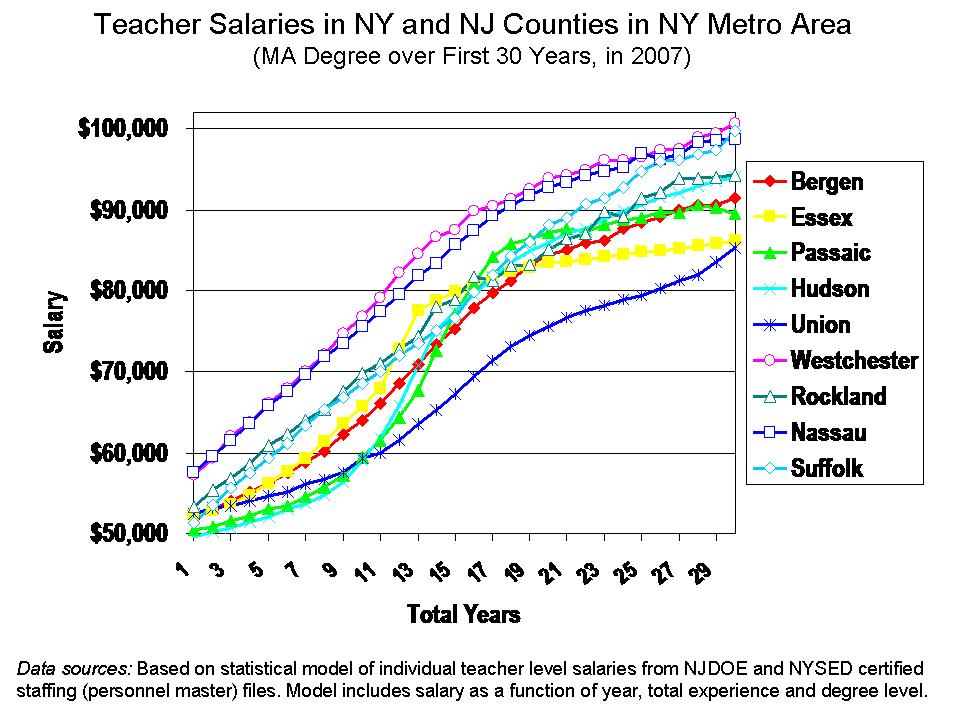
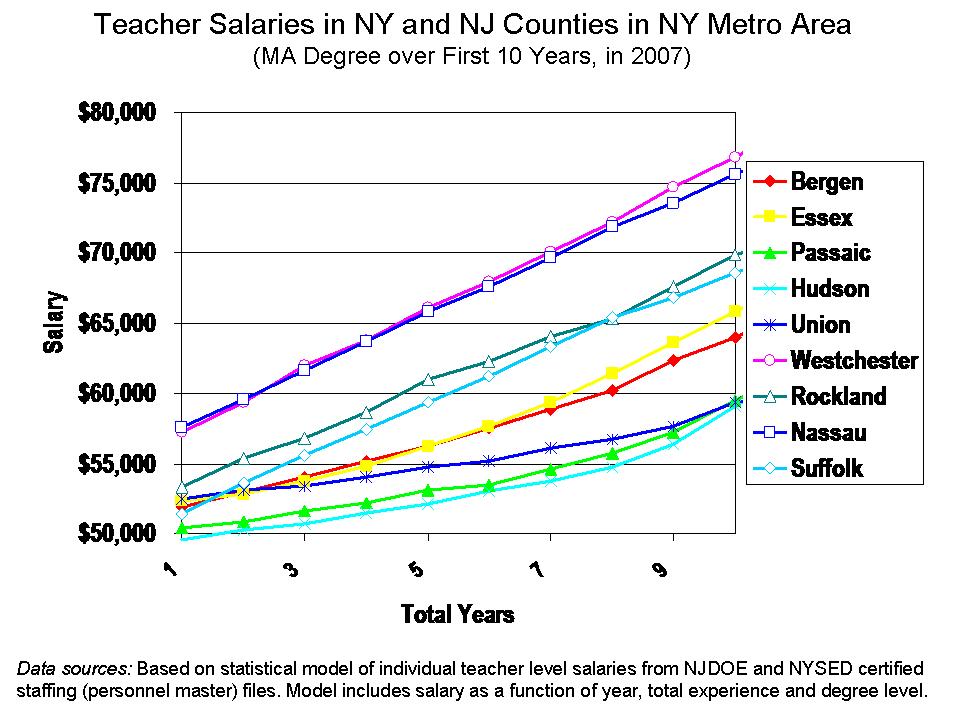
Here’s some more statistical fuel for the fire on the question of whether New Jersey teacher salaries are “spiraling out of control.” Here are comparisons of projected New Jersey and New York teacher salaries based on statistical models of the actual teacher level salary data for individual teachers in these counties in Northern New Jersey and Southern New York State.

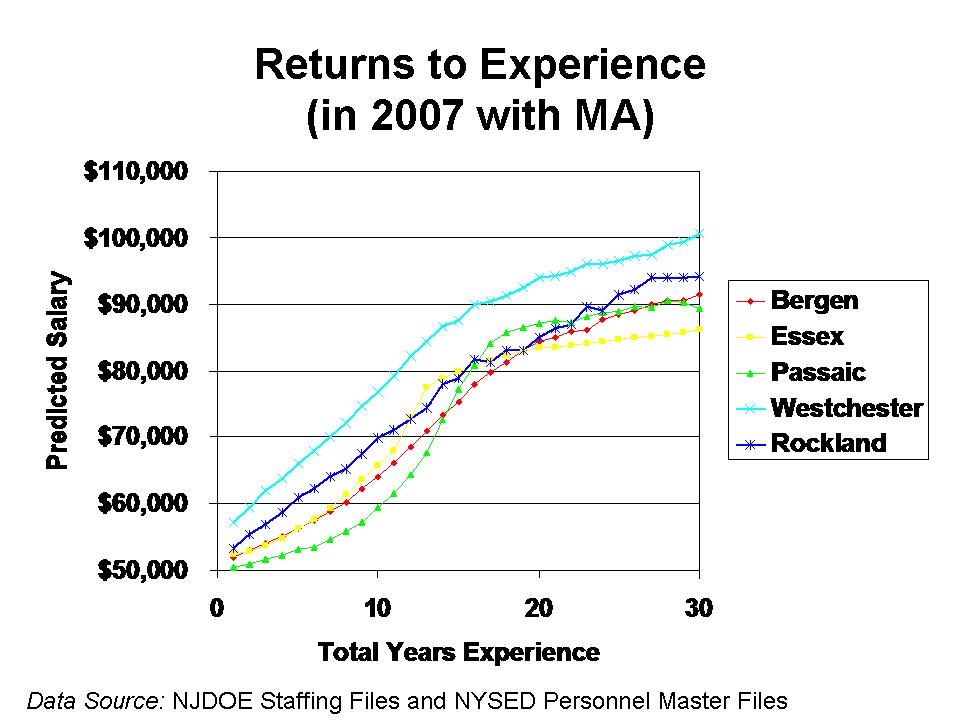
Fitting a statistical model of salaries to teacher experience, year, and degree level allows me to project salaries of comparable teachers in the same year and to project the average annual salary growth. I am then also able to hold year and degree level constant and map the changes in salary that are associated with changes in experience levels.

Here it is:

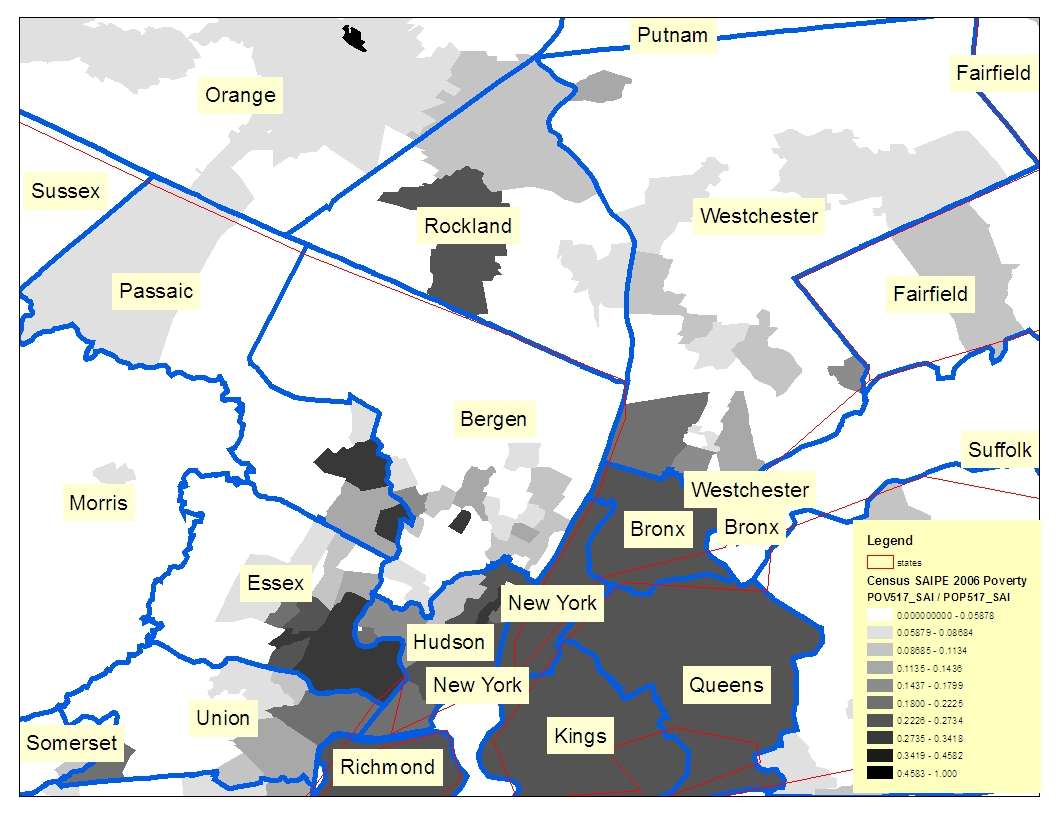
First, here is the location of the counties in question – with background shading of poverty rates. Each county includes some very affluent areas, but also some higher poverty school districts.

The first graph shows that Westchester County, NY teacher salaries are well above those of nearby New Jersey counties, and on average, Westchester salaries have increased more in recent years. Rockland County, NY salaries for teachers with a BA surpass the highest of the New Jersey counties in the figure by 2007, because Rockland salaries are also growing faster than NJ county salaries. Bergen County teachers, immediately adjacent to Rockland and closest to Westchester, fall well below those counties and have grown, on average, more slowly.

New Jersey school districts place less premium on holding advanced degrees. The second figure shows that the gap between NY teachers and NJ teachers is actually slightly larger for teachers who hold a masters degree. Here, both southern NY state counties are higher and growing faster than all three northeastern NJ counties.

The next two graphs map out the returns to years of experience for the NJ and NY counties. Only in one zone of experience (around 20 years) do teacher salaries in NY counties surpass those of the average similar teacher with a BA in Rockland County, NY. On the front end and back end, Rockland teachers beat out all three NJ counties in the graph. Westchester teachers far surpass all others in the graph. One issue of concern that I see here is that New Jersey teachers during the early-mid career stage seem to fall well behind. New Jersey salary schedules tend to sag during this period (5 to 10 years), but NY salaries continue with relatively linear growth. NJ salaries then bump up quickly around step 13 to 15 in many districts. I’m not convinced that this makes sense in terms of recruiting and retaining the best possible teachers.

Again, because the masters bump is smaller in NJ, when one maps the returns to experience for a teacher with an MA in these counties, NJ teachers fall further behind.

RECAP: So, lets recap this new information with my various previous posts on the question of the supposed exorbitant growth of New Jersey teacher salaries –

1) Over a nearly 20 year period, New Jersey teacher salaries relative to New Jersey non-teacher salaries of workers at the same age and degree level and based on an hourly wage comparison, have fallen further and  further behind over time. Teacher salaries sit at about 80% (for MA or BA) of non-teacher salaries in NJ, in same labor market at same age. Further, related research from Corcoran and Mishel suggests that it is highly unlikely that the total difference between teacher and non-teacher benefits closes much if any of this gap.

…overall K-12 teacher compensation was 27.5% greater than teacher wages alone, while overall professional compensation was 23.5% greater than professional wages. These differences in benefit shares translate into a benefits “bias”of 2.8 percentage points in 2006.

2) The total cost of certified elementary and secondary education employees as a share of the total state expenditure (current), has declined over a 10 year period from 1997 through 2007.  That is, certified teachers and administrators in elementary and secondary public schools in New Jersey have not, by way of salary increases, posed an increased burden on the state budget. Not at least as far as my most reasonable estimates would suggest.

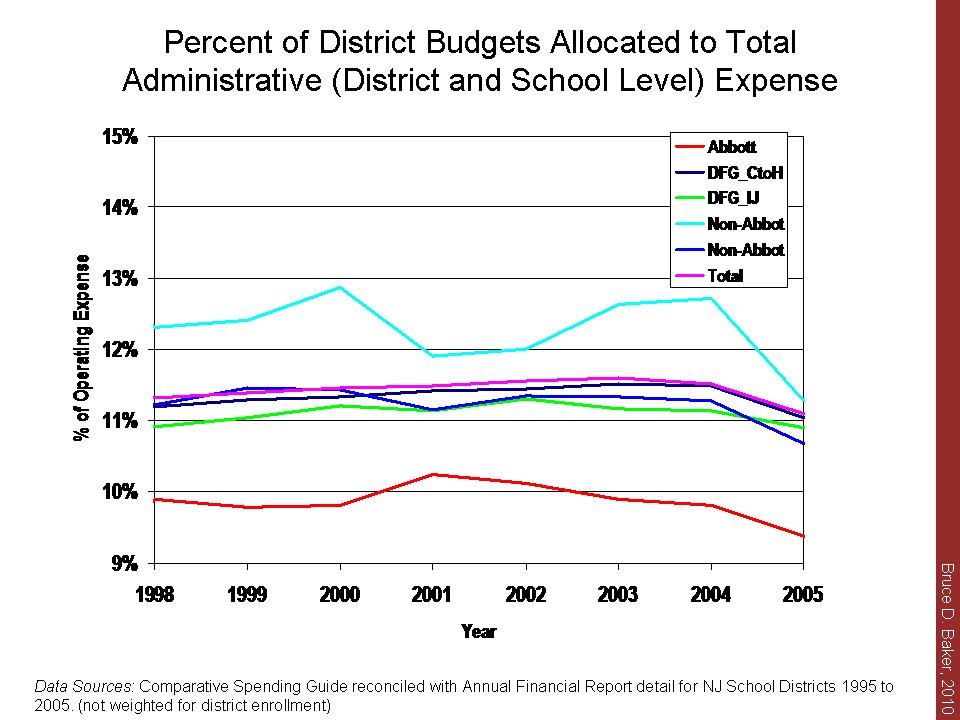
3) In addition, analyses of financial statements as well as analyses of personnel data indicate that administrative shares have remained remarkably stable over time and are by no means disproportionately higher in New Jersey’s large, urban and Abbott districts.

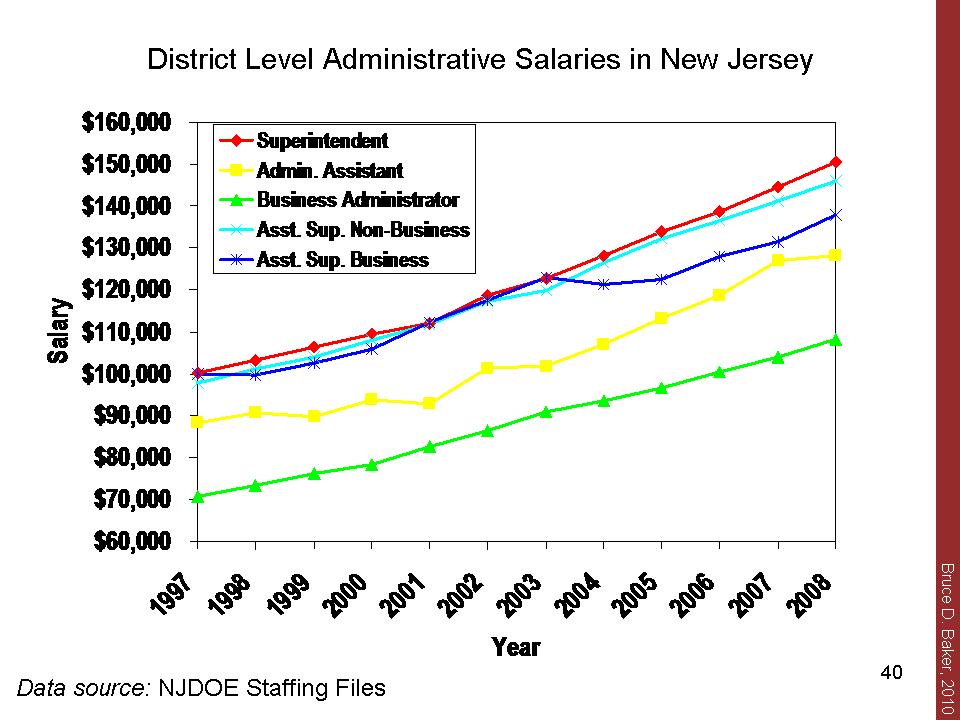
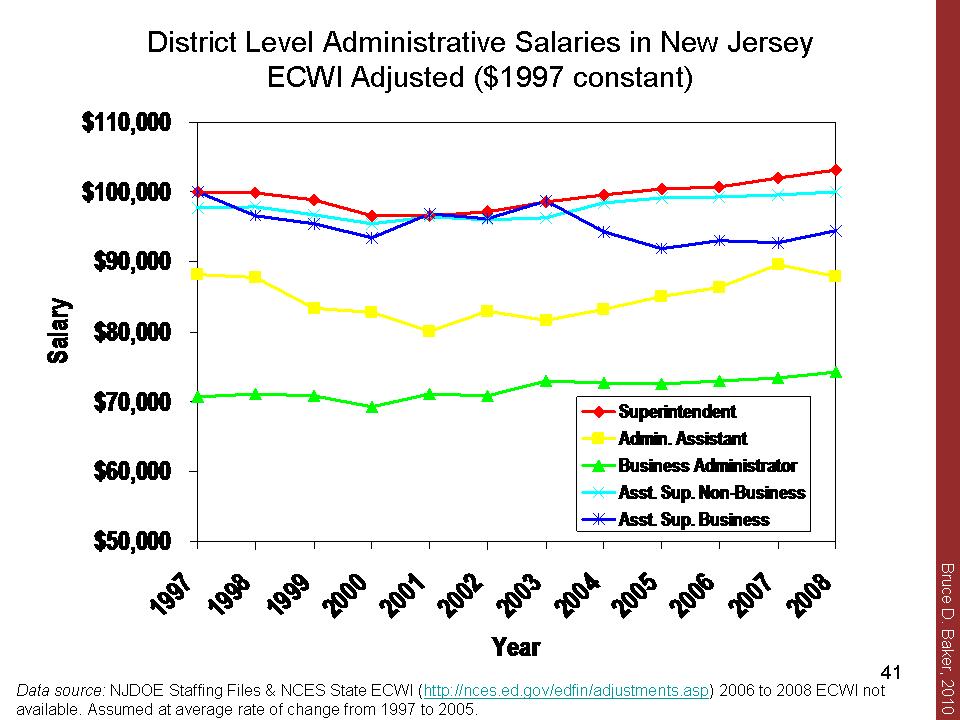
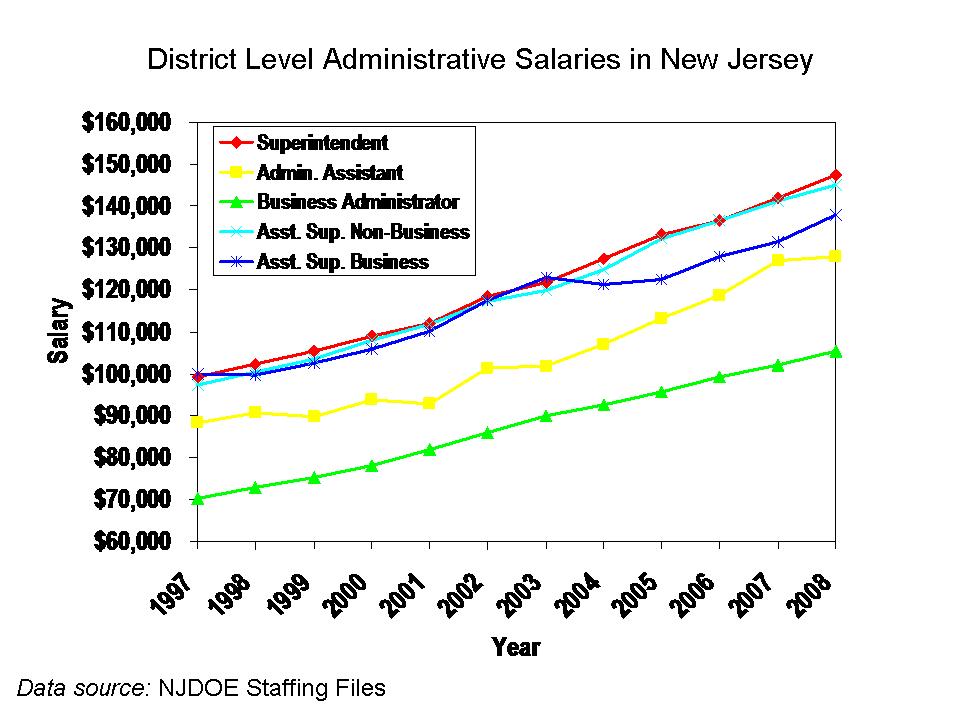
Given these findings, I would have a difficult time arguing that the New Jersey “tax burden,” which is also not highest in the nation is caused by either or both New Jersey teacher and bloated administrative salaries growing out of control.  I would also have a hard time making the argument to teachers that their evil, greedy administrators have been hoarding the goods to the disadvantage of the teachers. I wrote very early on about school administrator compensation.

============

A FEW ADDITIONAL NJ COUNTIES ADDED

===============

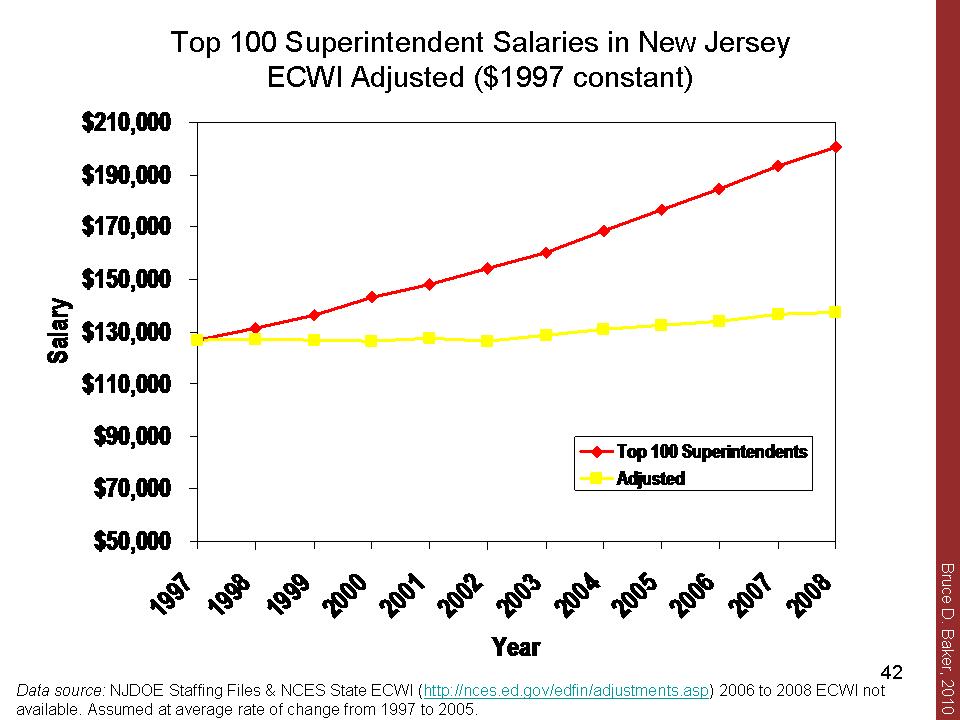
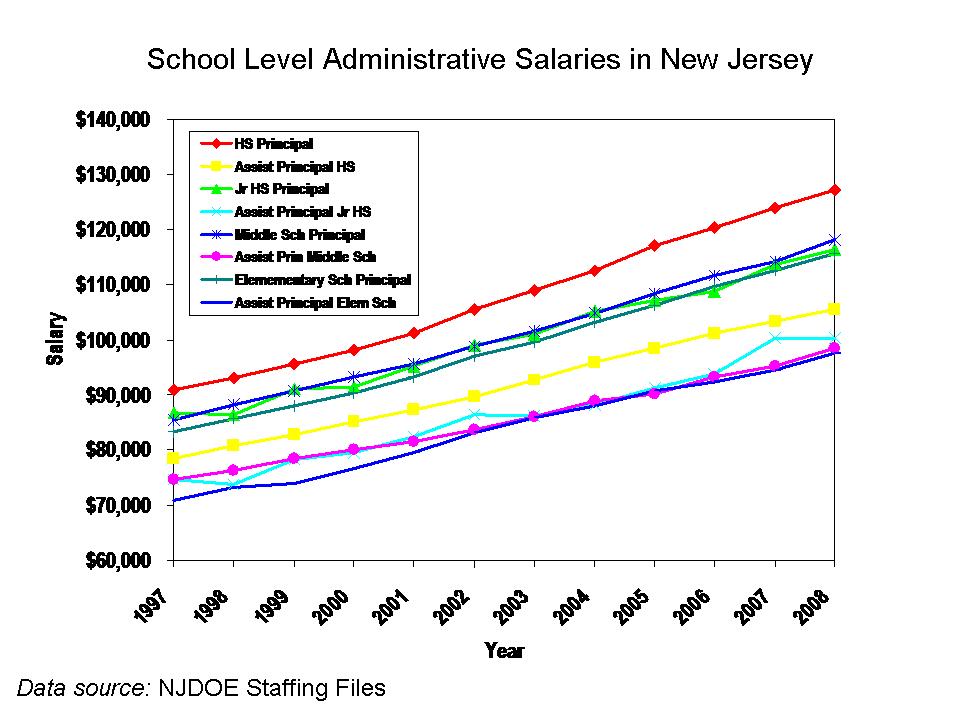
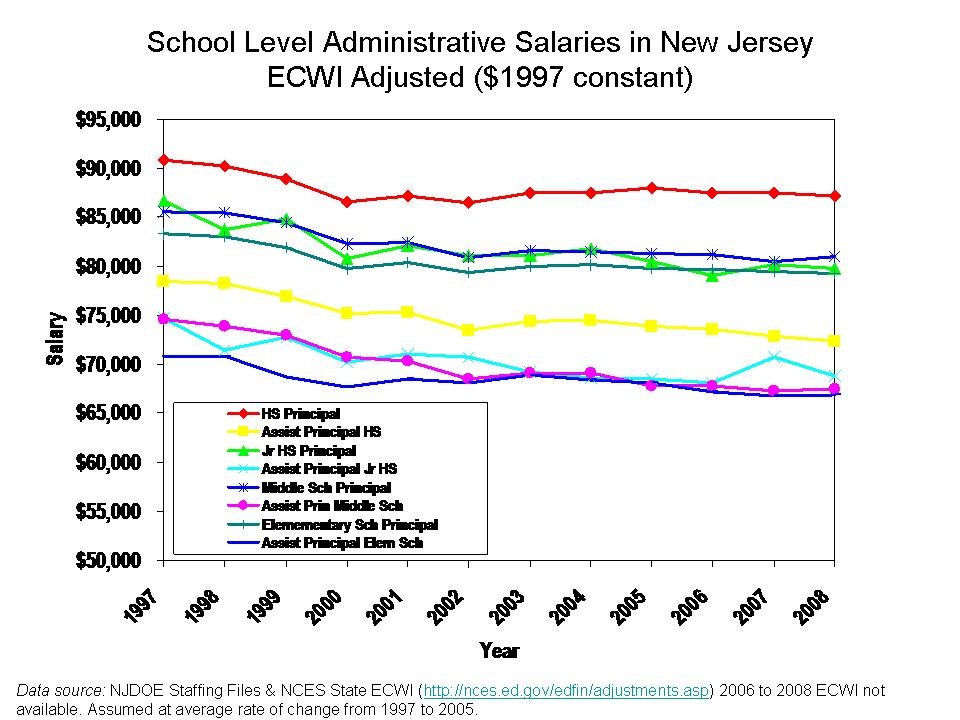
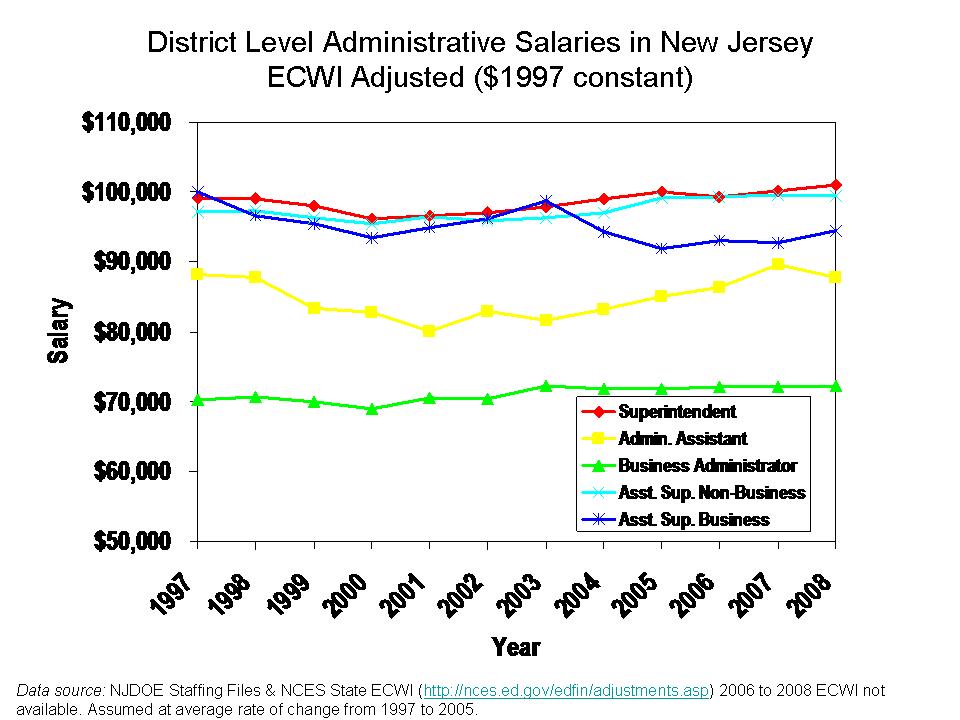
AND HERE ARE SOME GRAPHS OF NJ ADMINISTRATOR SALARIES OVER TIME. FIRST, WITH NO ADJUSTMENT FOR INFLATION AND SECOND, USING THE INFLATIONARY ADJUSTMENT FOR WAGES FROM THE NATIONAL CENTER FOR EDUCATION STATISTICS.


Here’s a more extreme portrayal:


=========

MORE COUNTIES ADDED TO TEACHER COMPARISONS


Would $8,000 Scholarships help Sustain NJ Private Schools?

Note: This was written prior to the announcement that the scholarship amounts would be $6000 for elementary and $9000 for secondary schools. The same logic and findings apply, though to an even greater extreme in light of these numbers.

Part of the argument being made for providing $8,000 scholarships for students to attend private schools in New Jersey is that those scholarships would help financially sustain struggling New Jersey private schools. I published an extensive report on private school costs last summer, here: http://epicpolicy.org/publication/private-schooling-US

In this report, one issue I address is the fiscal problems of urban Catholic schools which have struggled to survive on shoestring budgets. The reality is that most operate with a very large differential between tuition charged and actual operating costs. In 2007-08, average tuition charged by Catholic Parochial and Catholic Diocesan schools in New Jersey was about $4,000 and $5,000 respectively at the elementary level, and about $9,000 at the secondary level (based on the very limited sample in the Schools and Staffing Survey of 2007-08, National Center for Education Statistics). Private non-religious school tuition was about $11,000 at the elementary level and $18,000 at the secondary level. the weighted average tuition across all school types for New Jersey private schools was $10,206. So, even keeping this figure in mind… if tuition held constant from 2007-08 to 2010-11, the $8,000 scholarship would fall $2,000 short of average tuition… not even average cost.  Clearly, private schools on average would be taking a loss to accept these scholarships, unless only the lowest spending private schools accepted the scholarships or unless the scholarships were to stimulate massive additional philanthropy outside of the tax credit program.

But again, these above tuition estimates are based on relatively small numbers of schools and the schools from these national surveys cannot be listed individually because of confidentiality issues.

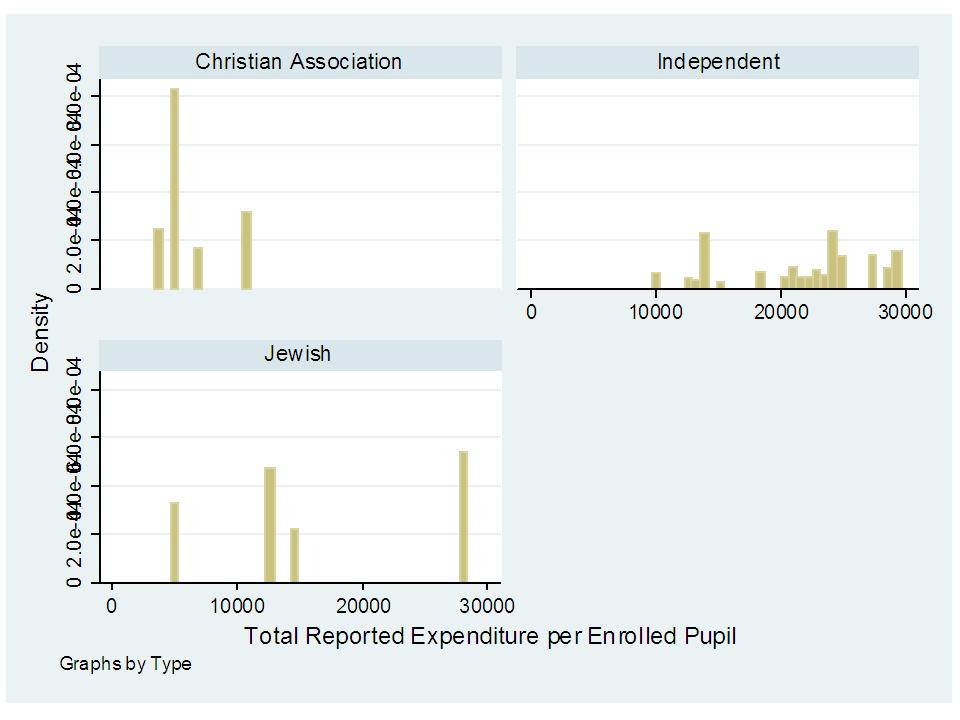
Most importantly those tuition figures don’t represent actual total costs of operating and maintaining these schools. All rely on some form of philanthropy and/or church subsidy to cover full costs. Below is a summary graph of IRS Tax Filing data on New Jersey private schools (2007 tax year).  Schools that most consistently report their financial data (by obligation) are those which are not officially religiously affiliated (specific church), but some religious schools do. The graph below includes  Total Expenditures per enrolled pupil, where Total Expenditures are from the IRS 990 (and include all expenditures including those for capital in the given tax year and other contracted services) and enrollment data are from the National Center for Education Statistics Private School Universe Survey.

Notably absent in the graph below, but included in the tuition averages above are Catholic schools, which represent approximately 67% (seems to vary by year of data) of students in private schools in New Jersey.

Most schools represented by the averages below would need to take a substantial loss for each child accepted on the $8,000 scholarship (in 2007).  There are no doubt interesting quirks (large capital expenditures for some?) and omissions (suspiciously low expenditures for others) in these individual school reported data, but they are illustrative nonetheless. Boarding schools are excluded.

An important feature here is that the only schools that would not operate at a loss on the proposed voucher level are religious schools. That is, we should expect that at this voucher level, the vast majority if not all students using the voucher would have to use it at private religious schools unless private non-religious schools were able to find substantial additional resources to offset large per pupil losses (cost – voucher differences).

In general, an $8,000 voucher would likely do little to help sustain fiscally stressed private schools in New Jersey because the voucher does not cover operating costs.

Providing these vouchers might (would likely) increase private school enrollment, making certain private schools more accessible to low-income families. And, some students may benefit from this (while others may not). But, such a program will likely do little to cure the fiscal woes of cash strapped private schools. In fact, some have argued specifically in reference to Catholic schools that parishioner philanthropy to the schools may decline as those schools take on more non-Catholic students through vouchers, causing the school’s mission to drift.

In a related recent post, I point out that in general, when it comes to these large differences in spending by private school sector, you get what you pay for: https://schoolfinance101.wordpress.com/2010/02/20/stossel-coulson-misinformation-on-private-vs-public-school-costs/

From previous post:

  • Private independent day schools which provide small class sizes with highly academically qualified teachers spend well above nearby public schools.
  • Catholic schools, where they report their finances (not the crude survey summary data of tuition and expense compiled annually by the National Catholic Education Association) spend marginally less than nearby public schools (but charge much lower tuition than cost), perform about the same if given the same kids and have comparably qualified teachers in terms of academic preparation. Note that Catholic schools in trying to operate on a shoestring have been financially failing at an alarming rate. That is how markets work when you try to hard to price your product below the cost of maintaining quality (a more friendly spin being that the social service mission of urban Catholic schools has outpaced church philanthropy). I discuss this extensively in the report.
  • Conservative Christian schools (to the extent they can be lumped together) operate at much less per pupil than traditional public schools and have lower outcomes given the same students and have disturbingly academically weak teaching staff based on national survey data.

Note: According to: http://www.njsendems.com/release.asp?rid=3254

The proposed voucher amount is to be $6,000 (elem) to $9,000 (secondary). The link above claims:

The $6,000 to $9,000 amount is the current average cost per student at non-public schools…

This statement is completely absurd… and quite simply FLAT OUT WRONG! According to what source? Does actual data matter at all here? Wow! Even Cato, which grossly underestimates private school costs estimates the NYC metro average at $10,500 for 2009 (see first section of this post, Cato link).

Mean per Pupil Spending by Private School Type

Distribution of Private School Students in New Jersey

Distribution of per Pupil Expenditures by Private School Type