Blog

We bought it twice but we no longer own it: The bad public policy behind charter school real estate deals

I’ve been spending much of my spring and summer trying to get a handle on the various business practices of charter schooling, the roles of various constituents, their incentives and interests – financial and otherwise – in the operations of charter schools. Throughout this process, I also try to consider how or whether similar practices and incentives exist for traditional district schools and private schools and how these markets intersect. There will be much more forthcoming on this blog, and in academic papers and reports in the next few months and year.

But one issue really struck me as particularly ludicrous as I spent more and more time drawing pictures and mapping out business relationships. I had avoided for the longest time digging into the weeds of charter school land deals and facilities financing. It’s messy and there are certainly plenty of fun scandalous news reports on the topic. But when I see this kind of stuff, I ask myself – what policies enable – or perhaps even encourage these things? Where’s the boundary between legally permissible and not… and between good policy and bad?

Here, I provide an example of something that’s just bad public policy. I can’t really say… except in one piece of this puzzle (as I’ve laid it out), that there are any truly bad, unethical, or illegal actors in this scenario. But the outcome is still bad… bad… patently… amazingly stupid public policy.

It all started way back…such a long, long time back…Way back in the days when the grass was still green, and the pond was still wet, and the clouds were still clean, and the song of the Swomee-Swans rang out in space…

Oh wait… wrong story….

Let’s go to the diagrams…

District controlled public school land and facilities are governed by the public that initially financed them. The public that financed these facilities and land acquisition typically did so by adopting in public referendum a promise to use their tax dollars (perhaps with support of state aid) to finance the debt required to buy the land and build the building. The public invested in the asset through debt financing, using low interest general obligation (GO) bonds.

Through annual budget approvals the public approved the maintenance of those facilities and their tax dollars were used to maintain their asset.  The public invested in the maintenance of that asset through annual operating expenses of the district. Perhaps the public even approved additional debt financing along the way for improvements and renovations.

Many of these grand facades of public schooling were financed long enough in our past that we forget that they were financed with the tax dollars of previous generations and have been passed along and their care entrusted to the current generation.

Figure 1. The Initial Purchase & Maintenance

Slide1

In many states, approval of charter schools to operate within district boundaries does not require local board or taxpayer approval. State government entities/appointees or elected bodies may serve as authorizers, and in some states, private entities and boards may authorize charter schools to establish, draw students and with them, public tax dollars for operating revenue/expense to support educational programs/services for those children.

Few states provide substantive support for charter school facilities acquisition and many/most states restrict charter schools (or district schools) from engaging in long term obligation of operating funds to finance debt, to acquire land and buildings. Instead, charter schools engage in lease agreements, typically shorter term, where lease payments are made from operating funds. But hey, who wants to be paying rent/lease year after year, and have nothing to show for it? State policies do typically permit, if not incentivize other organizations (including non-profit entities) to access “revenue bond” markets for urban re-development projects (in particular).

Quick primer on bond stuff:

General obligation bonds like those approved initially by voters for the facility are guaranteed by the full faith and credit of the municipality and taxes to be raised to pay off the debt. It’s pretty much guaranteed (except in the rare case that a town actually folds, entirely, financially, and say… picks up and re-establishes across the river). So, those bonds get pretty high ratings (from rating agencies) and thus low interest rates for paying off the debt.

Revenue bonds have to be guaranteed by the borrower with some revenue source. For third party entities purchasing land and buildings on behalf of charter schools, borrowers guarantee their bonds with the lease payments of the charter schools. Yeah… that’s right… the taxpayer subsidized operating funds for the charter school are used to make lease payments to a third party organization, which uses those lease payments to secure the debt to purchase the land/building. They usually get kind of a crappy interest rate (sometimes around 8.5% compared to, oh… about 4.5% for a similar size/structure GO bond) because the revenue source is less certain/more risky.

No clear, apparent harm/no foul here. Actually, it kind of makes sense for charter operators to collaborate to establish those third party land/facilities acquisition entities on their behalf, arguably a) so as not to get screwed with escalating lease payments down the line and b) to have an ownership stake in the property/asset. Now, some NJ charter operators caught some flack for creating different entities for each transaction and giving them strange names (like Pink Hula hoop), but I’m not sure I can blame them for the engaging in the increasingly common practice involved here.

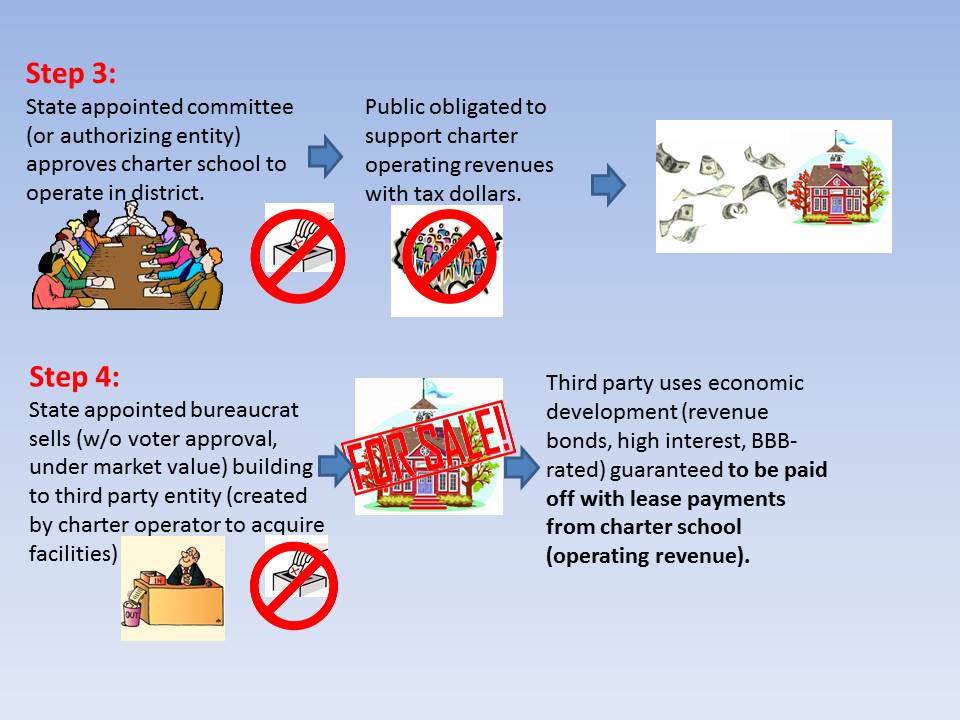
Figure 2 shows the sell-off/property transfer process and this is where, when looking at the bigger picture, it starts to make less sense – from a public policy standpoint. Because charter school growth in cities often means declining district enrollments and facilities use, this potentially frees up under-used district facilities – perhaps even putting some on the auction block. In many cases, these facilities can be sold without local voter approval, even if voters had to approve their original financing. But that’s actually just a tangential concern here.

The really fun piece is that public tax dollars, channeled through the charter school are being used to purchase the facility, for the third party, from the public? Whah??? Whah??? Yeah… I’m buying it from me for someone else?

Huh…. ??

Figure 2. The Sell-off

 Slide2

To recap:

  • Public buys facility with tax dollars
  • Public uses tax dollars to maintain their asset
  • Charter school uses public tax dollars (w/o public approval) to make lease payments to third party so they can buy same facility! (which public currently owns/controls)
    • & pays crappy interest rate in process
  • PUBLIC HAS BOUGHT SAME FACILITY TWICE (second time, from itself), AND NOW NO LONGER OWNS/CONTROLS IT!

That’s just dumb public policy even if, from the position of each of the parties involved, their actions would seem to make complete sense.

District – why should we keep maintaining a facility we don’t need? Can we generate some short term cash flow by selling it?

Charter operator – why should we make lease payments in perpetuity and have nothing to show for it? Why not collaborate to use existing policies to acquire assets?

Again, it’s not that anyone is doing anything ‘wrong’ (except that valuing these properties opens the door to manipulation), but rather, that public policy permits a bad deal for the public – one that essentially gives away a public asset while charging transaction fees along the way.

The major elements of the process differ little whether it occurs through loosely coupled, seemingly benevolent non-profits, or through for-profit charter management firms, their real estate acquisition arms and practice of flipping properties to real estate investment trusts (the major difference being the increased likelihood of rent gouging of the charter school in the latter version).

The absurdity of this relatively common example provides a case for seriously rethinking how we protect public interest and public assets as we move increasingly toward mixed delivery models of schooling – mixed in the sense that any jurisdiction might be served by a portfolio of traditional district schools, district governed or privately governed charter schools, etc.

I would argue that districts governed by public officials really need to be the stewards of these major public assets. This means that it may make more sense for state and local policymakers to craft more logical facilities management strategies which include co-location of charter schools (and the students they serve) – especially under state policies where charter schools are fiscally dependent (where charters receive funding as pass through from districts and where districts maintain responsibility for funding certain services for charter enrolled children). This means carefully evaluating and the appropriate and equitable operating subsidy rate for charter schools, given the children they serve with consideration for the facilities provided.

A secondary reason why maintaining public control over these assets is critically important is that it provides district officials (and the public they serve) the flexibility to change course – to decide, if/when that time comes, that it’s time to reign in charter/choice programs and reclaim a major role for traditional public schooling. Once the public assets are sold off under the model above, they are gone, and costs of rebuilding may be prohibitive. That’s a dangerous path for the future of our cities and children and families that inhabit them.

Yes – I am making a case for rethinking co-location as an option, or more broadly – centralized capital asset management. Co-location is contentious and there are a lot of tricky, politically and technically messy details to work out.

But, it’s a lot better than this alternative!

This needs to stop now!

========================

Addendum:

Fun debates on the sidelines about this topic. For example, how are my examples above any different from any individual person paid with public funding (public employee) buying any previously public asset? Aren’t these examples merely about a private contractor purchasing an asset, any asset, with the proceeds of their appropriately compensated work?

Now, it is conceivable that a charter school and its employees could take an approach that is seemingly more appropriate for private asset acquisition, even using what was originally the public dime (now, I’ve not said there’s anything wrong with what the charter is doing above, except that bad public policy allows it to happen).  A charter school could, instead of making the lease payment as a mere pass-through of public subsidy, simply pay all of its employees higher wages to the sum of that payment and then permit them to individually contribute to a fund either for the direct purchase of the property or indirect purchase via lease payment to the third party. But that would involve individual decisions regarding the use of their compensation. It’s not an institutional decision to simply pass the money through, and it’s seemingly less problematic unless the institution FORCES their employees to contribute that portion of their wages for purchase of the property.

I’ll talk about ways in which charter operators forcibly tax employee wages (for self gain) in a future post!

Now, one other public policy protection here might be to declare any assets acquired by the private contractor with public dollars to be owned by the public. This dispute has occurred elsewhere, as far back as when Education Alternatives, Inc. (1996) gained a management contract with Hartford CT schools and used start up funds to acquire technology.But given that many charter operators reasonably mix expenditure of public and private dollars, parsing who owns what can be exceedingly complex.

Of course, it may be reasonable to expect those charter operators who wish to privately own a facility to finance that facility with appropriately segregated private revenue sources.

Would it make more sense then for the district to sell the asset to some other private entity, like a real estate developer? and let the charter operators fend for themselves to find suitable educational spaces? That would seem a raw deal for both. The public loses the public asset, likely never achieving appropriate compensation for that asset, and the charter likely faces greater costs (extraction from their operating revenue) than could be achieved by thoughtful centralized facilities management.

One final note: A central issue above is that there is value to controlling these public assets which justifies the costs of maintaining them over time. Private entities have no interest in making sure that sufficient assets remain available for the provision of public schooling (regardless of provider type), just as private landlords have no interest in ensuring sufficient availability of affordable housing.  For cities to be able to provide sufficient educational services to all those in need, now and long into the future, cities need a plan for maintaining sufficient capital stock.  Similarly, if we value public parks and libraries, we can’t expect private markets to provide them in ways that will make them broadly, publicly available. We must subsidize them publicly, and maintain them publicly (even if we pay private contractors to do that maintenance).

Note: The figure below, constructed with data from the NCES Common Core, Public School Universe Survey shows that while in some major cities there has been overall decline in students in district and charter schools (cumulative), the transfer of students between district and charter schools tends to explain more of the district school enrollment decline. As such, the demand for facilities space is not declining substantially, but rather, shifting. Hence the interest in maintaining and managing a more constant capital stock to meet the needs of these children.

Charter Transfer

About those Ed Regs for Improving Teacher Equity: A preview of new (old) findings

Doc student Mark Weber and I have been blogging a bit less lately and digging in on a number of interesting academic papers ranging from analyses of charter school expenditures to inter and intra-district resource inequality.  Among these papers is an analysis of data provided by ED for states to run preliminary analyses of measures of teacher equity across schools.

As states roll out their plans, this topic is again getting some ed media attention, most of which (if not all) misses entirely the point that regulatory pressure passed by states along to local public districts will achieve little or nothing in equalizing the distribution of teacher/teaching/instructional resources across schools and children statewide. That is, without any attention to inter-district disparities in school funding, which as I have noted, have only continued to get worse. Bottom line, you can’t fix cross-school, statewide disparities in resources without fixing between district disparities in funding. Here are a portion of the intro and conclusions of our current draft:

Intro:

New federal regulations (State Plans to Ensure Equitable Access to Excellent Educators)[1] place increased pressure on states and local public school districts to improve their measurement and reporting of gaps in teacher attributes across schools and the children they serve, and ultimately to mitigate revealed disparities. But, these regulations largely sidestep the extent to which availability of financial resources might influence the distribution of teachers, pointing a finger instead at “root causes” such as lack of effective leadership, lack of comprehensive human capital strategies and otherwise ineffective and inefficient personnel policies.[2] Failure to emphasize the potential role of broader financial disparities as a root cause of inequitable access to excellent educators, and thus failure to mitigate those disparities, may undermine the administration’s goals.

Despite a lack of explicit attention to inter-district fiscal disparities as possible root causes of inequitable access to excellent educators, the administration provides guidance on measuring teacher equity using existing data sources and measures which either directly or indirectly involve financial resources. While broadly referencing “inexperienced, unqualified, or “out-of-field teachers” as a concern,[3] the administration’s guidance also cites measures of teacher salaries and cumulative school site spending on teacher compensation (as reported in the recent CRDC collection).[4]

Coinciding with these new federal regulations are a series of legal challenges in states including California and New York which claim that state statutes providing due process protections and defining tenure status for teachers are a primary cause of deficiencies in teacher qualifications, specifically in districts and schools within districts serving disadvantaged minority populations (Black, 2016). Implicit in these legal challenges is an assumption that if statutorily defined tenure status and due process requirements pertaining to teacher dismissal did not exist, statewide disparities in teacher qualities between higher and lower poverty schools (under the statutes in question) would be substantially mitigated. Like the federal regulations, this approach fails entirely to consider that disparities in district financial resources may be substantial determinants of statewide variations in teacher attributes.

As a basis by which inequality should be determined, the administration places significant emphasis on variations in concentrations of children in poverty across schools. That is, resources should be equitably distributed across children by their economic status.[5] Just what “equity” means under the circumstances is left to states to articulate in their proposals, but the language of the regulations suggests that, at the very least, children in high poverty settings should not be subjected to fewer total resources or teachers with lesser qualifications – that there should not be a negative correlation between poverty concentrations and resources.

A significant body of literature explains that in order to strive for more equitable student outcomes, there in fact should be a positive – progressive – correlation between aggregate resources allocated and factors such as child poverty concentrations, disability concentrations and language barriers (Baker and Green, 2014). Baker, Sciarra and Farrie (2009, 2012, 2014) evaluate the relationship between district poverty concentrations and state and local revenues, controlling for other cost factors, to rate the relative equity of state school finance systems. Center for American Progress (2015) proposed several suggestions for federal intervention to improve inter-district fiscal equity, adopting the equity measures estimated by Baker, Sciarra and Farrie(2015).[6]

Others have similarly evaluated funding disparities across schools within districts, focusing on whether and to what extent school site budgets and related resources are targeted to schools with higher concentrations of low income children (Ajwad 2006; Baker 2009a, 2012, 2014; Baker, Libby and Wiley, 2015; Chambers, Levin, and Shambaugh 2010; Levin et al. 2013). Baker (2012) simultaneously addresses variations across schools within districts, and across schools between districts.

The Educator Equity regulations appear to speak to a goal of achieving statewide equity across schools as the unit of analysis. That is, statewide, across schools, children in high poverty school setting should not be subjected to less quantity or quality instructional resources than children in lower poverty schools. The regulations largely ignore within versus between district distinctions, leaving states to navigate this terrain. Inequities in available resources persist both across school districts and across schools within districts, and there exist important relationships between the two. For example, if one district has far less total funding available than a neighboring district, it stands to reason that the average resources in the schools in that district will also be lower, even if there is variation among them within the district.

Organizational features of the public schooling system constrain what varies between districts versus within districts. Total budgets, for example, are district level concerns. While state aid formulas fund districts and help determine local tax policy, local property tax (and sales tax in some cases) revenues are raised by districts. These local budgets support district compensation structures, teacher contractual agreements including the structure of compensation, restrictions on assignments, placements and related working conditions that vary across districts as bargaining units, but not across schools within districts. As such, the competitiveness of a salary guide is most likely not to vary across schools within any one district. Thus, when considering root causes of disparities across schools, one must consider what factors can and do vary only across districts and what others may also vary within them. It would be illogical, for example, to attribute disparities across schools within districts to contractual constraints in collective bargaining agreements that vary only between districts. As such, the “root causes” of within versus between district disparities are likely much different.

Finally, but for a relatively small number of very large city or countywide school districts, individual districts tend not to have high and low poverty schools, or high and low minority concentration schools within their boundaries (Reardon and Owens, 2014). As such, evaluating equity, as framed above, exclusively across schools within districts may provide extremely limited information – reflecting, for example, only the variations in resources across high to very high poverty schools in one district, and across low to very low poverty schools in another, but ignoring entirely the disparities between the high and low poverty districts.

That is, some explanations don’t require deep understanding of economic theory or equity conceptions. Rather, they simply require understanding how schools and districts are organized – that we have schools within districts – that funding levels are determined at the district level [state funding formulas and local property taxation] – that many districts have only a few schools. Really simple, straight forward stuff like that.

If the big disparities are between districts, resulting from state school finance systems that fund districts as a unit, then putting pressure on those units to fix between school disparities ignores the bigger issue. I’ve explained previously why the moneyball argument that districts with fewer resources just need to be more creative with what they have is complete and utter crap.

Equally absurd, as explained above, are legal challenges which assert that the remedy to teacher equity between higher and lower poverty schools and districts is elimination of uniformly applied contractual protections (in state laws), without any regard for funding inequity between districts.

Our analyses of the federal data in our forthcoming paper highlight a few key issues. First as a background point, in many states, large numbers of districts have only one school per grade range. Where “School = District” and where inter-district funding disparities drive school level resource disparities, funding free solutions to school resource disparities can’t accomplish much, if anything.

Based on analysis of data from all states [except Wisconsin, which didn’t report complete data], we conclude:

Conclusions and Policy Implications

Findings herein raise significant concerns about the effectiveness of attempting to improve statewide equity of teacher resources through federal pressure on state education agencies, as found in the State Plans to Ensure Equitable Access to Excellent Educators. State education agencies generally lack budget authority, or substantial authority to alter distributions of state school aid to achieve greater progressiveness of state school finance systems. The purse strings and tax policy are governed by state legislatures. Absent any ability to improve inter-district spending equity, state education agencies have little ability to create the conditions necessary to improve the distribution of teaching resources across higher and lower poverty schools.

In several large, heterogeneous states, including New York, Pennsylvania and Illinois, districts serving more children in poverty have fewer total resources; their schools in turn have fewer total resources, less competitive teacher compensation and less desirable staffing ratios. In several states identified herein, district level variations in spending are significant determinants of statewide inequity in school site resources. Thus, school site resource variation is unlikely to be resolved by regulation, absent any correction to inter-district spending disparities. At best, states may pressure districts to improve within-district disparities in aggregate and specific teaching resources. While relevant and important, this policy objective misses the larger picture of persistent disparities in total resources between local public school districts that are highly socioeconomically and racially segregated (Baker, Sciarra & Farrie, 2015; Reardon & Owens, 2014).

Early evidence suggests that state education agency plans to comply with federal teacher equity regulations are likely to be little more than window dressing. In the spring of 2015, we began to see the first signs of how states intend to respond to new Federal regulations. For example, in response to the new Federal regulations, the New York State Education Department released a memo in April, 2015. In that memo, NYSED explained that their review of equity profile data provided by ED revealed:

  • According to the USED published equity profile, the average teacher in a highest poverty quartile school in New York earns $66,138 a year, compared to $87,161 for the average teacher in the lowest poverty quartile schools. (These numbers are adjusted to account for regional differences in the cost of living.) Information in the New York profile also suggests that students in high poverty schools are nearly three times more likely to have a first-year teacher, 22 times more likely to have an unlicensed teacher, and 11 times more likely to have a teacher who is not highly qualified.[1]
  • [1] http://www.regents.nysed.gov/meetings/2015Meetings/April/415p12hed2.pdf

Despite mention of substantial salary disparities, NYSEDs proposals for improving the distribution of teacher qualifications are paradoxically silent with respect to substantial funding disparities that persist between the state’s higher and lower poverty school districts (Baker, Sciarra, Farrie, 2015; Baker & Corcoran, 2012). In the portion of the memo addressing “root causes” of disparities in qualifications, NYSED officials instead list “talent management struggles” including: “Preparation, hiring and recruitment, professional development and growth, selective retention, extending the reach of top talent to the most high-need students.” Indeed, the department (NYSED) has little authority over the state school finance system that yields these disparities.

The findings herein also raise questions regarding the validity of claims that state laws regarding teacher tenure and due process protections are a significant cause of disparities in teaching resources available across differing poverty and minority concentration settings. It seems unlikely at best (or even entirely illogical) that contractual protections applied uniformly across all local public school districts within a state could be a significant factor in creating these disparities. Across schools and districts, student characteristics, working conditions and resources vary, but due process requirements and tenure procedures do not. Findings herein suggest that between district disparities in spending are a substantial determinant of total staffing expenditures, instructional expenditures, average salaries and staffing ratios in schools. These factors contribute to the relative competitiveness of staff wages and working conditions. Coupled with related studies showing that between-district variations in teacher qualifications are as great or greater than within-district, cross-school variations, it seems far more likely that factors such as spending, which vary significantly across districts, are the more likely culprits inducing disparities in teacher attributes, and not state laws applied uniformly across districts. Findings herein suggest as much, directly and consistently.

Put simply, the amount of funding available to any school district determines the amount it can spend on its schools and, in turn, the combination of wage competitiveness and staffing ratios the district can provide. Those with more can spend more; those without can’t. Where inter-district inequities persist – especially where districts serving needier student populations have substantially lower spending – so too will inequities in the various indicators suggested for review by the U.S. Department of Education. Regulatory intervention without more substantive changes to state school finance systems will likely achieve little. So too will legal challenges to statutes and regulations which fail to correct inter-district disparities in available funding.

NOTES

[1] https://www.federalregister.gov/articles/2014/11/10/2014-26456/agency-information-collection-activities-comment-request-state-plan-to-ensure-equitable-access-to

[2] The recent state policy guidance document notes:

“There are a number of possible root causes of equity gaps, including a lack of effective leadership, poor working conditions, an insufficient supply of well-prepared educators, insufficient development and support for educators, lack of a comprehensive human capital strategy (such as an over-reliance on teachers hired after the school year has started), or insufficient or inequitable policies on teacher or principal salaries and compensation. These are offered as examples of root causes; an SEA should examine its own data carefully to determine the root causes of the equity gaps identified in its State.”

[3] For example, ED guidance notes:

“At a minimum, an SEA must identify equity gaps based on data from all public elementary and secondary schools in the State on the rates at which students from low-income families and students of color are taught by inexperienced, unqualified, or out-of-field teachers (see question A-1).”

[4] Specific measures and data referenced include:

“For example, the Department encourages each SEA to carefully review the data submitted by its LEAs for the Civil Rights Data Collection (CRDC), district level per-pupil expenditures the SEA has submitted to the National Center for Education Statistics (NCES) via the F-33 survey, as well as data that the SEA has submitted to EDFacts regarding classes that are taught by highly qualified teachers (HQT)4 in developing the State Plan, and any other high-quality, recent data that the SEA has that are relevant to the SEA’s State Plan. To assist in this review, the Department sent each SEA its own complete CRDC data file that has been augmented with selected information from other data sources (such as school-level enrollment by race and eligibility for free and reduced-price lunch).”

“Using data from the 2011–2012 school year, each Educator Equity Profile compares a State’s high-poverty and high-minority schools to its low-poverty and low-minority schools, respectively, on the: (1) percentage of teachers in their first year of teaching; (2) percentage of teachers without certification or licensure; (3) percentage of classes taught by teachers who are not HQT; (4) percentage of teachers absent more than 10 days; and (5) average teacher salary (adjusted for regional cost of living differences).”

[5] The administration’s guidance defines an “equity gap” as follows:

Equity gap: “an equity gap is the difference between the rate at which low-income students or students of color are taught by excellent educators and the rate at which their peers are taught by excellent educators.”

[6] https://www.americanprogress.org/issues/education/report/2015/05/18/113397/a-fresh-look-at-school-funding/

The Collapse of State School Finance Systems & Why It Matters

This post is a follow up to my recent post identifying America’s Most Financially Disadvantaged School Districts.

Let me start by summarizing the why it matters part, which I address more thoroughly here. The bottom line – a substantial body of empirical research indicates the positive influence of state school finance reforms on student outcomes. As explained in the post linked above:

To summarize, there exist no methodologically competent analyses yielding convincing evidence that significant and sustained funding increases provide no educational benefits, and a relative few which do not show decisively positive effects.[xvii] On balance, it is safe to say that a sizeable and growing body of rigorous empirical literature validates that state school finance reforms can have substantive, positive effects on student outcomes, including reductions in outcome disparities or increases in overall outcome levels.[xviii]

Several state specific longitudinal studies discussed in that post have shown positive effects on student outcomes of substantive, targeted state school finance reforms. Among the most studied states is Massachusetts, and its reforms initiated in the 1990s.

Three studies of Massachusetts school finance reforms from the 1990s find similar results. The first, by Thomas Downes and colleagues found that the combination of funding and accountability reforms “has been successful in raising the achievement of students in the previously low-spending districts.” (p. 5)[i] The second found that “increases in per-pupil spending led to significant increases in math, reading, science, and social studies test scores for 4th- and 8th-grade students.”[ii] The most recent of the three, published in 2014 in the Journal of Education Finance, found that “changes in the state education aid following the education reform resulted in significantly higher student performance.”(p. 297)[iii]

But who needs all that empirical stuff anyway? Sadly, that’s what we’ve come to.

Here, I’ll take a quick look at the formerly good, the always bad and the increasingly downright ugly in state school finance systems. But for some apparent positive movement on school finance formula reforms in Pennsylvania (which starts at the bottom of the heap), there isn’t a whole lot of good news out there. Despite the slow, steady but uneven economic recovery across states state school finance systems remain in decline or in recession-frozen state.

In our sort-of-annual report “Is School Funding Fair” we estimate “fairness ratios” for state and local revenues and for staffing (per 100 pupils). We’ve been producing that report for a few years and the newest report takes a look at the last five years of available data to show which states improved the equity (fairness) of their state school finance systems and which have gotten worse.  A “fairness ratio” is a measure of “progressiveness” of the distribution of resources, where a ratio of 1.2 would indicate that a very high poverty school district has 20% more revenue, or staffing (or whatever resource) than a very low poverty school district in that same state (corrected for competitive wage variation and economies of scale).

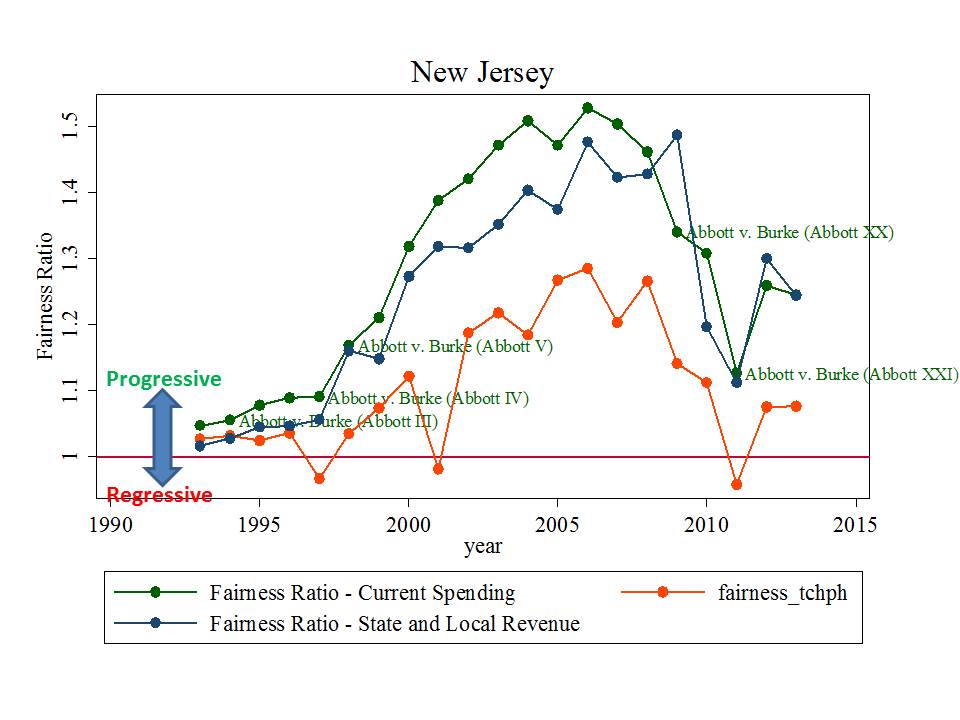
We can now track relatively consistently, these fairness ratios for a 21 year period! This means we can really capture the ebb and flow of equity within states and we can attach to those trends, key events. For example, here’s what’s happened in New Jersey for the 21 year period, for a) state and local revenue per pupil fairness (which includes revenue for capital expenses), b) current spending per pupil fairness (which includes federal title I funds to high poverty schools) and c) teachers per 100 pupils fairness.

Figure 1. New Jersey Fairness Trends over Time

Slide3As we can see, New Jersey’s funding fairness peaked around 2005 and since then has taken a significant tumble. 2011 data appear problematic, but consistently so across each measure. Nonetheless, by 2013, New Jersey had reverted to roughly the same degree of progressiveness as had been achieved by 2000, and substantively less than in 2005.

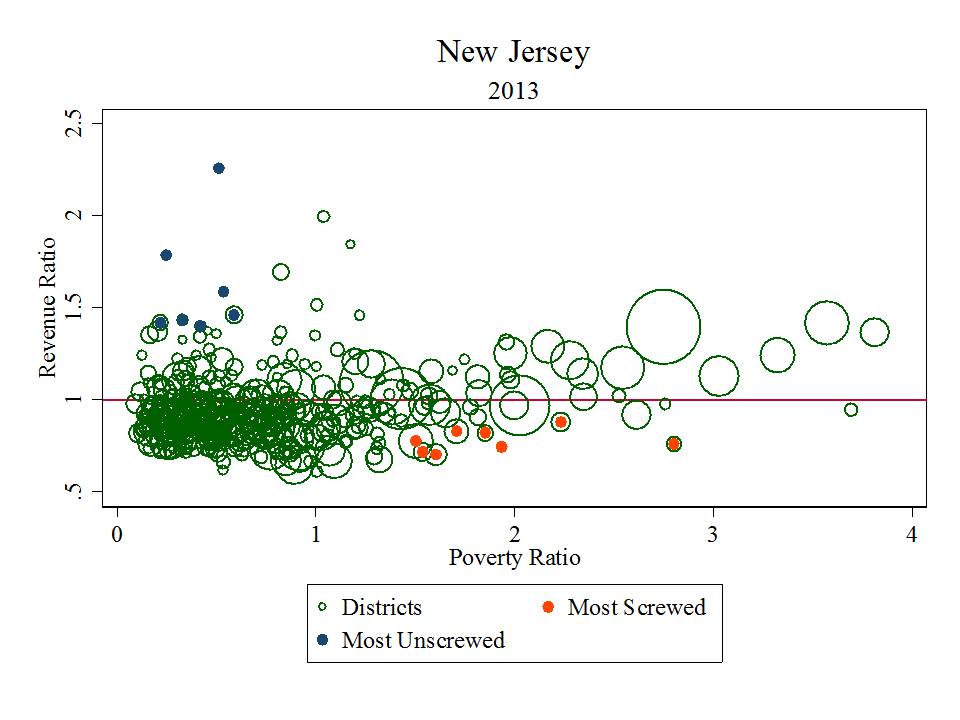
Here’s what the pattern across districts looks like for 2013, where, for each district the poverty rate and revenue per pupil measure are expressed relative to the average for the labor market of that district.

Figure 2. Relative Poverty and Relative Revenues for New Jersey Districts in 2013

Slide4New Jersey still maintains a relatively consistent   up hill, progressive slope of the relationship between revenues and poverty. However, this progressiveness is in sharp decline with frozen and reduced funding to high need districts, and low poverty districts beginning to run away from the pack, raising significantly more local tax revenue. Also, there are those high need districts that have largely been left out (orange dots).

Sadly, this is about as good as it gets these days.

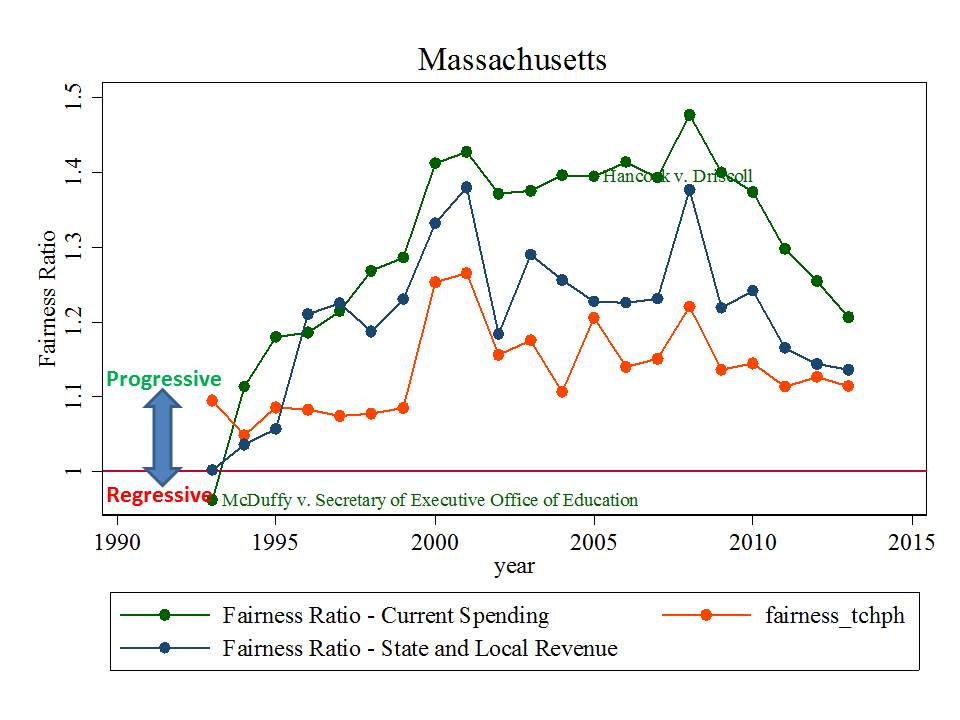
Another “model” school finance system over time has been Massachusetts. But here’s the long term trend.

Figure 3. Massachusetts Fairness Trends over Time

Slide1Funding fairness in Massachusetts has collapsed similarly to that of New Jersey, reverting to levels not seen since around 2000. This despite numerous studies showing the positive influence of the scale up in targeted resources. But the distribution of revenues in Massachusetts has been less consistent than that of New Jersey, and has declined even more unevenly. Figure 4 shows the 2013 pattern.

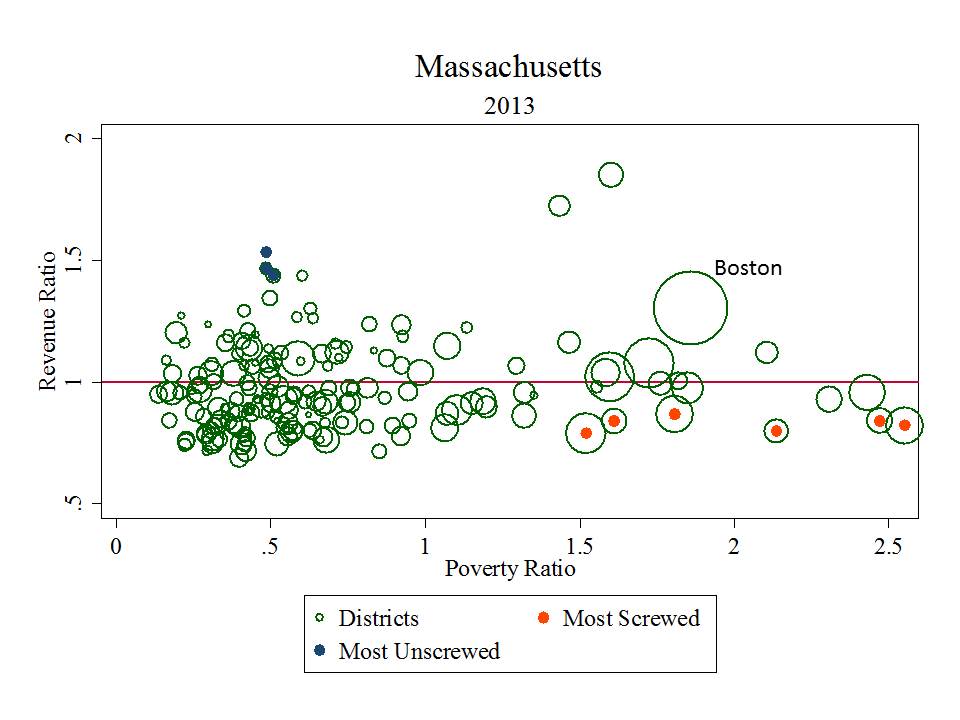
Figure 4. Relative Poverty and Relative Revenues for Massachusetts Districts in 2013

Slide2Here, the remaining progressiveness of the Massachusetts school finance system is driven almost entirely by funds targeted to the City of Boston (which, by no means, is to suggest that Boston has received adequate support given its needs, but rather, that Boston has been provided relatively more adequate support than some similarly high poverty districts). Other high need districts are left out. Massachusetts has a surprising number of relatively large enrollment districts that qualify as financially disadvantaged in my previous post (and here, by the same measures).  The progressive funding behind the Massachusetts “miracle” is a thing of the past.

And again, these are the “good” states, for the most part.

Pennsylvania and Illinois are the two worst states in the nation – year after year – time and time again, when it comes to inequity of state school finance systems. Here’s Pennsylvania over time.

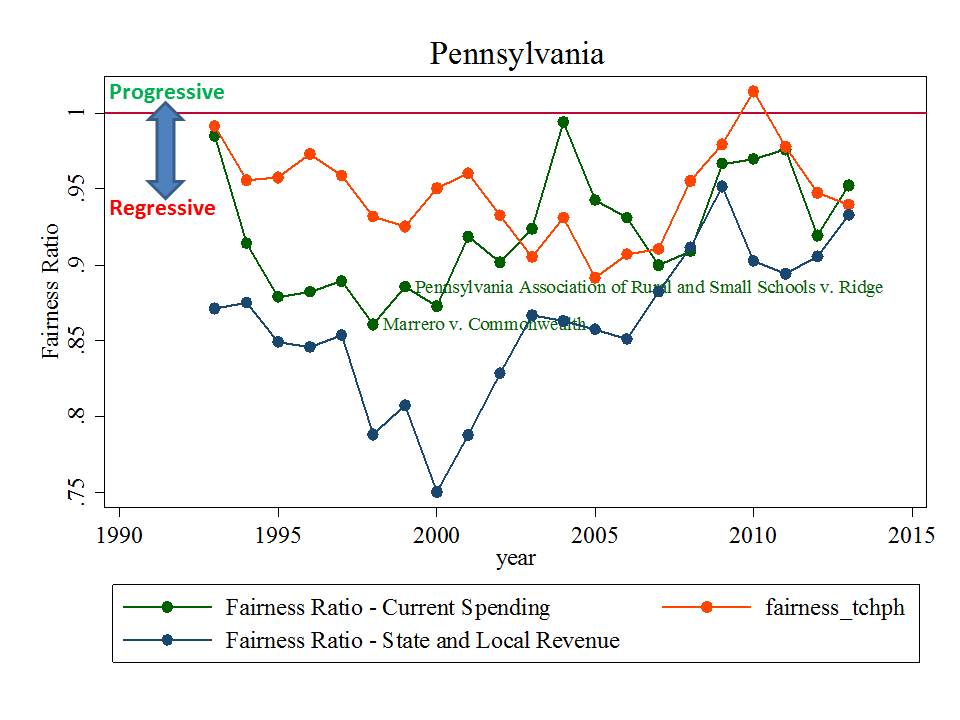
Figure 5. Pennsylvania Fairness Trends over Time

Slide7I guess the positive news here is that it’s not necessarily getting worse. Again, this stuff is relative. To an extent, the progressiveness of Pennsylvania school finance leveled off in recent years not because funding was maintained or increased in high poverty settings but because it grew more slowly in low poverty surroundings. Still, the system was, is… has pretty much always been a regressive mess. Here’s the 2013 distribution.

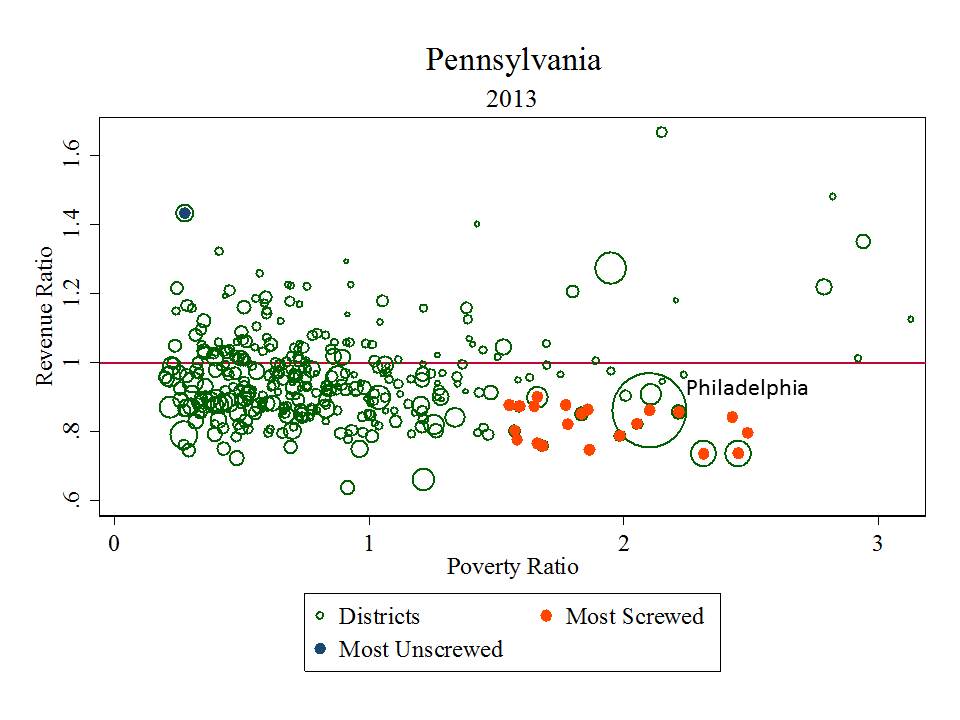
Figure 6. Relative Poverty and Relative Revenues for Pennsylvania Districts in 2013

Slide8Philadelphia, Reading, Allentown and other high poverty districts mainly in eastern, PA continue to have far less revenue per pupil than their lower poverty neighbors, and districts like Lower Merion (immediately adjacent to Philly) continue to run away from the pack (blue circle district).

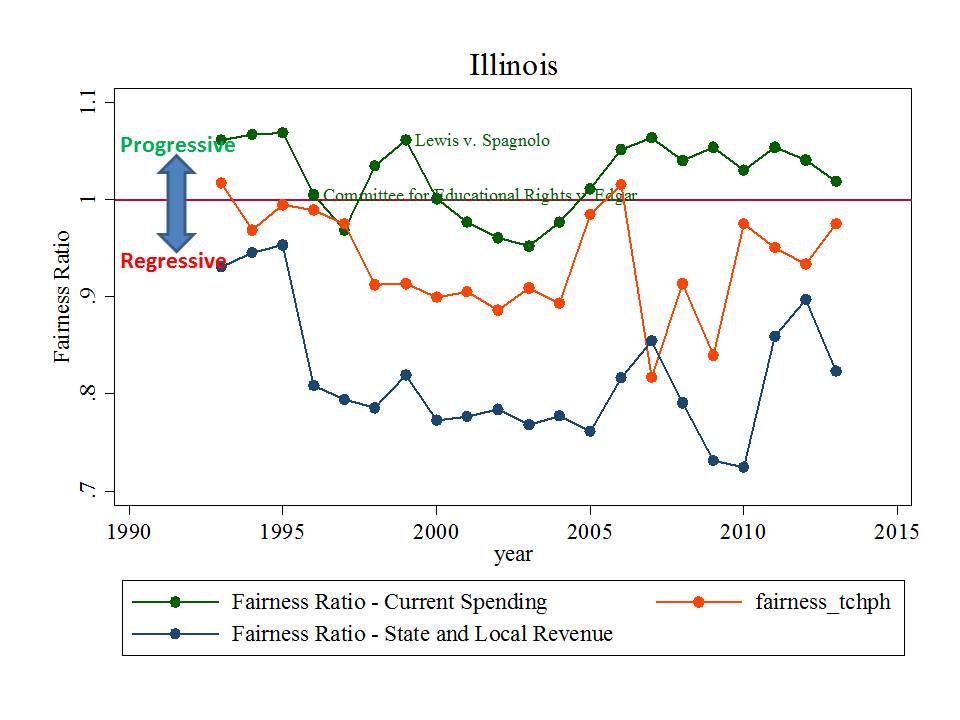
The main difference between Illinois and Pennsylvania is that Illinois has a larger number of affluent leafy suburbs that are running away from the pack. Illinois like Pennsylvania has had a consistently regressive finance system for… well… ever. Actually, it’s only gotten worse over the long term.

Figure 7. Illinois Fairness Trends over Time

Slide9And here’s the 2013 district level distribution.

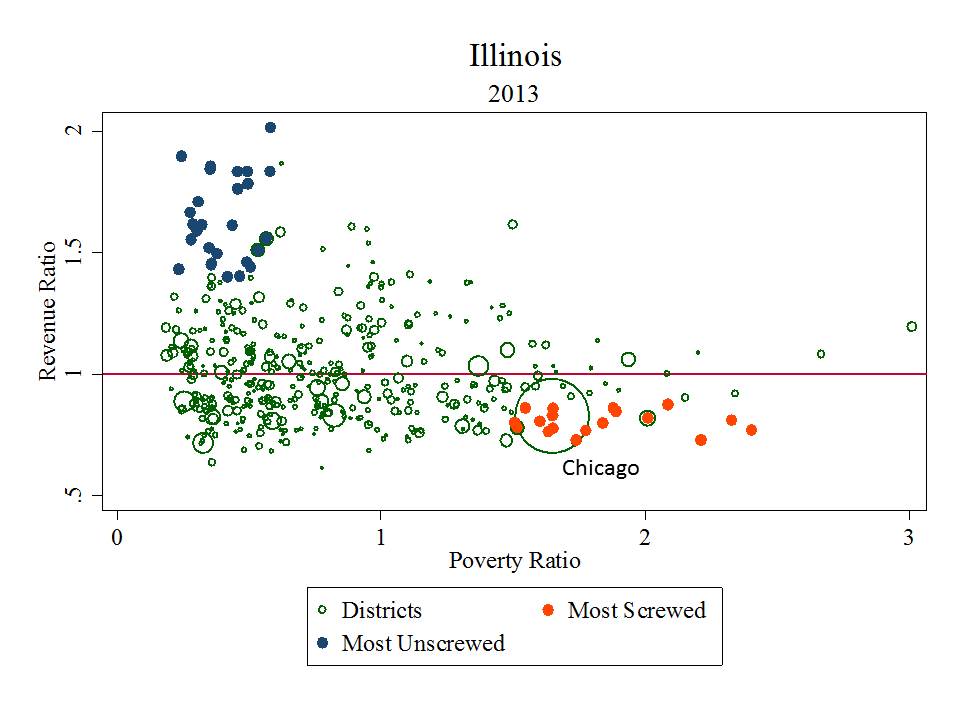
Figure 8. Relative Poverty and Relative Revenues for Illinois Districts in 2013

Slide10Dude… that’s just obscene. Chicago, and many of it’s high poverty, high minority concentration surroundings have far less than average revenue per pupil, which many of their low poverty neighbors have more than 50% higher than average revenue per pupil.  Put bluntly, that’s just a stupid huge unfair disparity.

Here’s one more for ya’… since anti-school-funding mythology tells us that Missouri has perpetually dumped all of its money into St. Louis and Kansas City over time.

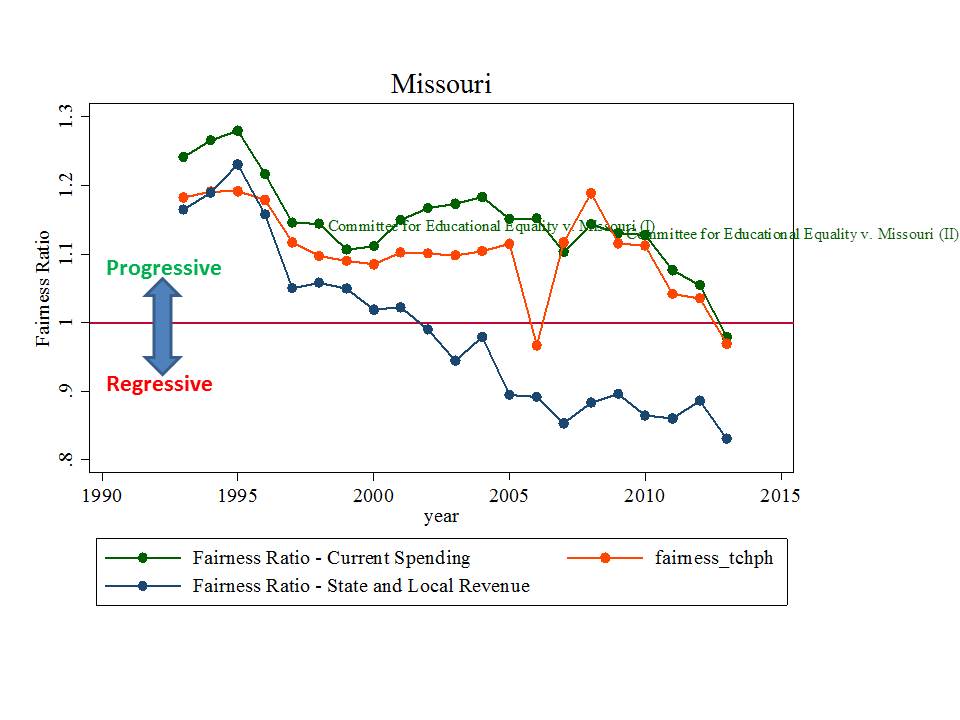
Figure 9. Missouri Fairness Trends over Time

Slide11Indeed there was a period in the mid-1990s when St. Louis City and Kansas City benefited from revenues generated under desegregation orders. Notably, many of those revenues were dedicated to specific programs, services and/or capital investments. But that too is a thing of the past, and Missouri’s school finance system has been in persistent decline ever since. Here’s the 2013 distribution.

Figure 10. Relative Poverty and Relative Revenues for Missouri Districts in 2013

Slide12Now, even St. Louis City falls into the category of financially disadvantaged, along with many of its high poverty, high minority concentration neighbors including Riverview Gardens and Ferguson-Florissant.

We are not  going to redeem our public education system – achieve “college readiness” for all and crush those common standards in a system which we choose to fund in this way.

No, charter school expansion – forcibly sorting students and dollars among inequitable choices isn’t going to put a dent in this problem. Liberty (of choice) is not a substitute for Equity! Especially when choices are constrained and inequitable.

No, firing the “bad teachers” – that is, all those who got stuck with bad student growth ratings while being underpaid to teach in resource deprived settings with excessively large classes and total student loads... that’s not going to help either.  Are there really that many totally awesome teachers waiting in line to be underpaid to do the harder work, when they can go elsewhere instead?

No, “Money-Ball” strategies won’t fix this mess, and the comparison is stupid to begin with. Yeah… fine… let baseball continue to be an “unfair game.” Kids’ schooling – education and economic opportunity shouldn’t be! It’s just that simple.

It’s time to start fixing this. Accepting the evidence that substantive, sustained and targeted school finance reforms matter. And acknowledging the simple truth that maintaining such an inequitable system serves no legitimate public, national or state interest.

Finally, it takes a robust and equitable system of taxes and revenues to solve this problem and we just need to get over that.

=====================

[i] Downes, T. A., Zabel, J., and Ansel, D. (2009). Incomplete Grade: Massachusetts Education Reform at 15. Boston, MA. MassINC.

[ii] Guryan, J. (2001). Does Money Matter? Estimates from Education Finance Reform in Massachusetts. Working Paper No. 8269. Cambridge, MA: National Bureau of Economic Research.

“The magnitudes imply a $1,000 increase in per-pupil spending leads to about a third to a half of a standard-deviation increase in average test scores. It is noted that the state aid driving the estimates is targeted to under-funded school districts, which may have atypical returns to additional expenditures.” (p. 1)

[iii] Nguyen-Hoang, P., & Yinger, J. (2014). Education Finance Reform, Local Behavior, and Student Performance in Massachusetts. Journal of Education Finance, 39(4), 297-322.

America’s Most “Financially Disadvantaged” (e.g. Screwed) School Districts 2013

For a number of years I’ve been producing lists of what I call America’s Most Screwed Public School Districts. The kind folks at Center for American Progress, in 2012, worked with me to put out a report on these districts, and how they got where they are.

https://cdn.americanprogress.org/wp-content/uploads/2014/07/BakerSchoolDistricts.pdf

I’ve also shown on this blog that some/many of these districts have been screwed for years… decades in fact. These include major cities like Chicago, IL and Philadelphia, PA, as well as secondary cities like Reading, PA, Allentown, PA, Waukegan, IL, Bridgeport, CT, New Britain, CT among others.

The attached table uses the following thresholds for the analysis:

  • More than 50% higher census poverty rate than the average for all districts sharing the same labor market.
  • Less than 90% of the state and local revenue per pupil of the average for all districts sharing the same labor market.

As I’ve explained numerous times on this blog, relative resources and relative conditions matter greatly in school finance. From the CAP report:

It is important to understand that the value of any given level of education funding, in any given location, is relative. That is, it matters less whether a district spends $10,000 per pupil or $20,000 per pupil than how that funding compares to other districts operating in the same regional labor market—and, for that matter, how that money relates to other conditions in the regional labor market.

The first reason relative funding matters is that schooling is labor intensive. The quality of schooling depends largely on the ability of schools or districts to recruit and retain quality employees. The largest share of school districts’ annual operating budgets is tied up in the salaries and wages of teachers and other school workers. The ability to recruit and retain teachers in a school district in any given labor market depends on the wage a district can pay to teachers relative to other surrounding schools or districts and relative to nonteaching alternatives in the same labor market.[2] The second reason is that graduates’ access to opportunities beyond high school is largely relative and regional. The ability of graduates of one school district to gain access to higher education or the labor force depends on the regional pool in which the graduate must compete.

So, without further ado, here’s this year’s list, based on averages from 2011 to 2013. I’ve excluded districts in rural labor markets, districts with fewer than 2,000 students and non-k12 districts for now!

Table 1

Bottom line – There’s simply no excuse to have local public school districts with, in many cases, twice the poverty rate of their surroundings and substantively less funding per pupil to meet those children’s needs. It is well understoodwell understood -well freakin’ understood that these children require more resources and that more resources matter, despite decades of unsubstantiated and empirically bankrupt blather to the contrary.


Thoughts on School Funding & Baltimore

There’s been more than a little opportunistic, misguided bloviating about Baltimore in recent weeks, including misguided discussions of and references to per pupil spending in Baltimore City Public Schools. The gist of most claims has been that Baltimore City Schools spend more than most other large (or large urban) districts in the country, but their outcome still stink. Thus, for example, more money isn’t the issue. We just need stuff like, more charter schools, which don’t need more money to be awesome (except that, well, the most awesome among them elsewhere tend to spend a lot more money!)

My point here is to simply lay out the data, the issues and some context for better understanding school finance issues facing Baltimore Public Schools.

Baltimore is Carved out as a Segregated, High Poverty City District

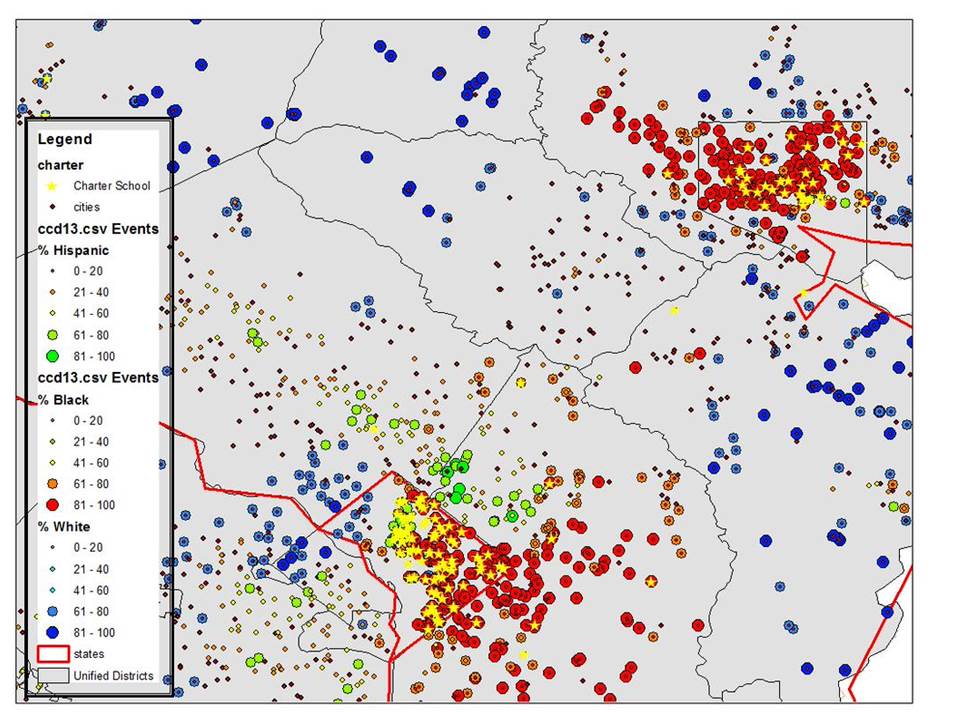
Maryland, like other “southern” state school systems is generally organized into county school districts, some of which are increasingly racially and economically diverse. But, Maryland like other southern states saw fit in their historical development of public school governance to isolate/separate certain “city” school districts and make them their own. Invariably, these city/county separations fall sharply (or did at their origin) along racial lines. That’s certainly true in Baltimore as the map below indicates.

Empirical analyses repeatedly show that racial and socio-economic isolation can dramatically affect the costs of improving educational outcomes.

Figure 1- Racial distribution of school populations by districts in Baltimore/DC Area (BCPS in Upper Right)

Slide1So, what we’ve got here is a district that from its origin, is a racially isolated, high poverty district that has to find some way on its own to dig out of that hole.

Maryland has put some, though not that much effort into funding equity

It is true that the state of Maryland has put more effort perhaps than some other states in targeting funding toward districts serving children with greater needs. But even our own most recent estimates give the state a “D” for funding fairness, or the relationship between state and local revenues with respect to child poverty, across districts.[1]

More specifically, here’s the position of Baltimore City, compared to all other districts in the Baltimore Core Based Statistical Area, in terms of census poverty rates and current spending per pupil from 1993 to 2012.

Baltimore starts the period with 2.25 times the census poverty rate of its surroundings, and 93% of the average current spending per pupil and ends the period somewhat better in funding, with 113% of the current spending, but similar poverty disadvantage. As I explain in numerous posts and reports, relative funding and relative need matter greatly!

Figure 2 – Baltimore City Relative Poverty and Relative School Spending to Labor Market Surroundings

 Slide2

Certainly, BCPS is better off than some, in that it does have higher than average per pupil spending. But, a 13% margin on spending is hardly sufficient to close the gap for a district with 2.3 times the poverty rate of surroundings!

Baltimore’s Big Fat Weighted Student Funding Fail?

I decided to dig a bit deeper based on recently released data from the U.S. Department of Education, which report school site per pupil total salary (and instructional salary) expenses. Now, readers of my blog know that I’m quick to point out that the flexibility of districts to reshuffle resources across schools within districts depends substantially on states providing those districts sufficient resources to begin with. As noted above, Baltimore City really isn’t provided sufficient resources to address its extreme needs. But, I must say that in my exploration of within-district resource allocation in this case, what I found was a bit disturbing, but not surprising.

Baltimore was applauded back in 2009 in the Reason Foundation’s Weighted Student Funding Yearbook as being an innovator in weighted student funding models. You see, Baltmore was going to focus on allocating school site budgets not on deficit oriented thinking – like student needs/poverty, etc. – but rather, on performance measures. I expressed my skepticism at the time, along with critiquing other plainly idiotic aspects of the Reason report.

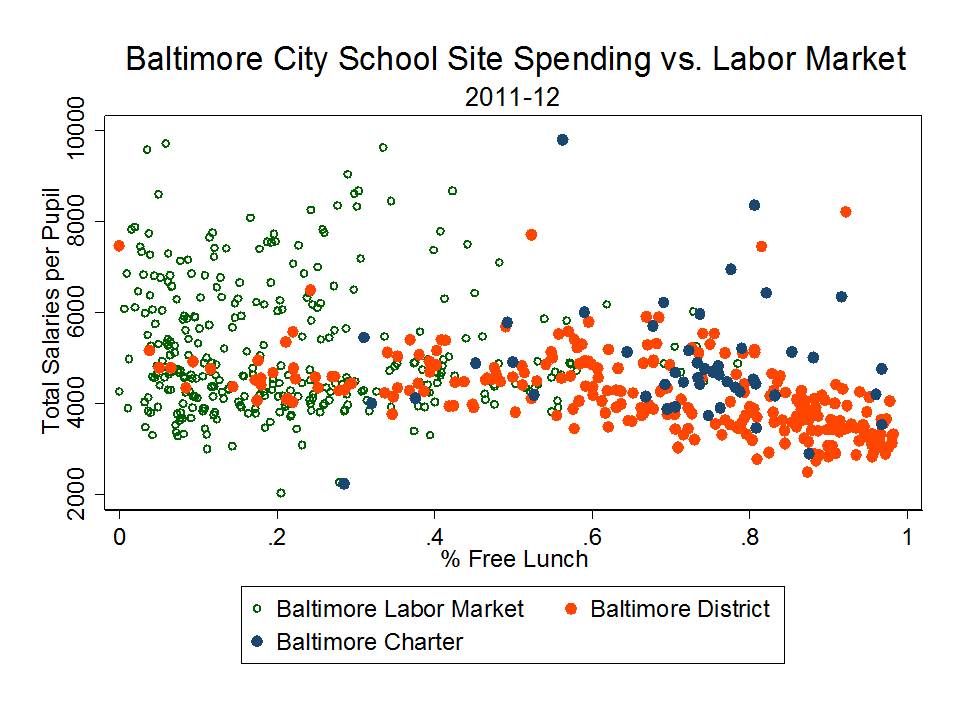
Whether related to the design of their weighted student funding model or not, Baltimore City Schools, by 2011-12, had accomplished (or perhaps merely maintained) a disturbingly inequitable distribution of school site spending with respect to low income concentrations.

Figure 3 – Baltimore’s Big Fat Weighted Student Funding Fail?

Slide3


Figure 4 – Factors Predicting the Distribution of Total Salary Resources

Slide4

Figure 4 shows that on average, as we move from 0% to 100% low income, per pupil total salary expense drops by over $1,200 per pupil. Charter and district schools are comparably funded, at comparable characteristics.

Surrounding schools have $675 per pupil higher total salary expense, despite BCPS having higher current operating spending per pupil.

Figure 5 – Distribution of Key Resources across Baltimore City, Charter and Surrounding Schools

 Slide5

Baltimore City schools appear to provide about a 5% competitive wage boost over surrounding districts, but have only 90% of the staffing ratios per pupil of surroundings. It is unlikely that a 5% wage differential is sufficient to recruit/retain teachers in the City of Baltimore. Charters in Baltimore pay a higher wage differential (19% over surroundings) and have comparable staffing ratios to surroundings. But, this is only possible because they currently rely on very large shares of “novice” (first two years) teachers. Such a staffing model isn’t likely sustainable in the long term, unless as a matter of policy, large shares of teachers are annually dismissed.

Note that these data are from 2011-12 and since that time, things may have changed! (one can hope)

In the Aggregate, Baltimore isn’t the Failure that Some Claim

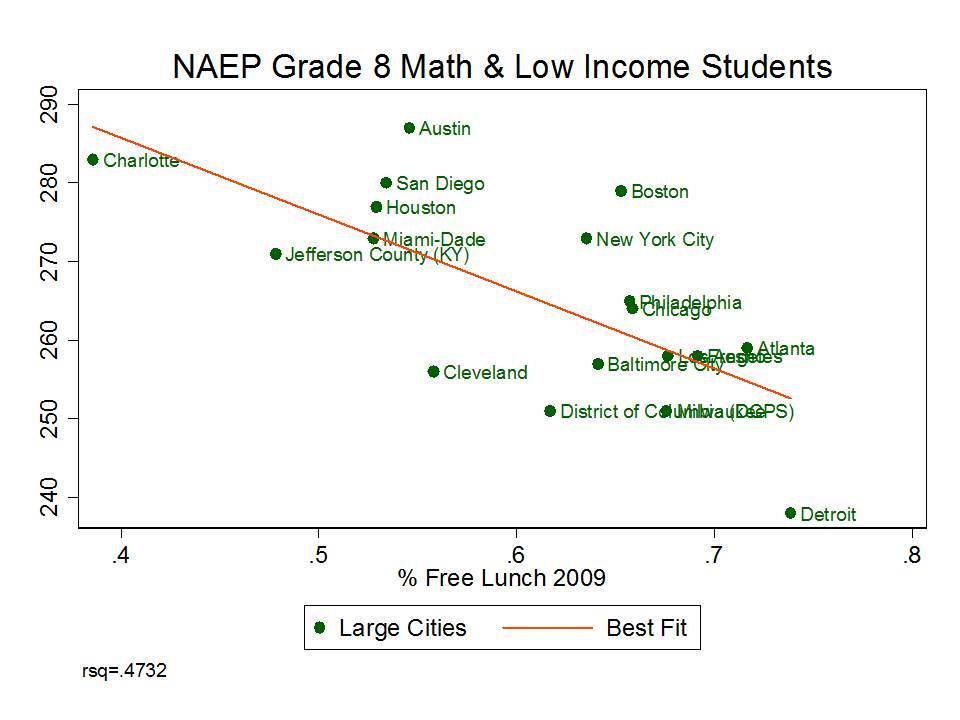
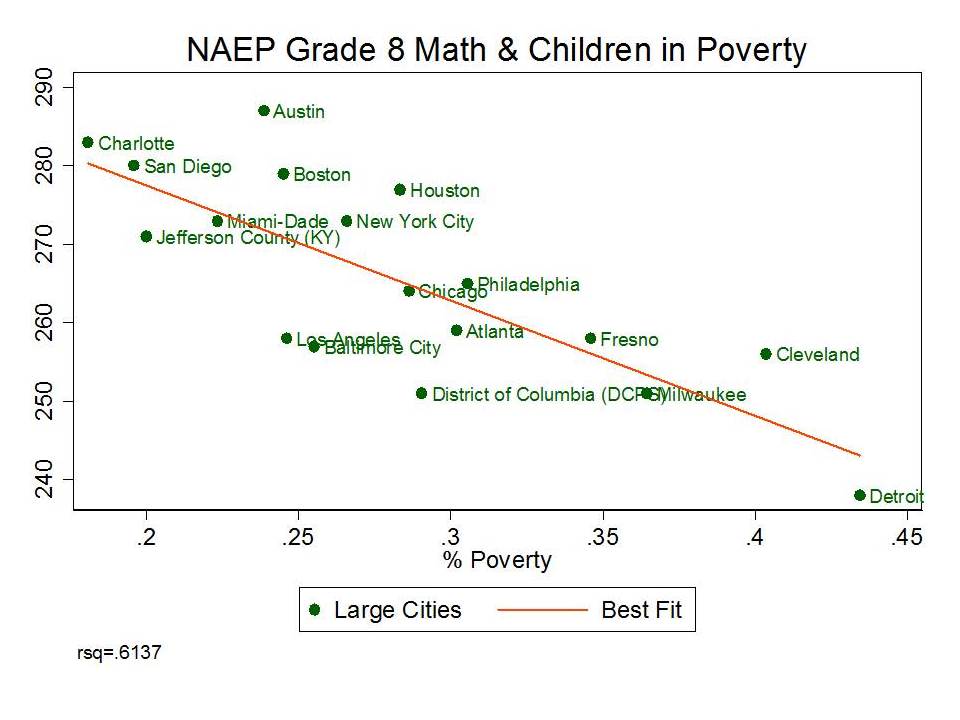
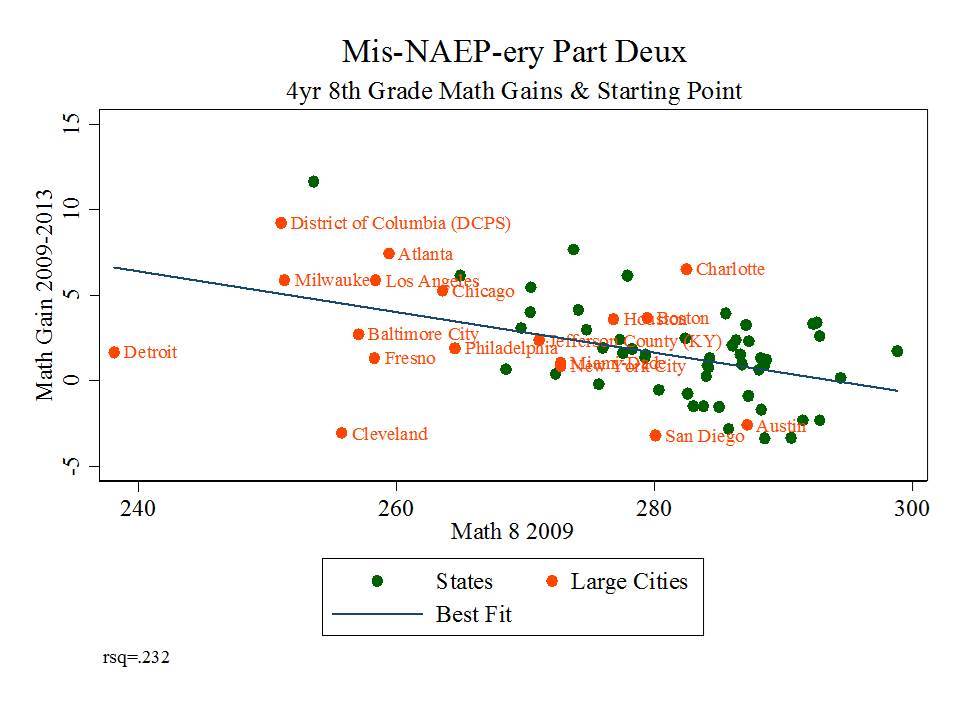
Finally, what about those student outcomes in Baltimore? Is Baltimore really an example of throwing money down the rat hole? Is it really the case that Baltimore spends so much more than other cities, but simply fails so much worse? Here are some graphs from a post I did a while back on the NAEP Urban District Results.

Figure 6 – 8th Grade Math & Free Lunch

Slide6

Figure 7 – 8th Grade Math & Census Poverty

Slide7

Figure 8 – 8th Grade Math Gains and Starting Point

Slide8

Figure 9 – 8th Grade Reading Gains and Starting Point

Slide9

To summarize, Baltimore does somewhat less well than expected on mean NAEP scale scores given measures of their students’ low income status, but they certainly aren’t a striking outlier here.

As for gains in recent years, Baltimore has shown reasonable average gains, given expectations.

What does it all mean?

I’m not really sure I have an answer to this question. But, to break down the information above:

Baltimore certainly isn’t proof positive of the failure of pouring tons of money into traditional urban public school districts. First, we haven’t poured that much money into Baltimore, given its needs. Second, it hasn’t performed as poorly as some might characterize.

But, Baltimore does provide us with some evidence of the culpability of districts and district leadership on following through with equity objectives. As I’ve explained in peer reviewed studies, merely claiming adoption of Weighted Student Funding does not ensure equity. In fact, because WSFs are as vulnerable to political pressures as any other method of within-district resource allocation, they are as likely to yield an inequitable result.

[1] http://schoolfundingfairness.org/ia_reports_2014.htm

Will Kiryas Joel Finally Get its Way? Who really benefits from NY’s “Invest in Ed” Tax Credit?

Tuition tax credit programs establish privately governed entities that provide scholarships, typically to “lower income” families, for their children to attend private schools. The idea is to provide tax credits to corporations and individuals who give money to these tuition scholarship entities.

The compelling governmental interest for these policies, as we often hear is that low income kids are trapped in failing urban public schools and that these tuition scholarships will help them attend either outstanding, elite private independent schools, or established catholic schools. Certainly, as I illustrated in a recent blog post, a large share of private schooled children in New York State do attend Catholic schools. And more perhaps might, if provided with tuition scholarships.

But, as I’ve shown in other contexts, the primary beneficiaries of these scholarships – where the money actually lands – isn’t necessarily where we might assume, given the framing of the policy.

Which brings us to Kiryas Joel (and other similar contexts in New York State, like the area served by East Ramapo School District). Years ago, the tiny village of Kiryas Joel, in the town of Monroe sought to establish itself as its own independent public school district – and independent public school district that would, in effect, serve an exclusively, homogeneous religious community. The New York legislature, on their behalf actually passed a districting law, just for them, that would create these boundaries. Why? They just wanted to have a fully publicly subsidized school system where they could serve – the way they saw fit – their specific religious community. To which the high court of this land said – nay nay.

Here’s a quick summary from oyez.org:

BOARD OF EDUC.KIRYAS JOEL VILLAGE SCHOOL v. GRUMET

Facts of the Case 

In 1989, the New York legislature passed a school districting law that intentionally drew its boundaries in accordance with the boundaries of the Village of Kiryas Joel, a religious enclave of Satmar Hasidim who practice a strict form of Judaism. Shortly before the new district commenced operations, the taxpayers and the association of state school boards embarked on a lawsuit claiming that the statute created a school district that limited access only to residents of Kiryas Joel.

Question 

Did the 1989 statute violate the First Amendment’s Establishment?

Yes. In a 6-to-3 decision, the Court held that the statute’s purpose was to exclude all but those who lived in and practiced the village enclave’s extreme form of Judaism. This exclusionary intent failed to respect the Establishment Clause’s requirement that states maintain a neutral position with respect to religion, because it clearly created a school zone which excluded those who were non-religious and/or did not practice Samtar Hasidism. Indeed, the very essence of the Establishment Clause is that government should not demonstrate a preference for one religion over another, or religion over non-religion in general.

http://www.oyez.org/cases/1990-1999/1993/1993_93_517

But alas, those were different times. Since that time, our high court has determined, for example, that if a tuition voucher program is established by a government entity, and if that voucher program is based on the choices of individual, private actors (parents and students), even if the majority of those students/families take their voucher to religious institutions (as they did in Cleveland), the policy being neutral to those choices, does not violate the establishment clause.

This has led me to ponder, in recent years, what if New York State had simply established a voucher model for the region surrounding Kiryas Joel? Rather than declaring a separate government entity that happened to be homogenously religious? That might work. The kids/families would just so happen to choose, 100%, their village yeshivas. The policy on its face would be “neutral.” Except perhaps that the legislation creating the policy would have chosen this religious community specifically for this “pilot” program. That might again tip the tables against Kiryas Joel (unless perhaps, as in the failed, proposed NJ legislation, the policy just happened to include, but not exclusively, the religious community).

But alas, we need not even worry about that, because our high court a few years back created an immunity shield for policies that indirectly rather than directly allocate those tuition scholarships! You see, if a state instead creates a tax credit for individuals and corporations to give to a scholarship granting entity, rather than directly allocating those same tax dollars, it appears that resident/citizen/taxpayers don’t have a right to bring legal challenges to the policy to begin with. [you see, in a case like Zelman/Cleveland Vouchers, taxpayers can challenge the use of their tax dollars for religious institutions on an objection of conscience basis. But, taxpayers can’t challenge the distribution of someone else’s “untaxed” contributions, even if the fiscal effect is the same]. To summarize:

Arizona Christian School Tuition Organization v. Winn

Facts of the Case

Arizona taxpayers challenged the constitutionality of Arizona’s tuition tax credit in an Arizona federal district court. They alleged the tax credit violated the Establishment Clause of the First Amendment because it funneled money to private religious schools. The district court dismissed the case. On appeal, the U.S. Court of Appeals for the Ninth Circuit reversed, holding that the taxpayers had standing to bring their suit and had alleged a viable Establishment Clause claim.

Question 

Do the plaintiffs lack standing because they cannot allege that the Arizona tuition tax credit involves the appropriation or expenditure of state funds?

Yes. The Supreme Court overturned the lower court in an opinion by Justice Anthony Kennedy. The majority held that the challengers to the tax credit in Arizona lack standing under Article III. Justice Elena Kagan filed a dissenting opinion joined by Justices Ruth Bader Ginsburg, Stephen Breyer and Sonia Sotomayor. “State sponsorship of religion sometimes harms individuals only (but this ‘only’ is no small matter) in their capacity as contributing members of our national community,” Kagan wrote for the dissenters.

http://www.oyez.org/cases/2010-2019/2010/2010_09_987

Which all brings us to the here and now in New York State. There now exist (at least) two versions of a tuition tax credit program being pitched in New York State. The pitch is the same as usual. The faces of that pitch are the same as usual – including Cardinal Dolan of the NY Archdiocese [perhaps on the assumption that this policy will a) help firm up the financial condition of NY’s Catholic Schools while b) providing low income NYC children “trapped” in failing schools the opportunity to attend Catholic schools].

Like previous New Jersey bills, the Assembly version (largely mirrored by the Governor’s budget language version) of the bill places emphasis on providing scholarships to children from families with income below a certain level. As stated in the bill:

Section three of this bill also provides definitions for terms such as “authorized contribution,” “public education entity,” “local education fund,” and “educational scholarship organization.” An “eligible student” who can receive a scholarship must reside in a household with not more than $250,000 in adjusted gross income; however, to ensure the needs of low-income communities are addressed, on educational scholarship organization must provide at least half its scholarships for students from households with income below 150% of the reduced-price lunch income thresholds. http://assembly.state.ny.us/leg/?default_fld=&bn=A02551&term=2015&Summary=Y&Actions=Y&Votes=Y&Memo=Y&Text=Y

The NY Senate version doesn’t worry itself with allocating the scholarships to lower income children, as far as I can tell.

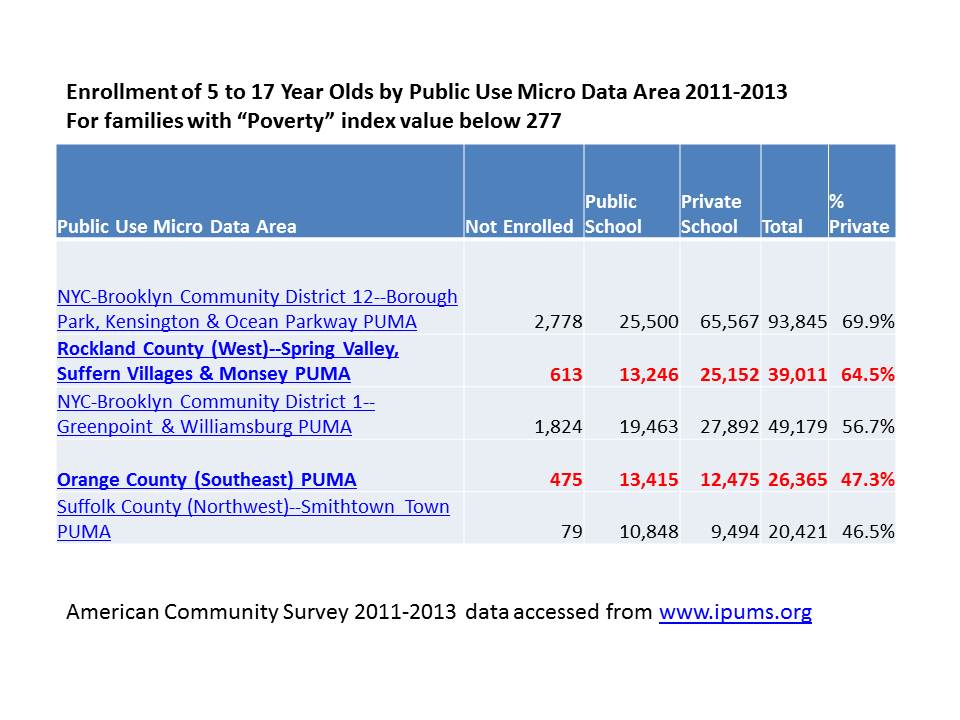
But as I have previously laid out in New Jersey, the casual observer might be surprised to learn where those communities are, in which the largest shares of children already enrolled in private schools qualify by income status for these scholarships (by the 150% of the 185% income threshold for poverty, which is the 277% income threshold).

Let’s take a look first at the Public Use Micro Data Areas in New York State from 2011-2013 by Public Use Micro Data Area.

Table 1 – Private School Enrollments in New York State for Public Use Micro Data Areas with HIGHEST % Low Income Enrolled in Private Schools

Slide1

Interestingly, but not surprisingly (since I’ve seen this pattern elsewhere), the highest rates of “private school enrollment” among “income qualified families” are in places like Brooklyn, Rockland County and Orange County. These latter two public use microdata areas are home to two very unique New York State school districts: Kiryas Joel Village (Orange County) and East Ramapo. The plight of East Ramapo school district has been covered extensively in the media in recent years and is analogous to that of Lakewood, New Jersey in many respects.

Kiryas Joel is no stranger to media coverage either, with many stories specifically covering the village leadership’s creativity in accessing public subsidies and tax breaks.

Half, to more than half of children in these communities attend private schools, much like Lakewood, NJ. That is, half of children from families claiming low income!  Families that would/will qualify for preferential treatment under the scholarship program.

Now, one might say, this is all private school students. Surely they represent a mix of school types. They aren’t all in one type – one religion – of schools. Well, here are the private school enrollments in 2011-12 for towns in the Rockland area, and in Monroe which is home to Kiryas Joel. These enrollments are from the NCES Private School Universe Survey.

Table 2 – Private School Enrollments (total enrollments)

Slide2

Well, okay, in fact most of them are in Orthodox schools, which is pretty well understood by anyone familiar with these communities.  In fact, if the Census data and Private School Survey data were precise enough to isolate specifically schools and enrolled children in the village of Kiryas Joel, I believe we’d still find 100%.

So then, what’s the big deal? Well, what we have here, in New York State, is quite similar to what I found in New Jersey- that the immediate big beneficiaries of the tax credit scholarships will likely NOT be low income minority children heading off to Horace Mann, Dalton, Trinity or NYC Catholic schools, but rather, the vast population of already enrolled “low income” families in the state’s burgeoning orthodox communities – those who disproportionately declare themselves as low income, yet already attend private schools.

So, in other words, Kiryas Joel finally gets its way after all these years – the opportunity to have their exclusively religious schools fully, or nearly fully subsidized at public/taxpayer expense, albeit indirectly.

And thanks to more recent supreme court decisions, no one even has legal standing to challenge the policy as designed, if it’s actually adopted.

Is this what “invest in ed” is really all about?

Unconstitutional by any other name is still Unconstitutional

schoolfinance101's avatarConsortium on Education Policy & Finance

A Review of the Kansas “Block Grant” School Finance Legislation

BBaker.Hsub7.Kansas.4_9_15

Bruce D. Baker, Rutgers University

In this report, I present a brief review of Kansas House Substitute for Senate Bill 7, which has been labeled the “Block Grant” funding formula, adopted as a replacement to the School District Finance Act, and to be enacted through the 2016-17 fiscal year. Major features of the plan include:

  1. Calling it a “block grant;”
  2. Freezing in place prior year general fund aggregate (not per pupil) state aid through the next two fiscal years;
    1. To include a .4% across the board cut for FY2015-16 and FY2016-17 to generate “extraordinary” needs aid pool;
  3. Imposing cuts to prior year supplemental fund state aid for the next fiscal year;
  4. Imposing cuts to prior year capital outlay state aid for the next fiscal year.

Put simply, a freeze by any other name is still a freeze and a…

View original post 537 more words

The Willful Ignorance of the NJ Star Ledger

After having a series of conversations with Star Ledger reporter Julie O’Connor about her desire to write a cover story about how TEAM Academy is producing miracles in Newark, I wrote this post:

https://schoolfinance101.wordpress.com/2015/01/30/ed-writers-try-looking-beyond-propaganda-press-releases-for-success-stories/

The reason for this post is explained in this paragraph:

Well, one reason I’m going there is that I’m sick of getting e-mail and phone inquiry after inquiry about the same charter schools – and only charter schools – asking how/why are they creating miracle outcomes. I try to explain that there may be more to the story. The reporter then says that the charter school’s data person says I’m wrong – validating their miracle outcomes (despite their own data not being publicly available/replicable, etc. and often with reference to awesome outcomes reported in popularly cited studies of totally different charter schools).

For a while after writing this, I figured that the NJ Star Ledger reporter who was so insistent on writing her rah rah TEAM article had simply given up. But alas no. The puff piece finally arrived today: http://www.nj.com/opinion/index.ssf/2015/05/beating_newarks_odds_kipp_charter_network_is_poise.html#incart_river

Now, it’s written as an editorial, so I guess that means it’s okay to make stuff up, ignore lots of stuff, and just generally roll with a combination of propaganda provided to you by the school and your own personal predisposition.

What’s so disturbing about this all is that the title of the editorial itself is directly refuted by the statewide analysis I provided. That TEAM relatively marginally beats expectations, and in fact, several Newark Public schools and a few other charter schools in Newark “beat the odds” so to speak, by much more. AND THE AUTHOR OF THE EDITORIAL WAS FULLY AWARE OF THIS.

I refused to call the reporter in part because I wanted there to be a full, complete transcript of our e-mail conversations. I’m sick of banging my head against this wall.

Below is a transcript of the conversation that started with an inquiry to Diane Ravitch from Julie O’Connor. Others were included on the e-mail chain and jump in at various points.

Reporter Inquiry

Prof. Ravitch,

I’m on the editorial board at The Star-Ledger in New Jersey, and I’m working on a cover story for our Perspective section about the KIPP schools in our state. The college attendance stats of KIPP seniors in Newark seem pretty impressive, and I was wondering if you have the same reaction, and what you think of KIPP’s forays into Camden.

Would really appreciate it if you could give me a call at []. Would like to discuss KIPP in the context of your criticisms of the broader charter school movement, and whether or not you think it is an exception.

Many thanks,

Julie O’Connor

The hand-off

Julie,

I suggest you talk to Mark Weber and Bruce Baker at Rutgers, who have studied charters in NJ. I lean on their research. The question is not whether one chain can produce successful graduates, but whether charters in general are helping the most vulnerable schools, whether they are reducing the funding and capacity of public schools, and whether their success-when it exists–is the result of selection and attrition.

Diane Ravitch

Reporter

Ok, thanks for your prompt reply.

Prof. Baker emailed me his report on free/reduced lunch and the TEAM schools, but I have been unable to reach him on the phone to discuss KIPP or my follow up questions.

Basically, I am looking for a reaction to two claims from KIPP that seem impressive: The college attendance rates (last year, 95 percent of KIPP seniors went to college, 89% to a 4-year, 6 percent to a 2-year), and the fact that KIPP kids in elementary and high school equal or outperform the average for the state of NJ (some years they do in middle school, too, though this year they didn’t).

KIPP kids are 87% free/reduced lunch and the state is in the 30s. I understand that Baker and others are skeptical about comparing KIPP kids to their peers in the Newark district. But what about comparing them to the state average? And what about their college attendance rates?

I would like to discuss the criticisms of the charter school movement and whether you view KIPP as an exception, or more of the same. Prof. Baker, can you please give me a call as soon as you get a chance? []. We are hoping to run the story in the next week or so.

Many thanks,

Julie

Baker to Reporter

My point is, and shall continue to be that news stories on education should NOT be driven by some PR prompt from specific schools touting their “successes” through anecdotes. Thus, my only reaction is the reaction I posted previously about school performance, given analyses across all schools, using comparable, publicly available data:

https://schoolfinance101.wordpress.com/2015/01/30/ed-writers-try-looking-beyond-propaganda-press-releases-for-success-stories/

The bottom line is that KIPP schools performance on comparable measures of student growth, controlling for demography, resources, etc., are relatively average (marginally above average). Many district schools, including ones in Newark, far outperform them.

Reporter to Baker

Ok. Even if KIPP students aren’t representative of their district, isn’t it still impressive that they are beating the state average, given that their student population is significantly poorer?

KIPP says 93 percent of their students stay with them (7 percent leave their schools each year for any reason).

If what this tells us is that KIPP students have high scores and go to college, how do they fit into criticisms of the larger charter school movement? And what do you think of KIPP’s expansion into Camden?

Prof. Baker, read your blog post and would like to discuss. I am not sure how you are measuring growth in these ranked schools. Are you skeptical about the accuracy of the college attendance rates and performance numbers reported by KIPP? If so, why? Please give me a call. []

Thanks.

Baker to Reporter

Not without running a model of demographics against the same outcome measures across all schools, to see how/whether they truly deviate, statistically, from expectations. Anecdotes of this type are unhelpful for understanding what’s “impressive” statistically or not.

For measuring growth, I’m using the state’s own reported school Median Growth Percentile – for 2012, 2013 and 2014.

Skeptical or not, context is what’s needed for them to really mean anything. The context of all other schools, and their demographics, to evaluate statistically whether the KIPP schools actually deviate from what would otherwise be expected (given enough schools to estimate a model of expectations).

Reporter to Baker

Ok. Is the state average not considered a good measure of how schools are doing?

Is your central point in creating your own measurement for whether schools deviate from expectations that KIPP schools have more resources and classroom time and better class sizes, and that’s why their students are doing so well?

Are you trying to account for those factors in your outcome measure, since you might not find such conditions in traditional district schools? That seems to be your argument in this blog post:

https://schoolfinance101.wordpress.com/2013/03/01/the-non-reformy-lessons-of-kipp/

Trying to understand your general view of KIPP’s performance.

Baker to Reporter (w/head banging against desk)

No. State average is NOT a useful comparison.  Given the number of things that vary across schools, one needs to look at any given school in the context of all schools, with all available measures. Not just compare one school to the state average and say, for example, “it’s got higher poverty, and higher outcomes than the state average.” That comparison misses a lot of other factors that may vary across schools. One needs to see how those factors affect the outcome measure across schools and then compare against the overall pattern.

Second – I’m not “creating” my own measurement. I’m doing what I describe above. Taking the state’s measures, and making comparisons among “otherwise similar” schools along the trend of schools, given their various attributes. That is, how much higher, or lower than expected, does a school score (on growth) given all of those factors that vary.

Now, I also use the state’s growth measure,  because, for all its shortcomings, it is actually the best available New Jersey measure of what a school might be contributing to student outcomes (rather than what kids come in with, or who leaves and when). But that measure too is ONLY useful if you control for/account for the various factors. Quite simply, this is how credible analysis of this type is done, knowing full well that even this approach can’t capture some factors that affect outcomes that really aren’t about how good/bad a school is.

Their performance tends to be marginally above average, to about average, considering all schools including district schools. For that matter, several Newark district schools have higher performance. Discovery Charter school is the standout among charters. North Star seems to do well, but I believe that the model isn’t really capturing the effect of their substantially greater attrition, or different student population. But who knows.  But then again, Robert Treat has very different student population and tends to show very weak gains with adjustment for the included factors.

Reporter (who clearly never bothered to read the original post)

What factors that vary are you trying to account for? It is things like resources, classroom time and class sizes?

Baker to Reporter (direct response to ignorant question)

They are all listed in the blog post!

https://schoolfinance101.wordpress.com/2015/01/30/ed-writers-try-looking-beyond-propaganda-press-releases-for-success-stories/

Outcome is Growth

Corrected for:

  1. prior average scale score level
  2. % free lunch
  3. % disability (because I cant’ break out by severity, charters like TEAM actually get an advantage here)
  4. % Ell
  5. total staffing expense per pupil
  6. school grade range served
  7. school size

More Exasperated Baker to Reporter

Schools in Newark: https://schoolfinance101.com/wp-content/uploads/2015/01/slide18.jpg

Charter Schools Statewide: https://schoolfinance101.com/wp-content/uploads/2015/01/slide24.jpg

So again, I ask, why do you feel the necessity to write a story on KIPP schools? And why the apparent obsession on trying to find a miracle in KIPP? How do these supposed miracles (that generally aren’t) come across your desk?

An objective statistical run of all schools in the state, using the state’s own best available measure as the outcome, finds TEAM in Newark to be a decent – relatively above average – school, but no miracle. There are no miracles in this complex endeavor. That’s fine. They do a pretty good job, and seem to do a better job of serving a more representative student population than some others (see also: https://schoolfinance101.wordpress.com/2013/11/27/where-are-the-most-economically-segregated-charter-schools-why-does-it-matter/)

I’m not trying to rain on their parade. I’m just pointing out that if we take all of the data from schools around the state and try to figure out who’s actually “doing better than expected” given who they serve and the resources they have, we don’t identify KIPP as the standout.

Weber to Reporter

Julie, I am going to encourage you to read Bruce’s entire post, as it is far more sophisticated and comprehensive than what I am going to include here.

That said, let me put this in very simple — admittedly, TOO simple — terms:

This is a very quick and very dirty scatterplot that shows the average scores on the NJASK Grade 8 English Language Arts (ELA) exam from last year for every school in the state. I’ve highlighted TEAM on this graph.

The NJASK score is on the vertical or y-axis. On the horizontal or x-axis is the percentage of students who qualify for free or reduced price lunch, a proxy measure for student economic disadvantage (a student’s family has to be at 185% or below the poverty line to qualify for FRPL).

The first and most obvious thing to notice is the relationship between how many FRPL kids a school has and its average test score. Clearly, when FRPL goes up, test scores go down. 70% of the variation in these scores can be statistically explained by the percentage of FRPL kids at the school.

We all know this. Poverty matters.

The green line through the middle is called a regression line: it’s a kinda-sorta “average” that predicts how well a school will do given its FRPL percentage. If you’re above the line, you’re doing better than prediction; if you’re below the line, you’re doing worse.

TEAM is above the line – hooray for them. But how many other schools do you see across the state that are at least as far above the line as TEAM? How many are way, way further above that line compared to TEAM?

Again: what Bruce did in his post was far more sophisticated than this, because he’s using a statistical model to account for other things that will affect student outcomes, like percentages of special education kids and how much a school spends per pupil on staff (yes, money does matter). He’s also judging outcomes on SGPs, which is arguably a better measure of a school effectiveness.

I’m boiling this down, however, to reinforce his point: yes, TEAM is a better-than-average school. Again, good for them… but why all the outsized attention? Why are you writing a story about them and not the many, many other schools that “beat prediction” much better than TEAM? How many district schools could be considered “miracles” relative to TEAM that get ignored by the op-ed pages of your newspaper?

Julie, you and I both know I have been the Star-Ledger Editorial Page’s harshest critic on education. I’ve admitted before that sometimes I have gone too far… but can you understand my frustration? Can you understand how unfair it appears to those of us who have taken the time to study Bruce’s work that TEAM gets all the accolades while many schools that — by TEAM’s own standards — are doing a BETTER job than they are, yet continue to be ignored?

I am asking you to listen to Bruce carefully and take the time to understand what he is saying. This stuff matters. You control arguably the most important space for punditry in the state. You owe it to your readers to get this stuff right.

If I can help further, let me know.

Mark Weber

Reporter (still not bothering to read, and returning to anecdotes provided by school)

What about the 95 percent of KIPP seniors that went to college last year? That seems impressive to me.

Also, when you say comparing KIPP to the state average doesn’t mean anything without “running a model of demographics against the same outcome measures across all schools, to see how/whether they truly deviate, statistically, from expectations” — isn’t that what the Mathematica study does? Control for any differences in student population?

Baker (even more exasperated) to Reporter

Why don’t you write it that way then – that it seems impressive to you.  I’m not going there, with your representation of data, passed along to you most likely by the school, without opportunity run appropriate models on the data. And I don’t have time to be doing that right now, or quibbling with you over your strange incessant desire to write a story on how awesome you think these schools are, without ever bothering to look at the schools in the context of all schools, where many others may, in fact be even more impressive.

And are you speaking of some Mathematica study of TEAM Academy specifically, and their graduation and college matriculation rates? Or Mathematica studies of KIPP schools generally/nationally ? [I believe only the latter exists –http://www.mathematica-mpr.com/~/media/publications/PDFs/education/kipp_middle.pdf]  Yes, the network’s results are solid. Not miraculous. But solid. Driven in part, perhaps by selection issues (see methods critiques below), and in part by resources. KIPP schools in many contexts substantially outspend their “competition” offering higher salaries, much smaller classes, longer days/years, etc. Certainly won’t deny that those types of resources matter.

Comments on related methods here: https://schoolfinance101.wordpress.com/2012/12/20/thoughts-on-randomized-vs-randomized-charter-school-studies/

and: https://schoolfinance101.wordpress.com/2013/07/12/thinking-writing-about-educational-research-policy-implications/

There are indeed limitations these methods.

Some information here on where TEAM fits on resource/demographics, etc in Newark: https://njedpolicy.wordpress.com/2015/01/13/research-note-resource-equity-student-sorting-across-newark-district-charter-schools/

Weber to Reporter

Related to the issue of resources:

Find attached the 2012 tax forms for TEAM, Friends of TEAM, and KIPP. You can access these easily at guidestar.org.

You will notice on page 42 of the KIPP 990 that TEAM received $1,053,147 in direct support from KIPP. This likely does not include all sorts of administrative, logistical, marketing, lobbying, etc. activity KIPP undertakes on behalf of TEAM.

On page 21 of the Friends of TEAM 990, you’ll find a $1,005,332 grant to TEAM. On page 9, you’ll see the group took a rental income loss of $1,813,501, likely to the school’s benefit (were I you, I’d certainly ask them about this).

In 2011-12, TEAM enrolled 1,504.5 students. If you take the grants from KIPP and FOT together, that comes to $1,368 additional expenditures per child, not including the rental loss that FOT took. So far as I know, this extra funding is not reported in the NJ Taxpayers Guide to Education Spending.

Let me be clear: it is, in my opinion (an opinion backed up by a substantial and growing body of research) that spending this extra money on behalf of these students will help their academic growth. This is a good thing.

But it is exactly the sort of issue that is not addressed by the Mathematica report, nor by any number of other “studies” that purport to show the superiority of KIPP’s methods by holding all things constant.

So how does TEAM spend all this extra money? Well, here’s one way:

At all stages of a teachers career, TEAM pays a higher salary, even when adjusted for experience, than NPS (and way more than Newark’s “local” charters). When you pay more and offer better working conditions, you can attract people who are willing to work longer hours (to a point).

But they manage to keep salary costs low by also doing this:

Notice the high number of teachers with only one year of experience at TEAM? Notice how they barely have any teachers with more than 15 years of experience? That’s when the NPS salary guide gives veteran teachers a big boost.

Is this a smart strategy? Absolutely. Is it sustainable? I say almost certainly not. Does TEAM really think they can keep recycling their staff AND expand the number of students enrolled? Are there really that many young people out there willing to make teaching at TEAM a temporary career? And is that really good for the city and its students?

As Bruce says: TEAM does a good job. They are, by the numbers, a good school. But I would argue KIPP’s methods are not replicable at a large scale. In fact, THEY’D probably agree with me, because they have said over and over again that they are not interested in taking over an entire district.

Julie, if you are willing to dig into this and go behind the talking points the KIPP publicity machine feeds the press, I think you will find TEAM’s “success” raises more questions than it answers:

– If more money is good for charter schools, why isn’t it good for pubic schools?

– Is it good for the teaching profession to encourage the growth of schools that appear to run on a policy of churning much of their staff?

– When we get past the issues of different student populations, attrition, extra resources, hiring practices, test prep, etc., what, exactly, is so special about KIPP/TEAM?

Mark

Five Steps to Cagebusting Relinquishment and the Suburban School District of the Future!

As I explained in my previous post, relinquishment in the form of “chartering” has taught us much about how to “fix” urban school districts. But why should urban districts be the only ones to benefit from the wisdom of emergent “disruptive” models of school organization? Here, I provide an overview/preview of what may eventually become my defining academic contribution! How to fix the suburban school district. How to relinquish the leafy ‘burbs! So, here it is, in all its, glory, the rough outline of my forthcoming manifesto on Cagebusting Relinquishment and the Suburban School District of the Future!

Step 1 – Hire a private management company(ies) to manage 100% of district operating funds and any/all subcontracted service agreements, including those addressed under Step 5 below. This will include all employee contracts as well as all additional vendor contracts. What’s really cool about this is that the Local Board of Education’s reported budget and annual financial report become one single line of expense – Contracted Services – to the management company. Nothing else need be disclosed to the public/taxpayers. The rest is at the discretion of the private management company, whose finances and contractual arrangements may not be subject to public access/review. The public only gets to see that one line – that lump sum payment by the board of education to the manager(s). In other words – Step 1 – Relinquish! ‘cuz relinquishment rocks!

Step 2 – The local board of education and private manager quickly concoct a new school rating system that allows them to declare all schools to be failing, requiring that the schools be closed and reconstituted under the private manager. This bold “disruptive” step permits the private manager to establish its own employee contracts and recruit its own employees to fill the roles of the (crappy, self-interested, tenured, government employed) teachers and administrators immediately dismissed by the local board of education because their schools technically no longer exist. The private manager might, for example, choose to establish a feeder/pipeline relationship with an emergency/expedited training program for young suburban saviors (on the expectation of significant turnover to hold long run staffing costs down), or establish its own H1B visa processing entity to enable the schools to employ foreign teachers paid modest stipends. Because these are all employees of the private manager, and not “public” employees, reshuffling them, dismissing them (if they don’t leave fast enough to keep costs down), etc. is easy because many constitutional and statutory protections of public employees are irrelevant.

Step 3 – the private manager establishes rigid no excuses discipline policies and written contractual agreements with parents and their children to abide by those discipline policies or face immediate dismissal. Like the employees, students/parents may be forgoing constitutional and statutory protections they would have in a government operated institution. Rather, discipline policy may be evaluated by the courts as a contractual agreement with the private provider, giving that provider wide latitude to impose draconian requirements if they so choose.

Step 4 – the private manager and local board of education would probably want to declare the system to be one of district wide, open choice where each year, all families in the district rank their school choices and students are sorted by computer algorithm into assigned schools, regardless of proximity to home (or transportation costs systemwide). This way, when draconian school discipline policies get called into question, the board of education and private manager(s) can assert that the children chose the school to which they were assigned and were not forced to enter into this contractual agreement. The private manager might wish to operate a single building in a remote corner of the district for all kids who are dismissed from the various “no excuses” schools. Additional overflow facilities may be required over time. Costs might be held down in these facilities by making them online learning centers with 100/1 pupil/teacher ratios. No rules. No goals. Just a bunch of computers in cubicles where kids, can, if they see fit, log on to K12.com. Children dismissed from any of the “schools of choice” may not require any due process, since they can land in one of the handy, dandy holding pens.

Step 5 – Raise short term cash by selling off all of your facilities (& major capital assets) to a Real Estate Investment Trust. Imagine what you could do with all of that cash? Besides, annual maintenance and operations of a large district’s aging capital stock might be running you about $1,200 per pupil per year. Instead, you can lease the same buildings back from the REIT on a Triple Net Lease (paying lease + property tax* + maintenance) for an expense of, oh, around $3,000 per pupil, with expected annual increases. This, on top of the general management fee paid to the private school management company.

*that is, if these properties become taxable when owned/leased by a for profit REIT

Any takers? Scarsdale? Millburn? Blue Valley (KS)?

Chartering for Thee [& all that comes with it] but Not for Me?

I’m currently in the middle of several research projects which, as they sit on my plate, are not directly related, but intersect. In one set of projects, I have worked with colleagues Preston Green and Joseph Oluwole to better understand how the increasingly complex public-private structures emerging in the charter school sector alter the rights of various constituents – parents, taxpayers, students and employees. We have published two law review articles on these topics:

Separately, I’m involved in a number of projects more central to my own primary area of research involving better understanding variations in schooling resources across schools, districts and children. This includes past work on New York City, Texas and Ohio charter schools, where one of the products of that work will finally appear in the journal Education Finance and Policy this summer. Currently, I continue to explore variations in school site expenditures, including staffing and instructional staffing expenditures by operator type and location – within and across the mix of charter and district providers.

Finally, I’m also trying to finally get a better handle on capital financing issues related to charter schooling in order, if nothing else, to be able to provide instructive summaries of the various mechanisms commonly used, comparison to traditional district municipal financing, and the cost, efficiency and legal rights issues across the various mechanisms. This turns out to be an ugly, messy endeavor, which is why I’ve tried so hard to avoid it so far.

I also love making maps. It’s just fun to see how policies play out in geographic space and with respect to demography.  This post is mainly about maps. But it’s those maps that really heightened my concern over questions I’ve raised previously regarding the distribution of lost rights (law review papers above).

Charter schooling – or more specifically “Chartering” – is pitched most specifically as a solution for long failed “urban” (in quotes for a reason) schools. Point of clarification. I consider “charter schooling” a phrase that represents the original “movement” which through various state statutory structures permitted the start up of independently governed and operated, publicly financed schools. “Chartering” is a more aggressive policy intervention whereby state and local policy makers engage more directly in promoting the expansion of charter schooling by converting district schools to charters, closing district schools to pave the way for charter expansion, transferring district capital assets to charter operators, and generally dismantling the public district in order to expedite its replacement with a “portfolio” of charter operators.

The assumption of the most aggressive “chartering” advocates (or relinquishers – a particularly twisted/warped framing) is that aggressive steps are needed and with all deliberate speed (no time to worry about understanding the law, history, or even why current problems exist) to “save ‘urban’ lives:”

Again, a core assumption of the movement is that we’ve tried everything, including pouring massive sums of money into urban districts – more than they could ever possibly even need – to achieve reasonable outcomes. But we haven’t.

To the extent we ever have put in effort to improve resources, it has actually produced positive results – more broadly and consistently positive than “chartering” as a movement.Evidence consistently points to the importance of financial resources for improving schooling quality.

Yes, some specific charter operators have produced impressive test score gains. Interestingly, these also tend to be very well resourced charter operators, often spending 50% more than district schools, providing substantially longer school days and years, paying their teachers more and providing them smaller class sizes and much smaller total student loads. That is, those highly successful charter operators (as opposed to the dreadfully failing ones) may in fact be providing greater support for the assertion that money matters than for the assertion that “chartering” matters.

As I’ve explained time and time again on this blog, there are many features of “chartering” that require much closer scrutiny – and more systematic evaluation (more so than media or blog reports of “scandal”).  Here are but a few “features” of chartering (and to an extent, “charter schooling”) that I’ve either discussed previously, or are emerging as part of my (or others) current studies.

Feature 1: Compromising the Legal Rights of Taxpayers, Employees and Children

As I’ve explained in previous posts, these particular issues vary by state, due both to differences in language of state charter school laws and to relevant case law. But, as we explain in our law review articles above, there remain, in nearly every circumstance, significant differences in rights of various constituents under traditional Local Education Agency governance than under mixed-private-public governance. [more on this table in this post]

Chartering vs. Traditional District Schooling

Dimension Local Education Agency Privately Governed Charter (Non-State Actor)
Governance Governed by public officials (with all rights & immunities)Elected or appointedNecessarily subject to open public records & open meetings lawsNecessarily required to comply with public bidding requirements

Necessarily required to disclose publicly employee contracts

Governed by appointed (self-appointed) board of private citizensMay not be subject to open records or meetings lawsMay not be required to engage in public contract/bidding requirements

Private appointed board may hire private management firm

Finance Required to disclose finances (reported relatively consistently in most state data systems, including detailed AFRs (annual financial reports) & public posting of budgets) Usually required to report expenditure of public funding. State data systems spotty and inconsistent on charter school revenue/spending data (may be required to disclose IRS filings [form 990])
Disclosure Public officials subject to open meetings laws.All documents/employee contracts/financial documents & communications between officials subject to open records laws. Board members & managers may not be subject to open meetings. Many documents/contracts with private manager, etc. considered private/proprietary.
Employees Public employees with key constitutional and statutory protections Private employees, forgoing certain rights to bring legal challenges against their employer
Students Retain rights to not have their government (school) infringe on various constitutional and statutory rights, and to uphold key statutory obligations. Students may forgo numerous rights under privately governed discipline codes.

Recent Evidence on Children’s Rights in New York City Charter Schools

Specifically pertaining to the treatment of children under charter school discipline policies, Advocates for Children found the following:

  1. 107 of the 164 NYC charter school discipline policies we reviewed permit suspension or expulsion as a penalty for any of the infractions listed in the discipline policy, no matter how minor the infraction. By contrast, the New York City Department of Education’s (DOE) Discipline Code aligns infractions with penalties, limiting suspension to certain violations and prohibiting expulsion for all students under age 17 and for all students with disabilities.6
  2. 82 of the 164 NYC charter school discipline policies we reviewed permit suspension or expulsion as a penalty for lateness, absence, or cutting class, in violation of state law.
  3. 133 of the 164 NYC charter school discipline policies we reviewed fail to include the right to written notice of a suspension prior to the suspension taking place, in violation of state law.
  4. 36 of the 164 NYC charter school discipline policies we reviewed fail to include an opportunity to be heard prior to a short-term suspension, in violation of the U.S. Constitution, New York State Constitution, and state law.
  5. 25 of the 164 NYC charter school discipline policies we reviewed fail to include the right to a hearing prior to a long-term suspension, in violation of the U.S. Constitution, New York State Constitution, and state law.
  6. 59 of the 164 NYC charter school discipline policies we reviewed fail to include the right to appeal charter school suspensions or expulsions, even though state law establishes a distinct process for charter school appeals.
  7. 36 of the 164 NYC charter school discipline policies we reviewed fail to include any additional procedures for suspending or expelling students with disabilities, in violation of federal and state law.
  8. 52 of the 164 NYC charter school discipline policies we reviewed fail to include the right to alternative instruction during the full suspension period, in violation of state law.

http://www.advocatesforchildren.org/sites/default/files/library/civil_rights_suspended.pdf?pt=1

Indeed, many of these policies were found to be non-compliant. And thus, corrective action may be in order. Perhaps a review of district schools’ policies would also turn up violations. But it seems likely that expansion of charter schooling in the city has actually led to a proliferation of non-compliant, student rights-trampling, discipline policies. And policies that may explain (likely explain) disproportionate suspension rates.

Given the prevalence of these policies found in NYC Charter Schools (which are among the better resourced, well established schools in the nation), one might easily argue these policies to be a “feature” not an outlier, or bug of “urban chartering.”

Selling off Public Assets & Draining Operating Resources

This is an area I’m just beginning to get a handle on, and much of the evidence in this area is anecdotal, but as it comes together, it points to a handful of common models involving charter governance, land deals and facilities lease arrangements. One of my big concerns is that, among other things, public assets including valuable land and school facilities are being “relinquished” as district school enrollments drop – often these days because district officials themselves are forcibly closing their schools and handing them over to charter operators – or, sending out pamphlets to parents telling them that the charter schools are better, so choose them, not us. In many cases, citywide enrollments are remaining relatively constant. That is, the number of children that need to be served isn’t changing. Children are being shifted from district schools to charter schools. District facilities (land and buildings representing the investment of taxpayers over decades) are being sold at bargain rates, and there’s no turning back. Many urban districts now lack the capital assets to serve the children they would be responsible for serving, were the charter sector to suddenly collapse. (2013_njeda_teamacademycharterschool_pos , http://njparcels.com/property/0714/1801/15 , http://njparcels.com/sales/0714_2570_1 , http://njparcels.com/property/0714/2569/1 , http://njparcels.com/property/0714/2570/1 , and Elsewhere).

Then there are these particularly suspect (and illegal) examples, which involve complicated intersections of governance and land/real estate and facilities financing.

Imagine/Renaissance Deal

In a case decided in Federal District Court in August, 2014, it was found that Imagine Schools Inc. had engaged in several suspect governance and finance arrangements. Generally, in terms of governance, the court explained:

Imagine Schools recruited the board members, arranged for the board members to apply for the charter and then entered into an Operating Agreement with the Renaissance Board that required the Board to give Imagine Schools all of the tax revenues that the Board was entitled to receive as a charter school. Under Missouri law, Imagine Schools could not obtain that revenue stream itself absent the formation of the Renaissance Board.

In short, there is no evidence that Imagine Schools made any effort to recruit an independent board or to strengthen the independence of the Renaissance Board once selected. In fact, it is the policy of Imagine Schools to control the board rather than vice versa, as evidenced by the statement of Dennis Bakke, the owner and founder of Imagine Schools. Mr. Bakke clearly believed that the Renaissance Academies belonged to Imagine Schools and that the job of the Renaissance Board was to go along with Imagine Schools’ decisions unless Imagine Schools was engaging in illegal activity. In fact, Mr. Bakke encouraged his executives to limit and discourage board member control of “Imagine’s” charter schools by obtaining pre-signed, undated resignation letters from board members at the time they joined the a board so that board members could be expelled at any time he or she asserted too much authority. Id. It is therefore not a surprise that Mr. Rogers, with all his experience as a public school administrator, did not understand that the in contrast to the status of the Renaissance Board, Imagine Schools is one of the nation’s largest charter school management companies and specializes in managing the operations of charter schools.

This case also involved a facilities leasing twist whereby the initial property owner (SchoolHouse Finance) of the facility leased to the school was an arm of the management company (Imagine) itself. Among other things, the court found that the property owner had gouged the charter school, charging a 2% higher rate than appropriate.  The court explained that Imagine used its SchoolHouse Finance arm to flip the property: “SchoolHouse Finance sold the buildings to EPR Properties, a real estate investment trust, in order to free itself up to make more real estate purchases for other charter schools it was starting. EPR Properties then leased the properties back to SchoolHouse Finance for an annual rental rate of approximately 10 percent of the total development cost of the properties. SchoolHouse itself had been charging 12%.  The court mandated repayment of the additional 2% that had been cumulatively charged by SchoolHouse, accepting as reasonable the rate charged by EPR.

Chester Community Charter School

An audit of Chester Community Charter School in Pennsylvania revealed similar issues.

“Chester Community Charter School (Charter School) improperly received $1,276,660 in state lease reimbursements for buildings that were ineligible for those payments. We question these buildings’ eligibility since one for the Charter School’s Founders previously owned them and later transferred them to a related nonprofit (Nonprofit) established for the sole purpose of supporting the Charter School We also found that the Charter School’s Founder was the buildings’ landlord until October 2010. Furthermore, this same individual started a for profit Management Company for which he is currently its Chief Executive Officer (CEO). This Management Company runs the Charter School, and the Management Company and the Nonprofit are located at the same address. These ownership transfers and questionable transactions among associated individuals and entities created circular lease arrangements among related parties sharing ownership interest in the buildings.” (p. 12)

In October 2010, the Charter School Founder/Management Company CEO sold the buildings to a newly created Nonprofit that he and some associates created with the primary purpose of leasing the properties back to the Charter School. The buildings were sold to the Nonprofit for $50.7 million and financed through a municipal bond.” (p 12-13)

At that time, a new 30 year lease agreement was created between the Charter School and the Nonprofit effective October 9, 2010 to August 31, 2040. According to the Nonprofit’s Internal Revenue Service tax returns (2010, 2011, and 2012), all of the Nonprofit’s reported income and expenses have been related to the Charter School’s leased buildings. (p. 13)

Yes, these are cases where institutions went beyond the scope of permissible behavior, got caught and ended up paying a price. But it is through these cases, litigation and audits that we better understand the legally employable mechanisms that set the stage for these actions.

A common mechanism in each case is the some private entity is created to take on bond debt to acquire some land and facility (be it previously public property or not). That entity renovates the property to be minimally suitable for running a charter school and that entity may also serve as the leasing agent for the first few years in which the charter operates. Amazingly, in the Kansas City (Renaissance charter) case, that leasing agent was found to have gouged the school even more so than than the for profit entity to which the property was later flipped.

Notably, several charter schools around the country have lease arrangements with EPR. [http://www.eprkc.com/portfolio-overview/public-charter-schools-list/ ] As an example, one of the few schools in New Jersey with an EPR lease (or at least listed on the EPR site) is Camden Community Charter School (affiliated with Chester Community Charter School), the school that reports by far the highest administrative expenses (likely significantly influenced by contracted lease payments) of any in the state of New Jersey. CCCS spends a reported $5,325 per pupil on administration, or 43.6% of its total spending.  Similar cases/arrangements have been reported widely from Michigan to Ohio to St. Louis. These are simply the emerging models for facilities acquisition and management in charter schooling in many places. They are what they are. It is conceivable that these mechanisms can be used in mutually beneficial ways. And it’s possible that they can be abused as in the examples above. It’s also possible that a traditional district could sell it’s own buildings to EPR to raise cash, and then lease them back from EPR on a triple net lease. I’d love to know if any actually do?

These capital financing deals are pretty much a “feature” of the system, not an outlier, or bug.

Again, my concern is that we are allowing these practices to become the standard for “chartering”, largely unchecked if not endorsed and promoted, by policy. But would other communities allow the same? Do they want the same? Or is this some grand experiment we are willing to test out only on certain communities? On other people’s children?

And Who’s Lucky Enough to Lose those Rights & Assets?

Let’s take a spacial and racial look at the distribution of “chartering” using the 2013 Common Core of Data Public School Universe Survey. In the following maps of major metropolitan areas:

  • Large Red Circles = Schools with >80% Black Enrollment
  • Large Blue Circles = Schools with >80% White Enrollment
  • Large Green Circles = Schools with >80% Hispanic Enrollment
  • Smaller dots = more integrated schools
  • Yellow Stars = Charter Schools

 Baltimore and Washington, DC

Balt_DC

Detroit

DetroitPhiladelphia

PhillyNew York City/Newark, NJ

NY MetroOhio

Ohio

Lots of yellow stars on big red dots. Not so many on big blue dots.

What Needs to be Done Right Now

I will have much more to say about these issues as my current batch of research projects progresses. I’m still trying to sort through it all. But certainly even in the short run, these issues need a closer look.

They need a closer look in part because they so disproportionately affect low income, urban and minority communities.  At the very least in the short term:

1. states must tighten charter school laws to guarantee that local constituents, including parents, students, taxpayers and employees have the rights afforded them that would be afforded to anyone by their relationship to a predominantly publicly financed elementary/secondary school.

2. states must scrutinize carefully any new/forthcoming or recent past transfers of public assets (land, buildings) by local public districts and establish policies to protect taxpayers against future such transfers and ensure that local public districts retain the capacity to serve the public good.

3. states must also scrutinize any/all facilities lease arrangements.

That’s a short list for now. There will be much more to come later this Summer.

Cheers.