I was pleased to read this morning that the Texas Legislature is now finally reconsidering the error of adopting into law the 65% requirement pitched by pundits a few years back as a revenue neutral “solution” for increasing education spending.
Of course, it was in Texas that the actual agenda of those pundits was revealed in a memo exposed in the Austin American Statesman.
Doug Elmer of the University of Kansas and I wrote about the 65 cent solution in the January 2009 issue of Educational Policy (The Politics of Off-the-Shelf School Finance Reform).
What makes the 65 cent solution so interesting, in retrospect, is that it was a “reform” that in some states become legislation, but was never based on any evidence whatsoever that allocating 65 cents of every “education dollar” improves outcomes. In fact, Doug Elmer and I discuss the best empirical research on this topic which suggests otherwise.
Further, setting aside those good empirical studies of the relationship between instructional budget shares and student outcomes, the basic argument for the 65 cent solution was utterly absurd. The 65 cent solution was based on the argument that public school systems are inefficient and wasteful and should be told how to use their money. So… the 65 cent target was selected as roughly (slightly higher than) the average percent of current expenditures allocated to instruction (based on NCES expenditure data). So… the idea is that school districts are inneficient and wasteful in general, therefore we should ask them all to spend roughly like the average public school district? Good thinkin’… eh?
I’ve gotta give them some credit. The Kansas Legislature is getting more creative and arguably a little better at math over the years. But, the primary objective remains the same – find some way… any way… blatant or more preferably deceitful… to redirect funding allocated for higher poverty larger town and urban school districts to someone else… preferably the ‘burbs and when necessary, small rural districts.
Over the years, the Kansas legislature has come up with many angles to achieve this policy objective – like allocating “new facilities” weighted aid to suburban districts in amounts that for years dwarfed at risk and bilingual education aid to poor urban districts next door. Most recently, when legislators realized that the jig was up… and they at least had to call the aid, at risk aid, they concocted a scheme to shift some of the at risk aid, to “children who are not poor and do not live in poor districts but fail the state assessments.” Yes, failure based aid for the ‘burbs. A brilliant solution.
Them Kansas Legislators have been convinced for years that them darn city liberal and minority folk are suckin’ the state budget dry by stickin’ a “poor kid” label on everyone they can find and even ones they can’t find – fudgin’ the numbers and gettin’ rich in the process. (this was part of the reason for the move to the non-poor failing child weight).
They’ve now come up with a new way to correct them-there-fudged-numbers. Okay… back to civilized speech.
HB 2357 proposes to base each district’s at risk funding on the lesser of the district’s actual at risk count or the district’s U.S. Census Poverty Rate times 2.37. The multiplier is, in theory (I’ve not seen their math), based on the idea that at risk counts are higher than census poverty rates because they are based on national school lunch program cut points for family income, which are at higher income thresholds.
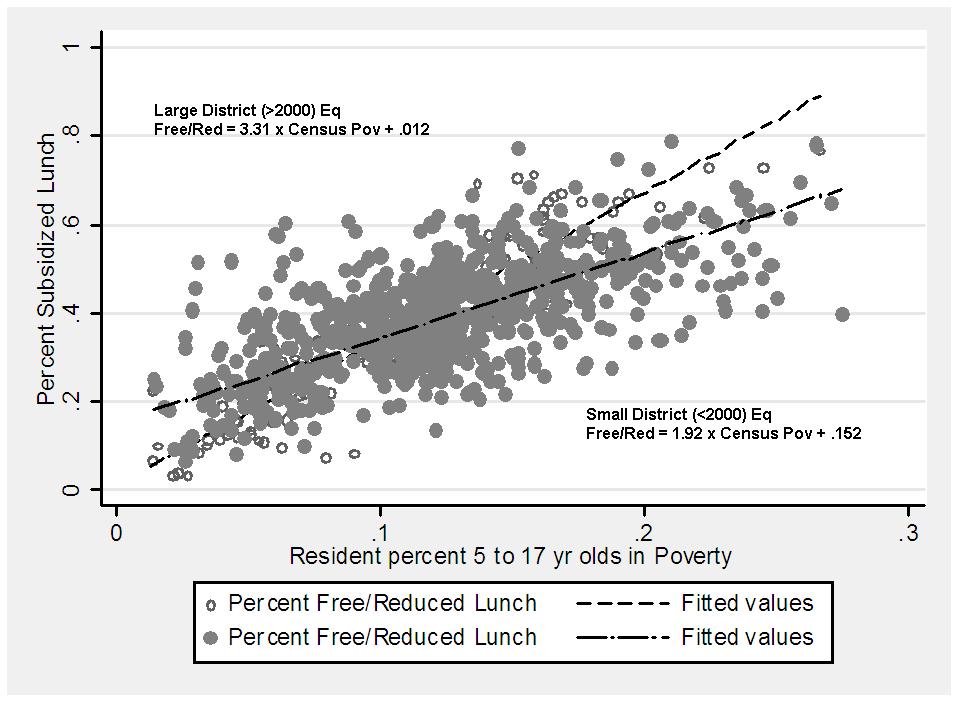
The problem with using the same multiplier (2.37) for smaller and larger districts across the state is that the ratio of at risk children to census poverty tends to be higher in larger districts – about 3.3 (over 2,000 students) to 3.36 (over 5,000 students) – and lower in smaller districts (under 2.0 in districts enrolling fewer than 2,000 students). This happens because of the way in which those income thresholds cut differently across urban and rural areas. Too little time to fully explore this issue here.
Here’s a figure that shows the slope for larger and for smaller districts in Kansas based on three years of data from the National Center for Education Statistics.
Relationship between Census Poverty Rates and Subsidized Lunch Rates in Kansas
Now, I don’t suspect that the legislators who proposed this new trick really understood quite why this new approach would lead to reduced at risk funding for large high poverty districts, but I have little doubt that they understand fully that this policy will have this effect (and that they chuckled when they had this revelation) – and that is precisely why it has been proposed.
HB 2357 follows a long line of similar Kansas policies both prior to and following court rulings – from new facilities weighting, to the “high priced house” adjustment, to the middle/upper middle class failure weight.
While I must congratulate them on their new found creativity, I must urge the Kansas Legislature to simply get over it and for once try doing the right thing!
DUMP 2357, or at least fix those ratios to be differentiated on the basis of district size.
=====
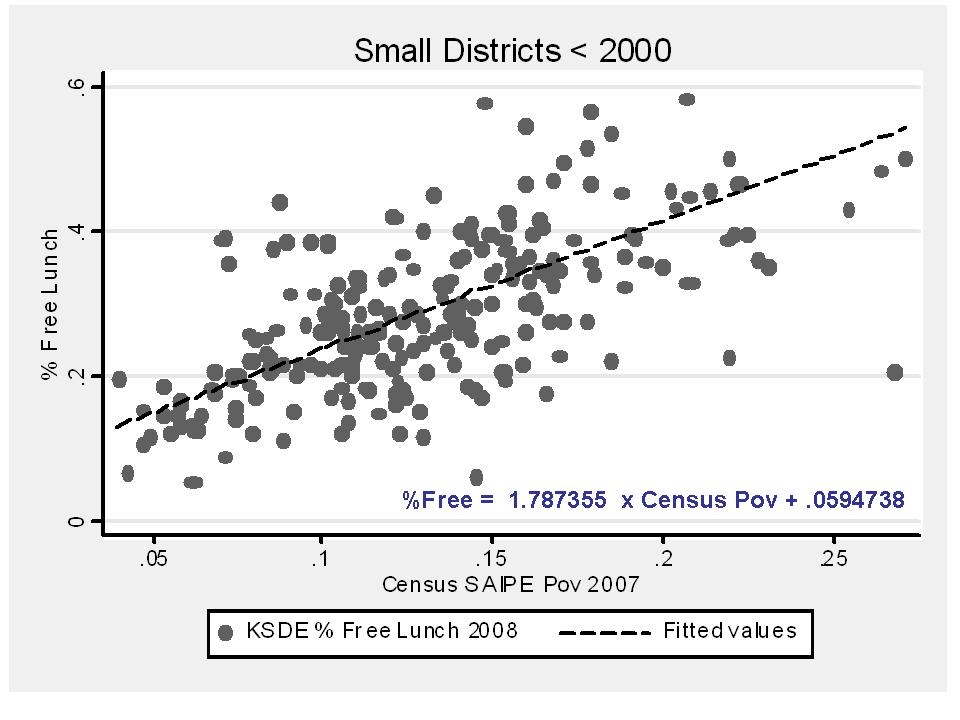
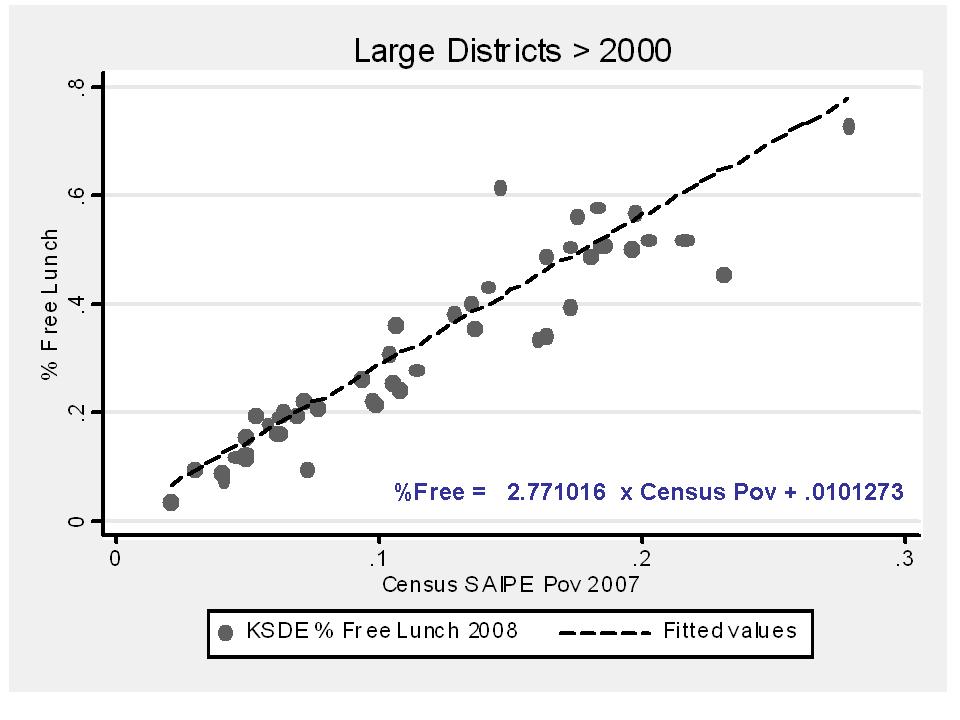
Quick rerun of the equations for 2008 KSDE % Free Lunch numbers as a function 0f 2007 Census Small Area Poverty Rates:
Small district (<2000) equation is
%Free = 1.787355 x Census Pov + .0594738
Larger district (>2000) equation is
%Free = 2.771016 x Census Pov + .0101273
By the way… it doesn’t look like there are a whole lot of outliers among the larger districts. They’re not the ones with the irregular free lunch counts – at least by reference to poverty rates… so why implement a policy that penalizes them?
Here are some quick summary points regarding education funding and student outcomes in Louisiana and Mississippi, two states getting some national attention these days…
1. In Louisiana, according to data on 5 to 17 year olds from the American Community Surveys of 2005 to 2007, approximately 17% of children avoid the public schooling system to attend private schools. That’s second highest in the nation. Mississippi is closer to, but still above the middle among states.
2. In addition to ranking second highest in non-public school attendance, Louisiana also ranks second lowest in “effort” in financing public schools, where effort is measured as total state and local spending on public education as a percentage of gross state product. Mississipi, because it is a generally poorer state with lower GSP, is nearer the average on effort.
3. Both states rank near the bottom annually on the reading and math portions of the National Assessment of Educational Progress.
4. Both states rank near the bottom annually on state and local per pupil spending on public schools even after adjusting for regional variation in competitive wages and for various other characteristics of public schools (size, poverty rate, etc.).
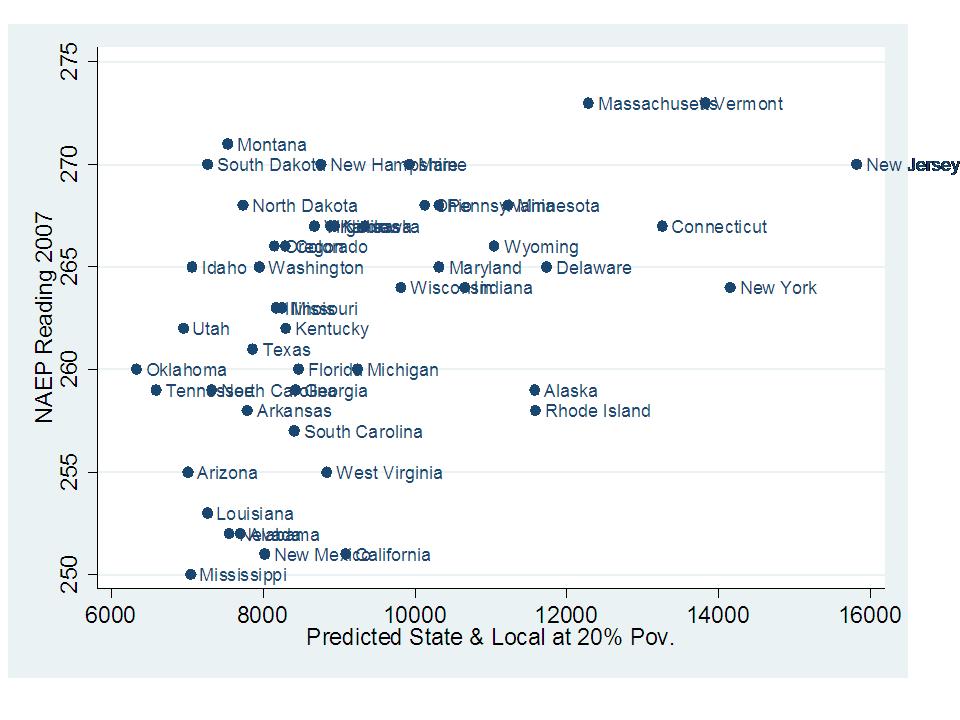
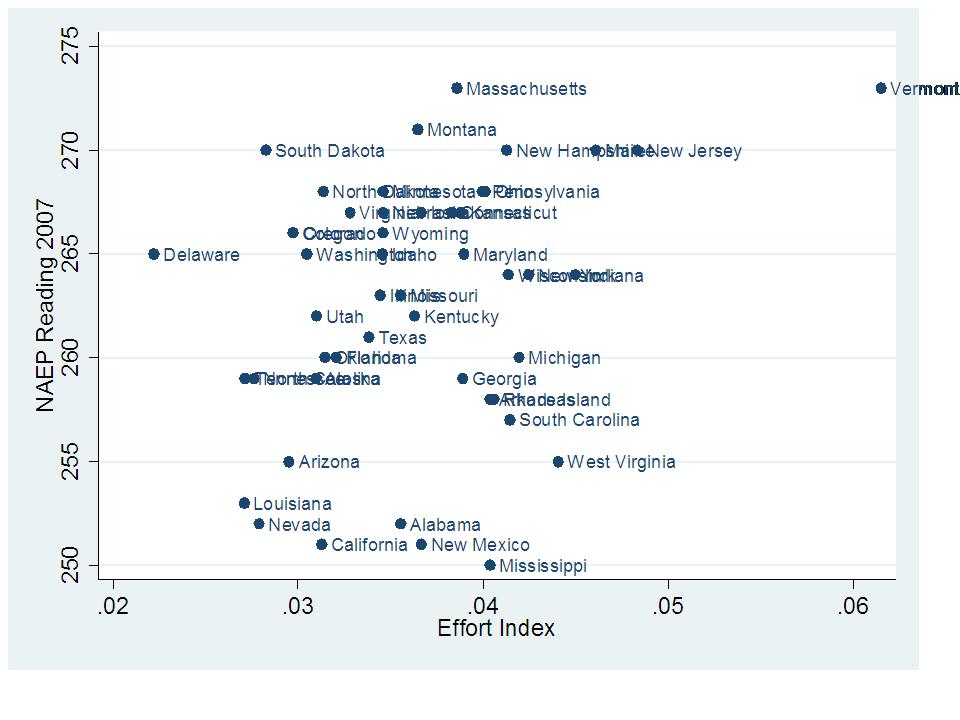
The two figures below are illustrative of the position of Louisiana and Mississippi on questions of education funding, effort and outcomes.
Regional Wage and Cost Adjusted State and Local Revenues and NAEP Reading
This first chart shows that there exists a modest relationship between state and local spending on education across states and NAEP reading scores. And two states that spend little and achieve little are Louisiana and Mississippi.
Effort and NAEP Reading
This second graph shows the relationship between Effort (% of GDP spent on public schools including state and local resources) and NAEP reading scores. As noted above, Mississippi puts up relatively average effort but in spite of this effort simply cannot muster the resources to achieve desirable outcomes with it’s very high poverty student population.
Lousiana has much less excuse than Mississippi. It’s effort is low. It’s spending is low, and indeed it’s outcomes are low, for those who remain left behind in public schools in Lousiana.
Once again, efforts to reform Philadelphia public schools are in the news, and one item that remains at least a significant part of that reform package is a proposal to use a Weighted Student Funding formula to improve equity in resource allocation across schools within the Philadelphia public school system. Here’s the link to a recent story:
Let me be absolutely clear that I am not opposed to Weighted Student Funding per se. What I am opposed to, and have been very vocal about, is the overselling of Weighted Student Funding as a panacea for both within district equity concerns and for decentralized management of schools and school systems.
Let me start here by clarifying that Weighted Student Funding and decentralized management are two separate issues that are often purposefully entangled when presented by pundits. Indeed, having a well defined school based allocation formula can enable decentralization of decision making to building principals. I offer (reiterate) three potential concerns here regarding weighted student funding coupled with decentralized management, specifically regarding Philadelphia.
1. It remains very difficult if not entirely infeasible for large urban school districts to successfully tilt their internal playing field (across schools within district) when those large urban districts remain at a competitive disadvantage regarding financial resources compared to surrounding districts competing for teachers on the same labor market.
In no major city in the nation is this concern more true than in Philadelphia (with Chicago running second). In relative terms (urban core per pupil spending relative to surrounding districts), Philadelphia has consistently been the least well funded urban core district in the nation for quite some time… falling in some years as low as 76% of surrounding district spending (using the NCES labor market definition).
In my recent work on Texas and Ohio cities, none of which are as poorly positioned as Philadelphia, I found that the relative funding of the urban core compared to surrounding districts poses a significant constraint on the urban core district’s ability to reshuffle funding. For example, the lowest poverty, lowest minority concentration schools in the urban core typically are higher poverty, higher minority concentration than suburban schools only streets away. Even before tilting the playing field to move funding out of the lower poverty urban district schools and to the higher poverty ones, the lower poverty schools within the urban districts are already at a competitive disadvantage relative to even lower poverty neighboring schools in adjacent suburbs. This is not to suggest, by any means, that the urban core districts should make no attempt at leveling their playing field, but that the urban district may be unable to significantly tilt their playing field to assist the higher poverty schools. Here is a schematic diagram I often use to describe this problem:
Difficulties in Tilting the Within District Playing Field
Here is an example of school level budgets per pupil (elementary schools) in a section of Dallas, immediately adjacent to marginally lower poverty but higher spending schools in Mesquite ISD.
Spending per Pupil in Dallas Schools and Neighboring District
Now, credit should be given to ye ol’ Commonwealth of PA for recently adopting their first, statewide, reasonably organized basic education funding formula (special education remains substantially screwed up), albeit slowly phased in and already under the gun due to state budget concerns. However, the figure below shows that even after first year state support shifts, Philadelphia city school district remains at a significant financial disadvantage compared to districts in Montgomery, Bucks, Chester and Delaware counties (neighbors in the same labor market).
Philadelphia is much higher poverty than neighbors, and still has fewer financial resources!
2. There is little compelling evidence that large urban districts using Weighted Student Funding are achieving any greater equity in resource allocation across schools when compared with other large urban districts in the same state which do not use WSF.
This was a major finding of my recent and ongoing work. Look, the reality is that any resource allocation formula from state to school districts or from school districts to schools, is subject to political tug-of-war.Whether we’re talking about allocating staffing positions from one school to another, or dollars generated by weights, constituents involved in the process will attempt to figure out which levers on the system can be used to benefit them and then the games will begin. This is how, for example, Cincinnati ends up adopting within its weighted funding formula a larger adjustment for gifted children than for children in poverty. This is how, for example, the state of Kansas had adopted a larger weight for children in “new facilities” (in affluent suburban districts) than for children in poverty or children with limited English language proficiency (prior to recent court rulings). These are the politics of weighted funding systems – and these politics differ little from any other politics which involving shifting finite resources toward some and away from others.
One should not be fooled into believing that Weighted Funding eliminates such games. It merely creates new ones. (see my Art of Inequitable School Funding post)
3. After presenting one critical review of weighted student funding and decentralized governance I was challenged by a skeptic of my work to provide any reasonable argument against the decentralized governance component – on the basis that it is somehow a well understood and broadly accepted fact among scholars that decentralized governance of large urban school districts is necessarily good – always and forever.
In light of the first two points above, consider the following. First, decentralized decision making is and can only be as good as the decentralized decision makers – in this case, the principals of schools to be granted greater control. Now, this issue is largely about equity right? Well, as it turns out, in many urban settings, the principals with the weakest academic qualifications (those who’ve repeatedly failed certification exams, attended academically weaker undergraduate and graduate preparation programs) are leading the schools with the highest poverty and minority concentrations. Some of my earlier work (in Educational Administration Quarterly with Bruce Cooper) indicates a propensity among principals to hire teachers with academic backgrounds similar to their own – a propensity which can work for the positive, or negative.
With leadership quality distributed in this manner across schools within large urban districts, would decentralizing control lead to greater equity? I suspect not. Further, if district resources are relatively constrained as in Philadelphia it remains unlikely that leadership quality may be effectively redistributed (by paying high enough salaries to principals of the toughest schools) and even less likely that those principals can be provided sufficient resources to recruit and retain the teachers they need.
===
So… all of that heavy stuff in mind, I urge caution in making too much of this next round of Philadelphia school reforms and other similar attempts elsewhere. Without sufficient targetted resources to Philadelphia public schools, the district may continue to spin its wheels for some time. I hope not.
One area of school finance about which I’ve written quite a bit is what I refer to as the “tricks of the trade” in state aid allocation formulas. Most people who study or observe state school funding policies, including popular media outlets like Education Week tend to make the automatic assumption that increased state effort toward financing local schools necessarily leads to more equitable distribution of resources. After all, the initial goals of state intervention and aid allocation were to (a) encourage towns to create public schooling systems for their children and (b) to equalize towns’ ability to pay for schools, because substantial disparities in taxable property wealth across towns made it more difficult for some than others to pay for quality schools.
However, as state aid formulas have become increasingly complex over time, so too have the various ways in which state legislatures may craft allocations of aid in ways that actually send fewer dollars to those who need them more. Here is my short list of some of the more common Tricks of the Trade that shift state aid away from poorer, higher minority concentration school districts and quite often toward neighboring affluent suburban districts. Many of these policies lead to sharp racial differences in funding across school districts. And at least some of these policies are built on historical racial disparities within public education systems and in housing and residential segregation.
1. Aid allocated based on Average Daily Attendance rather than based on enrollment or membership. This one is relatively straight forward. Higher poverty and higher minority concentration school districts tend to have lower average daily attendance rates. As such, providing per pupil financing on the basis of average daily attendance systematically reduces aid to high poverty, high minority districts. Preston Green and I show this effect in an article titled “Urban Legends, Desegregation and School Finance: Did Kansas City Really Prove that Money Doesn’t Matter.”
===
Missouri is among a handful of states that continues to provide aid to local public school districts on the basis of their average daily attendance (ADA) rather than by enrolled pupil count or membership. From 2000 to 2004, poverty rates and black student population share alone explain 59% of variations in attendance rates across Missouri school districts enrolling over 2,000 students. Both black population share and poverty rate are strongly associated with lower attendance rates, leading to systematically lower funding per eligible or enrolled pupil in districts with higher shares of either population. Table 9 shows that, in 1999, while districts on average (excluding KCMSD) lost 5.6% of state aid due to differences between enrollment and ADA, KCMSD lost nearly 13%. That margin has decreased after KCMSD had improved its attendance rates. Nonetheless, KCMSD continues to receive a lower share of state aid due to ADA based funding, than other districts with lower poverty rates and smaller black populations.
====
2. Incorrectly estimated or wrongly conceived geographic cost (wage variation) adjustments. Geographic cost adjustments seem to be the new, hip and cool way to manipulate state aid formulas in order to drive more funding to affluent suburban districts, or in the case of Wyoming, very affluent tourist locations (Jackson Hole). Because estimating a well conceived and appropriate factor to compensate for variations in employment costs can be a complicated endeavor, Legislatures in some states have latched on to “plain common sense” solutions to twist state aid in their favor. I write about the worst of these in a recent article in the journal of education finance titled Doing more harm than good. The two most offensive examples of which I am presently aware are the Wyoming legislature’s choice to retain an index that provides 40% additional resources to Jackson Wyoming simply because the average housing value in Jackson (for tourist properties of the rich) is much higher than the rest of the state. Equally offensive is the Kansas policy that allows additional revenues to be raised in the 17 districts with housing values over 25% above state average. Most problematic about this Kansas policy is that those receiving the adjustment are districts in the Kansas City metropolitan area where the majority of residential housing was developed with racial restrictions in deeds – restrictions that were introduced as late as 1962 (years after prohibited by the U.S. Supreme Court) and were only symbolically stricken from deeds in 2006 (after some Kansas legislators resisted when the issue was raised the previous year). For a fun article on this topic, see: http://www.pitch.com/2005-04-14/news/funny-math/
More on this topic at a later point.
3. Allocating or adjusting aid based on existing patterns of teacher degree levels or teacher experience. An alternative to creating a complex wage index for adjusting aid is simply to include a factor that reinforces directly the existing patterns of disparities in teacher qualifications across wealthier and poorer school districts. Preston Green and I, in an article in the American Journal of Education titled “Tricks of the Trade” explain how Alabama, which at one time funded its highly segregated public schooling system on teacher units, assigning white teacher units twice the dollar value of black teachers, managed to accomplish roughly the same pattern of disparity across black and white schools by retaining their teacher unit funding model but allocating more money to schools having teachers with advanced degrees (the whiter, less poor schools). The Arizona alternative is to provide more funding to districts where the average teacher experience level is above the state average (whiter, less poor schools) – the Teacher Experience Index.
Like funding on attendance (why should we pay for kids who aren’t there?), funding on teacher experience and degree level can be argued to pass that “plain common sense” test, at least in some states. “Let’s fund ’em for the teachers they dun-did-got… not them ones they wish they dun-did-got or for cryin’ out loud, the ones they actually need.”
4. Allocating substantially higher levels of aid per high school student than per elementary school student in a district (student grade level weighting within K-12 unified school districts).
This one is a little trickier and more subtle, and thankfully the average effect of this “trick” seems to be somewhat smaller than the others on this list. But, I have found in some recent work that when a state puts a big enough differential in place on the cost of high school students relative to elementary school students, poorer, higher minority unified K-12 school districts end up receiving systematically less funding than more affluent districts. There appears to be a relationship between the percentage of children who are in elementary versus high school grades and district poverty rates. Higher poverty districts have more children in elementary grades and fewer in upper grades, and there may be any number of logical explanations for this pattern. First, dropouts may affect the pattern. Second, as children grow up beyond elementary grades, their parents may become more professionaly stable and have the opportunity to move up and out. Also, those same parents may have had the option while the child was in the elementary grades, but when faced with the prospect of poor urban middle or secondary schools they finally exercised that option. Or, they perhaps exercised the private schooling option (urban Catholic high school).
5. Census-based financing of special education programs. I used to strongly favor the “flat” or census based special education funding approach because of the increased flexibility and reduced incentive to identify children with marginal disabilities. For those not familiar, census based funding for special education involves setting a statewide average (or some other arbitrary) rate of assumed children with disabilities that exist in all school districts and then funding on that arbitrarily set assumed rate. Okay… those of you working in the field of special education can see the problem with this already… but that hasn’t slowed the policy momentum in this direction, has it?
After evaluating a handful of state special education finance programs, I’ve changed my mind… quite strongly. Hey… we don’t provide the same amout of poverty based funding across districts – because the concentration of children in poverty varies by neighborhood and town. We don’t provide the same level of funding for bilingual education programs – because the concentrations of children with limited English speaking skills varies by neighborhood and town. And, as I’ve come to learn, the concentrations of children with various forms of disabilities vary by neighborhood and town… and in some cases in logical and explanable ways. Large town and small city hubs that are otherwise distant from major urban centers and surrounded by rural areas often have much higher rates of children with disabilities than their surrounding rural districts. These patterns show up in both school enrollment data and in U.S. Census data based on resident responses (not school identification practices). It seems logical that parents having children identified with a disability might choose to relocate to the nearest population hub where a wider array of social and medical services are available. Whatever the reasons, disability population concentrations, like poverty, vary widely from one location to the next across states. And quite often, disability concentrations vary in relation to poverty and even minority student concentrations. In two states where I have conducted recent analyses, higher poverty school districts are systematically disadvantaged by this flat approach to special education funding.
I feel compelled to provide this brief historical note regarding consolidation of school districts in Kansas and questions over the court’s authority to use Article 6, Section 6 of the Kansas constitution as a basis for compelling the legislature to “make suitable provision for finance of the educational interests of the state.” You see, that version of Article 6 wasn’t always there. That bit that requires the legislature to make suitable provision for finance. It was added in the 1960s. Okay… so that means it was added by some hippy do-gooders who don’t represent today’s more thoughtful Kansas values. Wait… that’s not entirely how it happened. The re-drafting of the education articles came about at least in part – if not primarily – because the legislature had repeatedly tried to figure out a way to consolidate schools. If I recall correctly, in the 1940s and later, the legislature passed one law after another trying to force consolidation, but the meddling KS supreme court of the time wouldn’t let them, because they did not have the constitutional authority to do so. So… what did they do… they proposed a redrafting of the education article to grant themselves that authority, and simultaneously granted themselves the responsibility to make suitable provision for finance. In fact, they got the new education article ratified in 1966, just in time to make sure that the 1963 consolidation law could be fully implemented without court intervention.
That in mind, here’s Mike O’Neal back in 2005 responding to the court’s authority to invoke that “suitable” clause in Article 6 –
Some lawmakers questioned whether the court even had the authority to order additional funding.
“If the court is telling me to vote for $143 (million) in extra money, and I don’t think it’s in best interest of the state of Kansas, taxpayers or my school district, I’m not going to do it,” said Rep. Mike O’Neal, a Hutchinson Republican and one of the architects of the bill. “I think that’s the way all 165 legislations should feel about it.”
Interestingly, O’Neal seems more than ready – now – to take advantage of the authority granted by the 1966 constitutional revisions, but seems somewhat averse to accepting the responsibility.
===============
Excerpt from a forthcoming book chapter by Bruce Baker and Preston Green:
Separate and Unequal by Design: What’s the Matter with the Rising State Role in Kansas Education?
Previous attempts at consolidation had been overturned on the partial basis that the legislature lacked the authority to delegate control to county level committees to oversee and manage consolidation (Donaldson v. Hines, 1947; School District, Joint No. 71, Rooks County v. Throckmorton, 1962). In the 1963 Act, the legislature adopted an alternative strategy of delegating oversight to the State Superintendent of Public Instruction. Every significant procedure in the process, including ratification of local elections, required the state superintendent’s decision or approval (State Department of Public Instruction, 1967).
Perhaps questioning whether they were again walking on tenuous ground in allocating so much authority to the State Superintendent of Public Instruction, legislators sought to redraft the state’s constitution to specifically grant themselves the authority to do what they had already done. An 11-member citizen task force was formed to make recommendations to legislators regarding guiding principles for revision of Article 6 of the constitution. The proposed language for a new Article 6 included, among other things, the following:
Section 1: The legislature shall provide for intellectual, educational, vocational and scientific improvement by establishing and maintaining public schools, educational institutions and related activities which may be organized and changed in such manner as may be provided by law.
Section 2: (a) The legislature shall provide for a state board of education which shall have general supervision of public schools, educational institutions and all the educational interests of the state, except educational functions delegated by law to the state board of regents. The state board of education shall perform such other duties as may be provided by law.
Section 5:Local public schools under the general supervision of the state board of education shall be maintained, developed and operated by locally elected boards. When authorized by law, such boards may make and carry out agreements for cooperative operation and administration of educational programs under the general supervision of the state board of education, but such agreements shall be subject to limitation, change or termination by the legislature.
Section 6: The legislature shall make suitable provision for finance of the educational interests of the state. No tuition shall be charged for attendance at any public school to pupils required by law to attend such school, except such fees or supplemental charges as may be authorized by law. The legislature may authorize the state board of regents to establish tuition, fees and charges at institutions under its supervision.
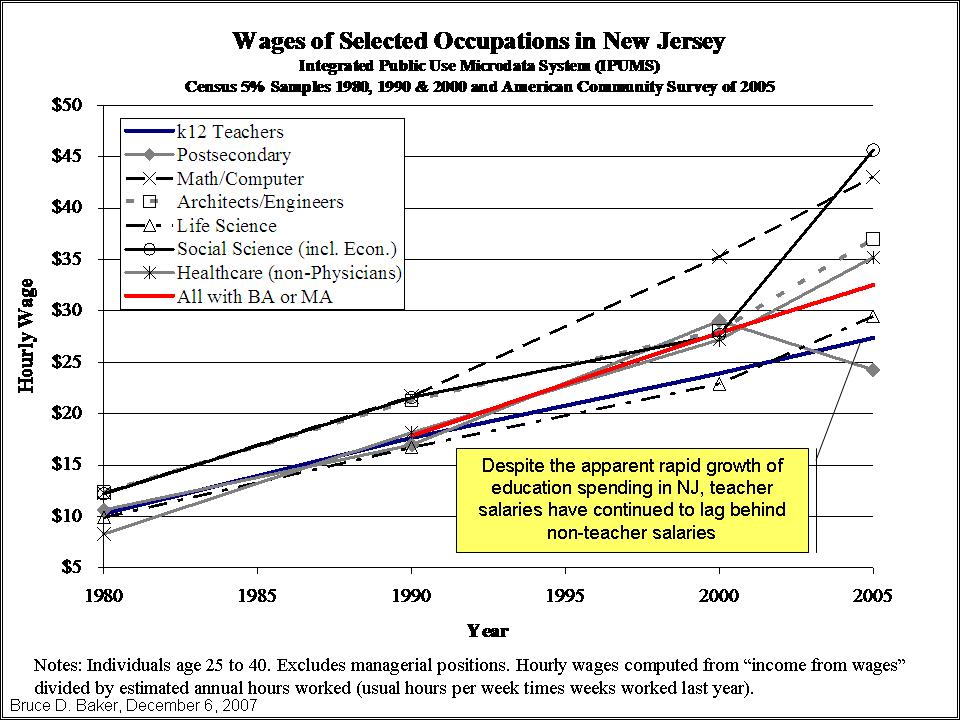
I start this entry with a graph. We’ve all been hearing about the rough economic times and troubled state budgets. And, in New Jersey we’ve been hearing about how public employees should take the hit, just like private sector employees. At least some media outlets love to to toss around the bombastic rhetoric about how everyone else is suffering and has been for years… while those damn teacher salaries – because of their powerful unions – have just continued to climb and climb – seemingly leaving the rest of us in the dust.
Well, above is one verison of the story – a comparison of teacher wages with wages from other professions for individuals aged 25 to 40 holding a bachelors or masters degree (degree levels held by most teachers). For this analysis I use hourly wages drawn from decennial census data (www.ipums.org) and from the American Community Survey (ACS for 2005). Teacher wages are shown on the blue line, and were relatively competitive in 1980 according to these data. Since 1990 teacher wages have lagged significantly relative to other individuals with a BA or MA (and similar age span) in other professions.
When budgets get tight across states, legislatures try to figure out where they are going to find savings… as fast as possible. One idea that resurfaces now and then is consolidation of school districts and/or other layers of government within states, where some of those layers draw on state resources – especially schools. The issue has again emerged in Kansas as having the potential to produce “huge” savings. There is little doubt in the research literature on public education costs that smaller school districts do have elevated costs of producing even the same outcome levels of larger districts. The best review of literature on this topic was written by Andrews, Duncombe and Yinger (2002) in the Economics of Education Review, which noted that costs tend to rise for districts enrolling fewer than 2,000 students. Costs tend to rise most sharply for districts enrolling fewer than 300 students. Duncombe and Yinger have also produced more recent work on the potential savings from consolidation.
In this article (later published in the Journal of Education Finance and Policy) the authors do find that consolidation can lead to reduced operating costs – assuming schools within districts are reorganized to achieve more optimal size.
As you might expect, Kansas Liberty, throwing its support behind the conservative house Speaker Mike O’Neil has chosen to echo the speaker’s arguments about the huge potential savings… most likely from reduction of administrative redundancies (their argument… certainly not mine).
Consolidating Kansas school districts and other layers of government further is probably a good idea, but the savings are unlikely to be any where near as large as legislators might desire. A few important points:
1. central administrative overhead costs for public schools are relatively small – as a share of public education expenditures. The real long term savings comes not so much from reducing centralized administration (numbers of district units) but from reorganizing individual schools into more optimal operating sizes – where feasible (elementary schools of 300 to 500 students and high schools of 600 to 900 students). But, achieving this optimal long run arrangement often means significant increases in short run capital costs. As such, a well designed consolidation plan likely does not help with the short term budget crunch.
2. When one thinks of consolidating Kansas school districts, one often thinks only of consolidating the smallest of rural school districts, but many of these districts likely can’t feasibly be consolidated at the school level. Only the relatively small district level redundancies might be eliminated. One must also look to reorganize smaller districts that are carved out of and clustered near the state’s much larger cities and towns (e.g. consolidating Piper with KCK).
As for total savings, the legislature needs to realize that large shares of the state’s children already attend scale efficient, reasonably well organized school districts (as a function of the 1963 consolidations) and many of the children who attend very small districts also attend districts that are geographically remote, such that the bulk of operating costs cannot (with present teaching/learning strategies) be cut.
Consolidating and/or reorganizing school districts is likely an even more viable option for states other than Kansas. I cannot say enough that the rationality, equity and adequacy of state programs for financing public school systems is inextricably linked to the organization of those school districts – the grade ranges of children they serve, the enrollment size of those districts and the extent to which many small “un-organized” school districts are, in some states, carved out of densely populated areas.
Below is a table of states ranked by the percentage of children in those states who attend scale efficient (>2,000 students) unified K-12 school districts (NCES Common Core of Data fro 2006-07). While states like Montana, South Dakota, Wyoming and Nebraska make this list – as does Kansas, there is arguably less that can be done in these states to feasibly relocate children into schools and districts of optimal size.
Vermont, on the other hand is a particularly interesting case – with only slightly more students in total than Wyoming, but very few attending unified public school districts of reasonable size. Vermont is near the top of my list for major re-organization, especially as student enrollments continue to decline. The lack of organization of Vermont school districts, the role of non-operating districts and complex tuition arrangements between elementary and union high school districts has – year after year – undermined that state’s ability to achieve greater equity in school funding.
The case is similar, though arguably even more exaggerated in the nation’s most population dense state – New Jersey. Like Vermont, New Jersey has a multitude of small, non-unified school districts, not in the remote southern pine barrens area, but in densely populated areas adjacent to New York City (Bergen County) and near Philadelphia. In some cases, undersized K-8 school districts span a few city blocks. Even more so than Vermont, New Jersey has made efforts to improve equity in school funding – but some of these gains are necessarily offset by the awkward and inefficient organization of New Jersey school districts.
Finally, there’s Illinois – which unlike Vermont or New Jersey has never really made any effort to improve equity in financing schools. In fact, Illinois is among the only states that to this day maintains a persistent strong negative relationship between available school resources and school district poverty and racial composition. Now, not familiar with details of school district organization in Illinois, one might assume the unorganized school districts to exist in the southern and more rural regions of the state. However, Illinois’ lack of organization of school districts mirrors that of New Jersey – existing primarily in the most densely populated suburbs around Chicago.
So, there they are… my picks for the day for consolidation and reorganization – Vermont, Illinois and New Jersey – if anyone is paying attention. In Illinois and New Jersey especially, the geographic constraints to reorganizing where students attend school are minimized. Vermont might take a little more work, and all three will require some significant investment in new and reorganized infrastructure.
Okay… so the media is on it. Do a Google News Search on “Education Week” and “Quality Counts” and you’ll get over 100 headlines from major and small local news outlets across the country, like:
Unfortunately, as I discussed yesterday, at least the finance portion of these ratings is relatively meaningless – failing to capture critically important features of state school finance systems. (See my previous post)
This failure is particularly evident in the paragraph below from the Education Week summary of their newest findings. Yes, there are huge disparities in funding across Alaska schools – because tiny remote school districts are incredibly expensive to operate, relative to scale efficient districts in the state’s larger cities and towns. And yes, there are relatively large differences in spending across New Jersey districts. But New Jersey, more than any other state in the country (along with others like Minnesota), systematically allocates greater resources to poor urban districts. Much of the difference in resources across New Jersey school districts can be predicted as a function of student need variation across districts. And so it should be.
Broadly speaking, equity indicators still show wide disparities across districts in many states. For example, our Restricted Range indicator measures the difference in per-pupil expenditures between school districts at the 95th and 5th percentiles of spending within individual states, adjusted for regional cost differences and student needs. Smaller gaps denote more equitable spending across the districts in a state. Our analysis found a $12,307 gap between those high- and low-spending districts in Alaska in the 2005-06 school year, the largest difference in the nation. New Jersey had the second-largest gap—$10,838—and West Virginia displayed the smallest gap at $1,895.
This particular article in the Lawrence Journal World includes a quote by a legislative leader that perpetuates one of the standard myths of education funding – that somehow, any funding that is not “going to the classroom” is necessarily wasteful funding.
This argument relates back to a “movement” of a few years ago in which pundits bankrolled by Overstock.com CEO Patrick Byrne were wining and dining conservative state legislators to get them to introduce legislation that would mandate that 65% of each education dollar be spent in the classroom! Thankfully, this movement came to a grinding halt when the motives of this movement came out in a memo (exposed by the Austin Statesman) by the movement’s main pundit – Tim Mooney.
Anyway, a colleague – Douglas Elmer – and I have a new article out on this topic, and Off the Shelf school finance reforms (in Educational Policy, vol 23, #1, Jan. 2009).
From our recent article, here’s a quick run-down on what research studies say on this particular topic:
===========
The core assumption of the 65% solution is that increasing the share of spending to areas labeled as “instruction” will improve student outcomes without increasing overall levels of education spending. Implicit in this argument, and highlighted by some anecdotal examples provided on the FCE web site, is the notion that schools are presently wasting too much money in areas such as administration. FCE argues the districts can reallocate that money to instruction. In the 1990s, while schools endured the aftermath of A Nation at Risk and the subsequent criticisms of rising education spending and stagnant outcomes, many policy analysts conducted studies on education spending. These studies made the forgone conclusion that central administrative expenses were necessarily inefficient and therefore harmful for students, and that higher percentages of dollars allocated “to the classroom” were efficient, and therefore beneficial to students. Programmers developed software for school districts to track dollars to the classroom[1]and studies reported instructional expenditures in New York City schools at only 21.9% in an attempt to validate the inefficiency of large urban school districts (Speakman et al., 1996). However, few methodologically strong studies were able to directly link student outcomes to the ratio of resources districts allocated to administrative and other non-instructional expenses and classroom instructional expenses.[2]
A significant point of confusion in the literature on instructional spending relates to the difference between instructional spending levels and instructional spending as a share of total spending. For example, proponents of the 65% Solution point to a policy brief prepared for Texas legislators (Patterson, 2005) citing the research of Wenglinsky (1997) as finding a positive relationship between instructional spending and student outcomes. Wenglinsky, however, does not evaluate tradeoffs between instructional and other spending an outcomes, but rather finds that either instructional or administrative spending increases, both of which appear related to increased overall staffing and class size reduction, lead to improved educational outcomes.
Like Wenglinsky (1997), Ferguson and Ladd (1996) find in Alabama that instructional spending has a positive effect on test scores. Using data from Oklahoma school districts, Jacques and Borsen (2002) evaluate the effects of spending levels on student outcomes across a variety of categories, finding “Test scores were positively related to expenditures on instruction and instructional support, and are negatively related to expenditures on student support, such as counseling and school administration.” (p. 997) The authors raise concerns however with deriving causal implications from their findings, noting: “It could be that schools with problems hire more administrators and counselors.” (p.997) Taken together, these findings suggest that when policy makers add new money to education systems, adding that money to instruction areas while holding other areas constant may improve outcomes. In each case, however, researchers evaluated the level of resources allocated to schools, but not tradeoffs or potential reallocation of existing levels of resources. A core tenet of both the 65 and 100% solutions is not that states raise the level of funding for schools, but rather that lawmakers’ require districts to reallocate existing funds.
Bedard and Brown (2000), in an unpublished working paper, attempt the leap from evaluating levels of spending across categories to evaluating relative proportions, and find that reallocation from administration specifically toward classroom instruction might lead to increased outcomes. “Either the reallocation of $100 from administrative to classroom spending, with no change in overall expenditures, or an $100 increase aimed directly at the classroom moves the average California high school approximately 5 percentage points higher in the state test score rankings.” (p. 1) But, Taylor, Grosskopf and Hayes (2007) also in an unpublished working paper, using data on Texas schools to test directly the 65% solution, find that “the analysis suggests that schools that spend a larger share of their budgets on instruction are significantly less efficient than other public schools.” (p. 1)
Two other published, peer reviewed studies specifically examine the relationship between administrative expenses and student outcomes also yielded conflicting findings.In one, Brewer (1996) found little relationship between non-instructional expenses and student outcomes.Marlow (2001), contrasting with Brewer’s findings to an extent, found that: “While numbers of teachers do not influence performance measures, numbers of administrators are shown to positively affect performance — results that suggest that too many teachers, but too few administrators, are employed.”[3]
Finally, Huang and Yu (2002) combine NAEP data with NCES Common Core expenditure data to evaluate whether current expenditures per pupil and/or the difference between an individual district’s instructional spending rate and the state average instructional spending rate (called DDR in their study) relate to student outcomes in 1990, 1992 and 1996. The authors found overall positive effects of current spending on outcomes but “Net of relevant district factors, DDR was found unrelated to districts’ average 8th grade math performance.” This test is similar to testing whether districts over or under a 65% instructional spending threshold perform better or worse. The difference is that each district’s instructional share is benchmarked against its own state mean.
Probably the best, and most direct recent test of the 65% solution can be found here:
Taylor, L., Grosskopf, S., Hayes, K. (2007) Is a low instructional share an indicator of school inefficiency? Exploring the 65 percent solution. Bush School of Government and Public Service. Texas A&M University. Working Paper # 590
[1] Entire states such as Rhode Island adopted these resource tracking systems (IN$ITE)
[2] However, several methodologically weak production function studies did find cross-school correlations between percentage of expenditures on instruction and school aggregate test scores.
[3] Marlow’s finding seems counterintuitive and may be explained by factors overlooked in Marlow’s analysis. Among other things, studies that are more recent have shown that districts with higher overall spending or higher fiscal capacity to spend tend to spend proportionately more on administration. Many of those same higher spending, higher fiscal capacity school districts also serve more advantaged student populations and/or benefit from stronger community support.



 School Finance 101