At the Intersection of Money & Reform Part I: Teacher Compensation

The blogging has been quiet for a while. This is partly because I feel like most issues that arise have already been dealt with somewhere on this blog. Also because I’ve been involved in several, simultaneous, long-term projects. These projects intersect with many topics I’ve addressed previously on this blog. At times, this blog serves as a palette for testing/sharing ideas. So… in this, and a rapid fire sequence of follow up posts, I will share some excerpts of forthcoming, and early stage in progress work. 

[from work in progress… some re-used stuff here, from http://www.shankerinstitute.org/resource/does-money-matter]

The Coleman report looked at a variety of specific schooling resource measures, most notably teacher characteristics, finding positive relationships between these traits and student outcomes. A multitude of studies on the relationship between teacher characteristics and student outcomes have followed, producing mixed messages as to which matter most and by how much.[i] Inconsistent findings on the relationship between teacher “effectiveness” and how teachers get paid – by experience and education – added fuel to “money doesn’t matter” fire. Since a large proportion of school spending necessarily goes to teacher compensation, and (according to this argument) since we’re not paying teachers in a manner that reflects or incentivizes their productivity, then spending more money won’t help.[ii] In other words, the assertion is that money spent on the current system doesn’t matter, but it could if the system was to change.

Of course, in a sense, this is an argument that money does matter. But it also misses the important point about the role of experience and education in determining teachers’ salaries, and what that means for student outcomes.

While teacher salary schedules may determine pay differentials across teachers within districts, the simple fact is that where one teaches is also very important in determining how much he or she makes.[iii] Arguing over attributes that drive the raises in salary schedules also ignores the bigger question of whether paying teachers more in general might improve the quality of the workforce and, ultimately, student outcomes. Teacher pay is increasingly uncompetitive with that offered by other professions, and the “penalty” teachers pay increases the longer they stay on the job.[iv]

A substantial body of literature has accumulated to validate the conclusion that both teachers’ overall wages and relative wages affect the quality of those who choose to enter the teaching profession, and whether they stay once they get in. For example, Murnane and Olson (1989) found that salaries affect the decision to enter teaching and the duration of the teaching career,[v] while Figlio (1997, 2002) and Ferguson (1991) concluded that higher salaries are associated with more qualified teachers.[vi] In addition, more recent studies have tackled the specific issues of relative pay noted above. Loeb and Page showed that:

“Once we adjust for labor market factors, we estimate that raising teacher wages by 10 percent reduces high school dropout rates by 3 percent to 4 percent. Our findings suggest that previous studies have failed to produce robust estimates because they lack adequate controls for non-wage aspects of teaching and market differences in alternative occupational opportunities.”[vii]

In short, while salaries are not the only factor involved, they do affect the quality of the teaching workforce, which in turn affects student outcomes.

Research on the flip side of this issue – evaluating spending constraints or reductions – reveals the potential harm to teaching quality that flows from leveling down or reducing spending. For example, David Figlio and Kim Rueben (2001) note that, “Using data from the National Center for Education Statistics we find that tax limits systematically reduce the average quality of education majors, as well as new public school teachers in states that have passed these limits.”[viii]

Salaries also play a potentially important role in improving the equity of student outcomes. While several studies show that higher salaries relative to labor market norms can draw higher quality candidates into teaching, the evidence also indicates that relative teacher salaries across schools and districts may influence the distribution of teaching quality. For example, Ondrich, Pas and Yinger (2008) “find that teachers in districts with higher salaries relative to non-teaching salaries in the same county are less likely to leave teaching and that a teacher is less likely to change districts when he or she teaches in a district near the top of the teacher salary distribution in that county.”[ix]

With regard to teacher quality and school racial composition, Hanushek, Kain, and Rivkin (2004) note: “A school with 10 percent more black students would require about 10 percent higher salaries in order to neutralize the increased probability of leaving.”[x] Others, however, point to the limited capacity of salary differentials to counteract attrition by compensating for working conditions.[xi]

In a perfect world, we could tie teacher pay directly to productivity, but contemporary efforts to do so, including performance bonuses based on student test results, have generally failed to produce concrete results in the U.S.[xii] Recently published studies of individual and group financial incentives continue to find mixed to null effects. [xiii] Alternative compensation models in some settings have yielded positive results. Dee and Wyckoff (2014) find some evidence that comprehensive strategy combining teacher evaluation and financial incentives can yield marginal improvements to the average rate of student achievement growth among retained teachers.[xiv] Similarly, in a study of Austin, TX pay for performance (P4P) program, Balch and Springer (2015) found that ““The AISD REACH program is associated with positive student test score gains in both math and reading during the initial year of implementation. Student test score gains are maintained in the second year, but we do not find any additional growth.” [xv] Sojourner and colleagues (2014) found “Exploiting district variation in participation status and timing, we find evidence that P4P-centered HRM reform raises students’ achievement by 0.03 standard deviations.” [xvi] In a more extreme application of financial incentives, characterized as “loss aversion,” Fryer and Levitt study the effect of providing teachers’ bonuses in advance and taking the money back if students do not improve sufficiently. They find that this approach “yields math test score increases between 0.2 and 0.4 standard deviations. This effect is on par with the impact of increasing teacher quality by more than one standard deviation.” [xvii]

Still missing in this literature are cost effectiveness comparisons of the alternatives. That is, if we take the same total payroll dollars and allocate those dollars traditionally across teachers with incremental differences in salaries by experience and credentials held, as opposed to implementing those salaries and bonuses by the above alternatives, along with the associated costs of the evaluation metrics used for allocating salaries, do we see differences in production of student outcomes? That is, can comparable or better outcomes be achieved where the summed costs of alternative compensation and costs of producing metrics for allocating that compensation are equal to or less than current costs?

Assertions that performance-based pay is necessarily more cost-effective than traditional salary structures also falsely assume traditional step and lane salary schedules to be monolithic. In practice, salary differentials associated with experience and credentials vary widely. Some are compressed from top to bottom, and some not. They may favor experience over credentials or vice versa. Hendricks (2015a, 2015b) explores these issues. Hedricks finds that

“Increasing salaries for teachers with 3 or more years of experience differentially retains high-ability teachers, while higher salaries for teachers with 0-2 years of experience differentially retain low-ability teachers. This likely occurs because higher early-career salaries disrupt a positive sorting process that exits among novice teachers.”[xviii]

That is, one might restructure traditional salary schedules to achieve gains comparable or greater than deeper structural changes to compensation. Hendricks also finds that changing salary structures may alter recruitment potential, and the recruiting pool:

“Overall, a 1% increase in base salary for teachers of a particular experience level increases the proportion of the targeted teachers hired by 0.04-0.08 percentage points. Pay increases have the largest effect on hire rates among teachers with 2-3 years of experience and the effect diminishes with experience. I show that higher teacher salaries provide a dual benefit of retaining and attracting a more effective distribution of teachers. Districts may also improve student achievement growth at no cost by reshaping their salary schedules so that they are increasing and concave in teacher experience.”[xix]

In the wake of growing literature and policy rhetoric asserting the inefficiency of paying teachers according to experience and credentials, a handful of new studies have surfaced revealing that the gains in student outcomes resulting from increased teacher experience may extend well beyond the first few years of experience.[xx] Thus, it would not be entirely inefficient for salaries to continue scaling upward with increased experience, especially given additional costs of implementing alternative measures on which to base salaries. Wiswall (2013) finds that:

“using an unrestricted experience model I find that for mathematics achievement there are high returns to later career teaching experience, about twice as much dispersion in initial teacher quality as previously estimated, and a pattern of negative selection where high quality teachers are more likely to exit.”[xxi]

Papay and Kraft (2015) find:

“Consistent with past research, we find that teachers experience rapid productivity improvement early in their careers. However, we also find evidence of returns to experience later in the career, indicating that teachers continue to build human capital beyond these first years.”[xxii]

Ladd and Sorensen (2014) find:

“Once we control statistically for the quality of individual teachers by the use of teacher fixed effects, we find large returns to experience for middle school teachers in the form both of higher test scores and improvements in student behavior, with the clearest behavioral effects emerging for reductions in student absenteeism. Moreover these returns extend well beyond the first few years of teaching.” [xxiii]

Perhaps most importantly, the overall efficiency and effectiveness of teacher compensation does not depend exclusively on the extent to which each dollar allocated to any and every teacher’s salary can be associated precisely with a measurable, marginal gain to the test scores of children linked with that teacher. First, benefits of schooling extend beyond short run measured achievement gains. Second, teacher compensation exists, and exerts whatever influence it may, within a complex social and economic system. Thoughtful expositions considering these complex dynamics are few and far between. Two recent examples, however, include a largely theoretical piece, supported by longitudinal descriptive data by Gilpin and Kaganovich (2011) and a recent NBER paper by Jesse Rothstein (2012).

Gilpin and Kaganovich (2011) propose a general equilibrium model of teacher quantity and quality adopting the premise that teachers’ relative wages (to other sectors) are critical to maintaining quality of teaching workforce. Additionally, compression of salaries (at the high end) may reduce retention and recruitment of talented teachers. Illustrated in their data, the long run increase in teacher quantity has led to lagging wage competitiveness, thus potentially compromising labor quality. But so too has growth in wages of competing sectors. They explain that a rise in premium for high ability will outpace that for the average even besides the effect of technological change, hence an additional downward pressure on the “real” quality of education inputs. Because of the rise in premium for high ability, Gilpin and Kaganovich assert that “Countering this trend would therefore require an increase in the share of GDP spent on basic education, assuming that the institutional setup of the school system remains unchanged.” (428) In other words, because talent is becoming more expensive more rapidly in other sectors, more investment, as of share of GDP, may be required merely to maintain education quality. That said, this theoretical exposition, while built on much the same research base as I review herein and previously, is not fully vetted in the present article.

Rothstein (2012) critiques the presumption that tying teacher pay directly to measures of performance outcomes would necessarily improve efficiency of money allocated to compensation. He explains:

Simulations indicate that labor market interactions are important to the evaluation of alternative teacher contracts. Typical bonus policies have very small effects on selection. Firing policies can have larger effects, if accompanied by substantial salary increases. However, misalignment between productivity and measured performance nearly eliminates the benefits while preserving most of the costs.[xxiv]

And so it goes – while we have some new evidence that alternative compensation methods and evaluation metrics may yield some positive results, we do not as of yet have deeper understanding of the relative cost effectiveness of alternatives. Further, we have some evidence that restructuring compensation while still based on traditional metrics (experience and credentials) may have positive effects on teacher recruitment and retention. What we do know in each case is that the overall level of teacher compensation continues to matter for recruitment of talent into the teaching profession, relative to other labor market opportunities. Further, the relative compensation of teachers across settings within labor markets continues to matter.

To summarize, despite all the uproar about paying teachers based on experience and education, and its misinterpretations in the context of the “Does money matter?” debate, this line of argument misses the point. To whatever degree teacher pay matters in attracting good people into the profession and keeping them around, it’s less about how they are paid than how much. Furthermore, the average salaries of the teaching profession, with respect to other labor market opportunities, can substantively affect the quality of entrants to the teaching profession, applicants to preparation programs, and student outcomes. Diminishing resources for schools can constrain salaries and reduce the quality of the labor supply. Further, salary differentials between schools and districts might help to recruit or retain teachers in high need settings. In other words, resources used for teacher quality matter.

NOTES

[i] Hanushek, E.A. (1971) Teacher Characteristics and Gains in Student Achievement: Estimation Using MicroData. Econometrica 61 (2) 280-288

Clotfelter, C.T., Ladd, H.F., Vigdor, J.L. (2007) Teacher credentials and student achievement: Longitudinal analysis with student fixed effects. Economics of Education Review 26 (2007) 673–682

Goldhaber, D., Brewer, D. (1997) Why Don’t Schools and Teachers Seem to Matter? Assessing the Impact of Unobservables on Educational Productivity. The Journal of Human Resources, 332 (3) 505-523

Ehrenberg, R. G., & Brewer, D. J. (1994). Do school and teacher characteristics matter? Evidence from High School and Beyond. Economics of Education Review, 13(1), 1-17.

Ehrenberg, R. G., & Brewer, D. J. (1995). Did teachers’ verbal ability and race matter in the 1960s? Economics of Education Review, 14(1), 1-21.

Jepsen, C. (2005). Teacher characteristics and student achievement: Evidence from teacher surveys. Journal of Urban Economics, 57(2), 302-319.

Jacob, B. A., & Lefgren, L. (2004). The impact of teacher training on student achievement: Quasi-experimental evidence from school reform. Journal of Human Resources, 39(1),50-79.

Rivkin, S. G., Hanushek, E. A., & Kain, J. F. (2005). Teachers, schools, and academic achievement. Econometrica, 73(2), 471.

Wayne, A. J., & Youngs, P. (2003). Teacher characteristics and student achievement gains. Review of Educational Research, 73(1), 89-122.

For a recent review of studies on the returns to teacher experience, see:

Rice, J.K. (2010) The Impact of Teacher Experience: Examining the Evidence and Policy Implications. National Center for Analysis of Longitudinal Data in Educational Research.

[ii] Some go so far as to argue that half or more of teacher pay is allocated to “non-productive” teacher attributes, and so it follows that that entire amount of funding could be reallocated toward making schools more productive.

See, for example, a recent presentation to the NY State Board of Regents from September 13, 2011 (page 32), slides by Stephen Frank of Education Resource Strategies: http://www.p12.nysed.gov/mgtserv/docs/SchoolFinanceForHighAchievement.pdf

[iii] Lankford, H., Loeb., S., Wyckoff, J. (2002) Teacher Sorting and the Plight of Urban Schools. Educational Evaluation and Policy Analysis 24 (1) 37-62

[iv] Allegretto, S.A., Corcoran, S.P., Mishel, L.R. (2008) The teaching penalty : teacher pay losing ground. Washington, D.C. : Economic Policy Institute, ©2008.

[v] Richard J. Murnane and Randall Olsen (1989) The effects of salaries and opportunity costs on length of state in teaching. Evidence from Michigan. Review of Economics and Statistics 71 (2) 347-352

[vi] David N. Figlio (2002) Can Public Schools Buy Better-Qualified Teachers?” Industrial and Labor Relations Review 55, 686-699. David N. Figlio (1997) Teacher Salaries and Teacher Quality. Economics Letters 55 267-271. Ronald Ferguson (1991) Paying for Public Education: New Evidence on How and Why Money Matters. Harvard Journal on Legislation. 28 (2) 465-498.

[vii] Loeb, S., Page, M. (2000) Examining the Link Between Teacher Wages and Student Outcomes: The Importance of Alternative Labor Market Opportunities and Non-Pecuniary Variation. Review of Economics and Statistics 82 (3) 393-408

[viii] Figlio, D.N., Rueben, K. (2001) Tax Limits and the Qualifications of New Teachers. Journal of Public Economics. April, 49-71

See also:

Downes, T. A. Figlio, D. N. (1999) Do Tax and Expenditure Limits Provide a Free Lunch? Evidence on the Link Between Limits and Public Sector Service Quality52 (1) 113-128

[ix] Ondrich, J., Pas, E., Yinger, J. (2008) The Determinants of Teacher Attrition in Upstate New York. Public Finance Review 36 (1) 112-144

[x] Hanushek, Kain, Rivkin, “Why Public Schools Lose Teachers,” Journal of Human Resources 39 (2) p. 350

[xi] Clotfelter, C., Ladd, H.F., Vigdor, J. (2011) Teacher Mobility, School Segregation and Pay Based Policies to Level the Playing Field. Education Finance and Policy , Vol.6, No.3, Pages 399–438

Clotfelter, Charles T., Elizabeth Glennie, Helen F. Ladd, and Jacob L. Vigdor. 2008. Would higher salaries keep teachers in high-poverty schools? Evidence from a policy intervention in North Carolina. Journal of Public Economics 92: 1352–70.

[xii] For major studies specifically on the topic of “merit pay,” each of which generally finds no positive effects of merit pay on student outcomes, see:

Glazerman, S., Seifullah, A. (2010) An Evaluation of the Teacher Advancement Program in Chicago: Year Two Impact Report. Mathematica Policy Research Institute. 6319-520

Springer, M.G., Ballou, D., Hamilton, L., Le, V., Lockwood, J.R., McCaffrey, D., Pepper, M., and Stecher, B. (2010). Teacher Pay for Performance: Experimental Evidence from the Project on Incentives in Teaching. Nashville, TN: National Center on Performance Incentives at Vanderbilt University.

Marsh, J. A., Springer, M. G., McCaffrey, D. F., Yuan, K., Epstein, S., Koppich, J., Kalra, N., DiMartino, C., & Peng, A. (2011). A Big Apple for Educators: New York City’s Experiment with Schoolwide Performance Bonuses. Final Evaluation Report. RAND Corporation & Vanderbilt University.

[xiii] Yuan, K., Le, V. N., McCaffrey, D. F., Marsh, J. A., Hamilton, L. S., Stecher, B. M., & Springer, M. G. (2012). Incentive Pay Programs Do Not Affect Teacher Motivation or Reported Practices Results From Three Randomized Studies. Educational Evaluation and Policy Analysis, 0162373712462625.

Springer, M. G., Ballou, D., Hamilton, L., Le, V. N., Lockwood, J. R., McCaffrey, D. F., … & Stecher, B. M. (2011). Teacher Pay for Performance: Experimental Evidence from the Project on Incentives in Teaching (POINT). Society for Research on Educational Effectiveness.

Springer, M. G., Pane, J. F., Le, V. N., McCaffrey, D. F., Burns, S. F., Hamilton, L. S., & Stecher, B. (2012). Team Pay for Performance Experimental Evidence From the Round Rock Pilot Project on Team Incentives. Educational Evaluation and Policy Analysis, 34(4), 367-390.

[xiv] Dee, T. S., & Wyckoff, J. (2015). Incentives, selection, and teacher performance: Evidence from IMPACT. Journal of Policy Analysis and Management, 34(2), 267-297.

[xv] Balch, R., & Springer, M. G. (2015). Performance pay, test scores, and student learning objectives. Economics of Education Review, 44, 114-125.

[xvi] Sojourner, A. J., Mykerezi, E., & West, K. L. (2014). Teacher Pay Reform and Productivity Panel Data Evidence from Adoptions of Q-Comp in Minnesota. Journal of Human Resources, 49(4), 945-981.

[xvii] Fryer Jr, R. G., Levitt, S. D., List, J., & Sadoff, S. (2012). Enhancing the efficacy of teacher incentives through loss aversion: A field experiment (No. w18237). National Bureau of Economic Research.

[xviii] Hendricks, M. D. (2015). Public Schools Are Hemorrhaging Talented Teachers: Can Higher Salaries Function as a Tourniquet?. Available at SSRN 2564703.

[xix] Matthew D. Hendricks, Towards an optimal teacher salary schedule: Designing base salary to attract and retain effective teachers, Economics of Education Review (2015), doi: 10.1016/j.econedurev.2015.05.008

[xx] For a review of much the same literature, see: http://www.shankerinstitute.org/blog/recent-evidence-teacher-experience-and-productivity

[xxi] Wiswall, M. (2013). The dynamics of teacher quality. Journal of Public Economics, 100, 61-78.

[xxii] Papay, J. P., & Kraft, M. A. (2015). Productivity returns to experience in the teacher labor market: Methodological challenges and new evidence on long-term career improvement. Journal of Public Economics.

[xxiii] Ladd, H. F., & Sorensen, L. C. (2014). Returns to teacher experience: Student achievement and motivation in middle school. Center for Analysis of Longitudinal Data in Education Research Working Paper, 112.

[xxiv] Rothstein, J. (2012). Teacher quality policy when supply matter. Documents de treball IEB, (35), 1-65.

Rothstein, J. (2012). Teacher quality policy when supply matters (No. w18419). National Bureau of Economic Research.

A Reply from Matt Barnum:

Nice post. I certainly agree with a lot of your points here – particularly on the importance of a strong base salary and some of the issues around cost effectivness- but I’m more optimistic about alternative, partially performance-based compensation than you. Here’s why:

Retention/recruitment: You don’t get into it but there is evidence that (not too surprisingly) performance pay will improve the retention of teachers deemed effective. This to me is the primary goal and benefit of performance pay. See: http://www.tnconsortium.org/data/files/gallery/ContentGallery/Effective_Teacher_Retention_Bonuses_Evidence_from_TN.pdf and http://epa.sagepub.com/content/36/1/67.

This one’s trickier to prove causality, but there’s also research suggesting performance pay helps recruit more qualified applicants to teaching (albeit by the pretty crude measure of SAT scores): https://aefpweb.org/sites/default/files/webform/Teacher%20Selection%2011-17-11.pdf

TN/NY studies: I generally don’t put too much stock in these studies, well designed as they were. They measure a very narrow aspect – effort – of how performance pay can improve outcomes. I strongly suspect that if we ran the same experiment but with base pay increases being the treatment, we would find similar null results. And yet as you document base pay matters a great deal.

Cost effectiveness: This is a big question mark as you say. Sojourner et al found the MN program was highly cost effective based on its social benefits but didn’t compare it to alternative interventions. The Talent Transfer Initiative study (http://www.mathematica-mpr.com/our-publications-and-findings/publications/evaluation-of-the-teacher-incentive-fund-implementation-and-impacts-of-payforperformance-after-two) which paid effective teachers to transfer schools, found the program cost effective relative to class size reductions at the elementary school level, but not in middle schools. Rothstein’s paper that you cite found that performance pay would be cost effective relative to CSR, though as you point out his interpretation was one of skepticism regarding whether the performance metrics could be appropriately utilized.

I actually think the best evidence may be the recent study on TIF (http://www.mathematica-mpr.com/our-publications-and-findings/publications/evaluation-of-the-teacher-incentive-fund-implementation-and-impacts-of-payforperformance-after-two) which found (very) small gains in achievement for schools that used performance pay relative to schools that raised pay across the board. This suggests that performance pay may be preferable to broad based raises (at least in the short term).

Master’s degrees: You don’t get into this issue but another study recently came out in the long drip-drop of research that has pretty consistently found master’s degrees have virtually no measurable effect on teacher performance: http://www.caldercenter.org/publications/do-master’s-degrees-matter-advanced-degrees-career-paths-and-effectiveness-teachers

Experience: I think the recent studies on experience have been really interesting and important, though I’m not quite convinced they’re enough to change conventional wisdom on most gains coming in the first couple years. McGee+Winters also have a good point on this issue:

“Such papers demonstrate that the gains to experience from later years are disguised by selection bias, whereby more effective experienced teachers are more likely to exit the classroom than less effective teachers. While such papers offer evidence of quality returns to late- career experience for teachers who remain in the classroom, the papers do not dispute the assertion that quality differences, between more and less experienced teachers in the same school district, essentially plateau after five to seven years”.

(http://www.manhattan-institute.org/pdf/cr_104.pdf)

The Winters/McGee paper also finds that including pensions into salary significantly raises the extent to which experience is rewarded through salaries. Fitzpatrick shows that teachers value pension compensation at 20 cents on the dollar: https://www.aeaweb.org/articles.php?doi=10.1257%2Fpol.20140087

I agree with your point that tests aren’t the only thing that matters here, though it’s not clear which way that cuts. Jackson found zero benefits of experience in his estimates of teacher impacts on non-cognitive outcomes: http://www.nber.org/papers/w18624. On the other hand, the Ladd/Sorensen study you cite finds large gains to experience when it comes to teachers’ impact on student attendance; Gershenshon also finds positive returns to experience though they’re smaller than Ladd/Sorensen (http://nebula.wsimg.com/d7c78771b96568a0cf214566fbab09e6?AccessKeyId=33C759F2990E6F78DB85&disposition=0&alloworigin=1). We would definitely benefit from more research on this point.

In sum, I think there is good reason to be cautiously optimistic about alternative compensation systems in comparison to the traditional models. The cost effectiveness/alternatives issue is still very much an open empirical question as you say, but I think there are good theoretical reasons to expect performance pay to win out. Again, your summary was very thoughtful, and I agree with parts of it, but I thought it might be useful to share the perspective of someone who looks at the same evidence but coming to different conclusions.

Quick response, from me:

I have actually addressed the Master’s issue a few times on the blog:

https://schoolfinance101.wordpress.com/2010/11/05/bump/

https://schoolfinance101.wordpress.com/2013/10/06/paying-economists-by-hair-color-thoughts-on-masters-degrees-teacher-compensation/

I also realistically view teacher compensation structures as the ugly/imperfect output of a necessary negotiation process, somewhat like school finance formulas. They will always be imperfect, and some players/groups in the system will get “more than they should” (an inefficient, or seemingly inefficient allocation) as political tradeoff, but that the system still requires a process of deliberation/negotiation among parties. In the best case, reasonable technical/research evidence is introduced into those negotiations and helps to shape the output. One of my arguments is that traditional step and lane salary schedules are not entirely inefficient, as Hanushek argues (at the extreme), because a) the steps are tied primarily to experience which does matter, even beyond the first few years, and b) implementing these salary schedules at scale is cheap… because it depends on easy to measure/obtain proxies like experience and education (where the master’s degrees may be as much about how many positions you can play as they are about whether you play your one position well). Is it the tightest link? No. BUT, a) establishing a really tight link between each additional dollar allocated to salary and “outcomes” requires knowing what the hell those outcomes really ought to be, b) figuring out how to measure them and c) efficiently integrating them into a compensation model. At some point, the imperfect proxies start looking good again. That said, as my post points out, I’m open to thoughtfully negotiated alternative compensation schemes, including those that incentivize teaching in high need schools and differentiation by area of expertise (based on external labor market pressures).

Imposing some supposed technocratic ideal won’t work, because the technocrats are responsive to political forces (and political money) as well, and often are as imbalanced ideologically (though perhaps along different ideological spectrum) or even more imbalanced than the negotiation process.

As for VAM vs. other measures… I actually don’t address the others, but view them with comparable skepticism. It’s all messy (and we can’t evaluate the usefulness of others, versus VAM, by which predicts next years VAM better. VAM will win that one, as it did in Gates MET).

The key is that personnel decisions are made in messy contexts and have to involve human judgment involving a number of angles. (see this post: https://schoolfinance101.wordpress.com/2011/07/22/teacher-selection-smart-selection-vs-dumb-selection/)

It’s not just about selecting or dumping the teacher who may or may not generate a marginal test score gain in X subject or self contained classroom the following year (the classic circular validity test of VAM).
In making actual personnel decisions, there’s the question of whether there’s a likely better candidate pool waiting in line, or whether the individual plays other key roles in the school, etc. It’s not just about the likelihood (albeit very noisy) that the same teacher with similar kids the next year can produce marginally better gains than his/her peers. Policy mandates or even localized matrices with mindless application of cut scores thwarts thoughtful personnel decisions. And yes, a totally incompetent administrator can thwart thoughtful personnel decisions too. But I would assert that forcing that person to apply some matrix won’t help much (may be a last resort where administrative incompetence can’t be overcome, or replaced).
BUT, that’s where VAM data (from multiple specifications, perhaps cranked through some useful visualizations) can help administrators in large enough districts to identify problem areas… such as lagging algebra performance in a subset of schools, or with a subset of teachers. That noisy screen can be used for follow up action… which might yield insights about the actual teacher/teaching/quality, or something else that’s going on. It may lead to personnel related actions, curricular changes, or whatever. Great possibilities if used wisely/thoughtfully.

Education’s Merchant of Doubt: One man’s deceitful mission to undermine fair and adequate school funding

Back in 2012, I opined: “It is hard to imagine a time in the history of American public education when there has been such a widespread political effort to argue that improving the quality of schools has little or nothing to do with the amount of money spent on public education. That is, that money simply doesn’t matter.”[1] It seemed as though at some point, discourse might begin to turn the corner on this question. That it might become more publicly acceptable and even acceptable in some political circles to acknowledge the relevance of money for improving the quality of schooling, and creating more equitable and adequate schools for achieving modern outcome goals.

But that rhetoric persists as strong as ever both in political circles and in the pseudo-academic policy research which informs that rhetoric. Further, even as the economy has begun to rebound state school finance systems have continued to lag, perhaps in part due to the persistent rhetoric regarding the irrelevance of school funding, and preferences for not merely revenue neutral, but revenue negative reforms.

In reference to a legal challenge brought against New York State, by small city school districts, New York’s Governor Cuomo opined:

“We spend more than any other state in the country,”

“It ain’t about the money. It’s about how you spend it – and the results.” [2]

In conversations regarding Federal education spending priorities, Virginia Congressman Dave Brat proclaimed:

“Socrates trained Plato in on a rock and then Plato trained in Aristotle roughly speaking on a rock. So, huge funding is not necessary to achieve the greatest minds and the greatest intellects in history.” [sic][3]

And so it is: we need only provide sufficient collection of rocks to ensure educational adequacy. That is, setting aside the modern-day competitive wage required to recruit and retain philosophy instructors of the quality of Socrates and provide them 1:1 student/teacher ratios.

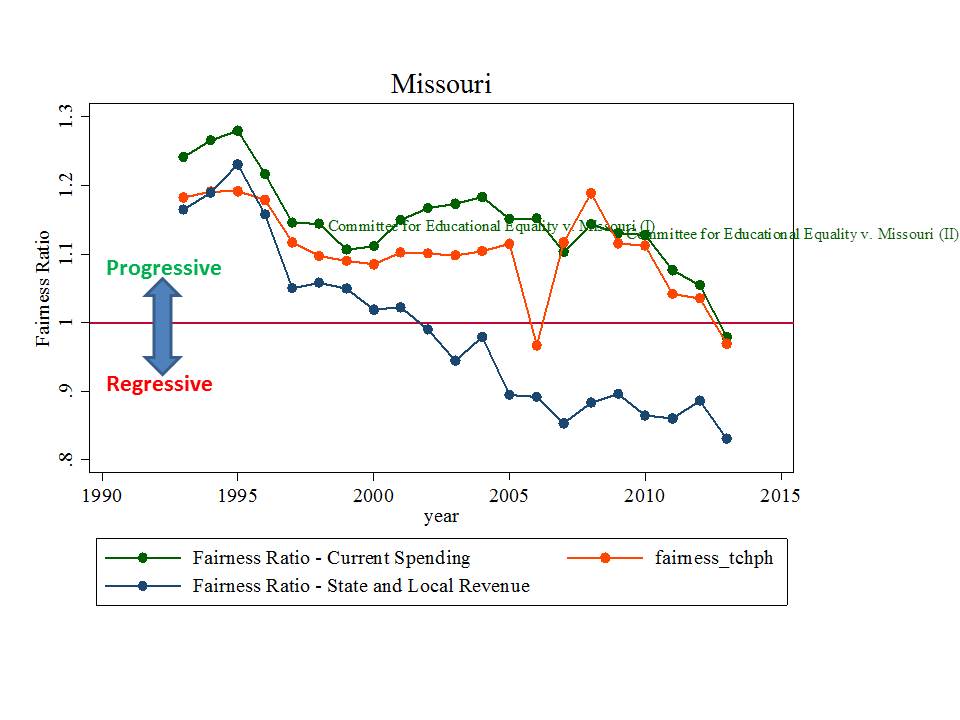
In recently published analysis, I found that during the recession, state school finance systems took a substantial hit, both in terms of total state and local revenue and in terms of equity between districts serving lower and higher poverty student populations:

The recent recession yielded an unprecedented decline in public school funding fairness. Thirty-six states had a three year average reduction in current spending fairness between 2008-09 and 2010-11 and 32 states had a three year average reduction in state and local revenue fairness over that same time period. Over the entire 19-year period, only 15 states saw an overall decline in spending fairness. In years prior to 2008 (starting in 1993) only 11 states saw an overall decline in spending fairness. [4]

A more recent report from the Center on Budget and Policy Priorities revealed that through 2014-15, most state school finance systems had not yet begun to substantively rebound:

At least 30 states are providing less funding per student for the 2014-15 school year than they did before the recession hit. Fourteen of these states have cut per-student funding by more than 10 percent. (These figures, like all the comparisons in this paper, are in inflation-adjusted dollars and focus on the primary form of state aid to local schools.)

Most states are providing more funding per student in the new school year than they did a year ago, but funding has generally not increased enough to make up for cuts in past years. For example, Alabama is increasing school funding by $16 per pupil this year. But that is far less than is needed to offset the state’s $1,144 per-pupil cut over the previous six years. [5]

In short, the decline of state school finance systems continues and the rhetoric opposing substantive school finance reform shows little sign of easing. Districts serving the neediest student populations continue to take the hardest hit. Yet, concurrently, many states are substantively raising outcome standards for students[6] and increasing the consequences on schools and teachers for not achieving those outcome standards. Some positive signs include recent structural reforms, possibly involving new revenue in California and Pennsylvania, in each case focusing on districts serving high poverty student populations. But other states which cut substantially during the economic downturn, even under the pressure of prior and ongoing judicial review and oversight, have continued to cut (Kansas) or largely freeze state aid (New York).

From the cloud of doubt to a rock of certainty

In my 2012 report Does Money Matter in Education? I explained how one man’s mission to create a cloud of uncertainty surrounding the relationship between school quality and available funding has distorted public policy discourse over school finance reform.

One might characterize Eric Hanushek as education’s own “merchant of doubt.”

I explained the evolution of Eric Hanushek’s frequently reiterated assertions of “no systematic relationship between school expenditures and student performance,” [7] originating in the 1980s, to more recent, bolder claims that substantial funding cuts cause no harm.

While compelling evidence has continued to accumulate regarding the importance of funding for improving school quality, Hanushek in various outlets and public testimony has continued to drift from the cloud of doubt to a rock of certainty. That is, certainty that money has little or no role in improving school quality and that school finance reforms which infuse additional funds only lead to greater inefficiency, having little or no effect on either equity or adequacy of schooling.[8]

To summarize, the current Hanushekian dogma includes the following core principles:

  1. Because schools already spend so much and do so with such great inefficiency, additional funding is unlikely (read “will not and cannot”) to lead to improved student outcomes;
  2. How money is used matters much more than how much money is spent;
  3. Therefore, some schools and districts having more or less than others is inconsequential, since those with less may simply make smarter spending decisions.

According to the recent rhetoric of Hanushek, these principles are ironclad, in in his own words they are “conventional wisdom,” on which “virtually all analysts” agree. They are “commonly believed,” “overall truth,” and backed by an “enormous amount of scientific analysis” and “substantial econometric evidence,” and “considerable prior research.”

For example, in the winter of 2015, in the context of school funding litigation in New York State, Hanushek opined:

“An enormous amount of scientific analysis has focused on how spending and resources of schools relates to student outcomes. It is now commonly believed that spending on schools is not systematically related to student outcomes.”[9]

Yet, the enormous amount of scientific analysis to which Hanushek referred in his expert testimony was primarily cited to a 2003 summary of much of his prior work from the 1980s, work which has been discredited on numerous occasions, [10] not to mention, research that has occurred in the last 12 years.[11] Similarly, in the same context (Maisto v. State) Hanushek proclaims:

“There has been substantial econometric evidence that supports this lack of relationship.”

Backed again (in footnote 6 of his report) by the same short list of dated self-citation.[12] In an even more recent attempt to rebut a new, major study finding positive effects of school finance reforms,[13] Hanushek (2015) makes the following version of the same claim:

Considerable prior research has failed to find a consistent relationship between school spending and student performance, making skepticism about such a relationship the conventional wisdom.”[14]

This time, anchoring that claim only to his 2003 piece (by hyperlink to the “prior research” phrase) on the Failure of input based schooling policies,[15] choosing to ignore entirely the considerably larger body of more rigorous work I summarize in my 2012 review on the topic.

The extension of these claims that nearly everyone agrees, and all (or, a veritable shit-ton of) research says that there’s no clear relationship between spending and student performance is the assertion that there is broad agreement that how money is spent matters far more than how much there is. As phrased by Hanushek in the context of New York State school finance litigation:

Virtually all analysts now realize that how money is spent is much more important than how much is spent. This finding is particularly true at the upper levels of current U.S. spending.[16]

As with the prior declarations, this one is made with the exceedingly bold assertion that virtually all analysts agree on this point – without reference to any empirical evidence to that point (a seemingly gaping omission for a decidedly empirical claim about a supposedly empirical truth). Put bluntly, if you don’t have it, you can’t spend it. Thus, the two issues – how much you have and how you spend it – are inextricably linked.

Perhaps most disconcerting is that Hanushek has recently extended this argument to declare that equity gaps in funding, or measures of them, aren’t an important policy concern either. They are, by his proclamation “vacuous” and “lacking any scientific basis.”[17]

Put differently, what Hanushek is opining by declaring calculations of equity gaps to be vacuous and lacking scientific basis is that it matters not whether one school or district has more resources than another. Regardless of any spending differences, schools and districts can provide equitable education – toward equitable outcome goals. Those with substantively fewer resources simply need to be more efficient. Since all public schools and districts are presently so inefficient, achieving these efficiency gains through more creative personnel policies, such as performance based pay, and dismissal of “bad teachers”, are easily attainable.

Of course, even if we assume creative personnel policies to yield marginal improvements to efficiency, if schools with varied levels of resources pursued these strategies with comparable efficiency gains, inequities would remain constant. Requiring those with less to simply be more efficient with what they have is an inequitable requirement. This argument is often linked in popular media and the blogosphere with the popular book and film Moneyball, which asserts that clever statistical analysis for selecting high productivity, undervalued players was the basis for the (short lived) success of the low payroll in 2002 and 2003 Oakland A’s baseball team. The flaws of this analogy are too many to explore thoroughly herein, but the biggest flaw is illustrated by the oft-ignored subtitle of the book – The art of winning an unfair game. That is, gaining a leg up through clever player selection is necessary in baseball because vast wealth and payroll differences across teams make baseball an unfair game. Put bluntly, public schooling should not be an unfair game.

The Eroding Soil under the Rock

From judges to scholars, critics of evidence (other than myself) used by Hanushek to support the above claims have characterized that evidence as “facile,” based on “fuzzy logic”[18] and “weak and factually tenuous.”[19]

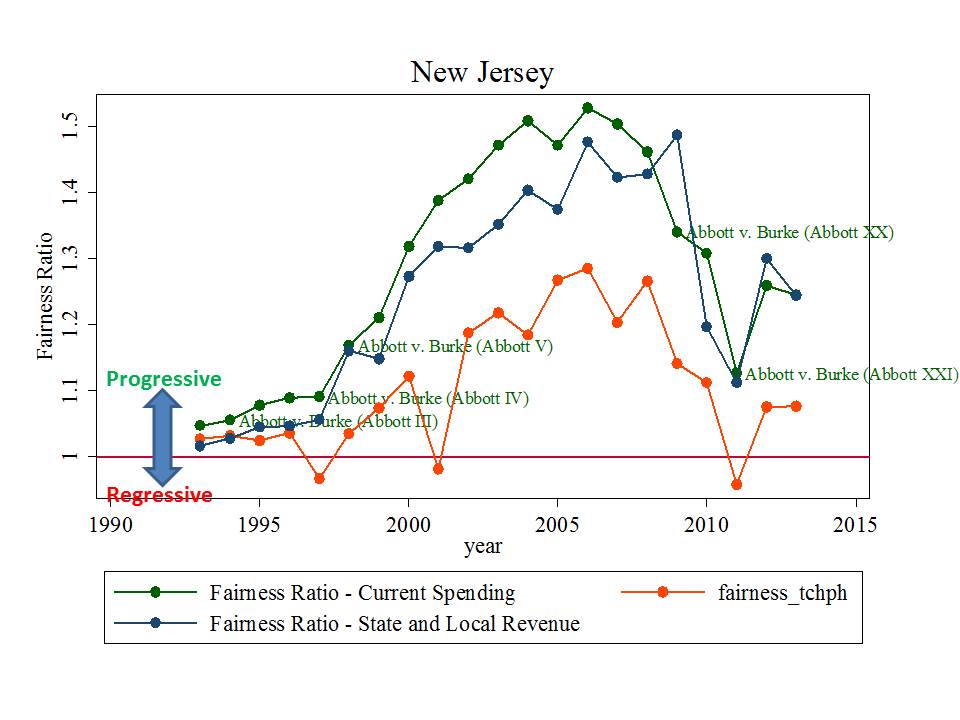
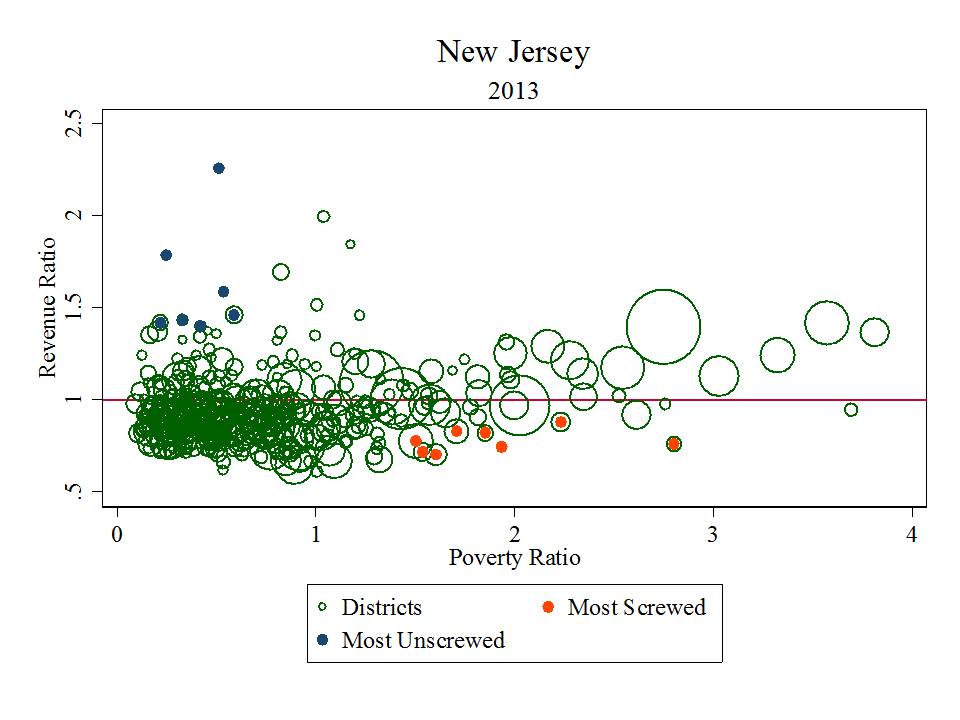
Two recurring examples used by Hanushek to illustrate the unimportance of funding increases for improving outcomes, are the “long term trend” or “time trend” argument, and anecdotal claims of the failures of input-based reforms in New Jersey. Baker and Welner (2011) tackle in depth, the fallacies of Hanushek’s New Jersey claims.[20] Here, I point to Hanushek’s own, albeit facile, unacknowledged self-debunking of his New Jersey claims. But first, I address the “long term trend” claim.

Again from recent testimony in New York State, Hanushek provides the following exposition of the “long term trend” assertion:

The overall truth of this disconnect of spending and outcomes is easiest to see by looking at the aggregate data for the United States over the past half century. Since 1960, pupil‐teacher ratios fell by one‐third, teachers with master’s degrees over doubled, and median teacher experience grew significantly (Chart 1).4 Since these three factors are the most important determinants of spending per pupil, it leads to the quadrupling of spending between 1960 and 2009 (after adjusting for inflation). At the same time, plotting scores for math and reading performance of 17‐year‐olds on the National Assessment of Educational Progress (NAEP, or “The Nation’s Report Card”) shows virtually no change since 1970 (Charts 2 and 3).5[21]

This claim like many others is made with language of astounding certainty – the “overall truth” as it exists in the mind of Hanushek. This claim is commonly accompanied by graphs showing per pupil spending going up over time, pupil to teacher ratios going down, and national assessment scores appearing relatively flat, much of which is achieved via the smoke and mirrors of representing spending and outcome data on completely different scales, and failures to adjust appropriately for changing costs and related obligations of the public education system, and changing demography of the tested population.[22] Oversimplified visuals are used to make the proclamation that student achievement shows “virtually no change,” a statement discredited on closer inspection.[23] Jackson and colleagues provide additional examples of how such facile analyses lead to fallacious conclusions (ironically using cigarette smoking data).[24]

Hanushek extends his use of the long term trend argument in his recent critique of findings from Jackson and colleagues that court ordered infusions of funding to select schools and districts led to long term gains in educational attainment, income and poverty reduction for those subjected to increased funding. Hanushek asserts:

If a ten percent increase yields the results calculated by Jackson, Johnson, and Persico, shouldn’t we have found all gaps gone (and even reversed) by now due to the actual funding increases?

Thus, if the massive average spending increases reported by Hanushek as the actual long term trend did not lead to elimination or reversal of gaps, Jackson, Johnson and Persico’s findings must be wrong? Right?

Of course, this assertion is complete and utter nonsense, because Jackson and colleagues don’t assert, and Hanushek’s own national average long term trend data do not show that all low income children, lower performing subgroups and/or those in low wealth communities were subjected to dramatic funding increases. In fact, if Hanushek’s average spending increases were driven as much by increases in wealthy (low poverty/minority) districts as they were by increases in poorer districts, then gaps would likely remain constant, all else equal.  That is, the average level of funding, and changes in average level say nothing of gaps or distributions in funding or changes in gaps or distributions. Put bluntly, the average level of funding, and the distribution of funding are two different things. Conflating the two is intentionally deceitful.

As explained by Baker and Welner (2011)[25] Hanushek for years has cited the failures of New Jersey’s school finance reforms as the basis for why other states should not increase funding to high poverty schools. In litigation in Kansas in 2011, Hanushek proclaimed:

“The dramatic spending increases called for by the courts (exhibit 34) have had little to no impacts on achievement. Compared to the rest of the nation, performance in New Jersey has not increased across most grades and racial groups (exhibits 35-40). These results suggest caution in considering the ability of courts to improve educational outcomes.”[26]

Hanushek reiterated these claims in the context of the even more recent New York school funding challenge. [27] This is a surprising claim to preserve when one’s own recent (2012) marginally more rigorous analyses of state achievement growth rates on national assessments (from 1992 to 2011)[28] find the following:

“The other seven states that rank among the top-10 improvers, all of which outpaced the United States as a whole, are Massachusetts, Louisiana, South Carolina, New Jersey, Kentucky, Arkansas, and Virginia.”[29]

The same report by Hanushek shows impressive reductions in the share of students scoring “below basic” in New Jersey, especially for 8th grade math (Figure 4).

To be sure, there are others in academe and policy research that raise questions about the most effective ways to leverage school funding to achieve desired outcomes, and do so via more rigorous, thoughtful analyses.

There are others who opine in the public square[30] and courtroom[31] that school finance reform – specifically infusing additional funding to districts serving high need student populations – is neither the most effective nor most efficient path toward improving schooling equity or adequacy. But empirical evidence to support claims of more efficient alternatives remains elusive.

Nonetheless, the “facile” and “factually tenuous” illustrations above must be put to rest, and the divisive, manipulative (intellectually insulting) and damaging rhetoric of education’s merchant of doubt cast aside once and for all.

NOTES

[1] Baker, B. D. (2012). Revisiting the Age-Old Question: Does Money Matter in Education?. Albert Shanker Institute.

[2] http://blogs.wsj.com/metropolis/2014/02/11/cuomo-on-education-funding-lawsuit-it-aint-about-the-money/

[3] http://thinkprogress.org/education/2015/02/13/3623158/brat-education-plato/

[4] Baker, B. D. (2014). Evaluating the recession’s impact on state school finance systems.

Education Policy Analysis Archives, 22(91). http://dx.doi.org/10.14507/epaa.v22n91.2014

[5] Leachman, M., & Mai, C. (2014). Most States Still Funding Schools Less Than Before the Recession. Center on Budget and Policy Priorities, October 16, 2014, http://www. cbpp. org/cms/index. cfm? fa= view&id, 4213.

[6]

Bandeira de Mello, V., Bohrnstedt, G., Blankenship, C., and Sherman, D. (2015). Mapping State Proficiency Standards Onto NAEP Scales: Results From the 2013 NAEP Reading and Mathematics Assessments (NCES 2015-046). U.S. Department of Education, Washington, DC: National Center for Education Statistics. Retrieved [date] from http://nces.ed.gov/pubsearch.

[7] Hanushek, E.A. (1986) Economics of Schooling: Production and Efficiency in Public Schools. Journal of Economic Literature 24 (3) 1141-1177. A few years later, Hanushek paraphrased this conclusion in another widely cited article as “Variations in school expenditures are not systematically related to variations in student performance”

Hanushek, E.A. (1989) The impact of differential expenditures on school performance. Educational Researcher. 18 (4) 45-62

Hanushek describes the collection of studies relating spending and outcomes as follows:

“The studies are almost evenly divided between studies of individual student performance and aggregate performance in schools or districts. Ninety-six of the 147 studies measure output by score on some standardized test. Approximately 40 percent are based upon variations in performance within single districts while the remainder look across districts. Three-fifths look at secondary performance (grades 7-12) with the rest concentrating on elementary student performance.” (fn #25)

[8] Notably, Hanushek then and now asserts that it’s not that money doesn’t matter at all, but rather that additional money doesn’t matter on top of the already high (apparently indisputably and invariably) levels of spending that currently exist across all U.S. schools.

[9] http://www.edlawcenter.org/assets/files/pdfs/maisto/masito%20trial%20documents/State%27s%20Expert%20Report%20-%20Dr.%20Eric%20Hanushek.pdf

[10] Baker, B. D. (2012). Revisiting the Age-Old Question: Does Money Matter in Education?. Albert Shanker Institute.

[11] Including but not limited to:

Jackson, C. K., Johnson, R., & Persico, C. (2015). The Effects of School Spending on Educational and Economic Outcomes: Evidence from School Finance Reforms (No. w 20847) National Bureau of Economic Research.

Papke, L. (2005). The effects of spending on test pass rates: evidence from Michigan. Journal of Public Economics, 89(5-6). 821-839.

Hyman, J. (2013). Does Money Matter in the Long Run? Effects of School Spending on Educational Attainment. http://www-personal.umich.edu/~jmhyman/Hyman_JMP.pdf.

Deke, J. (2003). A study of the impact of public school spending on postsecondary educational attainment using statewide school district refinancing in Kansas, Economics of Education Review, 22(3), 275-284. (p. 275)

Nguyen-Hoang, P., & Yinger, J. (2014). Education Finance Reform, Local Behavior, and Student Performance in Massachusetts. Journal of Education Finance, 39(4), 297-322.

Downes, T. A. (2004). School Finance Reform and School Quality: Lessons from Vermont. In Yinger, J. (Ed.), Helping Children Left Behind: State Aid and the Pursuit of Educational Equity. Cambridge, MA: MIT Press

[12] Specifically, Hanshek includes the following footnote:

Hanushek (2003). See also Hanushek (1981, (1986, (1989). The statistical analyses focus on the independent impact of resources on performance after allowing for differences among families, peers, and neighborhoods. A variety of sophisticated approaches have been applied to schooling situations across the countries, and the reviews summarize these studies. The aggregate results of the most sophisticated of these studies are shown below.

[13] Jackson, C. K., Johnson, R. C., & Persico, C. (2015). The effects of school spending on educational and economic outcomes: Evidence from school finance reforms (No. w20847). National Bureau of Economic Research.

[14] http://hanushek.stanford.edu/opinions/does-money-matter-after-all

[15] http://hanushek.stanford.edu/sites/default/files/publications/Hanushek%202003%20EJ%20113%28485%29.pdf

[16] http://www.edlawcenter.org/assets/files/pdfs/maisto/masito%20trial%20documents/State%27s%20Expert%20Report%20-%20Dr.%20Eric%20Hanushek.pdf

[17] Specifically, Hanushek proclaims:

It also underscores how calculations of equity gaps in spending, of costs needed to achieve equity, or of costs needed to obtain some level of student performance are vacuous, lacking any scientific basis.” (Maisto, p4)

http://www.edlawcenter.org/assets/files/pdfs/maisto/masito%20trial%20documents/State%27s%20Expert%20Report%20-%20Dr.%20Eric%20Hanushek.pdf

[18] http://educationnext.org/money-matter/

[19] http://www.shawneecourt.org/DocumentCenter/View/457

[20] Baker, B., & Welner, K. (2011). School finance and courts: Does reform matter, and how can we tell. Teachers College Record, 113(11), 2374-2414.

[21] http://www.edlawcenter.org/assets/files/pdfs/maisto/masito%20trial%20documents/State’s%20Expert%20Report%20-%20Dr.%20Eric%20Hanushek.pdf

[22] http://junkcharts.typepad.com/junk_charts/2011/04/bill-gates-should-hire-a-statistical-advisor.html

[23] See, for example:

http://www.epi.org/publication/fact-challenged_policy/

[24] The authors explain:

To see the problems of Hanushek’s logic, consider the following true statistics: between 1960 and 2000 the rate of cigarette smoking for females decreased by more than 30 percent while the rate of deaths by lung cancer increased by more than 50 percent over the same time period.[1] An analysis of these time trends might lead one to infer that smoking reduces lung cancer. However, most informed readers can point out numerous flaws in looking at this time trend evidence and concluding that “if smoking causes lung cancer, then there should have been a large corresponding reduction in cancer rates so that there can be no link between smoking and lung cancer.” However, this is exactly the facile logic invoked by Hanushek regarding the effect of school spending on student achievement.

http://educationnext.org/money-matter/

[25] Baker, B., & Welner, K. (2011). School finance and courts: Does reform matter, and how can we tell. Teachers College Record, 113(11), 2374-2414.

[26] http://www.robblaw.com/PDFs/1169.pdf

[27] http://www.edlawcenter.org/assets/files/pdfs/maisto/masito%20trial%20documents/State’s%20Expert%20Report%20-%20Dr.%20Eric%20Hanushek.pdf

[28] As explained by the authors:

We also examine changes in student performance in 41 states within the United States between 1992 and 2011, allowing us to compare these states with each other.

Our findings come from assessments of performance in math, science, and reading of representative samples in particular political jurisdictions of students who at the time of testing were in 4th or 8th grade or were roughly ages 9–10 or 14–15.

[29] Hanushek, E. A., Peterson, P. E., & Woessmann, L. (2012). Is the US catching up: international and state trends in student achievement. Education Next, 12(4), 24.

http://www.hks.harvard.edu/pepg/PDF/Papers/PEPG12-03_CatchingUp.pdf

[30] http://jaypgreene.com/2015/05/29/does-school-spending-matter-after-all/

[31]Including renowned segregationist David Armor who continues to testify alongside Hanushek, http://www.edlawcenter.org/assets/files/pdfs/maisto/masito%20trial%20documents/State’s%20Expert%20Report%20-%20Dr.%20David%20Armor.pdf

Pondering Chartering: Who’s actually running America’s charter schools?

Education policy research and the rhetoric emergent from that research typically fails to represent the realities – the real distribution – of schooling across our nation. We focus extensively on urban schooling most often ignoring what might or might not work in the suburbs or rural areas. We focus on development of reading and math/STEM skills but far less on other content, knowledge or skills. We focus on measuring teacher/teaching quality through estimates of student gains in reading and math, but often ignore the contextual factors that may influence teacher effectiveness, or other less commonly measured outcomes.

These foci aren’t necessarily problematic. After all, there’s only so much we can research at any given time. The problem lies in our desire – specifically in translation to policy recommendations – to broadly extrapolate the meaning of these findings.  Sometimes, it’s a mere extrapolation problem, where researchers and well-meaning policymakers simply wish to project one finding onto an entirely different situation.

Other times, it’s a straight up bait-and-switch, where self-interested actors or advocates point to one great success, and then swap it for a cheap imitation in their own policy recommendations/proposal. It’s like holding up Exeter or Andover as examples of great private schooling to advance a voucher argument, and then providing a voucher sufficient for children to attend their local evangelical school housed in a double-wide on a vacant lot. [private school cost/spending data here]

Charter school research is, in my view, one of the most problematic areas of education policy research, especially in its translation to policy recommendations. The most extreme version of the pro-charter unregulated expansion argument goes something like this:

Look at the research on those massive gains created by KIPP schools, especially those studies done by Mathematica researchers, as well as the work of Dynarski and colleagues in Boston. And hey, look at Fryer’s stuff on NYC’s ‘no excuses’ charters! This is incredible. We must move forward with all deliberate speed to replicate this!

And how must we do that – well, we really need to take the lid off this movement – no caps. Increase subsidies. Have more authorizers available to fast-track the flood of new applications from these great providers! That’s it. Move… and move now! From Arizona, to Ohio, Michigan, Florida and beyond – authorizers will ensure accountability. The few… and let me emphasize that… few… bad actors will be shut down, and these amazing providers will flourish across our great nation!

Okay… so maybe I’m overdoing it a bit. Certainly some, even those at TB Fordham institute have now admitted problems in the Ohio charter accountability process. And the folks at Brookings have raised questions about the quality of Arizona charter schools.

At least a handful of studies on high profile charter operators have yielded substantive, positive results, at least with respect to growth on narrowly measured student achievement outcomes, and in some cases on college acceptance/matriculation. Of course, even these studies, like the Mathematica/KIPP studies, or Fryer studies tend to totally ignore key features of the models that may be contributing to those outcomes – like money, smaller classes, more time and teacher pay to support that time.

But here’s the bigger picture – In all of this time that we’ve been allowing and inducing charter school growth, while studying KIPPs and others to validate positive effects – we’ve paid far too little attention to the actual distribution of providers out there. Most charter schools aren’t KIPP (whether we like KIPP or their educational model/practices). And most charter schools across the country aren’t like NYC’s (or Boston’s) other major charter operators.

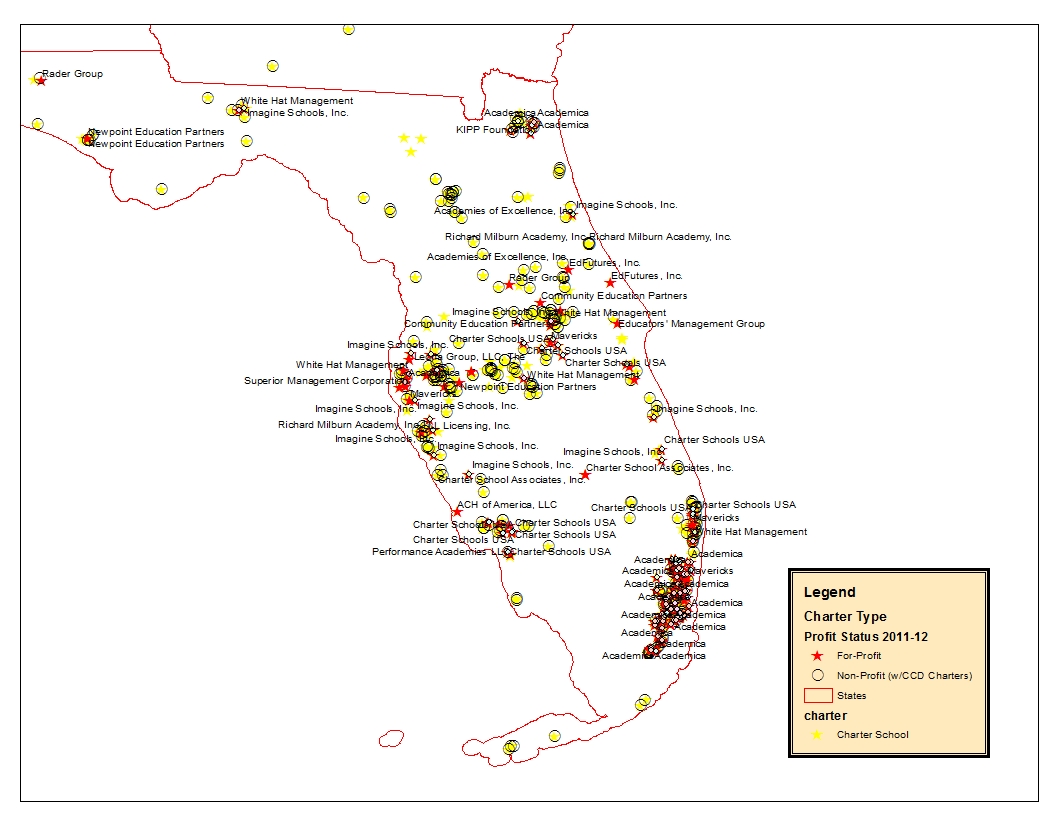
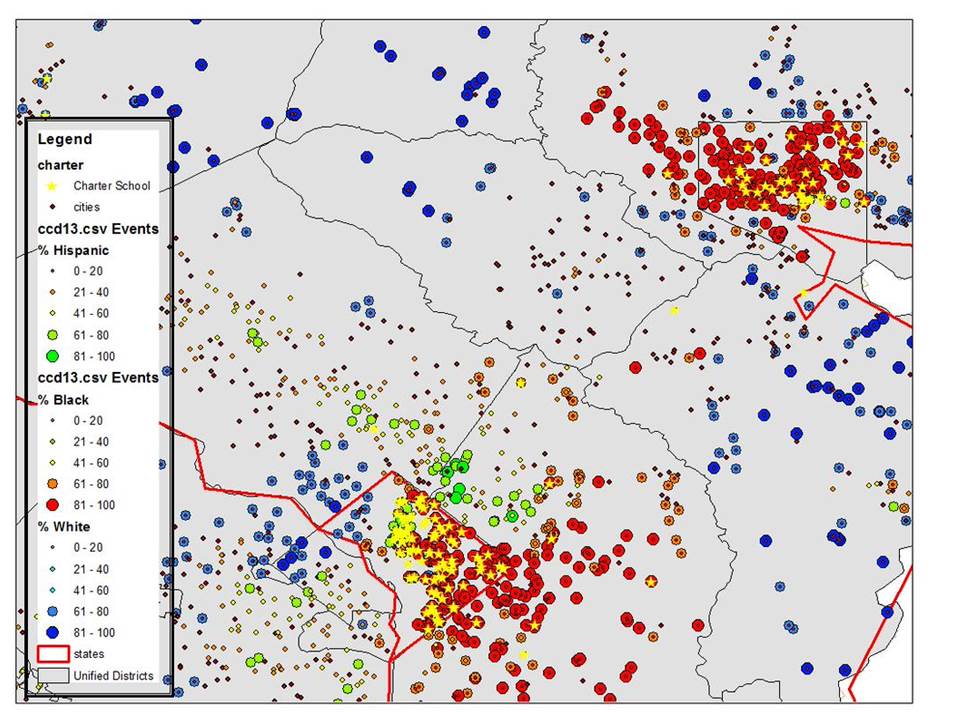
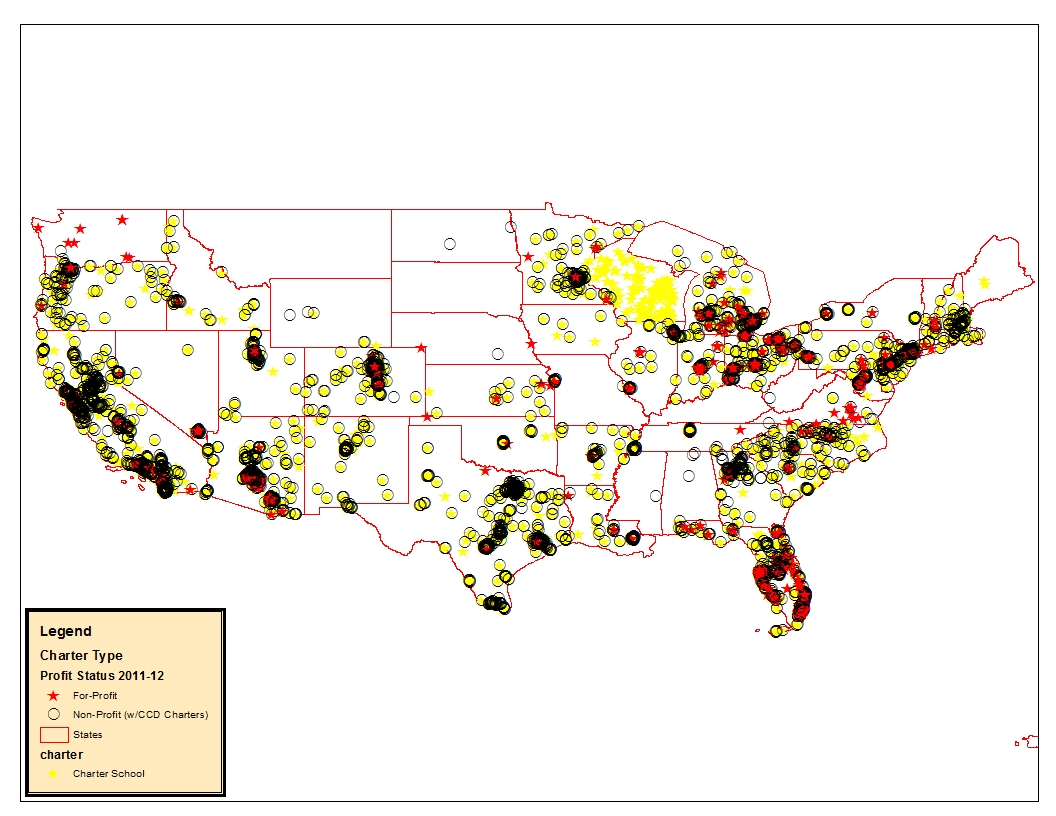
First, here’s a national map of charter school distribution based on the 2013 NCES Common Core, public school universe survey, with indicators from 2011-12 of the management type fort those schools (data set for Wisconsin incomplete). Yeah… there are charter schools in major Northeastern/Mid-Atlantic cities from Boston to DC, but there are also one heck of a lot of charter schools in Florida, Ohio, Michigan, Arizona and other states where charters have a far less stellar track record. There are also, as shown in Figure 1, a large number of charter schools presently operated by for-profit management companies (much more on the implications of this in a future post).

Figure 1. National Distribution of Charter Schools by Management Type

National Map

And even in the Northeast, most of them are NOT those heavily privately subsidized KIPP schools (though there are a few more “Uncommon” schools than elsewhere). Yeah, there are a few scattered around, and by 2015, KIPP’s own website indicates that they serve about 70k kids, but that would still put them only close to the top 5 providers nationally, against our 2011-12 figures (assuming no other operator grew since then, as KIPP did).

Who is out there? Well, Edison Schools are still there. White Hat, K12, and others with more questionable track records. And this (region) is as good as it gets!

In these maps, I’ve only labeled the management company for companies that managed at least 20 schools in our 2011-12 data. Management company data linked from prior work by Gary Miron and colleagues (diligently matched/vetted by my doc student Mark Weber. Mapped version here from prelim data set).  Note that a common issue with mapping this type of data is that the school address may show up at the corporate address rather than the actual school location.

Figure 2. Atlantic Coast Schools

Atlantic Coast

Figure 3. Southeast

SoutheastBut for a few KIPP schools, more southeastern charters are either managed by smaller firms, are independent, or are managed by White Hat. Florida is even more fun. Florida has a plethora of providers we don’t often hear about in academic research, but more often hear about in scandalous news headlines (Academica, Mavericks, Imagine[more later])

Figure 4. Florida

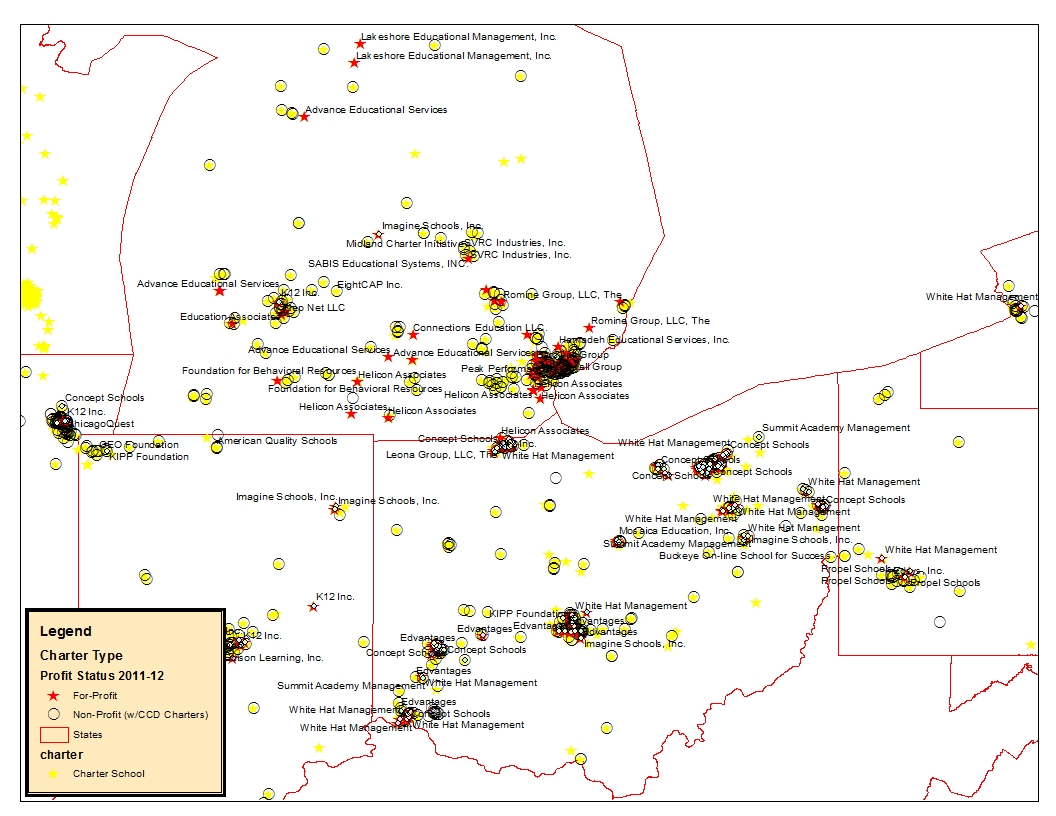
FloridaGreat lakes states are dominated by providers like White Hat Management, Summit Academy, Concept Schools and also Imagine Schools!  No, these are not the Exeters and Andovers (or KIPPs) of charter schooling. What they are is the actual population of providers as they exist across states. Again, there are a few KIPPs in there but they are clearly overshadowed by other providers for whom we have far less rigorous academic analysis of their program/service quality.

Figure 5. Great Lakes

Great Lakes

The KIPP presence in Texas and New Orleans is somewhat stronger, but again, they exist amidst a multitude of other providers including National Heritage Academies, Cosmos schools, among others.

Figure 6. Gulf Coast

Gulf CoastAnd moving west….

Figure 7. Southwest

Southwest

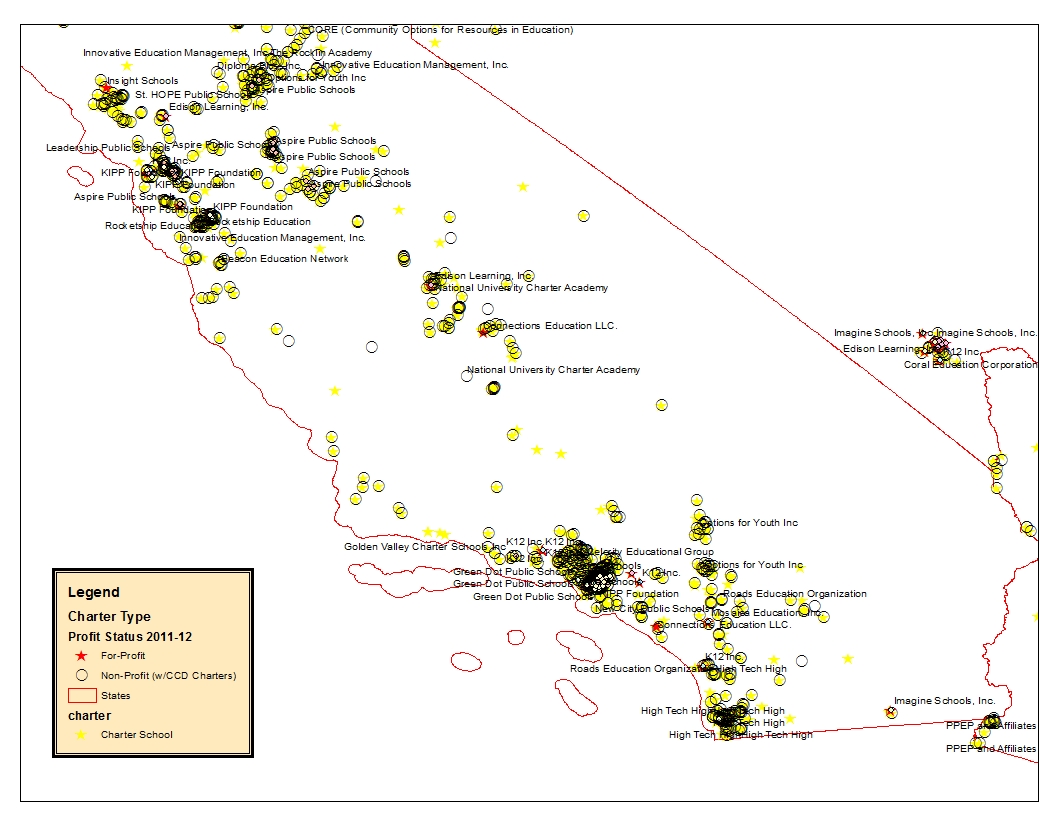
Figure 8. California

SoCalI’m certainly not saying these are all bad schools. That any non-KIPP charter can’t be as good as a KIPP charter. That’s just silly.  I’m also not saying that all KIPP schools are great and that they are the only great charter schools. Yes, my own research has found KIPP schools, along with Uncommon Schools and other NYC charter chains to be particularly well endowed financially.

What I am saying is that it is very problematic to adopt the logic –

KIPP = Charter School

KIPP = Awesome (by virtue of KIPP-iness alone)

therefore

Charter = Awesome (by association with KIPP-iness)

therefore unfettered expansion of charters is super totally awesome!

For most of America, this argument leads to a massive bait and switch.

Further, as I’ve explained in recent posts, it would be worth our time to step out of the charter vs. district school box and ask more broadly, what’s working? Where is it working? Why is it working?  Can it work similarly elsewhere? And most importantly, what the heck to we mean by “working?”

We must evaluate collectively charter, district, and for that matter private schools across rural, urban and suburban settings, with consideration for the uniqueness of regional, state and local policy contexts. This is all doable.  But periodically, we need to step back and assess what’s really going on.

===================

Market share by manager (for those enrolling over 10k students in 2011-12. all others aggregated to single category. excludes Wisconsin data)

Presentation1

Hmmm… seemed relevant (a bit over the top, but relevant):

We bought it twice but we no longer own it: The bad public policy behind charter school real estate deals

I’ve been spending much of my spring and summer trying to get a handle on the various business practices of charter schooling, the roles of various constituents, their incentives and interests – financial and otherwise – in the operations of charter schools. Throughout this process, I also try to consider how or whether similar practices and incentives exist for traditional district schools and private schools and how these markets intersect. There will be much more forthcoming on this blog, and in academic papers and reports in the next few months and year.

But one issue really struck me as particularly ludicrous as I spent more and more time drawing pictures and mapping out business relationships. I had avoided for the longest time digging into the weeds of charter school land deals and facilities financing. It’s messy and there are certainly plenty of fun scandalous news reports on the topic. But when I see this kind of stuff, I ask myself – what policies enable – or perhaps even encourage these things? Where’s the boundary between legally permissible and not… and between good policy and bad?

Here, I provide an example of something that’s just bad public policy. I can’t really say… except in one piece of this puzzle (as I’ve laid it out), that there are any truly bad, unethical, or illegal actors in this scenario. But the outcome is still bad… bad… patently… amazingly stupid public policy.

It all started way back…such a long, long time back…Way back in the days when the grass was still green, and the pond was still wet, and the clouds were still clean, and the song of the Swomee-Swans rang out in space…

Oh wait… wrong story….

Let’s go to the diagrams…

District controlled public school land and facilities are governed by the public that initially financed them. The public that financed these facilities and land acquisition typically did so by adopting in public referendum a promise to use their tax dollars (perhaps with support of state aid) to finance the debt required to buy the land and build the building. The public invested in the asset through debt financing, using low interest general obligation (GO) bonds.

Through annual budget approvals the public approved the maintenance of those facilities and their tax dollars were used to maintain their asset.  The public invested in the maintenance of that asset through annual operating expenses of the district. Perhaps the public even approved additional debt financing along the way for improvements and renovations.

Many of these grand facades of public schooling were financed long enough in our past that we forget that they were financed with the tax dollars of previous generations and have been passed along and their care entrusted to the current generation.

Figure 1. The Initial Purchase & Maintenance

Slide1

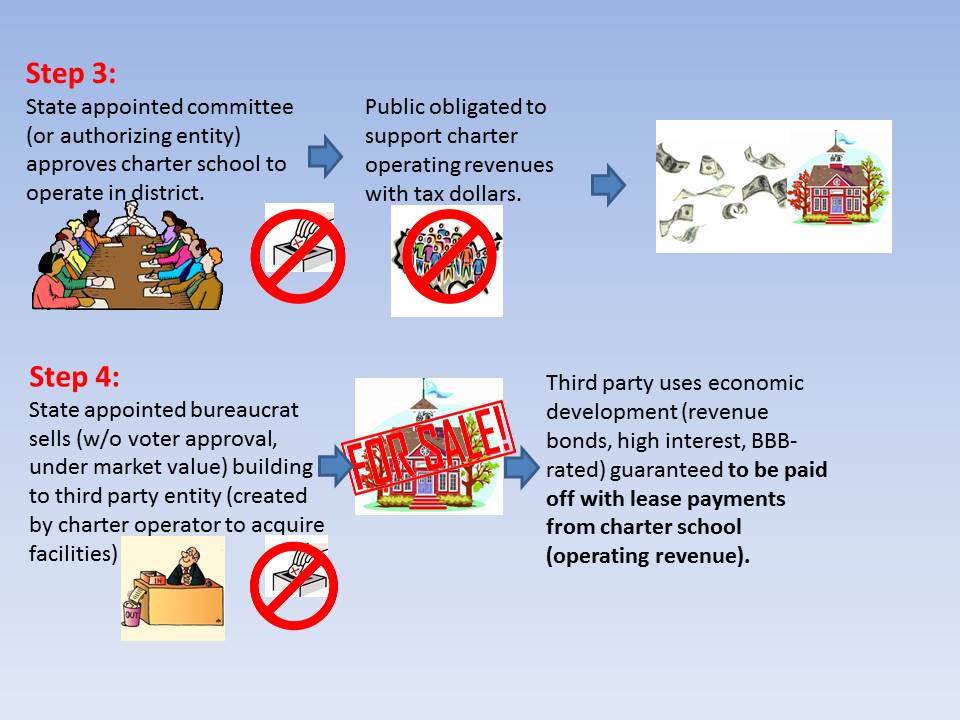
In many states, approval of charter schools to operate within district boundaries does not require local board or taxpayer approval. State government entities/appointees or elected bodies may serve as authorizers, and in some states, private entities and boards may authorize charter schools to establish, draw students and with them, public tax dollars for operating revenue/expense to support educational programs/services for those children.

Few states provide substantive support for charter school facilities acquisition and many/most states restrict charter schools (or district schools) from engaging in long term obligation of operating funds to finance debt, to acquire land and buildings. Instead, charter schools engage in lease agreements, typically shorter term, where lease payments are made from operating funds. But hey, who wants to be paying rent/lease year after year, and have nothing to show for it? State policies do typically permit, if not incentivize other organizations (including non-profit entities) to access “revenue bond” markets for urban re-development projects (in particular).

Quick primer on bond stuff:

General obligation bonds like those approved initially by voters for the facility are guaranteed by the full faith and credit of the municipality and taxes to be raised to pay off the debt. It’s pretty much guaranteed (except in the rare case that a town actually folds, entirely, financially, and say… picks up and re-establishes across the river). So, those bonds get pretty high ratings (from rating agencies) and thus low interest rates for paying off the debt.

Revenue bonds have to be guaranteed by the borrower with some revenue source. For third party entities purchasing land and buildings on behalf of charter schools, borrowers guarantee their bonds with the lease payments of the charter schools. Yeah… that’s right… the taxpayer subsidized operating funds for the charter school are used to make lease payments to a third party organization, which uses those lease payments to secure the debt to purchase the land/building. They usually get kind of a crappy interest rate (sometimes around 8.5% compared to, oh… about 4.5% for a similar size/structure GO bond) because the revenue source is less certain/more risky.

No clear, apparent harm/no foul here. Actually, it kind of makes sense for charter operators to collaborate to establish those third party land/facilities acquisition entities on their behalf, arguably a) so as not to get screwed with escalating lease payments down the line and b) to have an ownership stake in the property/asset. Now, some NJ charter operators caught some flack for creating different entities for each transaction and giving them strange names (like Pink Hula hoop), but I’m not sure I can blame them for the engaging in the increasingly common practice involved here.

Figure 2 shows the sell-off/property transfer process and this is where, when looking at the bigger picture, it starts to make less sense – from a public policy standpoint. Because charter school growth in cities often means declining district enrollments and facilities use, this potentially frees up under-used district facilities – perhaps even putting some on the auction block. In many cases, these facilities can be sold without local voter approval, even if voters had to approve their original financing. But that’s actually just a tangential concern here.

The really fun piece is that public tax dollars, channeled through the charter school are being used to purchase the facility, for the third party, from the public? Whah??? Whah??? Yeah… I’m buying it from me for someone else?

Huh…. ??

Figure 2. The Sell-off

 Slide2

To recap:

  • Public buys facility with tax dollars
  • Public uses tax dollars to maintain their asset
  • Charter school uses public tax dollars (w/o public approval) to make lease payments to third party so they can buy same facility! (which public currently owns/controls)
    • & pays crappy interest rate in process
  • PUBLIC HAS BOUGHT SAME FACILITY TWICE (second time, from itself), AND NOW NO LONGER OWNS/CONTROLS IT!

That’s just dumb public policy even if, from the position of each of the parties involved, their actions would seem to make complete sense.

District – why should we keep maintaining a facility we don’t need? Can we generate some short term cash flow by selling it?

Charter operator – why should we make lease payments in perpetuity and have nothing to show for it? Why not collaborate to use existing policies to acquire assets?

Again, it’s not that anyone is doing anything ‘wrong’ (except that valuing these properties opens the door to manipulation), but rather, that public policy permits a bad deal for the public – one that essentially gives away a public asset while charging transaction fees along the way.

The major elements of the process differ little whether it occurs through loosely coupled, seemingly benevolent non-profits, or through for-profit charter management firms, their real estate acquisition arms and practice of flipping properties to real estate investment trusts (the major difference being the increased likelihood of rent gouging of the charter school in the latter version).

The absurdity of this relatively common example provides a case for seriously rethinking how we protect public interest and public assets as we move increasingly toward mixed delivery models of schooling – mixed in the sense that any jurisdiction might be served by a portfolio of traditional district schools, district governed or privately governed charter schools, etc.

I would argue that districts governed by public officials really need to be the stewards of these major public assets. This means that it may make more sense for state and local policymakers to craft more logical facilities management strategies which include co-location of charter schools (and the students they serve) – especially under state policies where charter schools are fiscally dependent (where charters receive funding as pass through from districts and where districts maintain responsibility for funding certain services for charter enrolled children). This means carefully evaluating and the appropriate and equitable operating subsidy rate for charter schools, given the children they serve with consideration for the facilities provided.

A secondary reason why maintaining public control over these assets is critically important is that it provides district officials (and the public they serve) the flexibility to change course – to decide, if/when that time comes, that it’s time to reign in charter/choice programs and reclaim a major role for traditional public schooling. Once the public assets are sold off under the model above, they are gone, and costs of rebuilding may be prohibitive. That’s a dangerous path for the future of our cities and children and families that inhabit them.

Yes – I am making a case for rethinking co-location as an option, or more broadly – centralized capital asset management. Co-location is contentious and there are a lot of tricky, politically and technically messy details to work out.

But, it’s a lot better than this alternative!

This needs to stop now!

========================

Addendum:

Fun debates on the sidelines about this topic. For example, how are my examples above any different from any individual person paid with public funding (public employee) buying any previously public asset? Aren’t these examples merely about a private contractor purchasing an asset, any asset, with the proceeds of their appropriately compensated work?

Now, it is conceivable that a charter school and its employees could take an approach that is seemingly more appropriate for private asset acquisition, even using what was originally the public dime (now, I’ve not said there’s anything wrong with what the charter is doing above, except that bad public policy allows it to happen).  A charter school could, instead of making the lease payment as a mere pass-through of public subsidy, simply pay all of its employees higher wages to the sum of that payment and then permit them to individually contribute to a fund either for the direct purchase of the property or indirect purchase via lease payment to the third party. But that would involve individual decisions regarding the use of their compensation. It’s not an institutional decision to simply pass the money through, and it’s seemingly less problematic unless the institution FORCES their employees to contribute that portion of their wages for purchase of the property.

I’ll talk about ways in which charter operators forcibly tax employee wages (for self gain) in a future post!

Now, one other public policy protection here might be to declare any assets acquired by the private contractor with public dollars to be owned by the public. This dispute has occurred elsewhere, as far back as when Education Alternatives, Inc. (1996) gained a management contract with Hartford CT schools and used start up funds to acquire technology.But given that many charter operators reasonably mix expenditure of public and private dollars, parsing who owns what can be exceedingly complex.

Of course, it may be reasonable to expect those charter operators who wish to privately own a facility to finance that facility with appropriately segregated private revenue sources.

Would it make more sense then for the district to sell the asset to some other private entity, like a real estate developer? and let the charter operators fend for themselves to find suitable educational spaces? That would seem a raw deal for both. The public loses the public asset, likely never achieving appropriate compensation for that asset, and the charter likely faces greater costs (extraction from their operating revenue) than could be achieved by thoughtful centralized facilities management.

One final note: A central issue above is that there is value to controlling these public assets which justifies the costs of maintaining them over time. Private entities have no interest in making sure that sufficient assets remain available for the provision of public schooling (regardless of provider type), just as private landlords have no interest in ensuring sufficient availability of affordable housing.  For cities to be able to provide sufficient educational services to all those in need, now and long into the future, cities need a plan for maintaining sufficient capital stock.  Similarly, if we value public parks and libraries, we can’t expect private markets to provide them in ways that will make them broadly, publicly available. We must subsidize them publicly, and maintain them publicly (even if we pay private contractors to do that maintenance).

Note: The figure below, constructed with data from the NCES Common Core, Public School Universe Survey shows that while in some major cities there has been overall decline in students in district and charter schools (cumulative), the transfer of students between district and charter schools tends to explain more of the district school enrollment decline. As such, the demand for facilities space is not declining substantially, but rather, shifting. Hence the interest in maintaining and managing a more constant capital stock to meet the needs of these children.

Charter Transfer

About those Ed Regs for Improving Teacher Equity: A preview of new (old) findings

Doc student Mark Weber and I have been blogging a bit less lately and digging in on a number of interesting academic papers ranging from analyses of charter school expenditures to inter and intra-district resource inequality.  Among these papers is an analysis of data provided by ED for states to run preliminary analyses of measures of teacher equity across schools.

As states roll out their plans, this topic is again getting some ed media attention, most of which (if not all) misses entirely the point that regulatory pressure passed by states along to local public districts will achieve little or nothing in equalizing the distribution of teacher/teaching/instructional resources across schools and children statewide. That is, without any attention to inter-district disparities in school funding, which as I have noted, have only continued to get worse. Bottom line, you can’t fix cross-school, statewide disparities in resources without fixing between district disparities in funding. Here are a portion of the intro and conclusions of our current draft:

Intro:

New federal regulations (State Plans to Ensure Equitable Access to Excellent Educators)[1] place increased pressure on states and local public school districts to improve their measurement and reporting of gaps in teacher attributes across schools and the children they serve, and ultimately to mitigate revealed disparities. But, these regulations largely sidestep the extent to which availability of financial resources might influence the distribution of teachers, pointing a finger instead at “root causes” such as lack of effective leadership, lack of comprehensive human capital strategies and otherwise ineffective and inefficient personnel policies.[2] Failure to emphasize the potential role of broader financial disparities as a root cause of inequitable access to excellent educators, and thus failure to mitigate those disparities, may undermine the administration’s goals.

Despite a lack of explicit attention to inter-district fiscal disparities as possible root causes of inequitable access to excellent educators, the administration provides guidance on measuring teacher equity using existing data sources and measures which either directly or indirectly involve financial resources. While broadly referencing “inexperienced, unqualified, or “out-of-field teachers” as a concern,[3] the administration’s guidance also cites measures of teacher salaries and cumulative school site spending on teacher compensation (as reported in the recent CRDC collection).[4]

Coinciding with these new federal regulations are a series of legal challenges in states including California and New York which claim that state statutes providing due process protections and defining tenure status for teachers are a primary cause of deficiencies in teacher qualifications, specifically in districts and schools within districts serving disadvantaged minority populations (Black, 2016). Implicit in these legal challenges is an assumption that if statutorily defined tenure status and due process requirements pertaining to teacher dismissal did not exist, statewide disparities in teacher qualities between higher and lower poverty schools (under the statutes in question) would be substantially mitigated. Like the federal regulations, this approach fails entirely to consider that disparities in district financial resources may be substantial determinants of statewide variations in teacher attributes.

As a basis by which inequality should be determined, the administration places significant emphasis on variations in concentrations of children in poverty across schools. That is, resources should be equitably distributed across children by their economic status.[5] Just what “equity” means under the circumstances is left to states to articulate in their proposals, but the language of the regulations suggests that, at the very least, children in high poverty settings should not be subjected to fewer total resources or teachers with lesser qualifications – that there should not be a negative correlation between poverty concentrations and resources.

A significant body of literature explains that in order to strive for more equitable student outcomes, there in fact should be a positive – progressive – correlation between aggregate resources allocated and factors such as child poverty concentrations, disability concentrations and language barriers (Baker and Green, 2014). Baker, Sciarra and Farrie (2009, 2012, 2014) evaluate the relationship between district poverty concentrations and state and local revenues, controlling for other cost factors, to rate the relative equity of state school finance systems. Center for American Progress (2015) proposed several suggestions for federal intervention to improve inter-district fiscal equity, adopting the equity measures estimated by Baker, Sciarra and Farrie(2015).[6]

Others have similarly evaluated funding disparities across schools within districts, focusing on whether and to what extent school site budgets and related resources are targeted to schools with higher concentrations of low income children (Ajwad 2006; Baker 2009a, 2012, 2014; Baker, Libby and Wiley, 2015; Chambers, Levin, and Shambaugh 2010; Levin et al. 2013). Baker (2012) simultaneously addresses variations across schools within districts, and across schools between districts.

The Educator Equity regulations appear to speak to a goal of achieving statewide equity across schools as the unit of analysis. That is, statewide, across schools, children in high poverty school setting should not be subjected to less quantity or quality instructional resources than children in lower poverty schools. The regulations largely ignore within versus between district distinctions, leaving states to navigate this terrain. Inequities in available resources persist both across school districts and across schools within districts, and there exist important relationships between the two. For example, if one district has far less total funding available than a neighboring district, it stands to reason that the average resources in the schools in that district will also be lower, even if there is variation among them within the district.

Organizational features of the public schooling system constrain what varies between districts versus within districts. Total budgets, for example, are district level concerns. While state aid formulas fund districts and help determine local tax policy, local property tax (and sales tax in some cases) revenues are raised by districts. These local budgets support district compensation structures, teacher contractual agreements including the structure of compensation, restrictions on assignments, placements and related working conditions that vary across districts as bargaining units, but not across schools within districts. As such, the competitiveness of a salary guide is most likely not to vary across schools within any one district. Thus, when considering root causes of disparities across schools, one must consider what factors can and do vary only across districts and what others may also vary within them. It would be illogical, for example, to attribute disparities across schools within districts to contractual constraints in collective bargaining agreements that vary only between districts. As such, the “root causes” of within versus between district disparities are likely much different.

Finally, but for a relatively small number of very large city or countywide school districts, individual districts tend not to have high and low poverty schools, or high and low minority concentration schools within their boundaries (Reardon and Owens, 2014). As such, evaluating equity, as framed above, exclusively across schools within districts may provide extremely limited information – reflecting, for example, only the variations in resources across high to very high poverty schools in one district, and across low to very low poverty schools in another, but ignoring entirely the disparities between the high and low poverty districts.

That is, some explanations don’t require deep understanding of economic theory or equity conceptions. Rather, they simply require understanding how schools and districts are organized – that we have schools within districts – that funding levels are determined at the district level [state funding formulas and local property taxation] – that many districts have only a few schools. Really simple, straight forward stuff like that.

If the big disparities are between districts, resulting from state school finance systems that fund districts as a unit, then putting pressure on those units to fix between school disparities ignores the bigger issue. I’ve explained previously why the moneyball argument that districts with fewer resources just need to be more creative with what they have is complete and utter crap.

Equally absurd, as explained above, are legal challenges which assert that the remedy to teacher equity between higher and lower poverty schools and districts is elimination of uniformly applied contractual protections (in state laws), without any regard for funding inequity between districts.

Our analyses of the federal data in our forthcoming paper highlight a few key issues. First as a background point, in many states, large numbers of districts have only one school per grade range. Where “School = District” and where inter-district funding disparities drive school level resource disparities, funding free solutions to school resource disparities can’t accomplish much, if anything.

Based on analysis of data from all states [except Wisconsin, which didn’t report complete data], we conclude:

Conclusions and Policy Implications

Findings herein raise significant concerns about the effectiveness of attempting to improve statewide equity of teacher resources through federal pressure on state education agencies, as found in the State Plans to Ensure Equitable Access to Excellent Educators. State education agencies generally lack budget authority, or substantial authority to alter distributions of state school aid to achieve greater progressiveness of state school finance systems. The purse strings and tax policy are governed by state legislatures. Absent any ability to improve inter-district spending equity, state education agencies have little ability to create the conditions necessary to improve the distribution of teaching resources across higher and lower poverty schools.

In several large, heterogeneous states, including New York, Pennsylvania and Illinois, districts serving more children in poverty have fewer total resources; their schools in turn have fewer total resources, less competitive teacher compensation and less desirable staffing ratios. In several states identified herein, district level variations in spending are significant determinants of statewide inequity in school site resources. Thus, school site resource variation is unlikely to be resolved by regulation, absent any correction to inter-district spending disparities. At best, states may pressure districts to improve within-district disparities in aggregate and specific teaching resources. While relevant and important, this policy objective misses the larger picture of persistent disparities in total resources between local public school districts that are highly socioeconomically and racially segregated (Baker, Sciarra & Farrie, 2015; Reardon & Owens, 2014).

Early evidence suggests that state education agency plans to comply with federal teacher equity regulations are likely to be little more than window dressing. In the spring of 2015, we began to see the first signs of how states intend to respond to new Federal regulations. For example, in response to the new Federal regulations, the New York State Education Department released a memo in April, 2015. In that memo, NYSED explained that their review of equity profile data provided by ED revealed:

  • According to the USED published equity profile, the average teacher in a highest poverty quartile school in New York earns $66,138 a year, compared to $87,161 for the average teacher in the lowest poverty quartile schools. (These numbers are adjusted to account for regional differences in the cost of living.) Information in the New York profile also suggests that students in high poverty schools are nearly three times more likely to have a first-year teacher, 22 times more likely to have an unlicensed teacher, and 11 times more likely to have a teacher who is not highly qualified.[1]
  • [1] http://www.regents.nysed.gov/meetings/2015Meetings/April/415p12hed2.pdf

Despite mention of substantial salary disparities, NYSEDs proposals for improving the distribution of teacher qualifications are paradoxically silent with respect to substantial funding disparities that persist between the state’s higher and lower poverty school districts (Baker, Sciarra, Farrie, 2015; Baker & Corcoran, 2012). In the portion of the memo addressing “root causes” of disparities in qualifications, NYSED officials instead list “talent management struggles” including: “Preparation, hiring and recruitment, professional development and growth, selective retention, extending the reach of top talent to the most high-need students.” Indeed, the department (NYSED) has little authority over the state school finance system that yields these disparities.

The findings herein also raise questions regarding the validity of claims that state laws regarding teacher tenure and due process protections are a significant cause of disparities in teaching resources available across differing poverty and minority concentration settings. It seems unlikely at best (or even entirely illogical) that contractual protections applied uniformly across all local public school districts within a state could be a significant factor in creating these disparities. Across schools and districts, student characteristics, working conditions and resources vary, but due process requirements and tenure procedures do not. Findings herein suggest that between district disparities in spending are a substantial determinant of total staffing expenditures, instructional expenditures, average salaries and staffing ratios in schools. These factors contribute to the relative competitiveness of staff wages and working conditions. Coupled with related studies showing that between-district variations in teacher qualifications are as great or greater than within-district, cross-school variations, it seems far more likely that factors such as spending, which vary significantly across districts, are the more likely culprits inducing disparities in teacher attributes, and not state laws applied uniformly across districts. Findings herein suggest as much, directly and consistently.

Put simply, the amount of funding available to any school district determines the amount it can spend on its schools and, in turn, the combination of wage competitiveness and staffing ratios the district can provide. Those with more can spend more; those without can’t. Where inter-district inequities persist – especially where districts serving needier student populations have substantially lower spending – so too will inequities in the various indicators suggested for review by the U.S. Department of Education. Regulatory intervention without more substantive changes to state school finance systems will likely achieve little. So too will legal challenges to statutes and regulations which fail to correct inter-district disparities in available funding.

NOTES

[1] https://www.federalregister.gov/articles/2014/11/10/2014-26456/agency-information-collection-activities-comment-request-state-plan-to-ensure-equitable-access-to

[2] The recent state policy guidance document notes:

“There are a number of possible root causes of equity gaps, including a lack of effective leadership, poor working conditions, an insufficient supply of well-prepared educators, insufficient development and support for educators, lack of a comprehensive human capital strategy (such as an over-reliance on teachers hired after the school year has started), or insufficient or inequitable policies on teacher or principal salaries and compensation. These are offered as examples of root causes; an SEA should examine its own data carefully to determine the root causes of the equity gaps identified in its State.”

[3] For example, ED guidance notes:

“At a minimum, an SEA must identify equity gaps based on data from all public elementary and secondary schools in the State on the rates at which students from low-income families and students of color are taught by inexperienced, unqualified, or out-of-field teachers (see question A-1).”

[4] Specific measures and data referenced include:

“For example, the Department encourages each SEA to carefully review the data submitted by its LEAs for the Civil Rights Data Collection (CRDC), district level per-pupil expenditures the SEA has submitted to the National Center for Education Statistics (NCES) via the F-33 survey, as well as data that the SEA has submitted to EDFacts regarding classes that are taught by highly qualified teachers (HQT)4 in developing the State Plan, and any other high-quality, recent data that the SEA has that are relevant to the SEA’s State Plan. To assist in this review, the Department sent each SEA its own complete CRDC data file that has been augmented with selected information from other data sources (such as school-level enrollment by race and eligibility for free and reduced-price lunch).”

“Using data from the 2011–2012 school year, each Educator Equity Profile compares a State’s high-poverty and high-minority schools to its low-poverty and low-minority schools, respectively, on the: (1) percentage of teachers in their first year of teaching; (2) percentage of teachers without certification or licensure; (3) percentage of classes taught by teachers who are not HQT; (4) percentage of teachers absent more than 10 days; and (5) average teacher salary (adjusted for regional cost of living differences).”

[5] The administration’s guidance defines an “equity gap” as follows:

Equity gap: “an equity gap is the difference between the rate at which low-income students or students of color are taught by excellent educators and the rate at which their peers are taught by excellent educators.”

[6] https://www.americanprogress.org/issues/education/report/2015/05/18/113397/a-fresh-look-at-school-funding/

The Collapse of State School Finance Systems & Why It Matters

This post is a follow up to my recent post identifying America’s Most Financially Disadvantaged School Districts.

Let me start by summarizing the why it matters part, which I address more thoroughly here. The bottom line – a substantial body of empirical research indicates the positive influence of state school finance reforms on student outcomes. As explained in the post linked above:

To summarize, there exist no methodologically competent analyses yielding convincing evidence that significant and sustained funding increases provide no educational benefits, and a relative few which do not show decisively positive effects.[xvii] On balance, it is safe to say that a sizeable and growing body of rigorous empirical literature validates that state school finance reforms can have substantive, positive effects on student outcomes, including reductions in outcome disparities or increases in overall outcome levels.[xviii]

Several state specific longitudinal studies discussed in that post have shown positive effects on student outcomes of substantive, targeted state school finance reforms. Among the most studied states is Massachusetts, and its reforms initiated in the 1990s.

Three studies of Massachusetts school finance reforms from the 1990s find similar results. The first, by Thomas Downes and colleagues found that the combination of funding and accountability reforms “has been successful in raising the achievement of students in the previously low-spending districts.” (p. 5)[i] The second found that “increases in per-pupil spending led to significant increases in math, reading, science, and social studies test scores for 4th- and 8th-grade students.”[ii] The most recent of the three, published in 2014 in the Journal of Education Finance, found that “changes in the state education aid following the education reform resulted in significantly higher student performance.”(p. 297)[iii]

But who needs all that empirical stuff anyway? Sadly, that’s what we’ve come to.

Here, I’ll take a quick look at the formerly good, the always bad and the increasingly downright ugly in state school finance systems. But for some apparent positive movement on school finance formula reforms in Pennsylvania (which starts at the bottom of the heap), there isn’t a whole lot of good news out there. Despite the slow, steady but uneven economic recovery across states state school finance systems remain in decline or in recession-frozen state.

In our sort-of-annual report “Is School Funding Fair” we estimate “fairness ratios” for state and local revenues and for staffing (per 100 pupils). We’ve been producing that report for a few years and the newest report takes a look at the last five years of available data to show which states improved the equity (fairness) of their state school finance systems and which have gotten worse.  A “fairness ratio” is a measure of “progressiveness” of the distribution of resources, where a ratio of 1.2 would indicate that a very high poverty school district has 20% more revenue, or staffing (or whatever resource) than a very low poverty school district in that same state (corrected for competitive wage variation and economies of scale).

We can now track relatively consistently, these fairness ratios for a 21 year period! This means we can really capture the ebb and flow of equity within states and we can attach to those trends, key events. For example, here’s what’s happened in New Jersey for the 21 year period, for a) state and local revenue per pupil fairness (which includes revenue for capital expenses), b) current spending per pupil fairness (which includes federal title I funds to high poverty schools) and c) teachers per 100 pupils fairness.

Figure 1. New Jersey Fairness Trends over Time

Slide3As we can see, New Jersey’s funding fairness peaked around 2005 and since then has taken a significant tumble. 2011 data appear problematic, but consistently so across each measure. Nonetheless, by 2013, New Jersey had reverted to roughly the same degree of progressiveness as had been achieved by 2000, and substantively less than in 2005.

Here’s what the pattern across districts looks like for 2013, where, for each district the poverty rate and revenue per pupil measure are expressed relative to the average for the labor market of that district.

Figure 2. Relative Poverty and Relative Revenues for New Jersey Districts in 2013

Slide4New Jersey still maintains a relatively consistent   up hill, progressive slope of the relationship between revenues and poverty. However, this progressiveness is in sharp decline with frozen and reduced funding to high need districts, and low poverty districts beginning to run away from the pack, raising significantly more local tax revenue. Also, there are those high need districts that have largely been left out (orange dots).

Sadly, this is about as good as it gets these days.

Another “model” school finance system over time has been Massachusetts. But here’s the long term trend.

Figure 3. Massachusetts Fairness Trends over Time

Slide1Funding fairness in Massachusetts has collapsed similarly to that of New Jersey, reverting to levels not seen since around 2000. This despite numerous studies showing the positive influence of the scale up in targeted resources. But the distribution of revenues in Massachusetts has been less consistent than that of New Jersey, and has declined even more unevenly. Figure 4 shows the 2013 pattern.

Figure 4. Relative Poverty and Relative Revenues for Massachusetts Districts in 2013

Slide2Here, the remaining progressiveness of the Massachusetts school finance system is driven almost entirely by funds targeted to the City of Boston (which, by no means, is to suggest that Boston has received adequate support given its needs, but rather, that Boston has been provided relatively more adequate support than some similarly high poverty districts). Other high need districts are left out. Massachusetts has a surprising number of relatively large enrollment districts that qualify as financially disadvantaged in my previous post (and here, by the same measures).  The progressive funding behind the Massachusetts “miracle” is a thing of the past.

And again, these are the “good” states, for the most part.

Pennsylvania and Illinois are the two worst states in the nation – year after year – time and time again, when it comes to inequity of state school finance systems. Here’s Pennsylvania over time.

Figure 5. Pennsylvania Fairness Trends over Time

Slide7I guess the positive news here is that it’s not necessarily getting worse. Again, this stuff is relative. To an extent, the progressiveness of Pennsylvania school finance leveled off in recent years not because funding was maintained or increased in high poverty settings but because it grew more slowly in low poverty surroundings. Still, the system was, is… has pretty much always been a regressive mess. Here’s the 2013 distribution.

Figure 6. Relative Poverty and Relative Revenues for Pennsylvania Districts in 2013

Slide8Philadelphia, Reading, Allentown and other high poverty districts mainly in eastern, PA continue to have far less revenue per pupil than their lower poverty neighbors, and districts like Lower Merion (immediately adjacent to Philly) continue to run away from the pack (blue circle district).

The main difference between Illinois and Pennsylvania is that Illinois has a larger number of affluent leafy suburbs that are running away from the pack. Illinois like Pennsylvania has had a consistently regressive finance system for… well… ever. Actually, it’s only gotten worse over the long term.

Figure 7. Illinois Fairness Trends over Time

Slide9And here’s the 2013 district level distribution.

Figure 8. Relative Poverty and Relative Revenues for Illinois Districts in 2013

Slide10Dude… that’s just obscene. Chicago, and many of it’s high poverty, high minority concentration surroundings have far less than average revenue per pupil, which many of their low poverty neighbors have more than 50% higher than average revenue per pupil.  Put bluntly, that’s just a stupid huge unfair disparity.

Here’s one more for ya’… since anti-school-funding mythology tells us that Missouri has perpetually dumped all of its money into St. Louis and Kansas City over time.

Figure 9. Missouri Fairness Trends over Time

Slide11Indeed there was a period in the mid-1990s when St. Louis City and Kansas City benefited from revenues generated under desegregation orders. Notably, many of those revenues were dedicated to specific programs, services and/or capital investments. But that too is a thing of the past, and Missouri’s school finance system has been in persistent decline ever since. Here’s the 2013 distribution.

Figure 10. Relative Poverty and Relative Revenues for Missouri Districts in 2013

Slide12Now, even St. Louis City falls into the category of financially disadvantaged, along with many of its high poverty, high minority concentration neighbors including Riverview Gardens and Ferguson-Florissant.

We are not  going to redeem our public education system – achieve “college readiness” for all and crush those common standards in a system which we choose to fund in this way.

No, charter school expansion – forcibly sorting students and dollars among inequitable choices isn’t going to put a dent in this problem. Liberty (of choice) is not a substitute for Equity! Especially when choices are constrained and inequitable.

No, firing the “bad teachers” – that is, all those who got stuck with bad student growth ratings while being underpaid to teach in resource deprived settings with excessively large classes and total student loads... that’s not going to help either.  Are there really that many totally awesome teachers waiting in line to be underpaid to do the harder work, when they can go elsewhere instead?

No, “Money-Ball” strategies won’t fix this mess, and the comparison is stupid to begin with. Yeah… fine… let baseball continue to be an “unfair game.” Kids’ schooling – education and economic opportunity shouldn’t be! It’s just that simple.

It’s time to start fixing this. Accepting the evidence that substantive, sustained and targeted school finance reforms matter. And acknowledging the simple truth that maintaining such an inequitable system serves no legitimate public, national or state interest.

Finally, it takes a robust and equitable system of taxes and revenues to solve this problem and we just need to get over that.

=====================

[i] Downes, T. A., Zabel, J., and Ansel, D. (2009). Incomplete Grade: Massachusetts Education Reform at 15. Boston, MA. MassINC.

[ii] Guryan, J. (2001). Does Money Matter? Estimates from Education Finance Reform in Massachusetts. Working Paper No. 8269. Cambridge, MA: National Bureau of Economic Research.

“The magnitudes imply a $1,000 increase in per-pupil spending leads to about a third to a half of a standard-deviation increase in average test scores. It is noted that the state aid driving the estimates is targeted to under-funded school districts, which may have atypical returns to additional expenditures.” (p. 1)

[iii] Nguyen-Hoang, P., & Yinger, J. (2014). Education Finance Reform, Local Behavior, and Student Performance in Massachusetts. Journal of Education Finance, 39(4), 297-322.

America’s Most “Financially Disadvantaged” (e.g. Screwed) School Districts 2013

For a number of years I’ve been producing lists of what I call America’s Most Screwed Public School Districts. The kind folks at Center for American Progress, in 2012, worked with me to put out a report on these districts, and how they got where they are.

https://cdn.americanprogress.org/wp-content/uploads/2014/07/BakerSchoolDistricts.pdf

I’ve also shown on this blog that some/many of these districts have been screwed for years… decades in fact. These include major cities like Chicago, IL and Philadelphia, PA, as well as secondary cities like Reading, PA, Allentown, PA, Waukegan, IL, Bridgeport, CT, New Britain, CT among others.

The attached table uses the following thresholds for the analysis:

  • More than 50% higher census poverty rate than the average for all districts sharing the same labor market.
  • Less than 90% of the state and local revenue per pupil of the average for all districts sharing the same labor market.

As I’ve explained numerous times on this blog, relative resources and relative conditions matter greatly in school finance. From the CAP report:

It is important to understand that the value of any given level of education funding, in any given location, is relative. That is, it matters less whether a district spends $10,000 per pupil or $20,000 per pupil than how that funding compares to other districts operating in the same regional labor market—and, for that matter, how that money relates to other conditions in the regional labor market.

The first reason relative funding matters is that schooling is labor intensive. The quality of schooling depends largely on the ability of schools or districts to recruit and retain quality employees. The largest share of school districts’ annual operating budgets is tied up in the salaries and wages of teachers and other school workers. The ability to recruit and retain teachers in a school district in any given labor market depends on the wage a district can pay to teachers relative to other surrounding schools or districts and relative to nonteaching alternatives in the same labor market.[2] The second reason is that graduates’ access to opportunities beyond high school is largely relative and regional. The ability of graduates of one school district to gain access to higher education or the labor force depends on the regional pool in which the graduate must compete.

So, without further ado, here’s this year’s list, based on averages from 2011 to 2013. I’ve excluded districts in rural labor markets, districts with fewer than 2,000 students and non-k12 districts for now!

Table 1

Bottom line – There’s simply no excuse to have local public school districts with, in many cases, twice the poverty rate of their surroundings and substantively less funding per pupil to meet those children’s needs. It is well understoodwell understood -well freakin’ understood that these children require more resources and that more resources matter, despite decades of unsubstantiated and empirically bankrupt blather to the contrary.


Thoughts on School Funding & Baltimore

There’s been more than a little opportunistic, misguided bloviating about Baltimore in recent weeks, including misguided discussions of and references to per pupil spending in Baltimore City Public Schools. The gist of most claims has been that Baltimore City Schools spend more than most other large (or large urban) districts in the country, but their outcome still stink. Thus, for example, more money isn’t the issue. We just need stuff like, more charter schools, which don’t need more money to be awesome (except that, well, the most awesome among them elsewhere tend to spend a lot more money!)

My point here is to simply lay out the data, the issues and some context for better understanding school finance issues facing Baltimore Public Schools.

Baltimore is Carved out as a Segregated, High Poverty City District

Maryland, like other “southern” state school systems is generally organized into county school districts, some of which are increasingly racially and economically diverse. But, Maryland like other southern states saw fit in their historical development of public school governance to isolate/separate certain “city” school districts and make them their own. Invariably, these city/county separations fall sharply (or did at their origin) along racial lines. That’s certainly true in Baltimore as the map below indicates.

Empirical analyses repeatedly show that racial and socio-economic isolation can dramatically affect the costs of improving educational outcomes.

Figure 1- Racial distribution of school populations by districts in Baltimore/DC Area (BCPS in Upper Right)

Slide1So, what we’ve got here is a district that from its origin, is a racially isolated, high poverty district that has to find some way on its own to dig out of that hole.

Maryland has put some, though not that much effort into funding equity

It is true that the state of Maryland has put more effort perhaps than some other states in targeting funding toward districts serving children with greater needs. But even our own most recent estimates give the state a “D” for funding fairness, or the relationship between state and local revenues with respect to child poverty, across districts.[1]

More specifically, here’s the position of Baltimore City, compared to all other districts in the Baltimore Core Based Statistical Area, in terms of census poverty rates and current spending per pupil from 1993 to 2012.

Baltimore starts the period with 2.25 times the census poverty rate of its surroundings, and 93% of the average current spending per pupil and ends the period somewhat better in funding, with 113% of the current spending, but similar poverty disadvantage. As I explain in numerous posts and reports, relative funding and relative need matter greatly!

Figure 2 – Baltimore City Relative Poverty and Relative School Spending to Labor Market Surroundings

 Slide2

Certainly, BCPS is better off than some, in that it does have higher than average per pupil spending. But, a 13% margin on spending is hardly sufficient to close the gap for a district with 2.3 times the poverty rate of surroundings!

Baltimore’s Big Fat Weighted Student Funding Fail?

I decided to dig a bit deeper based on recently released data from the U.S. Department of Education, which report school site per pupil total salary (and instructional salary) expenses. Now, readers of my blog know that I’m quick to point out that the flexibility of districts to reshuffle resources across schools within districts depends substantially on states providing those districts sufficient resources to begin with. As noted above, Baltimore City really isn’t provided sufficient resources to address its extreme needs. But, I must say that in my exploration of within-district resource allocation in this case, what I found was a bit disturbing, but not surprising.

Baltimore was applauded back in 2009 in the Reason Foundation’s Weighted Student Funding Yearbook as being an innovator in weighted student funding models. You see, Baltmore was going to focus on allocating school site budgets not on deficit oriented thinking – like student needs/poverty, etc. – but rather, on performance measures. I expressed my skepticism at the time, along with critiquing other plainly idiotic aspects of the Reason report.

Whether related to the design of their weighted student funding model or not, Baltimore City Schools, by 2011-12, had accomplished (or perhaps merely maintained) a disturbingly inequitable distribution of school site spending with respect to low income concentrations.

Figure 3 – Baltimore’s Big Fat Weighted Student Funding Fail?

Slide3


Figure 4 – Factors Predicting the Distribution of Total Salary Resources

Slide4

Figure 4 shows that on average, as we move from 0% to 100% low income, per pupil total salary expense drops by over $1,200 per pupil. Charter and district schools are comparably funded, at comparable characteristics.

Surrounding schools have $675 per pupil higher total salary expense, despite BCPS having higher current operating spending per pupil.

Figure 5 – Distribution of Key Resources across Baltimore City, Charter and Surrounding Schools

 Slide5

Baltimore City schools appear to provide about a 5% competitive wage boost over surrounding districts, but have only 90% of the staffing ratios per pupil of surroundings. It is unlikely that a 5% wage differential is sufficient to recruit/retain teachers in the City of Baltimore. Charters in Baltimore pay a higher wage differential (19% over surroundings) and have comparable staffing ratios to surroundings. But, this is only possible because they currently rely on very large shares of “novice” (first two years) teachers. Such a staffing model isn’t likely sustainable in the long term, unless as a matter of policy, large shares of teachers are annually dismissed.

Note that these data are from 2011-12 and since that time, things may have changed! (one can hope)

In the Aggregate, Baltimore isn’t the Failure that Some Claim

Finally, what about those student outcomes in Baltimore? Is Baltimore really an example of throwing money down the rat hole? Is it really the case that Baltimore spends so much more than other cities, but simply fails so much worse? Here are some graphs from a post I did a while back on the NAEP Urban District Results.

Figure 6 – 8th Grade Math & Free Lunch

Slide6

Figure 7 – 8th Grade Math & Census Poverty

Slide7

Figure 8 – 8th Grade Math Gains and Starting Point

Slide8

Figure 9 – 8th Grade Reading Gains and Starting Point

Slide9

To summarize, Baltimore does somewhat less well than expected on mean NAEP scale scores given measures of their students’ low income status, but they certainly aren’t a striking outlier here.

As for gains in recent years, Baltimore has shown reasonable average gains, given expectations.

What does it all mean?

I’m not really sure I have an answer to this question. But, to break down the information above:

Baltimore certainly isn’t proof positive of the failure of pouring tons of money into traditional urban public school districts. First, we haven’t poured that much money into Baltimore, given its needs. Second, it hasn’t performed as poorly as some might characterize.

But, Baltimore does provide us with some evidence of the culpability of districts and district leadership on following through with equity objectives. As I’ve explained in peer reviewed studies, merely claiming adoption of Weighted Student Funding does not ensure equity. In fact, because WSFs are as vulnerable to political pressures as any other method of within-district resource allocation, they are as likely to yield an inequitable result.

[1] http://schoolfundingfairness.org/ia_reports_2014.htm

Will Kiryas Joel Finally Get its Way? Who really benefits from NY’s “Invest in Ed” Tax Credit?

Tuition tax credit programs establish privately governed entities that provide scholarships, typically to “lower income” families, for their children to attend private schools. The idea is to provide tax credits to corporations and individuals who give money to these tuition scholarship entities.

The compelling governmental interest for these policies, as we often hear is that low income kids are trapped in failing urban public schools and that these tuition scholarships will help them attend either outstanding, elite private independent schools, or established catholic schools. Certainly, as I illustrated in a recent blog post, a large share of private schooled children in New York State do attend Catholic schools. And more perhaps might, if provided with tuition scholarships.

But, as I’ve shown in other contexts, the primary beneficiaries of these scholarships – where the money actually lands – isn’t necessarily where we might assume, given the framing of the policy.

Which brings us to Kiryas Joel (and other similar contexts in New York State, like the area served by East Ramapo School District). Years ago, the tiny village of Kiryas Joel, in the town of Monroe sought to establish itself as its own independent public school district – and independent public school district that would, in effect, serve an exclusively, homogeneous religious community. The New York legislature, on their behalf actually passed a districting law, just for them, that would create these boundaries. Why? They just wanted to have a fully publicly subsidized school system where they could serve – the way they saw fit – their specific religious community. To which the high court of this land said – nay nay.

Here’s a quick summary from oyez.org:

BOARD OF EDUC.KIRYAS JOEL VILLAGE SCHOOL v. GRUMET

Facts of the Case 

In 1989, the New York legislature passed a school districting law that intentionally drew its boundaries in accordance with the boundaries of the Village of Kiryas Joel, a religious enclave of Satmar Hasidim who practice a strict form of Judaism. Shortly before the new district commenced operations, the taxpayers and the association of state school boards embarked on a lawsuit claiming that the statute created a school district that limited access only to residents of Kiryas Joel.

Question 

Did the 1989 statute violate the First Amendment’s Establishment?

Yes. In a 6-to-3 decision, the Court held that the statute’s purpose was to exclude all but those who lived in and practiced the village enclave’s extreme form of Judaism. This exclusionary intent failed to respect the Establishment Clause’s requirement that states maintain a neutral position with respect to religion, because it clearly created a school zone which excluded those who were non-religious and/or did not practice Samtar Hasidism. Indeed, the very essence of the Establishment Clause is that government should not demonstrate a preference for one religion over another, or religion over non-religion in general.

http://www.oyez.org/cases/1990-1999/1993/1993_93_517

But alas, those were different times. Since that time, our high court has determined, for example, that if a tuition voucher program is established by a government entity, and if that voucher program is based on the choices of individual, private actors (parents and students), even if the majority of those students/families take their voucher to religious institutions (as they did in Cleveland), the policy being neutral to those choices, does not violate the establishment clause.

This has led me to ponder, in recent years, what if New York State had simply established a voucher model for the region surrounding Kiryas Joel? Rather than declaring a separate government entity that happened to be homogenously religious? That might work. The kids/families would just so happen to choose, 100%, their village yeshivas. The policy on its face would be “neutral.” Except perhaps that the legislation creating the policy would have chosen this religious community specifically for this “pilot” program. That might again tip the tables against Kiryas Joel (unless perhaps, as in the failed, proposed NJ legislation, the policy just happened to include, but not exclusively, the religious community).

But alas, we need not even worry about that, because our high court a few years back created an immunity shield for policies that indirectly rather than directly allocate those tuition scholarships! You see, if a state instead creates a tax credit for individuals and corporations to give to a scholarship granting entity, rather than directly allocating those same tax dollars, it appears that resident/citizen/taxpayers don’t have a right to bring legal challenges to the policy to begin with. [you see, in a case like Zelman/Cleveland Vouchers, taxpayers can challenge the use of their tax dollars for religious institutions on an objection of conscience basis. But, taxpayers can’t challenge the distribution of someone else’s “untaxed” contributions, even if the fiscal effect is the same]. To summarize:

Arizona Christian School Tuition Organization v. Winn

Facts of the Case

Arizona taxpayers challenged the constitutionality of Arizona’s tuition tax credit in an Arizona federal district court. They alleged the tax credit violated the Establishment Clause of the First Amendment because it funneled money to private religious schools. The district court dismissed the case. On appeal, the U.S. Court of Appeals for the Ninth Circuit reversed, holding that the taxpayers had standing to bring their suit and had alleged a viable Establishment Clause claim.

Question 

Do the plaintiffs lack standing because they cannot allege that the Arizona tuition tax credit involves the appropriation or expenditure of state funds?

Yes. The Supreme Court overturned the lower court in an opinion by Justice Anthony Kennedy. The majority held that the challengers to the tax credit in Arizona lack standing under Article III. Justice Elena Kagan filed a dissenting opinion joined by Justices Ruth Bader Ginsburg, Stephen Breyer and Sonia Sotomayor. “State sponsorship of religion sometimes harms individuals only (but this ‘only’ is no small matter) in their capacity as contributing members of our national community,” Kagan wrote for the dissenters.

http://www.oyez.org/cases/2010-2019/2010/2010_09_987

Which all brings us to the here and now in New York State. There now exist (at least) two versions of a tuition tax credit program being pitched in New York State. The pitch is the same as usual. The faces of that pitch are the same as usual – including Cardinal Dolan of the NY Archdiocese [perhaps on the assumption that this policy will a) help firm up the financial condition of NY’s Catholic Schools while b) providing low income NYC children “trapped” in failing schools the opportunity to attend Catholic schools].

Like previous New Jersey bills, the Assembly version (largely mirrored by the Governor’s budget language version) of the bill places emphasis on providing scholarships to children from families with income below a certain level. As stated in the bill:

Section three of this bill also provides definitions for terms such as “authorized contribution,” “public education entity,” “local education fund,” and “educational scholarship organization.” An “eligible student” who can receive a scholarship must reside in a household with not more than $250,000 in adjusted gross income; however, to ensure the needs of low-income communities are addressed, on educational scholarship organization must provide at least half its scholarships for students from households with income below 150% of the reduced-price lunch income thresholds. http://assembly.state.ny.us/leg/?default_fld=&bn=A02551&term=2015&Summary=Y&Actions=Y&Votes=Y&Memo=Y&Text=Y

The NY Senate version doesn’t worry itself with allocating the scholarships to lower income children, as far as I can tell.

But as I have previously laid out in New Jersey, the casual observer might be surprised to learn where those communities are, in which the largest shares of children already enrolled in private schools qualify by income status for these scholarships (by the 150% of the 185% income threshold for poverty, which is the 277% income threshold).

Let’s take a look first at the Public Use Micro Data Areas in New York State from 2011-2013 by Public Use Micro Data Area.

Table 1 – Private School Enrollments in New York State for Public Use Micro Data Areas with HIGHEST % Low Income Enrolled in Private Schools

Slide1

Interestingly, but not surprisingly (since I’ve seen this pattern elsewhere), the highest rates of “private school enrollment” among “income qualified families” are in places like Brooklyn, Rockland County and Orange County. These latter two public use microdata areas are home to two very unique New York State school districts: Kiryas Joel Village (Orange County) and East Ramapo. The plight of East Ramapo school district has been covered extensively in the media in recent years and is analogous to that of Lakewood, New Jersey in many respects.

Kiryas Joel is no stranger to media coverage either, with many stories specifically covering the village leadership’s creativity in accessing public subsidies and tax breaks.

Half, to more than half of children in these communities attend private schools, much like Lakewood, NJ. That is, half of children from families claiming low income!  Families that would/will qualify for preferential treatment under the scholarship program.

Now, one might say, this is all private school students. Surely they represent a mix of school types. They aren’t all in one type – one religion – of schools. Well, here are the private school enrollments in 2011-12 for towns in the Rockland area, and in Monroe which is home to Kiryas Joel. These enrollments are from the NCES Private School Universe Survey.

Table 2 – Private School Enrollments (total enrollments)

Slide2

Well, okay, in fact most of them are in Orthodox schools, which is pretty well understood by anyone familiar with these communities.  In fact, if the Census data and Private School Survey data were precise enough to isolate specifically schools and enrolled children in the village of Kiryas Joel, I believe we’d still find 100%.

So then, what’s the big deal? Well, what we have here, in New York State, is quite similar to what I found in New Jersey- that the immediate big beneficiaries of the tax credit scholarships will likely NOT be low income minority children heading off to Horace Mann, Dalton, Trinity or NYC Catholic schools, but rather, the vast population of already enrolled “low income” families in the state’s burgeoning orthodox communities – those who disproportionately declare themselves as low income, yet already attend private schools.

So, in other words, Kiryas Joel finally gets its way after all these years – the opportunity to have their exclusively religious schools fully, or nearly fully subsidized at public/taxpayer expense, albeit indirectly.

And thanks to more recent supreme court decisions, no one even has legal standing to challenge the policy as designed, if it’s actually adopted.

Is this what “invest in ed” is really all about?

Unconstitutional by any other name is still Unconstitutional

schoolfinance101's avatarConsortium on Education Policy & Finance

A Review of the Kansas “Block Grant” School Finance Legislation

BBaker.Hsub7.Kansas.4_9_15

Bruce D. Baker, Rutgers University

In this report, I present a brief review of Kansas House Substitute for Senate Bill 7, which has been labeled the “Block Grant” funding formula, adopted as a replacement to the School District Finance Act, and to be enacted through the 2016-17 fiscal year. Major features of the plan include:

  1. Calling it a “block grant;”
  2. Freezing in place prior year general fund aggregate (not per pupil) state aid through the next two fiscal years;
    1. To include a .4% across the board cut for FY2015-16 and FY2016-17 to generate “extraordinary” needs aid pool;
  3. Imposing cuts to prior year supplemental fund state aid for the next fiscal year;
  4. Imposing cuts to prior year capital outlay state aid for the next fiscal year.

Put simply, a freeze by any other name is still a freeze and a…

View original post 537 more words