School Funding Myths & Misdirects

There exist a handful commonly cited bodies of evidence and deceitful smokescreens intended to undermine the importance of equitable and adequate financing for schools. Here’s my abbreviated rebuttal sheet to what I call the School Money Myths & Misdirects:

First, many including Eric Hanushek assert that school spending has climbed for decades but test scores have remained “virtually flat.”[1]  Others have countered, however, that in fact test scores have not remained flat, especially when accounting for changes to the student population.[2] Still others have pointed out the fallacious logic of this argument noting that “between 1960 and 2000 the rate of cigarette smoking for females decreased by more than 30 percent while the rate of deaths by lung cancer increased by more than 50 percent over the same time period” seemingly implying that smoking cessation increases lung cancer, if one applies the same flawed reasoning.[3] I rebut the overall trends for student outcomes and spending in a recent blog post.

Second, many point to (supposed) high spending of the United States and relatively low scores on international assessments as evidence that spending in the U.S. in particular seems unrelated to school quality. Like the long term trend argument, this argument mischaracterizes U.S. students’ performance.[4] It also relies on very poor, not cross-nationally comparable school spending figures, while failing to consider a host of intervening factors.[5] The most thorough rebuttal of this claim can be found in a recent report I wrote with Mark Weber.

Third, in 1986, Eric Hanushek produced the first in a series of “vote count” meta-analyses wherein he tallied the cases in which research studies found positive, negative or non-significant correlations between school resource measures and student outcomes. Finding mixed results, Hanushek concluded “There appears to be no strong or systematic relationship between school expenditures and student performance.”(p. 1162)[6] This claim became a mantra for those denying the connection between spending and school quality. Soon thereafter other researchers applied quality standards to filter existing studies, finding that the preponderance of higher quality studies in fact did find positive correlations. [7] But these studies pale in comparison in both methodological rigor and relevance to more recent longitudinal studies which consistently find positive effects of school finance reforms on student outcomes.[8]  A thorough review of this literature is available in my Shanker Institute report – Does Money Matter in Education.

Fourth, Hanushek and others also continue to rely on anecdotal claims of massive spending increases in Kansas City, Missouri and in the state of New Jersey which failed to lead to any substantive improvement in student outcomes.[9] The Kansas City claims most often mischaracterize the amount, duration and context (desegregation order) of the funding.[10]  The New Jersey claims are most conveniently rebutted by Hanushek himself. While in the context of several recent school funding legal challenges Hanushek has asserted “Compared to the rest of the nation, performance in New Jersey has not increased across most grades and racial groups,” [11] his own more recent work has found:  “The other seven states that rank among the top-10 improvers, all of which outpaced the United States as a whole, are Massachusetts, Louisiana, South Carolina, New Jersey, Kentucky, Arkansas, and Virginia.”[12]

Fifth and finally, two arguments that frequently resurface are that:

  1. a) how money is spent matters more than how much; and
  2. b) student backgrounds matter much more than schools and money.

While the assertion that “how money is spent is important” is certainly valid, one cannot reasonably make the leap to assert that how money is spent is necessarily more important than how much money is available. Yes, how money is spent matters, but if you don’t have it, you can’t spend it. Further, those who have more of it, have more latitude in determining how to use it.

The second assertion misses the point entirely. The assertion that student background is more strongly associated with student outcomes than are school resource measures is valid. That finding can either be used as a misdirect, to convince the public that there’s no sense trying to leverage  resources to mitigate these disparities or that statement can be viewed as a challenge to be overcome in part through well-crafted state school finance policy and resource allocation. In fact it is precisely because student backgrounds matter so much in determining outcomes that we must figure out how to leverage resources best to offset disadvantages created disparities in backgrounds. Because disparities in student backgrounds are so substantial, the costs of offsetting those disparities can be substantial.[13]

Notes

[1] Hanushek, E. (2015) Money Matters After All? Education Next http://educationnext.org/money-matters-after-all/

[2] Rothstein, R. (2011). Fact-Challenged Policy. Policy Memorandum# 182. Economic Policy Institute.

[3] Jackson, K., Johnson, R.C., Persico, C. (2015) Money Does Matter After All. Education Next. http://educationnext.org/money-matter

[4] Carnoy, M., & Rothstein, R. (2013). What do international tests really show about US student performance. Economic Policy Institute, 28.

[5] Baker, B. D., & Weber, M. (2016). Deconstructing the Myth of American Public Schooling Inefficiency.

[6]E. A. Hanushek, “Economics of Schooling: Production and Efficiency in Public Schools,” Journal of Economic Literature 24, no. 3 (1986): 1141-1177. A few years later, Hanushek paraphrased this conclusion in another widely cited article as “Variations in school expenditures are not systematically related to variations in student performance.” E. A. Hanushek, “The Impact of Differential Expenditures on School Performance,” Educational Researcher 18, no. 4 (1989): 45-62. Hanushek describes the collection of studies relating spending and outcomes as follows: “The studies are almost evenly divided between studies of individual student performance and aggregate performance in schools or districts. Ninety-six of the 147 studies measure output by score on some standardized test. Approximately 40 percent are based upon variations in performance within single districts while the remainder look across districts. Three-fifths look at secondary performance (grades 7-12) with the rest concentrating on elementary student performance” (fn #25).

[7]Greenwald and colleagues explain: “Studies in the universe Hanushek (1989) constructed were assessed for quality. Of the 38 studies, 9 were discarded due to weaknesses identified in the decision rules for inclusion described below. While the remaining 29 studies were retained, many equations and coefficients failed to satisfy the decision rules we employed. Thus, while more than three quarters of the studies were retained, the number of coefficients from Hanushek’s universe was reduced by two thirds” (p. 363). Greenwald and colleagues further explain that: “Hanushek’s synthesis method, vote counting, consists of categorizing, by significance and direction, the relationships between school resource inputs and student outcomes (including but not limited to achievement). Unfortunately, vote-counting is known to be a rather insensitive procedure for summarizing results. It is now rarely used in areas of empirical research where sophisticated synthesis of research is expected” (p. 362).
Hanushek (1997) provides his rebuttal to some of these arguments, and Hanushek returns to his “uncertainty” position: “The close to 400 studies of student achievement demonstrate that there is not a strong or consistent relationship between student performance and school resources, at least after variations in family inputs are taken into account” (p. 141). E. A. Hanushek, “Assessing the Effects of School Resources on Student Performance: An Update,” Educational Evaluation and Policy Analysis 19, no. 2 (1997): 141-164. See also E. A. Hanushek, “Money Might Matter Somewhere: A Response to Hedges, Laine and Greenwald,” Educational Researcher 23 (May 1994): 5-8.

[8] Jackson, C. K., Johnson, R. C., & Persico, C. (2015a). The effects of school spending on educational and economic outcomes: Evidence from school finance reforms (No. w20847). National Bureau of Economic Research.

Jackson, C.K., Johnson, R.C., & Persico, C. (2015b) Boosting Educational Attainment and Adult Earnings. Education Next. http://educationnext.org/boosting-education-attainment-adult-earnings-school-spending/

Lafortune, J., Rothstein, J., Schanzenbach, D.W. (2015) School Finance Reform and the Distribution of Student Achievement. Working Paper. University of California at Berkeley. http://eml.berkeley.edu/~jrothst/workingpapers/LRS_schoolfinance_120215.pdf

Candelaria, C., Shores, K. (2017) Court Ordered Finance Reforms in the Adequacy Era: Heterogeneous Causal Effects and Sensitivity. Working Paper

[9] Baker, B., & Welner, K. (2011). School finance and courts: Does reform matter, and how can we tell. Teachers College Record, 113(11), 2374-2414.

[10] Baker, B., & Welner, K. (2011). School finance and courts: Does reform matter, and how can we tell. Teachers College Record, 113(11), 2374-2414.

[11]http://www.robblaw.com/PDFs/1169.pdf. (Gannon v. Kansas)

[12]E. A. Hanushek, P. E. Peterson and L. Woessmann, “Is the US Catching Up: International and State Trends in Student Achievement,” Education Next 12, no. 4 (2012): 24,
http://www.hks.harvard.edu/pepg/PDF/Papers/PEPG12-03_CatchingUp.pdf.

[13] Duncombe, William, and John Yinger. “How much more does a disadvantaged student cost?.” Economics of Education Review 24, no. 5 (2005): 513-532.


Persistent Inequity & Dangerously Ignorant Denial

Another excerpt from forthcoming work:

======================

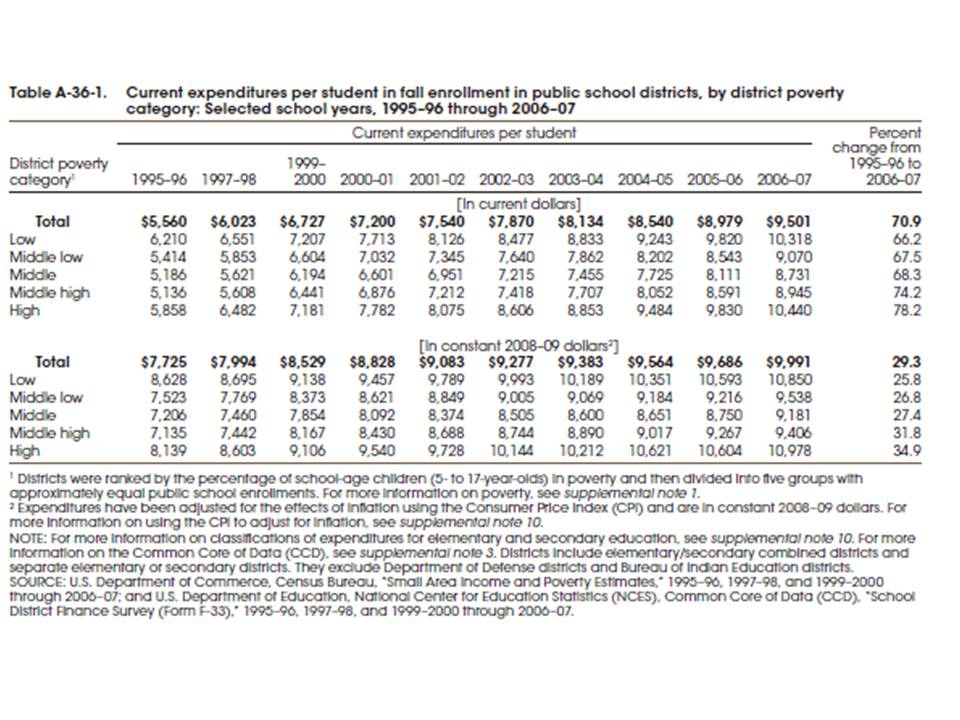
In 2011, the Obama administration formed a national equity commission[1] to explore fiscal inequities across U.S. Schools. In one meeting of that commission, participant Eric Hanushek introduced the following table (A-36-1, in Figure 44) from the National Center for Education Statistics to assert that, on average, U.S. States had already raised levels of spending in high poverty districts to the point where, on average, high poverty districts spend more than low poverty districts.  This statement is factually correct, based on Table A-36-1 of the 2010 Condition of Education Report, of the National Center for Education Statistics. The implication being that school funding equity is not the problem, but rather, the problem lies with inefficiency in high poverty districts.

Figure 1

Slide44

There are a few problems with using this table to draw these implications, setting aside that the dollar figures are not adjusted for differences in labor costs across settings.  While $10,978 (constant dollars) is in fact higher than $10,850, this difference is hardly enough to provide for the differences in programs and services needed to close achievement gaps between our highest and lowest poverty children. But perhaps most importantly, these broad, national average figures hide substantial variation both across and within states. Many states have highly inequitable school funding systems and many districts and the children they serve continue to be significantly disadvantaged by state school finance systems, ranging from imperfect to god-awful.

In 2014 I produced a report for the Center for American Progress identifying America’s Most Financially Disadvantaged School Districts.  This report came about as an extension of a series of blog posts in which I had identified what I referred to as America’s Most Screwed School Districts.  It had become increasingly clear to me that the indicators we created for the School Funding Fairness report card, while useful for describing overall patterns, were hiding important disparities within states behind the averages. For example, the disparities I pointed out in the previous section in Massachusetts and New Jersey. These are two of the best, most progressive state school finance systems in the nation, but even in these states there are districts which are high in student poverty and have far fewer resources than the other districts around them. Many districts, and thus the children they serve, were being overlooked in our indicators and subject to mischaracterization by others, without readily available rebuttal.

It is important to understand that the value of any given level of education funding, in any given location, is relative. That is, it does not matter whether a district spends $10,000 per pupil or $20,000 per pupil. It matters how that funding compares to other districts operating in the same regional labor market—and, for that matter, how that money relates to other conditions in the regional labor market. The first reason relative funding matters is that schooling is labor intensive. The quality of schooling depends largely on the ability of schools or districts to recruit and retain quality employees. The largest share of school districts’ annual operating budgets is tied up in the salaries and wages of teachers and other school workers. The ability to recruit and retain teachers in a school district in any given labor market depends on the wage a district can pay to teachers relative to other surrounding schools or districts and relative to nonteaching alternatives in the same labor market.[2] The second reason is that graduates’ access to opportunities beyond high school is largely relative and regional. The ability of graduates of one school district to gain access to higher education or the labor force depends on the regional pool in which the graduate must compete.[3]

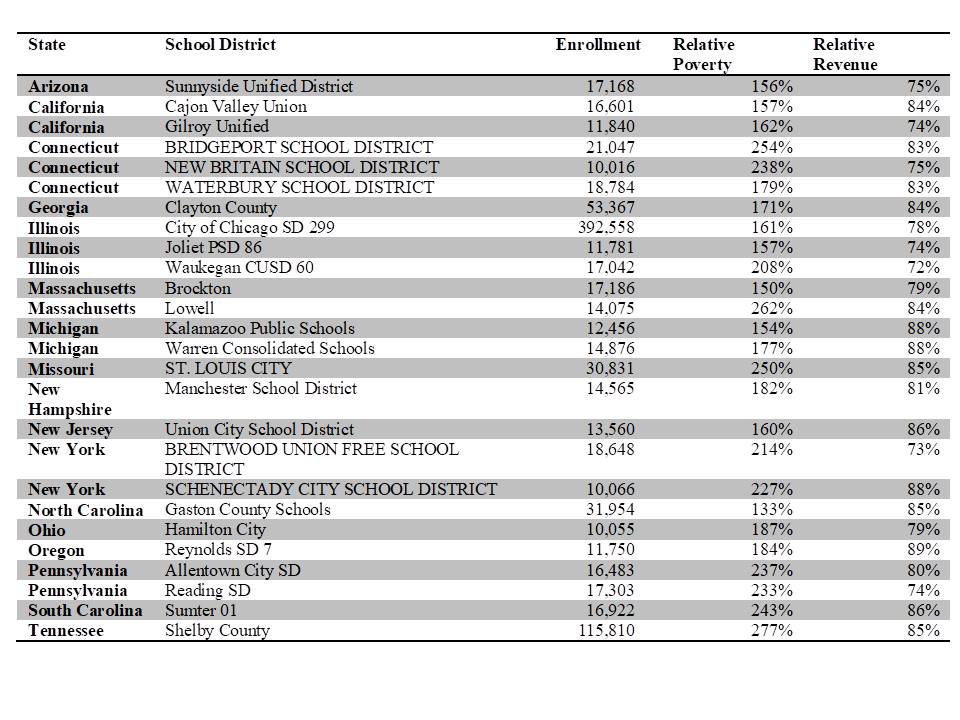
Table 1 lists k-12 (unified) districts identified based on 2015 fiscal and poverty data, which have <90% state and local revenue of their labor market average and >150% of the poverty rate.  Many other repeat suspects like Philadelphia (w/approximately 90% revenue) continue to lie at the margins. Year after year, Philadelphia and Chicago have appeared as the two most screwed large urban districts. Along with Philadelphia, other Pennsylvania cities including Reading and Allentown face even more dire conditions, and along with Chicago, Illinois districts like Waukegan and Joliet make the list year after year.  While Hartford and New Haven in Connecticut have received additional aid in support of their magnet programs, creating an appearance of progressive funding in Connecticut, other districts including Bridgeport, Waterbury and New Britain have been entirely left out. It seems a relatively easy call to suggest that disparities of this type and magnitude are simply wrong – unfair – and should be remedied.

Table 1

America’s Most Financially Disadvantaged Districts 2015

Screwed

Baker, B.D., Srikanth, A., Weber, M.A. (2016). Rutgers Graduate School of Education/Education Law Center: School Funding Fairness Data System. Retrieved from: http://www.schoolfundingfairness.org/data-download

To put these disparities into context, we know that high poverty districts need not only equal resources but substantially more resources per pupil to achieve common outcomes for their students. One of the more rigorous studies to ask just how much more applied cost models to districts in New York state, finding that the costs associated with each additional child in poverty (U.S. Census poverty income level) were about 1.5 more (2.5 times) the costs of achieving the same outcome measures for children not in poverty.[4] Thus, a district serving 30% children below the poverty line would have costs approximately 75% higher or 1.75 times (.3 x 2.5) per pupil cost for a district with 0% census poverty.

As obviously problematic as these disparities are, they still have their detractors and deniers, which is especially disheartening. Take for example the twitter exchange below between Andy Smarick, Fellow of the American Enterprise Institute, later appointed President of the Maryland State Board of Education and Author of The Urban School System of the Future[5], and Kombiz Lavasany, a research manager at the American Federation of Teachers.  The premise of Mr. Smarick’s book is that urban school systems have failed despite receiving massive resources. According to Mr. Smarick, urban traditional public school districts don’t and can’t work, and must be replaced with a portfolio of privately managed autonomous charter schools. This premise is largely borrowed from a 1997 book by Paul Hill, Lawrence Pierce and Jim Guthrie titled Reinventing Public Education.[6]

In the exchange below, Andy Smarick opines with great confidence that Philadelphia is among those large urban districts which have received massive sums of money, repeatedly, to “prop it up.”[7] The only hint at evidence here is the claim that Philadelphia’s state aid is among the highest in the state. Of course, that’s because Philadelphia is by far the largest district in the state (several times larger than any other district).

Figure 2

Slide45

I might have taken less offense to Mr. Smarick’s proclamation had I not been under the false impression that most reasonably informed education policy wonks understood that Philadelphia was in fact one of (if not the) nation’s least well-funded large urban districts, operating in the context of one of the nation’s least equitable states. Apparently, it wasn’t so widely understood. Nonetheless, publicly available and easily fact-checkable data were and are pretty clear on this point.

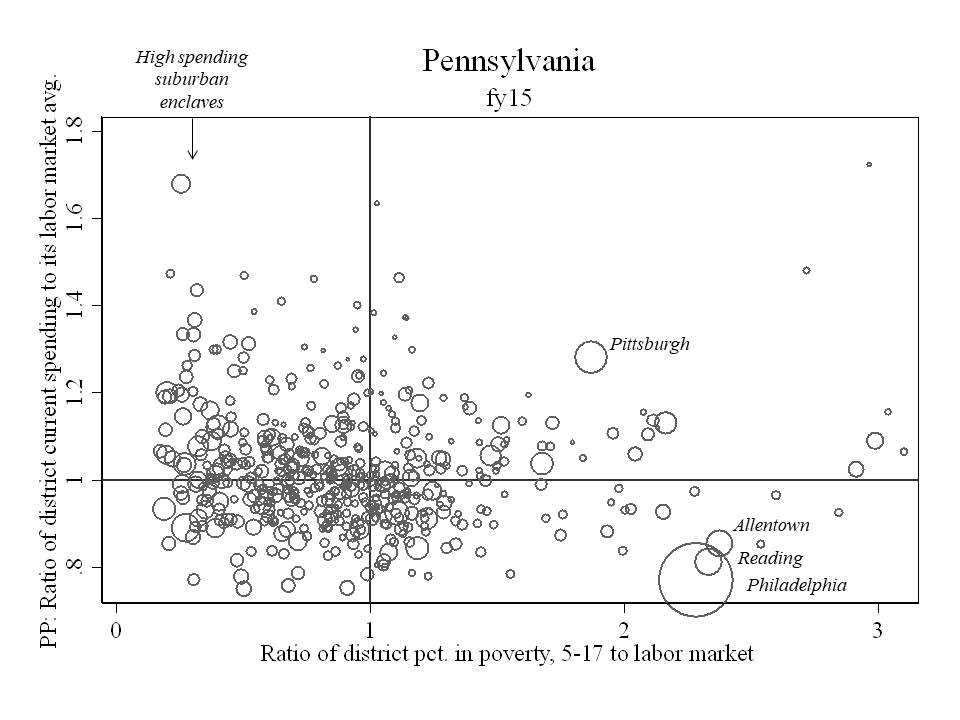
Let’s take a look at Pennsylvania school finance and the position of Philadelphia within that mix. Figure 3 shows Pennsylvania school districts arranged by their poverty rates and by per pupil spending relative to districts in their surrounding labor market.  Again, the size of each circle represents the enrollment size of each district.  Philadelphia stands out as the large circle in the lower right area of the graph. That is, Philadelphia has a little more than double the poverty rate of all districts in its area, and has less than 80% of the current spending per pupil in 2015.  In other words, Philadelphia is the classic case of a “Screwed District” as I originally reported on my blog in June of 2012.[8]

Figure 3

Slide46

Baker, B.D., Srikanth, A., Weber, M.A. (2016). Rutgers Graduate School of Education/Education Law Center: School Funding Fairness Data System. Retrieved from: http://www.schoolfundingfairness.org/data-download

Figure 4 shows the plight of Philadelphia Public Schools over time, from 1993 to 2015.  During this period, child poverty rates climbed from just under double the labor market average to over double the labor market average.  Throughout the period of over two decades, Philadelphia has received substantively less in per pupil revenue and spent less per pupil on average than surrounding districts, despite having much greater need and facing much higher costs.  Despite bombastic rhetoric to the contrary, the Commonwealth of Pennsylvania has done little, if anything, for decades to “prop up” school spending in Philadelphia.  Evidence-free bluster to the contrary is reckless and irresponsible.

Figure 4

Slide47

Baker, B.D., Srikanth, A., Weber, M.A. (2016). Rutgers Graduate School of Education/Education Law Center: School Funding Fairness Data System. Retrieved from: http://www.schoolfundingfairness.org/data-download

Among the financially disadvantaged districts of the Commonwealth, are two other eastern Pennsylvania cities – Reading and Allentown.  Reading was the subject of a feature article in the Huffington Post by education writer Joy Resmovits back in 2012, in which Resmovits detailed the ground level impact of Reading’s funding plight, including substantial staffing cuts and elimination of the district’s preschool program.[9] Kansas City native Michael Q. McShane, then with the American Enterprise Institute (now with the Missouri-based Show-Me Institute) responded to the Resmovits column in a piece he titled “It’s not about the money” in which he argued: “Ms. Resmovits was right to point to Reading as an example of a property-poor district that cannot raise enough local funds to support education. However, as the 20-year changes in funding show, the state has worked to remedy this shortfall.”[10] McShane’s evidentiary basis for his claim was to show that the percent of Reading’s funding coming from the state had increased over time and was greater than that of other districts. Thus, the state was doing its part and responsibility for any failures should fall squarely on Reading school district officials. Clearly, however, as shown in Figure 5, the state’s efforts have been far from sufficient to remedy the shortfall.  The percent of revenue that comes from the state is irrelevant if the sum of state and local revenue remains insufficient. Reading is an especially flagrant case of savage school funding inequalities. Reading is a mid-size city district with nearly 250% of the poverty rate and about 73.6% of the state and local revenue per pupil of the surrounding labor market.

Figure 5

Slide48

Baker, B.D., Srikanth, A., Weber, M.A. (2016). Rutgers Graduate School of Education/Education Law Center: School Funding Fairness Data System. Retrieved from: http://www.schoolfundingfairness.org/data-download

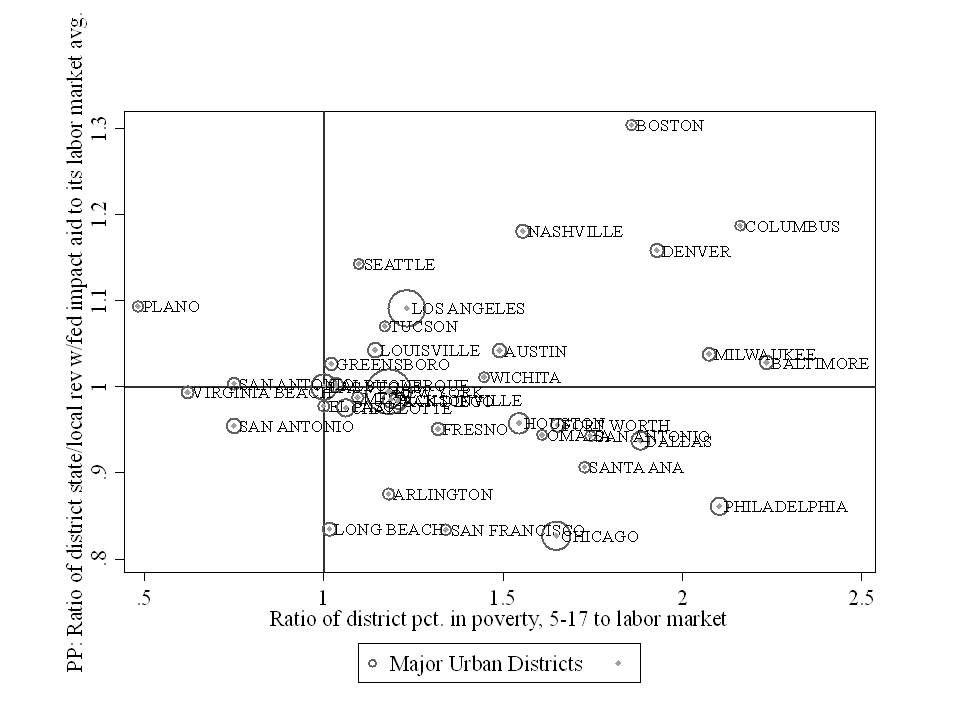
While Philadelphia and Reading are particularly egregious examples of disparities, it is false to assume or make data-free proclamations regarding propping up large city school districts with vast sums of state aid. Figure 6 shows the relative poverty and relative state and local revenue for large city school districts with 50,000 or more students in 2013.  Again, Philadelphia and Chicago are most disadvantaged. Boston is most advantaged here, but its margin of poverty difference is still double that of its surroundings and margin of revenue difference only about 30% higher than surroundings.  Even Boston’s progressive spending differential falls well short of cost estimates for achieving common outcomes.[11] Thus it should come as no surprise that Boston students’ outcomes continue to fall short.

Figure 6

Slide49


Baker, B.D., Srikanth, A., Weber, M.A. (2016). Rutgers Graduate School of Education/Education Law Center: School Funding Fairness Data System. Retrieved from: http://www.schoolfundingfairness.org/data-download

NOTES

[1] Mercury News. A 28-member commission studing the problem of school fundign inequities, will hold a meeting in San Jose March 4. Feb 24, 2011. http://www.mercurynews.com/2011/02/24/a-28-member-commission-studying-the-problem-of-school-funding-inequities-will-hold-a-meeting-in-san-jose-march-4/

[2] Bruce, D. B. “Revisiting the Age-Old Question: Does Money Matter in Education.” The Albert Shanker Institute (2012).

& Baker, Bruce D. “Does money matter in education?.” Albert Shanker Institute (2016).

http://www.shankerinstitute.org/images/doesmoneymatter_final.pdf.

[3] Bruce D. Baker and Preston C. Green III as well as William Koski and Rob Reich explain that to a large extent, education operates as a positional good, whereby the advantages obtained by some necessarily translate to disadvantages for others. For example, Baker and Green explain that, “In a system where children are guaranteed only minimally adequate K–12 education, but where many receive far superior opportunities, those with only minimally adequate education will have limited opportunities in higher education or the workplace.”

Baker, Bruce, and Preston Green. “Conceptions of equity and adequacy in school finance.” Handbook of research in education finance and policy (2008): 203-221.;

Koski, William S., and Rob Reich. “When adequate isn’t: The retreat from equity in educational law and policy and why it matters.” Emory LJ 56 (2006): 545.

, available at http://www.law.emory.edu/fileadmin/journals/elj/56/3/Koski___Reich.pdf.

[4] Duncombe, William, and John Yinger. “How much more does a disadvantaged student cost?.” Economics of Education Review 24, no. 5 (2005): 513-532.

[5] Smarick, Andy. The urban school system of the future: Applying the principles and lessons of chartering. R&L Education, 2012.

See also: Wexler, Natalie. Should we give up on urban public school districts and replace them with something completely different? Greater Greater Washington. May 7, 2014. https://ggwash.org/view/34640/should-we-give-up-on-urban-public-school-districts-and-replace-them-with-something-completely-different

[6] Hill, Paul, Lawrence C. Pierce, and James W. Guthrie. Reinventing public education: How contracting can transform America’s schools. University of Chicago Press, 2009.

[7] Smarick mentions Baltimore, Boston, Detroit, Milwaukee and New York in an exchange here: https://edexcellence.net/articles/does-money-matter-is-school-funding-fair

[8] Baker, Bruce D. America’s Most Screwed City Schools. School Finance 101. June 2, 2012. https://schoolfinance101.wordpress.com/2012/06/02/americas-most-screwed-city-schools-where-are-the-least-fairly-funded-city-districts/

[9]Resmovitz, Joy. Reading, Pennsylvania: Poorest U.S. City Loses Pre-Kindergarten, 170 Teachers. Huffington Post. June 15, 2012.  http://www.huffingtonpost.com/2012/06/14/reading-pennsylvania-schools_n_1598398.html

[10]McShane, Michael Q. Fact Checking HuffPost: It’s not about the money. American Enterprise Institute. Oct 5, 2012.  https://www.aei.org/publication/fact-checking-huffpost-its-not-about-the-money/

[11] Duncombe, William, and John Yinger. “Why is it so hard to help central city schools?.” Journal of Policy Analysis and Management (1997): 85-113.

Duncombe, William, and John Yinger. “How much more does a disadvantaged student cost?.” Economics of Education Review 24, no. 5 (2005): 513-532.

More on Within-District “Equity” and Charter Expansion

The 1990s saw a flurry of studies which began to explore equity of resources across schools within districts. These studies revealed significant variation in spending across schools, raising the legitimate concern regarding the effectiveness of state school finance formulas alone for resolving inequitable resources to students. After all, in some states like New York, a single district might serve over 1/3 of all pupils, across over 1,000 schools.  Getting enough money to New York City to achieve equity with other districts statewide was one thing, but ensuring that the resources flowed equitably to children across schools within this very large, socially, economically and racially diverse city was another thing entirely.

Over the next decade through the late 2000s, within district inequality became a convenient scapegoat issue for federal policymakers, informed by beltway think tanks.[1]  The message that emerged was that due to years of litigation and pressure by state courts, states had largely met their obligations to resolve disparities between local public school districts and that the bulk of remaining disparities were those that persist within school districts.[2] Thus, the most useful exertion of federal pressure is on local district officials and their corrupt policies which drive more money to schools in rich neighborhoods within districts, and away from poor neighborhoods within the same districts.

The political convenience of focusing on within district equity was that federal policy and funding could be leveraged to place pressure on local bureaucrats – school superintendents and local boards of education – to fix their inequitable budget allocations, regardless of how much money was available. It was a simple, revenue neutral solution, one which avoided federal officials placing any pressure on state legislatures and governors to fund more equitable statewide formulas, which might require raising taxes. These federal policies exist today in the form of “comparability” regulations which require that local school districts can show that poor schools receive resources at least comparable to those of rich schools in order to qualify to receive federal Title I funding.[3] Title I has long required that districts supplement, not supplant state and local resources with Title I funds for high poverty schools.

Indeed, it is important that we consider not only the delivery of resources from states to local districts, but also how those resources reach schools and children. But federal attention on within district disparities without regard for between district disparities has created an unfortunate distraction from the larger issue – that many high need school districts simply lack sufficient resources to provide their students equal educational opportunity – and have limited capacity to reshuffle those resources from poor to poorer schools within their highly segregated boundaries.

To begin with, assertions that the remaining dominant disparities in school finance are those across schools within district are based on analyses that range from merely insufficient to flawed and outright deceitful.[4]  Additionally, the argument falsely presumes that there exist large numbers of school districts around the country that have both rich and poor neighborhoods within their boundaries, and many schools sorted among them. Except in southern states operating county systems, most racial and economic segregation exists across school district boundaries, not across schools within districts. Further, in many states there exist a relative few districts which actually have large numbers of schools and even fewer where there exists large variation in poverty across those schools.

In a recent article on the limits of federal comparability regulation, Mark Weber and I explain that 21 states have less than one-half of students attending districts with 10 or more schools. Vermont has none. 15 Fifteen states have more than 1/3one-third of their students attending districts with fewer than five schools (meaning likely fewer than three at any grade level, three elementary, one middle, one secondary, or single high school regional districts).

In this same article, Mark Weber and I go further to illustrate that if we look across schools statewide, variations in district spending strongly dictate statewide variations in school spending. We explain that “District spending variation explains an important, policy relevant share of school staffing expenditures in 13 states. In many states, including Illinois and New York, a nearly 1:1 relationship exists between district spending variation and school site spending variation (2).”[5] In other words, if a district has more money, so too do the schools within that district.

The right way to evaluate spending variation across schools

When evaluating within district spending we must take steps to parse “good variation” from “bad variation,” or more specifically “equity enhancing variation” from “equity eroding variation.”  The same is true for between district spending differences. Recall that in the School Funding Fairness model which evaluates between district spending disparities, we estimate the relationship between census poverty rates and district revenues (and spending), while accounting for variation in competitive wages across regions, district enrollment size (economies of scale) and population sparsity. Failure to account for relevant factors influencing spending variation can lead to erroneous conclusions.  Here are two examples of such erroneous conclusions from school level analyses:

  • Bad Example 1: A 2007 study by authors at the Buckeye Institute in Ohio counted up the districts where there existed a positive versus negative correlation between low income shares and per pupil spending across schools within those districts. They found that most of the 70 high poverty districts they studied did not have clear positive correlations between school spending and low income shares. [6] As I explained in a critique of this study, most of what they actually found was that school districts with one or a few elementary schools, a middle school, and a high school a) often had higher per pupil spending in the high school, and b) the high school often had lower shares of children reported as qualifying for free or reduced lunch. This was an important revelation to me at the time, since this is a common pattern, with a variety of explanations including lower compliance filing forms to qualify for subsidized lunch at the secondary level. But it’s not evidence that Ohio districts were shortchanging higher poverty schools to favor lower poverty ones.
  • Bad (really stupid) Example 2: A more egregious example comes from a New York based charter school advocacy organization called Families for Excellent Schools which released a report arguing that New York City’s highest funded middle schools were also its worst! The press release for their report proclaimed: “At the middle school level, the bottom 50 schools received an average $30,256 per pupil, compared with $16,277 at the top 50 middle schools.”[7]  The goal of their report was to advocate that these funds should instead be directed toward charter school expansion, since it was clear, by this finding, that the district simply didn’t know how to leverage resources to improve student achievement.  But this “study” missed the simple fact that in New York City like most large districts, the primary driver of differences in spending across schools within districts is the share of children with disabilities served in the schools. Children with disabilities significantly influence staffing ratios and thus school level spending. It also turns out, not surprisingly, that schools with more children with disabilities tend to have lower average test scores. Thus, more spending leads to lower test scores?

So then, what’s the right approach for characterizing good and bad disparities across schools within districts? Through numerous peer reviewed publications and consulting work with colleagues including Jesse Levin at the American Institutes for Research, we have arrived at a common set of factors that should typically be included in any model of within district, school level spending variation.  First we must consider the grade level issue, both because there exist differences in spending approaches across grade levels and differences in student need measures, such as free or reduced lunch. It’s not that we have any real basis for assuming that elementary school costs more than high school or vice versa, but that direct comparisons ignoring grade level are problematic and can lead to invalid conclusions (like the Buckeye report).

While we consider district size and population sparsity in our School Funding Fairness model evaluating district spending, one can make the argument that there should not exist inefficiently small (higher spending because they are small) schools in densely populated urban contexts. Having these schools for some drains resources from others. It’s inequitable variation, not equitable variation. Perhaps most importantly, we must consider the distribution of children with disabilities across schools, preferably with consideration of which schools are serving children with more severe disabilities requiring even more direct instructional and related services support personnel.

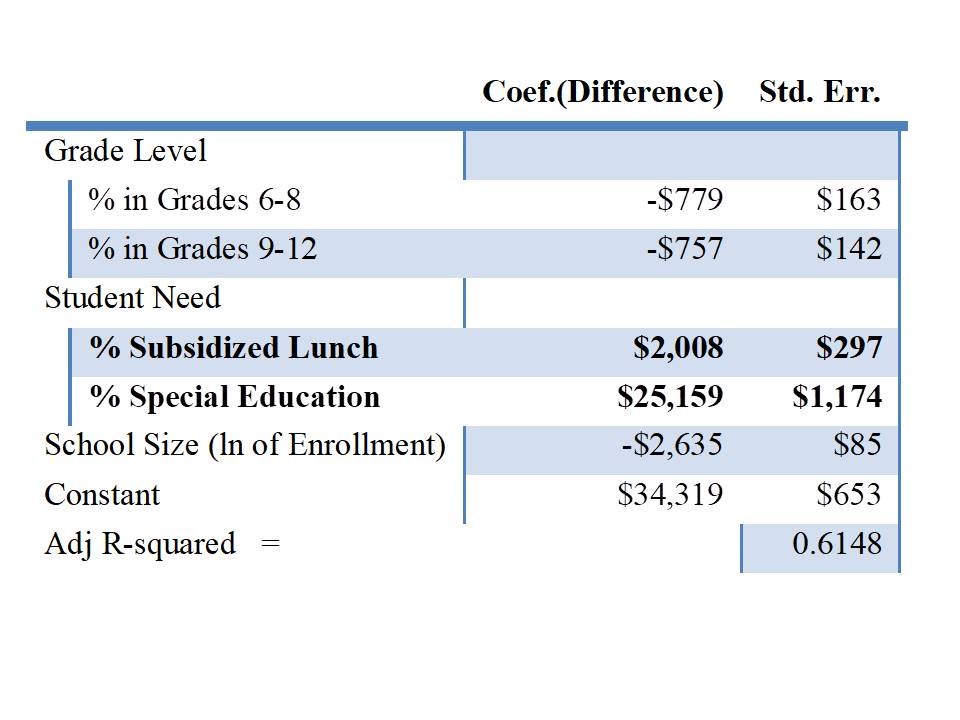
Let’s apply these guidelines to take a look at school site spending variations in New York City and Baltimore. Table 1 and Table 2 present results of regression models of school spending in New York City and New York State. It’s important to understand here that I’m just using these models to characterize the average patterns across all schools in each district. Often, statistical models like this are used for drawing inferences about relationships. These models are simply describing patterns – actual patterns, across all schools. For New York City, for example, I find that as we go from 0% to 100% children in middle grades, per pupil spending drops by $779 per pupil. As we move from 0% to 100% children in secondary grades, per pupil spending drops by $757. That is, elementary per pupil spending tends to be highest in New York City. The average regular elementary school spent about $21,229 per pupil in 2015. As we move from a school with 0% low income children to 100% low income children, spending increases by about $2,000 (about a 10% margin). If we went from a school with 0% children in special education to 100%, spending per pupil would double. Most schools fall between 0 and 30% special education, so the practical difference is about 1/3 of the $25,159. Importantly, these factors explain over 60% of the variations in spending across New York City Schools. That is, most of the variation in spending across New York City schools is rational, explainable variation. Still, a sizeable share is not, and should be vetted further.

Table 1

Model of School Site Spending in New York City 2015

By contrast, Table 2 shows a model applied to statewide, inter-district spending variation in New York in 2015. Here, I also include factors for regional wage variation and for economies of scale and population sparsity. As such, this even richer model should be able to explain even more variation if that variation is rationally related to cost and need factors. But, the state level model only yields about 45% variation explained by rational factors. More disturbingly, however, the state model reveals an overall statewide pattern of regressive inter-district disparity, wherein a district with 100% poverty would be expected to have nearly $12,000 less in per pupil spending than a district with 0% poverty.  So, at least in New York State, spending disparities within New York City are less of a problem than spending disparities statewide.  New York City intra-district funding is mildly progressive whereas statewide inter-district funding is regressive.

Table 2

Model of Statewide Current Spending per Pupil for New York State Districts in 2015

Charter Expansion and Within-District Equity

Now let’s take a look at Baltimore, where I include two different models. The New York City analysis above does not include charter schools. The Baltimore analysis does. In an equitable district/charter system, after accounting for the relevant factors, there should not be any difference in spending between charter schools and district schools. Otherwise, charter schooling in-and-of-itself is introducing inequity.  Baltimore, unlike New York City does spend more in schools serving more secondary level students. Again, the margins of difference related to special education are the greatest, but are somewhat buffered where the shares of students who have mild disabilities is greater.

In the first model, it would appear that on average, schools serving more low income children have lower per pupil spending. That is, Baltimore school funding is flat to regressive. But, when one takes account of charter schools, what we see is that charter schools, on average, spend slightly more ($249 per pupil) than otherwise similar district schools and that spending with respect to low income children is slightly progressive ($183 per pupil increase moving from 0% to 100% low income). The reason this pattern flips when accounting for charter schools is that a) Baltimore charter schools serve, on average, fewer low income students than do district schools and b) Baltimore charter schools spend slightly more per pupil than district schools. That is, they introduce an inequity to the system. This finding is common.

Table 3

Model of School Site Spending In Baltimore 2013-2015

In a 2015 article in the journal Education Finance and Policy, Ken Libby, Katy Wiley and I discuss similar findings regarding charter schools in New York City and Houston. Specifically, we found that New York City charter schools both served less needy student populations than nearby district schools and on average, after accounting for student population differences, those charter schools spent significantly more per pupil than district schools. Even more striking were the differences in spending within the charter sector, between schools having substantial private contributions versus those receiving far less outside of their public subsidies. [8] In follow up work, in an article published in 2017 in the journal Educational Policy, Mark Weber and I found that for-profit charter operators, on average divert more money from direct classroom services, leading to even greater variation across schools in jurisdictions with a mix of district schools, for-profit and non-profit charter schools. [9]

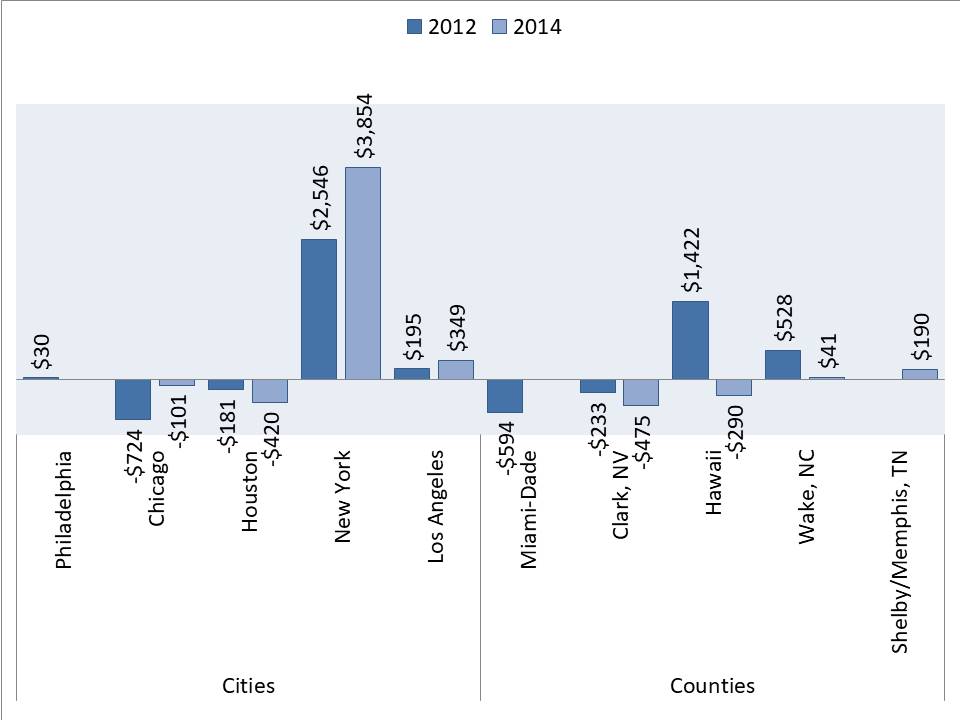
In ongoing work, Mark Weber, Ajay Srikanth and I are finding that across large school districts which have sizeable and growing charter sectors, student sorting by demographics is exacerbated and school spending variations increased. That is, expanded chartering seems to be leading to increased inequality across schools within common geographic spaces. Using data from two waves of the Civil Rights Data Collection, we again find that controlling for the factors listed previously, New York City charter schools continue to spend far more than district schools serving similar populations (Figure 1). Results are mixed for other settings, but inequities are inequities, in whichever direction they fall.

Figure 1


Focusing for the moment specifically on New York City – as I show above, New York City, across public district schools has achieved greater equity than New York State has achieved across districts. In fact, one of the most significant factors compromising equity across schools within New York City is the expansion of charter schools!

Worse, the extent to which charter expansion adversely affects equity for children within New York City is difficult to measure accurately in the absence of a common financial reporting system inclusive of all revenues and expenditures for school sites, including the value of allocated services.

Incompatible Policy Preferences: Comparability & Expanded Choice

Tightening comparability regulations governing within district equity (defined in terms of progressiveness) while pushing for expanded choice and diversification of operators and governing bodies are entirely incompatible policies. In some states, charter schools are governed by and financed through local district budgets, providing the opportunity for districts to use common formulas for funding district and charter schools. In other states, fully independent charter schools may be authorized to operate within district spaces but outside of their control or financing. Some states like Texas have both.

Expanding the mix of providers and provider types in a common space is more likely to result in increased variations in quality and spending than in convergence toward equity.  Private providers have widely varied access to outside resources, resulting in highly unequal “revenue enhancement.”  The incentive for school operators is to pursue whatever means is necessary to be the preferred school of choice (for the preferred students), not to spend only what is needed to provide equal opportunity to achieve common outcomes.

Expanding choice also means accepting the presence of inefficiently small startups, at least for a period of time.  Continued shifting of students from one sector to another within the same geographic space means accepting simultaneously inequities and inefficiencies associated with growth related costs in one sector, and stranded expenses in another.  For a system to be equitable, policymakers must figure out how to manage these inequities. Thus far, they’ve largely ignored them


Notes

[1] Hall, Daria, and Natasha Ushomirsky. “Close the Hidden Funding Gaps in Our Schools. K-12 Policy.” Education Trust (2010).

Spatig-Amerikaner, Ary. “Unequal Education: Federal Loophole Enables Lower Spending on Students of Color.” Center for American Progress (2012).

[2] Baker, Bruce D., and Kevin G. Welner. “Premature celebrations: The persistence of inter-district funding disparities.” Education Policy Analysis Archives/Archivos Analíticos de Políticas Educativas 18 (2010).

[3] Luebchow, Lindsey. “Equitable Resources in Low Income Schools: Teacher Equity and the Federal Title I Comparability Requirement.” New America Foundation (2009).

Dynarski, Mark, and Kirsten Kainz. “Requiring school districts to spend comparable amounts on Title I schools is pushing on a string.” Evidence Speaks Reports 1 (2016): 21.

[4] Baker, Bruce D., and Kevin G. Welner. “Premature celebrations: The persistence of inter-district funding disparities.” Education Policy Analysis Archives/Archivos Analíticos de Políticas Educativas 18 (2010).

See also: Dynarski, Mark, and Kirsten Kainz. “Requiring school districts to spend comparable amounts on Title I schools is pushing on a string.” Evidence Speaks Reports 1 (2016): 21.

[5] Baker, Bruce D., and Mark Weber. “State school finance inequities and the limits of pursuing teacher equity through departmental regulation.” education policy analysis archives 24 (2016): 47.

[6] Carr, M., Gray, N., and Holley, M. (2007, Sept. 20). Shortchanging Disadvantaged Students: An analysis of intra-district spending patterns in Ohio. Policy Report No. 14. Columbus: The Buckeye Institute for Public Policy Solutions. Retrieved Oct. 10, 2007, from http://www.buckeyeinstitute.org/docs/Shortchanging_Disadvantaged_Students.pdf

[7] http://www.familiesforexcellentschools.org/news/press-release-cost-failure

[8] Baker, Bruce D., Ken Libby, and Kathryn Wiley. “Charter School Expansion and Within-District Equity: Confluence or Conflict?.” Education Finance and Policy (2015).

[9] Weber, Mark, and Bruce Baker. “Do For-Profit Managers Spend Less on Schools and Instruction? A national analysis of charter school staffing expenditures.” Educational Policy (2017): 0895904816681525.

Incompatible Policy Preferences: Comparability & Expanded Choice

Another excerpt from forthcoming work:

In a 2015 article in the journal Education Finance and Policy, Ken Libby, Katy Wiley and I discuss similar findings regarding charter schools in New York City and Houston. Specifically, we found that New York City charter schools both served less needy student populations than nearby district schools and on average, after accounting for student population differences, those charter schools spent significantly more per pupil than district schools. Even more striking were the differences in spending within the charter sector, between schools having substantial private contributions versus those receiving far less outside of their public subsidies. [i] In follow up work, in an article published in 2017 in the journal Educational Policy, Mark Weber and I found that for-profit charter operators, on average divert more money from direct classroom services, leading to even greater variation across schools in jurisdictions with a mix of district schools, for-profit and non-profit charter schools. [ii]

In ongoing work, Mark Weber, Ajay Srikanth and I are finding that across large school districts which have sizeable and growing charter sectors, student sorting by demographics is exacerbated and school spending variations increased. That is, expanded chartering seems to be leading to increased inequality across schools within common geographic spaces. Using data from two waves of the Civil Rights Data Collection, we again find that controlling for student characteristics and grade ranges served, New York City charter schools continue to spend far more than district schools serving similar populations (Figure 1). Results are mixed for other settings, but inequities are inequities, in whichever direction they fall.

Figure 1Slide105

Tightening comparability regulations governing within district equity (defined in terms of progressiveness with respect to low income concentrations) while pushing for expanded choice and diversification of operators and governing bodies are entirely incompatible policies. In some states, charter schools are governed by and financed through local district budgets, providing the opportunity for districts to use common formulas for funding district and charter schools. In other states, fully independent charter schools may be authorized to operate within district spaces but outside of their control or financing. Some states like Texas have both.

Expanding the mix of providers and provider types in a common space is more likely to result in increased variations in quality and spending than in convergence toward equity.  Private providers have widely varied access to outside resources, resulting in highly unequal “revenue enhancement.”  The incentive for school operators is to pursue whatever means is necessary to be the preferred school of choice (for the preferred students), not to spend only what is needed to provide equal opportunity to achieve common outcomes.

Expanding choice also means accepting the presence of inefficiently small startups, at least for a period of time.  Continued shifting of students from one sector to another within the same geographic space means accepting simultaneously inequities and inefficiencies associated with growth related costs in one sector, and stranded expenses in another.  For a system to be equitable, policymakers must figure out how to manage these inequities. Thus far, they’ve largely ignored them.

[i] Baker, Bruce D., Ken Libby, and Kathryn Wiley. “Charter School Expansion and Within-District Equity: Confluence or Conflict?.” Education Finance and Policy (2015).

[ii] Weber, Mark, and Bruce Baker. “Do For-Profit Managers Spend Less on Schools and Instruction? A national analysis of charter school staffing expenditures.” Educational Policy (2017): 0895904816681525.

Choice as a Substitute for Adequacy?

Another excerpt from forthcoming work…

Much of the expansion of charter schooling occurred during the recession. That is, states were adding schools while reducing overall funding, adding inequitable choices on top of increasingly inequitable and inadequate systems.  Expanded charter schooling was a centerpiece of the Duncan/Obama education reform platform which coincided with the recession and “new normal” era.

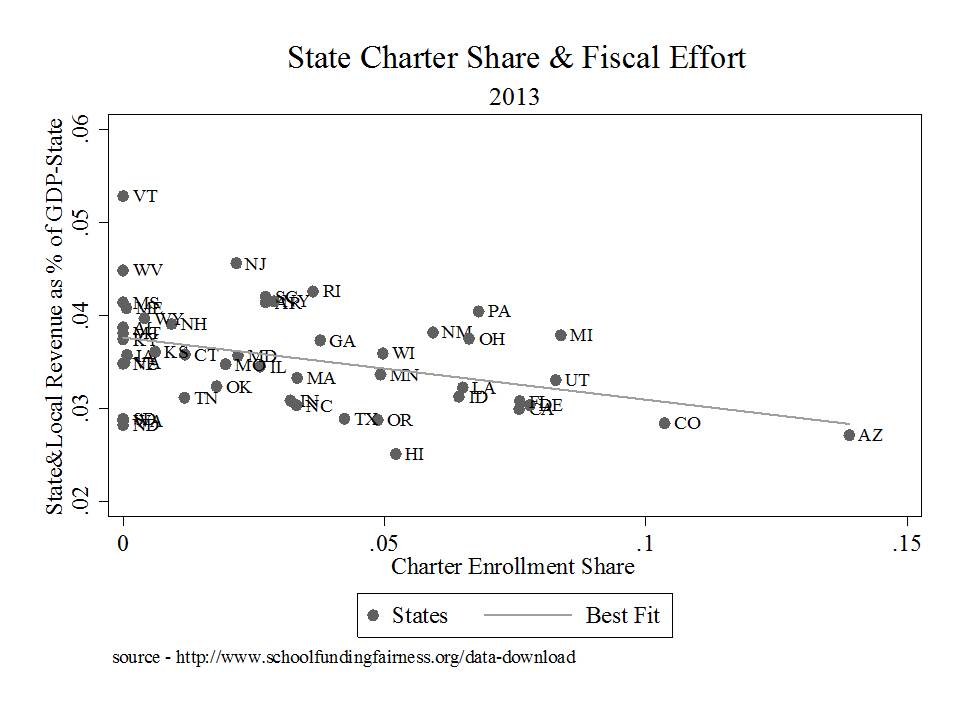
Cursory descriptive analyses (as well as more complex longitudinal models) suggest that states which most expanded their charter sectors are also among those states which most reduced their overall effort toward financing public education. This is a disturbing finding in part because charter schools rely similarly on public financing. Reducing public financing affects negatively both district and charter schools. Further, increasing the number of schools, holding enrollments constant, shifting students from one sector to another creates additional costs, at least in the short run.[i]

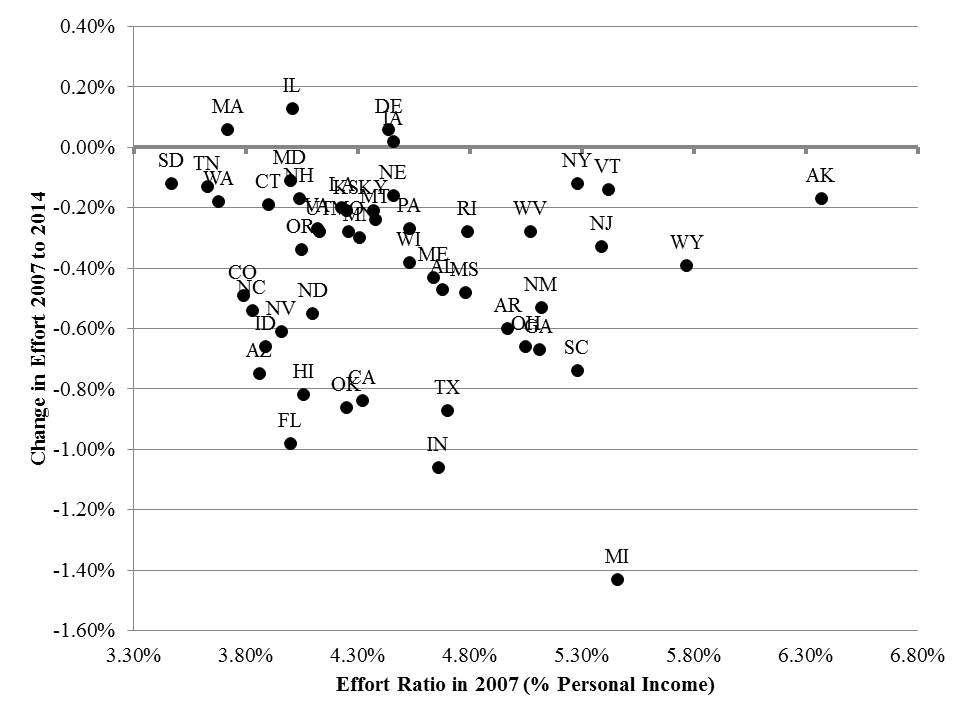
It is conceivable that state policymakers with an ideological preference for choice and the assumption that a competitive market based system can “do more with less,” apply that ideology to state tax and spending policies. Or it just may be that states where legislators prefer choice and charter schools are also states where legislators prefer not to raise taxes or spend money on schools in general, whatever type. Whatever the cause, Figure 1 shows that states like Colorado and Arizona with very high charter market share have, in 2015, the lowest effort rates for financing public education (inclusive of charter spending).  Michigan, another high charter share state reduced its effort more than any other state from 2007 to 2014 (Figure 2, applying alternative measure of effort).  Overall, higher charter share states have lower effort.

Figure 1

Slide90

Figure 2

Slide77

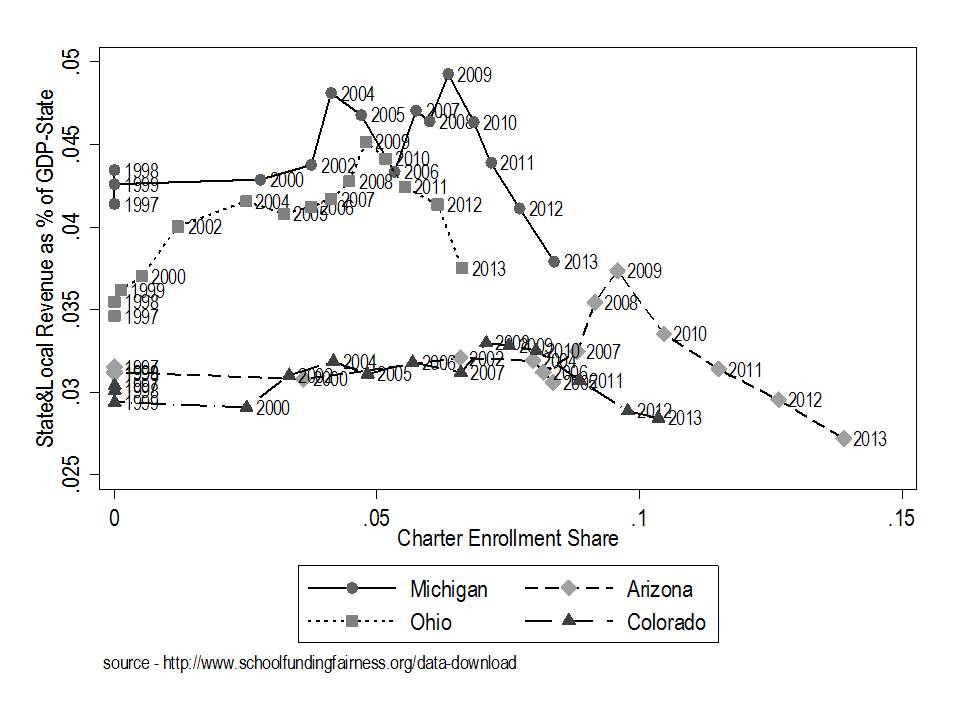
Focusing on four high charter market share states – Arizona, Colorado, Michigan and Ohio – we can see in Figure 3 that beginning in 2009 as charter market shares accelerated beyond 5%, state and local effort toward financing public schools dropped precipitously. All four states have charter market shares over 5%, with Colorado and Arizona over 10%. Two of the four states started as low effort states and two as higher effort states. Michigan and Arizona saw the greatest drop in effort, but effort also declined in the other two.

Figure 3

Slide93

Whether there is causal direction between charter market share and state effort or these patterns merely exist as a function of shared ideologies of state policymakers, these patterns are problematic for both charter and district schools in these states. Equitable and adequate financing is prerequisite regardless of operator type.

[i] Bifulco, Robert, and Randall Reback. “Fiscal impacts of charter schools: lessons from New York.” Education Finance & Policy  9.1 (2014): 86-107.

When school finance research died & why it matters #MSFRGA

As I continue work on my forthcoming book on school finance, I find myself reflecting on the state of the field. Where we stand, and how we got here, and perhaps most importantly, how we should move forward.

I personally began studying school finance around 1994 and completed my doctoral work in 1997 at Teachers College at Columbia University in New York. In 1995, while a doctoral student, and still largely unaware of the breadth of literature in my field, I received (actually, I went in someone’s place) an invitation to attend a symposium sponsored by the New York State Regents. The symposium was on the topic of Cost-Effectiveness in Education and included research papers presented by academic researchers from universities across the state. The papers were released as a report to the New York State Board of Regents in March of 1996.[i] These were state supported research studies, including research advancing the application of conceptual models and statistical methods for studying cost-effectiveness and efficiency of local public school districts. The studies were at the highest levels of empirical and conceptual rigor, and conducted by leading researchers in the field (something I totally didn’t get at the time as a cocky and naïve doctoral student).  These studies were part of an ongoing research consortium among scholars from Cornell, Syracuse, SUNY Albany and NYU, supported by the Regents of the State of New York. Over time, research emanating from this group would serve to break ground in analyses of equity,[ii] efficiency,[iii] resource allocation and the use of state longitudinal data systems to study teacher labor markets.

Similar efforts on similar topics were occurring in the State of Texas, where state agencies and academic researchers were collaborating to better understand variations in labor costs, in order to inform re-calibration of their state school finance formula. In early 2000s, the Texas legislature established the Texas School Finance Project, in which I was involved with researchers from Texas A&M University.[iv] State supported efforts in Texas, like New York served to significantly advance our knowledge of education costs, cost analysis, cost variation and efficiency through the production of numerous prominent and frequently cited reports.[v]

Research emanating from these states also found its way into national symposia sponsored by the U.S. Department of Education and released in two different recurring report series – Developments in School Finance and Selected Papers in School Finance. These reports have long since been discontinued, occurring mainly between 1995 and 2005. These reports like the state efforts in New York and Texas, tackled with empirical rigor, issues including the development of national indices to capture variation in teacher wages from region to region, labor market to labor market and district to district, [vi] the application of statistical modeling techniques to estimate costs of achieving common outcome goals,[vii] and statistical tests of the reliability and validity of estimates of school performance and efficiency.[viii]

These were the very types of analyses needed to inform state school finance polices and to advance the art and science of evaluating educational reforms for their potential to improve equity, productivity and efficiency.  But these efforts largely disappeared over the next decade. More disconcerting, these efforts were replaced by far less rigorous, often purely speculative policy papers, free of any substantive empirical analysis and devoid of any conceptual frameworks.

This shift was largely brought about under the leadership of Arne Duncan.  Kevin Welner of the University of Colorado and I explained first in a report for the National Education Policy Center and subsequently in shorter form in the journal Educational Researcher,  that Secretary Duncan had begun to give lip service to improving educational productivity and efficiency, but accompanied that lip service with wholly insufficient resources. Kevin Welner and I explained that:

“the materials provided on the Department’s website as guiding resources present poorly supported policy advisement. The materials listed and recommendations expressed within those materials repeatedly fail to provide substantive analyses of the cost effectiveness or efficiency of public schools, of practices within public schools, of broader policies pertaining to public schools, or of resource allocation strategies.” [ix]

Among other issues, the materials provided on the web site failed to acknowledge even the existence of the relevant conceptual frameworks and rigorous empirical methods which had risen to prominence in state supported and federally documented research in the years prior.

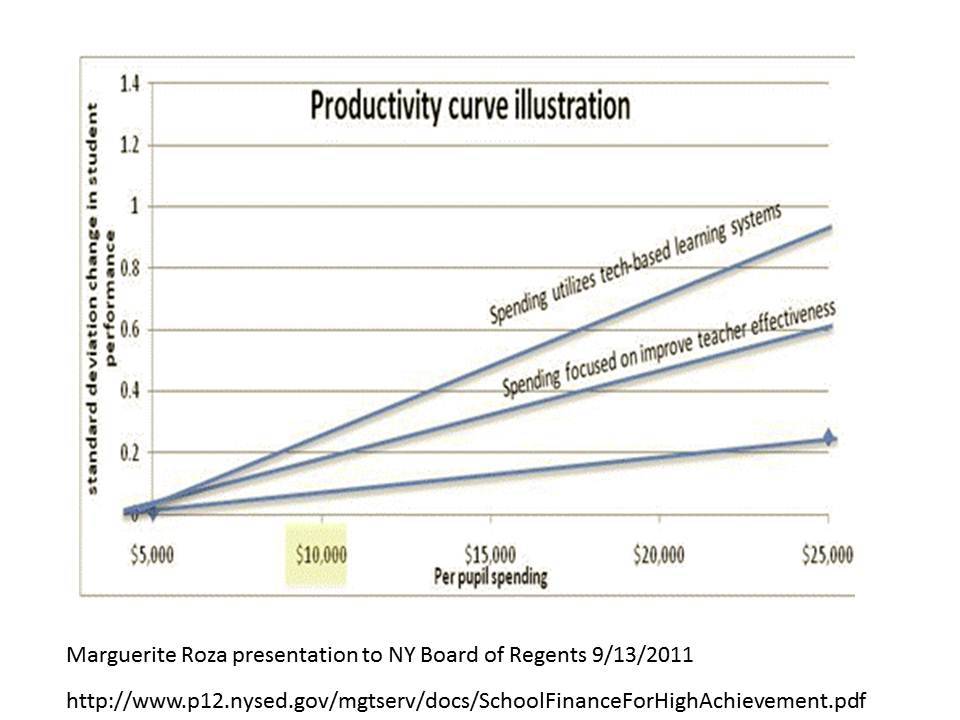
Not surprisingly, a similar shift occurred in the states. In 2011, John King, New York Education Commissioner, close ally of and eventual replacement for Arne Duncan took a “different” approach to the annual Regents Symposium. Prominent researchers were invited to sit in the audience and be subjected to presentations by the authors of many of the materials from Duncan’s productivity web site, including but not limited to, the baseless graph I have presented in several previous posts.  Here it is again (as much as it pains me):

Slide11

Researchers in attendance that day forwarded to me their critique of that graph:

Maguerite Roza made claims that the service delivery programs she discussed could increase the productivity of educational spending several fold and illustrated this point with a graph.  It is hard to know where to start in responding to this claim.  First, she did not explain how the productivity of current spending was measured, so it is difficult to assess the claims she made about that.  However, we are familiar with the literature on educational productivity and do not believe the productivity of current service delivery models can be estimated as precisely as she claimed, and suspect that the basis for the figures presented is questionable.  Concerning the productivity of the innovations she was advocating there are several problems.  It is not at all clear what the innovations are that she is claiming would create such large productivity improvements.  Also, it is not clear what research those productivity estimates are based on.    During the Q&A session, she indicated that these innovations were less than a year old.  How can the productivity gain produced by service models used in a very small number sites for a very short time be determined? They can’t.  It is not an overstatement to say that the claims about productivity improvement were simply made up. [emphasis added]

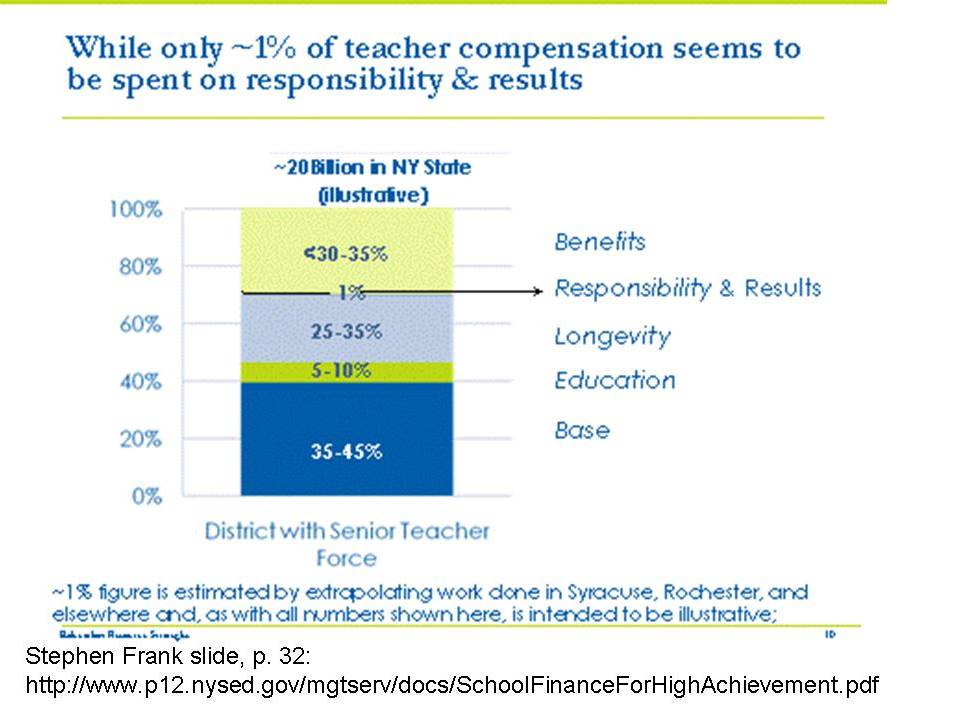
Below is a second, equally problematic graph that was presented in that same symposium, also later used by John King in presentations to school administrators across New York. Here, the presenter (using a graph from an organization called Educational Resource Strategies) argues that only a very small share of teacher salaries actually goes into “responsibility for results.” Thus, all of the salary differences above base salaries – and by extension much of school funding in total – is squandered inefficiently and can and should be reallocated, presumably toward “responsibility for results,” whatever that may mean or however that should be measured.

Slide12

Researchers in attendance that day forwarded to me this critique:

Dr. Fisher [the presenter of this graph] made the claim that 30 to 40 percent of school district dollars were spent on resources that had no relation to student achievement.  Again, the basis for this claim was not presented, so it is difficult to assess.  However, the little explanation that was presented suggests that the analysis suffered from serious conceptual errors.  Arguments can be made for a flatter teaching salary schedule, however, those arguments are more complicated than the speaker acknowledged.  Particularly, the suggestion that any spending on teacher salaries above the starting salary is unproductive is, well, wrong.

It is likely that most of the people in the audience did not take these claims very seriously.  Nonetheless, it was disappointing to see such claims being made by researchers in a forum like this one.

I raise these issues because:

  1. It is vital that we return to the application of relevant frameworks and rigorous methods for studying productivity and efficiency; and
  2. It is vital that the U.S. Department of Education and State Education Agencies play a role in supporting this research and enabling the highest quality research and data to inform policy – specifically, state school finance policy and the federal role.

To reiterate a take home point of many previous posts, equitable and adequate financing are prerequisite conditions for our education systems, regardless of how we choose to deliver those systems. System delivery may alter what’s equitable or adequate. But without rigorous and relevant analyses, we can never know how or to what extent.

NOTES

[i] Berne, Robert. Study on Cost-effectiveness in Education. University of the State of New York, State Education Department, 1996.

[ii] University of the State of New York. Board of Regents. Supporting Cost-effective School Reform: New York State Board of Regents 1996-97 Detailed Proposal On School Aid. Albany, N.Y.: University of the State of New York, State Education Dept., 1996.

[iii] Duncombe, William, and Jerry Miner. “Productive Efficiency and Cost-Effectiveness: Different Approaches to Measuring School Performance.” Study on Cost-Effectiveness in Education: Final Report, ed. R. Berne (Albany: State Education Department, New York State Board of Regents, 1996) (1996): 141-156.

[iv] http://bush.tamu.edu/research/faculty/TXSchoolFinance/

[v] Alexander, Celeste D., et al. “A study of uncontrollable variations in the costs of Texas public education.” A summary report prepared for the 77th Texas Legislature, Austin: Charles A. Dana Center, University of Texas-Austin. Available at http://www. utdanacenter. org/research/reports/ceireport. pdf.(Last accessed on 3/4/04.) (2000).

Taylor, Lori L., et al. “Updating the Texas cost of education index.” Journal of Education Finance 28.2 (2002): 261-284.

Taylor, Lori L., and Harrison Keller. “Competing perspectives on the cost of education.” Developments in School Finance 2002–2002 (2003): 111-26.

Baker, Bruce D., Lori Taylor, and Arnold Vedlitz. “Measuring educational adequacy in public schools (Report prepared for the Texas Legislature Joint Committee on Public School Finance, The Texas School Finance Project).” Retrieved August 17 (2004): 2006.

[vi] Chambers, Jay G. “Public school teacher cost differences across the United States: Introduction to a teacher cost index (TCI).” Developments in school finance (1995): 19-32.

[vii] Reschovsky, Andrew, and Jennifer Imazeki. “The development of school finance formulas to guarantee the provision of adequate education to low-income students.” Developments in school finance 124 (1997): 121-48.

[viii] Bifulco, Robert, and William Duncombe. “Evaluating School Performance: Are we ready for prime time?.” Developments in School Finance, 1999–2000 (2002): 9.

Rubenstein, Ross, et al. “Distinguishing good schools from bad in principle and practice: A comparison of four methods.” Developments in School Finance: 2003 (2004): 53.

Stiefel, Leanna, Hella Bel Hadj Amor, and Amy Ellen Schwartz. “Best schools, worst schools, and school efficiency: A reconciliation and assessment of alternative classification systems.” Developments in School Finance: 2004 81 (2005).

[ix] Baker, Bruce, and Kevin G. Welner. “Evidence and rigor: Scrutinizing the rhetorical embrace of evidence-based decision making.” Educational Researcher 41.3 (2012): 98-101.

School Finance Prerequisites: On Liberty vs. Equality

Liberty vs. Equality

A common refrain among school choice advocates is that expansion of choice through vouchers and charter schooling is the “civil rights issue of our time.”[i] That introduction of competition through choice is a tide which raises all boats! These claims infer a connection between expanding the “liberty” associated with choice and improving educational equality, educational adequacy and equal educational opportunity across all children and groups. But, these assertions inappropriately conflate the “liberty” associated with choice, with equality.

A lengthy literature in political theory explains that liberty and equality are preferences which most often operate in tension with one another.[ii] While not mutually exclusive, they are certainly not one-and-the-same. Preferences for and expansion of liberties most often leads to greater inequality and division among members of society, whereas preferences for equality moderate those divisions.[iii] The only way expanded liberty can lead to greater equality is if available choices are substantively equal – conforming to a common set of societal standards. But if available choices are substantively equal, then why choose one over another? Systems of choice and competition rely on differentiation, inequality, winners and losers.

Applied to the real world context of America’s highly racially and socio-economically segregated system of public schooling, choice advocates assert that the liberty of school choice necessarily disrupts the inequitable relationship between ones’ zip code of residence and the quality of schooling available. Providing choices across jurisdictional boundaries can also disrupt the capitalization relationship which drives growing inequality. That is, if housing isn’t linked to local schools, then housing prices are less likely to respond to differences in local school quality.[iv]

Choice advocates are divided on whether expanded school choice should include vouchers for private schools or merely subsidies for private operators of government sanctioned charter schools, the line between the two being more blurred in legal terms than typically acknowledged.[v] Regardless, however, in most cases, choice-based systems of schooling remain highly limited by geography and often restricted to the same geographic boundaries which define local public school districts and municipalities. For example, in many states, charter school choice is functionally limited to choice between district schools and charter schools within the district boundaries. That is, charter school choice, and voucher systems in cities like Milwaukee merely permit the reshuffling of urban minority children among a limited set of alternatives. Broader geographic expansion faces significant political and operational hurdles (e.g. “perfect mobility”).

Further, as displayed in my own work on charter school expansion in New York City, Texas, [vi] and nationally,[vii] expansion of charter schooling has largely led to expansion of vastly unequal choices. Some charter schools, operated by politically connected and financially well-endowed management companies are able to provide longer school years, longer days, smaller classes and richer curricula than others.[viii] Those same charter schools are the ones most chosen, with the longest waiting lists.  That is, the choices are unequal and unequally accessible.  A system of unequal choices is still an unequal system. As for “adequacy,” a system where the most available choices are the least adequate is not adequate. We must be willing as a society to deal openly with our preferences for liberty versus equality and design systems which best balance these often competing preferences.

[i]A simple google search of the phrases “school choice” and “civil rights” is sufficiently revealing: https://www.google.com/search?q=%22school+choice%22+%22civil+rights%22&ie=utf-8&oe=utf-8

[ii] De Tocqueville, A. (1835). Democracy in america (Vol. 2). Saunders and Otley.

[iii] Levin, H. (2001). Privatizing Education: Can The School Marketplace Deliver Freedom Of Choice, Efficiency, Equity, And Social Cohesion?. Westview Press. See also: Matear, A. (2007). Equity in education in Chile: The tensions between policy and practice. International Journal of Educational Development, 27(1), 101-113.

[iv] Brunner, E., Sonstelie, J., & Thayer, M. (2001). Capitalization and the voucher: an analysis of precinct returns from California’s Proposition 174. Journal of Urban Economics, 50(3), 517-536.

[v] Green, P. C., Baker, B. D., & Oluwole, J. (2014). Having it both ways: How charter schools try to obtain funding of public schools and the autonomy of private schools.

Green, P. C., Baker, B. D., & Oluwole, J. (2015). The legal status of charter schools in state statutory law.

[vi] Baker, B. D., Libby, K., & Wiley, K. (2015). Charter School Expansion and Within-District Equity: Confluence or Conflict?. Education Finance and Policy.

[vii] Baker, B. (2016). Exploring the consequences of charter school expansion in US cities. Economic Policy Institute, November, 30.

[viii] Baker, B. D., Libby, K., & Wiley, K. (2015). Charter School Expansion and Within-District Equity: Confluence or Conflict?. Education Finance and Policy.

School Finance Prerequisites: On the provision of public education

The next several posts will include what I consider to be prerequisite material for understanding state school finance systems and public education systems more broadly.

Education as a Taxpayer Financed (Quasi) Public Good

Let’s step back for a moment and consider broadly the provision of public goods and services through a system of taxpayer support. In the United States, for elementary and secondary education in particular, that system combines federal (about 10%), state and local (varied by state) tax dollars to pay for the provision of public education systems.

Slide34

Public education systems are largely state governed. Local tax dollars are generally raised from property taxes on residential, commercial and industrial properties within geographic spaces defined in state law as local public school districts. In some states, these “districts” are contiguous with other municipal (city/town) boundaries, while in others they are not. Generally, the rules for and parameters determining local taxation are governed by states.  State dollars typically come from state general funds fueled by income and sales taxes and are allocated to local districts through various aid formulas, governed by state legislatures. Similarly, federal aid is allocated to states by various formulas governed by Congress, from revenue derived primarily from federal income taxes.

Governments (at all levels), established by the people for the people, collect and redistribute tax dollars to provide for the mix of public goods and services desired. Investment in public schooling is investment in “human capital,” and the collective returns to that investment are greater than the sum of the returns reaped by each individual who furthers her education.[i] We invest public resources into the education of the public, for the benefit of the public.

The dollars provided via taxation support both a) infrastructure and b) annual operations for public goods & services. This includes schools, roads, public safety (police/fire), national security, public utilities, parks, etc. Investment in public infrastructure meant to serve not only immediate users, but users for generations to come. Support of annual operations is also not exclusively to the benefit of those using the service or good today or this year. Contributors of tax dollars include those directly and indirectly benefiting (both parents of school-aged children, property owners without school aged children). Indirect benefits accrued from investment in system of public schooling include capitalization in housing values (e.g. “better” schools increase property values).

The necessity to revisit the basic connections between taxation and the provision of public goods[ii] comes about partly in response to a frequent argument of school choice (voucher and charter) advocates that the public tax dollars belong (or at least should belong) to the child, not the institutions (schools). Institutions – especially government institutions – are faceless bureaucracies, thus “bad” whereas children are obviously “good.” That is, even if those institutions are established to serve the children. While this claim makes a compelling soundbite, it falsely assumes an oversimplified linear tax collection to spending distribution path and individualistic benefit basis for public goods and services. That taxpayer-parents (presumed one and the same?) pool their money such that the money can be distributed not based on any collective preferences but instead according to each individual’s preferences for their own child, and with no other contributor to the pool having influence over individual choices. That is, individual parent preferences for the use of public dollars always supersede societal preferences. This ideology runs contrary to the basic concept of public goods and services.

The “money belongs to the child” claim also falsely assumes that the only expenses associated with each individual’s education choice are the current annual expenses of “educating” that individual. Further, that the expenses associated with educating (equitably) the first, second and third child are the same as the ninety-ninth child choosing any one institution.  That is, it ignores entirely marginal costs and economies of scale, foundational elements of origins of public institutions. We collect tax dollars and provide public goods and services because it allows us to do so at an efficient scale of operations.

Rather, the tax dollars collected belong to (are governed or controlled by) the democratically governed community (local, state, national/Federal) that established the policies for collecting those tax dollars, which are to be distributed according to the demands – preferred goods and services – of that community within the constraints of the law.  Public spending matters not only to those using it here and now. Those dollars don’t just belong to parents of children presently attending the schools. The assets acquired with public funding, often with long-term debt (15 to 20 years), surely do not belong exclusively to parents of currently enrolled children.  This is not to suggest that this is the perfect or even best possible system, but rather that it is the system we have in place – one that provides for democratic control and taxpayer financing of public schooling – governed and regulated by the appropriate local, state and federal authorities and laws.[iii]

[i] Sweetland, S. R. (1996). Human capital theory: Foundations of a field of inquiry. Review of educational research, 66(3), 341-359.

[ii] Education, or public schooling (public school systems) in particular is not typically considered a “public good” as the provision of public schooling does not comply with the definition of a “pure public good” which can be equally accessed by all, without reduction in benefits to any.  The intent here (in the above tweet-storm) was to shed some light on the importance of understanding the role/position of these publicly financed education systems in society and that there’s more to these systems than the year to year provision of “schooling” to those who happen to be school aged in a specific community at a specific point in time.

[iii] Another recent policy proposal which ignores these realities is the “parent trigger,” a policy which allows the parents of children presently attending a particular public school to petition (by simple majority) to have that school taken over by a private management company, including potential transfer of capital assets to the private manager.[iii] Clearly, 51% of parents of currently enrolled students should not be granted such authority over an institution financed by a much larger taxpaying public.


Reality Check: Innovation & Substitution in Charter & Private Schools?

Market Induced Innovations in Charter & Private Schools?

A frequent critique of traditional public schools is that as bureaucratic public institutions, operating under collective bargaining agreements with politically powerful labor unions, public schools are beholden to those unions and inefficiently allocate resources into increasing numbers of unionized staff and into salaries and benefits for those staff (typically favoring quantity over quality/wage). Lacking any market competition, there is no need to seek more efficient alternatives.

Charter schools by contrast are not beholden to all of the same bureaucratic structures and obligations, and are subject to market competition. As such, if there are innovations out there which really can change the way schooling gets done, we might find those innovations emerging in the charter sector.  To an even greater extent, private schooling is also not subject to the same bureaucratic controls and labor agreements of public systems and private schools which drive the majority of their revenue from tuition paying parent-consumers must be particularly responsive to local and regional competitive market pressures.

While modern charter schooling was conceived by some as a way to spur innovation – try new things – evaluate them – and inform the larger system, studies of the structure and practices of charter schooling find the sector as a whole not to be particularly “innovative.”[i] Analyses by charter advocates at the American Enterprise Institute find that the dominant form of specialized charter school is the “no excuses” model – a model which combines traditional curriculum and direct instruction with strict disciplinary policies and school uniforms, in some cases providing extended school days and years.[ii] Further, charter schools raising substantial additional revenue through private giving tend to use that funding to a) provide smaller classes, and b) pay teachers higher salaries for working longer days and years.[iii] For those spending less, total costs are held down, when necessary, through employing relatively inexperienced, low wage staff and maintaining high staff turnover rates.[iv] In other words, the most common innovations are not especially innovative or informative for systemic, structural reform.

Lessons from High Profile Charter Operators in NYC

Studies of charter school effectiveness show vast differences across charter school operators (management companies) and across cities and regions. Studies of charter school efficiency will be discussed in a later post. Studies of charter schools in New York City have often shown strong positive effects, as have studies of major, established charter school operators like the Knowledge is Power Program (KIPP).[v]

Here, I provide an illustrative walk through of the characteristics of students, resources and teachers for major operators of charter schools in New York City, based on data from my prior research.[vi] The data are from the years 2008 to 2010.  I begin with Figure 20 which compares the demographics of major charter school operators in New York City to those of district schools serving the same grade ranges in the same borough of the city.  For each of these major operators, including the oft cited KIPP schools, the share of low income (those qualified for free lunch, or <130% income threshold for poverty status), English language learners (ELL), and children with disabilities is lower than for district schools, in some cases quite substantially.  That is, on average, these schools are serving far less needy and thus less costly student populations than district schools.

Figure 20

Slide24

Figure 21 shows the relative spending of these schools when compared with district schools in the same borough of New York City, serving the same grade levels and similar students.  In the lighter gray bars, schools are also compared with schools of similar size. Charter schools tend to be smaller and operate at higher expense as a result of lacking economies of scale. Harlem Children’s Zone, KIPP and Uncommon Schools significantly outspend similar district schools. Success charter network does as well, when setting aside scale related spending differences, which might be considered inefficient. That is, in a population dense urban center, why operate schools which are so small that they incur additional expenses? That they lack economies of scale?

Figure 21

Slide26

Figure 22 shows that the additional spending relative to district schools, at least in Harlem Children’s Zone, KIPP and Uncommon Schools translates into consistently smaller class sizes than in comparable district schools.  Achievement First has leveraged their dollars (a smaller available margin) specifically toward 8th grade math class sizes. That is, these schools are using their additional spending to provide smaller classes, in some cases, within a context of much smaller schools.

Figure 22

Slide28

Figure 23 shows the relative wages of teachers in these schools, compared to teachers with similar degree levels and experience in district schools.  Teachers in the charter schools tend to have far fewer average years of experience and thus lower average salaries. This occurs both because of higher turnover rates among young teachers in the charter schools and because many of the schools themselves, at the time were only 5 to 10 years old.  The dark bars show the relative annual salary difference, and the lighter bars show the salary difference adjusted for contract months.  Teachers in Achievement First and Uncommon Schools are paid substantially higher annual salaries than similar teachers in district schools. But, a share of that difference is due to the longer years they are assigned to work. While the margins of difference are smaller for Harlem Children’s Zone and KIPP schools, the patterns are similar. There exists a substantial annual salary differential, but nearly all of that salary differential is attributed to additional contracted months.

Figure 23

Slide29

Collectively, these figures tell a story of high profile, well-funded charter operators in New York City leveraging their additional resources in three, logical and rather traditional ways: 1) hiring more staff per pupil in order to provide smaller class sizes, 2) paying their teachers more at any given level of experience and degree, and 3) specifically paying those teachers more to work more hours, days and months.  That is, more people for more time.

Studies of Charter School Resource Allocation

The New York City examples above are somewhat unique. Not every city and state has the same well-endowed high flying charter operators and local philanthropy to support them. Our study which first illustrated these differences in New York, found that Ohio charter schools were much less well-off and Texas charter operators a mixed bag.[vii] Further, the examples above are by no means meant to imply that charter schools allocate dollars to human resources in exactly the same way as district schools. Rather, the point is that charter schools that have the resources to do so – the flexibility to make trade-off decisions – often choose to spend on logical things – like competitive wages, more money for more time and smaller classes.

Studies of resource allocation in charter schools have indeed found some systematic differences between charter school and traditional district schools spending. But those differences are hardly what one would consider a result of technological innovation or substitution. In most cases, observed resource allocation differences result from structural constraints like operating at inefficient scale, with inadequate access to capital for acquisition and renovation of facilities, or simply being new and having larger numbers of new, young and lower paid employees.

Two studies of Michigan charter schools, which operate fiscally independently of local public districts, have found them to have particularly high administrative expenses and low direct instructional expenses. Arsen and Ni (2012) found that “Controlling for factors that could affect resource allocation patterns between school types, we find that charter schools on average spend $774 more per pupil per year on administration and $1141 less on instruction than traditional public schools.”[viii] (p. 1) Further, they found “charter schools managed by EMOs spend significantly more on administration than self-managed charters (about $312 per pupil). This higher spending occurs in administrative functions traditionally performed at both the district central office and school building levels.” (p. 13)

Izraeli and Murphy (2012) found that district schools in Michigan tended to spend more on instruction per student than did charter schools, and the gap grew by about 5 percent to nearly 35% percent over the period studied (1995-96 to 2005-06) (p. 265).[ix] Further they found the spending gap for instructional spending to be greater than that for general spending. The overall funding gap between district and charter schools was approximately $230. The spending gap for basic programs was $562 and for total instruction $910. The authors note “much like a profit-maximizing firm, charter schools generate a surplus of revenue over expenditure.” (Izraeli & Murphy, 2012, p. 265)

Bifulco and Reback (2014) explore the complex relationship between fiscally dependent charter schools and their host districts in upstate New York cities. Particularly relevant to our investigation is Bifulco and Reback’s finding that having fiscally dependent charter schools separately affiliated with outside management companies and governance structures can create excess, redundant costs (p. 86).[x]

Others have explored teacher compensation in relation to instructional expense in charter schools. In a recent comprehensive review of charter school research, Epple, Romano and Zimmer (2015) summarize that “On the whole, teachers in charter schools are less experienced, are less credentialed, are less white, and have fewer advanced degrees.[xi] They are paid less, their jobs are less secure, and they turnover with higher frequency.” (Epple, 2015) Similarly, in a report on spending behavior of Texas charter schools Taylor and colleagues (2011)[xii] explain that much of the difference between instructional and non-instructional expense across differing types of charter and district schools is tied to differences in teacher compensation. The authors explain that “open-enrollment charter schools paid lower salaries, on average, than did traditional public school districts. Average teacher pay was 12% lower for teachers in open-enrollment charter schools than for teachers in traditional public school districts of comparable size, and adjusted for differences in local wage levels, average teacher pay was 24% lower. Average teacher salaries were lower not only because open-enrollment charter schools hired less experienced teachers, on average, but also because open-enrollment charter schools paid a smaller premium for additional years of teacher experience.” (p. ix)

Lessons from Texas

Variations across Texas operators provide additional insights. Table 3 provides an example, using two sources of Texas school expenditure data, of the very different approaches of two nonprofit education management organizations—KIPP and Harmony.[xiii] Specifically, Table 3 contrasts the revenues and expenditures of charter schools relying primarily on revenue enhancement versus those relying on expenditure cutting to free up resources for “other” uses, presumably including innovation. KIPP’s primary approach to supporting its various additional costs is one of revenue enhancement,[xiv] whereas Harmony’s is one of salary expense reduction.

Publicly subsidized revenues in Texas charter schools and in urban districts are relatively consistent. Nonetheless, KIPP schools in Texas in 2013, on average, increased their operating expenses by nearly 20%. While major urban district schools, other charter schools, and Harmony schools spent around $8,500 per pupil, KIPP schools reported spending $10,280—a conservative figure that likely misses some additional spending by KIPPs regional and national organizations on Texas KIPP schools. Despite the higher revenue, Table 3 indicates that KIPP’s instructional spending was second lowest. Harmony’s was lowest: even though in comparison to urban district and other charter school its total operating expense was lower, Harmony still spent a smaller percentage on instruction. KIPP’s total payroll per pupil remained higher than that of Harmony.

Despite having the highest total operating expense, KIPP schools diverted the largest shares to both central and school leadership activities. And, while Harmony’s central administrative expenses were lower than “other” charter schools as a share of operating expense, its “plant services” expenses were noticeably higher, approaching 20% of operating expense.  Again, while these operating expenses are notably different both among charter operators and between charter operators and district schools, it is difficult to attribute these differences to disruptive innovation or technological substitution. In particular, the more researched of the two operators, KIPP, has maintained expenditure on personnel, but shifted emphasis toward administrative personnel (school leadership).

Table 2

Slide42

Private Schools

Private schools have the greatest flexibility to operate differently than traditional public district schools and arguably the greatest competitive market pressure to do so. There exists much less evidence on private school spending, resource allocation or teacher compensation.  One difficulty in making private to public school comparisons is that private schools, by nature of their reduced regulation, vary widely and vary regionally, and financial reporting of charter schools is sparse, inconsistent and decentralized.  Like charter schools, private schools vary by their operator type. While many private school studies view schools only in terms of Catholic Schools, other religious schools and “other” non-religious schools, these distinctions are not sufficiently fine grained. In a 2009 study, I collected IRS financial filings of 1,500 private schools nationally, combining those data with national surveys of private school teachers, school enrollments and pupil to teacher ratios (for nearly all private schools).[xv]

Table 3 summarizes the comparisons with public schools of major private schools by their primary affiliation. Catholic schools (parish elementary and middle schools and diocesan secondary schools) for example, had very low nominal tuition prices, but per pupil spending much higher than their tuition, at $10,135, comparable to nearby district schools (metro area). Catholic schools had lower teacher salaries for similar teachers, but comparable staffing ratios. At the bottom end were low tuition and relatively low spending schools belonging to dominant Christian schools associations. These lower spending schools managed to maintain reasonable staffing ratios, but with low salaries.

At the other end of the spectrum are those schools belonging to the major independent schools associations (National Association of Independent Schools and regional affiliates, National Independent Private Schools Association), which includes the most elite (and high priced) private independent day schools (boarding schools were excluded from the analysis). These were also the schools for which the most comprehensive fiscal data were available. Tuition rates for these schools were nearly 50% higher than nearby district per pupil spending and per pupil spending nearly double nearby district per pupil spending.  These institutions in particular, have the opportunity to leverage resources creatively.

 Table 3

Slide43

As Table 3 shows, more elite private independent schools tend to leverage their resource advantage primarily in dramatically reduced pupil to teacher ratios of <10:1 compared to nearly 17:1 for nearby districts.  While annual salaries for otherwise comparable teachers are somewhat lower for private independent school teachers, they are higher than for other private school teachers. Further, elite private independent schools tend to operate shorter school years (by 10 or more days) compared to district schools, and independent school teachers serve much lower total student loads (total students taught per day, week or year) than their public district counterparts. Again, the financial resources translate to human resources, with some insightful differences in the trade-offs between staffing quantities and salaries and intertwined factors like numbers of students and courses taught.

One notable disruptive innovation of elite private schooling which continues to drive the human resource intensive model at the secondary level was the introduction in 1930 of large oval wooden tables (akin to corporate boardroom tables) which typically seat a maximum of 14 (some up to 18) to encourage student and faculty interaction.  Harkness Tables and the accompanying philosophy were introduced as a gift by wealthy philanthropist Edward Harkness to the elite New Hampshire boarding school Phillips Exeter Academy, which continues to promote Harkness learning in its marketing.[xvi] Harkness tables persist to this day as central to the teaching and learning philosophy of many elite private independent schools. But they are also a testament to the preference for a human resource intensive model of schooling involving small interactive classes staffed with highly qualified academic instructors.  To the extent that these schools also have the flexibility to introduce what modern edupreneurs might consider disruptive technologies (tablets & hand held devices, cloud-based computing, interactive video, white-boards, etc.), these schools are more likely to take a both-and rather than either-or path. That is, i-pads around the Harkness Table rather than in place of it.

Take Home Points

The central take home point of this post is that on average, the financial resources available to schools, whether public district (previous posts), charter or private schools generally translate to human resources. Financial resources translate to the quantities of staff which can be hired or retained and they translate to the wages that can be paid. And both of these matter.

To summarize:

  1. Schooling is human resource intensive, whether traditional public, charter or private;
  2. When schools have more money, they invest it in more staff and better paid staff and when they don’t, they can’t;
  3. Public systems enjoy the scale efficiencies which mitigate administrative and other overhead expenses, including construction, maintenance and operations of capital;
  4. Compensation for staffing across sectors remains largely a function of years of experience, credentials earned and contractual hours worked.

The third and fourth points were less fully elaborated in this post, but are equally important.  As noted in this post, charter schools often divert resources from direct instruction and personnel NOT to achieve greater flexibility and adopt disruptive technologies, but rather because they lack economies of scale and they also often lack access to capital needed to access necessary land and buildings.[i] My work on private schools also revealed significantly higher administrative expenses than for public schools partly due to scale differences, but also due to the choice to pay top administrators much higher salaries than superintendents of much larger public districts.[ii] Finally, despite much talk of creative, alternative, performance based compensation for teachers, my related work on charter and private schools finds that the primary determinants of differences in pay across teachers are their years of experience, the degrees and credentials they hold, and the amount of time they are expected to work and students they are expected to serve.[iii]

This is not to suggest that this is the way it should be or will always be. Rather, this is how schools currently work in the United States (and around the world for that matter). This is how schools use money, whether large public bureaucracies, publicly subsidized private operators, or fully independent private operators. As of yet, researchers, policymakers, pundits, pontificators and even self-proclaimed “thought leaders” have yet to conjure some new secret sauce or technological innovation which can greatly improve equity, adequacy and efficiency.  Human resources matter and equitable and adequate financial resources are necessary for hiring and retaining the teachers and other school staff necessary to achieve equal educational opportunity across all children. Understanding these baseline conditions and relationships is prerequisite for moving forward.

NOTES

[i] Preston, C., Goldring, E., Berends, M., & Cannata, M. (2012). School innovation in district context: Comparing traditional public schools and charter schools. Economics of Education Review, 31(2), 318-330.

[ii] Michael Q. McShane and Jenn Hatfield (2015) Measuring Diversity in Charter School Offerings. Washington, DC: American Enterprise Institute. http://www.aei.org/wp-content/uploads/2015/07/Measuring-Diversity-in-Charter-School-Offerings.pdf

[iii] Baker, B. D., Libby, K., & Wiley, K. (2012). Spending by the Major Charter Management Organizations: Comparing Charter School and Local Public District Financial Resources in New York, Ohio, and Texas. National Education Policy Center.

[iv] Epple, D., Romano, R., & Zimmer, R. (2015). Charter schools: a survey of research on their characteristics and effectiveness (No. w21256). National Bureau of Economic Research.

Toma, E., & Zimmer, R. (2012). Two decades of charter schools: Expectations, reality, and the future. Economics of Education Review, 31(2), 209-212.

[v] Gleason, P. M., Tuttle, C. C., Gill, B., Nichols-Barrer, I., & Teh, B. R. (2014). Do KIPP schools boost student achievement?. Education Finance & Policy, 9(1), 36-58.

Angrist, J. D., Dynarski, S. M., Kane, T. J., Pathak, P. A., & Walters, C. R. (2012). Who benefits from KIPP?. Journal of policy Analysis and Management, 31(4), 837-860.

Dobbie, W., Fryer, R. G., & Fryer Jr, G. (2011). Are high-quality schools enough to increase achievement among the poor? Evidence from the Harlem Children’s Zone. American Economic Journal: Applied Economics, 3(3), 158-187.

Dobbie, W., & Fryer Jr, R. G. (2013). Getting beneath the veil of effective schools: Evidence from New York City. American Economic Journal: Applied Economics, 5(4), 28-60.

[vi] Baker, B. D., Libby, K., & Wiley, K. (2012). Spending by the Major Charter Management Organizations: Comparing Charter School and Local Public District Financial Resources in New York, Ohio, and Texas. National Education Policy Center.

Baker, B. D., Libby, K., & Wiley, K. (2015). Charter School Expansion and Within-District Equity: Confluence or Conflict?. Education Finance and Policy.

[vii] Baker, B. D., Libby, K., & Wiley, K. (2012). Spending by the Major Charter Management Organizations: Comparing Charter School and Local Public District Financial Resources in New York, Ohio, and Texas. National Education Policy Center.

[viii] Arsen, D. D., & Ni, Y. (2012). Is administration leaner in charter schools? Resource allocation in charter and traditional public schools. education policy analysis archives, 20, 31.

[ix] Izraeli, O., & Murphy, K. (2012). An Analysis of Michigan Charter Schools: Enrollment, Revenues, and Expenditures. Journal of Education Finance, 37(3), 234-266.

[x] Bifulco, R., & Reback, R. (2014). Fiscal Impacts of Charter Schools: Lessons from New York. Education Finance & Policy, 9(1), 86-107.

[xi] Epple, D., Romano, R., & Zimmer, R. (2015). Charter Schools: A Survey of Research on Their Characteristics and Effectiveness (No. w21256). National Bureau of Economic Research.

[xii] Taylor, L.L. Alford, B.L., Rollins, K.G., Brown, D.B., Stillisano. J.R., Waxman, H.C. (2011) Evaluation of Texas Charter Schools 2009-2010 (Revised Draft). Texas Education Research Center. Texas A&M University, College Station.

[xiii] Harmony Schools are actually subsumed under the Cosmos Foundation Inc. and Harmony and Cosmos under the umbrella of the national network of Gulen charter schools.  http://gulencharterschools.weebly.com/

[xiv] Gronberg, T. J., Jansen, D. W., & Taylor, L. L. (2012). The relative efficiency of charter schools: A cost frontier approach. Economics of Education Review, 31(2), 302-317.

[xv] Baker, B. D. (2009). Private Schooling in the US: Expenditures, Supply, and Policy Implications. Education Policy Research Unit.

[xvi] https://exeter.edu/exeter-difference/how-youll-learn

Additional Notes

[i] Baker, B., & Miron, G. (2015). The business of charter schooling: Understanding the policies that charter operators use for financial benefit. Boulder, CO: National Education Policy Center. Retrieved January, 27, 2016.

[ii] Baker, Bruce D. “Private Schooling in the US: Expenditures, Supply, and Policy Implications.” Education Policy Research Unit (2009).

[iii] http://www.bostonglobe.com/metro/2017/09/03/most-boston-charter-schools-reject-performance-based-pay-for-teachers/i64tLVRwL9WqsRxzJ6Z7XJ/story.html?platform=hootsuite


Reality Check: Edupreneurs, “Tech-based Solutions” & Misguided Innovation

Elementary and secondary schooling, regardless of sector – public, publicly authorized and financed charter, or private – remains a human resource intensive industry.  Quality schooling requires sufficient numbers of sufficiently trained teachers, support staff, administrators and others to get the job done.  There must be enough of them and they must be sufficiently compensated to attract quality candidates into the field.

The share of school spending allotted to salaries and benefits of employees has been remarkably stable over time, at about 81% (Figure 10). The share allocated to employee benefits has climbed (about 6%) and has been offset by a commensurate decline in the share allocated to salaries and wages.

Figure 10

Slide13.JPG

Reformers and edupreneurs[i] have spent decades diddling around the edges of education systems pursuing the ultimate technological innovations. In the broad sense, technological innovation for improving productivity and efficiency refers to any change in the way things are done – the organization and deployment of staff, delivery of programs, use of materials, supplies, etc. where those changes are brought about by introduction of some new technology – as simple as pens and pencils replacing slate tablets. The idea is that the introduction of new technology and resulting change in the way things get done, leads to improved efficiency – lower cost of getting the same outcomes, or same cost of getting even better outcomes!  An extension of this concept, “Disruptive Innovation” refers to major shifts in the way things are done. Critics of public education systems assert that disruptive innovation is needed to completely overhaul our stagnant, costly, inefficient and failing system.

Modern edupreneurs and disrupters seem to have taken a narrow view of technological substitution and innovation, equating technology almost exclusively with laptop and tablet computers – screen time – as potential replacements for teachers – whether in the form of online schooling in its entirety, or on a course by course basis (unbundled schooling).[ii] For example, the often touted Rocketship model (a chain of charter schools), makes extensive use of learning lab time in which groups of 50 to 70 (or more) students work on laptops while supervised by uncertified “instructional lab specialists.”[iii] Fully online charter schools have expanded in many states often operated as for-profit entities.[iv] The overarching theme is that there must be some way to reduce the dependence on human resources to provide equal or better schooling, because human resources are an ongoing, inefficient expense.

In 2011, on the invitation of New York State Commissioner of Education John King (later, replacement of Arne Duncan as U.S. Secretary of Education), Marguerite Roza, at the time a Senior Economic and Data Advisor to the Bill & Melinda Gates Foundation,[v] presented the Productivity Curve illustration (Figure 11) at a research symposium of the New York State Board of Regents.[vi] Roza used her graph to assert that, for example, for $20,000 per pupil, tech-based learning systems could provide nearly 4x the bang for the buck as the status quo, and double the bang for the buck as merely investing in improved teacher effectiveness.

The most significant shortcoming of this graph, however, was that it was entirely speculative[vii] (actually, totally made up! Fictional!) – a) not based on any actual empirical evidence that such affects could be or have anywhere been achieved, b) lacking any definition whatsoever as to what was meant by “tech-based learning systems” or “improve teacher effectiveness”, and c) lacking any information on the expenditures or costs which might be associated with either the status quo or the proposed innovations. That is, without any attention to the cost effectiveness frameworks I laid out in the previous chapter. The graph itself was then taken on the road by Commissioner King and used in his presentations to district superintendents throughout the state![viii]

Figure 11

Slide11.JPG

In a comprehensive review of literature on the state of charter schooling in the U.S., including online charter schooling, authors Epple, Romano and Zimmer paint a rather ugly picture of the outcomes achieved by fully online “cyber” charter schools, noting: “online ‘cyber’ schools appear to be a failed innovation, delivering markedly poorer achievement outcomes than TPSs.”[ix] (p. 55) Perhaps we just haven’t figured out yet how to most effectively and efficiently deploy mass substitution of human resources with computing technology. Or, perhaps, such mass substitution simply isn’t productive. Most disturbingly, expansion of these alternatives has not been accompanied by serious efficiency or cost effectiveness analysis. Indeed it’s possible that the outcome reductions measured are consistent with the associated expenditure reductions, thus a break-even on efficiency.

That is, doing less for less.  

Notes

[i] http://www.gettingsmart.com/2013/09/rise-edupreneur/

[ii] Baker, B. D., & Bathon, J. (2013, October). Financing Online Education and Virtual Schooling. National Education Policy Center.

[iii] http://www.npr.org/sections/ed/2016/06/24/477345746/high-test-scores-at-a-nationally-lauded-charter-network-but-at-what-cost

[iv] Weber, M., & Baker, B. (2017). Do For-Profit Managers Spend Less on Schools and Instruction? A national analysis of charter school staffing expenditures. Educational Policy, 0895904816681525.

[v] http://www18.georgetown.edu/data/people/mr1170/cv.doc

[vi] http://www.p12.nysed.gov/mgtserv/docs/SchoolFinanceForHighAchievement.pdf

[vii] Note that the lines in the graph are actually drawn in, and not graphed from data. Also, the lines imply that at $5,000 per pupil expenditure, regardless of approach – status quo, improved teacher effectiveness, or tech-based solutions, nothing can be accomplished, though it is unclear whether the Y-axis represents an absolute standard, or change, or relative to what?

[viii] http://www.p12.nysed.gov/docs/commissioner-nyscoss-presentation-092611.pdf

[ix] Epple, D., Romano, R., & Zimmer, R. (2015). Charter schools: A survey of research on their characteristics and effectiveness (No. w21256). National Bureau of Economic Research.