What does $5,000 get you in Georgia?

This proposal caught my eye the other day… but it took me a few days to round up the relevant data and figures.

http://www.beaconcast.com/articles/20090307

The proposal is to give every kid in Georgia a $5,000 dollar voucher to take to the public or private school of his or her choice. At the time of this blog post, I am currently working on a massive research project compiling the financial statements of private schools (IRS 990) and combining those data with enrollment data for those schools in an attempt to figure out what private schools actually spend per pupil. NOT WHAT THEIR TUITION RATE IS, BUT WHAT THEY SPEND! I’m looking at total expenditures per pupil in a given tax year (2006) and comparing with total expenditures per pupil in public schools in the same labor market (mainly metro areas).

I’m all for any plan that could substantially disrupt the educational disparities that result from racial and socioeconomic segregation in neighborhoods, housing stock, etc. that ultimately dictate who goes to what school, who chooses to teach where and as a result, strongly influences the distribution of schooling quality in ways that contribute substantially to persistence of black-white achievement gaps. Watch this exceptional lecture for a more thorough explanation:

http://www.uark.edu/ua/der/Lecture_Series/Hanushek/Hanushek.html

The first simple critique I have of the current Georgia Senate Bill (SB) 90 proposal is that it fails to provide at least some transportation support/subsidy… which means that choice will be severely limited for lower income families. That’s a serious problem which undermines most if not all good that might come of such a proposal.

But aside from that little problem, let’s take a look at some basic stats on private schooling enrollments, types and per pupil spending in Georgia… to see how this $5,000 voucher stacks up.

Figure 4 (sorry about not including 1 though 3, limited space in the blog) shows that the largest two sectors of private schooling in Georgia are Christian (not Catholic) schools (affiliated with AACS and/or ACIS) and Independent Schools. Actually, the strong presence of independent schools could potentially lessen concerns that most if not all choices made by students and families would result in channeling funds to religious schools. That is, if funding was sufficient for independent schools.

georgia-private-schools

Figure 5 displays the student weighted frequency distribution for independent school per pupil spending in Georgia in 2006 based on IRS filings of 43 independent day schools serving nearly 26,000 students. The minimum expenditure was $9,579, nearly twice the proposed voucher level.

From my most recent data source, there are over 850,00 students in public schools in the Atlanta metro area alone. So, if even 1% of those students wanted to attend even the lowest spending private independent school (8,500), someone would need to cough up and additional $38,921,500 to cover the gap in annual costs (ignoring the capital expense of taking on an additional 8,500 students). If 1% of students in the Atlanta metro area attended the average (statewide mean, Atlanta mean even higher) independent school, at a gap of $10,061, someone would have to cough up an additional $85,518,500. So much for the big savings from vouchers here. If state government is saving, then it’s only because someone else is forced to pick up the tab.
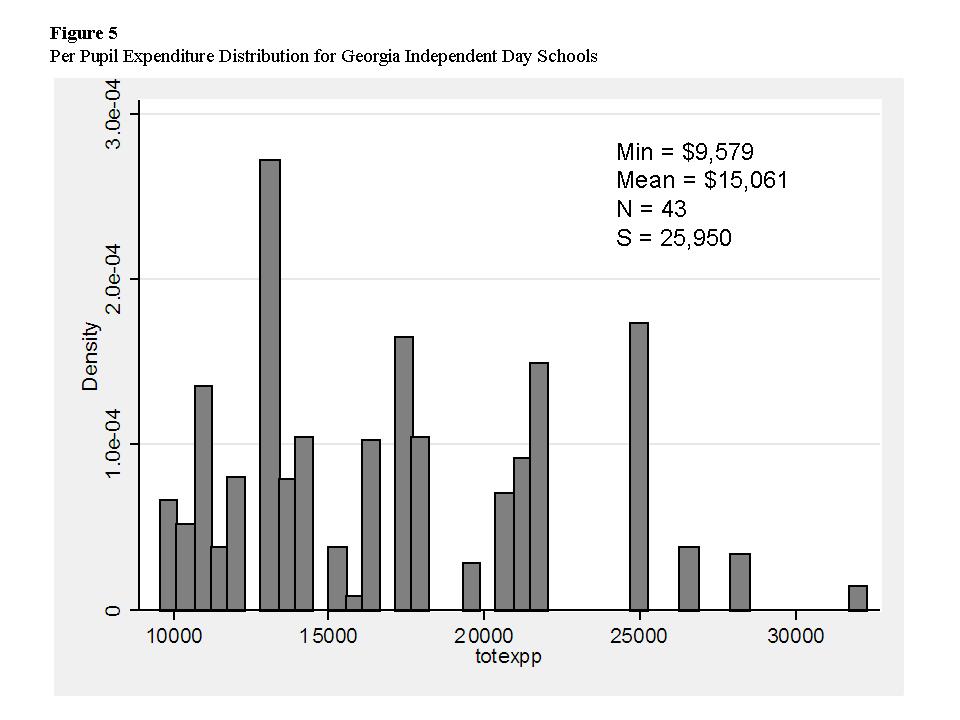
Private Independent School per Pupil Expenditures in Georgia

Okay… so lets assume instead that 1% of Atlanta area children shift over to Christian schools. Surely they must be a lot cheaper than the public schools. Everyone… I mean everyone knows and fully accepts the conventional wisdom that private schools spend a whole lot less than public schools… and of course… get much better results… right?

Figure 6 shows the distribution of per pupil spending for Christian schools from IRS filings of 36 Christian schools statewide in Georgia, serving 13,777 students. My IRS filing rate is lower here than for independent schools for two reasons. Many formally religiously affiliated schools don’t file IRS 990. Second, I eliminated from my data, schools with expenditure budgets smaller than $500,000 (mostly really tiny schools, some start-up, some dying out). Figure 6 shows that there are some Christian schools that show spending levels below 5,000 (about 8 schools). But still, the enrollment weighted average is nearly $8,000, meaning that a 1% shift in Atlanta metro public school students to “average” private Christian schools would still require $25,500,000 to come from somewhere.

Perhaps some rethinking of Senate Bill (SB) 90 is in order.

Christian School per Pupil Expenditures in Georgia

Raising Arizona School Finance? Can’t be done!

So… I come across this blog which at first appears on target… indicating that typical rankings of state school finance are problematic. But then the blog goes awry…

http://www.paysonroundup.com/news/2009/mar/06/pupil_spending_statistic_meaningless_misleading/

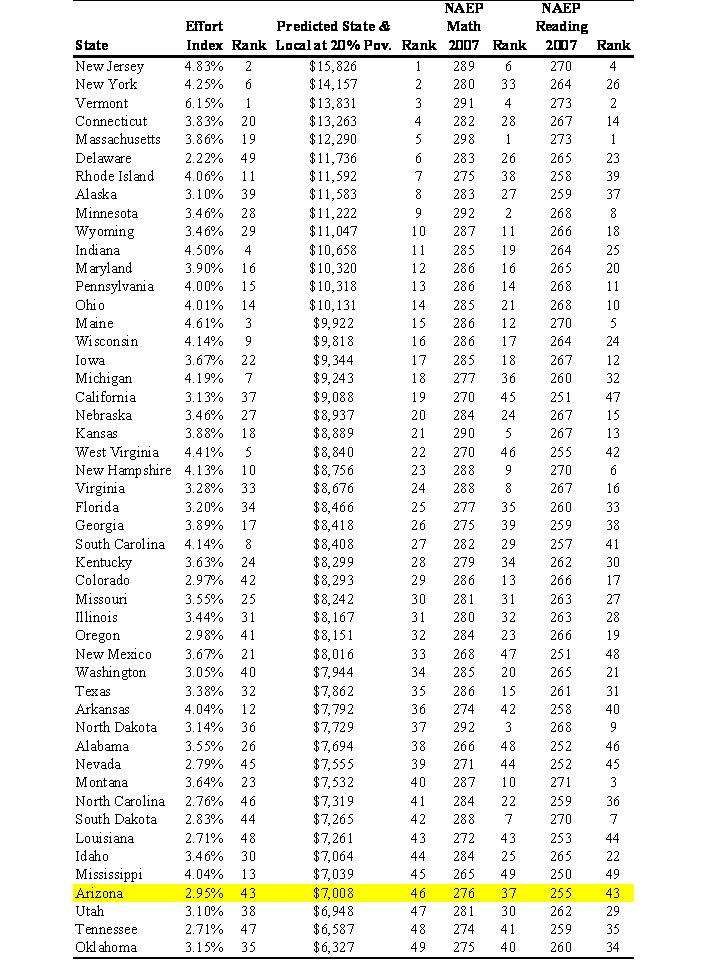
The point of the blog is that Arizona school funding isn’t as bad as it looks. Not 49th nationally, and that funding alone is not all important. So… I went back to my model based estimates of “total state and local revenue per pupil” (which includes capital…), and my state effort indices (total state and local school spending as a share of gross state product and an actual student outcome measure – NAEP math and reading scores to see how Arizona really does.

My state and local revenue comparisons are based on a statistical model which controls for differences in the percent of children attending small remote schools, rates of poverty, regional variation in competitive wages, children with disabilities, etc. It controls for the generally accepted set of cost factors influencing the costs of producing student outcomes. With the model, I generate predicted values for a district of the same characteristics across all states (to the extent that such a district exists). Nonetheless, it’s the best way I can currently think of to get rid of all of that messiness that leads to misleading comparisons in Education Week and the Education Trust.

So… How does Arizona do?

How Does Arizona Really Do?

So… Arizona is not 49th nationally… it’s 46th. Hooray! And, It ranks 43rd in effort, and 43rd in NAEP reading. The best AZ does is 37th in NAEP math.

In addition to these statistics, on which Arizona performs quite poorly, let me share a few other major concerns I have with Arizona school finance. Arizona is among the few states, which by the design of the state aid allocation formula actually allocates systematically fewer resources to higher poverty districts. This occurs because the state formula – unlike nearly all others – has no adjustment for poverty concentration. And, working against poverty, the state formula has an adjustment to drive more money to districts that already have more experienced teachers (Teacher Experience Index). This is disgraceful… and puts Arizona near the top of my list for “worst of the worst” in school finance.

Quick note to the author of the blog to which I initially responded here. The fact that Arizona ranks 21st (above 25th) on total education spending is meaningless when Arizona ranks 16th in the number of  children to be educated with that spending, and 13th in child poverty (Small Area Income and Poverty Estimates of the U.S. Census, 2006).

A technical note – having worked back and forth between state reported data systems and NCES fiscal data, I usually find a reasonable degree of correlation between the two. Not in Arizona. Arizona data – either the state version or the NCES version are highly irregular and it is difficult to discern which data are most accurate. I suspect that the state data are… but they are not generally available on the web (as they are in most states). AZ is particularly bad at public disclosure of school finance data.

Take your 65 cents and …well… you know

I was pleased to read this morning that the Texas Legislature is now finally reconsidering the error of adopting into law the 65% requirement pitched by pundits a few years back as a revenue neutral “solution” for increasing education spending.

http://www.star-telegram.com/804/story/1242118.html

Of course, it was in Texas that the actual agenda of those pundits was revealed in a memo exposed in the Austin American Statesman.

Doug Elmer of the University of Kansas and I wrote about the 65 cent solution in the January 2009 issue of Educational Policy (The Politics of Off-the-Shelf School Finance Reform).

http://epx.sagepub.com/cgi/reprint/23/1/66.pdf

What makes the 65 cent solution so interesting, in retrospect, is that it was a “reform” that in some states become legislation, but was never based on any evidence whatsoever that allocating 65 cents of every “education dollar” improves outcomes. In fact, Doug Elmer and I discuss the best empirical research on this topic which suggests otherwise.

Further, setting aside those good empirical studies of the relationship between instructional budget shares and student outcomes, the basic argument for the 65 cent solution was utterly absurd. The 65 cent solution was based on the argument that public school systems are inefficient and wasteful and should be told how to use their money. So… the 65 cent target was selected as roughly (slightly higher than) the average percent of current expenditures allocated to instruction (based on NCES expenditure data). So… the idea is that school districts are inneficient and wasteful in general, therefore we should ask them all to spend roughly like the average public school district? Good thinkin’… eh?

Another Lame Attempt by KS Legislators to Screw High Poverty Districts!

I’ve gotta give them some credit. The Kansas Legislature is getting more creative and arguably a little better at math over the years. But, the primary objective remains the same – find some way… any way… blatant or more preferably deceitful… to redirect funding allocated for higher poverty larger town and urban school districts to someone else… preferably the ‘burbs and when necessary, small rural districts.

Over the years, the Kansas legislature has come up with many angles to achieve this policy objective – like allocating “new facilities” weighted aid to suburban districts in amounts that for years dwarfed at risk and bilingual education aid to poor urban districts next door. Most recently, when legislators realized that the jig was up… and they at least had to call the aid, at risk aid, they concocted a scheme to shift some of the at risk aid, to “children who are not poor and do not live in poor districts but fail the state assessments.” Yes, failure based aid for the ‘burbs.  A brilliant solution.

Them Kansas Legislators have been convinced for years that them darn city liberal and minority folk are suckin’ the state budget dry by stickin’ a “poor kid” label on everyone they can find and even ones they can’t find – fudgin’ the numbers and gettin’ rich in the process. (this was part of the reason for the move to the non-poor failing child weight).

They’ve now come up with a new way to correct them-there-fudged-numbers. Okay… back to civilized speech.

HB 2357 proposes to base each district’s at risk funding on the lesser of the district’s actual at risk count or the district’s U.S. Census Poverty Rate times 2.37. The multiplier is, in theory (I’ve not seen their math), based on the idea that at risk counts are higher than census poverty rates because they are based on national school lunch program cut points for family income, which are at higher income thresholds.

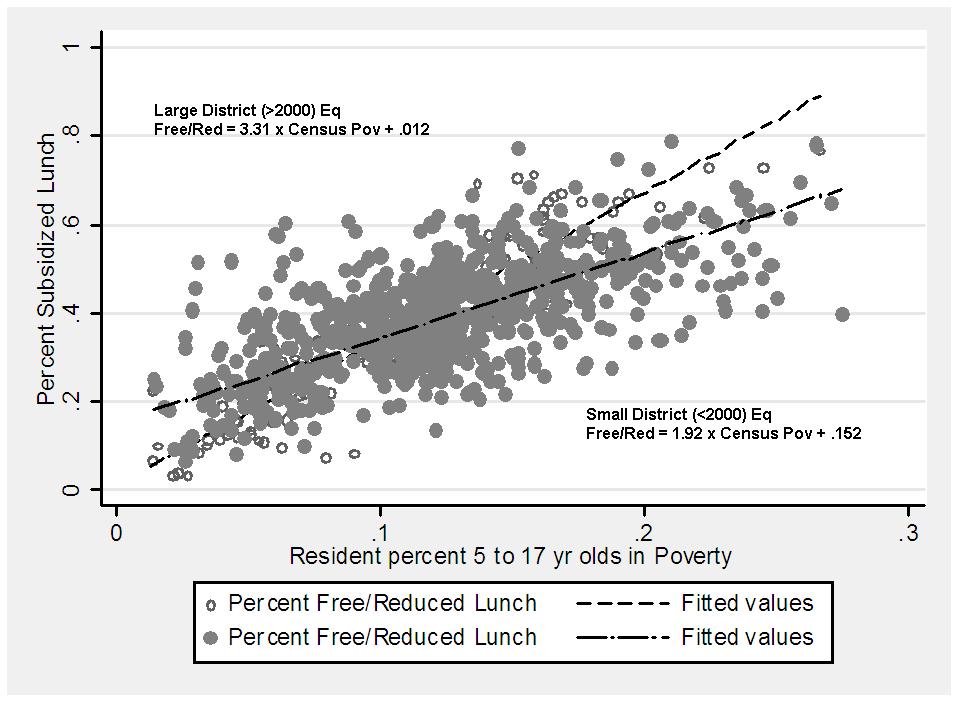
The problem with using the same multiplier (2.37) for smaller and larger districts across the state is that the ratio of at risk children to census poverty tends to be higher in larger districts – about 3.3 (over 2,000 students) to 3.36 (over 5,000 students) – and lower in smaller districts (under 2.0 in districts enrolling fewer than 2,000 students). This happens because of the way in which those income thresholds cut differently across urban and rural areas. Too little time to fully explore this issue here.

Here’s a figure that shows the slope for larger and for smaller districts in Kansas based on three years of data from the National Center for Education Statistics.

Relationship between Census Poverty Rates and Subsidized Lunch Rates in Kansas

Now, I don’t suspect that the legislators who proposed this new trick really understood quite why this new approach would lead to reduced at risk funding for large high poverty districts, but I have little doubt that they understand fully that this policy will have this effect (and that they chuckled when they had this revelation) – and that is precisely why it has been proposed.

HB 2357 follows a long line of similar Kansas policies both prior to and following court rulings –  from new facilities weighting, to the “high priced house” adjustment, to the middle/upper middle class failure weight.

While I must congratulate them on their new found creativity, I must urge the Kansas Legislature to simply get over it and for once try doing the right thing!

DUMP 2357, or at least fix those ratios to be differentiated on the basis of district size.

=====

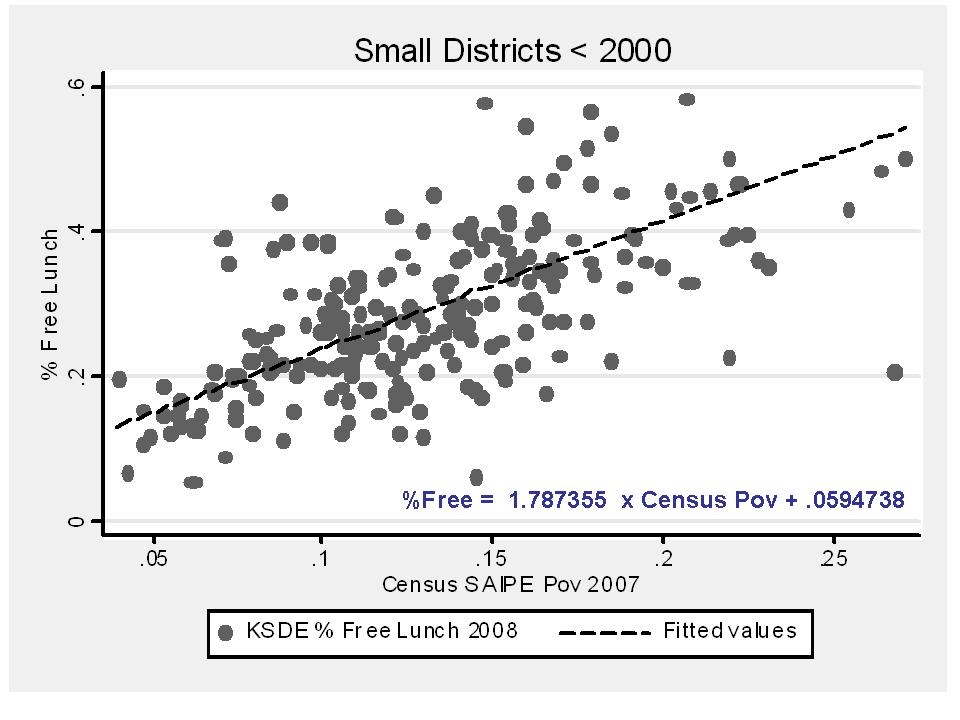
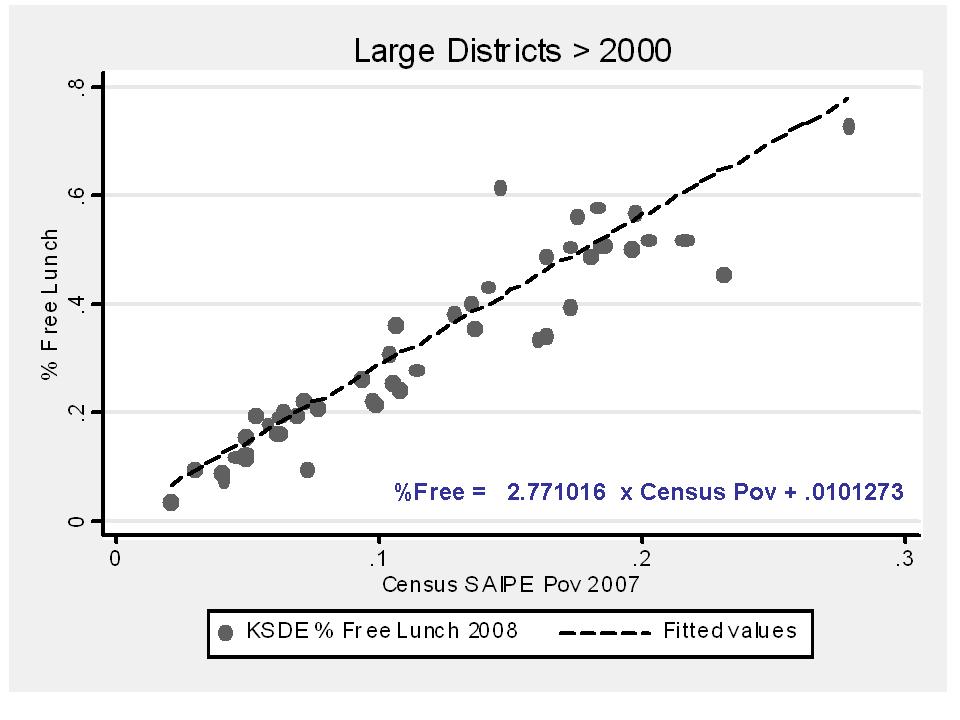
Quick rerun of the equations for 2008 KSDE % Free Lunch numbers as a function 0f 2007 Census Small Area Poverty Rates:

Small district (<2000) equation is

%Free =  1.787355  x Census Pov + .0594738

slide23

Larger district (>2000) equation is

%Free =   2.771016  x Census Pov + .0101273

slide12

By the way… it doesn’t look like there are a whole lot of outliers among the larger districts. They’re not the ones with the irregular free lunch counts – at least by reference to poverty rates… so why implement a policy that penalizes them?