Two Persistent Reformy Misrepresentations regarding VAM Estimates

I have written much on this blog about problems with the use of Value-added Estimates of teacher effect (used loosely) on student test score gains on this blog. I have addressed problems with both the reliability and validity of VAM estimates, and I have pointed out how SGP based estimates of student growth are invalid on their face for determining teacher effectiveness.

But, I keep hearing two common refrains from the uber-reformy (those completely oblivious to the statistics and research of VAM while also lacking any depth of understanding of the complexities of the social systems [schools] into which they propose to implement VAM as a de-selection tool) crowd. Sadly, these are the people who seem to be drafting policies these days.

Here are the persistent misrepresentations:

Misrepresentation #1: That this reliability and error stuff only makes it hard for us to distinguish among all those teachers clustered in the middle of the distribution. BUT… we can certainly be confident about those at the extremes of the distribution.  We know who the really good and really bad teachers are based on their VAM estimates.

WRONG!

This would possibly be a reasonable assertion if reliability and error rates were the only problem. But this statement ignores entirely the issue of omitted variables bias (other stuff that affects teacher effect estimates that may have been missed in the model), and just how much those observations in the tails jump around when we tweak the VAM by adding or removing variables, or rescaling measures.

A recent paper by Dale Ballou & colleagues illustrates this problem:

“In this paper, we consider the impact of omitted variables on teachers’ value-added estimates, and whether commonly used single-equation or two-stage estimates are preferable when possibly important covariates are not available for inclusion in the value-added model. The findings indicate that these modeling choices can significantly influence outcomes for individual teachers, particularly those in the tails of the performance distribution who are most likely to be targeted by high-stakes policies.” (Ballou et al., 2012) [emphasis added]

The problem is that we can never know when we’ve got that model specification just right. Further, while we might be able to run checks as to whether the model estimates display bias with respect to measurable external factors, we can’t know if there is bias with respect to stuff we can’t measure, nor can we always tell if there are clusters of teachers in our model whose effectiveness estimates are biased in one direction and other clusters in another direction (also in relation to stuff unmeasured).  That is, we can only test this omitted variables bias stuff when we can add in and take out measures that we have. We simply don’t know how much bias remains due to all sorts of other unmeasured stuff, nor do we know just how much that bias may affect many of those distributions in the tails!

Misrepresentation #2: We may be having difficulty in these early stages of estimating and using VAM models to determine teacher effectiveness, but these are just early development problems that will be cleared up with better models, better data and better tests.

WRONG AGAIN!

Quite possibly, what we are seeing now is as good as it gets.  Keep in mind that many of the often cited papers applying the value-added methodology date back to the mid-1990s. Yeah…. we’ve been at this for a while and we’ve got what we’ve got!

Consider the sources of the problems with the reliability and validity of VAM estimates, or in other words:

The sources of random error and/or noise in VAM estimates

Random error in testing data can be a function of undetected and uncorrected poorly designed test items, such as items with no correct response or more than one correct response, testing conditions/disruptions, and kids being kids – making goofy errors such as filling in the wrong bubble (or toggling the wrong box in computerized testing) or simply having a brain fart on stuff they probably otherwise knew quite well. We’re talking about large groups of 8 and 9 year old kids in some cases, in physically uncomfortable settings, under stress, with numerous potential distractions.

Do we really think all of these sources of noise are going to go away? Substantively improve over time? Testing technology gains only have a small chance at marginally improving some of these. I hope to see those improvements. But it’s a drop in the bucket when it comes to the usefulness, reliability and validity of VAM estimates.

The factors other than the teacher which may influence the average test score gain of students linked to that teacher

First and foremost, kids simply aren’t randomly sorted across teachers and the various ways in which kids aren’t randomly sorted (by socioeconomic status, by disability status, by parental and/or child motivation level) substantively influence VAM estimates. As mentioned above, we can never know how much the unmeasured stuff influences the VAM estimates.  Why? It’s unmeasured!

Second, teachers aren’t randomly sorted among teaching peers and VAM studies have shown what appear to be spillover effects – where teachers seem to get higher VAM estimates when other teachers serving the same students get higher VAM estimates.  Teacher aides, class sizes, lighting/heating/cooling aren’t randomly distributed and all of this stuff may matter.

And you know what?  This stuff isn’t going to change in the near future.  In fact, the more time we waste obsessing on the future of VAM-based de-selection policies instead of equitably and adequately financing our school systems, the more that equity of schooling conditions is going to erode across children, teachers, schools and districts – in ways that are very much non-random [uh… that means certain kids will get more screwed than others].  So perhaps our time would be much better spent trying to improve the equity of those conditions across children. Provide more parity in teacher compensation and working conditions, and better integrating/distributing student populations.

Look – if we were trying to set up an experiment or a program evaluation in which we wanted our VAM estimates to be most useful – least likely to be biased by unmeasured stuff – we would take whatever steps we could to achieve the “all else equal” requirement.  Translated to the non-experimental setting – applied in the real world – this all else equal requirement means that we actually have to concern ourselves with equality of teaching conditions – equality of the distribution of students by race, SES and other factors.  Yeah… that actually means equitable access to financial resources – equitable access to all sorts of stuff (including peer group).

In other words, we’d be required to exercise more care in establishing equality of conditions or explaining why we couldn’t if we were simply comparing program effectiveness for academic publication than the current reformy crowd is willing to exercise when deciding which teachers to fire. [then again, the problem is that they don’t seem to know the difference. Heck, some of them are still hanging their hopes on measures that aren’t even designed for the purpose !]

But this conversation is completely out-of-sight, out-of-mind for the uber-reformy crowd. That’s perhaps the most ludicrous part of all of this reformy VAM-pocrisy !  Ignoring the substantive changes to the education system that could actually improve the validity of VAM estimates by asserting that VAM estimates alone will do the job, which they couldn’t possibly do if we continue to ignore all this stuff!

Finally, one more reason why VAM estimates are unlikely to become more valid or more useful over time? Once we start using these models with high stakes attached, the tendency for the data to become more corrupted and less valid escalates exponentially!

By the way, VAM estimates don’t seem to be very useful for evaluating a) the effectiveness of teacher preparation programs [due to the non-random geographic distributions of graduates] or b) principals either! More on this at another point.

Note on VAM-based de-selection: Yeah… the uber-reformy types will argue that no-one is saying that VAM should be used 100% for teacher de-selection, and further that no-one is really even arguing for de-selection.  WRONG! AGAIN! As I discussed in a previous post, the standard reformy legislation template includes three basic features which essentially amount to using VAM (or even worse SGPs) as the primary basis for teacher de-selection – yes, de-selection. First, use of VAM estimates in a parallel weighting system with other components requires that VAM be considered even in the presence of a likely false positive. NY legislation prohibits a teacher from being rated highly if their test-based effectiveness estimate is low. Further, where VAM estimates vary more than other components, they will quite often be the tipping point – nearly 100% of the decision even if only 20% of the weight – and even where most of that variation is NOISE or BIAS… not even “real” effect (effect on test score growth). Second, the reformy template often requires (as does the TEACHNJ bill in NJ) that teachers be de-selected (or at least have their tenure revoked) after any two years in a row of falling on the wrong side of an arbitrary cut point rammed through these noisy data.

Finally, don’t give me the anything is better than the status quo crap!
Video Thoughts on Test Scores, VAM, SGP & Teacher Evaluation

Recent Bank Street College of Education Symposium on teacher evaluation

Additional video clips from legislative forum at the New Jersey Principals and Supervisors Association

General Issues in Teacher Evaluation: Where to Start in New Jersey

http://www.youtube.com/watch?v=5B7gAkB5-QU&feature=player_detailpage#t=1208s

Pilots versus Expedited Legislated Evaluation Models (Rigidity of Legislation)

http://www.youtube.com/watch?v=5B7gAkB5-QU&feature=player_detailpage#t=1878s

Complete Forum Video:

No Excuses! Really? Another look at our NEPC Charter Spending Figures

UPDATED MAY 11, 2012

Not surprisingly, KIPPs first response to our recent NEPC study was to declare it outright flawed. KIPP then proceeded to make up every possible explanation they could – every possible “excuse” – conjure every possible out of context – or different context estimate or “fact” to make their case that they in fact spend equal or less than schools in New York City and Houston.

I guess what continues to perplex me most is the stance that KIPP takes whenever anyone writes anything about them, in a report not sponsored by them or by one of their major funders (some of which are quite good).  Whether a descriptive analysis of attrition rates or our analysis of spending per pupil, KIPPs standard response is to deny, deny, deny.

We have not said anywhere in our report that there’s anything wrong with spending more to do a good job – run a good school. It would be preposterous for us to make such an assertion. We have simply tried to lay out a reasonable comparison of what schools are spending, compared to otherwise similar schools. These comparisons are appropriate, and are necessary for making judgments about any marginal benefits that might be achieved by students attending different schools.

We show that part of the KIPP puzzle in Houston is explained by their attempts to provide more competitive front end teacher wages. Nothin’ wrong with that! It’s certainly a logical recruitment/retention strategy. Notably, it would become difficult to maintain these margins as school staff matures. These are issues worth monitoring over time – to see if CMOs entering their second and third decades of operation can continue to hold expenses down by holding staff experience down, while still recruiting and retaining energetic, high quality teachers. I will likely be conducting more extensive analyses of these salary structures across KIPP and other schools in NYC and Texas in the future, and hope to have a more productive discussion on the topic when that time comes.

KIPP argues that we counted all of their centralized expenses against them, and counted NONE against the NYC public schools. This is not true. We actually didn’t count KIPP regional and national expenses that exist beyond what the locals pay in management fees accounted for on their budgets.

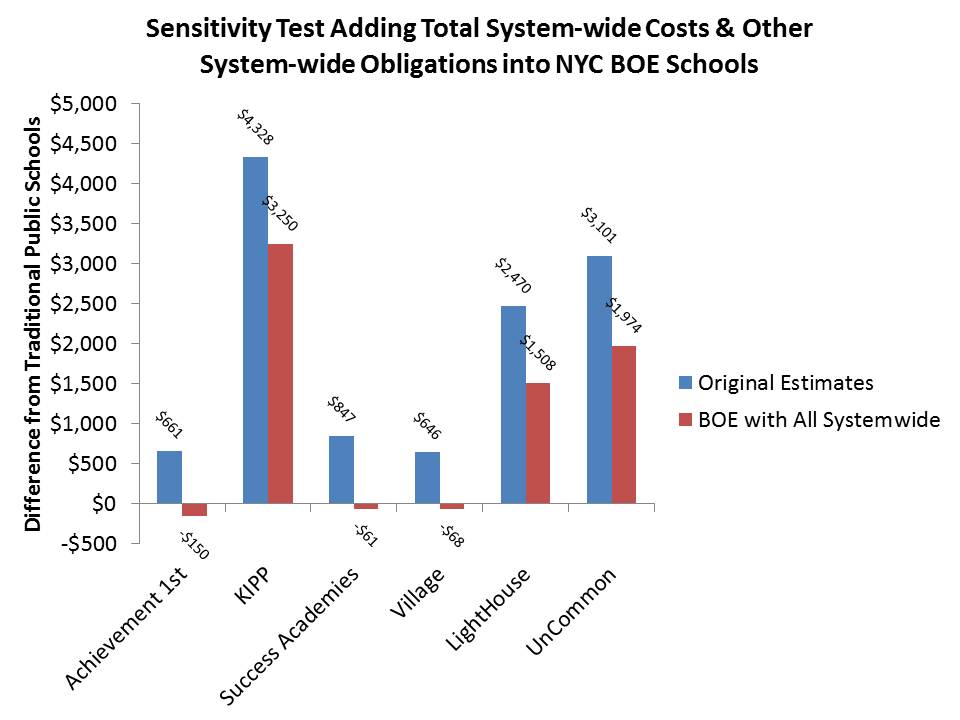
Second, as I will show below, even if we count all of the system-wide expenses (& other obligations) of NYC BOE schools, KIPP schools continue to substantially outspend them.

Further, KIPP complains that we include expenses on their KIPP to College program. It’s a program. It’s a support service. It’s an expenditure. Further, even the KIPP schools budgets that don’t include KIPP to college exceed NYC BOE spending. And KIPP plays the usual card, in reference to Houston, not NYC, that they must incur the full costs (from their operating expenses) of facilities, implying that public districts have absolutely no costs of facilities.

Clearly, such comparisons are complicated and we acknowledge as much throughout our paper. Further, we provide substantial detail as to the types of data being compared and potential issues with the comparisons.

New York City

Let’s look first at our New York City comparisons. The data in NYC are pretty good, but because the charter financial reports are not part of the same system as the district school site budgeting data, they are not necessarily designed to be directly comparable. We had removed system-wide costs from the NYC BOE schools, in addition to removing costs for facilities (because BOE also pays for charter facilities), food and transportation, and we removed payments to charters. KIPPs assertion is that clearly if we add back in all system-wide costs NYC BOE schools would be spending at least the same if not more than KIPP schools.  This is especially the case if, as KIPP asserts, that pension costs alone should add $2,200 per pupil to the BOE schools (this is a perfect example of a wrong context number extracted from a different comparison [a good one by IBO]).

Of course, this assertion doesn’t pass a basic smell test even given the information that already existed prior to our report. In the Independent Budget Office report which we cite, the IBO evaluated the comparability of the public subsidy rate of co-located (as with KIPP) charters and BOE schools, finding that the co-located charters had the equivalent subsidy of slightly higher than BOE schools on average district-wide. Note that subsidy rates aren’t expenditures. It’s a different comparison. But subsidy rates provide a starting point for what could be spent. And KIPP was ahead at the starting line, albeit only slightly.

Add to that, the fact that KIPP schools do not serve average special education populations, the major driver of differences in spending across BOE schools (as we validate). Thus, compared to these schools rather than average district-wide, KIPP moves further ahead. Then, I think we all understand by this point that KIPP raises and spends at least some private funding.  Fair enough? We’ve got two reports out on this:

  1. Baker, B.D. & Ferris, R. (2011). Adding Up the Spending: Fiscal Disparities and Philanthropy among New York City Charter Schools. Boulder, CO: National Education Policy Center. Retrieved [date] from http://nepc.colorado.edu/publication/NYC-charter-disparities.
  2. Baker, B.D., Libby, K., & Wiley, K. (2012). Spending by the Major Charter Management Organizations: Comparing charter school and local public district financial resources in New York, Ohio, and Texas. Boulder, CO: National Education Policy Center. Retrieved [date] from http://nepc.colorado.edu/publication/spending-major-charter.

Add their private spending to the already growing margin, and you’ve got a bigger margin of difference in per pupil spending between KIPP schools and otherwise similar NYC BOE schools. On its face, it’s highly suspect for KIPP to argue that they do not spend more than NYC BOE schools.

But, just for fun, let’s rerun the regressions from our report with all system-wide costs added back to BOE schools and see if that puts them ahead of KIPP spending.

Here’s the overall comparison:

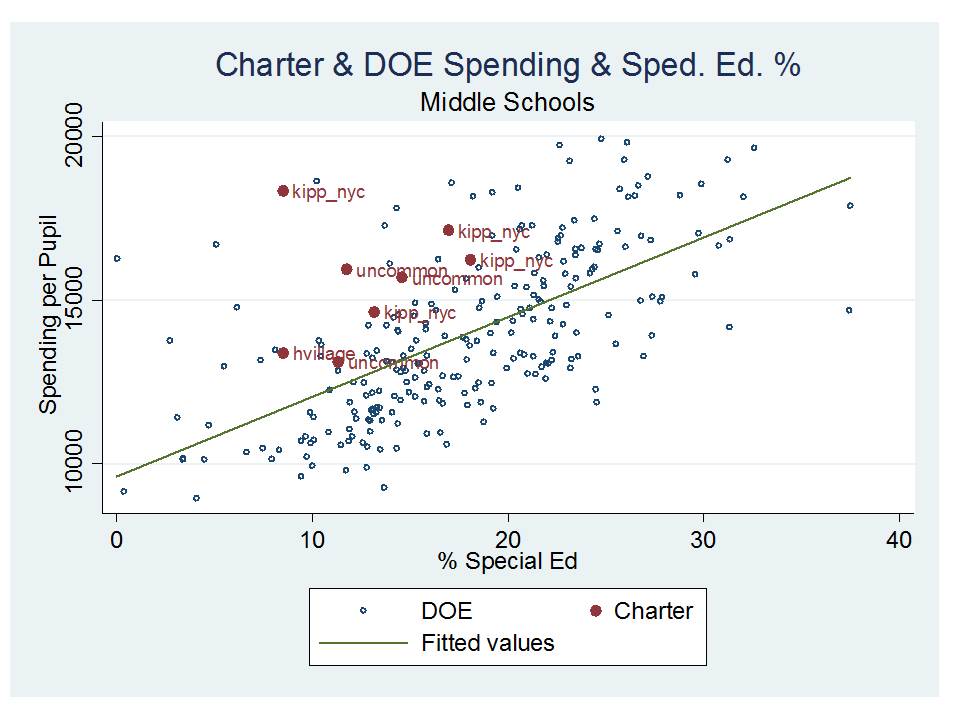
Even after adding system-wide costs back into BOE schools, KIPP schools spend more than $3,000 per pupil more than BOE schools.

Now here are the breakout scatterplots, starting with our original:

And then with all system-wide costs added back in to BOE school:

Hmmm… seems that KIPP schools are still significantly outspending otherwise similar BOE schools – about 25% more.

Another really important point here is that none of these adjustments alter KIPP charter spending relative to the other charters. KIPP continues to outspend the other charters by as much as they did in our original analyses.

What we don’t include for KIPP

We don’t include regional (KIPP NY) or national expenditures above and beyond what is covered by the school management fees. We write extensively in Appendix C of our report about these additional expenditures and difficulty in parsing precisely how much was spent by KIPP regional and national organizations and what services were provided as in-kind services to schools. This is a potentially significant break that we give to KIPP, setting aside entirely their centralized costs of the organization (those above and beyond what is covered by management fees).

Texas

It was problematic enough for KIPP to assert that they spend similarly to NYC BOE schools, but it was surely a stretch to assert that they spend similarly to Houston ISD schools which have been significantly constrained under state school finance policies in recent years. KIPP first pulls the facilities cost card to make their case, as usual, implicitly assuming public district facilities to be free. We discuss this issue on Page 49 of our report (and in numerous other locations):

Charter advocates often argue that charters are most disadvantaged in financial comparisons because charters must often incur from their annual operating expenses, the expenses associated with leasing facilities space. Indeed it is true that charters are not afforded the ability to levy taxes to carry public debt to finance construction of facilities. But it is incorrect to assume when comparing expenditures that for traditional public schools, facilities are already paid for and have no associated costs, while charter schools must bear the burden of leasing at market rates – essentially and “all versus nothing” comparison. First, public districts do have ongoing maintenance and operations costs of facilities as well as payments on debt incurred for capital investment, including new construction and renovation. Second, charter schools finance their facilities by a variety of mechanisms, with many in New York City operating in space provided by the city, many charters nationwide operating in space fully financed with private philanthropy, and many holding lease agreements for privately or publicly owned facilities.

KIPP also argues that their per pupil spending figures are inflated due to spending for growth. Hey. That’s an expenditure. By the way, typically, per pupil expenditures rise with declining enrollment (as the denominator goes down). Yes, there might be scaling up expenditures, but they tend not to have dramatic effect on per pupil expenditures. If KIPP has chosen to pay for redundant administration, etc. in order to support scaling up, then so be it. That’s an expenditure. We would hope to see these expenses level off down the line with additional analyses. We’ll wait and see on that.

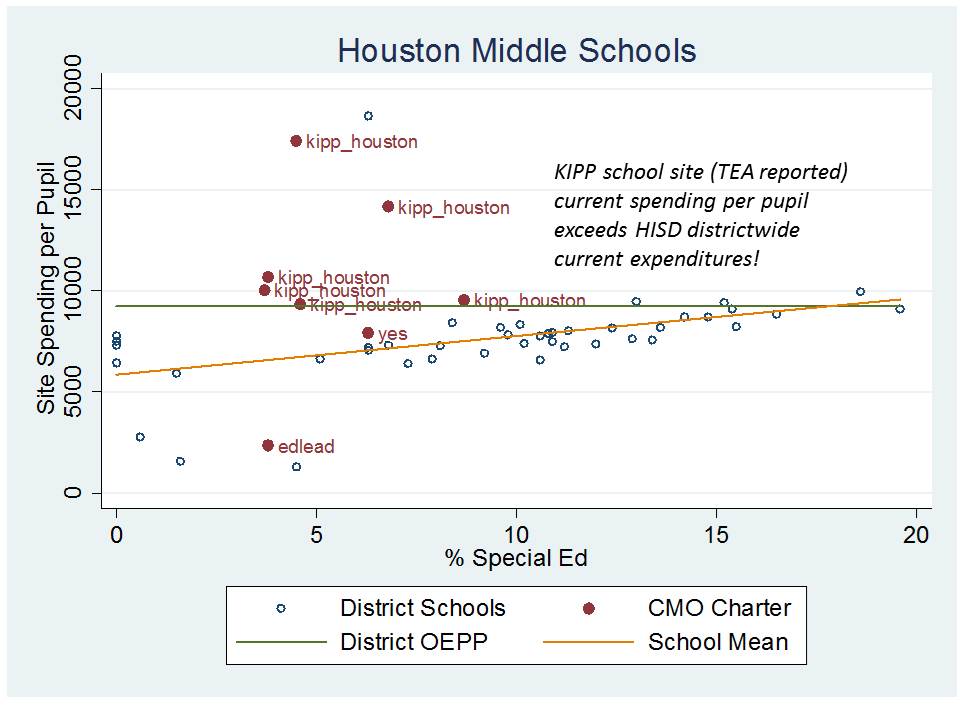
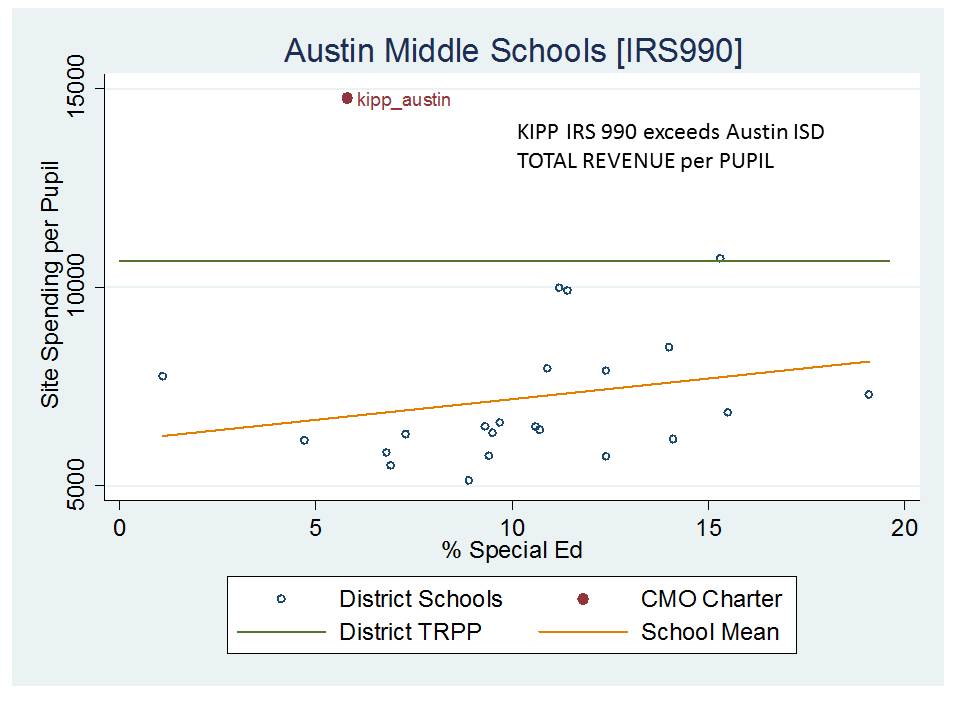
But, back to our actual comparisons in Houston. We used two different approaches in Texas. First of all, in Houston, KIPP spending per pupil was much closer than in other Texas cities, where KIPP spending totally blew away district schools spending. But back to Houston. Using current operating expenditures per pupil data for KIPP and Houston schools, we show that KIPP middle schools outspend not only otherwise similar schools in HISD, but the district-wide average operating expenditure per pupil.

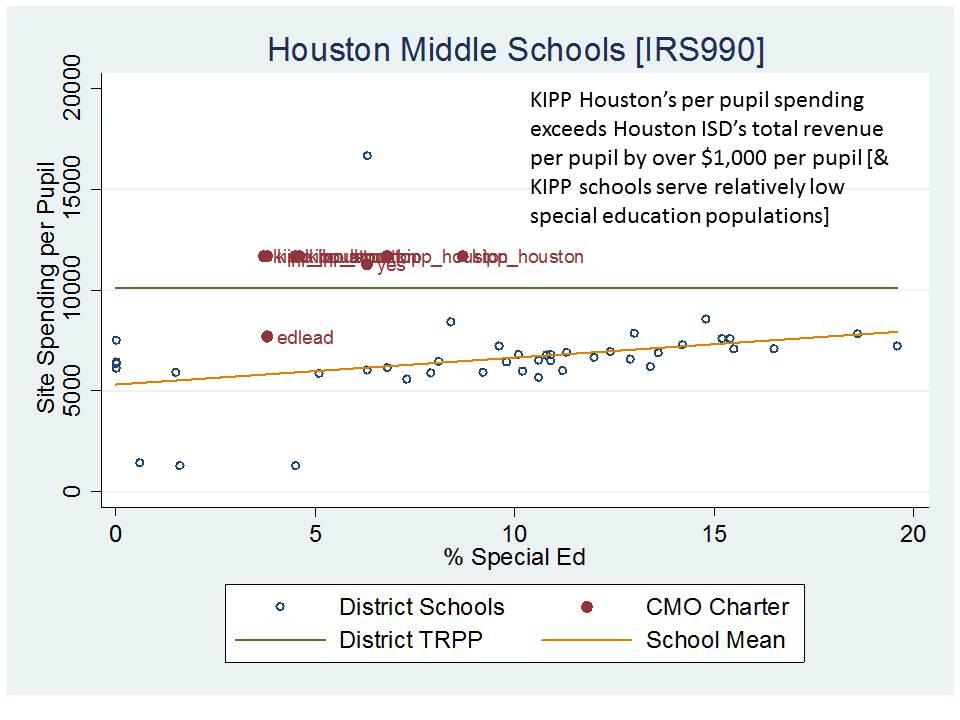
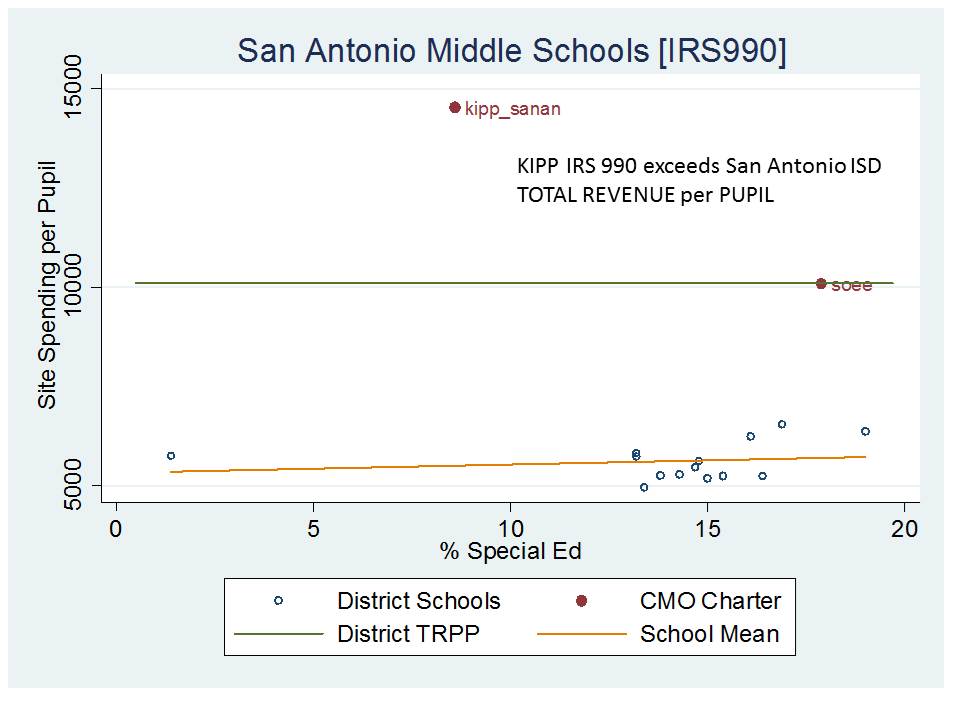
Further, we show that KIPP total district (IRS 990) expenditures significantly exceed Houston ISD’s TOTAL REVENUE PER PUPIL, including revenue for retiring debt and maintenance of HISD’s large capital stock.

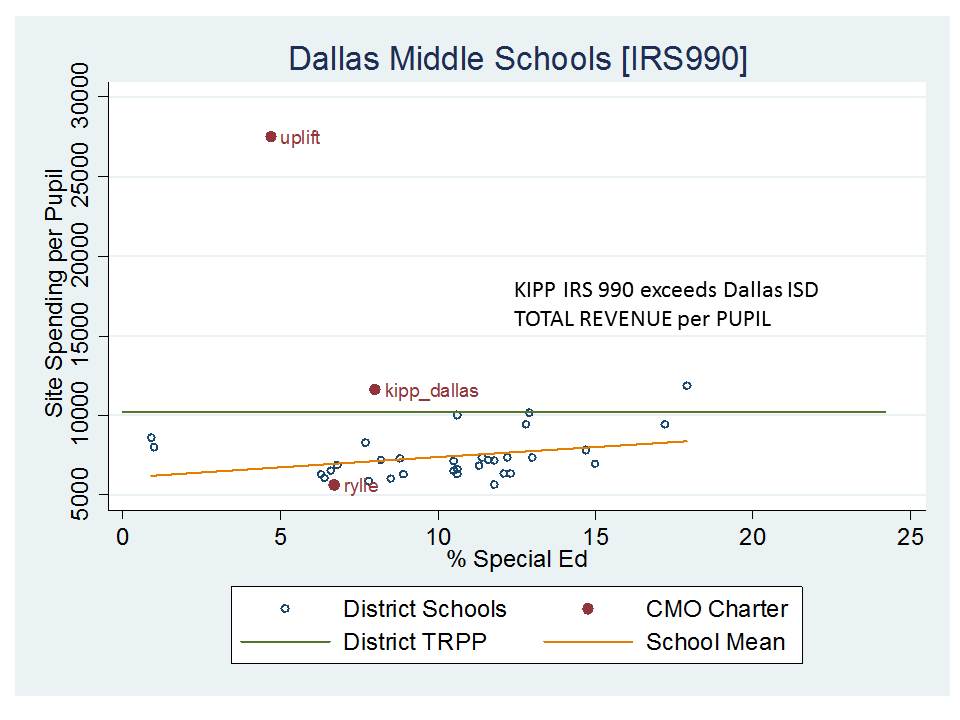
Here are additional figures not included in the report, comparable to the figure above for other cities in Texas where KIPP  operates. In each and every case, KIPP IRS 990 total expenditures per pupil EXCEED district TOTAL REVENUES PER PUPIL.

What we don’t include for KIPP

Again, we don’t attempt to figure out the additional expenses of KIPP national allocated to schools, above and beyond what is paid for from the local/regional KIPPs through management fees to the national organization.

Closing Thoughts

I encourage those interested in these topics to not only browse the abstract of our report, but to also dig deep into the appendices and end notes – which are as long as the report itself. Heck, follow the hyperlinks to the data sources and take your own stab at this stuff. That’s what we need out here – not more excuses and unfounded anecdotal arguments.

I actually hesitate to write about KIPP and perhaps that’s just what they want. Apparently no one should write about them that hasn’t been paid by them to write about the. Those who do should be forewarned that you’ll have to waste inordinate time responding to their complaints – excuses – about what you wrote. As of this post, I hope to be done with this topic.

Follow up on why Publicness/Privateness of Charter Schools Matters

My post the other day was intended to shed light on the various complexities of classifying charter schools as public or private. Some have argued that the distinctions I make are a distraction from the bigger policy issues. The point was not to address those issues, but rather to dispose of the misinformed rhetoric that charter schools are necessarily public in every way that traditional public schools are. They clearly are not. And the distinctions made in my previous post have important implications not only for teachers employment rights (or any school employee), but also for student rights. Further, it is really, really important that teachers considering their options and parents considering their options understand these distinctions and make fully informed choices.

Preston Green of Penn State University [co-author of Charter Schools and the Law] offered the following comments on my previous post:

Charter schools are always characterized as “public schools.” Many parents assume that they would receive the same constitutional rights in charter schools as other public schools. In fact, I use to think this.

My thinking changed when I spoke at a workshop for charter school attorneys. Several attorneys insisted that they were not beholden to federal constitutional and statutory provisions. They cited the Ninth Circuit’s Caviness decision, in which the Ninth Circuit held that a charter school was not a state actor with respect to employment issues. These attorneys insisted that the same logic applied to student issues as well.

This is especially concerning for black males. Researchers have consistently found that black male students are disproportionately subjected to school discipline, such as suspensions and expulsions. In public schools, the Due Process Clause protects them from arbitrary suspensions and expulsions. For example, in Pennslyvania,schools must provide students with an informal hearing for out-of-school suspensions from 4-10 days (22 Pennsylvania Code § 12.8, 2012). The school must provide parents with written notification of the time and the place of the hearing. The student has the write to speak and produce witnesses at the hearing as well as the right to question witnesses present at the hearing.

Pennsylvania regulations also require formal hearings for school exclusions of more than 10 days (22 Pennsylvania Code § 12.8, 2012). Formal hearings require the school to provide parents with a copy of the expulsion policy, notice that the student may obtain counsel, and the procedures for the expulsion hearing. The student has the power to cross-examine, testify, and present witnesses. Further, the school must maintain an audio recording of the hearing.

If charter schools are not public actors, then constitutional law would not apply. I have argued that courts might apply contract law, as is generally the case for private schools. If a private school “has clearly stated the rule, preferably in writing, and a parent chooses to have his or her child attend the school, a court will generally uphold the rule” (Shaughnessy, 2003, p. 527). For example, in Flint v. Augustine High School (1975), a Louisiana private school expelled two students for violating its no smoking policy. The school’s handbook called for a fine of $5 for the first offense, and a penalty of either a $10 fine or an expulsion for the second offense. The state court of appeals upheld the suspension of the students. In reaching this decision, the court declared that private institutions “have a near absolute right and power to control their own internal disciplinary procedure which, by its very nature, includes the right and power to dismiss students” (p. 234). Although the court allowed that due process protections could not “be cavalierly ignored or disregarded,” it held that “if there is color of due process – that is enough” (p. 235).

In Hernandez v. Bosco Preparatory High (1999), a New Jersey court for the first time addressed the question of the procedural rights of expelled private high school students. It found that constitutional law did not apply to private high schools. Interestingly, the court found that high school students would receive less protection than private university students.

I raise these points because parents may be unwittingly giving up their constitutional protections to attend charter schools. One has to wonder whether parents would enroll their children if they were aware of this possibility.

The distinction is important. And it’s a distinction that may occur at many levels of the system, as I explained in the previous post. Again, this is not to say that publicness/privateness necessarily speaks to substantive differences in school quality for children, or workplace quality for employees.  As I’ve mentioned numerous times on my blog, my best teaching job was at an elite private (no doubt, no ambiguity, private) school. My worst was at a different private school, with two public districts in between – one much better than the other. The issues of publicness/privateness proved inconsequential to me personally during my time as a teacher (mainly because I left the worst private school before I decided to engage in any [more] battles). But to others they may not, and it is important to understand the distinction. At least a few teachers in privately governed charter schools have already been blindsided by misinformed assumptions that they possess public employee protections.  Given the comments of Preston Green above, I suspect student rights cases are not far behind.

Charter Schools Are… [Public? Private? Neither? Both?]

…Directly Publicly Subsidized, Limited Public Access, Publicly or Privately Authorized, Publicly or Privately Governed, Managed and Operated Schools

Let’s break it down:

Directly publicly subsidized

Charter schools are directly subsidized by a combination of (primarily) state and local tax dollars (state dependent) transferred to charter schools on the basis of their enrollments.

This funding is analogous to a directly subsidized voucher program that would transfer tax dollars to private schools on the basis of students signing up for the voucher program.

This funding is also analogous to the state aid that is delivered on a pupil enrollment basis to local public school districts, but the funding is different from local tax dollars that are raised based on the values of taxable properties and are not dependent on pupil enrollments.

Note that traditional public schools or charter schools may receive a variety of non-government (non-taxpayer supported) revenues including private gifts, private foundation grants, fees/event receipts, facilities rental, etc.

The direct subsidy for charters is distinctly different from indirect subsidies like tuition tax credits, which provide the opportunity for individuals or other entities to receive a full tax credit for donating funds to an independently operated/managed entity which then distributes those funds as vouchers or scholarships.

An important legal distinction is that the U.S. Supreme Court has recently decided that when tuition tax credit funds are used to support religious education, taxpayers have no standing to challenge that distribution as a distribution of their tax dollars, due to the indirect nature of the subsidy. See: ARIZONA CHRISTIAN SCHOOL TUITION ORGANIZATION v. WINN

Limited Public Access

Charter schools are limited public access in the sense that:

  1. They can define the number of enrollment slots they wish to make available
  2. They can admit students only on an annual basis and do not have to take students mid-year
  3. They can set academic, behavior and cultural standards that promote exclusion of students via attrition.

[may vary and/or be restricted under state policies]

A traditional public school or “district school” or “government school” must accept students at any point during the year and but for specific disciplinary circumstances that may permit long term suspensions and expulsions. Traditional public schools cannot shed students who do not meet academic standards, comply with more general behavioral codes or social standards, such as parental obligations.

Imagine a community park, for example, that is paid for with tax dollars collected by all taxpayers in the community, and managed by a private board of directors. That board has determined that the park may reasonably serve only 100 of the community’s 1,000 residents. The amount of tax levied is adjusted for the park’s capacity. To determine who gets to use the park annually, interested residents subscribe to a lottery, where 100 are chosen each year. Others continue to pay the tax whether chosen for park access or not. The park has a big fence around it, and only those granted access through the lottery may gain entrance. Imagine also that each of the 100 lottery winners must sign a code of conduct to be unilaterally enforced by the private manager of the park. That management firm can establish its own procedures (or essentially have none) for determining who has or has not abided by the code of conduct and revoke access privileges unilaterally. This is clearly not a PUBLIC park in the way that scholars such as Paul Samuelson describe public goods.

Note that while public districts may limit slots to individual schools, especially magnets (which are clearly also limited public access), districts must accommodate all comers (a charter school operated by a district would be part of a system that is not limited in enrollment). That is, they cannot limit total slots in the district, regardless of physical plant constraints. Districts may also limit slots at schools through assignment policies and choice-based enrollment plans. But again, districts cannot limit total slots or mid-year access. This is an important difference between districts and charters. State laws may require that under-subscribed charters must admit students mid-year. But this requirement would not apply to those charters that are fully subscribed and/or have waiting lists.

Another note: Unlike a pure public good, both traditional public schools and a public park would be subject to diminishing value to each participant as they become overcrowded. That is, at some point, as additional individuals access the park or the school, it begins to diminish the value that each individual receives. So  even the more “public” park or school isn’t really a pure public good. My point here is that there are still substantive differences between traditional public schools and charter schools.

Put very simply, the ability to decide precisely how many students a school will serve, and wait list/deny others, makes charter schools significantly more limited than public school districts in their public access.

Save for another day the topic of restrictive real estate development and local public school districts.

Publicly or Privately Authorized [contingent on state policy]

States have varied policies regarding the entities that may grant charters for charter schools to commence (and continue) operations and draw on public tax dollars to serve children who subscribe. In some states, only government agencies themselves can authorize charter schools and therefore may also un-authorize them. In other states, statutes grant authority to private entities to grant and revoke charters. These private entities tend to be non-profit entities, including universities which may be quasi-public, governed by boards of directors that are private citizens, not elected government officials.

That boards of directors or governing bodies of authorizers are not public or elected officials is an important delineation. Indeed statutes may declare that they must comply with all statutes and regulations pertaining to public officials, but such requirements are not implicit.

The non-public, non-government status of governing boards of charter authorizers has significant legal implications regarding such issues as a) whether meetings are subject to open meetings laws, b) whether records are subject to open public records laws. Further, recourse for individuals – employees or students – against these private entities differs than it would if these entities were public.

Publicly or Privately Locally Governed [contingent on state policy]

States have varied policies regarding the local governance of charter schools, but many states require that the local governance of independently operated charters take the form of a board of directors which consists of self-appointed private citizens, not elected or appointed public officials. States also permit local public school districts to operate their own charter schools which remain under the authority of their local board of education which is either directly elected or consists of appointed government officials (usually mayoral appointments).

Again, the distinctions are important, having significant legal implications for taxpayers, students and employees.

As with authorizers, private boards of directors might invoke the claim that they are not subject to open meetings laws or open public records requirements. Unless explicitly stated in state charter laws, this argument might be accepted, since private boards of directors are not implicitly subject to these requirements.

Publicly or Privately Managed and Operated [contingent on state policy]

Finally, whether governed by the public officials of the local public school district, or by a board of directors of private citizens, those governing boards might choose to contract a private entity to manage and operate the school.

That entity might be the entity with which the employees of the school hold their contracts. This has significant implications for employee rights, as we have seen in the 9th circuit ruling in Caviness v. Horizon Community Learning Center. (teachers do not have certain legal recourse against private employers under Section 1983 of the U.S. Code which applies only to “state actors.”)

It also has implications for public access to information on teacher contractual agreements. Private managers of charter schools may invoke their private status, along with their private governing boards, to claim that teacher contracts are not subject to open public records requests, even though those teachers’ salaries are paid for with public tax dollars.

They may similarly invoke claims of their private status in limiting access to meetings. Again, unless explicitly stated to the contrary in state law, charter managers and their governing boards may succeed in avoiding disclosure.

Private managers of charter schools, and private boards governing charter schools may also choose to require student disciplinary codes and parental participation regulations and may invoke provisions in those codes which allow them to unilaterally dismiss parents or families (to the extent permissible under state charter laws). Because the managers and governing boards are not state actors, student and family recourse may be limited.

Scholars Preston C. Green, III, Erica Frankenberg et al. (Penn State University) have a forthcoming article discussing the implications of the Caviness decision regarding student rights in privately governed and managed charter schools. They note:

Although charter schools are frequently portrayed as “public schools,” a recent United States Court of Appeals decision, Caviness v. Horizon Learning Center (2010) suggests that charter schools may not have to provide constitutional protections for their students.  Therefore, contract law may apply to conflicts between charter schools and their students, as is the case in private schools.  Private schools have a great deal more latitude over disciplinary issues than public schools (Shaughnessy, 2003).

A few final thoughts…

These are important distinctions. They are not trivial.

Teachers choosing to sign contracts with private governing boards and/or managers of charter schools should understand that they likely do not have the rights of public employees, unless explicitly stated.

So too should parents of children attending privately governed and managed charter schools.

Further, so too should taxpayers and/or citizen/voters understand that depending on how the courts see it, and depending on whether charter laws are sufficiently detailed in their requirements, privately governed and privately managed charter schools may not be required to fully disclose financial documents pertaining to the expenditure of public funds, or to permit access to their meetings.

The fact that many state charter laws and federal regulatory references to charter schools refer to them as “public” is a hollow proclamation that has little legal or practical bearing on the more nuanced distinctions I address here.

Those who casually (belligerently & ignorantly) toss around the rhetoric that “charters are public schools” need to stop. This rhetoric misinforms parents, teachers and taxpayers regarding their rights, assumptions and expectations.

I’m under the impression that many teachers considering working for, or currently working for privately operated charters do not necessarily understand how their rights may differ from those of traditional public school teachers and I suspect the same is true for parents and students. That’s certainly not to say that all privately managed charter schools would take advantage of their increased latitude in negative ways. There are some good private management companies and perhaps some bad ones, just like there are good private schools and bad ones (I had the pleasure of working at one of each!).

Those who characterize charter schools as purely private also don’t fully capture the nuances laid out above, though some charters – by virtue of the many layers of organization laid out above and by virtue of emerging case law – may be moving in that direction.

Note that these legal debates over whether charter schools are state actors or private entities only come about because, when an issue is raised regarding open records or meetings, or employee or student rights, it is the lawyers for the charter school that invoke the claim that they are private entities. Like here! or here!   I surely hope those invoking their private status when legally convenient are not among those proclaiming their public status when politically convenient. You just can’t have it both ways.